💥Join UPSC 2027,2028 Mentorship (July Batch) + XFactor Notes & Microthemes PDF

Author: CD Staff

  • [RSTV Archive] Indigenous Military Doctrine

    UPSC 2022 countdown has begun! Get your personal guidance plan now! (Click here)

    The Indian Armed forces are considering introducing Bhagwad Gita and Kautilya’s Arthashastra as part of the curriculum for Officers.

    A few weeks back, the Prime Minister had stressed the importance of enhancing indigenization in the national security system, not only in sourcing equipment and weapons but also in the doctrines, procedures and customs practised in the armed forces.

    What is a Military Doctrine?

    • Military doctrine is the expression of how military forces contribute to campaigns, major operations, battles, and engagements.
    • It is a guide to action, rather than being hard and fast rules. Doctrine provides a common frame of reference across the military.

    Why do we need such a doctrine?

    • It helps standardize operations, facilitating readiness by establishing common ways of accomplishing military tasks.
    • It decides what you buy, produce, or prioritize, all of which flows from deciding your best fighting foot.

    Definitions worldwide

    • Russia defines it as “a system of officially adopted State views on the preparation for armed defence and armed protection of the Russian Federation”.
    • The NATO (North Atlantic Treaty Organisation) defines it as “fundamental principles by which the military forces guide their actions in support of objectives”.

    Objectives of a military doctrine

    • Doctrine links theory, history, experimentation, and practice.
    • Its objective is to foster initiative and creative thinking.
    • It provides the military with an authoritative body of statements on how military forces conduct operations and provides a common lexicon for use by military planners and leaders.

    India’s Military Doctrine

    • The current combat doctrine of the Indian Army is based on the effective combined utilization of holding formations and strike formations.
    • In the case of an attack, the holding formations would contain the enemy and strike formations would counter-attack to neutralize enemy forces.
    • In the case of an Indian attack, the holding formations would pin enemy forces down whilst the strike formations attack at a point of Indian choosing.
    • India’s nuclear doctrine follows the policy of credible minimum deterrence, No first strike, No use of nuclear weapons on Non-nuclear states and Massive nuclear retaliation in case deterrence fails.

    India has (since 2004) adopted a new war doctrine known as “Cold Start” and its military has conducted exercises several times since then based on this doctrine.

    India’s own: Cold Start Doctrine

    • “Cold Start” involves joint operations between India’s three services and integrated battle groups for offensive operations.
    • A key component is the preparation of India’s forces to be able to quickly mobilize and take offensive actions without crossing the enemy’s nuclear-use threshold.

    Need for Indigenization of Military Doctrine

    • To learn from others is laudable, but it prevents clarity on our innate strengths and capabilities.
    • For instance, re-evaluate how the Himalayas remained India’s true frontier for decades.
    • Using it as an advantage could translate into a series of airfields to quickly bring up men and material, while removing roads altogether.
    • Let the enemy battle it out in the forests. Our advantage is in bringing forces to bear against a China with incredibly long logistics lines.

    Decisive factors in India’s doctrine

    • India is a country of continental size with land borders shared with a large number of countries, 1197 islands and a coastline of 7516 kilometres with a vast Exclusive Economic Zone.
    • Despite her historically developed racial, cultural, linguistic and religious diversity, India is a nation with an innately all-embracing, secular polity that has welcomed and assimilated various cultures into her existing milieu.
    • Her modern values are rooted in democratic governance and profound respect for human life.
    • Defending India calls for defending her physical, economic and cultural identity in the prevalent geo-political milieu.

    (a) Geopolitical scenario

    • The geo-political scenario is fast changing and is likely to continue to do so in the coming decades.
    • Although the USA remains the only super power today, the world is witnessing the emergence of various centres of power, with India emerging as one of the leading global players.
    • Each centre of power is attempting to achieve a ‘balance of interest’ as opposed to the erstwhile ‘balance of power’.

    (b) Economic scenario

    • With market forces playing an important role, economic strength is likely to become the currency of power. National economies are undergoing liberalization to cater to globalization.
    • The dominance of the developed world over the global economy is, nonetheless, likely to continue.
    • Even so, China and India have been acknowledged as emerging economic powers.
    • Economic linkages and inter-dependence amongst countries are likely to result in mutual security becoming an important issue.
    • Water, energy sources (mainly oil) and even environmental issues may emerge as causes of future conflict between states.

    (c) Security Scenario

    • The security challenges facing India are varied and complex as it has two unsettled borders.
    • The country has experienced four major conventional border wars besides an undeclared war fought in Kargil in 1999.
    • It is engaged in an externally abetted proxy war for the last several years in Jammu and Kashmir and has been combating terrorism perpetuated by militant and terrorist groups sponsored by a foreign State.
    • At the same time, a number of insurgencies, spurred by tribal and ethnic aspirations in addition to left wing ideologies are being tackled in various parts of the country.
    • A number of nuclear weapon states are in India’s neighbourhood; hostile, radical or fundamentalist elements gaining access to and posing a threat with weapons of mass destruction (WMD) is also a possibility.

    Way forward

    • The first step in this process is of course the visualization of how the next conflict and future wars will unfold.
    • The challenges are myriad and the views to meet these challenges are varied both in the manner it is to be done and the timing.
    • It is also a fact that a template which is applicable to a particular country cannot be applied across the board as we are dictated by our own peculiarities of terrain, resources and adversaries.
    • Major restructuring is the need of the hour and it would take time.
    • However, let us not forget that of the four wars we have fought since Independence, we were victorious in three – surely, there are some good fundamentals on which Indian military and strategic thought have evolved.
  • ESCAPE THE SNOOZE MODE IN YOUR UPSC-CSE PREPARATION

    ESCAPE THE SNOOZE MODE IN YOUR UPSC-CSE PREPARATION

    We talked to 8000+ aspirants in the last one year and their answers will surprise you.

    Inconsistency in UPSC preparation is like getting up at 5 am. A night before you set up your alarm. The motivation to get up is high at this point. But in the morning, when the alarm rings, we swipe it to the right with a thought “IN 5 MINUTES…FOR SURE!!”. This snooze cycle usually continues for some time till we realize it is 8 am. Already a bad start to the day! To add to it, you will spend the whole day repenting upon not being able to get up early, instead of focusing upon the time we have. The same goes for UPSC preparation. You set your targets but one slight glitch and your whole preparation go off track. Till the time you yourself realize this mismanagement, it is a bit too late. Anxiety builds up, performance levels fall. You are not able to achieve even 10% OF YOUR TRUE POTENTIAL on the D-day.

    WE ASKED 8000+ STUDENTS ONE SIMPLE QUESTION –

    “WHAT IS THE BIGGEST OBSTACLE THAT YOU ARE FACING IN YOUR UPSC PREPARATION?”

    YOU WILL BE ASTOUNDED THAT ONE ANSWER WAS COMMON IN REPLIES – INCONSISTENCY.

    They are Consistently Inconsistent. Meaning, they go through these highs and lows in their preparation. They are able to study for days, week but they hit a sudden gap in preparation. Then, they find it very hard to come back. The good news is that we have the solution.

    Our philosophy behind MENTORSHIP is to get you out of this Snooze cycle. This ensures that you are the BEST VERSION of yourself in this journey. If you are under the impression that mentorship is weekly calls you attend, then you are mistaken, my friend. Trust us, your mentor will be your ‘FRIEND, PHILOSOPHER AND GUIDE’.

    How Mentorship can fight inconsistency in preparation?

    TO EACH THEIR OWN – Every aspirant is different. Their strengths and weaknesses are different. Their time availability is also different. Identifying this is important so you don’t end up making unrealistic targets and lose momentum. Your mentor will make sure you start slow but remain consistent to build your confidence. Making your schedule structured based on our experience of working with 2500+ students is our first priority. 

    TRACK YOUR PROGRESS – When you see yourself grow, it becomes easier to motivate yourself to push boundaries. Tracking your progress can happen in many ways like mentorship calls or chat sessions or by regular tests. The idea is to ensure that you don’t go off track in your preparation, and even if you do, we have your back.

    EVOLUTION – A constant guidance is important to bring consistency to your UPSC preparation. Guidance is not about clearing your doubts or asking you to study when you don’t. It is also about the evolution of your preparation. This is where you and your mentor work as a team. A constant effort to PLAN AND BUILD UP YOUR ABILITY to learn in a faster and more efficient way.

    TALK IT OUT – The biggest hurdle in achieving your highest level of consistency is the emotional part. Every now and then, you. surround yourself with negative thoughts, you feel scared and depressed. Instead of resolving these emotional issues, you avoid them as it seems like a waste of your precious time. You have to understand that ignoring emotional troubles does not solve them. What your doing is building an emotional time bomb that may burst a week before your mains or prelims! This is where your MENTOR AS A FRIEND comes in. All our mentors have been through this journey. We understand your fears and anxieties. So, TALK IT OUT.

    Don’t let inconsistency keep you away from your dreams.

    Fill up the SAMANVAYA form given below. Let us know your problems and we will find a solution to it, just like our students say ” TOGETHER WE CAN AND WE WILL”.

  • Important National Highways, Waterways and ports in India

    07th Sept 2021

    UPSC 2022 countdown has begun! Get your personal guidance plan now! (Click here)

    Important National Highways in India

    • According to the Ministry of Roads, Transport and Highways (MoRTH), there are 599 National Highways in India. Over a period of time, the numbering of National Highways in India has been renewed. The total length of National Highways is 132500 Kms.
    • National Highways Authority of India (NHAI) is an autonomous authority to develop, maintain, and manage the National Highways of India. Central Government has the power to notify any highway as the National Highway and such highway will be specified in the Schedule.
    • The Ministry of Road Transport and Highways is responsible for the development of National Highways.
    • The government launched the Bharatmala Project for the development of about 26,000 km length of Economic Corridors, which along with Golden Quadrilateral (GQ) and North-South and East-West (NS-EW) Corridors are expected to carry the majority of the Freight Traffic on roads.
    National HighwayLength (in kilometers)Route
    NH 44 (old NH 7)3,745Srinagar to Kanyakumari
    NH 273,507Porbandar in Gujarat to Silchar in Assam
    NH 48 (old NH 8)2,807Delhi to Chennai
    NH 522,317Sangrur, Punjab to Ankola, Karnataka
    NH 30 (Old NH 221)2,040Sitarganj in Uttarakhand to Ibrahimpatnam in Andhra Pradesh.
    NH 61,873Jorabat in Meghalaya and terminates at Selling in Mizoram
    NH 531,781Hajira in Gujarat and Pradip port in Odisha.
    NH 16 (Old NH 5)1,711East coast of West Bengal to Chennai in Tamil Nadu.
    NH 66 (Old NH 17)1,622Panvel and terminates at Kanyakumari
    NH 19 (Old NH 20)1,435Delhi to Kolkata
    NH 341,426Gangotri Dham in Uttarakhand to Lakhnadon in Madhya Pradesh

    Operational National Waterways in India:

    Sl. No.NW NumberRiver SystemRouteLength (in km)LocationsEstablished
    1NW – 1Ganga-Bhagirathi-HooghlyPrayagraj – Haldia1620Uttar Pradesh, Bihar, Jharkhand, West Bengal1986
    2NW – 2BrahmaputraSadiya-Dhubri891Assam1988
    3NW – 3West Coast Canal, Champakara Canal, and Udyogamandal CanalKottapuram – Kollam205Kerala1993
    4NW – 4Krishna and GodavariKakinada–Puducherry stretch of canals, Kaluvelly Tank, Bhadrachalam – Rajahmundry, Waziraba–Vijayawada1095Andhra Pradesh, Tamil Nadu, and Puducherry2008
    5NW – 10Amba River45Maharashtra
    6NW – 83Rajpuri Creek31Maharashtra
    7NW – 85Revadanda Creek – Kundalika River System31Maharashtra
    8NW – 91Shastri river–Jaigad creek system52Maharashtra
    9NW – 68Mandovi – Usgaon Bridge to the Arabian Sea41Goa
    10NW – 111Zuari– Sanvordem Bridge to Marmugao Port50Goa
    11NW – 73Narmada River226Gujarat and Maharashtra
    12NW – 100Tapi River436Gujarat and Maharashtra
    13NW – 97 (Sundarbans Waterways)Namkhana to AtharaBankiKhalIndo-Bangladesh Protocol Route172West Bengal

    List of New Waterways in India

    StateNo. of rivers/canalName of the River / Canal
    Andhra Pradesh2Pennar and Tungabhadra
    Arunachal Pradesh1Lohit
    Assam14Aai, Barak, Beki, Dhansiri / Chathe, Dehing, Dikhu, Doyans, Gangadhar, Jinjiram, Kopili, Lohit, Puthimari, Subansiri and Tlwang (Dhaleswari)
    Bihar6Gandak, Ghaghra, Karamnasa, Kosi, Punpun and Sone
    Delhi1Yamuna
    Goa6Chapora, Cumberjua, Mandovi, Mapusa, Sal and Zuari
    Gujarat5Jawai-Luni – Rann of Kutch, Mahi, Narmada, Sabarmati and Tapi
    Haryana2Indira Gandhi Canal and Yamuna
    Himachal Pradesh3Beas, Ravi and Sutlej
    Jammu & Kashmir4Chenab, Indus, Jhelum and Ravi
    Jharkhand2Kherkai and Subarnarekha
    Karnataka11Bheema, Ghataprabha, Gurupur, Kabini, Kali, Malaprabha, Netravathi, Panchagangavali (Panchagangoli), Sharavati, Tungabhadra and Udayavara
    Kerala4AVM Canal, Alappuzha- Changanassery Canal, Alappuzha- Kottayam – Athirampuzha Canal and Kottayam-Vaikom Canal
      Amba, Arunawati – Aran, Dabhol Creek – Vashishti River, Kalyan-Thane-Mumbai Waterway – Vasai Creek – Ulhas River, Manjara, Nag, Narmada, Penganga – Wardha, Rajpuri Creek, Revadanda Creek – Kundalika River, Savitri (Bankot Creek), Shastri River – Jaigad Creek, Tapi and Wainganga – Pranahita
    Maharashtra14
    Meghalaya5Ganol, Jinjiram, Kynshi, Simsang and Umngot (Dawki)
    Mizoram1Tlwang (Dhaleswari)
    Nagaland1Tizu – Zungki
    Odisha5Baitarni, Birupa – Badi Genguti – Brahmani, Budha Balanga, Mahanadi and Subarnarekha
    Punjab3Beas, Indira Gandhi Canal and Sutlej
    Rajasthan3Indira Gandhi Canal, Jawai-Luni – Rann of Kutch and Luni
    Tamil Nadu9AVM Canal, Bhavani, Kaveri – Kollidam, Manimutharu, Palar, Pazhyar, Ponniyar, Tamaraparani and Vaigai
    Telangana5Bheema, Manjara, Penganga – Wardha, Tungabhadra and Wainganga – Pranahita
    Uttar Pradesh10Asi, Betwa, Chambal, Gandak, Ghaghra, Gomti, Karamnasa, Tons, Varuna and Yamuna

    Transportation plays an important role in the development of a country and it is of great significance for a developing country like India. The country is bestowed with a plethora of diverse topography which enables different kinds of transportation. India has about 14500 km of navigable waterways. This includes rivers, backwaters, canals, creeks, and so on.

    • National Waterways Act came into effect in 2016. It proposed 106 additional National Waterways and merges 5 existing Acts which were declared the 5 National Waterways. As a result, 106 new waterways were identified by IWAI and intimated to MoS. In this regard, the National Waterways Act, 2016 was published in the Gazette of India, Extraordinary, Part II, Section I dated 26th March, 2016 as an Act No. 17 of 2016
    • In 1986, the Government of India created the Inland Waterways Authority of India (IWAI) for regulation and development of Inland Waterways for navigation and shipping.
    • Out of the 111, National Waterways declared under the National Waterways Act, 2016, 13 are operational for shipping and navigation and cargo/passenger vessels are moving on them.

    Major Sea Ports in India 

    Major Sea Ports  Currently, there is a total of 13 major seaports in India currently among which 12 are government-controlled and one, Ennore port of Chennai is the corporate one. These are located in the 9 coastal Indian states (Gujarat, Maharashtra, Goa, Karnataka, Kerala, Tamil Nadu, Andhra Pradesh, Orissa, and West Bengal).

    S. No.StateName of PortPoints to Remember
    1.KeralaKochi Port or Cochin Portlocated on the Willington island on the South-Western coast of India The port is generally called as the natural gateway for the industrial and agricultural produce markets of South-West India. Exports of spices, tea, and coffee. It is one of the centers for shipbuilding.
    2. Tamil NaduEnnoreIndia’s First corporatized port and 12th major port of India. It is located on the Coromandel Coast about 24 km north of the Chennai Port. Trades: Iron Ore, Coal, petroleum products and chemicals
    3.West BengalHaldiaSituated on Hugli river Formed to relieve pressure on Kolkata port
    4. West BengalKolkata PortIt is the only riverine major port in India. Known for twin dock systems viz. Kolkata Dock on the eastern bank and Haldia Dock on the western bank of river Hooghly Trade: Jute, tea, Coal, Steel 
    5.GujaratKandlaKnown as Tidal Port located in the Gulf of Kutch It was constructed after partition when Karachi Port was transferred to Pakistan. It also relieves the congestion of Mumbai Port Largest port by volume of cargo handled. It has been acknowledged as Trade Free Zone
    6.KarnatakaMangaloreIt is deep water, all weathered port. Deals with the iron ore exports It is the only major port of the coastal state of Karnataka.
    7.GoaMarmagoaSituated on the estuaries of the river Juari It is a natural harbour It was awarded the status of a major port in the year 1963. It is a leading iron ore exporting port in India.
    8.MaharashtraMumbaiLargest Natural Port and harbor In India  Earlier, this port location was used by the navies of Shivaji. This port has 3 enclosed wet docks:  Prince’s Dock Victoria Dock Indira Dock The busiest Port in India Jawahar Dweep is an island in the harbor, for Crude and petroleum products handling.
    9.MaharashtraJawaharlal Nehru Port or Nhava Sheva Port Largest Artificial Port and also the largest container port of India. The name Nhava Sheva is given because of the names of two villages that existed in that area. It is located on the eastern shore of Mumbai harbor off Elephanta Island and can be accessed via Thane Creek. This port is the terminal point of the Western Dedicated Freight Corridor of Indian Railways. Trade: Textiles, sporting goods, carpets, pharmaceuticals, chemicals etc.
    10.OdishaParadipFirst Major Port commissioned after Independence. Located at the confluence of Mahanadi river and Bay of Bengal. deals with the export of iron and aluminum and Iron ore is exported to Japan in huge quantity.
    11.Tamil NaduTuticorinThis port has been renamed as V.O.Chidambaranar Port. It is an artificial port located in the Gulf of Mannar. It is famous for pearl fishery in the Bay of Bengal and thus also known as the pearl city. Trade:  coal, salt, petroleum products, and fertilizers 
    12.Andhra PradeshVishakapatnamThis port is a natural harbor and also is the 2nd largest port by volume of cargo handled.  Port is located midway between the Chennai Port and Kolkata Port. Trade: Iron Ore, Coal, Alumina and oil. 
    13.Tamil NaduChennaiChennai Port is the largest port on the East coast i.e. Bay of Bengal and the second largest port of India after JNPT. Artificial port.

    Samanvaya: Free 1-to-1 mentorship for UPSC IAS

    Fill up this form to schedule a free on-call discussion with senior mentor from Civilsdaily. Once submitted we will call you within 24 hours.

    Civilsdaily Samanvaya 1-On-1 Mentorship Form

    Field will not be visible to web visitor

  • [Burning Issue] National Hydrogen Mission: A step toward developing a Hydrogen Economy

    UPSC 2022 countdown has begun! Get your personal guidance plan now! (Click here)

    India recently announced the launch of the National Hydrogen Mission (NHM) with an aim to cut down carbon emissions and increase the use of renewable sources of energy. The broad objective of the mission is to scale up Green Hydrogen production and utilization and to align India’s efforts with global best practices in technology, policy and regulation. Accordingly, the Government of India has allotted Rs 25 crore in the Union Budget 2021–22 for the research and development in hydrogen energy.

    The NHM aims to leverage the country’s landmass and low solar and wind tariffs to produce low-cost green hydrogen and ammonia for export to Japan, South Korea, and Europe. In this regard, there are immense possibilities for India to collaborate with the Gulf Cooperation Council (GCC) countries that have also invested significantly in developing hydrogen as a future source of energy.

    What is National Hydrogen Energy Mission?

    • Focus: The main aim of the mission is on generation of hydrogen from green power resources and to link India’s growing renewable capacity with the hydrogen economy.
    • Goal: India’s ambitious goal of 175 GW by 2022 got an impetus in the 2021-22 budget which allocated Rs. 1500 crore for renewable energy development and NHM.
    • Sustainable energy and help in reduce import: The usage of hydrogen will not only help India in achieving its emission goals under the Paris Agreement, but will also reduce import dependency on fossil fuels.
    • The mission will include all aspects including research and exploration of areas where hydrogen can be used.

    Green Hydrogen Mission is not only essential to decarbonise heavy industries like steel and cement but it will equally clean electric mobility that doesn’t depend on rare minerals to be explored.

    What is Hydrogen Energy?

    • Hydrogen is an important source of energy since it has zero carbon content and is a non-polluting source of energy in contrast to hydrocarbons that have net carbon content in the range of 75–85 per cent.
    • Hydrogen energy is expected to reduce carbon emissions that are set to jump by 1.5 billion tons in 2021.
    • It has the highest energy content by weight and lowest energy content by volume.
    • As per International Renewable Energy Agency (IRENA), Hydrogen shall make up 6 per cent of total energy consumption by 2050.
    • Hydrogen energy is currently at a nascent stage of development, but has considerable potential for aiding the process of energy transition from hydrocarbons to renewable.

    Hydrogen as an energy source:

    • Hydrogen is the lightest (travels up in the atmosphere and rarely found in purity) and first element on the periodic table.
    • Most hydrogen on Earth is bonded to oxygen in water and to carbon in live or dead and/or fossilized biomass. It can be created by splitting water into hydrogen and oxygen.
    • At standard temperature and pressure, hydrogen is a nontoxic, nonmetallic, odorless, tasteless, colorless, and highly combustible diatomic gas.
    • Hydrogen fuel is a zero-emission fuel when burned with oxygen. It can be used in fuel cells or internal combustion engines. It is also used as a fuel for spacecraft propulsion.
    • Hydrogen can be sourced from natural gas, nuclear power, biomass, and renewable power like solar and wind.

    Why is India focusing on Hydrogen to fulfill its energy demands?

    • The enthusiasm about hydrogen has a simple reason: whether it’s used in a fuel cell or burned to create heat, wherever hydrogen replaces fossil fuels, it slows global warming.
    • Inclusion of “Hydrogen” as an energy carrier in the future energy portfolio presents a unique opportunity to address emerging energy vectors, including power to gas, power to power, and power to mobility and even vehicle to grid applications.
    • India remains committed to environmental and climate causes with a massive thrust on deploying renewable energy and energy efficiency measures. 
    • In the past six years, India has increased its renewable power portfolio from 32 GW to almost 100 GW and is well on track to achieve 450 GW target of renewable energy generating capacity by 2030.
    • Diversification of our energy basket would be the key lever enabling this transition. That’s why the emergence of hydrogen at the centre stage is a welcome development.

    How Hydrogen can be produced?

    • Commercially viable Hydrogen can be produced from –

    1. Hydrocarbons including natural gas, oil and coal through processes like steam methane reforming, partial oxidation and coal gasification

    2. Renewables like water, sunlight and wind through electrolysis and photolysis and other thermo-chemical processes.

    • The current global demand for hydrogen is 70 million metric tons per year, more than 76 per cent of which is being produced from natural gas, 23 per cent comes from coal and the remaining is produced from electrolysis of water.
    • Storage: Hydrogen can be stored in cryo-compressed tanks in gaseous form apart from being kept in liquefied and solid state.

    Primarily uses

    • Presently, Hydrogen is mostly used in industry sector including those dealing with oil refining, ammonia production, methanol production and steel production.
    • It has huge potential in transportation sector as a direct replacement to fossil fuels.
    • Shipping and aviation have limited low-carbon fuel options available and represent an opportunity for hydrogen-based fuels.

    What Is Grey, Blue, And Green Of Hydrogen?

    • Hydrogen has been color-coded based on the source of production and the emphasis is on the use of Green Hydrogen as it helps in reducing the emissions of greenhouse gases and increases the share of renewables in total energy consumption.

    Grey Hydrogen

    • The most common form of hydrogen, it’s created from fossil fuels and the process releases carbon dioxide which is not captured.
    • There is also a gasification process which uses coal as a feedstock, creating brown hydrogen, which also releases carbon dioxide and can be put in the same category as grey.

    Blue Hydrogen

    • Blue hydrogen uses the same process as grey, except this time the carbon is captured and stored. This makes it much more environmentally friendly, but comes with added technical challenges and a big increase in cost.
    • Carbon capture and storage (CCS) has been around a while, with the technology being used by heavy industry and power generation companies burning fossil fuels.
    • The technology can capture up to 90% of the CO2 produced, so it isn’t perfect but clearly a massive improvement.

    Green Hydrogen

    Green hydrogen will be a unique energy vector that can enable deep decarbonization of many sectors such as transportation, industry, and power. One of the most common methods of generating green hydrogen is by electrolysis of pure water through electrolyzers.

    We will discuss it in detail as it is very important for today’s world to rely on such a source of energy which can redefine the GHGs emission and sustainable use of energy resources while keeping global warming in check.

    How is green hydrogen produced?

    • In a world struggling to address the issue of climate change and growing carbon footprint, green hydrogen is being heralded as the future of energy.
    • Unlike gray hydrogen, green hydrogen is fully renewable in both its source material and its energy supply. 
    • For source material, green hydrogen today is typically generated from water through a process known as electrolysis, which uses an electric current to split water into its component molecules of hydrogen and oxygen. 
    • This is done using a device called an electrolyzer, which utilizes a cathode and an anode (positively and negatively charged electrodes). 
    • This process produces only oxygen – or steam – as a byproduct. 
    • As for energy supply, to qualify as “green hydrogen,” the source of electricity used for electrolysis must derive from renewable power, such as wind or solar energy.
    • Currently the production of green hydrogen is two or three times more expensive than blue hydrogen.

    How can green hydrogen be used?

    Hydrogen can be used in broadly two ways. It can be burnt to produce heat or fed into a fuel cell to make electricity.

    • fuel-cell hydrogen electric cars and trucks
    • container ships powered by liquid ammonia made from hydrogen
    • “green steel” refineries burning hydrogen as a heat source rather than coal
    • hydrogen-powered electricity turbines that can generate electricity at times of peak demand to help firm the electricity grid
    • H-CNG can be used as a as a substitute for natural gas for cooking and heating in homes and automotive.

    What makes Hydrogen one of the best options in disguise?

    1. Its availability

    2. Its efficiency: The energy in 2.2 pounds (1 kilogram) of hydrogen gas contains about the same as the energy in 1 gallon (6.2 pounds, 2.8 kilograms) of gasoline.

    3. Its characteristics of a clean fuel: The only byproduct or emission that results from the usage of hydrogen fuel is water.

    2H2 (g) + O2 (g) → 2H2O (g) + energy

    With a wide range of methods to produce and use Hydrogen as a fuel, it thereby allows the impetus to a circular economy.

    What are the challenges in producing Green Hydrogen?

    India’s transition towards a green hydrogen economy (GHE) can only happen once certain key issues are addressed.

    1. Supply chain issues: GHE hinges upon the creation of a supply chain, starting from the manufacture of electrolysers to the production of green hydrogen, using electricity from a renewable energy source.
    2. Technology: Green hydrogen needs electrolysers to be built on a scale larger than we’ve yet seen.
    3. Transportation and Storage: Either very high pressures or very high temperatures are required, both with their own technical difficulties. It is hazardous because of its low ignition energy and high combustion energy.
    4. Risk to use as a fuel: Automotive fuels are highly inflammable, but a vehicle laden with hydrogen is likely to be more vulnerable in case of a major accident.
    5. Cost: To become competitive, the price per kilogram of green hydrogen has to reduce to a benchmark of $2/kg. At these prices, green hydrogen can compete with natural gas.
    6. Electricity: Creating green hydrogen needs a huge amount of electricity, which means an enormous increase in the amount of wind and solar power to meet global targets.
    7. Lack of proper infrastructure, only 500 Hydrogen stations exist globally.
    8. Only countable manufacturers are involved as market players in this technology.
    9. Integration with other energy vectors using information and communication infrastructure.
    10. Low user acceptance and social awareness.
    11. Developing after-sales service for hydrogen technology.

    Hydrogen Energy in India

    • At present, bulk of the global energy consumption comes from hydrocarbons.
    • Government as well as non-government funding agencies are engaged in R&D projects pertaining to hydrogen production, storage, utilisation, power generation and for transport applications.
    • National Hydrogen Energy Board formed in 2003and in 2006 the Ministry of New and Renewable Energy laid out the National Hydrogen Energy Road Map identifying transport and power generation as two major green energy initiatives.
    • By 2050 India intends to produce three-fourths of its hydrogen from renewable resources.
    • R&D projects in India focus on improving the efficiency of water-splitting reaction, and finding newer materials, catalysts and electrodes to accelerate the reaction. 

    What are the policy challenges?

    • Economic sustainability: One of the biggest challenges faced by the industry for using hydrogen commercially is the economic sustainability of extracting green or blue hydrogen.
    • Technological challenges: The technology used in production and use of hydrogen like Carbon Capture and Storage (CCS) and hydrogen fuel cell technology are at nascent stage.
    • Cost Factor: These technologies are expensive which in turn increases the cost of production of hydrogen and will require a lot of investment which in turn add fiscal pressure on government.
    • Higher Maintenance costs: Maintenance costs for fuel cells post-completion of a plant can be costly.
    • Commercial sector’s role is crucial: The commercial usage of hydrogen as a fuel and in industries requires mammoth investment in R&D of such technology and infrastructure for production, storage, transportation and demand creation for hydrogen.
    • Need for legal and administrative adherence, certification mechanisms, recommendations, and regulations for different components of the system.

    Way forward

    • India’s National Hydrogen Mission is a futuristic vision that can help the country not only cut down its carbon emissions but also diversify its energy basket and reduce external reliance.
    • Hydrogen energy is at a nascent stage of development but has significant potential for realizing the energy transition in India.
    • Having missed out on many technology-led innovations in the past, hydrogen presents India with the opportunity to lead the change. The parts of the puzzle just need to be put together.
    • Green hydrogen has the potential to decarbonise the sectors, which currently have the largest carbon footprint in the world.
    • With the capability to provide a zero-emission fuel, green hydrogen is well placed to be integrated into the transport sector and replace the use of coal and coke in the industrial sector.
    • India’s transition towards a green hydrogen economy can be a testament to the world on the achievement of energy security, without compromising the goal of sustainable development.
    • The GoI, therefore, must strongly pursue the objective of creating a GHE to make India a global manufacturing hub of green hydrogen and place itself at the top of the green hydrogen export market.

    UPSC 2022 countdown has begun! Get your personal guidance plan now! (Click here)

  • Why the success rate in UPSC CSE is only 0.2%?

    Why the success rate in UPSC CSE is only 0.2%?

    Dear aspirants, 

    We have spoken with over 3,000 UPSC aspirants personally and realised a shocking fact! We found out that only 2 in every 50 students who studied without the help of a dedicated mentor were able to qualify for Mains. BUT 40 out of every 50 aspirants who studied with a mentor qualified for UPSC Mains. The students who DID NOT get the guidance of a dedicated mentor found the following 4 problems:

    1. Difficulty to cope with the syllabus
    2. Poor guidance
    3. Poor time management 
    4. Ineffective answering techniques

    Fact: Successful UPSC aspirants don’t fight the syllabus, they learn how to tackle the 4 problems mentioned above.

    Here are 3 examples of common mistakes that most aspirants make and how mentors help them:

    1. Trying to read each and everything – Most aspirants spend a lot of time reading each and everything in the newspaper, in the books they buy, and the study material they get. This happens because no one tells them what to study and what not to study. This practice makes the syllabus even more vast and difficult to cope with. But if you know how to avoid reading unimportant things or if you receive good guidance, coping with the syllabus becomes extremely easy.
    2. Following Topper’s advice blindly – Most UPSC aspirants watch videos and read a lot about what the toppers did and follow it blindly. They forget that – every student learns at a different pace and through different techniques. The students at Civilsdaily have a dedicated mentor who understands your learning pace and guides you at your pace. This personal guidance makes learning easier and improves their consistency.
    3. Poor answer-writing practice – If you practice answer-writing in the correct way you can improve your accuracy, your speed, your recalling capacity, and your revision time. Most students, however, write answers without a direction. They practice answers blindly. But if you have a mentor who assesses your answers, corrects your mistakes, and gives you a direction, your scoring ability improves immediately.

    In fact, there are 20 more common mistakes that most students make and fail to qualify. These mistakes can be corrected with the right guidance as a mentor knows how to identify these mistakes and correct them.

    So, if you are an aspirant who wants to avoid these mistakes from the start or correct them now, just get in touch with our mentors using the form below and our senior mentors will get in touch with you immediately. 

    Do not wait! Every moment you spend in the wrong direction takes you away from your goal.

  • 06th Sept 2021 | Current Affairs Test – 06

    [WpProQuiz 770]


    [WpProQuiz_toplist 765]

  • Cropping Patterns in India

    04th Sept 2021

    UPSC 2022 countdown has begun! Get your personal guidance plan now! (Click here)

    Cropping Pattern in India

    Back to Basics: Cropping Pattern mean the proportion of area under different crops at a point of time, changes in this distribution overtime and factors determining these changes.

    Cropping pattern in India is determined mainly by rainfall, climate, temperature and soil type.

    Technology also plays a pivotal role in determining crop pattern. Example, the adoption of High Yield Varieties Seeds along with fertilisers in the mid 1960’s in the regions of Punjab, Haryana and Western Uttar Pradesh increased wheat production significantly.

    The multiplicity of cropping systems has been one of the main features of Indian agriculture. This may be attributed to following two major factors:

    1. Rainfed agriculture still accounts for over 92.8 million hectares or 65 percent of the cropped area. A large diversity of cropping systems exists under rainfed and dryland areas with an overriding practice of intercropping, due to greater risks involved in cultivating larger area under a particular crop.
    2. Due to prevailing socio-economic situations (such as; dependency of large population on agriculture, small land-holding size, very high population pressure on land resource etc.), improving household food security has been an issue of supreme importance to many million farmers of India, who constitute 56.15 million marginal (<1.0 hectare), 17.92 million small (1.0-2.0 hectare) and 13.25 million semi-medium (2.0-4.0 hectare) farm holdings, making together 90 percent of 97.15 million operational holdings.
    3. An important consequence of this has been that crop production in India remained to be considered, by and large, a subsistence rather than commercial activity.

    What are the types of cropping System?

    Different types of cropping systems are adopted on farms depending on the resources and technology available. The different & basic types of cropping System is explained below:

    Mono-cropping: If only one crop is grown in the land season after season, it is referred to as Monocropping. Example: Wheat will be planted year after year in the same field. 

    Crop Rotation: In this method, the type of crops grown in the field is changed each season or each year. farmers also change from crops to fallow. Example: Maize will be planted in the first year and beans in the second year. This Crop rotation system is a key principle of agriculture conservation as it improves the soil structure and fertility. It also helps to control weeds, pests, and diseases.

    Sequential Cropping: This system involves growing two crops in the same field, one after the other in the same year. Example: Planting maize during long rains, then beans during the short rains. 

    Inter-cropping: Growing two or more crops in the same field at the same time is called Intercropping. Examples: Planting alternating rows of maize and beans, or growing a cover crop in between the rows. 

    Mixed Intercropping: In this method, seeds of two crops are distributed or dibbling the seeds without any row arrangement. This method is called mixed intercropping. This method is easy to sow but makes weeding, fertilization, and harvesting difficult. 

    Multiple-Cropping: In this cropping system, farmers grow two or more crops on farmland in one year with intensive input management practices. It includes inter-cropping, mixed-cropping, and sequence cropping.

    Row Intercropping: In this method, both the main crop and the intercrop in rows are planted. The row intercropping makes weeding and harvesting easier than with mixed intercropping.

    Stir Cropping: This type of cropping involves planting broad strips of several crops in the field. Each strip will be 3–9 m wide. On slopes, the strips are laid out along the contour to prevent erosion. The farmer can rotate crops by planting each strip with a different crop in the next year. Example: Alternating strips of maize, soybean, and finger millet are planted. 

    Relay Cropping: In this method, one crop is planted and another crop, usually a cover crop, is planted in the same field before harvesting the first. It avoids competition between the main crop and the intercrop. Relay cropping uses the field for a long time since the cover crop usually continues to grow after the main crop is harvested.

    In Indian agriculture, three types of Cropping System is used. They are:

    • Mono-Cropping

    • Inter-cropping

    • Multiple-Cropping

    Factors Determining Cropping Pattern in India

    Cropping Pattern in India

    30 most important cropping patterns in India

    Specific Issues Related to the Cropping Pattern

    Crop Pattern Region/State Issues Related to Crop Pattern
    Rice-Wheat UP, Punjab, Haryana, Bihar, West Bengal, Madhya Pradesh. Over the years there is stagnation in the production and productivity loses.


    The main reasons for stagnation are:

    Over Mining of Nutrients from the soil.

    Declining Ground Water Table.

    Increase Pest Attacks and Diseases.

    Shortages of Labour.

    Inappropriate use of Fertilizers.

    Rice-Rice Irrigated and Humid coastal system of Orrisa, Tamil Nadu, Andhra Pradesh, Karnataka and Kerala. The major issues in sustaining the productivity of rice-rice system are:


    Deterioration in soil physical conditions.

    Micronutrient deficiency.

    Poor efficiency of nitrogen use. Imbalance in use of nutrients. Non-availability of appropriate trans planter to mitigate labour shortage during the critical period of transplanting.

    Rice- Groundnut Tamil Nadu, Andhra Pradesh, Karnataka, Orrisa and Maharashtra. The major issues in the pattern are:


    Excessive Rainfall and Water Logging.

    Non-availability of quality seeds.

    Limited expansion of Rabi Groundnut in Rice grown areas.

    Rice-Pulses Chhattisgarh, Orrisa and Bihar. Factors limiting Productivity are:


    Droughts and Erratic Rainfall distribution.

    Lack of Irrigation.

    Low coverage under HYV Seeds.

    Weed Attacks.

    Little attention to pest attacks and diseases.

    Marginalisation of land and Removal of Tribal from their own land.

    Maize-Wheat UP, Rajasthan, MP and Bihar The Reason for Poor Yields are:


    Sowing Timing.

    Poor Weed Management.

    Poor Plant Varieties.

    Poor use of organic and inorganic fertilizers.

    Large area under Rain Fed Agriculture.

    Sugarcane-Wheat UP, Punjab and Haryana accounts for 68% of the area under sugarcane.


    The other states which cover the crops are; Karnataka and MP.

    Problems in Sugarcane-Wheat system are:


    Late Planting.

    Imbalance and inadequate use of nutrients.

    Poor nitrogen use efficiency in sugarcane.

    Build-up of Trianthema partu lacastrum and Cyprus rotundus in sugarcane.

    The stubble of sugarcane pose tillage problem for succeeding crops and need to be managed properly.

    Cotton-Wheat Punjab, Haryana, West UP, Andhra Pradesh, Karnataka, Tamil Nadu. Problems in Cotton-Wheat system are:


    Delay Planting.

    Stubbles of cotton create the problem of tillage operations and poor tilth for wheat.

    Cotton Pest like Boll Worm and White Fly.

    Poor nitrogen use efficiency in cotton.

    Soya bean-Wheat Maharashtra, MP and Rajasthan Constraints limiting the soybean production and productivity are:


    A relatively recent introduction of soybean as a crop.

    Limited genetic diversity.

    Short growing period available in Indian latitudes.

    Hindered agronomy/availability of inputs at the farm level.

    Rainfed nature of crop and water scarcity at critical stage of plant growth.

    Insect pests and diseases, Quality improvement problems.

    Inadequate mechanization and partial adoption of technology by farmers have been identified.

    Legume Based Cropping Systems (Pulses-Oilseeds) MP, Gujarat, Maharashtra, Andhra Pradesh and Karnataka. The major issues in Legume based system are:


    Lack of technological advancement.

    Loses due to erratic weather and waterlogging.

    Diseases and Pests.

    Low harvest index, flower drop, indeterminate growth habit and very poor response to fertilizers and water in most of the grain legumes.

    Nutrient needs of the system have to be worked out considering N-fixation capacity of legume crops.

    Horticulture Crops in India

    India has made a good place for itself on the Horticulture Map of the World with a total annual production of horticultural crops touching over 1490 million tones during 1999-00.

    The horticultural crops cover about 9 percent of the total area contributing about 24.5 percent of the gross agricultural output in the country. However, the productivity of fruits and vegetables grown in the country is low as compared to developed countries.

    Vegetable Crops

    Vegetable crops in India are grown from the sea level to the snowline. The entire country can broadly be divided into six vegetable growing zones:

    Low productivity is the main feature of vegetable cultivation in India as farm yields of most of the vegetables in India are much lower than the average yield of the world and developed countries.

    The productivity gap is more conspicuous in tomato, cabbage, onion, chilli and peas. The preponderance of hybrid varieties and protected cultivation are mainly responsible for high productivity in the developed countries.

    Constraints in vegetable production:

    1. Lack of planning in Production

    2. Non-availability of seeds of improved varieties.

    3. High cost of basic production elements

    4. Inadequate plant protection measures and non-availability of resistant varieties.

    5. Weak marketing facilities

    6. Transportation limits

    7. Post-harvest losses

    8. Abiotic stresses.


    Samanvaya: Free 1-to-1 mentorship for UPSC IAS

    Fill up this form to schedule a free on-call discussion with senior mentor from Civilsdaily. Once submitted we will call you within 24 hours.

    Civilsdaily Samanvaya 1-On-1 Mentorship Form

    Field will not be visible to web visitor

  • Destroy Geography in Prelims 2021 And Kick-start Geography for 2022 || One session can transform your Geography preparation

    Destroy Geography in Prelims 2021 And Kick-start Geography for 2022 || One session can transform your Geography preparation

    Dear aspirants,

    You may be gearing up for Prelims 2021 or beginning your preparation for UPSC 2022, either way, one free session with Vikash Sir can transform your Geography preparation completely. 

    Here’s what you can expect from the webinar:

    1. Don’t feel confident in Geography for Prelims 2021: You can excel in 5 days by cracking the nerve of all topic – The physicals of Geography
    2. Live solution and answering techniques for 2015-2020 Geography questions.
    3. Want to start GS Geography Pre+Mains 2022? Crack the syllabus with Vikash sir
    4. Live answer writing session for UPSC mains on Geography
    5. Know your allies in the UPSC battle – Focused resource exploration of NCERT, G.C. Leong (Ch 15-25), and Maps (Static + Places in news)

    Do not miss this opportunity to destroy Geography in your exam and score above the cut-off. The webinar is absolutely free. 

    Date: 5/9/2021 (Sunday)

    Time: 7:00 P.M.

    Limited slots are available. Please register immediately.

  • 30 Day Complete Revision Program To Crack UPSC Prelims 2021 with Personal Mentorship by Parth Sir || 20 Tests + Study material + Exclusive Tikdam Video + Zoom Calls

    30 Day Complete Revision Program To Crack UPSC Prelims 2021 with Personal Mentorship by Parth Sir || 20 Tests + Study material + Exclusive Tikdam Video + Zoom Calls

    Dear aspirants,

    What you do in the next 30 days can make or break or career so it is important to make the right decisions, pick the right revision materials, and learn the right answering techniques. With these right choices our students have been able to score 130+ in Prelims and you can do the same!

    Our experienced and senior mentor, Parth sir, will guide you through the next 30 days with an intense revision exercise to help you crack Prelims in THIS attempt!

    https://youtu.be/aAKNF7xbJgw

    The revision program will take you through:

    1. 20 Tests for Prelims-2021 (8 Full-Length Test (FLTs) + 12 Current Affairs)
    2. Evidence-based question making with 360-degree testing
    3. One strategy calls in the beginning by Parth Verma sir and the rest through habitat group.
    4. Google meet session every alternative day
    5. Current affairs Magazine 2021 by CivilsDaily of one year
    6. Economic Survey and Budget Videos for Prelims-2021
    7. Exclusive video on Score boosting TIKADAMS for prelims-2021
    8. Static content (PDF & Videos) on GS for prelims-2021
    9. Decimate Prelims Content for Prelims-2021
    10. Learn to interlink Static and Current affairs
    11. Learn to maintain a calm mindset and positive outlook with Parth Sir.

    Scoring 130+ is not impossible if you have the right tricks up your sleeve!

    DateTest
    7th SeptCA Test 1- July Current Affairs
    8th SeptCA Test 2 – August Current Affairs
    9th SeptCA Test 3 – September Current Affairs
    10th SeptFLT 1 – Budget, Economic Survey & India Year Book
    11th SeptFLT 2 – Important Organizations, Agreements, Summits, Reports and Declarations of National and International importance.
    12th SeptCA Test 4 – October Current Affairs
    13th SeptCA Test 5 – November Current Affairs
    14th SeptCA Test 6 – December Current Affairs
    15th SeptFLT 3 – Special focus on latest Schemes/Acts/Policies – I
    16th SeptFLT 4 – Special focus on latest Schemes/Acts/Policies – II
    17th SeptCSAT Test 1
    18th SeptCSAT Test 2
    19th SeptCA Test 7 – January Current Affairs
    20th SeptCA Test 8 – February Current Affairs
    21st SeptCA Test 9 – March Current Affairs
    22nd SeptFLT 5 – Full Syllabus
    23rd SeptFLT 6 – Full Syllabus
    24th SeptCA Test 10 – April – May Current Affairs
    25th SeptCA Test 11 – June Current Affairs
    26th SeptCA Test 12 – July Current Affairs
    27th SeptFLT 7 – Full Syllabus
    28th SeptFLT 8 – Full Syllabus
    29th SeptCSAT Test 3
    30th SeptCSAT Test 4

    Facing any issue with test access post-enrollment?

    Share your payment confirmation, name, email id, and contact number along with the issue that you are facing (with screenshots if possible) at dj@civilsdaily.com

    We will resolve your issues in minutes.

    About Mentor:

    Parth Verma is a senior faculty of Civilsdaily and for the last 3 and half years, he is actively engaged with team CD in all verticals. He has given all 6 UPSC Mains, always clearing Prelims with a score of more than 135+ marks. He has also given 2 UPPCS Interviews and 4 UPPCS Mains and has scored one of the highest marks in UPPCS 2018 Interviews.

  • Major Ocean Currents


    UPSC 2022 countdown has begun! Get your personal guidance plan now! (Click here)

    04 Sept 2021

    Ocean Currents are influenced by 2 kinds of forces.

    1. Primary or Causation forces – that initiate the movement of water.
    2. Secondary forces – that modify the flow of the waters.

    Primary forces 

    The ocean is driven by the atmosphere above it in 2 ways

    1. Wind Stress or Frictional Drag – Friction between wind and oceans creates a frictional drag known as wind stress. It impacts the upper 100m of the ocean surface and sets the water in motion.

    2. Insolation – Heating by solar energy. The heating causes water to expand.

    >Causes water to expand. In the equatorial regions, the height is 8cm higher. This causes a slight gradient and water tend to flow down the slope.

    >Causes precipitation and evaporation which changes the salinity and hence the density of water.

    Secondary forces

    1. Coriolis Force – The effects of this force has been discussed in atmospheric circulations. It causes winds to deflect toward the right in the Northern Hemisphere and toward the left in the Southern Hemisphere, resulting in curved paths. It has a similar impact on Ocean Currents deflecting them to the right in the Northern Hemisphere and to the left in the Southern Hemisphere.

    2. Gravity – Gravity acts on the density difference of water. Density is a function of temperature and salinity and insolation, precipitation and evaporation play an important role.

    3. Shape of the ocean basin –

    *NCERT somewhat differs in its definition of Primary and Secondary forces, but the above classification is apter.

    Types of Ocean Currents

    There are 2 types of Ocean Currents

    1. Surface Currents also called Wind-Driven Currents 

    The Surface Currents are a result of the Wind-stress and are modified by Coriolis force. Hence Surface currents mimic Atmospheric Wind Circulations. The diagram below shows how Easterlies are in line with the equatorial current, the Westerlies are in line with Kuroshio and Gulf Stream.

    Ocean currents are constrained by the continental masses that border the three major oceans. This causes slight variations in their movement.

    To understand the mechanism, we touch upon few concepts.

    Ekman Spiral

    Ekman Spiral is the result of Coriolis force on the movement of surface water. The wind stress moves the uppermost layer of water. This layer, in turn, drags the layer below it. Each deeper layer moves more slowly than the layer above it until the movement ceases at a depth of about 100 meters.

    All layers of water are deflected by Coriolis force to the right in the Northern Hemisphere and to the left in the Southern Hemisphere. As a result, each successive layer moves 45 deg. to the direction of drag force being applied. The diagram below captures this aptly. This creates a twisting effect creating the spiral. The spiral is known as Ekman Spiral and each subsequent layer is called the Ekman Layer.

    The average movement of all the layers comes out to be 90 deg to the direction of the surface wind.

    Gyres

    Ekman Spiral gives rise to ‘Gyres’. These are ocean-circling currents that occur north and south of the equator. They do not occur at the equator, where the Coriolis effect is not present. There are five in all: two in the Pacific – north, and south of the equator, two in the Atlantic, and one in the Indian Ocean, south of the equator. In the northern Indian Ocean, the landmasses of Asia prevent the formation of a full gyre. Instead, there is a seasonally reversible current, driven by the Monsoon winds.

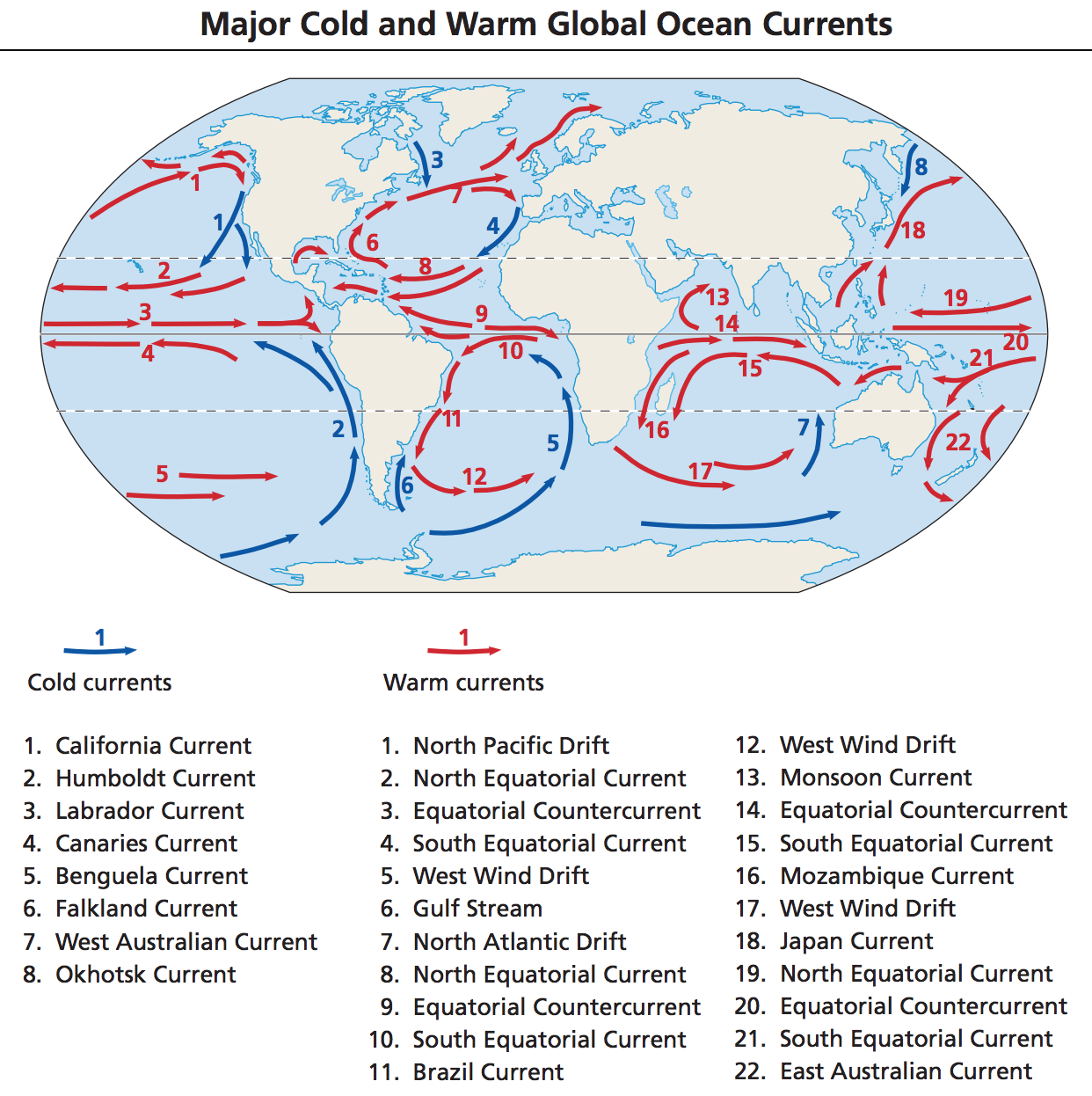
    Surface ocean currents are further divided into warm and cold currents

    2. Deep-water Currents also called Thermohaline Currents

    While wind effects drive ocean currents in the upper 100 meters of the ocean’s surface, ocean currents also flow thousands of meters below the surface. These deep-ocean currents are driven by differences in the water’s density, which is controlled by temperature (thermo) and salinity (haline). This process is known as thermohaline circulation.

    Cold, salty water is dense and sinks to the bottom of the ocean, and eventually returns to the surface through mixing. On a global scale, this sinking and rising of ocean water create what scientists call the ‘great ocean conveyor belt.’

    Case Study: The Gulf Stream

    Gulf Stream is where you don’t see a clear-cut distinction between the Wind-Driven and Thermohaline. The first part of the Gulf Stream that represents the warm waters to a certain extent are Wind Driven


    UPSC 2022 countdown has begun! Get your personal guidance plan now! (Click here)

    Samanvaya: Free 1-to-1 mentorship for UPSC IAS

    Fill up this form to schedule a free on-call discussion with senior mentor from Civilsdaily. Once submitted we will call you within 24 hours.

    Civilsdaily Samanvaya 1-On-1 Mentorship Form

    Field will not be visible to web visitor