💥Join UPSC 2027,2028 Mentorship (July Batch) + XFactor Notes & Microthemes PDF

Author: CD Staff

  • [Burning Issue] RBI Surplus Transfer


    Context

    • On August 26, the central board of the Reserve Bank of India (RBI) had decided to transfer a surplus of Rs 1.76 lakh crore to the government-its highest transfer ever-sparking a fierce debate.
    • The government was acting on the recommendations of a committee chaired by former RBI governor Bimal Jalan, on capital transfer.

    RBI’s earnings

    • The RBI is a “full service” central bank— not only is it mandated to keep inflation or prices in check, it is also supposed to manage the borrowings of the GOI and of state governments; supervise or regulate banks and NBFCs; and manage the currency and payment systems.
    • While carrying out these functions or operations, it makes profits.
    • Typically, its income comes from the returns it earns on its foreign currency assets, which could be in the form of bonds and treasury bills of other central banks or top-rated securities, and deposits with other central banks.
    • It also earns interest on its holdings of local rupee-denominated government bonds or securities, and while lending to banks for very short tenures, such as overnight.
    • It claims a management commission on handling the borrowings of state governments and the central government.

    RBI’s reserves

    Besides above earning, the RBI maintains four different Reserves which comprise of assets and earnings. These reserves are:

    I. Asset Development Fund

    • It aims to meet internal capital expenditure and investments in its subsidiaries to build contingency reserves of 12% of its balance sheet.
    • It provides support to the RBI associates like National House of Banking.

    II. Currency and Gold Revaluation Account

    • The Currency & Gold Revaluation Account (CGRA) makes up the biggest share — it was Rs 6.9 lakh crore in 2017-18.
    • This represents the value of the gold and foreign currency that the RBI holds on behalf of India.

    III. Contingency Fund

    • The Contingency Fund (CF) is a specific provision meant for meeting unexpected contingencies that arise from RBI’s monetary policy and exchange rate operations.
    • In both cases, the RBI intervenes in the relevant markets to adjust liquidity or prevent large fluctuations in currency value.
    • The CGRA and CF put together constituted 26% of assets

    IV. Investment Revaluation Account

    • It is the fund available with the RBI to compensate losses and accommodate gains in foreign and domestic securities.


    It’s Expenditure

    • Its expenditure is mainly on the printing of currency notes and on staff.
    • Besides the commission it gives to banks for undertaking transactions on behalf of the government across the country, and to primary dealers, including banks, for underwriting some of these borrowings.

    RBI’s surplus

    • This represents the amount RBI transfers to the government.
    • The RBI isn’t a commercial organisation like the banks or other companies that are owned or controlled by the government – it does not, as such, pay a “dividend” to the owner out of the profits it generates.
    • Although RBI was promoted as a private shareholders’ bank in 1935 with a paid up capital of Rs 5 crore, the government nationalized it in January 1949, making the sovereign its “owner”.
    • There are two unique features about RBI’s financial statements. It is not required to pay income tax and has to transfer to the government the surplus left over after meeting its needs.
    • What the central bank does, therefore, is transfer the “surplus” – that is, the excess of income over expenditure – to the government, in accordance with Section 47 (Allocation of Surplus Profits) of the RBI Act, 1934.

    Total Transfer

    • The surplus from the central bank comprised two components-Rs 1.23 lakh crore of surpluses for the year 2018-19.
    • An additional Rs 52,637 crore of excess provisions that was made available as per the revised economic capital framework recommended by the Bimal Jalan committee.
    • Of the Rs 1.23 lakh crore, the RBI has already transferred Rs 28,000 crore to the government in the previous fiscal, which will reflect in RBI’s upcoming annual report.
    • The transfer is also almost double the Rs 90,000 crore that was targeted in the Union budget presented by finance minister Nirmala Sitharaman.

    The revised Economic Capital Framework

    • The RBI had formed a committee chaired by former Governor Bimal Jalan to review its economic capital framework and suggest the quantum of excess provision to be transferred to the government.
    • The panel recommended a clear distinction between the two components of the economic capital of RBI i.e. Realized equity and Revaluation balances.
    • Revaluation reserves comprise of periodic marked-to-market unrealized/notional gains/losses in values of foreign currencies and gold, foreign securities and rupee securities, and a contingency fund.
    • Realized equity, which is a form of a contingency fund for meeting all risks/losses primarily built up from retained earnings. It is also called the Contingent Risk Buffer (CBR).


    The revised Surplus Distribution Policy
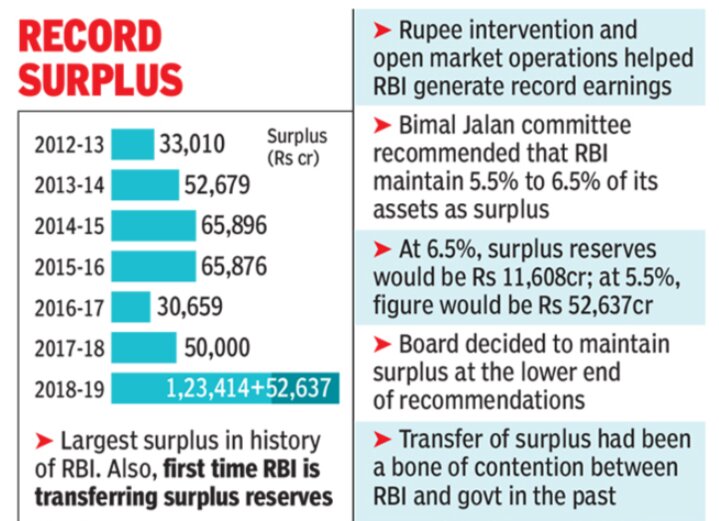
    • It was finalized is in line with the recommendations of the Bimal Jalan committee. It states-
    1. Any surplus due to the government can be paid only from retained earnings and not by using the notional revaluation reserves.
    2. The contingent capital buffer has to remain at all times in a band of 5.5 per cent – 6.5 per cent of the RBI’s total balance sheet
    3. The total economic capital of the RBI needs to be in the range of 20 per cent – 24.5 per cent of the RBI’s total balance sheet
    • Adhering to the recommendations, the RBI has decided to set the CBR level at 5.5% of the balance sheet, while transferring the remaining excess reserves worth ₹52,637 crore to the government.
    • If CBR is below the lower bound of requirement, risk provisioning will be made to the extent necessary and only the residual net income (if any) transferred to the Government.
    • However keeping CBR at a lower range of 5.5%, will reduce RBI’s space to manoeuvre monetary policy.


    Issues with the surplus transfer

    • The government has long held the view that going by global benchmarks, the RBI’s reserves are far in excess of prudential requirements.
    • Former RBI governors Y.V. Reddy and D. Subbarao had publicly opposed such transfers, as did former deputy governor Viral Acharya, who argued such a move could be “catastrophic”.
    • Former Chief Economic Advisor Arvind Subramanian had suggested that these funds be utilized to provide capital to government-owned banks.
    • The central bank, on its part, has traditionally preferred to be more cautious and build its reserves – keeping in mind potential threats from financial shocks, and the need to ensure financial stability and provide confidence to the markets.
    • From the central bank’s perspective, bigger reserves on its balance sheet is crucial to maintaining its autonomy.
    • The Opposition criticised the government for “stealing from the RBI”, saying that the government was “clueless about how to solve their self-created economic disaster”.

    Govt stance

    • The transfer of money from RBI to Government has been going on for years. It is not the first time that the apex bank has transferred its surplus money to the GoI.
    • The RBI reserves the right over the surplus money made by it; however, the Government thinks the other way round.
    • As per the Government, RBI reserves are filled with way more money than it requires.
    • This dilemma has always been an issue of conflict between the Central Government and the RBI.
    • This friction was lately seen in December 2018, which forced the then RBI Governor Urjit Patel to resign.

    Arguments in favor

    • The supporters of the government have been stout in the defence of this move.
    • They say that after all a committee headed by a well-regarded former RBI governor has recommended it.
    • They also argue that there is no point in RBI accumulating excess surplus and then doing nothing with it when the government can use it to boost the economy.

    How will govt use this surplus?

    • A major question has to do with what the money will be used for.
    • The amount could either be used to provide a fiscal stimulus to the economy-which is in the grip of a slowdown-or to reduce off-balance sheet borrowings, or meet an expected shortfall in revenue collections.
    • In the Union budget, the government had presented an optimistic scenario of raising Rs 4.76 lakh crore in additional resources to meet budget expenses.
    • However, since there is a clear slowdown ahead, this revenue target may not be met, in which case the surplus from the RBI would be used to bridge the shortfall.
    • However, if the budgetary targets are met in the normal course of activity, the government will use the amount as a stimulus.

    Way Forward

    • The government cannot stop or slow down spending – the economy is already losing steam with exports, private consumption and private sector investment slowing down.
    • If the government spending also goes down, it will hit an already beleaguered economy.
    • With the economy slowing down and the Goods and Services Tax (GST) not kicking in the expected buoyancy, the shortfall may even be higher.
    • The infusion of additional funds, thus, will help the government to substantially overcome this shortfall and achieve the fiscal deficit target without having to axe allocations to social sector and poverty alleviation.
    • It needs the money and the RBI is living up to its role as the lender of last resort – except that this is not a loan, and the government is not a bank, which needs a lender of last resort.


    References:

    https://www.civilsdaily.com/news/rbi-surplus/

    https://www.indiatoday.in/india-today-insight/story/rbi-crore-surplus-transfer-sparked-debate-1592858-2019-08-29

    https://www.thehindu.com/business/Economy/rbi-board-approves-176-lakh-cr-transfer-to-government/article29261534.ece

    https://www.livemint.com/industry/banking/the-numbers-behind-rbi-s-rs-1-76-lakh-crore-payout-to-government-10-points-1566974579350.html

    https://www.indiatoday.in/business/story/explained-how-much-did-government-gain-from-rbi-surplus-reserve-transfer-1592607-2019-08-28

    https://economictimes.indiatimes.com/mf/analysis/how-rbis-surplus-to-govt-will-impact-fiscal-deficit-and-bond-markets/articleshow/70869425.cms

    https://timesofindia.indiatimes.com/business/india-business/what-are-rbis-surplus-funds-where-do-reserves-come-from/articleshow/70849771.cms

    https://www.businesstoday.in/opinion/prosaic-view/what-rbi-surplus-bonanza-tells-about-government-finances/story/376132.html

    https://www.thehindu.com/opinion/lead/govt-needs-to-be-prudent-in-using-rbis-transfer/article29291770.ece

    https://www.thehindu.com/business/how-the-rbi-ended-2018-19-with-an-over-123-lakh-crore-surplus/article29292127.ece?homepage=true

  • [Burning Issue] Appointing the Chief of Defence Staff (CDS)


    Context

    • In his Independence Day address PM has announced the creation of the post of Chief of Defence Staff (CDS) to provide “effective leadership at the top level” to the three wings of the armed forces, and to help improve coordination among them.

    Background

    • India has had a feeble equivalent known as the Chairman, Chiefs of Staff Committee (CoSC); but this is a toothless office, given the manner in which it is structured.
    • The seniormost among the three Service Chiefs is appointed to head the CoSC, an office that lapses with the incumbent’s retirement.
    • The post did not further tri-service integration, resulting in inefficiency and an expensive duplication of assets.
    • This system is a leftover from the colonial era, with only minor changes being carried out over the years.

    The office of the Chief of Defence Staff (CDS)

    • The CDS is a high military office that oversees and coordinates the working of the three Services, and offers seamless tri-service views and single-point advice to the Executive (in India’s case, to the PM).
    • On long-term it provides for defence planning and management, including manpower, equipment and strategy, and above all, “jointsmanship” in operations.
    • In most democracies, the CDS is seen as being above inter-Service rivalries and the immediate operational preoccupations of the individual military chiefs.
    • The role of the CDS becomes critical in times of conflict.

    Why need such Office?

    • The creation of the CDS will eventually lead to the formation of tri-service theatre commands intended to create vertical integration of the three forces.
    • The CDS will be a single-point military adviser to the government and synergise long term planning, procurements, training and logistics of the three Services.
    • This is expected to save money by avoiding duplication between the Services, at a time of shrinking capital expenditure within the defence budget.
    • Military diplomacy is today supporting the conventional diplomacy. That can’t be done by different Services.

    Recent upheaval

    • The first proposal for a CDS came from the 2000 Kargil Review Committee (KRC) which called for a reorganization of the “entire gamut of national security management and apex decision-making and structure and interface between the Ministry of Defence and the Armed Forces Headquarters.
    • The Group of Ministers Task Force that studied the KRC Report and recommendations proposed to the Cabinet Committee on Security that a CDS, who would be five-star officer, be created.
    • In preparation for the post, the government created the Integrated Defence Staff (IDS) in late 2002, which was to eventually serve as the CDS’s Secretariat.
    • However, over the past 17 years, this has remained yet another nebulous department within the military establishment.

    What happened to the proposal?

    • Political misgivings, bureaucratic turf protection and inter-service mistrust, together, created so much friction that the CDS wagon could not start rolling.
    • No consensus emerged among the Services, with the IAF especially opposed to such a move.
    • Then opposition was against the idea of concentrating too much military power in the CDS’s post.
    • The Ministry of Defence (MoD) too, opposed it subtly for the same reasons, and because it could disrupt civil-military ties in the latter’s favour.
    • The smaller Air Force and Navy fear that the CDS would be from the Army, by far the largest Service.
    • The IAF has long argued that unlike the United States and other western militaries, the Indian Services are not an expeditionary force, for which a CDS is a necessity.
    • The appointment of a CDS would also lead to theatre commands, another aspect that the IAF opposes, fearing a diminution of its operational role.

    Naresh Chandra Committee recommendations

    • In 2011, more than a decade after the KRC Report, the UPA government which had opposed the CDS proposal when in opposition, set up the Naresh Chandra Committee on defence and security.
    • The Committee comprising retired Service Chiefs and other defence experts, suggested a watered-down version of the CDS proposal, in which the Chairman CoSC in the rank of a four-star officer would have a fixed tenure of two years.
    • He would have significantly more authority and powers than the Chairman CoSC, and would be a CDS in all but name.

    The case for having a CDS

    • Although the KRC did not directly recommend a CDS — that came from the GoM — it underlined the need for more coordination among the three Services, which was poor in the initial weeks of the Kargil conflict.
    • The KRC Report pointed out that India is the only major democracy where the Armed Forces Headquarters is outside the apex governmental structure.
    • It observed that Service Chiefs devote most of their time to their operational roles, “often resulting in negative results”.
    • Long-term defence planning suffers as day-to-day priorities dominate.

    Who serves the purpose as for now?

    • In effect it is the National Security Adviser.
    • This has been especially so after the Defence Planning Committee was created in 2018, with NSA as its chairman, and the foreign, defence, and expenditure secretaries, and the three Service Chiefs as members.

    Need for an integrated service

    • It is generally agreed that India badly needs a Combined Defence Staff to integrate defence planning and operations.
    • For a long time, it seemed that the IAF was marching to the beat of a different drummer.
    • The consequence of this reluctance to plan and work together showed up in Kargil.
    • The air force did not have the tactics and the appropriate weapons when called to assist the Indian Army.
    • Also, the PM and Defence Minister do not have the benefit of the views and expertise of military commanders, in order to ensure that higher level defence management decisions are more consensual and broad based.
    • The case for CDS aims to provide a single-point for giving military advice to the government, administer the Strategic Forces and to enhance the efficiency and effectiveness of the planning process through Intra and Inter- Service prioritization.

    The emerging theatres

    • Three theatres are straightforward: Northern, Western and Southern to address the threats from China, Pakistan and the Indian Ocean, respectively.
    • To these, we can add an eastern command for the Bay of Bengal littoral and an expeditionary command responsible for operations further afield.
    • In the years ahead, a combination of climate change, violent non-state actors and volatile politics will increase the demands on the government to deploy military forces beyond the subcontinent.
    • Despite a multitude of threats, India’s Armed Forces have very limited capacity to operate overseas. Hence, the need for an expeditionary command.
    • The major task of the new CDS will thus be to conceptualize and implement the transformation of the forces into theatre commands.

    With nuke at its hand

    • Administering the ‘Strategic Forces’ also denotes administration of India’s nuclear arsenal.
    • Presently, during a conflict that brings nuclear weapons into play, the chairman’s expected to be with the prime minister to provide advice and execute required actions.
    • This, though, is problematic as it would entail the chief being away from the important role of controlling and directing his own service forces.
    • The existing arrangement of seniority-based rotational appointment of the Chairman and the Chief of Staff Committee (COSC), has resulted in the side-lining the Chairman from this important role.
    • Short tenures of even a few months, combined with pressures of being the head of a Service, has been the primary reason.

    Neighbourhood examples

    • In 2016, China integrated its military and other police and paramilitaries into five theatres from the earlier seven area commands, each with its own inclusive headquarters, one of which has responsibility for the Indian border.
    • In contrast, India’s border with China is split between the Eastern, Western, and Northern Commands.

    The arguments against

    • Theoretically, the appointment of a CDS is long overdue, but there appears to be no clear blueprint for the office to ensure its effectiveness.
    • India’s political establishment is seen as being largely ignorant of, or at best indifferent towards, security matters, and hence incapable of ensuring that a CDS works.
    • Militaries by nature tend to resist transformation.
    • In the US, the 1986 Goldwater-Nichols Act elevated the Chairman from first among equals to the “principal military advisor” to the President and the Secretary of Defence.
    • In the Indian context, critics fear, the absence of foresight and understanding might end up making the CDS just another case of “jobs for the boys”.

    Way Forward

    • The last time India fought a major battle was the Kargil conflict in 1999 in which the Navy played a silent role while the Army and Air Force collaborated to evict intruders from Indian soil.
    • The lessons learnt then prompted the K. Subrahmanyam Committee to propose having a CDS for the first time.
    • Instrumentalism doesn’t always work; sometimes a giant leap is the need of the hour.
    • India has traditionally been a land power and, yes, the primary threats are still on land, from the northern and western borders.
    • But the threat matrix has changed since 1947 and the Indian Ocean region is fast metamorphosing into a major arena of friction, with increasing forays by the Chinese Navy and building up of regional navies with help from China.
    • Also, while the threat of war stills exists in the subcontinent under the nuclear overhang, the room for large conventional manoeuvres is over.
    • In a conflict situation, what would unfold are short and swift skirmishes which call for agility and swift action by the three services in unison.

    Recent developments

    • The Union defence ministry has set up a high-powered committee under National Security Advisor (NSA) Ajit Doval to implement the Cabinet Committee on Security (CCS) decision to create the much-awaited post.
    • The HPC is mandated to frame the terms of references for this post, according to top officials in the defence and national security establishment.

    Expected terms of references

    • While the government hasn’t disclosed about the powers of the CDS, it is learnt that he will be single-point military advisor to the defence minister.
    • He would be in an interface with the NSA in the Defence Planning Group and Defence Acquisition Council (DAC) as a member of the bodies.
    • The CDS will set budgetary priorities on the basis of available capital outlay for the three services and also define the acquisition priorities for hardware for the armed forces without any duplication.
    • The CDS will be the point person for military diplomacy for the country and be responsible for the overall preparedness of the forces.
    • The CDS, apart from assuming all the roles of COSC in the context of training, jointmanship, education in military academies, will be the head of tri-service Andamans and Nicobar Command (ANC) and will have substantive financial powers.
    • While all the three service chiefs will be answerable to him, the CDS or permanent COSC, will have the tri-services Strategic, Cyber, Space and Special Operations Command under him, with heads of these commands being held by the services in rotation.


    References:

    https://www.civilsdaily.com/news/explained-the-post-of-chief-of-defence-staff-cds/

    https://www.hindustantimes.com/india-news/committee-under-nsa-to-set-terms-for-cds-position/story-li74CKhSRIoBAT6zQlKxGI.html

    https://www.telegraphindia.com/opinion/the-chief-of-defence-staff-challenge/cid/1699997

    https://www.livemint.com/opinion/online-views/opinion-appointing-a-chief-of-defence-staff-would-just-be-the-first-step-1566137008619.html

    https://www.indiatoday.in/news-analysis/story/chief-of-defence-staff-cds-narendra-modi-1581393-2019-08-16

    https://scroll.in/article/934179/will-a-chief-of-defence-staff-put-an-end-to-the-inter-service-tussles-in-india

  • [Burning Issue] India’s Nuclear No First Use Policy


    Context

    • The ruling government has offered several paradigm changing cases for the field of strategic studies and international relations this year, such as the Balakot airstrike and abrogation of Article 370.
    • Now, with Raksha Mantri’s statement about India’s ‘No First Use’ of nuclear arms pledge, many observers in and outside India are jumbled to consider the various implications of his statement.
    • However, Pakistan, by contrast, has openly threatened a nuclear triad like on multiple occasions.

    Nuclear No First Use

    • No first use (NFU) refers to a pledge or a policy by a nuclear power not to use nuclear weapons.
    • It is a means of warfare unless first attacked by an adversary using nuclear weapons.
    • Earlier, the concept had also been applied to chemical and biological warfare.
    • Pakistan, Russia, the UK, the US and France say they will use nuclear weapons defensively against either nuclear or non-nuclear states only in the case of invasion or other attack against their territory or against one of their allies.

    NFU in India’s context

    • India first adopted a “No first use” policy after its second nuclear tests Pokhran-II, in 1998.
    • In August 1999, the govt. released a draft of the doctrine which asserts that nuclear weapons are solely for deterrence and that India will pursue a policy of “retaliation only”.
    • India’s official nuclear doctrine is codified in a 2003 document, which takes cues from the 1999 draft doctrine.
    • Since then, there has been no official communiqué about India’s nuclear policy from the government, but being primarily discussed on the basis of one-off statements by ministers, retired bureaucrats and military officials.

    India’s NFU doctrine

    Since 2003, India’s nuclear doctrine has had three primary components:

    1) No First Use

    • India will only use nuclear weapons in response to a nuclear attack on Indian Territory, or Indian forces.
    • A caveat is made about their possible use in response to a chemical or biological attack.

    2) Massive Retaliation

    • India’s response to a first strike will be massive, to cause ‘unacceptable damage’.
    • While the doctrine doesn’t explicitly espouse a counter-value strategy (civilian targets), the wording implies the same.

    3) Minimum Credible Deterrence

    • The number and capabilities of India’s nuclear weapons and delivery systems should merely be sufficient to ensure intolerable retaliation, also keeping in mind first-strike survival of its relatively meagre arsenal.
    • It underlines NFU with an assured second strike capability, and falls under minimal deterrence as opposed to mutually assured destruction.

    4) Cognizance with Political Authority

    • Nuclear retaliatory attacks can only be authorised by the civilian political leadership through the Nuclear Command Authority.
    • The Nuclear Command Authority comprises a Political Council and an Executive Council. The Political Council is chaired by the PM.

    Earlier debates on India’s NFU

    • In a 2010 speech, then national security advisor Shivshankar Menon described India’s nuclear doctrine as “no first use against non-nuclear weapon states”.
    • This implied that a first use by India of a nuclear weapons was possible against another nuclear-armed competitor.
    • At the time, the shift was meant to be subtle but deliberate.
    • But the fact that this formulation was never repeated – and was, in fact, reversed in subsequent statements – suggests that it is no longer a guiding principle, but should be seen only as a momentary signal against India’s adversaries.

    Revoking the NFU

    • Raksha Mantri’s statement is a part of a pattern reflecting a need to critically evaluate India’s nuclear doctrine, as voiced by other defence ministers and retired bureaucrats and military officials.

    Arguments against –

    I. India’s image as a responsible nuclear power is central to its nuclear diplomacy.

    • Nuclear restraint has allowed New Delhi to get accepted in the global mainstream.
    • From being a nuclear pariah for most of the Cold War, within a decade of Pokhran 2, it has been accepted in the global nuclear order.
    • It is now a member of most of the technology denial regimes such as the Missile Technology Control regime and the Wassenaar Arrangement.
    • It is also actively pursuing full membership of the Nuclear Suppliers Group. Revoking the ‘no first use’ pledge would harm India’s nuclear image worldwide.
    • Parting away with NFU would also be costly otherwise.

    II. A purely retaliatory nuclear use is easier to operationalize

    • Nuclear preemption is a costly policy as it requires massive investment not only in weapons and delivery systems but also intelligence, surveillance and reconnaissance (ISR) infrastructure.
    • The latest estimates of India’s nuclear weapons by the Bulletin of Atomic Scientists point to a small arsenal of 130-150 nuclear warheads even though it has enough militarygrade plutonium to produce 200 warheads.
    • Similarly, first use of nuclear weapons would require a massive increase in India’s nuclear delivery capabilities.
    • There is yet no evidence suggesting that India’s missile production has increased dramatically in recent times.
    • India’s ISR capabilities would have to be augmented to such a level where India is confident of taking out most of its adversary’s arsenal and this is nearly an “impossible task”.

    III. India would have to alter its nuclear alerting routine

    • India’s operational plans for its nuclear forces involve a four-stage process.
    • Nuclear alerting would start at the first hints of a crisis where decision-makers foresee possible military escalation.
    • This would entail assembly of nuclear warheads and trigger mechanisms into nuclear weapons.
    • The second stage involves dispersal of weapons and delivery systems to pre-determined launch positions. The third stage would involve mating of weapons with delivery platforms.
    • The last and final stage devolves the control of nuclear weapons from the scientific enclave to the military for their eventual use.

    IV. Other Factors

    • If India has to switch from NFU, it will have to make substantial changes to existing nuclear structures, alert levels, deployment and command and control arrangements.
    • This will involve a sizeable increase in delivery systems and warheads.
    • The pressure on India’s resources would also impact the buildup of other kinetic and non-kinetic capabilities.

    Arguments for-

    Nuclear disarmament is still a myth

    • India has been serious about nuclear disarmament.
    • India’s nuclear weapons have been a result of compulsions arising out of a nuclearised and hostile neighbourhood.
    • In the long-term, a nuclear weapons-free world would best serve the Indian national security interests, keeping aside moral considerations.
    • A nuclear weapons-free region including China is close to impossible.

    Quest for a nuclear rethink

    • The case to revoke the NFU pledge has also been made keeping in mind India’s other nuclear adversary: China.
    • Given the increasing asymmetry of conventional military power between the two countries, some analysts believe that India should revoke its NFU policy.
    • Where India’s fails to deter China conventionally, it should leverage its nuclear capability.
    • The sanctity of ‘no first use’ has been also called into question not only by strategic analysts but also high-ranking government officials.
    • In 2016, then defence minister Manohar Parrikar raised doubts on India’s adherence to the policy of ‘no first use’ by saying that New Delhi cannot “bind itself” to ‘no first use’ for eternity.
    • Political leaders have tried to insert an element of ambivalence into India’s nuclear doctrine.

    Advantages provided by NFU

    • The main advantage of NFU is that it minimizes the probability of nuclear use.
    • This is so because it enhances the possibility of containing the crisis before the point of no return when miscommunications, misjudgment, misperception or the fog of war may force either power to go first.
    • Instead, if both are NFU powers, there is greater probability of political leaders stepping back from the brink – for they know that a nuclear war cannot be won.
    • NFU for India also presents an opportunity for cooperation with China to work jointly towards a Global No First Use (GNFU) order.
    • Notably, there is considerable convergence regarding the belief of nuclear weapons being restricted to the political realm.

    What if NFU is revoked?

    • The notions of revoking erroneously embrace the idea that a nuclear war can be fought and won. This is utterly false.
    • Pakistan does not pose a conventional threat that India cannot counter. Given that, they are likely to persist with terrorism, which is a low-cost option.
    • On the other hand, India’s conventional military power, shaped to fight a limited war, is challenged to impose its will under the nuclear shadow.
    • Our foregoing NFU cannot prevent Pakistan from using terrorism as a tool of its India policy.
    • On the contrary, it enables Pakistan and other adversaries to invite international intervention in what India maintains as a bilateral issues.

    Evaluating the doctrine

    • Our policy of No First Use has many upsides, not all of them related to nuclear conflict.
    • Unlike countries such as China and the US, India does not regularly release publications detailing its nuclear doctrine, or shifts therein.
    • This ambiguity has some advantages of its own, but some further clarity pertaining to this subject is desperately needed.
    • The official doctrine today exists merely as a press release summarizing few points, with all other statements made offhand, with no great depth to them.
    • Whether we have to turn to these different strategies, or simply make minor changes to our existing doctrine remains to be seen.
    • The recent statement prompted this debate is indicative of a larger effort of comprehensively evaluating India’s nuclear doctrine, and not only posturing.

    Way Forward

    • All doctrines need periodic reviews and India’s case is no exception.
    • Indian doctrine does not support first use of nuclear weapons as it gives ample warning to the adversary of India’s intentions.
    • There is certainly a need for a reappraisal of India’s nuclear doctrine. Given how rapidly India’s strategic environment is evolving, it is imperative to think clearly about all matters strategic.
    • But if Indian policymakers do indeed feel the need to review the nation’s nuclear doctrine, they should be cognizant of the costs involved in so doing.
    • A sound policy debate can only ensue if the costs and benefits of a purported policy shift are discussed and debated widely.


    References:

    https://www.civilsdaily.com/news/explained-indias-doctrine-of-nuclear-no-first-use/

    https://en.wikipedia.org/wiki/No_first_use

    https://www.orfonline.org/research/nuclear-rethink-a-change-in-indias-nuclear-doctrine-has-implications-on-cost-war-strategy-54557/

    https://www.thehindu.com/opinion/editorial/unclear-doctrine/article29127566.ece

    https://thewire.in/security/rajnath-singh-no-first-use-nuclear-policy

    https://thediplomat.com/2019/08/from-no-first-use-to-no-first-use/

    https://indianexpress.com/article/opinion/editorials/a-new-playbook-rajnath-singh-nuclear-weapons-5918267/

  • [Burning Issue] US-China Trade War and Its Impact on India


    Context

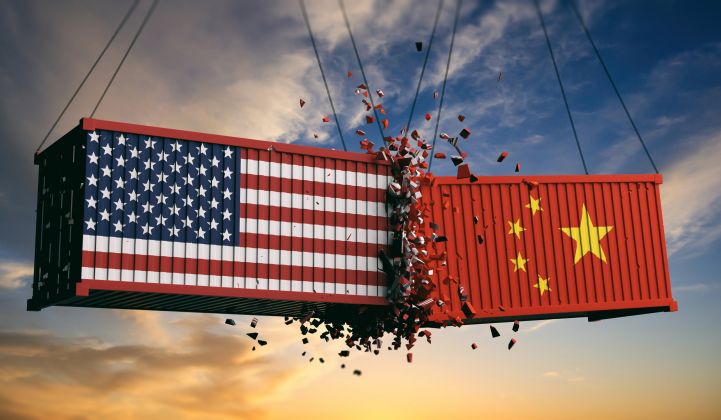
    • China and the United States have been engaged in a trade war through increasing tariffs and other measures since 2018.
    • The US is non-surprisingly the first to impose tariffs on Chinese goods to press demands for an end to policies that Washington says hurt US companies competing with Chinese firms.

    • China too responded with its own tit-for-tat tariffs on US goods.
    • This exacerbates the uncertainty in the global trading environment, affects global sentiment negatively, and adds to risk aversion globally.

    Background

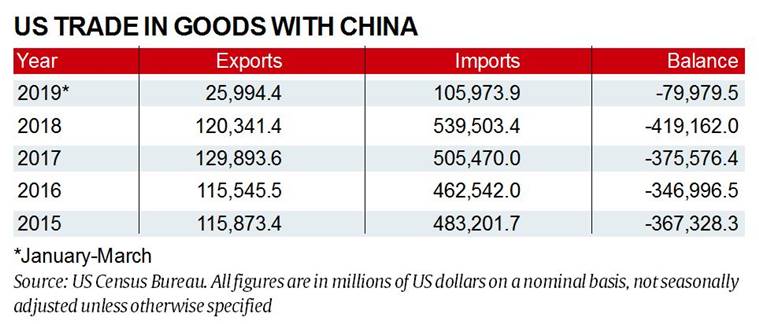
    • The dispute escalated after US demanded China to reduce its $375 billion trade deficit with the US, and introduce “verifiable measures” for protection of IPRs, technology transfer, and more access to American goods in Chinese markets.

    • Chinese devaluation of Yuan further fuelled the situation.
    • These tensions are now yielding in an increasingly fragmented global trading framework, weakening the rules-based system that has underpinned global growth, particularly in Asia.

    Differences being vented out through trade war

    • A major cause of these tensions is the growing battle between China and the U.S. for global economic and technological dominance.
    • US alleges China for the economic damage caused through alleged theft of intellectual property.
    • US has accused China of either stealing American intellectual property and military technology or adopting and enforcing policies.
    • This in turn puts U.S. patent holders at a disadvantage in Chinese markets by forcing foreign companies to engage in joint ventures with Chinese companies which in turn gives Chinese companies illicit access to their technologies
    • The Chinese government has denied forced transfer of IP is a mandatory practice, and acknowledged the impact of R&D performed in China.

    Trade war: A bluff for Protectionism?

    • Even with a trade war, US investment in China during January 2019 reportedly doubled, with foreign capital in China’s hitech industry increasing by 41%.
    • Trump has started dragging India to the ongoing situation by saying that the two were no longer “developing nations” and were “taking advantage” of the WTO tag.

    Getting ahead with Clouds of a global recession

    • Trade and geopolitical uncertainties have hit all major economies.
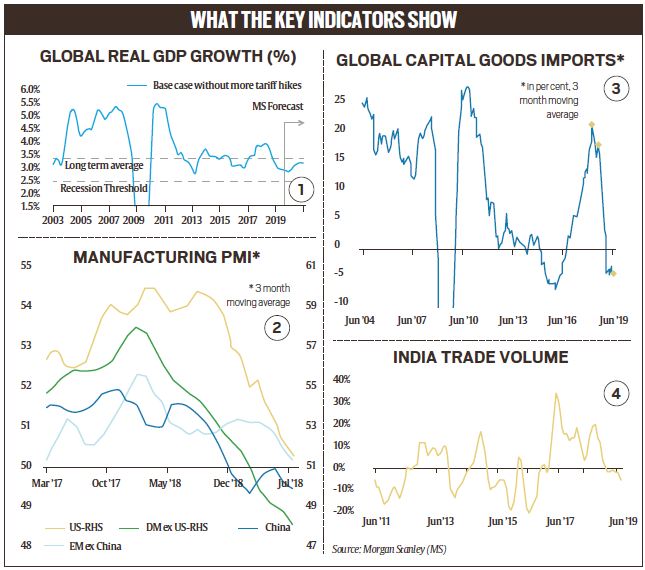
    • Earlier this month, researchers at Morgan Stanley, a leading investment bank, warned that if the US and China continue to raise tariff and non-tariff barriers over the next few months, the global economic growth rate will fall to a seven-year low of 2.8%.
    • The world economy could enter a recession within the next three quarters.
    • The last massive downward spiral in the global economy happened in the wake of the great financial crisis of 2008, and continued until 2010.

    What has triggered the alarm?

    • Earlier this month, the US declared China a “currency manipulator”.
    • In other words, it accused Beijing of deliberately weakening the yuan to make Chinese exports to the US more attractive and undercut the effect of increased US tariffs.
    • The intensifying trade war between the two has the potential to derail already weak global growth, and the signs are evident.

    • For instance, the global manufacturing Purchasing Managers’ Index (chart 2) and new orders sub-index have contracted for the second consecutive month in July; they are already at a seven-year low.
    • Further, the global capital expenditure cycle has “ground to a halt” (chart 3); since the start of 2018, there’s been a sharp fall-off in nominal capital goods imports growth.

    How can this lead to a global recession?

    • The German slowdown is a very good example. The absolute volume of global trade has stagnated and, in terms of percentage change, trade is contracting.
    • Higher tariffs are not only likely to douse demand but, crucially, hit business confidence.
    • The apprehension is global trade uncertainties could start a negative cycle, wherein businesses do not feel confident enough to invest more, given the lower demand for consumer goods.
    • Reduced capital investment would reflect in fewer jobs, which, in turn, will show up in reduced wages and, eventually, lower aggregate demand in the world.

    What about India?

    • As chart 4 shows, India’s trade is already suffering, and jobs are being lost.
    • For an economy that is struggling to find a domestic growth lever — government and businesses are overextended and household (that is, private family-level) consumption is down — exports could have provided a respite.

    Where does India stand in this trade war?

    • There is a lot of uncertainty with respect to how the ongoing retaliatory tariff impositions between the US and China.
    • There could be a short-term impact on the stock markets.
    • Several economists have indicated the possibility of India benefiting through increasing exports to the US and a shift of foreign direct investment (FDI) to India.
    • India is among a handful of economies that stand to benefit from the trade tensions between the world’s top two economies, a/c to the UN.
    • However, to substantively benefit from this situation, India requires a strategic approach to convert this opportunity into a major gain.
    • India needs to focus on becoming a new powerhouse as a global hub for exports, with a major positive impact on competitiveness and job creation.

    Impact on merchandise exports

    • China’s merchandise exports are almost the same as India’s GDP.
    • Even a 10% shift from Chinese exports to Indian exports would imply over 75% increase in Indian exports. India needs to develop a strategy and vision for itself and the world to make this a reality.
    • Its recent tepid export performance suggests that investment from large global companies is the transformative path for India, provided certain key points are kept in mind.

    India’s exports

    • India’s domestic market is large, but the focus of most large firms with major international brands and global presence is on exports and maintaining their global value chains (GVCs).
    • China’s 2018 exports to the US at $560 billion were nearly double of India’s total exports.

    India on global scenario

    • India’s aspirations to double its exports and create jobs depend on its success to link up effectively with GVCs.
    • As the seventh largest global economy and the 20th largest goods exporter, India is not yet a significant presence in GVCs.
    • To establish domestic capacity for export hubs and GVCs, strong presence of ‘lead firms’ that manage the GVCs becomes essential.

    Enhancing competence to reap benefits

    • For competing with other nations to attract major investments away from China, India needs to emphasise and improve implementation of support policies, with a new flagship programme, ‘India: Making for the World’.
    • Major global companies make investment decisions significantly based on ease of operational conditions and stable policy regimes.
    • All alternative countries under consideration focus on creating and effectively implementing investment-friendly regimes — that is, taking a step beyond policy announcement.

    Focusing on champion sectors

    • To give specific focus, certain selected sectors significant for employment, technology and exports should be identified for launching the programme.
    • These ‘champion’ sectors could be textiles and apparel, automotive products and electronics (with emphasis on mobiles), to be supplemented with a few other sectors later.
    • These three sectors in India are likely to contribute over $1 trillion by 2025.

    Way Forward

    • We should not forget that our exports plus imports of goods and services constitute around 42% of GDP.
    • Also, we have a current account deficit dependent on external capital inflows for financing.
    • There is no question that economic growth and asset markets will be badly hurt by a full-blown trade war.
    • The more important issue is the current global economic order is in danger of being dismantled, brick by brick.
    • The ramifications will go far beyond trade—the impact on geopolitics, for instance, could be far more serious.
    • In trade conflicts, there are no winners. Too much protectionism ultimately constricts global growth.
  • [Burning Issue] Assam NRC


    Context

    Migrations to Assam

    • Assam saw waves of migration, first as a colonial province and then as a border state in independent India.
    • The colonial Assam (1826–1947) witnessed migration from various provinces of British India for tea plantation.
    • The liberal attitude of the Colonial authorities further encouraged the continuous arrival of peasants from Bengal to Assam in search of fertile lands.
    • The Partition of the subcontinent and communal riots had just triggered vast population exchanges at the border.
    • And this unrelenting migration from East Pakistan, now known as Bangladesh led to a perceptible change in the demographic pattern in some districts of the Province.

    What exactly is the National Register of Citizens (NRC)?

    • The NRC is a register containing names of all genuine Indian citizens. The register was first prepared after the 1951 Census of India.
    • Since 2015, Assam has been in the process of updating the 1951 register.
    • The register is meant to be a list of Indian citizens living in Assam.
    • For decades, the presence of migrants, often called “bahiragat” or outsiders, has been a loaded issue here.

    Why is it being updated now?

    • One of the stated aims of the exercise is to identify so-called “illegal immigrants” in the state, many of whom are believed to have poured into Assam after the Bangladesh War of 1971.
    • In 1979, about eight years after the war, the state saw an anti-foreigners’ agitation.
    • Assamese ethnic nationalists claimed illegal immigrants had entered electoral rolls and were taking away the right of communities defined as indigenous to determine their political future.

    The Assam Accord

    • In 1985, the anti-foreigners’ agitation led by the All Assam Students’ Union came to an end with the signing of the Assam Accord.
    • Under this accord, those who entered the state between 1966 and 1971 would be deleted from the electoral rolls and lose their voting rights for 10 years, after which their names would be restored to the rolls.

    Who is a Foreigner in Assam?

    • The National Register of Citizens now takes its definition of illegal immigrants from the Assam Accord – anyone who cannot prove that they or their ancestors entered the country before the midnight of March 24, 1971, would be declared a foreigner and face deportation.
    • Those who entered on or after March 25, 1971, the eve of the Bangladesh War, would be declared foreigners and deported.
    • This means you could be born in India in 1971 to parents who crossed the border in that year, and still be termed an illegal immigrant at the age of 48.

    Why is the NRC being updated now?

    • The mechanism for detecting so-called foreigners had previously been delineated by the Illegal Migrants (Determination by Tribunals) Act of 1983.
    • This was struck down by the Supreme Court in 2005, on a petition which argued that the provisions of the law were so stringent, they made the “detection and deportation of illegal migrants almost impossible”.
    • The petitioner was Sarbananda Sonowal, now chief minister of Assam.
    • That same year, the decision to start updating the NRC was taken at a tripartite meeting attended by the Centre, the Assam government as well as the All Assam Students’ Union and chaired by then PM Manmohan Singh.

    The apex court intervention

    • The court came into the picture after a non-governmental organisation called Assam Public Works filed a petition asking that so-called illegal migrants be struck off the electoral rolls.
    • In 2013, the Supreme Court asked the Centre to finalise the modalities to update the new NRC.
    • The project was launched in earnest from 2015, monitored directly by the Supreme Court.

    How do the authorities establish citizenship?

    • The counting process went through several phases. First, there was data collection.
    • Most individuals applying for inclusion into the NRC had to prove not only that their ancestors had lived in Assam pre-1971 but also their relationship with the ancestor.
    • Then came the verification process. Documents were sent to the original issuing authorities while NRC officials conducted field verification.
    • Once the data was submitted, the applicant’s blood relations were plotted on a family tree.

    Why is the process so contentious?

    • Bengali Muslims, the community most often branded as illegal Bangladeshi immigrants, felt they were put under greater scrutiny than other groups.
    • These fears were deepened with the sudden appearance of an “original inhabitants” category in 2017.
    • The Assam state coordinator of the NRC, admitted that people internally classified as original inhabitants faced less scrutiny.
    • It was rumored that no Muslims had been included in this category.

    The “doubtful” D-Voters

    • The second draft was published on July 30, 2018. It excluded 2.48 lakh “D” voters and their descendants.
    • D voters or doubtful voters are people who had their voting rights suspended by the Election Commission because their citizenship was suddenly in doubt.
    • The letter “D” was placed next to their names in the electoral rolls.
    • It was reported that even “D” voters who had fought cases and got their names cleared in Foreigners’ Tribunals have not been able to shed the tag because the Election Commission’s software is not sophisticated enough.

    How many people have made it to the NRC so far?

    • Of the 3.29 crore people who applied, 2.89 crore people made it to the draft published on July 30, 2018.
    • But over 40.07 lakh were excluded, including army veterans, government employees, families of former presidents and Assam’s only woman chief minister.
    • There is no official community-wise or district-wise data. But anecdotal evidence suggests Bengali-origin communities were overwhelmingly affected.

    What about those excluded?

    • All those left out of the draft were told to make fresh claims to citizenship at the Foreigners Tribunals.
    • The MHA has amended the Foreigners (Tribunals) Order, 1964, and has empowered district magistrates in all States and UTs to set up tribunals to decide whether a person staying illegally in India is a foreigner or not.
    • Over the past year, the NRC officials also accepted objection forms which allowed people to flag the inclusion of “ineligible persons” in the register.
    • The law has since been struck down by the court but the tribunals persist, tasked with determining whether individuals being tried are foreigners and should be deported.

    Flaws in Foreigners Tribunals

    • Several flaws have been identified in this process, from the lack of legal aid to ex parte orders declaring people foreigners without even a trial.
    • Tribunal members are pressured to declare the maximum number of foreigners rather than clear people of the charge.
    • In anticipation of a fresh rush of cases after the final list, 1,000 more tribunals are being set up across the state.

    What happens to those who lose cases at the Foreigners Tribunals?

    • Neither the state nor the Centre has clarified what happens to those who lose their cases in the Foreigners’ Tribunals, whether they will be detained, deported or allowed to stay on without the rights and privileges of citizenship.
    • In the past, those deemed to be foreigners have been transferred to detention centres in the state. Till date, there are six across Assam, carved out of local prisons.
    • So-called foreigners have languished here for years in a legal limbo. While the Indian state has declared them foreigners, there is no repatriation treaty under which they can be deported to Bangladesh.
    • Last year, Assam also got sanction from the Centre to build the first standalone detention camp in the state, capable of housing 3,000 inmates.

    Bangladeshi un-acceptance

    • Over the years, Bangladeshi leaders have frequently been quoted in the media as denying the presence of its nationals in India.
    • Besides, there have been no visible recent efforts by India to push the matter with Bangladesh.
    • In fact, India is understood to have conveyed to Bangladesh, just before the final draft NRC was published, that there was no talk of deportation.
    • This was an effort directed at addressing a friendly neighbour’s concerns about the prospect, even if it was a theoretical one, of being flooded with a mass of deportees.

    Conclusion

    • Updating the national register of citizens is indeed a positive step but the actual success lies in its peaceful implementation.
    • It was essential to deal with the illegal immigration in Assam.
    • But a proper framework is need to be developed to deal with the post drafting issues in the region.
    • Moreover the state government should ensure that injustice should not be done to any of its citizens.

    Way Forward

    • India, as a country which follows the ideology of ‘Vasudhaiva Kutumbakam’, should not be hasty in taking decisions that can disenfranchise her citizens – contradicting its centuries-followed values.
    • The need of the hour is that Union Govt. should clearly chart out the course of action regarding the fate of excluded people from final NRC data.
    • The political parties should refrain from coloring the entire NRC process through electoral prospects that may snowball in to communal violence.
    • There is a need for a robust mechanism of legal support for the four million who have to prove their citizenship to India with their limited means.
  • [Burning Issue] Reorganization of Jammu and Kashmir


    Context

    • The Union Home Minister introduced two statutory resolutions, one, to recommend that the President issue a notification rendering Article 370 inoperative, and two, to accept the J&K Reorganization Bill.
    • The move was intended to fill the political vacuum in the valley.

    J&K Reorganization Process

    1. President issued a presidential order under Article 370 (1) of the Constitution
    • This clause enables the President to specify the matters which are applicable to J&K.
    • As it can be issued only with the J&K government’s concurrence, the notification uses the words “with the concurrence of the Government of the State of J&K”.
    • This presumably means the Governor, who is now administering the State under President’s Rule, has given his concurrence on behalf of the State government.
    1. The Order supersedes the 1954 Order
    • This effectively means that all the provisions that formed the basis of a separate “Constitution” for J&K stand abrogated.
    • The Order declares that all the provisions of the Constitution of India, shall apply to J&K too.
    1. Special measures for scrapping of Article 370
    • A few clauses were added to Article 367 of the Constitution. Article 367 contains “Interpretations”.
    • They contain guidance on how to read or interpret some provisions.
    • The new clauses say, when applicable to J&K, all references to the ‘Sadar-i-Riyasat’, acting on the aid and advice of the Council of Ministers, will be construed as references to the Governor of J&K.
    • All references to the State government shall mean “the Governor”.
    1. Abrogating Constituent Assembly
    • Most importantly, the reference to the “Constituent Assembly” in a provision to Article 370 (3) has been amended to read “Legislative Assembly of the State”.
    • This is the provision that says the President can declare that Article 370 is no more operative only on the recommendation of the Constituent Assembly.
    1. Reorganization
    • The Bill envisages converting J&K into a Union Territory with a legislature, and carve out Ladakh region as another Union Territory, but without a legislature.

    Background

    • J&K enjoyed special status under Article 370 of the Constitution of India.
    • This Article describes it as a temporary provision and that it will cease to be operative if the President issues a public notification to that effect.
    • However, prior to that, a recommendation is necessary from the Constituent Assembly of J&K.

    What is Article 370?

    • Included in the Constitution on October 17, 1949, Article 370 exempts J&K from the Indian Constitution (except Article 1 and Article 370 itself) and permits the state to draft its own Constitution.
    • It restricts Parliament’s legislative powers in respect of J&K. For extending a central law on subjects included in the Instrument of Accession (IoA) mere “consultation” with the state government is needed.
    • But for extending it to other matters, “concurrence” of the state government is mandatory.

    What changes did Art. 370 mandate?

    • As a result of Article 370, J&K had its own Constitution, and all laws passed by Parliament will not be applicable to the State, unless the State government gives its concurrence.
    • The Constitution (Application to J&K) Order, 1954, lists the Articles and provisions that apply to J&K.

    Another bone of contention: Article 35A

    • Further, the President also listed a set of exceptions under Article 35A of the Constitution.
    • Article 35A empowered the J&K state’s legislature to define “permanent residents” of the state and provide special rights and privileges to those permanent residents.
    • It protected the exclusive laws – such as the bar on outsiders buying property and women marrying non-Kashmiris losing their property rights – of the State.
    • It was added to the Constitution through a Presidential Order, i.e., The Constitution (Application to J&K) Order, 1954 – issued by the President of India on 14 May 1954.
    • This was an exercise of the powers conferred by the clause (1) of the Article 370 of the Indian Constitution, and with the concurrence of the Government of the State of J&K.

    Why Article 35A  was allowed to continue?

    • Since Article 35A predates basic structure theory of 1973, as per Waman Rao (1981), it cannot be tested on the touchstone of basic structure.
    • Certain types of restrictions on purchase of land are also in place in several other states, including some in the Northeast and Himachal Pradesh.
    • Domicile-based reservation in admissions and even jobs is followed in a number of states, including under Article 371D for undivided Andhra Pradesh.

    Outcome of the proposed reorganization

    I. Division of the state

    • Both Ladakh and Jammu and Kashmir will be Union territory.
    • J&K will have a state Legislative Assembly like Delhi and Puducherry while Ladakh would be a Union Territory without Legislature.

    II. Single national flag

    • The state would have just one National Flag that is our Tri-Colour of India.

    III. Status of Article 370

    • The Presidential Order has not scrapped Article 370.  All provisions of the article 370 are null and void except clause 1 .
    • Clause 1 of the article 370 envisages that Jammu and Kashmir is the integral part of India.
    • But invoking this very article special status of Jammu & Kashmir has been withdrawn.
    • Thus Article 370 is very much on the statute book.

    IV. Status of Article 35-A

    • Since Presidential Order of August 5 has extended all the provisions of the Constitution of India to Kashmir, Fundamental rights chapter has now been extended.
    • Hence discriminatory provisions of Article 35-A have now become unconstitutional. President also may withdraw Article 35-A.

    Analysing the reorganization-


    Why was Article 370 a bone of content?

    • Article 370 gave some special powers to the state of Jammu and Kashmir.
    • It allowed the state to have its own constitution, its own prime minister (which was later removed) and its own flag.
    • The article also restricted the Parliament’s jurisdiction to draft laws for the state except for three areas — defense, foreign affairs and communication.

    Why Article 35-A was discriminatory?

    • Article 35-A was inserted in the Constitution through a presidential proclamation in 1954.
    • It was surreptitiously inserted and it was neither a part of the original constitution nor did it come as a constitutional amendment.
    • This article empowered the state to decide permanent residents and their privileges with regards to land ownership and employment in Jammu and Kashmir.
    • And people who were deemed ‘non-residents’ were not allowed to buy property, settle down, seek government jobs, college admissions or scholarships.

    Was Article 370 a temporary provision?

    • It is the first article of Part XXI of the Constitution. The heading of this part is ‘Temporary, Transitional and Special Provisions’.
    • Article 370 could be interpreted as temporary in the sense that the J&K Constituent Assembly had a right to modify/delete/retain it; it decided to retain it.
    • Another interpretation was that accession was temporary until a plebiscite.
    • The Supreme Court in April 2018 said that despite the headnote using the word “temporary’, Article 370 is not temporary.
    • In Sampat Prakash (1969) the SC refused to accept Article 370 as temporary. A five-judge Bench said “Article 370 has never ceased to be operative”. Thus, it is a permanent provision.

    Was Article 370 useful to Centre?

    • The Centre has used Article 370 even to amend a number of provisions of J&K’s Constitution, though that power was not given originally.
    • Article 356 was extended though a similar provision that was already in Article 92 of the J&K Constitution, which required that President’s Rule could be ordered only with the concurrence of the President.
    • To change provisions for the Governor being elected by the Assembly, Article 370 was used to convert it into a nominee of the President.
    • Again, Article 249 (power of Parliament to make laws on State List entries) was extended to J&K without a resolution by the Assembly and just by a recommendation of the Governor.
    • In certain ways, Article 370 reduces J&K’s powers in comparison to other states. It is more useful for India today than J&K.

    Was it  un-constitutional?

    • Article 370 itself mentions Article 1, which includes J&K in the list of states.
    • It has been described as a tunnel through which the Constitution is applied to J&K.
    • India has used Article 370 at least 45 times to extend provisions of the Indian Constitution to J&K.
    • This is the only way through which, by mere Presidential Orders, India has almost nullified the effect of J&K’s special status.
    • By the 1954 order, almost the entire Constitution was extended to J&K including most Constitutional amendments.
    • Ninety-four of 97 entries in the Union List are applicable to J&K; 26 out of 47 items of the Concurrent List have been extended; 260 of 395 Articles have been extended to the state, besides 7 of 12 Schedules.

    Did it isolate J&K from India?

    • Article 3 of the J&K Constitution declares J&K to be an integral part of India.
    • In the Preamble to the J&K Constitution, there is no claim to sovereignty.
    • There is categorical acknowledgement about the object of the J&K Constitution being to further define the existing relationship of the state with the Union of India as its integral part thereof.
    • Moreover people of state are referred as ‘permanent residents’ not ‘citizens’.

    What it means for the Kashmiri Population?

    • Article 370 is not an issue of integration but of autonomy.
    • The recent Presidents Order is concerned with uniformity along with the integration.
    • Article 370 was not only part of the Constitution but also part of federalism, which is basic structure.
    • Kashmiris fear the move would lead to a demographic transformation of the region.

    Is the road clear for the reorganization?

    • Clause (3) of Article 370 gives the President power to end the special rights and privileges of the people of Jammu and Kashmir under the 1954 Order.
    • However, the clause carries a rider. President would have to first get the consent of the Constituent Assembly of J&K before issuing such a notification.
    • As there is no Constituent Assembly in existence now, there is nobody to recommend the scrapping of Article 370.
    • Ideally, any such amendment to the name of the ‘Constituent Assembly’ would require the assent of the Constituent Assembly itself.

     Way ahead

    • According to experts the order will face both legal and political challenges in the coming days.
    • The government can argue that the amendment made in August 5 notification only applies to Jammu and Kashmir and not the entire Dominion of India, and so, does not require a constitutional amendment.
    • This point of contention may reach the Supreme Court, where several petitions on the constitutionality of Article 35A, and in consequence Article 370, are pending for adjudication.
  • [Burning Issue] India US relations in the backdrop of recent hiccups


    Context

    • While India and the US claim to be strategic partners, the bones of contention are now more numerous and more substantial than they’ve been before.
    • The relations between the two countries had been plateauing for months with Trump being preoccupied with domestic and international battles.
    • The whim of US Administration under Trump and recent events has put the India-US relations again under test of time.

    Let’s take a look a timeline of recent events:

    • Discontinuing India’s designation as a beneficiary of its Generalized System of Preferences (GSP) duty concession programme
    • Freedom of religion issue
    • US claim of credit for settling Balakot Air strikes and Pulwama attack
    • US offer for mediation on Kashmir

    At glance

    I. Trade Issues

    • Trade is a big source of friction between the two nations. US companies see India’s 1.3bn people as a potentially lucrative market.
    • But they have been frustrated with New Delhi’s protectionism and unpredictable regulations and policies, which make India a notoriously tough place to do business.
    • Specific points of irritation include India’s price caps on medical devices such as stents; restrictions on US dairy imports; restrictions on foreign companies operating in e-commerce and retail; and new data localisation rules.
    • Trump has repeatedly complained about India’s 50 per cent import duties on Harley-Davidson motorcycles.
    • US administration also terminated India’s designation as a beneficiary of the GSP citing unfair protectionist measures by India.
    • The withdrawal of duty-free access to Indian exporters is somehow bound to damage the Indian economy.

    II. Visa Issues

    • Indians are not as welcome in the US as they used to be as thousands of techies seen their demand for an H1B visa extension rejected.
    • Such a cap on the Indian H1B visas would be an additional blow as Indians get about 70 per cent of the 85,000 H1B visas granted every year by the US.
    • One may argue that such practices are unfair, but India’s attempts at regulating migration in the North-east reflect the same agenda — the kind of agenda on which national-populists are elected.

    III. Freedom of Religion issue

    • The annual report of the State Department on Freedom of Religion accuses India that for more than half a decade India of not treating its minorities in the right manner.
    • It alleged the role of vigilante and right wing groups involved in “mob lynchings” to alienate non-Hindus or lower-caste Hindus is a significant contributor to the rise of religious violence and persecution.

    IV. Autonomy issues

    • India has long valued its strategic autonomy and its freedom to maintain a complex web of warm foreign relationships.
    • In particular, Iran and Russia are both longstanding traditional friends which have historically provided India with oil and military hardware.
    • India is in the process of purchasing S400 surface-to-air missile systems from Russia which could mean more sanctions as per a US law called “Countering America’s Adversaries Through Sanctions Act” (CAATSA).

    V. Content over Iran

    • Similarly, to be a friend of Iran and the US at the same time is getting more and more difficult.
    • New Delhi has had to bow to Washington when the Trump administration ended waivers that allowed India (among others, including China) to continue their oil imports from Iran
    • After all, India needs Iran because of Chabahar and Afghanistan — where the American withdrawal is another bone of contention.

    Immediate cause of rift: Unwelcomed move over mediation on Kashmir

    • More recently, Trump threw a bombshell at India during his meeting with Pak PM Imran Khan by saying that PM Modi had asked him to mediate on Kashmir.
    • India’s insistence on bilateralism has historically stemmed from the distrust of outsiders meddling in its internal affairs.
    • India has sought outside help from the world, not for mediation, but to rein in Pakistan’s meddling of terror in Kashmir.

    Why is US frustrated with India these days?

    • An important question is arising for Washington is: How far can the US rely on India to contain China?
    • In the last SCO meeting at Bishkek, Modi did not rule out India joining hands with Russia and China in the emerging trade war with the US.
    • Huawei is another potential sore point. The Chinese tech giant has plans for expansion in India and hopes to play a role in building the country’s 5G network.
    • The US has been pressurizing India to ban the Chinese company from its 5G development and deployment on the back of security concerns of Chinese surveillance on these networks.

    U.S. deterrence is not unusual

    • The US president claimed to have defused the India-Pakistan standoff that arose from the Pulwama attack. The US is said to have played a part in release of Abhinandan.
    • The US also played a role in forcing China to agree to the designation of Jaish chief Masood Azhar.
    • And most recently, Trump took credit for the arrest of Hafiz Saeed. Perhaps Trump thinks he has already resolved much of the problem.

    U.S. is still important

    • The US move to take a listing request for Jaish-e-Mohammad founder Masood Azhar directly to the UN Security Council is an indicator of its undeterred support for India.
    • The recent passing of a bill titled Fairness for High-Skilled Immigrants Act (HR 1044) which would make shorter wait time for Indian applicants of Green Cards is one of the major sigh of relief for Indian migrants.
    • Passing of HR 2123 Bill to give India Nato-ally like status is a vital step to enhance strategic cooperations.
    • The isolation of Pakistan by US is another boon for India’s quest for peace in South Asia.

    Conclusion

    • The US president’s statement can be explained away as another instance of “Trump being Trump”.
    • As usual, India cheers the strong support by the U.S. on multiple fronts.
    • The US like always has been clear to seek greater market access and the removal of trade barriers in our economic relationship.
    • Unlike the US-China trade war, and the US-Mexico disputes the recent differences were never at the centre of India-US relations.
    • As correctly pointed by Mike Pompeo, Great friends are bound to have disagreements.

    Way ahead

    • The current state of play suggests that the two countries were now at a crossroads.
    • There is no easy way to sugarcoat the present state of the relationship, it is one in which the only common denominator is a fundamental misunderstanding of priority objectives on the other side.
    • A strong commitment to improve the bilateral trade relationship and build a sound foundation for future successes is necessary.


    Also read:


    For amazing timeline of India-US relations since 1947 , navigate to the page:

    https://www.cfr.org/timeline/us-india-relations