Most of the aspirants don’t think about CSAT preparation until the fag end of UPSC Prelims only because it’s a qualifying paper. You have to get 33% of total marks i.e 66 marks to be clear Prelims. Failure to do so, will prevent you from writing Mains even if you have scored above 100+ marks in the GS Paper.
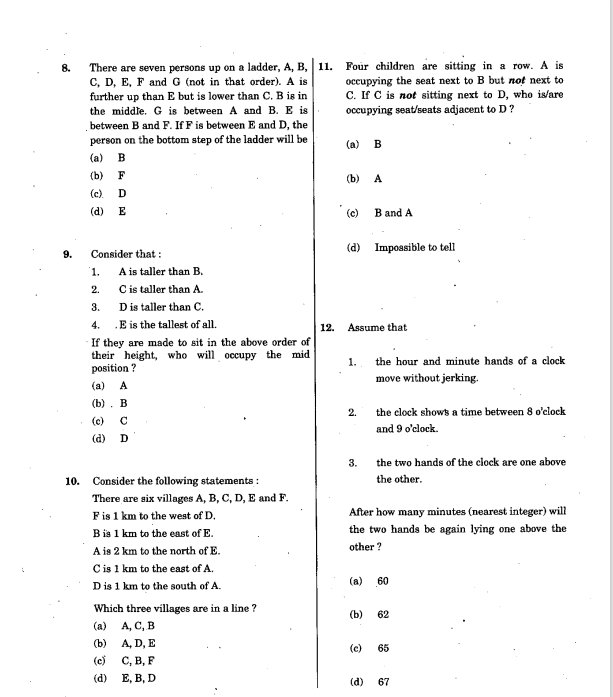
Since the last two years, the English Comprehension passages are getting lengthier and the Mathematical questions trickier. Let’s take a look at the 2012 CSAT Paper and compare it with the 2021 CSAT paper.
2014 CSAT Paper
Here the questions are asked chapter by chapter and are basic-to-moderate. Questions are direct and straightforward without much combination numerals.
2021 CSAT Paper
There is no particular order of questions asked. Immediately after LR questions, we have a question on time and distance. Also the questions are moderate-to-advanced. One cannot find out the answer in first glance itself. There is no one-size fits for all approach or a uniform formula by which you can crack the sequential questions.
Free Open to All CSAT Session by Civilsdaily Mentor Ravi Sir
If you have to clear the paper, then you have to attempt atleast 50 questions out of 80. Out of these 50 questions, 27 need to be right. There is also negative marking of 1.5 marks for every wrong answer. Hence, for aspirants from a non-mathematics background the challenge lies in practising for CSAT without reducing time for GS Preparation.
Do you want to know how you can complete both the lengthy comprehension passages and tricky mathematical questions within the stipulated time? Then it’s time you attended Civilsdaily Mentor Ravi sir’s webinar on Sunday.
Ravi sirhas cleared UPSC Prelims six times and attended the Interview round thrice. As a mentor, Ravi sir is a lifelong UPSC aspirant because he daily reads, checks and evaluates the right study materials for his students. On Monday, he will conduct a session on CSAT which is free for every aspirant to attend. All you have to do is register yourself for the session.
Key Takeaways in the CSAT Session Conducted by Ravi Sir
1. Topic-wise live demonstration on how to solve problems.
2. Examples of easy, moderate and advanced questions to solve.
3. Variety of questions under each topic.
4. Previous year question paper analysis from 2013 onwards. How to be ready for the new paper pattern.
5. Books one can refer for CSAT test series practice and to understand the concepts.
6. How to practice CSAT without compromising on GS paper studies.
7. Topic-wise weightage in Quantitative Aptitude.
8. Ravi sir will solve your doubts in a Q&A discussion towards the end of the session.
Webinar Details
If you want to know the secrets of finishing the CSAT paper in 2 hours, then this webinar is for you! We hope this webinar will help all 2022 aspirants implement the suggestions of Ravi sir
After beating lakhs of aspirants to be among the top two thousand UPSC candidiates, you might think the final round would be a breezer and requires no prior preparation. For someone who has prepared current affairs intensively for a year, they feel that they can answer the questions in the interview rounds impromptu.
However, let’s not forget that though the amount of competition decreases substantially in the interview round so much that you have 50% chances of clearing it, the quality of competition increases. You are set up against those aspirants whose average score in Mains is between 900-1000 marks. Most of the candidates fall in this marks bracket. The only way you can create a difference, is by performing exceeding well in the interview.
To understand how seriously Civilsdaily conducts its UPSC mock interviews, watch this video.
Why Mock Interviews Are a Better Way to Practice Than By Yourself or With Your Friends?
Rahul Reddy AIR 218, 2020 tries his best to answer international crisis issues in a diplamtic way
So, how can you practice for Interview round before you attend it? Does it have to be with friends or in front of the mirror? Remember, the most effective option is the one where you are simulating an actual UPSC interview enviornment. .
Casual DAF-II filling can cost you a UPSC attempt and thus, you must start your preparation with DAF II curation. The aspirants who have cleared UPSC Mains 2021 can register for our interview support program without any fee (FREE).
The purpose of mock interviews is to refine your approach, attitude and aptitude to excel in UPSC’s personality test. Mock interviews must support your quest at excelling in the final interview. You must be ready to tackle unexpected questions with your knowledge. You must have a solid opinion backed by data and facts for any issue.
That’s why Civilsdaily has brought the free mock interview initiative for all Mains-Qualified aspirants. You can practice as many times you would like before you are perfect. If you want to analyse your performance, we will share the video for your reference.
Here Are the Distinguished Panellists of Civilsdaily Mock Interview 2022
AIR 268 Nitish Rajora answers questions on Indian Economy with ease
One of the major advantages of attending the free mock interviews of Civilsdaily is that you will gain exposure to some of the finest bureaucrats retired as well as working, subject matter experts, psychoanalysts and faculty members. Our panellists have direct experience in recruitment and personality analysis.
1. Mr. Shankar Agarwal (Chairman)– Retired IAS Officer, 1980 Batch, Uttar Pradesh Cadre. Last held position: Joint Secretary for the Government of India.
GS-1 History of the world will include events from 18th century such as industrial revolution, world wars, redrawal of national boundaries, colonization, decolonization, political philosophies like communism, capitalism, socialism etc.— their forms and effect on the society.
GS-2 Bilateral, regional and global groupings and agreements involving India and/or affecting India’s interests.
GS-3 Indian Economy, Issues related to growth & development, Employment opportunities
HOW TO ATTEMPT ANSWERS IN DAILY ANSWER WRITING ENHANCEMENT(AWE)?
Daily 4 questions from General studies 1, 2, 3, and 4 will be provided to you.
A Mentor’s Comment will be available for all answers. This can be used as a guidance tool but we encourage you to write original answers.
You can write your answer on an A4 sheet and scan/click pictures of the same.
Upload the scanned answer in the comment section of the same question.
Along with the scanned answer, please share your Razor payment ID, so that paid members are given priority.
If you upload the answer on the same day like the answer of 11th February is uploaded on 11th February then your answer will be checked within 72 hours. Also, reviews will be in the order of submission- First come first serve basis
If you are writing answers late, for example, 11th February is uploaded on 13th February , then these answers will be evaluated as per the mentor’s schedule.
We encourage you to write answers on the same day. However, if you are uploading an answer late then tag the mentor like @Staff so that the mentor is notified about your answer.
*In case your answer is not reviewed, reply to your answer saying *NOT CHECKED*.
Earlier this month, the Union Cabinet has approved the setting up of the National Land Monetization Corporation (NLMC) to monetize surplus land and building assets of Central Public Sector Enterprises (CPSEs) and other agencies linked to the Government.
In this article, we will study how effective is this going to be, considering land monetization is a complex process, what potential challenges could NLMC face in the whole process, what roles and responsibilities will this separate agency be entrusted with?
What is NLMC?
The NLMC will be a firm, fully owned by the government, to carry out the monetisation of government and public sector assets in the form of surplus, unused or underused land assets.
It will fall under the administrative jurisdiction of the Ministry of Finance.
It will be set up with an initial authorised share capital of ₹5,000 crore and a paid-up capital of ₹150 crore.
Surplus land and building assets of CPSEs are expected to be transferred to the NLMC, which will then hold, manage and monetise them.
Functions of NLMC
The NLMC will-
Monetize underutilised or unused land parcels of Central Public Sector Enterprises (CPSEs)
Facilitate the monetisation of assets belonging to PSUs that have ceased operations or are in line for a strategic disinvestment
Actas an advisory body and support other government entities and CPSEs in identifying their surplus non-core assets
Benefits offered
Speeding up disinvestment: The setting of the NLMC will speed up the closure process of the CPSEs and smoothen the strategic disinvestment process.
Productive utilization of stagnant assets: It will also enable productive utilisation of these under-utilised assets by setting in motion private sector investments.
Easing up of finances: It will boost new economic activities such as industrialisation, boosting the local economy by generating employment and generating resources for potential economic and social infrastructure.
Maximum value realization: It will help monetising them in an efficient and professional manner, maximising the scope of value realisation.
What does monetization mean?
When the government monetises its assets, it essentially means that it is transferring the revenue rights of the asset (could be idle land, infrastructure, PSU) to a private player for a specified period of time.
In such a transaction, the government gets in return an:
Upfront payment from the private entity
Regular share of the revenue generated from the asset
Promise of steady investment into the asset, and
Title rights to the monetised asset
Why need monetization?
There are different reasons why the government monetizes its assets.
Revenue shortfall: One of them is to create new sources of revenue.
Pandemic damage control: The economy has already been hit due to the coronavirus pandemic and revenues are essential to fulfil the Modi government’s target of achieving a $5 trillion economy.
Risk management: Monetisation is also done to unlock the potential of unused or underused assets by involving institutional investors or private players.
Capital generation: It is also done to generate resources or capital for future asset creation, such as using the money generated from monetisation to create new infrastructure projects.
Need for NLMC
Professional dealing in negotiations: The firm will hire professionals from the private sector with a merit based approach
Market expertise: Asset monetisation of real estate requires expertise in valuation of property, market research, investment banking, land management, legal diligence and other related skill sets.
Global best practices: NLMC will undertake monetisation as an agency function and is expected to act as a directory of best practices in land monetisation.
How much land is currently available for monetization?
According to the Economic Survey 2021-2022, as of now, CPSEs have put nearly 3,400 acresof land on the table for potential monetisation.
They have referred this land to the Department of Investment and Public Asset Management (DIPAM).
As per the survey, monetisation of non-core assets of PSUs such as MTNL, BSNL, BPCL, B&R, BEML, HMT Ltd, Instrumentation Ltd etc. are at different stages.
Challenges to the NLMC
(a) Volatile market situation
The performance and productivity of the NLMC will also depend on the government’s performance on its disinvestment targets.
For example, the Life Insurance Corporation IPO, which was supposed to raise ₹60,000 crore is now shrouded in uncertainty owing to the Russia-Ukraine crisis making stock markets volatile.
If the IPO does not hit the markets by the end of March, the government would be missing its disinvestment targets by a wide margin.
(b) Issues with the transfer of rights
The process of asset monetisation does not end when the government transfers revenue rights to private players.
Identifying profitable revenue streams for the monetised land assets, ensuring adequate investment by the private player and setting up a dispute-resolution mechanism are also important tasks.
(c) Unattractiveness of PPP Model
Posing as another potential challenge would be the use of Public Private Partnerships (PPPs) as a monetisation model.
For instance, the results of the Centre’s PPP initiative launched in 2020 for the Railways were not encouraging.
It had invited private parties to run 150 trains of the Indian Railways but when bids were thrown open, nine clusters of trains saw no bidders.
Criticisms of NLMC
It militates philosophy of privatisation: PM has propounded more than once: the business of government is not business. Setting up a CPSE to help sell or shut down the existing CPSEs doesn’t appear quite congruous.
Privatisation process is not new: Dozens of companies have been sold; in many more, minority stakes have been offloaded. So, if the existing process has served so well, why try something new?
Conflict of interest: NLMC may have a turf war with the Department of Investment and Public Asset Management (DIPAM) which is tasked with similar functions.
Nature of NLMC: The government organs tend to acquire a life of their own. The National Anti-Profiteering Authority (NAA) is a case in point. It was supposed to be wound up in two years but still getting extensions.
Public land being sold: Publicly owned lands in a democracy are literally owned by the public. They are held in trust on behalf of the public by governments or government agencies.
Sale of crucial assets: Land holdings are one of the government’s most significant tangible assets, whether owned by central ministries, state governments, public sector undertakings or local bodies.
Way forward
There is a need to monetise non-core unused and under-used assets that would help the government generate substantial revenues.
For CPSEs undergoing strategic disinvestment or closure, monetisation of these stagnant surplus land and non-core assets is important to unlock their value.
There is a need to create a comprehensive inventory of public land and synergize the existing Government Land Information System (GLIS).
HOW TO ATTEMPT ANSWERS IN DAILY ANSWER WRITING ENHANCEMENT(AWE)?
Daily 4 questions from General studies 1, 2, 3, and 4 will be provided to you.
A Mentor’s Comment will be available for all answers. This can be used as a guidance tool but we encourage you to write original answers.
You can write your answer on an A4 sheet and scan/click pictures of the same.
Upload the scanned answer in the comment section of the same question.
Along with the scanned answer, please share your Razor payment ID, so that paid members are given priority.
If you upload the answer on the same day like the answer of 11th February is uploaded on 11th February then your answer will be checked within 72 hours. Also, reviews will be in the order of submission- First come first serve basis
If you are writing answers late, for example, 11th February is uploaded on 13th February , then these answers will be evaluated as per the mentor’s schedule.
We encourage you to write answers on the same day. However, if you are uploading an answer late then tag the mentor like @Staff so that the mentor is notified about your answer.
*In case your answer is not reviewed, reply to your answer saying *NOT CHECKED*.
As UPSC Mains results were announced last week, Sajal sir (Co-Founder of Civilsdaily and Mentor ofSmash Mains 2021 Program) was flooded with calls by delighted aspirants who thanked him for his mentorship. Sajal Sir himself is the topper of GS 2017 Mains paper and mentor of 400 UPSC Toppers.
After a quick check, we found out 41 Smash Mains students are qualified to attend the interview this year. As we are waiting for their interview results, we will not be announcing their names right now. However, we are sharing the testimonials of the qualified aspirants. We wish them all the very best!
As prelims is round the corner, you would have already started your revision. The main purpose of the UPSC prelims exam is to test your conceptual clarity in basic topics and application of current affairs in subject-related questions. Since the questions in prelims aren’t direct or straightforward, they appear to be outside the standard book and NCERTs.
Based on our research, we have come up with nearly 30-35 important subject-wise topics for Prelims 2022. In this article, we will be highlighting only 3 topics per subject. Those aspirants interested to get the complete handbook of Must-Read Static+ Current Affairs Prelims Topics can register for ourFree 1-on-1 Mentorship Session.Along With the Free Consultation+Handbook, aspirants will Get Free Personalised 60 Days Revision Timetable for Prelims 2022.
Polity
Important Supreme Court Judgements.
Revise important judgements passed by the Supreme Court in the year 2021 along with those mentioned in your polity standard books like Keshvananda Bharati case, Uman Rao Case and Minerva Mills Case. While reading up the reasoning behind the judgements, you will gain clarity of the constitutional provisions.
Fundamental Rights from Article 12-35
Every year, a minimum of 2-3 questions mandatorily ask about the basic human rights guaranteed by the constitution, their significance and limitations. Sample these questions from Prelims 2021.
1. Under the Indian constitution concentration of wealth violates
(a) The Right to Equality
(b) The Directive Principles of State Policy
(c) The Right to Freedom
(d) The Concept of Welfare
2. A legislation which confers on the executive or administrative authority an unguided and uncontrolled discretionary power in the matter of the application of law violates which one of the following Articles of the Constitution of India?
(a) Article 14
(b) Article 28
(c) Article 32
(d) Article 44
Non-constitutional Bodies
Questions have been consistently asked about the recent developments in the quasi-judicial, statutory and regulatory bodies set up by the state legislatures. Examples include the National Human Rights Commission, National Green Tribunal and National Law Commission. One must be aware of the corresponding laws around which these bodies were established.
Inflation has been a persistent issue that has affected Indians every year. Everytime, there is news on how the RBI plans to tackle the issue or how foreign crises result in inflation of goods in India. Aspirants are expected to understand types of inflation like demand-pull inflation, cost-push inflation and wholesale price inflation. Remedies for inflation can be found in the current affairs section. One can expect 2-3 questions in prelims from this section. The prelims questions would test the conceptual clarity in fiscal policy and inflation.
Money market
Aspirants are expected to have a general and not specialized knowledge on the financial instruments with high liquidity and short term maturities. The different kinds of credit that exist for different sections of the society needs to be read.
GDP Estimates
Every year one question in prelims is about the GDP estimates of a particular year. While reading this topic, aspirants must note down the department that releases this report, the difference between GDP and GVA and the Index of Industrial Production (IIP).
Aspirants are expected to make micronotes from the standard books they are reading on the role of international institutions in combating environmental pollution through conventions, acts and policies. Examples of such conventions are Stockholm convention, Ramsar Convention, CITES etc.
Biogeochemical cycles
Aspirants need to be familiar with the process of biogeochemical cycle, the types of biogeochemical cycle and the significance of the same. Questions around this are typically direct and straightforward.
Mapping of national parks, wildlife sanctuaries and wetlands
Every year, aspirants definitely get 3-5 fact based questions on national parks. Some of these questions could be asked due to a recent development in a particular park. For example, the Chilika Lake wetland was recently in news in January due to migratory birds like the Mongolian Gull staying there. The Chilika Lake is the first wetland of international importance under Ramsar convention. Certain aspects the aspirants must note down are the areas where the particular national park or wetland is spread across, the major attractions, the economic and social significance of the place.
Any report released by an international organisation on the performance of India against other countries under certain parameters must be revised. This includes The Global Hunger Index, World Happiness Report and Human Development Index.
GOI schemes for 2021
Ranging from agriculture, education, MSMEs, vulnerable sections and banking, aspirants need to have awareness on government initiatives in 2021. This will make it easier for them to solve indirect questions as well.
Electric Vehicles: India’s commitment towards electric vehicles and COP26 of Glasgow might be areas where prelims questions would be asked. Aspirants should understand the various measures to develop and promote the EV ecosystem in the country such asFaster Adoption and Manufacturing of Electric Vehicles (FAME II) scheme, Production-Linked Incentive (PLI) scheme for Advanced Chemistry Cell (ACC) and the recently launched PLI scheme for Auto and Automotive Components for manufacturers of electric vehicles.
Dark Genome
This is a hot topic in DNA research and aspirants must understand why research in this area is essential for treatment of diseases. Questions on genetics can be expected from Prelims this time.
Emerging technologies (5G, AI, Machine learning)
In recent years, a lot of questions have appeared about the latest developments in technology, their discoveries and the latest theories related to them. Few of these technologies are 5G, Quantum Key Distribution technology, hydrogen fuel cell etc. Aspirants must micronotes on these topics from prelims perspective.
Aspirants must practice places in the Indian Map on a regular basis. Particularly, they must focus on himalayan rivers like Ganga, Brahmaputra and Yamuna, peninsular rivers like Damodar, Mahanadi, Godavari, Krishna, Kaveri and Periyar. Not only rivers, but aspirants must know where exactly their tributaries are located. Apart from this, North to South Alignment of Mountains in Eastern ghat and Western Ghat, Andaman, Nicobar and Lakshadweep islands and Industrial Location and Ports need to be marked.
Climatic Regions in India
Aspirants must learn about the onset and withdrawal of the Indian Monsoon system, tropical cyclones, different climatic zones, factors that cause shifts in climate and intertropical convergence zone.
Continental Shift Theory
Present in the NCERT textbooks, this theory talks about the formation of different continents. Aspirants must keep an eye for one or two questions that might come from this topic in the Geography section.
Want to Know How a Free 1-on-1 Mentorship Looks Like? Watch This Video
In this video, there is first an initial discussion of the test performance, which is then followed by the mentor discussing the questions which the aspirant had got wrong and then he will ask the aspirant, where did he study the topic and to share the notes he made on that topic. The mentor will find out the problem and suggest the correct method of studying the topics. After the session gets over, the aspirant has to study the topics where he couldn’t score high marks in polity. After this, the next day the mentor will conduct another test only on those topics. This way the aspirant gains an understanding on how to approach the whole subject of polity.
This Spotlight is a part of our Mission Nikaalo Prelims-2022.
You can check the broad timetable of Nikaalo Prelims here
Session Details
Morning 12 PM – Prelims Spotlight Session
Evening 06:30 PM – TIKDAM/MCQs Session
Noon 03:00 PM – CSAT Google Meet Session
Evening 08 PM – Tests on Alternate Days
Join our Official telegram channel for Study material for GS and CSATHere
30th Mar 2022
Important straits in the news.
A strait is a naturally formed, narrow, typically navigable waterway that connects two larger bodies of water. Most commonly it is a channel of water that lies between two landmasses. Some straits are not navigable, for example, because they are too shallow, or because of an unnavigable reef or archipelago.
Strait of Hormuz
In NEWS – Denmark is leading a six-month joint European mission ‘EMASOH’ in the strait.
It links the Persian Gulf (west) with the Gulf of Oman and the Arabian Sea (southeast).
On the north coast lies Iran, and on the south coast the United Arab Emirates and Musandam, an exclave of Oman.
The strait is 35 to 60 miles (55 to 95 km) wide and separates Iran from the Arabian Peninsula.
It contains the islands of Qeshm (Qishm), Hormuz, and Hengām (Henjām) and is of great strategic and economic importance, especially as oil tankers collecting from various ports on the Persian Gulf must pass through the strait.
OPEC members Saudi Arabia, Iran, the UAE, Kuwait and Iraq export most of their crude via the Strait
Qatar, the world’s biggest liquefied natural gas (LNG) exporter, sends almost all of its LNG through the Strait
The UAE and Saudi Arabia have sought to find other routes to bypass the Strait, including building pipelines.
2. Strait of Malacca
Strait of Malacca connects the Andaman Sea (Indian Ocean) and the South China Sea (Pacific Ocean). Always in the news.
Stretching about 800km, it is the longest straits in the world and facilitates not just shipping and the movement of people in the surrounding communities but is a confluence of trade, cultures, ideas, and knowledge between the East and West.
It runs between the Indonesian island of Sumatra to the west and peninsular (West) Malaysia and extreme southern Thailand to the east and has an area of about 25,000 square miles (65,000 square km).
The strait derived its name from the trading port of Melaka (formerly Malacca)—which was of importance in the 16th and 17th centuries—on the Malay coast.
As the link between the Indian Ocean and the South China Sea, the Strait of Malacca is the shortest sea route between India and China and hence is one of the most heavily travelled shipping channels in the world.
Singapore, one of the world’s most important ports, is situated at the strait’s southern end.
The global shift in economic power from the West to the East coupled with burgeoning trade, investments, and production in areas spanning the Indian and Pacific Ocean regions has given increasing importance to this region.
3. Bab-el-Mandab
AMAN, Multinational Navy exercise of US, China and Russia was held.
The Bab al-Mandab strait is the narrow waterway that separates the Arabian Peninsula from the Horn of Africa.
It links the Red Sea to the Gulf of Aden and the Indian Ocean.
At its narrowest point, the strait is only 29 km wide between Yemen on one side and Djibouti and Eritrea on the other.
It is a key strategic channel for commerce and trade, with an estimated 4 percent of global oil supply passing through it.
4. Palk Strait
It connects the Bay of Bengal in the northeast with Palk Bay in the southwest. Always in news.
The strait is 40 to 85 miles (64 to 137 km) wide, 85 miles long, and less than 330 feet (100 metres) deep.
It receives several rivers, including the Vaigai (India), and it contains many islands on the Sri Lankan side.
The Sethusamudram Ship Canal Project (SSCP) is a 167 km long shipping canal, and envisages the creation of a navigable canal from the Gulf of. Mannar to the Bay of Bengal to facilitate the movement of ships.
The Adam’s Bridge is a series of sand shoals created by sedimentation over a period of time.
All islands are made up of a calcareous framework of dead reef and sand.
In India, the Gulf of Mannar region in Tamil Nadu is one of the four major coral reef areas and the others are Gulf of Kutch in Gujarat, Lakhsadweep and Andaman and Nicobar islands.
With its rich biodiversity of over 4,000 species of various flora and fauna, part of this Gulf of Mannar between Rameswaram and Tuticoirin covering 21 islands and the surrounding shallow coastal waters was declared as a Marine National Park in 1986.
5.Sunda Strait
Frequently in the news due to China, India, Pakistan and Indonesia.
It links the Java Sea (Pacific Ocean) with the Indian Ocean (south).
Sunda Strait, Indonesian Selat Sunda, is a channel, 16–70 miles (26–110 km) wide, between the islands of Java (east) and Sumatra.
The Sunda Strait is an important passage connecting the Indian Ocean with eastern Asia.
The strait stretches in a roughly northeast/southwest orientation, with a minimum width of 24 km (15 mi) at its northeastern end between Cape Tua on Sumatra and Cape Pujat on Java.
It is very deep at its western end, but as it narrows to the east it becomes much shallower, with a depth of only 20 m (65 feet) in parts of the eastern end.
It is notoriously difficult to navigate because of this shallowness, very strong tidal currents, sandbanks, and man-made obstructions such as oil platforms off the Java coast.
The strait’s narrowness, shallowness, and lack of accurate charting make it unsuitable for many modern, large ships, most of which use the Strait of Malacca instead.
6.Mozambique Channel
In the news due to Tropical storm Gombe.
It is located between the island nation of Madagascar on the east and Mozambique on the African mainland (west).
About 1,000 miles (1,600 km) long, it varies in width from 250 to 600 miles (400 to 950 km) and reaches a maximum depth of 10,000 feet (3,000 m).
The Comoro Archipelago marks the northern entrance, and the islands of Bassas da India and Europa lie in the south.
An important route for shipping in eastern Africa, it receives all major Madagascar rivers and has the ports of Mahajanga (Majunga) and Toliary (Tuléar) on the same coast.
Along the opposite coast are the mouth of the Zambezi River and the ports of Maputo (formerly Lourenço Marques), Moçambique, and Beira.
The Mozambique Current passes through the strait.
7.Gibraltar Strait
It was in the news due to smuggling boats.
It is a channel connecting the Mediterranean Sea with the Atlantic Ocean, lying between southernmost Spain and northwesternmost Africa.
It is 36 miles (58 km) long and narrows to 8 miles (13 km) in width between Point Marroquí (Spain) and Point Cires (Morocco).
It is one of the most significant global sea lanes because it provides a means of seaborne transit for shipping between the Atlantic and Mediterranean, and via the Suez Canal into the Indian Ocean and beyond.
After the English Channel, the Strait is the world’s busiest shipping lane.
8. Bosphorus strait and Dardanelles strait
Bosphorus,also known as the Strait of Istanbul, is a narrow, natural strait and an internationally significant waterway located in northwestern Turkey.
The Bosporus connects the Black Sea with the Sea of Marmara, and, by extension via the Dardanelles, the Aegean and Mediterranean seas.
It is the world’s narrowest strait used for international navigation.
Dardanelles is a narrow, natural strait and internationally significant waterway in northwestern Turkey that forms part of the continental boundary between Europe and Asia, and separates Asian Turkey from European Turkey.
The Dardanelles connects the Sea of Marmara with the Aegean and Mediterranean Seas, while also allowing passage to the Black Sea by extension via the Bosphorus.
The Dardanelles is 61 kilometres (38 mi) long, and 1.2 to 6 kilometres (0.75 to 3.73 mi) wide, averaging 55 metres (180 ft) deep with a maximum depth of 103 metres (338 ft) at its narrowest point abreast the city of Çanakkale
9. Yucatan Strait
Joining seas/ Water Bodies : Gulf of Mexico and Caribbean Sea
Location: Mexico-Cuba
10. Mesina Strait
Joining seas/ Water Bodies : Mediterranean Sea
Location: Italy-Sicily
11. Otranto Strait
Joining seas/ Water Bodies :Adriatic Sea & Ionian Sea
Location: Italy-Albania
12. Cook Strait
Joining seas/ Water Bodies :South Pacific Ocean
Location: New Zealand (North & South Islands)
13. North Channel
Joining seas/ Water Bodies :Irish Sea & Atlantic Ocean
Location: Ireland-England
14. Hudson strait
Joining seas/ Water Bodies : Gulf of Hudson & Atlantic Ocean
Location: Canada
15. Magellan strait
Join: Pacific and South Atlantic Ocean
Location: Chile
16. Makassar Strait
Joining seas/ Water Bodies: the Java Sea & Celebes Sea
Location: Indonesia
17. Tsugaru Strait
Joining seas/ Water Bodies: Japan Sea and Pacific Ocean
Location: Japan (Hokkaido-Honshu Island)
18. Tatar Strait
Joining seas/ Water Bodies: Japan Sea & Okhotsk Sea
Location: Russia (East Russia-Sakhalin Islands)
19. Fovex Strait
Joining seas/ Water Bodies: South Pacific Ocean
Location: New Zealand (South Island- Stewart Island)
20. Formosa Strait
Joining seas/ Water Bodies: the South China Sea & East China Sea
Location: China-Taiwan
21. Taurus Strait
Joining seas/ Water Bodies:Arafura Sea & Gulf of Papua
Location: Papua New Guinea — Australia
22. Bass Strait
Joining seas/ Water Bodies: the Tasman Sea & South Sea
Location: Australia
23. Bering Strait
Joining seas/ Water Bodies: the Bering Sea & Chukchi Sea
Location: Alaska-Russia
24. Bonne-Fasio Strait
Joining seas/ Water Bodies: Mediterranean Sea
Location: Corsica — Sardinia
25. Davis Strait
Joining seas/ Water Bodies : the Baffin Bay & Atlantic Ocean
Location: Greenland-Canada
26. Denmark Strait
Joining seas/ Water Bodies: North Atlantic and the Arctic Ocean
Location: Greenland-Iceland
27. Dover strait
Joining seas/ Water Bodies: The English Channel & North Sea
Location: England-France
28.Florida Strait
Joining seas/ Water Bodies: Gulf of Mexico and the Atlantic Ocean
Earlier this week, PM Modi and his Australian counterpart Scott Morrison held a virtual summit – the second one since June 2020.
Both nations agreed to unlock the untapped potential in bilateral trade and investment.
They highlighted the need to conclude the proposed Comprehensive Economic Cooperation Agreement (CECA) at the earliest.
India-Australia Relations: A Backgrounder
The India-Australia bilateral relationship has undergone evolution in recent years, developing along a positive track, into a friendly partnership.
The two nations have much in common, underpinned by shared values of a pluralistic, Westminster-style democracies, Commonwealth traditions, expanding economic engagement etc.
Several commonalities include strong, vibrant, secular and multicultural democracies, free press, independent judicial system and English language.
Historical Perspective
The historical ties between India and Australia started immediately following European settlement in Australia from 1788.
All trade, to and fro from the penal colony of New South Wales was controlled by the British East India Company through Kolkata.
India and Australia established diplomatic relations in the pre-Independence period, with the establishment of India Trade Office in Sydney in 1941.
The end of the Cold War and simultaneously, India’s decision to launch major economic reforms in 1991 provided the first positive move towards development of bilateral ties.
Various dimensions of ties
[A] Political partnership
Both the countries are members of G-20, ASEAN Regional Forum (ARF), IORA (Indian Ocean Rim Association), Asia Pacific Partnership on Climate and Clean Development, East Asia Summit and the Commonwealth.
Australia has been extremely supportive of India’s quest for membership of the APEC (Asia Pacific Economic Cooperation).
Australia whole-heartedly welcomed India’s joining of the MTCR (Missile Technology Control Regime).
[B] Trade and Economy
India is the 5th largest trade partner of Australia with trade in goods and services.
Two-way trade between India and Australia was worth A$24.3 billion ($18.3 billion) in 2020, up from just $13.6 billion in 2007, according to the Australian government.
After a series of attempts, in 2016, Australia opened the door for uranium exports to India.
An Australia-India Strategic Research Fund (AISRF) which was established in 2006, supports collaboration between scientists in India and Australia on cutting-edge research.
[C] Cultural ties
There is a longstanding people-to-people ties, ever increasing Indian students coming to Australia for higher education.
Growing tourism and sporting links, especially Cricket and Hockey, have played a significant role in further strengthening bilateral relations between the two countries.
India is one of the top sources of skilled immigrants to Australia.
The number of Indian students continue to grow with approximately 105,000 students presently studying in Australian universities.
After England, India is the second largest migrant group in Australia in 2020.
[D] Strategic Partnership
In 2009, India and Australia established a ‘Strategic Partnership’, including a Joint Declaration on Security Cooperation which has been further elevated to Comprehensive Strategic Partnership in 2020.
The Mutual Logistics Support Agreement has been signed during the summit that should enhance defence cooperation and ease the conduct of large-scale joint military exercises.
There is a technical Agreement on White Shipping Information Exchange.
Both nations conduct bilateral maritime exercise AUSINDEX. In 2018, Indian Air Force participated for the first time in the Exercise Pitch Black in Australia.
Foreign and Defence Ministers of both countries agreed to meet in a ‘2+2’ format biennially.
The first-ever Quad Leaders’ Virtual Summit held on 12 March 2021 saw the participation of Prime Ministers of India, Australia, Japan and President of USA.
A Civil Nuclear Cooperation Agreement between the two countries was signed in September 2014 during the visit of then PM Tony Abbott to India.
Significance of the ties
COVID Management: Australia is one of the few countries that has managed to combat COVID-19 so far through “controlled adaptation” by which the coronavirus has been suppressed to very low levels.
STEM: From farming practices through food processing, supply and distribution to consumers, the Australian agribusiness sector has the desired R&D capacity, experience and technical knowledge.
Natural resources: Australia is rich in natural resources that India’s growing economy needs. It also has huge reservoirs of strength in higher education, scientific and technological research.
Alliance with US: The two countries also have increasingly common military platforms as India’s defence purchases from the US continue to grow.
Affinity with ASEAN: Australia has deep economic, political and security connections with the ASEAN and a strategic partnership with one of the leading non-aligned nations, Indonesia.
Containing China: The Indo-Pacific region has the potential to facilitate connectivity and trade between India and Australia. Both nations can leverage their equation in QUAD to contain China.
International cooperation
Support at UNSC: Australia supports India’s candidature in an expanded UN Security Council.
APEC: Australia is an important player in APEC and supports India’s membership of the organisation. In 2008, Australia became an Observer in SAARC.
Some irritants in ties
Trade imbalance: India’s trade deficit with Australia has been increasing since 2001-02 due to India-Australia Free Trade Agreement. It is also a contentious issue in the ongoing RCEP negotiations which India left.
High tariff on agri products in India: India has a high tariff for agriculture and dairy products which makes it difficult for Australian exporters to export these items to India.
Non-tariff barriers in Australia: At the same time, India facesnon-tariff barriers and its skilled professionals in the Australian labour market face discrimination.
Visa Policy: India wants greater free movement and relaxed visa norms for its IT professionals, on which Australia is reluctant.
Future of QUAD: Australian lobby has sparked speculation over the fate of the Quadrilateral Consultative Dialogue (the ‘Quad) involving India, Australia, Japan and the United States.
Nuclear reluctance: Building consensus on non-nuclear proliferation and disarmament has been a major hurdle given India’s status as a nuclear power.
Racism against Indians: Increasing Racist attacks on Indians in Australia has been a major issue.
Way forward
Upgradation of 2+2 format: It is prudent too for New Delhi and Canberra to elevate the ‘two plus two’ format for talks from the Secretary level to the level of Foreign and Defence Ministers.
Removal of trade barriers: Both nations need to resolve disputes at the WTO with regard to the Australian sector can act as a serious impediment.
Balancing China: An ‘engage and balance’ China strategy is the best alternative to the dead end of containment.
Conclusion
Given the changing geopolitics, both Canberra and New Delhi are keen to move beyond mere rhetoric and build a robust partnership
The key is to keep the Australia story thriving in India, and India story thriving in Australia on a consistent basis in public memory.
This involves a holistic multi-stakeholder strategy and approach which deepens understanding and appreciation of each other.
As UPSC Mains results were announced last week, Sajal sir (Co-Founder of Civilsdaily and Mentor ofSmash Mains 2021 Program) was flooded with calls by delighted aspirants who thanked him for his mentorship. Sajal Sir himself is the topper of GS 2017 Mains paper and mentor of 400 UPSC Toppers.
After a quick check, we found out 41 Smash Mains students are qualified to attend the interview this year. As we are waiting for their interview results, we will not be announcing their names right now. However, we are sharing the testimonials of the qualified aspirants. We wish them all the very best!
As prelims is round the corner, you would have already started your revision. The main purpose of the UPSC prelims exam is to test your conceptual clarity in basic topics and application of current affairs in subject-related questions. Since the questions in prelims aren’t direct or straightforward, they appear to be outside the standard book and NCERTs.
Based on our research, we have come up with nearly 30-35 important subject-wise topics for Prelims 2022. In this article, we will be highlighting only 3 topics per subject. Those aspirants interested to get the complete handbook of Must-Read Static+ Current Affairs Prelims Topics can register for ourFree 1-on-1 Mentorship Session.Along With the Free Consultation+Handbook, aspirants will Get Free Personalised 60 Days Revision Timetable for Prelims 2022.
Polity
Important Supreme Court Judgements.
Revise important judgements passed by the Supreme Court in the year 2021 along with those mentioned in your polity standard books like Keshvananda Bharati case, Uman Rao Case and Minerva Mills Case. While reading up the reasoning behind the judgements, you will gain clarity of the constitutional provisions.
Fundamental Rights from Article 12-35
Every year, a minimum of 2-3 questions mandatorily ask about the basic human rights guaranteed by the constitution, their significance and limitations. Sample these questions from Prelims 2021.
1. Under the Indian constitution concentration of wealth violates
(a) The Right to Equality
(b) The Directive Principles of State Policy
(c) The Right to Freedom
(d) The Concept of Welfare
2. A legislation which confers on the executive or administrative authority an unguided and uncontrolled discretionary power in the matter of the application of law violates which one of the following Articles of the Constitution of India?
(a) Article 14
(b) Article 28
(c) Article 32
(d) Article 44
Non-constitutional Bodies
Questions have been consistently asked about the recent developments in the quasi-judicial, statutory and regulatory bodies set up by the state legislatures. Examples include the National Human Rights Commission, National Green Tribunal and National Law Commission. One must be aware of the corresponding laws around which these bodies were established.
Inflation has been a persistent issue that has affected Indians every year. Everytime, there is news on how the RBI plans to tackle the issue or how foreign crises result in inflation of goods in India. Aspirants are expected to understand types of inflation like demand-pull inflation, cost-push inflation and wholesale price inflation. Remedies for inflation can be found in the current affairs section. One can expect 2-3 questions in prelims from this section. The prelims questions would test the conceptual clarity in fiscal policy and inflation.
Money market
Aspirants are expected to have a general and not specialized knowledge on the financial instruments with high liquidity and short term maturities. The different kinds of credit that exist for different sections of the society needs to be read.
GDP Estimates
Every year one question in prelims is about the GDP estimates of a particular year. While reading this topic, aspirants must note down the department that releases this report, the difference between GDP and GVA and the Index of Industrial Production (IIP).
Aspirants are expected to make micronotes from the standard books they are reading on the role of international institutions in combating environmental pollution through conventions, acts and policies. Examples of such conventions are Stockholm convention, Ramsar Convention, CITES etc.
Biogeochemical cycles
Aspirants need to be familiar with the process of biogeochemical cycle, the types of biogeochemical cycle and the significance of the same. Questions around this are typically direct and straightforward.
Mapping of national parks, wildlife sanctuaries and wetlands
Every year, aspirants definitely get 3-5 fact based questions on national parks. Some of these questions could be asked due to a recent development in a particular park. For example, the Chilika Lake wetland was recently in news in January due to migratory birds like the Mongolian Gull staying there. The Chilika Lake is the first wetland of international importance under Ramsar convention. Certain aspects the aspirants must note down are the areas where the particular national park or wetland is spread across, the major attractions, the economic and social significance of the place.
Any report released by an international organisation on the performance of India against other countries under certain parameters must be revised. This includes The Global Hunger Index, World Happiness Report and Human Development Index.
GOI schemes for 2021
Ranging from agriculture, education, MSMEs, vulnerable sections and banking, aspirants need to have awareness on government initiatives in 2021. This will make it easier for them to solve indirect questions as well.
Electric Vehicles: India’s commitment towards electric vehicles and COP26 of Glasgow might be areas where prelims questions would be asked. Aspirants should understand the various measures to develop and promote the EV ecosystem in the country such asFaster Adoption and Manufacturing of Electric Vehicles (FAME II) scheme, Production-Linked Incentive (PLI) scheme for Advanced Chemistry Cell (ACC) and the recently launched PLI scheme for Auto and Automotive Components for manufacturers of electric vehicles.
Dark Genome
This is a hot topic in DNA research and aspirants must understand why research in this area is essential for treatment of diseases. Questions on genetics can be expected from Prelims this time.
Emerging technologies (5G, AI, Machine learning)
In recent years, a lot of questions have appeared about the latest developments in technology, their discoveries and the latest theories related to them. Few of these technologies are 5G, Quantum Key Distribution technology, hydrogen fuel cell etc. Aspirants must micronotes on these topics from prelims perspective.
Aspirants must practice places in the Indian Map on a regular basis. Particularly, they must focus on himalayan rivers like Ganga, Brahmaputra and Yamuna, peninsular rivers like Damodar, Mahanadi, Godavari, Krishna, Kaveri and Periyar. Not only rivers, but aspirants must know where exactly their tributaries are located. Apart from this, North to South Alignment of Mountains in Eastern ghat and Western Ghat, Andaman, Nicobar and Lakshadweep islands and Industrial Location and Ports need to be marked.
Climatic Regions in India
Aspirants must learn about the onset and withdrawal of the Indian Monsoon system, tropical cyclones, different climatic zones, factors that cause shifts in climate and intertropical convergence zone.
Continental Shift Theory
Present in the NCERT textbooks, this theory talks about the formation of different continents. Aspirants must keep an eye for one or two questions that might come from this topic in the Geography section.
Want to Know How a Free 1-on-1 Mentorship Looks Like? Watch This Video
In this video, there is first an initial discussion of the test performance, which is then followed by the mentor discussing the questions which the aspirant had got wrong and then he will ask the aspirant, where did he study the topic and to share the notes he made on that topic. The mentor will find out the problem and suggest the correct method of studying the topics. After the session gets over, the aspirant has to study the topics where he couldn’t score high marks in polity. After this, the next day the mentor will conduct another test only on those topics. This way the aspirant gains an understanding on how to approach the whole subject of polity.


![UPSC 2021 Free Mock Interview [LAST 2 SLOTS] || Unlimited Practice Sessions with India’s Most Experienced & Eminent IAS Interview Panel|| Limited Slots Available, Register Now](https://d18x2uyjeekruj.cloudfront.net/wp-content/uploads/2022/03/Interview-2.jpg)


