💥Join UPSC 2027,2028 Mentorship (July Batch) + XFactor Notes & Microthemes PDF

Category: Ranker Webinars

  • A Successful UPSC 2023 Depends on your Preparation Today|| Everyday you Waste is an Opportunity Lost || Fill Samanvaya Free 1-on-1 Mentorship Form to Stay Focused, Consistent & Ahead of Your Competition in UPSC Preparation

    A sneak peek into our 1-1 mentoring session for Prelims

    Civilsdaily helped 100+ aspirants get ranks in UPSC 2020. We helped 30 students secure ranks in the Top 100. After speaking with them personally on our UNHERD platform, we understood that there was one thing that was common between all the rankers!

    All the rankers committed themselves and NEVER postponed their preparationThey did not waste a single day but started preparing immediately. We also asked them WHY did they start immediately and did not wait? 

    This is what the rankers told us

    You will fall into a vicious cycle – Our toppers said that if aspirants do not start preparing immediately, they often fall into a vicious cycle of doubt and confusion. They wait for the right moment to start preparing but keep delaying it for numerous reasons like work, college, not-ready, etc. The more time they waste, the more confused they get, and the syllabus starts piling up. The toppers told us that the best thing they did was to start immediately and it helped them succeed!

    Lack of self-analysis can cost you 3-4 years – The toppers revealed that self-analysis is one of the most important things for an aspirant. You need to know the syllabus, the previous year questions for every topic, your strengths, your weaknesses, your learning speed, the best time to study, how to plan the study, etc. Most aspirants who fail the exam do not do self-analysis and just keep reading. This does not help as it wastes a lot of their time. In fact, if you are not sure about your strengths and weaknesses, it could easily cost you 3-4 years in preparation. The toppers also told us that they asked mentors for assessments when they felt confused. Self-analysis helped them focus on their weaknesses and improve them. And finally, they were able to crack the exam.

    UPSC is the biggest killer of self-belief – Our toppers told us that the UPSC exam is so tough and vast that it often kills an aspirant’s self-confidence. It becomes extremely difficult for them to remain consistent and motivated for the entire year. The rankers revealed that when they faced inconsistency and lacked self-confidence, they often spoke with their mentors who guided them. They found help in the mentors who understood their concerns and kept them motivated, especially when they felt down and depressed. This helped the rankers become consistent and prepare with the same energy every day!

    Self-study with no guidance doesn’t help – The rankers of 2020 told us that preparing for UPSC is like walking on a desert. You will be lost without a guide. They said that even when they were self-studying, they kept asking for guidance from mentors. What to study, what not to study, how to improve their answers, which areas to focus on, etc. The toppers stayed constantly in touch with mentors who helped them at every step. They did the hard work themselves but it would have been a waste if the hard work was not in the right direction.

    Always overachieve your daily target by 25% – The toppers said that they had a study plan with targets for every day! But that was not all. They always tried to overachieve the targets by at least 25%. Every time they overachieved, it gave them the confidence to do the same every day. And by the end of their preparation, they had a clear advantage over other aspirants because they studied 25% more than everyone, every single day!

    The toppers of 2020 told us that their handwork, right guidance, and smart planning at an early stage helped them succeed. They said that they did not want to postpone their preparation even by a single day as it would cost them ranks. And they were right! They started preparing immediately and are now rank-holders in UPSC!

    While UPSC 2023 may seem like a year away from now, looking at the syllabus one can say it’s just about the right time away. As Prelims 2022 approaches in June, more and more aspirants will realising how close they are to 2023 and begin preparing immediately. But it may just be too late by then!

    If you are reading this today, you are in luck. You have the opportunity to realise the urgency immediately. March has just begun and you can have an advantage of at least siix months over other aspirants if you start preparing today. And even with a year in your hand, it would take a high level of extremely focused study to crack the exam in June 2023. 

    The fact is thisYou CANNOT waste a single day in experimenting, hunting for resources, trying to collect reading material, etc. Every day from today is more valuable than anything you can imagine, and this is the time to focus with every bit of concentration you have.

    Given the time constraint and the urgency of the situation, you need to be practical. Speak with our mentors and get your preparation organised. Our mentors can help you streamline your preparation within 24 hours and will help you save precious time.Right now, nothing is more valuable than your time and if you wish to use it effectively, all it would take is a call with our mentors.

    The urgency is real, you can calculate yourself. And every moment you waste is an opportunity wasted. All you need to do is fill this form and our senior mentors will get in touch with you, with a solution designed especially for you! Speak with us, now as it’s a free 1-on-1 mentorship session with 40 minutes dedicated only for you.

    Get Motivated to Maintain Overall Consistency for UPSC

    It’s understandable we are humans and not programmable robots who can maintain the same level of interest everyday. However, maintaining an overall consistency throughout our preparation is neccessary to clear this competitive and vast exam. 

    Our philosophy behind MENTORSHIP is to get you out of this Snooze cycle. This ensures that you are the BEST VERSION of yourself in this journey. If you are under the impression that mentorship is weekly calls you attend, then you are mistaken, my friend. Trust us, your mentor will be your ‘FRIEND, PHILOSOPHER AND GUIDE’.

    TO EACH THEIR OWN – Every aspirant is different. Their strengths and weaknesses are different. Their time availability is also different. Identifying this is important so you don’t end up making unrealistic targets and lose momentum. Your mentor will make sure you start slow but remain consistent to build your confidence. Making your schedule structured based on our experience of working with 2500+ students is our first priority. 

    This image has an empty alt attribute; its file name is WhatsApp-Image-2021-05-05-at-10.14.09-AM.jpeg

    TRACK YOUR PROGRESS – When you see yourself grow, it becomes easier to motivate yourself to push boundaries. Tracking your progress can happen in many ways like mentorship calls or chat sessions or by regular tests. The idea is to ensure that you don’t go off track in your preparation, and even if you do, we have your back.

    This image has an empty alt attribute; its file name is WhatsApp-Image-2021-05-05-at-10.14.09-AM-4-576x1024.jpeg

    EVOLUTION – A constant guidance is important to bring consistency to your UPSC preparation. Guidance is not about clearing your doubts or asking you to study when you don’t. It is also about the evolution of your preparation. This is where you and your mentor work as a team. A constant effort to PLAN AND BUILD UP YOUR ABILITY to learn in a faster and more efficient way.

    This image has an empty alt attribute; its file name is WhatsApp-Image-2021-05-05-at-10.14.09-AM-6.jpeg

    TALK IT OUT – The biggest hurdle in achieving your highest level of consistency is the emotional part. Every now and then, you. surround yourself with negative thoughts, you feel scared and depressed. Instead of resolving these emotional issues, you avoid them as it seems like a waste of your precious time. You have to understand that ignoring emotional troubles does not solve them. What your doing is building an emotional time bomb that may burst a week before your mains or prelims! This is where your MENTOR AS A FRIEND comes in. All our mentors have been through this journey. We understand your fears and anxieties. So, TALK IT OUT.

    This image has an empty alt attribute; its file name is WhatsApp-Image-2021-05-05-at-10.14.09-AM-3.jpeg

    Don’t let inconsistency keep you away from your dreams.

    Fill up the SAMANVAYA form given below. Let us know your problems and we will find a solution to it, just like our students say ” TOGETHER WE CAN AND WE WILL”.

    How has Civilsdaily Mentorship, helped Aspirants become Toppers?

    The most difficult challenge faced by EVERY candidate is inconsistency. Be it inconsistency in studies, answer-writing practice, covering the syllabus, or revision, every candidate finds it difficult to cope with. But how do successful candidates manage to FIGHT Inconsistency so consistently?

    In UPSC 2020, Civilsdaily helped 80+ students secure ranks in their exams. In the top 100, every 3rd ranker was a Civilsdaily student.

     A very recent success story would be Vishwa Shah, student of Civilsdaily Mentor, Sukanya Ma’am. Vishwa has cleared the GPSC exam to become the Deputy Superintendent of Police in Gujarat. He has penned a thank-you note yesterday. Heartiest Congratulations to Vishwa!

    This image has an empty alt attribute; its file name is WhatsApp-Image-2021-12-27-at-18.49.53-727x1024.jpeg

    One of our other Civilsdaily Student, Shubham Nagargoje cleared the exams in 2020 to become an IPS Officer. Shubham was gracious enough to let us know how he felt about Civilsdaily Samanvaya Guidance under Parth sir.

    This image has an empty alt attribute; its file name is image-1.png
    This image has an empty alt attribute; its file name is WhatsApp-Image-2022-01-11-at-19.37.54-461x1024.jpeg

    To know how all of them cleared the exam with our mentorship, visit the Unherd Podcast.

    Now that results are announced for UPSC 2021 Prelims, out of 15 out of 25 students of Santhosh Gupta sir have been recommended to Mains. One such student, Rahul expresses his gratitude and extends his appreciation.

    Most of our Mentors like Sudhanshu sir, Sajal sir, Santhosh sir, Pravin sir, Parth Verma sir and Sukanya Ma’am were UPSC aspirants themselves and have attended UPSC Mains more than five times and UPSC Interview more than twice. Hence their mentorship is always a blend of the best test series, comprehensive notes and current affairs knowledge.

    This image has an empty alt attribute; its file name is 29d33a91-62aa-45e9-a906-327fbaad5180-1024x814.jpg
    This image has an empty alt attribute; its file name is 50f70a4d-c239-44a5-b49b-9b93617a378f-461x1024.jpg

    All of them dedicate their time weekly to give 1-on-1 mentorship to every student where they discuss last week’s performance and next week’s approach.

    Be it Telegram, Whatsapp or Habitiat channels, they are always available and clear student’s doubts in a turnaround time of 24 Hours.

    This image has an empty alt attribute; its file name is image-9-6.jpg
    This image has an empty alt attribute; its file name is WhatsApp-Image-2021-12-18-at-13.22.45-576x1024.jpeg
    This image has an empty alt attribute; its file name is WhatsApp-Image-2021-12-18-at-13.22.45-1-576x1024.jpeg
    This image has an empty alt attribute; its file name is WhatsApp-Image-2021-12-18-at-13.22.46-576x1024.jpeg
    This image has an empty alt attribute; its file name is WhatsApp-Image-2021-12-18-at-13.22.46-1-576x1024.jpeg
    This image has an empty alt attribute; its file name is WhatsApp-Image-2021-12-18-at-13.22.46-2-576x1024.jpeg
    This image has an empty alt attribute; its file name is WhatsApp-Image-2021-12-18-at-13.22.47-576x1024.jpeg
    This image has an empty alt attribute; its file name is image-9-5.jpg
    This image has an empty alt attribute; its file name is image-8.png

    Why Civilsdaily Mentors are the GPS for Your UPSC-CSE Preparation

    Remember there is always light at the end of the tunnel and if you want to get out of the tunnel you have to follow the direction of the light! Our mentors’ give you direction which is divided into daily modules. All you have to do is study and complete them on time.

    This image has an empty alt attribute; its file name is WhatsApp-Image-2021-11-29-at-21.47.49-1024x527.jpeg
    This image has an empty alt attribute; its file name is IMG-20211030-WA0003-461x1024.jpg
    This image has an empty alt attribute; its file name is IMG-20211029-WA0002-1-461x1024.jpg
    This image has an empty alt attribute; its file name is IMG-20211029-WA0001-1-461x1024.jpg
    This image has an empty alt attribute; its file name is IMG-20211029-WA0019-461x1024.jpg
    This image has an empty alt attribute; its file name is IMG-20211029-WA0018-461x1024.jpg
    This image has an empty alt attribute; its file name is WhatsApp-Image-2021-05-19-at-6.12.52-PM-576x1024.jpeg
    This image has an empty alt attribute; its file name is WhatsApp-Image-2021-05-05-at-10.14.09-AM-3.jpeg
    See the source image
    This image has an empty alt attribute; its file name is WhatsApp-Image-2021-05-19-at-6.12.52-PM-1.jpeg

    As every year passes by, we don’t get confident by the previous years’ performance and become laidback. Instead, we become more hungry to convert all our students into toppers.REGISTER HERE TO SCHEDULE YOUR FIRST FREE SAMANVAYA COUNSELLING SESSION IN NEXT 24 HOURS

    How are Current Civilsdaily Students Gearing up for UPSC-CSE 2022?

    This image has an empty alt attribute; its file name is 5_6161088602806683010.jpg

    Initially, our Civilsdaily student Smriti wasn’t confident about Prelims when she began her preparation. Though she had joined Civilsdaily in 2020, she started studying for UPSC-CSE back in 2019. At that time, Smriti had enrolled in multiple institutes. Though, most of these institutes had promised a personal mentor, she was unable to get in touch with them on a daily basis. Also those mentors never scheduled test-series on a weekly basis. Hence, despite preparing for a year, Smriti had scored only 35 marks out of 200 in her first test series by Civilsdaily.

    She then started writing 20-25 test series over the course of UAP 2021 and in her last test, her scores have drastically improved. She now scores in the range of 130-135 marks in prelims’ and 110+ in mains’ papers.

    In Smriti’s own words she describes her Samanvaya Mentorship Experience to be —

    Our parents provide us financial and emotional support, friends provide us moral support and the right mentor gives you logistic and logical support for UPSC. There are days when I felt I won’t be able to compete against lakhs of aspirants. That’s when my mentor, Ravi sir reminded me of my improvement and encouraged me that I can crack it with the same consistency. We need someone, who tells us we are performing well especially when we cannot see that ourselves. The mentorship at Civilsdaily helped me become mentally stronger as a person. In other institutes, mentors are allotted only for doubt resolution. But at Civilsdaily, I am getting end-to-end mentorship via value added notes, classes, test series and detailed evaluation.”

    Similarly our another Civilsdaily student, Ashish sums up his Samanvaya experience with Civilsdaily mentor, Pravin Sir, “Because of Pravin sir’s support, I am able to understand a topic in lesser time.”

    This image has an empty alt attribute; its file name is ashish-anand-testimonial-1-461x1024.jpg
    This image has an empty alt attribute; its file name is 69f7a70f-c53d-44b4-8e59-f297401650b5-1-461x1024.jpg
    This image has an empty alt attribute; its file name is ashish.jpg

    This is how Pravin sir evaluates Ashish’s Mains Test Series every week. After every test series evaluation, Pravin sir schedules a 1 hour call to discuss how Ashish can improve his marks and the sources he can refer for key topics.

    This image has an empty alt attribute; its file name is test-461x1024.jpg

    It’s Your Turn Get the Free 40 Min Counselling Session By a CD Mentor

    Civilsdaily mentors are so dedicated, consistent and focused for your UPSC goal, that you will eventually become focused into turning your dreams to reality.

    This image has an empty alt attribute; its file name is a2d57403-4c49-462b-8459-b15e690ea928-1-461x1024.jpg

    At the core of Civilsdaily UPSC mentorship, lies the fact that each one of you will have a unique journey while preparing for the exam. Some will get through on the first attempt without much effort while others will take both more time and more effort.

    We want to understand you better to help you optimize your journey so you can focus on the right things and not waste time on the wrong ones. We are asking you to tap into the valuable experiences of mentors who underwent the same grind and realize the pitfalls and understand the shortcuts to make it.

    In the first counselling session, we will understand your weaknesses. We then help you to stick to one plan or strategy throughout your preparation. We will then follow up with you on a daily basis to check if you are right on track. TALK TO OUR MENTORS & CLARIFY YOUR DOUBTS NOW

    This image has an empty alt attribute; its file name is photo1627364370-1024x1024.jpeg
    This image has an empty alt attribute; its file name is AAJ-.jpeg
  • [Sansad TV] Perspective – Project Tiger: Reclaiming Territories

    UPSC 2022 countdown has begun! Get your personal guidance plan now! (Click here)

    Context

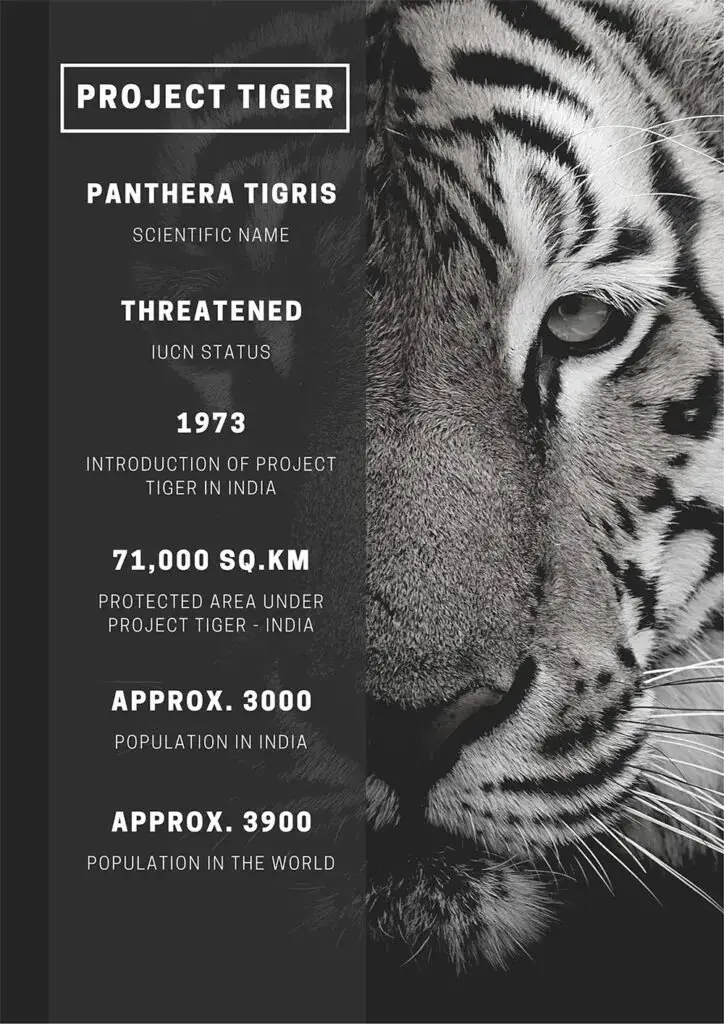
    • Project Tiger started in 1973, one of the largest species conservation initiatives in the world, is in its 49th year.
    • It has helped in restoring the population and strengthening conservation efforts for tigers.
    • However there are many challenges too. Managing the tiger population, giving them safe habitat, avoiding human-tiger conflicts are some of the issues that the project has faced.
    • Having said that, less than three thousand populations still puts these majestic cats in endangered species.

    What more needs to be done to create a safe and secure environment for tigers? What are the challenges? We will try to find out in this article.

    What is Project Tiger?

    https://www.naturesafariindia.com/wp-content/uploads/2021/07/bengal-tiger-factss1-724x1024.jpg.jpg

    • Launched from Jim Corbett National Park, Uttarakhand, the project is an ongoing scheme of the Ministry of Environment, Forest and Climate Change (MoEFCC).
    • The centrally sponsored scheme is applicable in nine reserves of different States, namely Assam, Bihar, Karnataka, Madhya Pradesh, Maharashtra, Odisha, Rajasthan, Uttar Pradesh, and West Bengal. 
    Project Tiger has been converted into a statutory authority, National Tiger Conservation Authority (NTCA) by providing enabling provisions in the Wild Life (Protection) Act, 1972 through an amendment, via Wild Life (Protection) Amendment Act, 2006.  The NTCA addresses ecological and administrative concerns for conserving tigers. It provides a statutory basis for the protection of tiger reserves and provides strengthened institutional mechanisms for the protection of ecologically sensitive areas and endangered species.

    Purpose of Project Tiger

    The tiger is a unique animal that plays a pivotal role in the health and diversity of an ecosystem.

    • Predation balance: It is a top predator which is at the apex of the food chain.
    • Regulation of herbivores: It keeps the population of wild ungulates in check, thereby maintaining the balance between prey herbivores and the vegetation upon which they feed.
    • Ecosystem balance: Therefore, the presence of tigers in the forest is an indicator of the well being of the ecosystem.
    • Tourism: Apart from the ecological services provided by the animal, the tiger also offers direct use such as attracting tourists, which provide incomes for local communities.

    Execution of the Project

    Project Tiger was administered by the NTCA. The overall administration of the project is monitored by a steering committee, which is headed by a director. A field director is appointed for each reserve, who is assisted by a group of field and technical personnel.

    1. Shivalik-Terai Conservation Unit
    2. North-East Conservation Unit
    3. Sunderbans Conservation Unit
    4. Western Ghats Conservation Unit
    5. Eastern Ghats Conservation Unit
    6. Central India Conservation Unit
    7. Sariska Conservation Unit
    8. Kaziranga Conservation Unit

    The various tiger reserves were created in the country based on the ‘core-buffer’ strategy:

    • Core Area: are free of all human activities. It has the legal status of a national park or wildlife sanctuary. It is kept free of biotic disturbances and forestry operations like a collection of minor forest produce, grazing, and other human disturbances are not allowed within.
    • Buffer Areas: are subjected to ‘conservation-oriented land use’. They comprise forest and non-forest land. It is a multi-purpose use area with twin objectives of providing habitat supplement to spillover population of wild animals from the core conservation unit and providing site-specific co-developmental inputs to surrounding villages for relieving their impact on the core area.

    Issues with the Project

    • Implementation bottlenecks: The efforts were hampered by poaching, as well as debacles and irregularities in Sariska and Namdapha, both of which were reported extensively in the Indian media.
    • Forest Dwellers Rights: The Forest Rights Act passed by the Indian government in 2006 recognizes the rights of some forest dwelling communities in forest areas. This has led to controversy over implications of such recognition for tiger conservation.
    • Man-Animal Conflict: Some have argued that this is problematic as it will increase conflict and opportunities for poaching; some also assert that “tigers and humans cannot co-exist”.
    • Abuse of Authority: Others argue that this is a limited perspective that overlooks the reality of human-tiger coexistence and the abuse of power by authorities, evicting local people and making them pariahs in their own traditional lands.

    Other efforts to save Tigers

    India is home to 70 percent of the global tiger population. Therefore, the country has an important role to play in tiger conservation.

    [1] Project Tiger

    (discussed above)

    [2] CITES (Convention on International Trade in Endangered Species of Wild Fauna and Flora)

    • Besides protecting tiger territory, other measures being taken to save the tiger include: curbing wildlife trade through international agreements.
    • CITES is an international agreement between governments aimed at ensuring that international trade in specimens of wild animals and plants, including tigers, does not threaten their survival. India ratified this treaty in 1976.

    [3] Global Tiger Forum and Tiger Range Countries

    • Established in 1994, the Global Tiger Forum is the only inter-governmental body for tiger conservation.
    • Its membership includes seven tiger range countries: Bangladesh, Bhutan, India, Cambodia, Myanmar, Nepal and Vietnam.

    [4] CA|TS

    • 14 tiger reserves have been accredited under CA|TS (Conservation Assured | Tiger Standards) categories.
    • The CA|TS is a set of criteria that examines the management of tiger sites to gauge the success rates of tiger conservation.

    [5] St. Petersburg Declaration   

    • This resolution was adopted In November 2010, by the leaders of 13 tiger range countries (TRCs) assembled at an International Tiger Forum in St. Petersburg, Russia
    • It aimed at promoting a global system to protect the natural habitat of tigers and raise awareness among people on white tiger conservation.

    [6] Various NGOs

    • International NGO members consist of World Wildlife Fund, International Fund for Animal Welfare (IFAW), and TRAFFIC.
    • Several national NGOs from India and Nepal are also members.

    Success of the Project Tiger

    The four-year tiger census report, Status of Tigers in India, 2018 shows numbers of the big cat have increased across all landscapes.

    The total count has risen to 2,967 from 2,226 in 2014 — an increase of 741 individuals (aged more than one year), or 33%, in four years.

    • At present, India has around 75% of tiger population and its source areas amongst the 13 tiger range countries in the world.
    • 2.24% of country’s geographical area is spread out in 51 tiger reserves in 18 States.

    Various threats to Tigers

    • Despite measures being initiated to protect wild tigers, habitat loss and poaching continue to pose a threat to the animal’s survival.
    • Tiger parts are used in traditional Chinese medicines, tiger skin is used for decorative and medicinal purposes and tiger bones are again used for medicinal purposes for curing body pain, et al.
    • Between 2000 and 2014, TRAFFIC’s research found that parts of a minimum of 1,590 Tigers were seized in Tiger range States, an average of two Tigers per week.

    Other existential threats to tigers

    • Man-Animal conflict: This largely seems a normal phenomenon in India. We broadly remember the case of Tigress Avni which was finally shot dead by the forest officials in Maharashtra.
    • Shrinking habitat: This often leads to territorial conflicts among the Tigers.
    • Issues with Tourism: Excess of tourist activities is problematic for animals. Frequent visits in reserved forests areas disrupt them to move freely for their prey.
    • Climate Change: The effects of climate change and floods are a major problem.  The latest study by WWF shows that Sundarban which is one of the biggest home of tigers in India would sink entirely in 2070.

    Way forward

    • The process of tiger conservation should be more dynamic and compatible with the future possibilities of climatic changes as well.
    • The Forest Department and the Central government can collaborate to protect the natural corridors to ensure the free movement of the tigers for better food resources.
    • Campaigns such as ‘Save the Tiger’ are recommended as effective measures to make people across the country and globe aware of the significance of conserving tiger species.
    • Sensitization of local communities against poaching is also a crucial measure in this regard.
    • We have to make the environment and development co-exist and go hand in hand by planning our future developmental goals in such a manner that our environmental goals are not compromised.
  • Government Bodies Related to Environment in India/Important Declarations, Conventions, Protocols Regarding UNFCCC COPs

     
    7th Apr 2022

    Government Bodies Related To Environment

    Central Pollution Control Board

    Established: It was established in 1974 under the Water (Prevention and Control of Pollution) Act, 1974.

    Objective: To provide technical services to the Ministry of Environment and Forests under the provisions of the Environment (Protection) Act, 1986.

    Key Functions:

    • Advise the Central Government on any matter concerning prevention and control of water and air pollution and improvement of the quality of air.
    • Plan and cause to be executed a nation-wide programme for the prevention, control or abatement of water and air pollution
    • Coordinate the activities of the State Board and resolve disputes among them
    • Provide technical assistance and guidance to the State Boards, carry out and sponsor investigation and research relating to problems of water and air pollution, and for their prevention, control or abatement
    • Plan and organise training of persons engaged in the programme on the prevention, control or abatement of water and air pollution
    • Organise through mass media, a comprehensive mass awareness programme on the prevention, control or abatement of water and air pollution
    • Collect, compile and publish technical and statistical data relating to water and air pollution and the measures devised for their effective prevention, control or abatement;
    • Prepare manualscodes and guidelines relating to treatment and disposal of sewage and trade effluents as well as for stack gas cleaning devices, stacks and ducts;
    • Disseminate information in respect of matters relating to water and air pollution and their prevention and control
    • Lay downmodify or annul, in consultation with the State Governments concerned, the standards for stream or well, and lay down standards for the quality of air.
    • Perform such other functions as may be prescribed by the Government of India.

    National Biodiversity Authority

    Established When: It is a statutory autonomous body under the Ministry of Environment and Forests, Government of India established in 2003, after India signed Convention on Biological Diversity (CBD) in 1992

    Headquarter: Chennai

    The objective of the body: Implementation of Biological Diversity Act, 2002

    Key Functions:

    It acts as a facilitating, regulating and advisory body to the Government of India “on issues of conservation, sustainable use of biological resources and fair and equitable sharing of benefits arising out of the use of biological resources.”

    Additionally, it advises State Governments in identifying the areas of biodiversity importance (biodiversity hotspots) as heritage sites.

    National Tiger conservation authority

    Established: It was established in December 2005 following a recommendation of the Tiger Task Force, constituted by the Prime Minister of India for reorganised management of Project Tiger and the many Tiger Reserves in India.

    Headquarter: Delhi

    Objective:

    • Providing statutory authority to Project Tiger so that compliance of its directives become legal.
    • Fostering accountability of Center-State in management of Tiger Reserves, by providing a basis for MoU with States within our federal structure.
    • Providing for oversight by Parliament.
    • Addressing livelihood interests of local people in areas surrounding Tiger Reserves.

    Key Functions:

    • to approve the tiger conservation plan prepared by the State Government under sub-section (3) of section 38V of this Act
    • evaluate and assess various aspects of sustainable ecology and disallow any ecologically unsustainable land use such as mining, industry and other projects within the tiger reserves;
    • provide for management focus and measures for addressing conflicts of  men and wild animal and to emphasize on co-existence in forest areas outside the National Parks, sanctuaries or tiger reserve, in the working plan code
    • provide information on protection measures including future conservation plan, estimation of population of tiger and its natural prey species, the status of habitats, disease surveillance, mortality survey, patrolling, reports on untoward happenings and such other management aspects as it may deem fit including future plan conservation
    • ensure critical support including scientific, information technology and legal support for better implementation of the tiger conservation plan
    • facilitate ongoing capacity building programme for skill development of officers and staff of tiger reserves.

    Animal Welfare Board of India

    Established When: It was established in 1962 under Section 4 of The Prevention of Cruelty to Animals Act,1960.

    Headquarter: Ballabhgarh

    Objective: To advise Government on Animal Welfare Laws and promotes animal welfare in the country.

    Key Functions:

    • Recognition of Animal Welfare Organisations: The Board oversees Animal Welfare Organisations (AWOs) by granting recognition to them if they meet its guidelines. The organisation must submit paperwork; agree to nominate a representative of the Animal Welfare Board of India on its Executive Committee, and to submit to regular inspections. After meeting the requirements and inspection, the organisation is considered for grant of recognition.
    • The AWBI also appoints key people to the positions of (Hon) Animal Welfare Officers, who serve as the key point of contact between the people, the government and law enforcement agencies.
    • Financial assistance: The Board provides financial assistance to recognised Animal Welfare Organisations (AWOs), who submit applications to the Board. Categories of grants include Regular Grant, Cattle Rescue Grant, Provision of Shelter House for looking after the Animals, Animal Birth Control (ABC) Programme, Provision of Ambulance for the animals in distress and Natural Calamity grant.
    • Animal welfare laws and Rules: The Board suggests changes to laws and rules about animal welfare issues. In 2011, a new draft Animal Welfare Act was published for comment. Guidance is also offered to organisations and officials such as the police to help them interpret and apply the laws.
    • Raising awareness: The Board issues publications to raise awareness of various animal welfare issues. The Board’s Education Team gives talks on animal welfare subjects, and trains members of the community to be Board Certified Animal Welfare Educators.

    Forest Survey of India

    Established When:  It is a government organization in India under the Union Ministry of Environment, Forest and Climate Change for conducting forest surveys and studies. The organization came into being in, 1981.

    Headquarter: Dehradun, Uttarakhand

    Objective

    The objective of the organization is monitoring periodically the changing situation of land and forest resources and present the data for national planningconservation and management of environmental preservation and implementation of social forestry projects.

    Key Functions

    • The Functions of the Forest Survey of India are:
    • To prepare State of Forest Report biennially, providing an assessment of the latest forest cover in the country and monitoring changes in these.
    • To conduct an inventory in forest and non-forest areas and develop a database on forest tree resources.
    • To prepare thematic maps on 1:50,000 scale, using aerial photographs.
    • To function as a nodal agency for collection, compilation, storage and dissemination of spatial database on forest resources.
    • To conduct training of forestry personnel in the application of technologies related to resources survey, remote sensing, GIS, etc.
    • To strengthen research & development infrastructure in FSI and to conduct research on applied forest survey techniques.
    • To support State/UT Forest Departments (SFD) in forest resources survey, mapping and inventory.
    • To undertake forestry-related special studies/consultancies and custom made training courses for SFD’s and other organizations on a project basis.

    Forest Survey of India assesses forest cover of the country every 2 years by digital interpretation of remote sensing satellite data and publishes the results in a biennial report called ‘State of Forest Report'(SFR).

    Central Zoo Authority of India

    Established: It was established in 1992 and constituted under the Wild Life (Protection) Act.

    Headquarter: Delhi

    Objective 

    The main objective of the authority is to complement the national effort in the conservation of wildlife.

    Standards and norms for housing, upkeep, health care and overall management of animals in zoos have been laid down under the Recognition of Zoo Rules, 1992.   

    Key Functions

    • Since its inception in 1992, the Authority has evaluated 513 zoos, out of which 167 have been recognized and 346 refused recognition.
    • The Authority’s role is more of a facilitator than a regulator.  It, therefore, provides technical and financial assistance to such zoos which have the potential to attain the desired standard in animal management. Only such captive facilities which have neither the managerial skills nor the requisite resources are asked to close down.
    • Apart from the primary function of the grant of recognition and release of financial assistance, the Central Zoo Authority also regulates the exchange of animals of the endangered category listed under Schedule-I and II of the Wildlife (Protection Act) among zoos.  
    • Exchange of animals between Indian and foreign zoos is also approved by the Authority before the requisite clearances under EXIM Policy and the CITES permits are issued by the competent authority.  
    • The Authority also coordinates and implements programmes on capacity building of zoo personnel, planned conservation breeding programmes and ex-situ research including biotechnological intervention for the conservation of species for complementing in-situ conservation efforts in the country.

    Major UN climate negotiations under UNFCCC- Timeline

    1992—

    The UN Framework Convention on Climate Change (UNFCCC) was adopted and opened for signatures in Rio de Janeiro, Brazil, at the UN Conference on Environment and Development, also known as the Earth Summit.

    154 signatories to the UNFCCC agreed to stabilize “greenhouse gas concentrations in the atmosphere at a level that would prevent dangerous interference with the climate system.”

    The treaty is not legally binding because it sets no mandatory limits on GHG emissions. Instead, the treaty provides for future negotiations to set emissions limits. The first principal revision is the Kyoto Protocol.

    1994—

    The UNFCCC Treaty entered into force after receiving 50 ratifications.

    1997—

    KYOTO PROTOCOL

    COP 3 was held in Kyoto, Japan. On December 11, the Kyoto Protocol was adopted by consensus with more than 150 signatories.

    The Protocol included legally binding emissions targets for developed country Parties for the six major GHGs, which are-

    • Carbon dioxide.
    • Methane.
    • Nitrous oxide.
    • Hydrofluorocarbons.
    • Perfluorocarbons, and
    • Sulfur hexafluoride.

    Annex of the Kyoto Protocol

    • Annex 1 – Industrialised Countries (mainly OECD) plus economies in transition (mainly former soviet block countries) – They would mandatorily reduce GHGs, base year – 1990
    • Annex 2 – Subset of Annex 1,  Industrialised Countries (mainly OECD), would also provide finances and technology to non annex countries
    • Non annex – not included in annex, all other countries, no binding targets
    • Annex A – gases covered under Kyoto <name those 7 gases>
    • Annex B – Binding targets for each Annex 1 country i.e Japan will reduce emission by X%, Australia by Y% 

    The Protocol offered additional means of meeting targets by way of three market-based mechanisms:

    • Emissions trading.
    • Clean Development Mechanism (CDM).
    • Joint Implementation (JI).

    Under the Protocol, industrialized countries’ actual emissions have to be monitored and precise records have to be kept of the trades carried out.

    India ratified the Kyoto Protocol in 2002.

    2000—

    COP 6 part I was held in The Hague, Netherlands. Negotiations faltered, and parties agreed to meet again.

    COP 6part II was held in Bonn, Germany. The consensus was reached on what was called the Bonn Agreements.

    All nations except the United States agreed on the mechanisms for implementation of the Kyoto Protocol.

    The U.S. participated in observatory status only.

    2001—

    COP 7 was held in Marrakesh, Morocco. The detailed rules for the implementation of the Kyoto Protocol were adopted and called the Marrakesh Accords.

    The Special Climate Change Fund (SCCF) was established to “finance projects relating to: adaptation; technology transfer and capacity building; energy transport, industry, agriculture, forestry and waste management; and economic diversification.”

    The Least Developed Countries Fund was also “established to support a work programme to assist Least Developed Country Parties (LDCs) carry out, inter alia [among other things], the preparation and implementation of national adaptation programmes of action (NAPAs).”

    2005—

    COP 11/CMP 1 were held in Montreal, Canada. This conference was the first to take place after the Kyoto Protocol took force. The annual meeting between the parties (COP) was supplemented by the first annual Meeting of the Parties to the Kyoto Protocol (CMP).

    The countries that had ratified the UNFCCC, but not accepted the Kyoto Protocol, had observer status at the latter conference.

    The parties addressed issues such as “capacity building, development and transfer of technologies, the adverse effects of climate change on developing and least developed countries, and several financial and budget-related issues, including guidelines to the Global Environment Facility (GEF).” (UNFCCC)

    2007—

    COP 13/CMP 3 were held in Bali. COP parties agreed to a Bali Action Plan to negotiate GHG mitigation actions after the Kyoto Protocol expires in 2012. The Bali Action Plan did not require binding GHG targets for developing countries.

    2009—

    June – As part of the UN Framework Convention on Climate Change (UNFCCC) process, governments met in Bonn, Germany, to begin discussions on draft negotiations that would form the basis of an agreement at Copenhagen.

    December – COP 15 was held in Copenhagen, Denmark.

    It failed to reach agreement on binding commitments after the Kyoto Protocol commitment period ends in 2012.

    During the summit, leaders from the United States, Brazil, China, Indonesia, India and South Africa agreed to what would be called the Copenhagen Accord which recognized the need to limit the global temperature rise to 2°C based on the science of climate change.

    While no legally binding commitments were required by the deal, countries were asked to pledge voluntary GHG reduction targets. $100 billion was pledged in climate aid to developing countries.

    2012—

    COP 18 was held in Doha, Qatar.

    Parties agreed to extend the expiring Kyoto Protocol, creating a second commitment phase that would begin on January 1, 2013 and end December 31, 2020. India ratified the second commitment period in 2017.

    Parties failed to set a pathway to provide $100 billion per year by 2020 for developing countries to finance climate change adaptation, as agreed upon at COP 15 in Copenhagen.

    The concept of “loss and damage” was introduced as developed countries pledged to help developing countries and small island nations pay for the losses and damages from climate change that they are already experiencing.

    2013—

    COP 19 was held in Warsaw, Poland.

    Parties were expected to create a roadmap for the 2015 COP in Paris where a legally binding treaty to reduce greenhouse gas (GHG) emissions is expected to be finalized (in order to come into effect in 2020).

    Differences of opinion on responsibility of GHG emissions between developing and developed countries led to a flexible ruling on the wording and a plan to discuss further at the COP 20 in Peru.

    A non-binding agreement was reached among countries to set up a system tackling the “loss and damage” issue, although details of how to set up the mechanism were not discussed.

    Concerning climate finance, the United Nations’ Reducing Emissions from Deforestation and Forest Degradation (REDD+) Program, aimed at preserving the world’s forests, was formally adopted.

    Little progress was made on developed countries committing to the agreed upon plan of providing $100 billion per year by 2020 to developing countries.

    2015—

    PARIS AGREEMENT

    COP 21 or CMP 11 was held in Paris.

    Aims of the Paris Agreement-

    1.Keep the global temperature rise this century well below 2 degrees Celsius above the pre-industrial level.

    2.Pursue efforts to limit the temperature increase even further to 1.5 degrees Celsius.

    3.Strengthen the ability of countries to deal with the impacts of climate change.

    COP 23 – BONN(GERMANY)

    First COP to be hosted by a small Island developing nation.
    Countries continued to negotiate the finer details of how the agreement will work from 2020 onwards.

    COP 24 – KATOWICE(POLLAND)

    • Countries settled on most of the tricky elements of the “rulebook” for putting the 2015 Paris agreement into practice.
    • This includes how governments will measure, report on and verify their emissions-cutting efforts, a key element because it ensures all countries are held to proper standards and will find it harder to wriggle out of their commitments.
      Read in detail here

    COP 26: Glasgow Agreement

    What was achieved?
    1. Mitigation:

    • The Glasgow agreement has emphasised that stronger action in the current decade was most critical to achieving the 1.5-degree target.

    2. Adaptation:

    • The Glasgow Climate Pact has:
    1. Asked the developed countries to at least double the money being provided for adaptation by 2025 from the 2019 levels.
    2. Created a two-year work programme to define a global goal on adaptation.

    3. Finance: 

    • In 2009, developed countries had promised to mobilise at least $100 billion every year from 2020.
    • The developed nations have now said that they will arrange this amount of 100 billion annual fund by 2023.

    4. Accounting earlier failures:

    • The pact has expressed “deep regrets” over the failure of the developed countries to deliver on their $100 billion promise.
    • It has asked them to arrange this money urgently and in every year till 2025.

    5. Loss and Damage:

    • There is no institutional mechanism to compensate nations for the losses, or provide them help in the form of relief and rehabilitation after suffering from climate disasters.
    • The loss and damage provision in the Paris Agreement seeks to address that.
    • Thanks to a push from many nations, substantive discussions on loss and damage could take place in Glasgow.

    6. Carbon Markets:

    • The Glasgow Pact has offered some reprieve to the developing nations.
    • It has allowed these carbon credits to be used in meeting countries’ first NDC targets
      Read in detail here

    NATIONALLY DETERMINED CONTRIBURTIONS (NDCs)

    • The national pledges by countries to cut emissions are voluntary.
    • The Paris Agreement requires all Parties to put forward their best efforts through “nationally determined contributions” (NDCs) and to strengthen these efforts in the years ahead.
    • This includes requirements that all Parties report regularly on their emissions and on their implementation efforts.
    • In 2018, Parties will take stock of the collective efforts in relation to progress towards the goal set in the Paris Agreement.
    • There will also be a global stock take every 5 years to assess the collective progress towards achieving the purpose of the Agreement and to inform further individual actions by Parties.

    Some facts-

    • It entered into force in November 2016 after (ratification by 55 countries that account for at least 55% of global emissions) had been met.
    • The agreement calls for zero net anthropogenic greenhouse gas emissions to be reached during the second half of the 21st century.
    • In the adopted version of the Paris Agreement, the parties will also “pursue efforts to limit the temperature increase to 1.5 °C.”
    • The 1.5 °C goal will require zero-emissions sometime between 2030 and 2050, according to some scientists.
    • The developed countries reaffirmed the commitment to mobilize $100 billion a year in climate finance by 2020 and agreed to continue mobilizing finance at the level of $100 billion a year until 2025.
    • In 2017, United States announced that the U.S. would cease all participation in the 2015 Paris Agreement on climate change mitigation.
    • In accordance with Article 28 of the Paris Agreement, the earliest possible effective withdrawal date by the United States cannot be before November 2020. Thus, The U.S. will remain a signatory till November 2020.

    RATIFICATION TO KIGALI AGREEMENT

    The Union Cabinet has given its approval for ratification of the Kigali Amendment to the Montreal Protocol on Substances that Deplete the Ozone Layer for phase down of Hydrofluorocarbons (HFCs) by India.

    What is Montreal Protocol?

    • The Montreal Protocol on Substances that Deplete the Ozone Layer is an international agreement made in 1987.
    • It was designed to stop the production and import of ozone-depleting substances and reduce their concentration in the atmosphere to help protect the earth’s ozone layer.
    • It sits under the Vienna Convention for the Protection of the Ozone Layer.

    What is the Kigali Amendment?

    • It is an international agreement to gradually reduce the consumption and production of hydrofluorocarbons (HFCs).
    • It is a legally binding agreement designed to create rights and obligations in international law.
    • While HFCs do not deplete the stratospheric ozone layer, they have high global warming potential ranging from 12 to 14,000, which has an adverse impact on climate.
      Read in detail here

  • All India Free Open Test on April 10th – Evaluate your Preparation before it’s too Late || Get Free Strategy Call After Test|| Hurry Up & Register Now

    All India Free Open Test on April 10th – Evaluate your Preparation before it’s too Late || Get Free Strategy Call After Test|| Hurry Up & Register Now

    First Nikaalo Prelims Open Test was an eye opener for many by highlighting your weak spots. Knowing WEAK AREAS in early stage of preparation can give you time to improve upon them. Hence, as promised we are conducting the 2nd All India Open Prelims Test under our mission Nikaalo Prelims 2022.

    GET READY TO EXPERIENCE THE COMPLETE EXAMINATION PATTERN!

    We are conducting both GENERAL STUDIES and CSAT test with high quality UPSC level questions along with Test Discussion.


    Click here to join Nikaalo Prelims Civilsdaily IAS Official space to Participate in the test discussion.

    Test date: 10th April 2022, Sunday

    TIME:

    GS 1: 9:30 am

    GS 2: 2:30 pm

    How our Prelims Test will help you?

    We at Civilsdaily understand the nuances of setting a paper. Through five cases explaining five questions, we’ll try to give you an idea about the varied difficulty level of prelims questions.

    These questions have been taken from the first test of Nikaalo Prelims All India Open Mock Test 2020 about Government Schemes and Policies.   

    CASE 1 – The oldest trick in the book. 

    DELIBERATELY CHANGING NAMES TO CONFUSE YOU. BE IT SCHEMES OR CONCEPTS. UPSC IS WELL KNOWN TO FLIP NAMES OF SIMILAR-SOUNDING SCHEMES AND CONCEPTS. LOOK AT THIS QUESTION. 

    Ques. Which of the following are the result areas of  STRIVE

    1. Improved performance of ITI.
    2. Improved and Broadened Apprenticeship Training.
    3. India International Skill Centers 

    Select the  correct answer from the  codes given below:

    a. 1 and 2 only

    b. 2 and 3 only

    c. 1 and 3 only

    d. 1 only

    Correct answer- 1 and 2 only

    In the above question, STRIVE has been used for SANKALP.  Both of them were announced at the same time for boosting Skill India Mission. It is very easy to get confused mark a wrong answer.

    CASE 2: Misleading names

    A LOT OF TIMES ESPECIALLY IN MATCH THE FOLLOWING TYPE OF QUESTIONS MISLEADING NAMES ARE USED. 

    Ques. Consider the following pairs:

       Schemes                          Objectives

    1. NIDHI: nurturing ideas and innovations into successful startups.
    2. SATYAM: rejuvenate research in yoga and meditation.
    3. MANAK: to help build a critical human resource pool for strengthening and increasing the research & development base.

    Which of the pairs given above are correctly matched?

    a. 1 and 2 only

    b. 2 and 3 only

    c. 1 and 2 only

    d. 1, 2 and 3

    Correct answer: 1, 2 and 3

    Misleading yet important names of initiatives under Ministry of Science and Technology have been used here. All pairs are correctly matched but it is very easy to get confused. 

    CASE 3: Are you rooted in society?

    UPSC has been playing with the expenditure figures and other such facts. It is done not only for the sole reason of checking your rote memory, but the ability to think in-depth about the issues faced by various sections. 

    Ques. With reference to ‘Kisan Urja Suraksha evam Utthaan Mahabhiyan (KUSUM) Scheme’, consider the following statements:

    1. The scheme provides for the installation of grid-connected solar power plants each of capacity up to 2 MW in the rural areas.
    2. The farmers will have to spend 50% of the total expenditure to acquire and install solar pumps.

    Which of the statements given above is/are correct?

    a. 1 only

    b. 2 only

    c. Both 1 and 2

    d. Neither 1 nor 2

    Correct answer: 1 only

    A very important scheme. The farmers have to tolerate only 10% of the total expenditure to acquire and install solar pumps. The Central Govt. will provide 60% cost while the remaining 30% will be taken care of by bank as credit. One must understand the inability of Indian farmers to spend 50% on solar pumps. This would have helped in eliminating options also.

    CASE 4: Going international.

    INTERNATIONAL COLLABORATION AND AID IN OUR SCHEMES AND POLICIES ARE RELEVANT. IF YOU EVER READ ABOUT THEM, KNOW THAT THE ISSUE IS OF CRITICAL IMPORTANCE FOR THE GOVERNMENT AND SOCIETY.

    Ques. With reference to Atal Bhujal Yojana, consider the following statements:

    1. It is a Centrally Sponsored Scheme with funding pattern of 50:50 between Government of India and states.
    2. This scheme is approved by the World Bank.

    Which of the following statements given above is/are correct?

    a. 1 only

    b. 2 only

    c. Both 1 and 2

    d. Neither 1 nor 2

    Correct answer: 2 only

    Here the Government of India’s collaboration with World Bank makes it important. Half of the financial contribution is from the World Bank in this initiative.

    Students must not ignore the contribution of international institutions especially if it is of such overwhelming nature.

    CASE 5: Core of the core

    YOU SHOULD BE ABLE TO REMEMBER THE BARE MINIMUM. THERE IS NO OTHER WAY IN SUCH QUESTIONS. YOU EITHER KNOW THEM OR YOU DON’T.

    Ques. Which of the following are the components of the National Social Assistance Programme (NSAP)?

    1. National Family Benefit Scheme (NFBS) 
    2. Annapurna.
    3. Indira Gandhi National Widow Pension Scheme (IGNWPS)

    Select the correct answer from the codes given below:

    a. 1 and 3

    b. 2 and 3

    c. 3 only

    d. 1, 2, and 3

    Correct answer: 1, 2 and 3

    The National Social Assistance Programme (NSAP) which came into effect from 15th August 1995, represents a significant step towards the fulfilment of the Directive Principles in Article 41 of the Constitution.

    It is a very important scheme under Ministry of Rural Development. Students are supposed to do flagship schemes of various ministries.

    WHAT IS NIKAALO PRELIMS?

    Mission Nikaalo prelims is a free fast-paced revision sequence to brush up your concepts for prelims. Major pillars of the programs are:

    1. Prelims SPOTLIGHT

    This initiative is meant to help you revise details and facts that can be asked in prelims. They are simplified, synthesized and prepared using most authentic sources. These can easily slip your mind or you can easily confuse these. Continuous Revision for the same is required. The themes picked up in the spotlight are not random but after analyzing and scrutinizing the PYQs of several years. Dare you to miss the updates!

    1. Static Subject Revision and Tests 

    Coverage and Relevance are the 2 Pillars of our Tests. Practicing tests is crucial part of Prelims preparation.

    3. Nikaalo Prelims Discussion on Civilsdaily IAS Official space

    All material, notes and doubt sessions will take place on Civilsdaily IAS Official Space.

    Click here to join Nikaalo Prelims Civilsdaily IAS Official space.

  • All India Free Open Test on April 10th – Evaluate your Preparation before it’s too Late || Get Free Strategy Call After Test|| Hurry Up & Register Now

    All India Free Open Test on April 10th – Evaluate your Preparation before it’s too Late || Get Free Strategy Call After Test|| Hurry Up & Register Now

    First Nikaalo Prelims Open Test was an eye opener for many by highlighting your weak spots. Knowing WEAK AREAS in early stage of preparation can give you time to improve upon them. Hence, as promised we are conducting the 2nd All India Open Prelims Test under our mission Nikaalo Prelims 2022.

    GET READY TO EXPERIENCE THE COMPLETE EXAMINATION PATTERN!

    We are conducting both GENERAL STUDIES and CSAT test with high quality UPSC level questions along with Test Discussion.


    Click here to join Nikaalo Prelims Civilsdaily IAS Official space to Participate in the test discussion.

    Test date: 10th April 2022, Sunday

    TIME:

    GS 1: 9:30 am

    GS 2: 2:30 pm

    How our Prelims Test will help you?

    We at Civilsdaily understand the nuances of setting a paper. Through five cases explaining five questions, we’ll try to give you an idea about the varied difficulty level of prelims questions.

    These questions have been taken from the first test of Nikaalo Prelims All India Open Mock Test 2020 about Government Schemes and Policies.   

    CASE 1 – The oldest trick in the book. 

    DELIBERATELY CHANGING NAMES TO CONFUSE YOU. BE IT SCHEMES OR CONCEPTS. UPSC IS WELL KNOWN TO FLIP NAMES OF SIMILAR-SOUNDING SCHEMES AND CONCEPTS. LOOK AT THIS QUESTION. 

    Ques. Which of the following are the result areas of  STRIVE

    1. Improved performance of ITI.
    2. Improved and Broadened Apprenticeship Training.
    3. India International Skill Centers 

    Select the  correct answer from the  codes given below:

    a. 1 and 2 only

    b. 2 and 3 only

    c. 1 and 3 only

    d. 1 only

    Correct answer- 1 and 2 only

    In the above question, STRIVE has been used for SANKALP.  Both of them were announced at the same time for boosting Skill India Mission. It is very easy to get confused mark a wrong answer.

    CASE 2: Misleading names

    A LOT OF TIMES ESPECIALLY IN MATCH THE FOLLOWING TYPE OF QUESTIONS MISLEADING NAMES ARE USED. 

    Ques. Consider the following pairs:

       Schemes                          Objectives

    1. NIDHI: nurturing ideas and innovations into successful startups.
    2. SATYAM: rejuvenate research in yoga and meditation.
    3. MANAK: to help build a critical human resource pool for strengthening and increasing the research & development base.

    Which of the pairs given above are correctly matched?

    a. 1 and 2 only

    b. 2 and 3 only

    c. 1 and 2 only

    d. 1, 2 and 3

    Correct answer: 1, 2 and 3

    Misleading yet important names of initiatives under Ministry of Science and Technology have been used here. All pairs are correctly matched but it is very easy to get confused. 

    CASE 3: Are you rooted in society?

    UPSC has been playing with the expenditure figures and other such facts. It is done not only for the sole reason of checking your rote memory, but the ability to think in-depth about the issues faced by various sections. 

    Ques. With reference to ‘Kisan Urja Suraksha evam Utthaan Mahabhiyan (KUSUM) Scheme’, consider the following statements:

    1. The scheme provides for the installation of grid-connected solar power plants each of capacity up to 2 MW in the rural areas.
    2. The farmers will have to spend 50% of the total expenditure to acquire and install solar pumps.

    Which of the statements given above is/are correct?

    a. 1 only

    b. 2 only

    c. Both 1 and 2

    d. Neither 1 nor 2

    Correct answer: 1 only

    A very important scheme. The farmers have to tolerate only 10% of the total expenditure to acquire and install solar pumps. The Central Govt. will provide 60% cost while the remaining 30% will be taken care of by bank as credit. One must understand the inability of Indian farmers to spend 50% on solar pumps. This would have helped in eliminating options also.

    CASE 4: Going international.

    INTERNATIONAL COLLABORATION AND AID IN OUR SCHEMES AND POLICIES ARE RELEVANT. IF YOU EVER READ ABOUT THEM, KNOW THAT THE ISSUE IS OF CRITICAL IMPORTANCE FOR THE GOVERNMENT AND SOCIETY.

    Ques. With reference to Atal Bhujal Yojana, consider the following statements:

    1. It is a Centrally Sponsored Scheme with funding pattern of 50:50 between Government of India and states.
    2. This scheme is approved by the World Bank.

    Which of the following statements given above is/are correct?

    a. 1 only

    b. 2 only

    c. Both 1 and 2

    d. Neither 1 nor 2

    Correct answer: 2 only

    Here the Government of India’s collaboration with World Bank makes it important. Half of the financial contribution is from the World Bank in this initiative.

    Students must not ignore the contribution of international institutions especially if it is of such overwhelming nature.

    CASE 5: Core of the core

    YOU SHOULD BE ABLE TO REMEMBER THE BARE MINIMUM. THERE IS NO OTHER WAY IN SUCH QUESTIONS. YOU EITHER KNOW THEM OR YOU DON’T.

    Ques. Which of the following are the components of the National Social Assistance Programme (NSAP)?

    1. National Family Benefit Scheme (NFBS) 
    2. Annapurna.
    3. Indira Gandhi National Widow Pension Scheme (IGNWPS)

    Select the correct answer from the codes given below:

    a. 1 and 3

    b. 2 and 3

    c. 3 only

    d. 1, 2, and 3

    Correct answer: 1, 2 and 3

    The National Social Assistance Programme (NSAP) which came into effect from 15th August 1995, represents a significant step towards the fulfilment of the Directive Principles in Article 41 of the Constitution.

    It is a very important scheme under Ministry of Rural Development. Students are supposed to do flagship schemes of various ministries.

    WHAT IS NIKAALO PRELIMS?

    Mission Nikaalo prelims is a free fast-paced revision sequence to brush up your concepts for prelims. Major pillars of the programs are:

    1. Prelims SPOTLIGHT

    This initiative is meant to help you revise details and facts that can be asked in prelims. They are simplified, synthesized and prepared using most authentic sources. These can easily slip your mind or you can easily confuse these. Continuous Revision for the same is required. The themes picked up in the spotlight are not random but after analyzing and scrutinizing the PYQs of several years. Dare you to miss the updates!

    1. Static Subject Revision and Tests 

    Coverage and Relevance are the 2 Pillars of our Tests. Practicing tests is crucial part of Prelims preparation.

    3. Nikaalo Prelims Discussion on Civilsdaily IAS Official space

    All material, notes and doubt sessions will take place on Civilsdaily IAS Official Space.

    Click here to join Nikaalo Prelims Civilsdaily IAS Official space.

  • Prelims Spotlight: Important Keywords Regarding Budgeting, Fiscal Policy, and Taxation

     
    6th Apr 2022

    Dear Aspirants,

    This Spotlight is a part of our Mission Nikaalo Prelims-2022

    Session Details

    Morning 12 PM  – Prelims Spotlight Session

    Evening 06:30  PM  – TIKDAM/MCQs Session

    Noon 03:00 PM – CSAT Google Meet Session

    Evening 08 PM  – Tests on Alternate Days

    Download Habitat app from the Playstore Join our Official Civilsdaily Space for GS and CSAT Here

    Annual financial statement:

    The Union Budget is the annual financial statement that contains the government’s revenue and expenditure for a fiscal year.

    It may also include planned sales volumes and revenues, resource quantities, costs and expenses, assets, liabilities and cash flows.

    The statement details the revenues from all sources, and expenditure on all activities that the government will undertake for the fiscal year. The fiscal year is calculated from 1 April-31 March.

    Under Article 112 of the Constitution, the government has to present a statement of estimated revenue and expenditure for every fiscal. This statement is called the annual financial statement. This document is divided into three sections: For each of these funds, the central government is required to present a statement of revenue and expenditure.

    1. Consolidated Fund:

    The Consolidated Fund of India, created under Article 266 of the Indian Constitution, includes the revenues received by the government and expenses made by it.

    All the revenue that the government receives through direct (income tax, corporation tax etc.) or indirect tax (Goods and Services Tax or GST) go into the Consolidated Fund of India.

    Revenue from non-tax sources like dividends, profits from the PSUs, and income from general services also contribute to the fund. Recoveries of loans, earnings from disinvestment and repayment of debts issued by the Centre also contribute to the fund.

    Howeverno money can be withdrawn for meeting expenses until the government gets the approval of the Parliament. Examples of expenditure include wages, salaries and pension of government employees, and other fixed costs. The repayment of debts incurred by the government is also done through the Consolidated Fund of India.

    The Consolidated Fund of India is divided into five parts:

    • Revenue account – receipts,
    • Revenue account – disbursements,
    • Capital account – receipts,
    • Capital account – disbursements, and
    • Disbursements ‘charged’ on the Consolidated Fund of India.

    Disbursements ‘charged’ on the Consolidated Fund of India is a special category within the Consolidated Fund of India which is not put to vote in the Parliament.

    This means whatever comes under this category need to be paid, whether the Budget is passed or not.

    The salary and allowances of the President, speaker and deputy speaker of the Lok Sabha, chairman and deputy chairman of the Rajya Sabha, salaries and allowances of Supreme Court judges, pensions of Supreme Court and High Court judges come under this category.

    2.Contingency fund:

    Like the Consolidated Fund of India, the Contingency Fund of India constitutes a part of the annual financial statement.

    Established under Article 267(1) of the Indian Constitution, the fund is maintained by the ministry of finance on behalf of the President of India.

    As the name suggests, the Contingency Fund of India is an account maintained for meeting expenses during any unforeseen emergencies.

    Parliamentary approval for such unforeseen expenditure is obtained, ex- post-facto, and an equivalent amount is drawn from the Consolidated Fund of India to recoup the Contingency Fund after such ex-post-facto approval.

    3. Public account.

    Article 266 of the Constitution defines the Public Account as being those funds that are received on behalf of the Government of India.

    Money held by the government in a trust — such as in the case of Provident Funds, Small Savings collections, income of government set apart for expenditure on specific objects like road development, primary education, reserve/special Funds, etc — are kept in the Public Account.

    Public Account funds do not belong to the government and have to be finally paid back to the persons and authorities that deposited them.

    Parliamentary authorisation for such payments is not required.

    However, when money is withdrawn from the Consolidated Fund with the approval of Parliament and kept in the Public Account for expenditure for a specific purpose, it is submitted for a vote in Parliament.

    Appropriation bill

    Appropriation Bill is a money bill that allows the government to withdraw funds from the Consolidated Fund of India to meet its expenses during the course of a financial year.

    As per Article 114 of the Constitution, the government can withdraw money from the Consolidated Fund only after receiving approval from Parliament.

    To put it simply, the Finance Bill contains provisions on financing the expenditure of the government, and Appropriation Bill specifies the quantum and purpose for withdrawing money.

    Vote-on-account

    The Constitution says that no money can be withdrawn by the government from the Consolidated Fund of India except under appropriation made by law.

    For that, an appropriation bill is passed during the Budget process.

    However, the appropriation bill may take time to pass through the Parliament and become a law. Meanwhile, the government would need permission to spend even a single penny from April 1 when the new financial year starts.

    Vote on the account is the permission to withdraw money from the Consolidated Fund of India in that period, usually two months.

    Vote on the account is a formality and requires no debate. When elections are scheduled a few months into the new financial year, the government seeks vote on account for four months. Essentially, vote on account is the interim permission of the parliament to the government to spend money.

    Corporation tax:

    Corporation tax is a direct tax imposed on the net income or profit that enterprises make from their businesses. Companies, both public and privately registered in India under the Companies Act 1956, are liable to pay corporation tax. This tax is levied at a specific rate according to the provisions of the Income Tax Act, 1961.

    Fringe benefits tax (FBT):
    The taxation of perquisites – or fringe benefits – provided by an employer to his employees, in addition to the cash salary or wages paid, is fringe benefits tax. It was introduced in Budget 2005-06. The government felt many companies were disguising perquisites such as club facilities as ordinary business expenses, which escaped taxation altogether. Employers have to now pay FBT on a percentage of the expense incurred on such perquisites.

    Direct Tax:

    A direct tax is paid directly by an individual or organization to the imposing entity. A taxpayer, for example, pays direct taxes to the government for different purposes, including real property tax, personal property tax, income tax, or taxes on assets. Direct taxes are based on the ability-to-pay principle. This economic principle states that those who have more resources or earn a higher income should pay more taxes.

    Indirect Tax
    In the case of indirect taxes, the incidence of tax is usually not on the person who pays the tax. These are largely taxes on expenditure and include Customs, excise and service tax.

    Indirect taxes are considered regressive, the burden on the rich and the poor is alike. That is why governments strive to raise a higher proportion of taxes through direct taxes. Moving on, we come to the next important receipt item in the revenue account, non-tax revenue.

    Non-tax revenue:

    Other than taxation being a primary source of income, the government also earns a recurring income, which is called non-tax revenue. While sources of tax revenue are few, the sources of non-tax revenue are many, with the number of collections per source. Although there are many sources of non-tax revenue, the amount per source is much less than that for tax revenue.

    For example, when citizens use services offered by the government, they pay bills, which are categorised as non-tax revenue, as the government provides infrastructure support to implement the services. Non-tax revenue also includes the interest collected by the government on the loans or funds offered to states.

    Grants-in-aid and contributions
    The third receipt item in the revenue account is relatively small grants-in-aid and contributions. These are in the nature of pure transfers to the government without any repayment obligation.
    These include expense incurred on organs of state such as Parliament, judiciary and elections. A substantial amount goes into administering fiscal services such as tax collection. The biggest item is the interest payment on loans taken by the government. Defence and other services like police also get a sizeable share. Having looked at receipts and expenditure on revenue account we come to an important item, the difference between the two, the revenue deficit.

    Revenue deficit:

    Revenue deficit arises when the government’s revenue expenditure exceeds the total revenue receipts.

    Revenue deficit includes those transactions that have a direct impact on a government’s current income and expenditure. This represents that the government’s own earnings are not sufficient to meet the day-to-day operations of its departments. Revenue deficit turns into borrowings when the government spends more than what it earns and has to resort to the external borrowings.

                   Revenue Deficit= Total revenue receipts – Total revenue expenditure.

    Revenue Deficit deals only with the government’s revenue receipts and revenue expenditures.

    Note that revenue receipts are receipts which neither create liability nor lead to a reduction in assets.

    It is further divided into two heads:

    • Receipt from Tax (Direct Tax,  Indirect Tax)
    • Receipts from Non-Tax Revenue

    Revenue Expenditure is referred to as the expenditure that does not result in the creation of assets reduction of liabilities. It is further divided into two types

    • Plan revenue expenditure
    • Non-plan revenue expenditure

    Fiscal Deficit:
    The fiscal deficit is defined as an excess of total budget expenditure over total budget receipts excluding borrowings during a fiscal year. In simple words, it is the amount of borrowing the government has to resort to meet its expenses. A large deficit means a large amount of borrowing. The fiscal deficit is a measure of how much the government needs to borrow from the market to meet its expenditure when its resources are inadequate.

    Primary deficit:

    Primary deficit is defined as a fiscal deficit of current year minus interest payments on previous borrowings.

             Primary deficit= Fiscal deficit – Interest payment on the previous borrowing

    In other words, whereas fiscal deficit indicates borrowing requirement inclusive of interest payment, the primary deficit indicates borrowing requirement exclusive of interest payment (i.e., amount of loan).

    We have seen that borrowing requirement of the government includes not only accumulated debt, but also interest payment on the debt. If we deduct ‘interest payment on debt’ from borrowing, the balance is called the primary deficit.

    Public debt:

    Public debt receipts and public debt disbursals are borrowings and repayments during the year, respectively. The difference is the net accretion to the public debt. Public debt can be split into internal (money borrowed within the country) and external (funds borrowed from non-Indian sources). Internal debt comprises treasury bills, market stabilisation schemes, ways and means advance, and securities against small savings.

    Ways and means advance (WMA):

    One of RBI’s roles is to serve as banker to both central and state governments. In this capacity, RBI provides temporary support to tide over mismatches in their receipts and payments in the form of ways and means advances.

    CESS:
    This is an additional levy on the basic tax liability. Governments resort to cess for meeting specific expenditure.

    Dividend distribution tax:

    A dividend is a return given by a company to its shareholders out of the profits earned by the company in a particular year. Dividend constitutes income in the hands of the shareholders which ideally should be subject to income tax.

    However, the income tax laws in India provided for an exemption of the dividend income received from Indian companies by the investors by levying a tax called the Dividend Distribution Tax (DDT) on the company paying the dividend. This tax has been abolished in the 2020-21 budget.

    FRBM Act 2003:

    The Fiscal Responsibility and Budget Management Act (FRBM Act), 2003, establishes financial discipline to reduce the fiscal deficit.

    What are the objectives of the FRBM Act?

    The FRBM Act aims to introduce transparency in India’s fiscal management systems. The Act’s long-term objective is for India to achieve fiscal stability and to give the Reserve Bank of India (RBI) flexibility to deal with inflation in India. The FRBM Act was enacted to introduce a more equitable distribution of India’s debt over the years.

    Key features of the FRBM Act

    The FRBM Act made it mandatory for the government to place the following along with the Union Budget documents in Parliament annually:

    1. Medium Term Fiscal Policy Statement

    2. Macroeconomic Framework Statement

    3. Fiscal Policy Strategy Statement

    The FRBM Act proposed that revenue deficit, fiscal deficit, tax revenue and the total outstanding liabilities be projected as a percentage of gross domestic product (GDP) in the medium-term fiscal policy statement.

    Fiscal Performance Index (FPI)

    • The composite FPI developed by CII is an innovative tool using multiple indicators to examine the quality of Budgets at the Central and State levels.
    • The index has been constructed using UNDP’s Human Development Index methodology which comprises six components for holistic assessment of the quality of government budgets, subsidies, pensions and defence in GDP
    • Quality of capital expenditure: measured by the share of capital expenditure (other than defence) in GDP
    • Quality of revenue: the ratio of net tax revenue to GDP (own tax revenue in case of States)
    • Degree of fiscal prudence I: fiscal deficit to GDP
    • Degree of fiscal prudence II: revenue deficit to GDP and
    • Debt index: Change in debt and guarantees to GDP

    Other measures of FPI

    • As per the new index, expenditure on infrastructure, education, healthcare and other social sectors can be considered beneficial for economic growth.

    Sabka Vishwas-Legacy Dispute Resolution Scheme

    • This Scheme is introduced to resolve and settle legacy cases of the Central Excise and Service Tax.
    • The proposed scheme would cover all the past disputes of taxes which may have got subsumed in GST; namely Central Excise, Service Tax and Cesses.
    • The Government expects the Scheme to be availed by a large number of taxpayers for closing their pending disputes relating to legacy Service Tax and Central Excise cases that are now subsumed under GST so they can focus on GST.
    • The Scheme is, especially, tailored to free a large number of small taxpayers of their pending disputes with the tax administration.

    Components of the Scheme

    • The two main components of the Scheme are dispute resolution and amnesty.
    • The dispute resolution component is aimed at liquidating the legacy cases of Central Excise and Service Tax that are subsumed in GST and are pending in litigation at various forums.
    • The amnesty component of the Scheme offers an oppor­tunity to the taxpayers to pay the outstanding tax and be free of any other consequence under the law.
    • The most attractive aspect of the Scheme is that it provides substantial relief in the tax dues for all categories of cases as well as full waiver of interest, fine, penalty,
    • In all these cases, there would be no other liability of interest, fine or penalty. There is also a complete amnesty from prosecution.

    Direct Tax Code:

    • The Direct Tax Code (DTC) is an attempt by the Govern­ment of India to simplify the direct tax laws in India.
    • It will revise, consolidate and simplify the structure of direct tax laws in India into a single legislation.
    • When implemented, it will replace the Income-tax Act, 1961 (ITA), and other direct tax legislation like the Wealth Tax Act, 1957.
    • The task force was constituted by the government to frame draft legislation for this proposed DTC in November 2017 and review the existing Income Tax Act.

    Direct Tax:

    • These are the taxes, paid directly to the government by the taxpayer. Under the direct tax system, the incidence and impact of taxation fall on the same entity, which cannot be transferred to another person.
    • It is termed as a progressive tax because the proportion of tax liability rises as an individual or entity’s income increases.
    • Examples- Income tax, corporate tax, Dividend Distri­bution Tax, Capital Gain Tax, Security Transaction Tax.
    • The system of Direct taxation is governed by the Cen­tral Board of Direct Taxes (CBDT). It is a part of the Department of Revenue in the Ministry of Finance.

    Corporate Tax

    • A corporate tax also popularly known as the company tax or the corporation tax is the tax levied on the capital or income of corporations or analogous legal entities.
    • In most countries, such taxes are levied at the national level, and a tax that is similar to that imposed at the na­tional level could be imposed at the local or state levels.
    • The taxes could also be termed as capital tax or income tax.
    • Generally, Partnership firms are not taxed at the entity level.
    • In most of nations, the corporations functioning in a country are taxed for the income from that country.
    • Many countries tax all income of corporations incorpo­rated in the country or those deemed to be resident for tax purposes in the country.
    • The income of the company that is to be taxed is computed similarly to the taxable income for individuals.
    • Tax is generally imposed on net profits.
    • In India, companies, both private and public which are registered in India under the Companies Act 1956, are liable to pay corporate tax.

    Securities transaction tax (STT)

    • Sale of any asset (shares, property) results in loss or profit. Depending on the time the asset is held, such profits and losses are categorised as long-term or short-term capital gain/loss.
    • In Budget 2004-05, the government abolished long-term capital gains tax on shares (tax on profits made on the sale of shares held for more than a year) and replaced it with STT.
    • It is a kind of turnover tax where the investor has to pay a small tax on the total consideration paid/received in a share transaction.

    Banking cash transaction tax (BCTT)

    • Introduced in Budget 2005-06, BCTT is a small tax on cash withdrawal from bank exceeding a particular amount in a single day.
    • The basic idea is to curb the black economy and generate a record of big cash transactions

    Cess

    • This is an additional levy on the basic tax liability Governments resort to cess for meeting specific expenditure. For instance, both corporate and individual income is at present subject to an education cess of 2%.
    • In the last Budget, the government had imposed another 1% cess – secondary and higher education cess on income tax – to finance secondary and higher education.

    Countervailing Duties (CVD)

    • Countervailing duty is a tax imposed on imports, over and above the basic import duty CVD is at par with the excise duty paid by the domestic manufacturers of similar goods
    • This ensures a level playing field between imported goods and locally-produced ones.
    • An exemption from CVD places the domestic industry at the disadvantage and over long run discourages investments in affected sectors.

    Export Duty

    • This is a tax levied on exports. In most instances, the object is not revenue, but to discourage exports of certain items.
    • In the last Budget, for instance, the government imposed an export duty of Rs 300 per metric tonne on the export of iron ores and concentrates and Rs 2,000 per metric tonne on the export of chrome ores and concentrates.

    Pass-through Status

    • A pass-through status helps avoid double taxation. Mutual funds, for instance, enjoy pass-through status.
    • The income earned by the funds is tax-free. Since mutual funds’ income is distributed to the unit-holders, who are in turn taxed on their income from such investments any taxation of mutual funds would amount to double taxation.
    • Essentially, it means the income is merely passing through the mutual funds and, therefore, should not be taxed.
    • The government allows venture funds in some sectors pass-through status to encourage investments in start-ups.

  • Starting Today [FEW SEATS LEFT & MOST AWAITED] Intensive Prelims Revision Program 2022|| LAUNCHING ON APRIL 05TH ||  60-Days Revision-Focused  Program for All UPSC-CSE Aspirants

    Starting Today [FEW SEATS LEFT & MOST AWAITED] Intensive Prelims Revision Program 2022|| LAUNCHING ON APRIL 05TH || 60-Days Revision-Focused Program for All UPSC-CSE Aspirants

    Can You Take The Challlenge of Completing 40 Full Length Tests in 60 Days Along With Revising 1.5 Years of Current Affairs? Santosh Gupta Sir, who has cleared prelims 6 times will help you out.

    Are you ready for Prelims-2022 in the next 60 days? If not, what’s stopping you? What’s making you wish if you had an extra 3-4 months to refine your preparation?

    Is it because you are stuck at a certain marks range like the 80-90s in your mock test series? Do you feel time is too short right now to improve your marks? But do you know, these 60+ days are more than enough for you to score above 130+ in Prelims 2022? Santosh Gupta sir is here for you.

    The next 60 days can make or break your UPSC-CSE dreams. Either, you might score 90-100 marks and  NOT qualify for Prelims or you can get 120-130+ and start preparing for Mains.

    Super-25 60 Day Revision Program Details

    Start Date

    April 05, 2022

    Three Main Pillars of Super-25 Revision Program

    This program is 100% useful for those aspirants who have already completed their prelims preparation and are worried of how would they do a final revision of all the 8 subjects in 8 weeks time. Those who want to solve atleast one 3-hour prelims test everyday, get on a call with their mentor and learn how to make effective micro-notes will find this program useful.

    The program is well-organised with a fixed schedule of tests, notes, and mentorship call as per student’s request. Super-25 Prelims Revision program eliminates the last minute clutter of UPSC preparation.

    See the source image

    1.  Covers 1500 high probable topics from Current Affairs and Static portions.

    2. 40 Full Length Tests ( 12 Basic + 10 Current affairs + 6 advanced + 8 full syllabus + 4 CSATs)

    3. 1-on-1 Regular Mentorship for every aspirants

    Faculty of Super-25

    Core Faculty of Civilsdaily, who have cleared UPSC Prelims 6 times and attended interview multiple times Sajal sir, Sudhanshu sir, Sukanya ma’am, Birendra sir and Santosh sir) will cover 1500 high probable topics with combined experience of 30 Prelims success. 

    Core faculty ( Sukany Ma’am, Parth, Birendra, Kesavardhan and Santosh Gupta sir)  will provide personalized timetable and practical strategies for prelims success.

    1.5 years ( January 2021-April 2022) of Current Affairs will be covered to ensure comprehensive coverage. The value-added notes will have current affairs news interlinked with static subjects. 

    The Budget and Economy Survey of 2022 will be discussed in detail. Every concept under it will be taught so that the student gains clarity. Probable questions from this portions will also be discussed. 

    30 Revision Classes with Strategy sessions by Santosh Gupta sir on most probable topics for Prelims 2022. 

    How was Super-25 Phase A & B?

    If you believe you have that unshakeable dedication to go to any length to achieve your goals, it’s time to stop despairing about your low prelims scores in the mock tests.

    You can undoubtedly pass the exam if you have the necessary determination and mindset and the appropriate approach and preparation technique.

    Aspirants who believed in themselves did not let their wrong preparation practices deter them. Instead, they enrolled themselves in Santosh Sir’s Super-25 Phase A & B Program and basked in their improvements!

    MODE OF PAYMENT

    PAY VIA CARD/UPI

    5,000+GST = 5,900/-

    ASK FOR A PAYMENT LINK FROM OUR TEAM/ PING US ON WHATSAPP

    DIRECT BANK DEPOSIT

    A/C NAME: APEIROGON TECHNOLOGIES PVT. LTD

    A/C NO: 50200016012695

    IFSC CODE: HDFC0000922

    GSTIN: 07AAOCA0521B1ZA

    WALK-IN & PAY

    VISIT OUR OFFICE AN SWIPE CARD/ DEPOSIT CASH & GET A RECEIPT

    GET IN TOUCH

    LOCATION: 1 LGF, Apsara Arcade, Next to Karol Bagh Metro Stn. (Gate #7), Delhi 110060

    CONTACT: hello@civilsdaily.com OR +91 8929987787₹5,000.00 + taxes

  • We are hiring! We need a Communications Manager and we invite you to apply | Job Description Inside

    We are hiring! We need a Communications Manager and we invite you to apply | Job Description Inside

    We, at Civilsdaily, are eagerly looking out for a Communications Manager, and we are inviting you to apply for the position.

    Communications Manager Job Description:

    We are looking for a self-motivated and talented communications manager to lead our communications department. In this position, you will be in charge of producing high-quality content that engages customers and builds brand recognition. Please read the responsibilities and requirements below. If you feel that you fit the bill then apply using the form below and we would love to have a chat with you!

    Responsibilities:

    1. Plan and manage the content and production of all marketing materials.
    2. Work with different marketing departments to generate new ideas and strategies.
    3. Create communication and marketing strategies for new products, launches, events, and promotions.
    4. Researches and understands key business challenges, customer behavior, target audiences, competitive activity, and environmental factors that impacts programs within the business and assigned departments.
    5. Liaise with PR agencies and sustain effective relations.
    6. Taking ownership and developing strategies for Social Media.
    7. Strategising and executing all forms of out-bound communication. 

    Skills Required:

    1. Strong, versatile, and effective writing skills
    2. Good organisational, planning, and coordination skills
    3. Ability to multi-task and re-prioritise as needed
    4. Desire to take full ownership of assigned projects and can work independently
    5. Ability to manage multiple projects simultaneously
    6. Possesses a sense of urgency; is self-motivated and detail-minded
    7. Strong interpersonal skills and ability to build collaborative relationships
    8. Good verbal presentation, group dynamic, and facilitation skills
    9. Proactive approach in resolving problems and issues

    Experience requirement:

    1. 3+ years of experience in content development and strategy formulation.
    2. Demonstrated experience with social media platforms.
    3. Digital marketing experience of 3+ years would be preferred.
    4. Experience of working in a high-volume and fast-paced environment.
    5. If you have a background in UPSC, it would definitely help.

    To apply, please click on the link below and fill the form:

  • Prelims Spotlight: Physiographic Divisions of India

    Dear Aspirants,

    This Spotlight is a part of our Mission Nikaalo Prelims-2022.

    You can check the broad timetable of Nikaalo Prelims here

    Session Details

    Morning 12 PM  – Prelims Spotlight Session

    Evening 06:30  PM  – TIKDAM/MCQs Session

    Noon 03:00 PM – CSAT Google Meet Session

    Evening 08 PM  – Tests on Alternate Days

    Join our Official Civilsdaily Space for GS and CSAT Here

    04 Apr 2022

    Let’s begin with the first physiographic division. It consists of:

    • THE HIMALAYAS, and
    • The Northeastern hills (Purvanchal).

    A) The Himalayas:

    The Himalayas are the highest and longest of all young fold mountains of the world. The Pamir, known as the roof of the world, connects the Himalayas with the high ranges of Central Asia.

    Let’s begin by understanding how the Himalayas came into being:

    About 40 to 50 million years ago, two large landmasses, India and Eurasia, driven by plate movement, collided. As a result, the sediments accumulated in Tethys Sea (brought by rivers) were compressed, squeezed and series of folds were formed, one behind the other, giving birth to folded mountains of the Himalayas.

    Recent studies show that India is still moving northwards at the rate of 5cm/year and crashing into the rest of Asia, thereby constantly increasing the height of Himalayas.

    The North-South division of the Himalayas

    The Himalayas consist of a series of parallel mountain ranges:

    1. The Greater Himalayan range, which includes:
      • The Great Himalayas(Himadri), and
      • The Trans-Himalayan range
    2. The Lesser Himalayas (or Himachal), and
    3. The Outer Himalayas (or Shiwalik).
    • Formation of these ranges: The Himadri and Himachal ranges of the Himalayas have been formed much before the formation of Siwalik range. The rivers rising in the Himadri and Himachal ranges brought gravel, sand and mud along with them, which was deposited in the rapidly shrinking Tethys Sea. In the course of time, the earth movements caused the folding of these relatively fresh deposits of sediments, giving rise to the least consolidated Shiwalik range.
    • Characteristic Features:
      • Notice in the map shown above that the Himalayas form an arcuate curve which is convex to the south. This curved shape of the Himalayas is attributed to the maximum push offered at the two ends on the Indian peninsula during its northward drift. In the north-west, it was done by Aravalis and in the Northeast by the Assam ranges.
      • Syntaxis/ Syntaxial bends: The gently arching ranges of the Himalayan mountains on their Western and Eastern extremities are sharply bent southward in deep Knee-bend flexures that are called syntaxial bends. On both the ends, the great mountains appear to bend around a pivotal point. The western point is situated south of the Pamir where the Karakoram meets the Hindu Kush. A similar sharp, almost hairpin bend occurs on the eastern limit of Arunachal Pradesh where the strike of the mountain changes sharply from the Easterly to Southerly trend. Besides these two major bends, there are a number of minor syntaxial bends in other parts of Himalayas.
        Syntaxial Bends of Himalayas
      • The Himalayas are wider in the west than in the east. The width varies from 400 km in Kashmir to 150 km in Arunachal Pradesh. The main reason behind this difference is that the compressive force was more in the east than in the west. That is why high mountain peaks like Mount Everest and Kanchenjunga are present in the Eastern Himalayas.
      • The ranges are separated by deep valleys creating a highly dissected topography.
      • The southern slopes of the Himalayas facing India are steeper and those facing the Tibetan side are generally gentler.
    • Let’s take up these Himalayan mountain ranges one by one:   The Himalayan Ranges | the Greater Himalayan Range, the Lesser Himalayas, the Shivaliks Indus-Tsangpo Suture Zone: It represents a belt of tectonic compression caused by the underthrusting of the Indian shield/ plate against the Tibetan mass. It marks the boundary between the Indian and Eurasian plates. The suture zone stretches from the North-Western Himalayan syntaxis bordering the Nanga Parbat to the East as far as the Namche Barwa Mountain. The Karakoram Range and the Ladakh plateau lie to the north of ITSZ and originally formed a part of the European plate. Main Central Thrust Zone: This separates the Higher Himalayas in the north from lesser Himalayas in the south. It has played an important role in the tectonic history of these mountains. Main Boundary Thrust: It is a reverse fault of great dimensions which extends all the way from Assam to Punjab and serves to separate the outer Himalayas from the lesser Himalayas.Himalayan Frontal Fault: It is a series of reverse faults that demarcates the boundary of the Shivalik from of the Himalayan province from the alluvial expanse of the Indo-Gangetic plains.
    Major Faults of the Himalayas – ITSZ, MCT, MBT, HFF
    The Himalayan Complex: A Cross-sectional View  

    Besides the longitudinal divisions, the Himalayas have been divided on the basis of regions from west to east:

    These divisions have been demarcated by river valleys:

    The Regional Divisions of Himalayas – the Western and Eastern Himalayas.
    1. Punjab Himalayas:
      • A large portion of Punjab Himalayas is in Jammu and Kashmir and Himachal Pradesh. Hence they are also called the Kashmir and Himachal Himalaya.
      • Major ranges: Karakoram, Ladakh, Pir Panjal, Zaskar and Dhaola Dhar.
      • The general elevation falls westwards.
      • The Kashmir Himalayas are also famous for Karewa formations.
        • ‘Karewas’ in Kashmiri language refer to the lake deposits, found in the flat-topped terraces of the Kashmir valley and on the flanks of the Pir Panjal range.
        • These deposits consist of clays, silts and sands, these deposits also show evidence of glaciation.
        • The occurrence of tilted beds of Karewas at the altitudes of 1500-1800m on the flanks of the Pir Panjal strongly suggests that the Himalayas were in process of uplift as late as Pliocene and Pleistocene (1.8mya to 10kyears ago)
        • Karewas are famous for the cultivation of Zafran, a local variety of saffron.
    2. Kumaon Himalayas
    3. Nepal Himalayas:
      • Tallest section of Himalayas
    4. Sikkim Himalayas:
      • Teesta river originates near Kanchenjunga
      • Jelep la pass- tri-junction of India- China-Bhutan
    5. Assam Himalayas:
      • The Himalayas are narrower in this region and Lesser Himalayas lie close to Great Himalayas.
      • Peaks: Namcha Barwa, Kula Kangri
      • Bengal ‘Duars’
      • Diphu pass- tri-junction of India- China-Myanmar
      • The Assam Himalayas show a marked dominance of fluvial erosion due to heavy rainfall.
    The West-East Division of Himalayas

    Glaciers and Snowline:

    Snowline: The lower limit of perpetual snow is called the ‘snowline’. The snowline in the Himalayas has different heights in different parts, depending on latitude, altitude, amount of precipitation, moisture, slope and local topography.

    1. The snowline in the Western Himalaya is at a lower altitude than in the Eastern Himalaya. E.g. while the glaciers of the Kanchenjunga in the Sikkim portion hardly move below 4000m, and those of Kumaon and Lahul to 3600m, the glaciers of the Kashmir Himalayas may descend to 2500m above the sea level.

    • It is because of the increase in latitude from 28°N in Kanchenjunga to 36°N in the Karakoram (Lower latitude —> warmer temperatures —> higher snowline).
    • Also, the Eastern Himalayas rise abruptly from the planes without the intervention of High ranges.
    • Though the total precipitation is much less in the western Himalayas, it all takes place in the form of snow.

    2. In the Great Himalayan ranges, the snowline is at a lower elevation on the southern slopes than on the northern slopes. This is because the southern slopes are steeper and receive more precipitation as compared to the northern slopes.

    Glaciers: The main glaciers are found in the Great Himalayas and the Trans-Himalayan ranges (Karakoram, Ladakh and Zaskar). The Lesser Himalayas have small glaciers, though traces of large glaciers are found in the Pir Panjal and Dhauladhar ranges. Some of the important glaciers are:

    Important Glaciers and their Locations

    Key differences between the Eastern and Western Himalayas:

    Key Difference between the Western and Eastern Himalayas.

    Important Passes in India:

    A pass is a narrow gap in a mountain range which provides a passageway through the barrier.

    Important Passes in India
    1. Pir Panjal Pass – It provides the shortest and the easiest metal road between Jammu and the Kashmir Valley. But this route had to be closed down as a result of partition of the subcontinent.
    2. Banihal Pass – It is in Jammu and Kashmir. The road from Jammu to Srinagar transversed Banihal Pass until 1956 when Jawahar Tunnel was constructed under the pass. The road now passes through the tunnel and the Banihal Pass is no longer used for road transport.
    3. Zoji La (Pass) – It is in the Zaskar range of Jammu and Kashmir. The land route from Srinagar to Leh goes through this pass.
    4. Shipki La (Pass) – It is in Himachal Pradesh. The road from Shimla to Tibet goes through this pass. The Satluj river flows through this pass.
    5. Bara Lacha Pass – It is also in Himachal Pradesh. It links Mandi and Leh by road.
    6. Rohtang Pass – It is also in Himachal Pradesh. It cuts through the Pir Panjal range. It links Manali and Leh by road.
    7. Niti Pass – It is in Uttarakhand. The road to the Kailash and the Manasarovar passes through it.
    8. Nathu La (Pass) – It is in Sikkim. It gives way to Tibet from Darjeeling and Chumbi valley. The Chumbi river flows through this pass.
    9. Jalep La (Pass) – At the tri-junction of India- China-Bhutan. The Teesta river has created this pass.

    B) The North-Eastern Hills and Mountains

    The North-Eastern Hills (Purvanchal): Patkai Bum, Naga Hills, Mizo Hills

    The Brahmaputra marks the eastern border of Himalayas. Beyond the Dihang gorge, the Himalayas bend sharply towards the south and form the Eastern hills or Purvanchal.

    • These hills run through the northeastern states of India.
    • These hills differ in scale and relief but stem from the Himalayan orogeny.
    • They are mostly composed of sandstones (i.e. Sedimentary rocks).
    • These hills are covered with dense forests.
    • Their elevation decreases from north to south. Although comparatively low, these hill ranges are rather forbidding because of the rough terrain, dense forests and swift streams.
    • Purvanchal hills are convex to the west.
    • These hills are composed of:
      • Patkai Bum – Border between Arunachal Pradesh and Myanmar
      • Naga Hills
      • Manipuri Hills – Border between Manipur and Myanmar
      • Mizo Hills.
    • Patkai Bum and Naga Hills form the watershed between India and Myanmar.
    • Extension of Purvanchal continues in Myanmar as Arakan Yoma –then Andaman and Nicobar Islands.
    Arakan Yoma – An Extension of Purvanchal in Myanmar

    The importance of Himalayan Region:

    1. Climatic Influence – The altitude of the Himalayas, their sprawl and extension intercept the summer monsoon. They also prevent the cold Siberian air masses from entering into India.
    1. Defence
    2. Source of perennial rivers
    3. Source of fertile soils
    4. Generation of hydroelectricity
    5. Forest wealth
    6. Orchards
    7. Minerals – The Himalayan region is rich in minerals e.g. gold, silver, copper, lead etc. are known to occur. Coal is found in Kashmir. But at the present level of technological advancement, it is not possible to extract these minerals. Also, it is not economically viable.
    8. Tourism
    9. Pilgrimage

    NORTHERN PLAINS

    Location and Extent:

    Northern plains are the youngest physiographic feature in India. They lie to the south of the Shivaliks, separated by the Himalayan Frontal Fault (HFF). The southern boundary is a wavy irregular line along the northern edge of the Peninsular India. On the eastern side, the plains are bordered by the Purvanchal hills.

    The Physiographic Divisions of India: the Northern Plains

    Formation of Northern Plains:

    Due to the uplift of the Himalayas in the Tethys Sea, the northern part of the Indian Peninsula got subsided and formed a large basin.

    northern-plains
    Source

    That basin was filled with sediments from the rivers which came from the mountains in the north and from the peninsula in the south. These extensive alluvial deposits led to the formation of the northern plains of India.

    Chief Characteristics:

    • The northern plain of India is formed by three river systems, i.e. the Indus, the Ganga and the Brahmaputra; along with their tributaries.
    • The northern plains are the largest alluvial tract of the world. These plains extend approximately 3200 km from west to east.
    • The average width of these plains varies between 150 and 300 km. In general, the width of the northern plains increases from east to west (90-100km in Assam to about 500km in Punjab).
    • The exact depth of alluvium has not yet been fully determined. According to recent estimates, the average depth of alluvium in the southern side of the plain varies between 1300-1400m, while towards the Shiwaliks, the depth of alluvium increases. The maximum depth of over 8000m has been reached in parts of Haryana.
    • The extreme horizontality of this monotonous plain is its chief characteristic (200m – 291m). The highest elevation of 291 m above mean sea level near Ambala forms a watershed between the Indus system and Ganga system).
    • The monotony of the physical landscape is broken at the micro-level by the river bluffs, levees etc.
      • [Floodplain – That part of a river valley, adjacent to the channel, over which a river flows in times of a flood.
      • Levee – An elevated bank flanking the channel of the river and standing above the level of the flood plain.
      • Bluff – A river cut cliff or steep slope on the outside of a meander. A line of bluffs often marks the edge of a former floodplain.]
    slide_34
    Source

    Physiographic Divisions of the Northern Plains:

    From the north to the south, the northern plains can be divided into three major zones:

    1. The Bhabar
    2. The Tarai
    3. The alluvial plains.

    The alluvial plains can be further divided into the Khadar and the Bhangar as illustrated below:

    Geomorphology of the Northern Plains

    Let’s understand these divisions one by one:

    Bhabar:

    • Bhabar is a narrow belt (8-10km wide) which runs in the west-east direction along the foot of the Himalayas from the river Indus to Teesta.
      Source
    • Rivers which descend from the Himalayas deposit their load along the foothills in the form of alluvial fans.
    • These fans consisting of coarser sediments have merged together to build up the piedmont plain/the Bhabar.
    • The porosity of the pebble-studded rock beds is very high and as a result, most of the streams sink and flow underground. Therefore, the area is characterized by dry river courses except in the rainy season.
    • The Bhabar track is not suitable for cultivation of crops. Only big trees with large roots thrive in this region.
    • The Bhabar belt is comparatively narrow in the east and extensive in the western and north-western hilly region.

    Tarai:

    • It is a 10-20 km wide marshy region in the south of Bhabar and runs parallel to it.
    • The Tarai is wider in the eastern parts of the Great Plains, especially in the Brahmaputra valley due to heavy rainfall.
    • It is characterized by the re-emergence of the underground streams of the Bhabar belt.
    • The reemerged water transforms large areas along the rivers into badly drained marshy lands.
    • Once covered with dense forests, most of the Tarai land (especially in Punjab, Uttar Pradesh and Uttarakhand) has been reclaimed and turned into agricultural land over a period of time.

    Bhangar:

    • It is the older alluvium along the river beds forming terraces higher than the flood plain.
    • Dark in colour, rich in humus content and productive.
    • The soil is clayey in composition and has lime modules (called kankar)
    • Found in doabs (inter-fluve areas)
    • ‘The Barind plains’ in the deltaic region of Bengal and the ‘bhur formations’ in the middle Ganga and Yamuna doab are regional variations of Bhangar. [Bhur denotes an elevated piece of land situated along the banks of the Ganga river especially in the upper Ganga-Yamuna Doab. This has been formed due to accumulation of wind-blown sands during the hot dry months of the year]
    • In relatively drier areas, the Bhangar also exhibits small tracts of saline and alkaline efflorescence known as ‘Reh’, ‘Kallar’ or ‘Bhur’. Reh areas have spread in recent times with an increase in irrigation (capillary action brings salts to the surface).
    • May have fossil remains of even those plants and animals which have become extinct.

    Khadar:

    • Composed of newer alluvium and forms the flood plains along the river banks.
    • Light in colour, sandy in texture and more porous.
    • Found near the riverbeds.
    • A new layer of alluvium is deposited by river flood almost every year. This makes them the most fertile soils of Ganges.
    • In Punjab, the Khadar rich flood plains are locally known as ‘Betlands’ or ‘Bets’.
    • The rivers in Punjab-Haryana plains have broad flood plains of Khadar flanked by bluffs, locally known as Dhayas. These bluffs are as high as 3metres.

    Northern Plain: Regional Divisions

    The Regional Divisions of the Northern Plains: Punjab, Ganga and the Brahmaputra Plains.

    1. Punjab Plains:
    • The Punjab plains form the western part of the northern plain.
    • In the east, the Delhi-Aravalli ridge separates it from the Ganga plains.
    • This is formed by the Indus and its tributaries; like Jhelum, Chenab, Ravi, Beas and Sutlej. A major portion of these plains is in Pakistan.
    • It is divided into many Doabs (do-“two” + ab- “water or river” = “a region or land lying between and reaching to the meeting of the two rivers”).
        Khadar and Bhangar
    • Important features:
      • Khadar rich flood plains known as ‘Betlands’ or ‘Bets’.
      • The rivers in Punjab-Haryana plains have broad flood plains of Khadar flanked by bluffs, locally known as Dhayas.
      • The northern part of this plane adjoining the Shivalik hills has been heavily eroded by numerous streams, which are called Chhos.
      • The southwestern parts, especially the Hisar district is sandy and characterized by shifting sand-dunes.
    1. Ganga Plains:
    • The Ganga plains lie between the Yamuna catchment in the west to the Bangladesh border in the East.
    • The lower Ganga plain has been formed by the down warping of a part of Peninsular India between Rajmahal hills and the Meghalaya plateau and subsequent sedimentation by the Ganga and Brahmaputra rivers.
    • The main topographical variations in these plains include Bhabar, Tarai, Bhangar, Khadar, levees, abandoned courses etc.
    • Almost all the rivers keep on shifting their courses making this area prone to frequent floods. The Kosi river is very notorious in this respect. It has long been called the ‘Sorrow of Bihar’.
    • The northern states, Haryana, Delhi, UP, Bihar, part of Jharkhand and West Bengal in the east lie in the Ganga plains.
    • The Ganga-Brahmaputra delta: the largest delta in the world. A large part of the coastal delta is covered tidal forests called Sunderbans. Sunderbans, the largest mangrove swamp in the world gets its name from the Sundari tree which grows well in marshland. It is home to the Royal Tiger and crocodiles.
    1. Brahmaputra Plains:
    • This plain forms the eastern part of the northern plain and lies in Assam.
    • Its western boundary is formed by the Indo-Bangladesh border as well as the boundary of the lower Ganga Plain. Its eastern boundary is formed by Purvanchal hills.
    • The region is surrounded by high mountains on all sides, except on the west.
    • The whole length of the plain is traversed by the Brahmaputra.
    • The Brahmaputra plains are known for their riverine islands (due to the low gradient of the region) and sand bars.
    • The innumerable tributaries of the Brahmaputra river coming from the north form a number of alluvial fans. Consequently, the tributaries branch out in many channels giving birth to river meandering leading to the formation of bill and ox-bow lakes.
    • There are large marshy tracts in this area. The alluvial fans formed by the coarse alluvial debris have led to the formation of terai or semi-terai conditions.

    Significance of this region:

    • The plains constitute less than one-third of the total area of the country but support over 40 percent of the total population of the country.
    • Fertile alluvial soils, flat surface, slow-moving perennial rivers and favourable climate facilitate an intense agricultural activity.
    • The extensive use of irrigation has made Punjab, Haryana and western part of Uttar Pradesh the granary of India (Prairies are called the granaries of the world).
    • Cultural tourism: Several sacred places and centres of pilgrimage are situated in these plains e.g. Haridwar, Amritsar, Varanasi, Allahabad, Bodh Gaya etc.
    • The sedimentary rocks of plains have petroleum and natural gas deposits.
    • The rivers here have very gentle gradients which make them navigable over long distances.

    PENINSULAR PLATEAU

    A. Location and Extent

    • The Peninsular Plateau lies to the south of the Northern Plains of India.
    • It is bordered on all sides by the hill ranges:
    • Delhi ridge in the north-west (extension of Aravalis),
    • the Rajmahal Hills in the east,
    • Gir range in the west, and
    • the Cardamom Hills in the south constitute the outer extent of the peninsular plateau.
    The Physiographic Divisions of India | The Peninsular Plateau
    • Outlier:
      • Shillong and Karbi-Anglong plateau.

    Note: Kutchch Kathiawar region – The region, though an extension of Peninsular plateau (because Kathiawar is made of the Deccan Lava and there are tertiary rocks in the Kutch area), they are now treated as an integral part of the Western Coastal Plains as they are now levelled down.

    • The Garo-Rajmahal Gap:
      • The two disconnected outlying segments of the plateau region are seen in the Rajmahal and Garo-Khasi Jaintia hills.
      • It is believed that due to the force exerted by the northeastward movement of the Indian plate at the time of the Himalayan origin, a huge fault was created between the Rajmahal hills and the Meghalaya plateau
      • Later, this depression got filled up by the deposition activity of the numerous rivers.
      • As a result, today the Meghalaya and Karbi Anglong plateau stand detached from the main Peninsular Block.

    Geological History and Features:

    The peninsular plateau is a tableland which contains igneous and metamorphic rocks. It is one of the oldest and the most stable landmass of India.

    In its otherwise stable history, the peninsula has seen a few changes like:

    1. Gondwana Coal Formation.
    2. Narmada-Tapi rift valley formation.
    3. Basalt Lava eruption on Deccan plateau:

    During its journey northward after breaking off from the rest of Gondwana, the Indian Plate passed over a geologic hotspot, the Réunion hotspot, which caused extensive melting underneath the Indian Craton. The melting broke through the surface of the craton in a massive flood basalt event, creating what is known as the Deccan Traps (Its various features have been discussed in the later portion of the article).

    Chief Characteristics:

    The entire peninsular plateau region is an aggregation of several smaller plateaus and hill ranges interspersed with river basins and valleys. The Chhattisgarh plain occupied by the dense Dandakaranya forests is the only plain in the peninsula.

    1. General elevation and flow of rivers:

    • The average elevation is 600-900 metres.
    • The general elevation of the plateau is from the west to the east, which is also proved by the pattern of the flow of rivers.
    • Barring Narmada and Tapti all the major rivers lying to the south of the Vindhyas flow eastwards to fall into the Bay of Bengal.
    • The westward flow of Narmada and Tapi is assigned to the fact that they have been flowing through faults or rifts which were probably caused when the Himalayas began to emerge from the Tethys Sea of the olden times.

    2. Some of the important physiographic features of this region are:

    • Tors – Prominent, isolated mass of jointed, weathered rock, usually granite.
    A granite tor near Ranchi
    A granite tor near Ranchi
    • Block Mountains and Rift Valleys:
    • Spurs: A marked projection of land from a mountain or a ridge
    spur
    Image Source
    • Bare rocky structures,
    • Series of hummocky hills and wall-like quartzite dykes offering natural sites for water storage.
    • Broad and shallow valleys and rounded hills
    • Ravines and gorges: The northwestern part of the plateau has a complex relief of ravines and gorges. The ravines of Chambal, Bhind and Morena are some of the well-known examples.

    3. The Deccan Traps:

    • One of the most important features of the peninsular plateau is the black soil area in the western and northwestern part of the plateau, which is known as the Deccan Trap.
    • From the end of the Cretacious until the beginning of the Eocene, numerous fissure-type eruptions took place in the north-western part of the Deccan plateau. It is believed that the lava outpourings were more than the mass comprising the present-day Himalayas.
    • It covers a major portion of the Maharashtra plateau and parts of Gujarat, northern Karnataka and Malwa plateau. Some parts of Tamil Nadu, Andhra Pradesh, UP, and Jharkhand have some outliers of Deccan trap.
    • Basalt is the main rock of the region.
    • The region has black cotton soil as a result of weathering of this lava material and this soil is one of the finest examples of the parent material controlled soils.

    Physiographic Divisions:

    On the basis of prominent relief features, the peninsular plateau can be divided into three broad groups:

    • The Central Highlands
    • The Deccan Plateau
    • The Northeastern Plateau.
    Physiographic Divisions and Important Mountain Ranges of the Peninsular Plateau

    Let’s take up these divisions one by one:

    1. The Central Highlands

    • The northern segment of the peninsular plateau is known as the Central Highlands.
    • Location:
      1. North of Narmada river.
      2. They are bounded to the west by the Aravallis.
      3. Satpura ranges (formed by a series of scarped plateaus) lie in the South.
    • General Elevation: 700-1,000 m above the mean sea level and it slopes towards the north and northeastern directions.
    • These highlands consist of the:
      1. Marwar upland – to the east of Aravallis in Rajasthan
        • A rolling plain carved by Banas river. [Rolling Plain: ‘Rolling plains’ are not completely flat; there are slight rises and fall in the landform. Ex: Prairies of USA]
        • The average elevation is 250-500 m above sea level.
      2. Madhya Bharat Pathar – to the east of Marwar upland.
      3. Malwa plateau – It lies in Madhya Pradesh between Aravali and Vindhyas. It is composed of the extensive lava flow and is covered with black soils.
      4. Bundelkhand plateau – It lies along the borders of UP and MP. Because of intensive erosion, semi-arid climate and undulating area, it is unfit for cultivation.
      5. Baghelkhand plateau – It lies to the east of the Maikal range.
      6. Chhotanagpur plateau – the northeast part of Peninsular plateau.
        • It Includes Jharkhand, parts of Chhattisgarh and West Bengal.
        • This plateau consists of a series of step-like sub-plateaus (locally called peatlands – high-level plateau). It is thus famous as the Patland plateau and known as Ruhr of India.
        • Rajmahal Hills are the northeastern projection of Chhota Nagpur Plateau.
        • It is a mineral-rich plateau.
    • The extension of the Peninsular plateau can be seen as far as Jaisalmer in the West, where it has been covered by the longitudinal sand ridges and crescent-shaped sand dunes called barchans.
    • This region has undergone metamorphic processes in its geological history, which can be corroborated by the presence of metamorphic rocks such as marble, slate, gneiss, etc.
    • Most of the tributaries of the river Yamuna have their origin in the Vindhyan and Kaimur ranges. Banas is the only significant tributary of the river Chambal that originates from the Aravalli in the west.
    Physiographic Divisions of the Peninsular Plateau – the Central Highlands and the Deccan Plateau

    2. The Deccan Plateau

    • The Deccan Plateau lies to the south of the Narmada River and is shaped as an inverted triangle.
    • It is bordered by:
      1. The Western Ghats in the west,
      2. The Eastern Ghats in the east,
      3. The Satpura, Maikal range and Mahadeo hills in the north.
    • It is volcanic in origin, made up of horizontal layers of solidified lava forming trap structure with step-like appearance. The sedimentary layers are also found in between the layers of solidified lava, making it inter–trapping in structure.
    • Most of the rivers flow from west to east.
    • The plateau is suitable for the cultivation of cotton; home to rich mineral resources and a source to generate hydroelectric power.
    • The Deccan plateau can be subdivided as follows:
      1. The Maharashtra Plateau – it has typical Deccan trap topography underlain by basaltic rock, the regur.
      2. The Karnataka Plateau (also known as Mysore plateau) – divided into western hilly country region of ‘Malnad’ and plain ‘Maidan’
      3. Telangana Plateau

    3. The Northeastern Plateau:

    • The Meghalaya (or Shillong) plateau is separated from peninsular rock base by the Garo-Rajmahal gap.
    • Shillong (1,961 m) is the highest point of the plateau.
    • The region has the Garo, Khasi, Jaintia and Mikir (Rengma) hills.
    • An extension of the Meghalaya plateau is also seen in the Karbi Anglong hills of Assam.
    • The Meghalaya plateau is also rich in mineral resources like coal, iron ore, sillimanite, limestone and uranium.
    • This area receives maximum rainfall from the south-west monsoon. As a result, the Meghalaya plateau has a highly eroded surface. Cherrapunji displays a bare rocky surface devoid of any permanent vegetation cover.

    Hill ranges of the peninsula:

    Most of the hills in the peninsular region are of the relict type (residual hills). They are the remnants of the hills and horsts formed many million years ago (horst: uplifted block; graben: subsided block).

    The plateaus of the Peninsular region are separated from one another by these hill ranges and various river valleys.

    Hill Ranges of the Peninsula

    1. The Aravalli Mountain Range:

    • It is a relic of one of the oldest fold mountains of the world.
    • Its general elevation is only 400-600 m, with few hills well above 1,000 m.
    • At present, it is seen as a discontinuous ridge from Delhi to Ajmer and rising up to 1722m (Gurushikhar peak in Mount Abu) and thence southward.
    • It is known as ‘Jarga’ near Udaipur and ‘Delhi Ridge’ near Delhi.
    • Dilwara Jain Temple, the famous Jain temple is situated on Mt. Abu.

    2. Vindhyan Ranges:

    • They rise as an escarpment running parallel to the Narmada-Son valley.
    • General elevation: 300 to 650 m.
    • Most of them are made up of sedimentary rocks of ancient ages.
    • They act as a watershed between Gangetic and peninsular river systems.

    3. Satpura ranges:

    • Satpura range is a series of seven mountains (‘Sat’ = seven and ‘pura’ = mountains).
    • The seven mountain ranges or folds of Satpura’s are:
      • Maikal Hills
      • Mahadeo Hills near Pachmarhi
      • Kalibhit
      • Asirgarh
      • Bijagarh
      • Barwani
      • Arwani which extends to Rajpipla Hills in Eastern Gujarat.
    • Satpura ranges run parallel between Narmada and Tapi, parallel to Maharashtra-MP border.
    • Dhupgarh (1,350 m) near Pachmarhi on Mahadev Hills is the highest peak of the Satpura Range.
    • Amarkantak (1,127 m) is another important peak. Amarkantak is the highest peak of the Maikal Hills from where two prominent rivers – the Narmada and the Son originate.
    • Note that three rivers originate from the three sides of Maikal hills (as shown in the following map) but, from Amarkantak, only two rivers (the Narmada and the Son) originate (and not Mahanadi).
    The Satpura Mountain Range

    4. Western and Eastern Ghats:

    • The Western Ghats:
      • These are a faulted part of the Deccan plateau running parallel from the Tapi valley to a little north of Kanyakumari (1600km). Their western slope is like an escarpment while eastern slope merges gently with the plateau.
      • Their average elevation is about 1,500 m with the height increasing from north to south.
    • The Eastern Ghats are in the form of residual mountains which are not regular but broken at intervals.
    • The Eastern and the Western Ghats meet each other at the Nilgiri hills.
    • A brief comparison between them:
    Differences between the Western and Eastern Ghats.
    A cross-sectional view through the Peninsular Plateau showing sharp relief contrast between the western and eastern margins

    Note: The Western Ghats are continuous and can be crossed through passes only. There are four main passes which have developed in the Western Ghats. These are:

    1. Thal Ghat – It links Nasik to Mumbai.
    2. Bhor Ghat – It links Mumbai to Pune.
    3. Pal Ghat – This pass is located between the Nilgiris and the Annamalai mountains. It is in Kerala and connects Kochi and Chennai.
    4. Senkota Pass – This pass located between the Nagercoil and the Cardamom hills links Thiruvananthapuram and Madurai.

    For the geographical location of these passes, see the following map:

    Important Passes in India

    Significance of the Peninsular Region:

    • Rich in mineral resources: The peninsular region of India is rich in both metallic and non-metallic minerals. About 98% of the Gondwana coal deposits of India are found in the peninsular region.
    • Agriculture: Black soil found in a substantial part of the peninsula is conducive for the cultivation of cotton, maize , citrus fruits etc. Some areas are also suitable for the cultivation of tea, coffee, groundnut etc.
    • Forest Products: Apart from teal, sal wood and other forest products, the forests of Western and Eastern Ghats are rich in medicinal plants and are home to many wild animals.
    • Hydel Power: many rivers, which have waterfalls. They help in the generation of hydroelectric power.
    • Tourism: There are numerous hill stations and hill resorts like Ooty, Mahabaleshwar, Khandala, etc.

    THE INDIAN DESERT

    The Indian desert is also known as the Thar Desert or the Great Indian Desert.

    Location and Extent:

    • Location – To the north-west of the Aravali hills.
    • It covers Western Rajasthan and extends to the adjacent parts of Pakistan.
    The Physiographic Divisions of India | The Indian Desert

    Geological History and Features

    • Most of the arid plain was under the sea from Permo-Carboniferous period and later it was uplifted during the Pleistocene age. This can be corroborated by the evidence available at wood fossils park at Aakal and marine deposits around Brahmsar, near Jaisalmer (The approximate age of the wood fossils is estimated to be 180 million years).
    • The presence of dry beds of rivers (eg Saraswati) indicates that the region was once fertile.
    • Geologically, the desert area is a part of the peninsular plateau region but on the surface, it looks like an aggradational plain.

    Chief Characteristics:

    • The desert proper is called the Marusthali (dead land) as this region has an arid climate with low vegetation cover. In general, the Eastern part of the Marushthali is rocky, while its western part is covered by shifting sand dunes.
    • Bagar: Bagar refers to the semi-desert area which is west of Aravallis. Bagar has a thin layer of sand. It is drained by Luni in the south whereas the northern section has a number of salt lakes.
    • The Rajasthan Bagar region has a number of short seasonal streams which originate from the Aravallis. These streams support agriculture in some fertile patches called Rohi.
    • Even the most important river ‘Luni’ is a seasonal stream. The Luni originates in the Pushkar valley of the Aravalli Range, near Ajmer and flows towards the southwest into the Rann of Kutch.
    • The region north of Luni is known as the Thali or sandy plain.
    • There are some streams which disappear after flowing for some distance and present a typical case of inland drainage by joining a lake or playa e.g. the Sambhar Lake. The lakes and the playas have brackish water which is the main source of obtaining salt.
    • Well pronounced desert land features:
      • Sand dunes: It is a land of undulating topography dotted with longitudinal dunes, transverse dunes and barchans. [Barchan – A crescent-shaped sand dune, the horns of which point away from the direction of the dominant wind; Longitudinal dune – A sand dune with its crest running parallel to the direction of prevailing wind]
    sand-dunes
    Image Source
    • Mushroom rocks
    • Shifting dunes (locally called Dhrians)
    • Oasis (mostly in its southern part)

    THE COASTAL PLAINS

    Of the total coastline of India (7517 km), that of the peninsula is 6100 km between the peninsular plateau and the sea. The peninsular plateau of India is flanked by narrow coastal plains of varied width from north to south.

    The Physiographic Divisions of India | The Coastal Plains

    On the basis of the location and active geomorphologic processes, these can be broadly divided into two parts:

    • The western coastal plains
    • The eastern coastal plains.

    We now take them up one by one:

    The Western Coastal Plain

    1. Extent: The Western Coastal Plains are a thin strip of coastal plains with a width of 50 km between the Arabian Sea and the Western Ghats.

    2. Subdivisions: Extending from the Gujarat coast in the north to the Kerala coast in the south, the western coast may be divided into following divisions:

    • Kachchh and Kathiawar coast in Gujarat,
    • Konkan coast in Maharashtra,
    • Goan Coast in Karnataka, and
    • Malabar coast in Kerala

    Note: Kutch and Kathiawar, though an extension of Peninsular plateau (because Kathiawar is made of the Deccan Lava and there are tertiary rocks in the Kutch area), they are still treated as an integral part of the Western Coastal Plains as they are now levelled down.

    Subdivisions of the eastern and Western Coastal Plains

    3. A coastline of submergence: The western coastal plains are an example of the submerged coastal plain. It is believed that the city of Dwaraka which was once a part of the Indian mainland situated along the west coast is submerged underwater.

    4. Characteristic Features:

    • The western coastal plains are narrow in the middle and get broader towards north and south. Except for the Kachchh and Kathiawar coastal region, these are narrower than their eastern counterpart.
    • The coast is straight and affected by the South-West Monsoon winds over a period of six months. The western coastal plains are thus wetter than their eastern counterpart.
    • The western coast being more indented than the eastern coast provides natural conditions for the development of ports and harbours. Kandla, Mazagaon, JLN port Navha Sheva, Marmagao, Mangalore, Cochin, etc. are some of the important natural ports located along the west coast.
    • The western coastal plains are dotted with a large number of coves (a very small bay), creeks (a narrow, sheltered waterway such as an inlet in a shoreline or channel in a marsh) and a few estuaries. The estuaries, of the Narmada and the Tapi are the major ones.
    • The rivers flowing through this coastal plain do not form any delta. Many small rivers descend from the Western Ghats making a chain of waterfalls.
    • The Kayals – The Malabar coast has a distinguishing feature in the form of ‘Kayals’ (backwaters). These backwaters are the shallow lagoons or the inlets of the sea and lie parallel to the coastline. These are used for fishing, inland navigation and are important tourist spots. The largest of these lagoons is the Vembanad lake. Kochi is situated on its opening into the sea.

    The Eastern Coastal Plain

    1. Extent: The Eastern Coastal Plains is a strip of coastal plain with a width of 100 – 130 km between the Bay of Bengal and the Eastern Ghats

    2. Subdivisions: It can be divided into two parts:

    • Northern Circar: The northern part between Mahanadi and Krishna rivers. Additionally, the coastal tract of Odisha is called the Utkal plains.
    • Coromandel Coast (or Payan Ghat): The southern part between Krishna and Kaveri rivers.

    3. A coastline of emergence: The eastern coastal plain is broader and is an example of an emergent coast.

    4. Characteristic features:

    • The eastern coastal plains are wider and drier resulting in shifting sand dunes on its plains.
    • There are well-developed deltas here, formed by the rivers flowing eastward in to the Bay of Bengal. These include the deltas of the Mahanadi, the Godavari, the Krishna and the Kaveri.
    • Because of its emergent nature, it has less number of ports and harbours. The continental shelf extends up to 500 km into the sea, which makes it difficult for the development of good ports and harbours.
    • Chilika lake is an important feature along the eastern coast. It is the largest saltwater lake in India.

    Significance of the Coastal Plains region:

    1. These plains are agriculturally very productive. The western coast grows specialized tropical crops while eastern coasts witnessed a green revolution in rice.
    2. The delta regions of eastern coastal plains have a good network of canals across the river tributaries.
    3. Coastal plains are a source of salt, monazite (used for nuclear power) and mineral oil and gas as well as centres of fisheries.
    4. Although lacking in adequate natural harbours, with a number of major and minor ports, coastal plains are centres of commerce and have attracted dense human settlements.
    5. The coastal regions of India are noted for tourist centres, fishing and salt making.

    THE ISLANDS

    There are two major island groups in India

    1. The island groups of Bay of Bengal: Andaman & Nicobar Islands
    2. The island groups of Arabian Sea: Lakshadweep and Minicoy Islands
    The Physiographic Divisions of India | The Islands

    Let’s take these up one by one:

    Andaman & Nicobar Islands:

    • Also called the emerald islands.
    • Location and Extent:
      • These are situated roughly between 6°N-14°N and 92°E -94°E.
      • The most visible feature of the alignment of these islands is their narrow longitudinal extent.
      • These islands extend from the Landfall Island in the north (in the Andamans) to the Indira Point (formerly known as Pygmalion Point and Parsons Point) in the south (In the Great Nicobar).
    • Origin: The Andaman and Nicobar islands have a geological affinity with the tertiary formation of the Himalayas, and form a part of its southern loop continuing southward from the Arakan Yoma.
    • The entire group of islands is divided into two broad categories:
      • The Andaman in the north, and
      • The Nicobar in the south.

    They are separated by a water body which is called the Ten-degree channel.

    • The Andaman islands are further divided into:
      • Great Andamans
        • North Andaman
        • Middle Andaman
        • South Andaman
      • Little Andaman

    Little Andaman is separated from the Great Andamans by the Duncan Passage.

    The Andaman and Nicobar Islands
    • Chief Characteristics:
      • These are actually a continuation of Arakan Yoma mountain range of Myanmar and are therefore characterized by hill ranges and valleys along with the development of some coral islands.
      • Some smaller islands are volcanic in origin e.g. the Barren island and the Narcondam Island. Narcondam is supposed to be a dormant volcano but Barren perhaps is still active.
      • These islands make an arcuate curve, convex to the west.
      • These islands are formed of granitic rocks.
      • The coastal line has some coral deposits and beautiful beaches.
      • These islands receive convectional rainfall and have an equatorial type of vegetation.
      • These islands have a warm tropical climate all year round with two monsoons.
      • The Saddle peak (North Andaman – 738 m) is the highest peak of these islands.
      • The Great Nicobar is the largest island in the Nicobar group and is the southernmost island. It is just 147 km away from the Sumatra island of Indonesia.

    Lakshadweep Islands:

    • These islands were earlier (before 1st November 1973) known as Laccadive, Minicoy and Amindivi Islands.
    • Location:
      • These are scattered in the Arabian Sea between 8°N-12°N and 71°E -74°E longitude.
      • These islands are located at a distance of 280 km-480 km off the Kerala coast.
    • Origin: The entire island group is built of coral deposits.
    • Important islands:
      • Amindivi and Cannanore islands in the north.
      • Minicoy (lies to the south of the nine-degree channel) is the largest island with an area of 453 sq. km.
    map_of_lakshadweep-en-svg
    Source
    • Chief Characteristics:
      • These consist of approximately 36 islands of which 11 are inhabited.
      • These islands, in general, have a north-south orientation (only Androth has an East-West orientation.
      • These islands are never more than 5 metres above sea level.
      • These islands have calcium-rich soils- organic limestones and scattered vegetation of palm species.
      • One typical feature of these islands is the formation of the crescentic reef in the east and a lagoon in the west.
      • Their eastern seaboard is steeper.
      • The Islands of this archipelago have storm beaches consisting of unconsolidated pebbles, shingles, cobbles and boulders on the eastern seaboard.
      • The islands form the smallest Union Territory of India.

    Other than the above mentioned two major groups, the important islands are:

    1. Majauli: in Assam. It is:
      1. The world’s largest freshwater (Brahmaputra river) island.
      2. India’s first island district
    2. Salsette: India’s most populous island. Mumbai city is located on this island.
    3. Sriharikota: A barrier island. On this island is located the satellite launching station of ISRO.
    4. Aliabet: India’s first off-shore oil well site (Gujarat); about 45 km from Bhavnagar, it is in the Gulf of Khambat.
    5. New Moore Island: in the Ganga delta. It is also known as Purbasha island. It is an island in the Sunderban deltaic region and it was a bone of contention between India and Bangladesh. In 2010, it was reported to have been completely submerged by the rising seawater due to Global warming.
    6. Pamban Island: lies between India and Sri Lanka.
    7. Abdul Kalam Island: The Wheeler Island near the Odisha coast was renamed as Abdul Kalam island in 2015. It is a missile launching station in the Bay of Bengal. The first successful land-to-land test of the Prithvi Missile was conducted from the mainland and it landed on the then uninhabited ‘Wheeler Island’ on November 30, 1993.

  • MEETING LINK INSIDE [Starting Today @ 7PM]Target Prelims 2022 – Last 60 days Plan to clear prelims || Free Webinar by Mentors of 400 UPSC-CSE Toppers, Sajal Sir ||  Limited Slots, Register Now

    MEETING LINK INSIDE [Starting Today @ 7PM]Target Prelims 2022 – Last 60 days Plan to clear prelims || Free Webinar by Mentors of 400 UPSC-CSE Toppers, Sajal Sir || Limited Slots, Register Now

    Target Prelims 2022 – Last 60-day Plan to Clear Prelims || with Sajal Sir

    Live Webinar on YouTube on April 4, 2022 @ 07:00 PM

    https://youtu.be/bKBFzNN08r0

    Post-Webinar Q&A Session with Sajal Sir : 5 minutes post webinar on YouTube

    Zoom Meeting Link:

    https://us06web.zoom.us/j/84434618365?pwd=OHoveTcwRUMwNFdSclplc2piNUVsdz09

    Meeting ID: 844 3461 8365

    Passcode: 328799

    No more just the reading of your standard NCERTs is sufficient to clear prelims. Prelims is becoming more Dynamic Year by Year. From 5 lakh plus students making it to roughly 10,000 students for mains stage is not an easy task.

    LAST 60 DAYS

    60 days is an apt time to not only prepare but clear prelims. Many veterans/topper who appear for prelims shift to PRELIMS MODE in the last 60 days.

    This is because 60 days period comfortably allows to finish your one last static revisions of all subject, also cover current affairs revisions and write mocks. Few days less than 60, just adds on to add mental pressure, which can compromise your preparation.

    Prelims is the most trickiest stage in UPSC Examination. Last 60 days is surely a DO OR DIE situation.

    KEY TAKEAWAYS FROM THIS WEBINAR:

    1. Know about essentials which should be part of your timetable in the next 60 days. How to make a perfect timetable in the last 60 days?


    2. Every day counts and each subject counts! How much time should be devoted to each subject? Let the experts tell you!


    3. 20, 30, 40 or 60 tests! How many tests are enough before prelims? Is there a magic number?


    4. Not just do’s but one should be aware about the don’t as well. What mistakes one needs to avoid in last 60 days?


    5. Revision is the most important part of UPSC preparation. Know about 5R Revision plan.


    6. Time test Elimination techniques for prelims. How to use Tikdam/Logical reasoning to score extra 25 marks?


    7. Confused between 2 options because they sound very similar. Know how to maximize efficiency while solving question?


    8. Last few days is not about making long notes. Discuss the process of making micro notes in last 60 days.

    Towards the end of the session, Sajal sir will hold a Q&A session for all aspirants to share their doubts and get answers from him.

    Webinar Details

    Prelims question papers have become more or less like a game of Sudoko. Except, in Sudoko you can solve the puzzle at your leisure and over here you are limited by 2 hours. We hope this webinar will help all 2022 aspirants implement the suggestions of Sajal sir

    Date: 04 April 2022 (Monday)

    Time: 7 P.M.

    About Sajal Sir

    He is the founder and Core Faculty at CD. Sajal Singh has the distinction be being 2017 topper of GS Mains. Over 400 students have emerged as toppers under Sajal Sirs mentorship in the last 7 years.

    Thank you messages from students who cleared Mains 2021 under the mentorship of Sajal sir

    Last Minute Mentorship can help you a long way
    Gratitude for Mains mentorship
    Appearing in Interview 2021

    Testimonials from our 2020 Toppers

    AIR 2, 2020
    AIR 14, 2020
    AIR 20, 2020
    AIR 25, 2020
    AIR 42, 2020
    https://youtu.be/DSwO38weHAA
    AIR 65, 2020
    AIR 148, 2020