💥Join UPSC 2027,2028 Mentorship (July Batch) + XFactor Notes & Microthemes PDF

Category: Ranker Webinars

  • Streak Daily Compilation of Questions & Videos – Sep 3, 2021

    Maintaining consistency is one of the biggest issues faced by IAS Aspirants. Streak’s initiative is to help Aspirants in their day-to-day preparation. You can follow the monthly, weekly, and daily timetables and continue this streak until you find yourself on the final list.

    Please register for Streak Initiative (free) through this link:- https://www.civilsdaily.com/course/streak-daily-initiative/

    You will get following study material:-

    1. Questions (PDF).
    2. RSTV/Yojana monthly notes (PDF).
    3. Burning issue (PDF).
    4. Subject specific (PDF).
    5. Mentor’s phone call for support & encouragement.

    _____________________________________________

    UPSC PRELIMS-2021 || Current Affairs Based Most Probable Questions – by Sukanya Rana

    Q1) By their percentage contribution to the greenhouse effect on Earth:

    a) water vapour>co2>ch4>o3

    b) co2>water vapour>ch4>o3

    c) co2>ch4> o3>water vapour

    d) water vapour>co2>o3>ch4

    Q2) Which of the following is a disadvantage of renewable energy?

    a) High pollution

    b) Available only in few places

    c) High running cost

    d) Unreliable supply

    Q3) Consider the following statements with respect to International Nitrogen Initiative (INI) 

    1. It was set up in 2003 under UNESCO’s International Geosphere Biosphere Program (IGBP). 

    2. INI conferences will be held every three years on different continents. 

    3. INI 2021 is being hosted by India’s Ministry of Environment, Forests and Climate Change. 

    Which of the statement(s) given above is/are correct? 

    a) 2 only 

    b) 1 and 3 only 

    c) 2 and 3 only 

    d) 1, 2 and 3

    Q4) Koyna Wildlife Sanctuary is situated in which of the following states? 

    a) Telangana 

    b) Andhra Pradesh 

    c) Maharashtra 

    d) Jharkhand

    Consider the following statements: 

    1. It is surrounded by the Phipsoo Wildlife Sanctuary to its north, the Buxa Tiger Reserve to its west and the Manas National Park to its east.

    2. The National Park, which has 11 different forest types and subtypes, is home to the golden langur, elephant, tiger, clouded leopard and Indian gaur. 

    Q5) Identify the National Park using the description given above: 

    a) Rajbari National Park 

    b) Mouling National Park 

    c) Raimona National Park 

    d) Saddle Peak National Park

    UPSC PRELIMS-2021 || Most Probable Questions on Environment & Ecology for UPSC Prelims 2021 – by Santosh Gupta

    Q1) Consider the following statements in context to Indian pangolin. 

    1. They are critically endangered. 

    2. The Indian pangolin is found in India and Pakistan only. 

    3. They are protected under Appendix I of the Convention on International Trade in Endangered Species (CITES). 

    Select the correct code from the codes given below.

    a) 1 and 2 only

    b) 2 and 3 only

    c) 3 only

    d) All of them

    Q2) Select the correct statement/s in context to Fresh water crocodiles

    1. India has two species of freshwater crocodiles 

    2. It prefers fast moving water. 

    3. Now it is only found in Chambal river sanctuary

    Which of the above statements are true?

    a) 1 and 2 only

    b) 2 and 3 only

    c) 1 only

    d) All of them

    Q3) With reference to sea cows. i. e., ‘dugong’, a mammal found in India, which of the following statements is/are correct?

    1. It is a herbivore feeding on seagrass

    2. These mammals are found only in warm

    coastal waters of the Indian Ocean.

    3. It is listed as endangered  in the IUCN

    Red List.

    Select the correct answer using the code

    given below.

    a) 1 and 2 only

    b) 1 and 3 only

    c) 1 only

    d) 1, 2 and 3

    Q4) Identify the correct statement/s in context to Hoolock Gibbons. 

    1. Hoolock Gibbons are the only species of apes found in India. 

    2. They can live in high temperature conditions. 

    3. It is found in the Southern part of India.

    Which of the above statements are true?

    a) 1 and 2 only

    b) 2 and 3 only

    c) 1 only

    d) All of them 

    Q5) Which of the following species is/are now

    extinct in the wild in India?

    1. Indian Cheetah

    2. Pink-headed duck

    3. Dodo bird

    4. Siberian crane

    Select the correct answer using the code

    given below.

    a) 1 and 3 only

    b) 1 and 2 only

    c) 2, 3  and 4 only

    d) 1, 2 and 3

    Daily Dose: Complete Snapshots of Everyday News – by Shweta Mishra

  • Destroy Geography in Prelims 2021 And Kick-start Geography for 2022 || One session can transform your Geography preparation

    Destroy Geography in Prelims 2021 And Kick-start Geography for 2022 || One session can transform your Geography preparation

    Dear aspirants,

    You may be gearing up for Prelims 2021 or beginning your preparation for UPSC 2022, either way, one free session with Vikash Sir can transform your Geography preparation completely. 

    Here’s what you can expect from the webinar:

    1. Don’t feel confident in Geography for Prelims 2021: You can excel in 5 days by cracking the nerve of all topic – The physicals of Geography
    2. Live solution and answering techniques for 2015-2020 Geography questions.
    3. Want to start GS Geography Pre+Mains 2022? Crack the syllabus with Vikash sir
    4. Live answer writing session for UPSC mains on Geography
    5. Know your allies in the UPSC battle – Focused resource exploration of NCERT, G.C. Leong (Ch 15-25), and Maps (Static + Places in news)

    Do not miss this opportunity to destroy Geography in your exam and score above the cut-off. The webinar is absolutely free. 

    Date: 5/9/2021 (Sunday)

    Time: 7:00 P.M.

    Limited slots are available. Please register immediately.

  • Characteristics of Soil, Classification of Indian Soils/ Methods of Irrigation

    UPSC 2022 countdown has begun! Get your personal guidance plan now! (Click here)

    03 Sept 2021

    Soil Characteristics

    Knowing a soil’s water, mineral, and organic components and their proportions can help us determine its productivity and what the best use for that soil may be. Several soil properties that can be readily tested or examined are used to describe and differentiate soil types. The most important properties are discussed below:

    1. Colour: A soil’s colour is generally related to its physical and chemical characteristics. E.g.

    • Soils rich in humus tend to be dark because decomposed organic matter is black or brown. Soils with high humus content are usually very fertile, so dark brown or black soils are often referred to as ‘rich’. [Note – Some dark soils may be dark because of other soil forming factors and may have little or no humus]
    • Red or yellow soils typically indicate the presence of iron.

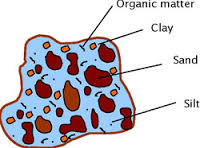
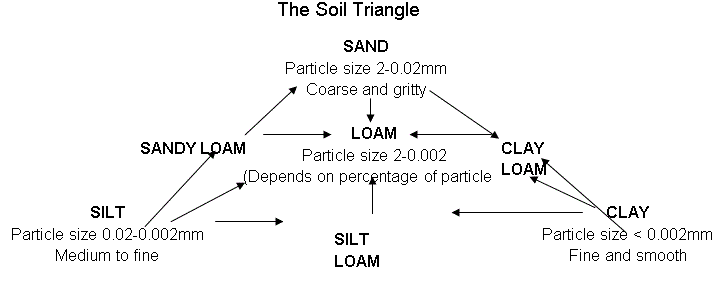
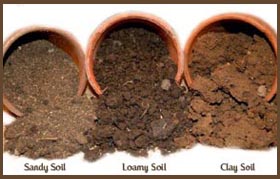
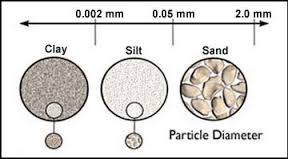
    2. Texture: The soil texture refers to the coarseness/fineness of the mineral matter in the soil. It is determined by the proportion of the sand, silt and clay particles:

    1. Clay: Particle Size – diameters less than 0.002 millimetre
    2. Silt: Particle Size – diameters between 0.002 millimetres to 0.05 millimetres.
    3. Sand: Particle Size – diameters between 0.05 and 2 millimetres.

    [Rocks larger than 2 millimetres are regarded as pebbles, gravel, or rock fragments and technically are not soil particles.]

    Note: Clay being the finest of all plays the most important role in soil chemistry (offers more surface area).

    The proportions of each of these soil fractions determine soil texture and its properties.

    The soil texture directly affects:

    • The soil water content
    • Water flow
    • Retention of nutrients
    • Extent of aeration

    Loamy Soil: Loamy soil is the one in which none of the three (sand/silt/clay) dominates the other two. In particular, loamy soil has about 40% sand, 40%silt, and 20% clay.

    Note: Generally speaking, Good Soils = Clay + Humus. The clay-humus complex is essential for a fertile soil as it provides it with a high water and nutrient holding capacity. Humus acts as a cement binding the soil particles together and thus reducing the risk of erosion.

    3. Structure :

    While the soil texture describes the size of soil particles, soil structure refers to the arrangement of the soil particles. The way in which sand, silt, clay and humus bond together is called soil structure. Structure can partially modify the effects of soil texture.

    Some structural characteristics of soil:

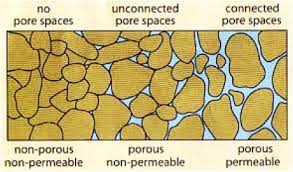
    • Permeability – The ease with which liquids/gases can pass through rocks or a layer of soil is called permeability. It depends on the size, shape and packing of particles. It is usually greatest in sandy soils and poor in clayey soils.
    • Porosity – The volume of water which can be held within a soil is called its porosity. It is expressed as a ratio of volume of voids (pores) to the total volume of the material.
    • Note: Most porous rocks are permeable with the exception of clay in which pore spaces are so small that they are often sealed with groundwater held by surface tension. Another exception – granite is non-porous but permeable. It is a crystalline rock and hence non-porous. Its individual crystals absorb little or no water but the rock may have numerous joints/ cracks through which the water can pass rendering it permeable.
    • A soil with high organic content also tends to have high porosity.

    4. Soil Chemistry – Acidity or Alkalinity:

    An important aspect of soil chemistry is acidity, alkalinity (baseness), or neutrality.

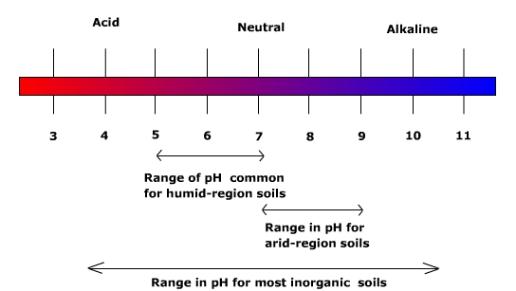
    Low pH values indicate an acidic soil, and a high pH indicates alkaline conditions. Most complex plants grow only in the soils with levels between pH 4 and pH 10 but optimum pH varies with the plant species.

    • In arid and semi-arid regions, soils tend to be alkaline and soils in humid regions tend to be acidic.
    • To correct soil alkalinity and to make the soil more productive, the soil can be flushed with irrigation water.
    • Strongly acidic soils are also detrimental to plant growth, but soil acidity can generally be corrected by adding lime to the soil.

    Now that we are done with the basics, let’s move on to the soils of India!

    Soils of India

    India has varied relief features, landforms, climatic realms and vegetation types. These have contributed to the development of various types of soils in India.

    Various classifications adopted to study the Indian Soils:

    1. In ancient times, soils used to be classified into two main groups:

    • Urvara (i.e. fertile), and
    • Usara (i.e. sterile)

    2. In the 16th century A.D., soils were classified on the basis of their inherent characteristics and external features such as texture, colour, the slope of land and moisture content in the soil.

    • Based on texture, main soil types were identified as sandy, clayey, silty and loam, etc.
    • On the basis of colour, they were red, yellow, black, etc.

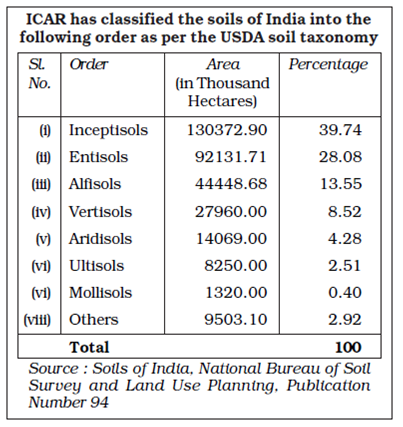
    3. The National Bureau of Soil Survey and the Land Use Planning an Institute under the control of the Indian Council of Agricultural Research (ICAR) did a lot of studies on Indian soils. In their effort to study soil and to make it comparable at the international level, the ICAR has classified the Indian soils on the basis of their nature and character as per the United States Department of Agriculture (USDA) Soil Taxonomy.

    Chief characteristics of these are:

    • Entisols – Immature soils that lack the vertical development of horizons. These soils are often associated with recently deposited sediments from wind, water, or ice erosion. Given more time, these soils will develop into another soil type.
    • Inceptisols – young soils that are more developed than entisols.
    • Vertisols – heavy clay soils that show significant expansion and contraction due to the presence or absence of moisture. These are common in areas that have shale parent material and heavy precipitation.
    • Aridisols – soils that develop in very dry environments.
    • Ultisols – associated with humid temperate to tropical climates. Warm temperatures and the abundant variability of moisture enhance the weathering process and increase the rate of leaching in these soils.
    • Mollisols – soils common to grassland environments

    4. On the basis of genesis, colour, composition and location, the soils of India have been classified into:

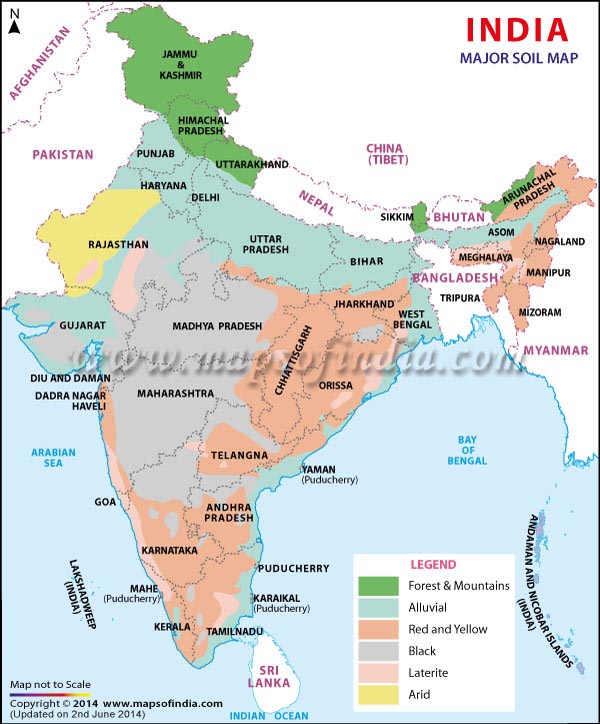
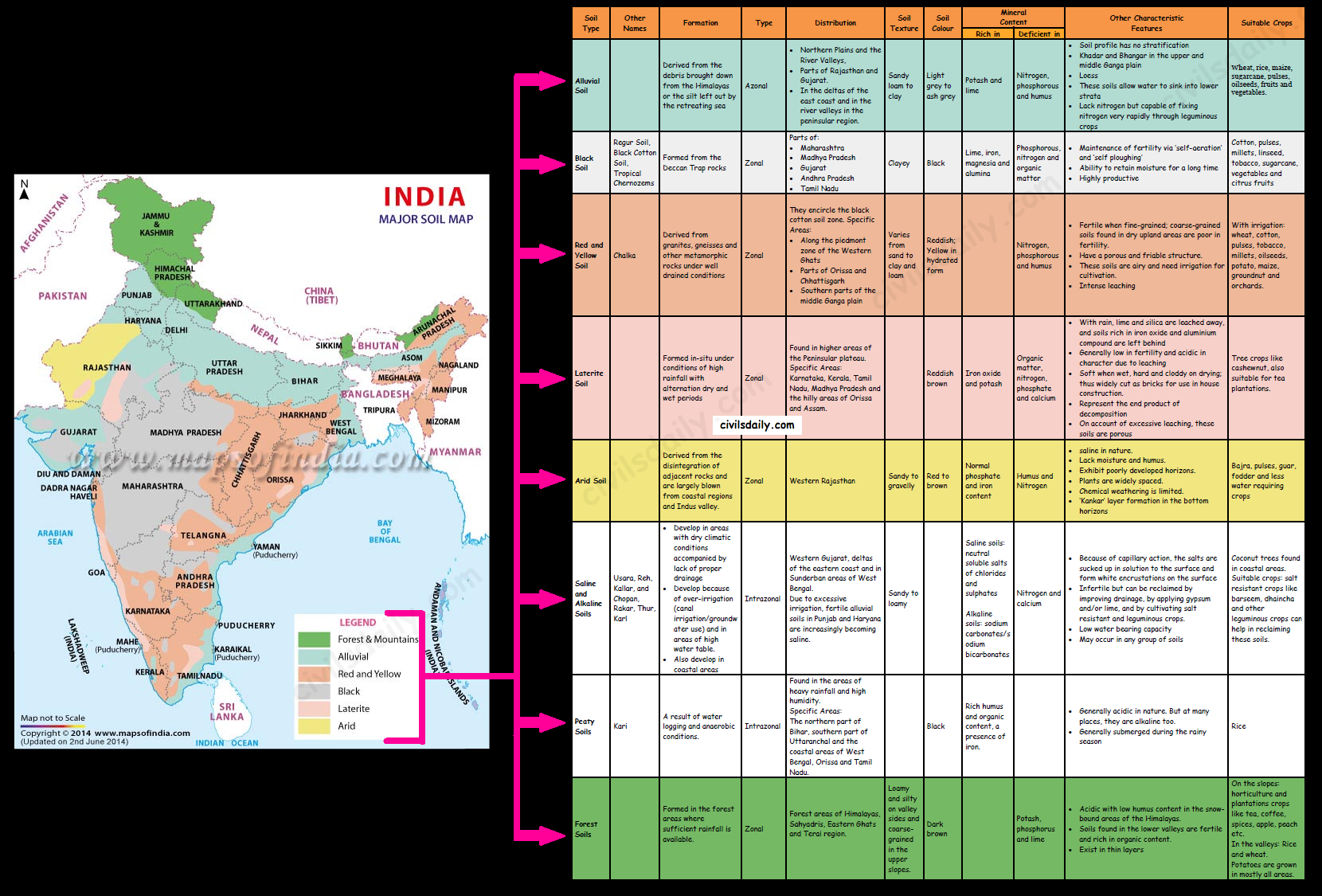
    (i) Alluvial soils

    (ii) Black soils

    (iii) Red and Yellow soils

    (iv) Laterite soils

    (v) Arid soils

    (vi) Saline soils

    (vii) Peaty soils

    (viii) Forest soils.

    5. Another way of classifying rocks is on the basis of dominant soil-forming factors:

    • Zonal Soil – These soils occur in broad geographical areas or zones.
      • They are influenced more by the climate and vegetation of the area rather than the rock-type.
      • They are mature, as a result of stable conditions over a long period of time.
      • For example – red soils, black soils, laterite soils, desert soils etc.
    • Azonal Soil – It is that soil which has been developed by the process of deposition by the agents of erosion.
      • It means that it has been made by the fine rocky particles transported from the far-off regions.
      • These are immature soils and lack well-developed soil profiles. This may be due to the non-availability of sufficient time for them to develop fully or due to the location on very steep slopes which prohibits profile development.
      • For Example – alluvial and loess soils.
    • Intrazonal Soil – These soils occur within other zonal soils.
      • It is a well-developed soil reflecting the influence of some local factor of relief, parent material, or age rather than of climate and vegetation.
      • For example, calcerous soil (soils which develop from limestone), peat soil.

    Soils and Crops of India

    1. Alluvial Soils

    • Formation: They are mainly derived from the debris brought down from the Himalayas or the silt left out by the retreating sea. Thus they are azonal soils.
    • Areas: Alluvial soils are widespread in the northern plains and the river valleys. Through a narrow corridor in Rajasthan, they extend into the plains of Gujarat. In the Peninsular region, they are found in deltas of the east coast and in the river valleys.
    • Soil texture: The alluvial soils vary in nature from sandy loam to clay. These soils are more loamy and clayey in the lower and middle Ganga plain and the Brahmaputra valley. The sand content decreases from the west to east.
    • Soil Colour: The colour of the alluvial soils varies from the light grey to ash grey depending on the depth of the deposition, the texture of the materials, and the time taken for attaining maturity.
    • Other Characteristic Features:
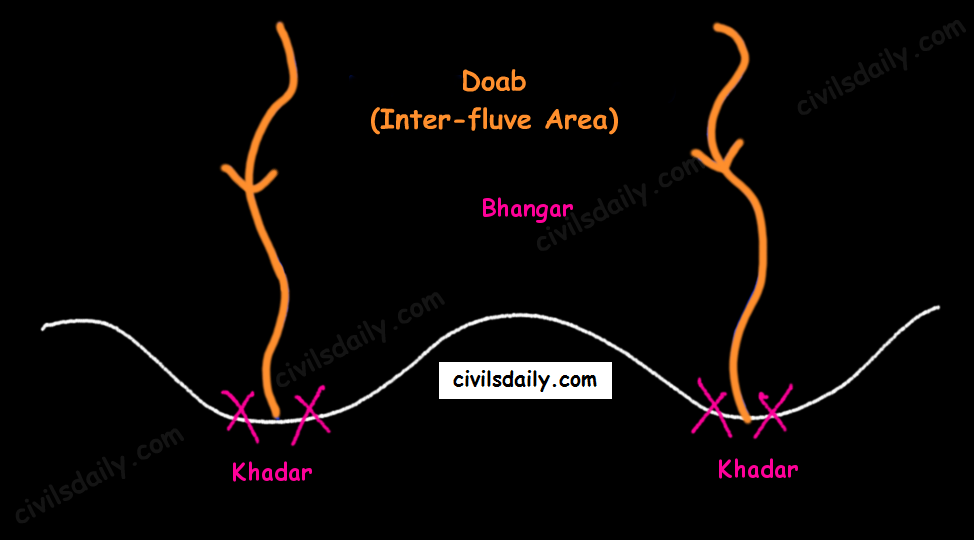
      • In the Upper and Middle Ganga plain, two different types of alluvial soils have developed, viz. Khadar and Bhangar.
    Khadar and Bhangar
    • Khadar: the newer alluvium deposited by floods annually, enriches the soil by depositing fine silts, light colour, found near river beds, porous in nature. Bhangar: older alluvium, clayey, darker, has lime nodules called Kankars, found in doabs (inter-fluve areas).
    • Alluvial soils of the northern plains —> transported soils —>, therefore, lack humus —> lack nitrogen [That is why we need to use nitrogenous fertilisers in the northern plains!]. Exception: the Ganga-Brahmaputra delta region is rich in humus.
    • These soils lack in nitrogen, phosphorus and humus. However, they are generally rich in potash and lime.
    • The soil profile has no stratification.
    • Alluvial soils are intensively cultivated.
    • In certain areas, these soils are covered with unproductive wind-borne soil called Loess.
    • Limitations:
      • Allow water to sink into lower strata, and
      • Lack nitrogen (But these soils are capable of fixing nitrogen very rapidly through leguminous crops (peas, beans, cloves etc.)
    • Suitable Crops: Wheat, rice, maize, sugarcane, pulses, oilseeds, fruits and vegetables, leguminous crops.

    2. Black Soil

    • These soils are locally known as the ‘Regur Soil’ or the ‘Black Cotton Soil’. Internationally, these are known as ‘tropical chernozems’. These soils are famous for the cultivation of cotton.
    • Formation: These have mainly formed from the Deccan Trap rocks —> Zonal Soils
    • Areas: These are found in the Deccan trap region. Black soil covers most of the Deccan Plateau which include parts of:
      • Maharashtra,
      • Madhya Pradesh,
      • Gujarat,
      • Andhra Pradesh and some parts of
      • Tamil Nadu.
    • Soil Texture: Black cotton soil (regur soil) is highly argillaceous i.e. clayey. It is deep and impermeable and thus has high water retention capacity.
    • Soil Colour: These soils are black in colour due to the presence of iron, aluminium compounds and humus.
    • Other Characteristic Features:
      • These soils are rich in minerals and known for their fertility.
      • The soil depth varies from place to place. It is very thick in lowlands but very thin on highlands. Also, in the upper reaches of the Godavari and the Krishna, and the northwestern part of the Deccan Plateau, the black soil is very deep.
      • These soils swell and become sticky when wet and develop deep wide cracks when dry. This helps in self-aeration, which leads to the absorption of nitrogen from the atmosphere. Thus, there occurs a kind of ‘self ploughing’. This aeration and oxidisation to deep levels contribute to the maintenance of the fertility of these soils. This continued fertility is favourable in the area of low rainfall for cotton cultivation even without irrigation.
      • Due to slow absorption and loss of moisture, the black soil retains the moisture for a very long time, which helps the crops, especially, the rain-fed ones, to sustain even during the dry season.
      • Chemically, the black soils are rich in lime, iron, magnesia and alumina. They also contain potash. But they lack in phosphorous, nitrogen and organic matter.
    • Suitable Crops: These soils are highly productive and well suited to the cultivation of cotton, pulses, millets, linseed, tobacco, sugarcane, vegetables and citrus fruits.

    Note: In the southern and eastern parts of the country where rainfall is heavy, black soils often occur in close proximity to red soils. Black soils occupy valleys and low-level areas whereas the red soils occur on higher slopes and hilltops. Mixed black and red soils occur in Coimbatore, Madurai, Tirunelveli (Tamil Nadu) and Bundelkhand region.

    3. Red and Yellow Soils

    • Locally called ‘Chalka’ in Andhra Pradesh.
    • Formation: These are derived from granites, gneisses and other metamorphic rocks —> Zonal Soils. These are formed under well-drained conditions.
    • Areas: Along the piedmont zone of the Western Ghat, a long stretch of area is occupied by red loamy soil. Yellow and red soils are also found in parts of Orissa and Chattisgarh and in the southern parts of the middle Ganga plain. They encircle the black cotton soil zone.
    • Soil Colour: The soil develops a reddish colour due to a wide diffusion of iron in crystalline and metamorphic rocks. It looks yellow when it occurs in a hydrated form. Often, their upper layer is red and the lower layer is yellow.
    • Soil Texture: Varies from sand to clay and loam.
    • Other Characteristic Features:
      • The fine-grained red and yellow soils are normally fertile, whereas coarse-grained soils found in dry upland areas are poor in fertility.
      • Have a porous and friable structure.
      • They are generally poor in nitrogen, phosphorous and humus.
      • These soils are airy and need irrigation for cultivation.
      • Intense leaching is a menace in these soil areas.
    • Suitable Crops: In places where irrigation facilities are available, the crops cultivated are wheat, cotton, pulses, tobacco, millets, oilseeds, potato, maize, groundnut and orchards.

    4. Laterite Soil

    • The word laterite has been derived from the Latin word ‘Later’ which means brick. These soils when wet are as soft as butter but become hard and cloddy on drying. Therefore, these are widely cut as bricks for use in house construction.
    • Formation: The lateritic soils are particularly found on high flat erosion surfaces in areas of high(>200cm) and seasonal rainfall. The alternating wet and dry seasons lead to the leaching away of the siliceous matter of the rocks leaving behind the compounds of iron and aluminium. These are zonal soils.
    • Areas: These soils have mainly developed in the higher areas of the Peninsular plateau. The laterite soils are commonly found in Karnataka, Kerala, Tamil Nadu, Madhya Pradesh and the hilly areas of Orissa and Assam.
    • Soil Colour: Reddish-brown in colour due to the presence of iron oxide.
    • Other characteristic features:
      • With rain, lime and silica are leached away, and soils rich in iron oxide and aluminium compound are left behind(thus the reddish-brown colour). Also, the humus content of the soil is removed fast by bacteria that thrive well in high temperature.
      • These soils represent the end product of decomposition and are generally low in fertility.
      • The pebbly crust is the important feature of laterites which is formed due to alteration of wet and dry periods.
      • These soils are acidic in character due to leaching. Application of manures and fertilisers is required for making these soils fertile for cultivation.
      • These soils are poor in organic matter, nitrogen, phosphate and calcium, while iron oxide and potash are in excess.
    • Suitable crops: Red laterite soils in Tamil Nadu, Andhra Pradesh and Kerala are more suitable for tree crops like cashew nut. These soils are also suitable for tea plantations.

    We discussed in detail alluvial, black, red and laterite soils. Let’s continue the discussion and move on to the next soil types!

    5. Arid Soils

    • Formation: These are derived from the disintegration of adjacent rocks and are largely blown from coastal regions and Indus valley.
    • Areas: Arid soils are characteristically developed in western Rajasthan, which exhibits characteristic arid topography.
    • Soil Colour: Arid soils range from red to brown in colour.
    • Soil Texture: They are generally sandy to gravelly in texture and have a high percentage of soluble salts.
    • Other characteristic features:
      • These are saline in nature. In some areas, the salt content is so high that common salt is obtained by evaporating the saline water.
      • Due to the dry climate, high temperature and accelerated evaporation, they lack moisture and humus.
      • These soils are deficient in nitrogen and humus. The phosphate and iron content is normal. These soils are rich in minerals but the main limitation is the lack of water.
      • The soils exhibit poorly developed horizons.
      • Plants are widely spaced.
      • Chemical weathering is limited.
      • Lower horizons of the soil are occupied by ‘kankar’ layers because of the increasing calcium content downwards. The ‘Kankar’ layer formation in the bottom horizons restricts the infiltration of water, and as such when irrigation is made available, the soil moisture is readily available for sustainable plant growth.
    • Suitable crops: If irrigated these soils give high agricultural returns. The availability of water from the Indira Gandhi canal has transformed the agricultural landscape of desert soils of western Rajasthan. These soils are mainly devoted to bajra, pulses, guar, fodder and less water requiring crops.

    6. Saline and Alkaline Soils

    • They are also known as Usara soils. Various local names for saline soils are Reh, Kallar, and Chopan, Rakar, Thur, Karl etc.
    • Formation:
      • These soils have developed in areas with dry climatic conditions (in areas having a little more rainfall than the areas of desert soils) accompanied by lack of proper drainage. In this situation, salts of sodium, calcium and magnesium are deposited on the upper layer of the soil by capillary action.
      • In the Rann of Kuchchh, the Southwest Monsoon brings salt particles and deposits there as a crust.
      • These soils are also formed when saline water spreads on the land at the time of high tide in coastal areas. Also, seawater intrusions in the deltas promote the occurrence of saline soils.
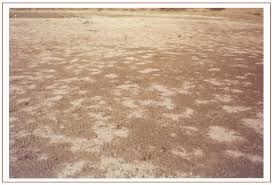
      • Salinization also occurs because of over-irrigation (canal irrigation/groundwater use) and in areas of the high water table (as in the coastal areas of Maharashtra and Tamil Nadu). Salinity from irrigation can occur over time wherever irrigation occurs. This is because almost all water (even natural rainfall) contains some dissolved salts. When the plants use the water, the salts are left behind in the soil and eventually begin to accumulate. Also, excessive irrigation with dry climatic conditions promotes capillary action, which results in the deposition of salt on the top layer of the soil (See the following figure).
      • These are thus, intrazonal soils.
    • Areas: They occur in arid and semi-arid regions, and in waterlogged and swampy areas. These are more widespread in western Gujarat, deltas of the eastern coast and in Sunderban areas of West Bengal.
    • Soil Texture: Their texture ranges from sandy to loamy.
    • Other characteristic features:
      • Because of capillary action, the salts are sucked up in solution to the surface and form white encrustations on the surface (See the picture below).
      • The salt efflorescence of calcium, magnesium and sodium makes these soils infertile.
      • Saline soils contain an excess of neutral soluble salts of chlorides and sulphates whereas sodic or alkali soils contain sodium carbonates/ sodium bicarbonates.
      • They lack in nitrogen and calcium and have low water-bearing capacity.
      • These soils can be reclaimed by improving drainage, by applying gypsum and/or lime, and by cultivating salt-resistant crops like barseem, dhaincha and other leguminous crops.
      • The saline and alkaline soils may occur in any group of soils.
    • Crops grown: In coastal areas, coconut trees are found in plenty in these soils. As discussed above, cultivating salt-resistant crops like bar seem, dhaincha and other leguminous crops can help in reclaiming these soils.
    • Note: In the areas of intensive cultivation with excessive use of irrigation, especially in areas of green revolution, the fertile alluvial soils are becoming saline. In such areas, especially in Punjab and Haryana, farmers are advised to add gypsum to solve the problem of salinity in the soil.

    7. Peaty Soils

    • These soils are locally called Kari in Kottayam and Alleppey districts of Kerala.
    • Formation: These are marshy soils and are a result of waterlogging and anaerobic conditions (which leads to partial decomposition of organic matter).
    • Areas: They are found in the areas of heavy rainfall and high humidity, where there is a good growth of vegetation. It occurs widely in the northern part of Bihar, the southern part of Uttaranchal and the coastal areas of West Bengal, Orissa and Tamil Nadu.
    • Soil Colour and Texture: These soils are normally heavy and black in colour
    • Other characteristic features:
      • These soils are characterised by a rich humus and organic content.
      • There is a presence of iron and varying amounts of organic matter (10-40%). The organic matter in these soils may go even up to 40-50 per cent.
      • These soils are generally acidic in nature. But at many places, they are alkaline also.
    • Suitable crops: These are generally submerged during the rainy season and utilised for the cultivation of rice.

    8. Forest Soils

    • Formation: As the name suggests, forest soils are formed in the forest areas where sufficient rainfall is available.
    • Areas: These are found in the forest areas of Himalayas, Sahyadris, Eastern Ghats and terai region.
    • Soil colour and texture: The soils vary in structure and texture depending on the mountain environment where they are formed. They are loamy and silty on valley sides and coarse-grained in the upper slopes. Their colour is dark brown.
    • Other Characteristics:
      • In the snow-bound areas of the Himalayas, they are acidic with low humus content. This is because humus is rawer at higher levels. Also, these soils are subjected to denudation due to landslides and snowfall.
      • The soils found in the lower valleys are fertile and rich in organic content.
      • Owing to sharp differences of hill slopes and climates, these soils may differ greatly even when in proximity. [Recall here the discussion on the impact of topography on soils!]
      • Also, these soils exist in thin layers because of their development on the mountain slopes.
      • These soils are poor in potash, phosphorus and lime.
      • Soil erosion is a major problem in these areas.
    • Crops grown: The slopes are used for horticulture and plantations crops like tea, coffee, spices, apple, peach etc. Rice and wheat are grown in valleys. Potatoes are grown in mostly all areas.

    Now that we are done with all the soil types, expand the following image for a quick revision!

    Methods of Irrigation

    Irrigation

    • Irrigation is the artificial application of water to the soil or agricultural field. It is the replacement or supplementation of rainwater with another source of water. It is used in dry areas and during periods of inadequate rainfall.
    • The main idea behind irrigation systems is to assist in the growth of agricultural crops and plants by maintaining with the minimum amount of water required, suppressing weed growth in grain fields, preventing soil consolidation etc.

    Well and Tube Well Irrigation

    • Wells are mainly found in U.P., Bihar, Tamil Nadu, etc. There are various types of wells – shallow wells, deep wells, tube wells, artesian wells, etc. From the shallow wells water is not always available as the level of water goes down during the dry months. Deep wells are more suitable for the purpose of irrigation as water from them is available throughout the year.
    • At places where ground water is available, a tube-well can be installed near the agricultural area. A deep tube well worked by electricity, can irrigate a much larger area (about 400 hectares) than a surface well (half hectares). Tube wells are mostly used in U.P., Haryana, Punjab, Bihar and Gujarat.
    • Merits: Well is simplest, cheapest and independent source of irrigation and can be used as and when the necessity arises. Several chemicals such as nitrate, chloride, sulphate, etc. found in well water add to the fertility of soil. More reliable during periods of drought when surface water dries up.
    • Demerits: Only limited area can be irrigated. In the event of a drought, the ground water level falls and enough water is not available. Tubewells can draw a lot of groundwater from its neighbouring areas and make the ground dry and unfit for agriculture.

    Canal Irrigation

    • Canals can be an effective source of irrigation in areas of low level relief, deep fertile soils, perennial source of water and extensive command area. Therefore, the main concentration of canal irrigation is in the northern plain of India, especially the areas comprising Uttar Pradesh, Haryana and Punjab.
    • The digging of canals in rocky and uneven areas is difficult and uneconomic. Thus, canals are practically absent from the Peninsular plateau area. However, the coastal and the delta regions in South India do have some canals for irrigation.
    • Two types: Inundation canals, which are taken out from the rivers without any regulating system like weirs etc. at their head. Such canals provide irrigation mainly in the rainy season when the river is in flood and there is excess water. Perennial Canals are those which are taken off from perennial rivers by constructing a barrage across the river. Most of the canals in India are perennial.
    • Merits: Most of the canals provide perennial irrigation and supply water as and when needed. This saves the crops from drought conditions and helps in increasing the farm production.
    • Demerits: Many canals overflow during the rainy season and flood the surrounding areas. Canal irrigation is suitable in plain areas only.

    Tank Irrigation

    • A tank is developed by constructing a small bund of earth or stones built across a stream. The water impounded by the bund is used for irrigation and other purposes. Tank comprises an important source of irrigation in the Karnataka Plateau, MP, Maharashtra, Odisha, Kerala Bundelkhand area of UP, Rajasthan and Gujarat.
    • Merits: Most of the tanks are natural and do not involve heavy cost for their construction and have longer life span. In many tanks, fishing is also carried on, which supplements both the food resources and income of the farmer.
    • Demerits: Many tanks dry up during the dry season and fail to provide irrigation when it is required. Lifting of water from tanks and carrying it to the fields is a strenuous and costly exercise.

    Drip Irrigation

    • In drip irrigation, water is applied near the plant root through emitters or drippers, on or below the soil surface, at a low rate varying from 2-20 liters per hour. The soil moisture is kept at an optimum level with frequent irrigations.
    • Among all irrigation methods, drip irrigation is the most efficient and can be practiced for a large variety of crops, especially in vegetables, orchard crops, flowers and plantation crops.
    • Merits: Fertilizer and nutrient loss is minimized due to localized application and reduced leaching. Field leveling is not necessary. Recycled non-potable water can be used. Water application efficiency increases. Soil erosion and weed growth is lessened.
    • Demerits: Initial cost can be more, can result in clogging, wastage of water, time and harvest, if not installed properly.

    Sprinkler Irrigation

    • In this method, water is sprayed into the air and allowed to fall on the ground surface somewhat resembling rainfall. The spray is developed by the flow of water under pressure through small orifices or nozzles. The sprinkler irrigation system is a very suitable method for irrigation on uneven lands and on shallow soils.
    • Nearly all crops are suitable for sprinkler irrigation systems except crops like paddy, jute, etc. The dry crops, vegetables, flowering crops, orchards, plantation crops like tea, coffee are all suitable and can be irrigated through sprinklers.
    • Merits: Suitable to all types of soil except heavy clay. Water saving. Increase in yield. Saves land as no bunds etc. are required.
    • Demerits: Higher initial cost. Under high wind conditions and high temperature distribution and application efficiency is poor.

    Other Types of Irrigation

    • Furrow Irrigation: Furrow irrigation is a type of surface irrigation in which trenches or “furrows” are dug between crop rows in a field. Farmers flow water down the furrows and it seeps vertically and horizontally to refill the soil reservoir. Flow to each furrow is individually controlled.

      • One of the difficulties of furrow irrigation is ensuring uniform dispersion of water over a given field. Another difficulty with furrow irrigation is the increased potential for water loss due to runoff.
    • Surge Irrigation: Surge irrigation is a variant of furrow irrigation where the water supply is pulsed on and off in planned time periods. The wetting and drying cycles reduce infiltration rates resulting in faster advance rates and higher uniformities than continuous flow.
    • Ditch Irrigation: It is a rather traditional method, where ditches are dug out and seedlings are planted in rows. The plantings are watered by placing canals or furrows in between the rows of plants. Siphon tubes are used to move the water from the main ditch to the canals.
    • Sub Irrigation or Seepage Irrigation: It is a method of irrigation where water is delivered to the plant root zone from below the soil surface and absorbed upwards. The excess may be collected for reuse.
      • Advantages are water and nutrient conservation, and labor-saving.
      • The outfitting cost is relatively high. Potential problems, such as the possibility of increased presence of disease in recycle water.

    UPSC 2022 countdown has begun! Get your personal guidance plan now! (Click here)

    Samanvaya: Free 1-to-1 mentorship for UPSC IAS

    Fill up this form to schedule a free on-call discussion with senior mentor from Civilsdaily. Once submitted we will call you within 24 hours.

    Civilsdaily Samanvaya 1-On-1 Mentorship Form

    Field will not be visible to web visitor

  • Destroy Geography in Prelims 2021 And Kick-start Geography for 2022 || One session can transform your Geography preparation

    Destroy Geography in Prelims 2021 And Kick-start Geography for 2022 || One session can transform your Geography preparation

    Dear aspirants,

    You may be gearing up for Prelims 2021 or beginning your preparation for UPSC 2022, either way, one free session with Vikash Sir can transform your Geography preparation completely. 

    Here’s what you can expect from the webinar:

    1. Don’t feel confident in Geography for Prelims 2021: You can excel in 5 days by cracking the nerve of all topic – The physicals of Geography
    2. Live solution and answering techniques for 2015-2020 Geography questions.
    3. Want to start GS Geography Pre+Mains 2022? Crack the syllabus with Vikash sir
    4. Live answer writing session for UPSC mains on Geography
    5. Know your allies in the UPSC battle – Focused resource exploration of NCERT, G.C. Leong (Ch 15-25), and Maps (Static + Places in news)

    Do not miss this opportunity to destroy Geography in your exam and score above the cut-off. The webinar is absolutely free. 

    Date: 5/9/2021 (Sunday)

    Time: 7:00 P.M.

    Limited slots are available. Please register immediately.
  • [RSTV Archive] Circular Economy: Concept & Challenges

    UPSC 2022 countdown has begun! Get your personal guidance plan now! (Click here)

    With a growing population, rapid urbanization, climate change and environmental pollution, India must move towards a circular economy. An economic approach aimed at eliminating waste and the continual use of resources, the circular economy offers a new paradigm that emphasizes the need to take a comprehensive view of products and processes.

    In this article, we shall understand the concept of a Circular economy over a linear one and also look at challenges that lie ahead.

    Circular Economy: The Concept

    • A circular economy (also referred to as “circularity”)is an economic system that tackles global challenges like climate change, biodiversity loss, waste, and pollution.
    • Most linear economy businesses take a natural resource and turn it into a product which is ultimately destined to become waste because of the way it has been designed and made.
    • This process is often summarized by “take, make, waste”.
    • By contrast, a circular economy includes 3 R’s (Reduce, Reuse and Recycle), Refurbishment, Recover, and Repairing of materials.
    • Hence, Circular Economy focuses on increasing productivity in terms of more efficient utilization of resources.

    Principles of Circular Economy

    The concept is based on three main principles:

    #1 Minimization of waste and pollution

    The concept suggests the minimization of waste and pollution by reducing damages from economic activities.

    #2 Extension of the useful life of products and materials

    A circular economy aims to extend the useful life of the products and materials by creating the loops of the materials and products circulating in the economy. The goal is achieved through the active reuse, repair, and remanufacturing of the products and materials utilized in the economy.

    #3 Regeneration of natural systems

    The regeneration of natural systems is one of the fundamental concepts of a (circular) economy. It enhances natural capital and creates the necessary conditions for the regeneration of natural systems.

    Why is the global attention towards this?

    • Raw material supply: Circular Economy fulfills the need for raw materials required by industries, especially the manufacturing industries.
    • Input costs are minimized: The output produced by industries in a circular economy comes back to the industries in the form of input.
    • QCDF improvement: Ultimately, QCDF (Quality, Cost, Delivery, and Flexibility) and sustainability level of industries get improved.

    Applications of Circularity

    (A) Construction sector

    (B) Food and Agriculture

    (C) Transportation and Mobility

    Benefits offered by Circular Economy

    For Economy

    • Economic growth, as defined by GDP, would be achieved mainly through a combination of increased revenues from emerging circular activities.
    • It lowers the cost of production through the more productive utilization of inputs.  
    • These changes in input and output of economic production activities affect economy-wide supply, demand, and prices.
    • Its effects ripple through all sectors of the economy adding to overall economic growth.

    For Environment

    • It solves the problem of disposal of waste by converting waste into raw materials.
    • Besides the problem of solid waste management, the circular economy also solves the problem of air pollution, water pollution, and land pollution.

    For Individuals

    • Lower cost for products and services
    • Greater utility and choice
    • Reduced negative externalities, e.g. congestion, pollution
    • Increased Efficiency of the products

    Limitations to the circular economy models

    There is some criticism of the idea of the circular economy.

    • Linearity: Recovery and recycling of materials that have been dispersed through pollution, waste and end-of-life product disposal require energy and resources, which increase in a nonlinear manner as the percentage of recycled material rises
    • Waste management: Impossibility for waste producers to dissociate themselves from their waste and emphasizes the contingent, multiple, and transient value of waste.
    • Unavoidability: A key tenet of this principle is to consider waste as avoidable and worthy of interest.
    • Utopian concept:  Circular Economy analogy of a circle evokes endless perfection; the analogy of scats evokes disorienting messiness.
    • Capability: Proponents of the circular economy have tended to look at the world purely as an engineering system and have overlooked the economic part of the circular economy.
    • Invisible economy: Invisible hand of market forces will conspire to create full displacement of virgin material of the same kind.

    Need of the hour

    • India has a huge potential for reuse and recycling as less than 10-15% of the total waste generated goes into the recycling process.
    • Circular Economy will boost the reuse and recycling of materials.
    • To start with, sectors like construction, agriculture and vehicle and mobility can be considered as they are going to get the largest growth in coming years and thus India will be able to save more than Rs. 40 lakh Crore by 2030.

    India’s roadmap

    • Digital India’: This mission contains a significant component of the recycling of electronic wastes. Swachh Bharat Mission is also about making wealth out of wastes.
    • Vehicle Scrappage Policy: This most recent reflects the perfect application of circular economy in Automobile sector.

    Way forward

    • Build circular economy knowledge and capacity: Taking maximum advantage of circular models requires decision-makers throughout the organisation to understand the benefits and take them into account in business decisions.
    • Innovate to create new products and business models and demonstrate their success: Businesses can foster innovation to address challenges, such as transition costs, more rapidly by collaborating with research institutions and by making information open source.
    • Collaborate with other businesses, policymakers, and the informal economy: Participation in pre-competitive collaboration in cross-industry and cross-value-chain networks can enable businesses to drive change that they cannot create on their own.
    • Invest in circular economy opportunities: While sizing and prioritizing the value of investment related to the circular economy opportunities outlined in this report requires detailed analysis, the circular economy offers attractive opportunities for both businesses and financial institutions.

    Conclusion

    • Resources in the world are finite. The circular economy will help the inefficient utilization of resources.
    • Political will is the key for implementation of Circular Economy.
    • Countries including India need to think about what they are taking from the environment and what they are contributing to it.
    • They also need to ensure that the material gets recycled or reused before it turns into waste.

  • Streak Daily Compilation of Questions & Videos – Sep 2, 2021

    Maintaining consistency is one of the biggest issues faced by IAS Aspirants. Streak’s initiative is to help Aspirants in their day-to-day preparation. You can follow the monthly, weekly, and daily timetables and continue this streak until you find yourself on the final list.

    Please register for Streak Initiative (free) through this link:- https://www.civilsdaily.com/course/streak-daily-initiative/

    You will get following study material:-

    1. Questions (PDF).
    2. RSTV/Yojana monthly notes (PDF).
    3. Burning issue (PDF).
    4. Subject specific (PDF).
    5. Mentor’s phone call for support & encouragement.

    _____________________________________________

    UPSC Daily Study Plan For 2021 and 2022 || STREAK – by Ravi Ranjan

    CSAT for UPSC Prelims || Free CSAT Sessions by Civilsdaily – by Ravi Ranjan

    UPSC PRELIMS-2021 || Current Affairs Based Most Probable Questions – by Sukanya Rana

    Q1) Which of the following can cause DNA damage and mutations in humans?

    a. Absorption of UV – A and UV – B

    b. Absorption of UV – B

    c. Absorption of UV – A

    d. Absorption of UV – A and UV – C

    Q2) Consider the following statements:

    1. The objective of the Minamata Convention is to protect human health and the environment from anthropogenic emissions and releases of mercury and mercury compounds.
    2. The treaty also addresses the direct mining of mercury, its export and import, its safe storage and its disposal once as waste.
    3. Dental fillings which use amalgam are also regulated under the convention.

    Select the correct option:

    a. 1 only

    b. 1 and 2

    c. 1 and 3

    d. 1, 2 and 3

    Q3) Consider the following statements about ozone hole over Arctic 

    1. It has reached a maximum extension of around 1 million sq km. 
    2. Recently, the German Aerospace Centre observed the closure of ozone holes mainly because of the reduced pollution levels due to covid-19 lockdown. 

    Which of the above statement(s) given above is/are correct? 

    a. 1 only 

    b. 2 only 

    c. Both 1 and 2 

    d. Neither 1 nor 2

    Q4) Consider the following statements with respect to Deepor Beel Lake 

    1. It is a permanent freshwater lake, in a former channel of the Brahmaputra River. 
    2. It is the only wetland in Assam designated as a site of importance under Ramsar Convention on Wetlands. 

    Which of the statement(s) given above is/are correct? 

    a. 1 only 

    b. 2 only 

    c. Both 1 and 2 

    d. Neither 1 nor 2

    Q5) Consider the following statements with respect to Galathea National Park 

    1. It is located on the island of Great Nicobar in the Andaman & Nicobar Islands.
    2. It is an iconic nesting site in India of the enigmatic Giant Leatherback, the world’s largest marine turtle. 
    3. The park is home to the indigenous Shompen community. 

    Which of the statements given above are correct? 

    a. 1 and 2 only 

    b. 1 and 3 only 

    c. 2 and 3 only 

    d. 1, 2 and 3

    UPSC PRELIMS-2021 || Most Probable Questions on Environment & Ecology – by Santosh Gupta

    Q1) Which of the following are regarded as ‘Ecosystem services’?

    1. Soil formation
    2. Nutrient cycling
    3. Habitat for wildlife
    4. Climate regulation
    5. Tourism 

    Select the correct answer using the code

    given below.

    a. 1 and 2 only

    b. 3, 4 and 5only

    c. 1, 2 and 3 only

    d. All of them

    Q2) Which of the following is/are the causes of coral bleaching in India?

    1. Excessive sedimentation in the reef
    2. ecosystem
    3. Excess nutrients like ammonia and
    4. nitrates entering the reef system
    5. Increased exposure to Ultraviolet (UV)
    6. Radiation
    7. Repeated EL- Nino and La- Nina

    Select the correct answer using the code given below.

    a. 1 and 3 only

    b. 1, 2 and 3 only

    c. 2 and 4 only

    d. All of them 

    Q3) Which of the following contribute in the Cultural eutrophication?

    1. Excessive use of fertilisers
    2. Untreated sewage
    3. Detergents containing phosphorus
    4. Discharge of industrial waste
    5. Acid rain 

    Select the correct answer using the code given below.

    a. 2, 3 and 4 only

    b. 1, 2 and 4 only

    c. 1 and 3 only

    d. All of them 

    Q4) Which of the following is/are the reasons for ozone depletion by polar stratospheric clouds?

    1. They convert free radicals of halogens to oxide which then reacts with ozone causing its depletion. 
    2. They remove gaseous nitric acid which reacts with oxides of halogens. 

    Select the correct answer using the code given below.

    a. 1 only

    b. 2 only

    c. 1 and 2 

    d. None of them

    Q5) Consider the following statements

    1. The acidified ocean water leads to reduction of sulphur which may lead to decreased cloud formation and raising global temperatures. 
    2. Ocean acidification occurs through the uptake of carbon dioxide (CO2) from the atmosphere only

    Which of the statement(s) given above is/are correct?

    a. 1 only

    b. 2 only

    c. 1 and 2 

    d. None of them

    Daily Dose: Complete Snapshots of Everyday News – by Shweta Mishra

  • Destroy Geography in Prelims 2021 And Kick-start Geography for 2022 || One session can transform your Geography preparation

    Destroy Geography in Prelims 2021 And Kick-start Geography for 2022 || One session can transform your Geography preparation

    Dear aspirants,

    You may be gearing up for Prelims 2021 or beginning your preparation for UPSC 2022, either way, one free session with Vikash Sir can transform your Geography preparation completely. 

    Here’s what you can expect from the webinar:

    1. Don’t feel confident in Geography for Prelims 2021: You can excel in 5 days by cracking the nerve of all topic – The physicals of Geography
    2. Live solution and answering techniques for 2015-2020 Geography questions.
    3. Want to start GS Geography Pre+Mains 2022? Crack the syllabus with Vikash sir
    4. Live answer writing session for UPSC mains on Geography
    5. Know your allies in the UPSC battle – Focused resource exploration of NCERT, G.C. Leong (Ch 15-25), and Maps (Static + Places in news)

    Do not miss this opportunity to destroy Geography in your exam and score above the cut-off. The webinar is absolutely free. 

    Date: 5/9/2021 (Sunday)

    Time: 7:00 P.M.

    Limited slots are available. Please register immediately.
  • Important Straits

    UPSC 2022 countdown has begun! Get your personal guidance plan now! (Click here)

    02 Sept 2021

    A strait is a naturally formed, narrow, typically navigable waterway that connects two larger bodies of water. Most commonly it is a channel of water that lies between two landmasses. Some straits are not navigable, for example, because they are too shallow, or because of an unnavigable reef or archipelago.

    1. Strait of Hormuz
    • It links the Persian Gulf (west) with the Gulf of Oman and the Arabian Sea (southeast).
    • On the north coast lies Iran, and on the south coast the United Arab Emirates and Musandam, an exclave of Oman. 
    • The strait is 35 to 60 miles (55 to 95 km) wide and separates Iran from the Arabian Peninsula.
    • It contains the islands of Qeshm (Qishm), Hormuz, and Hengām (Henjām) and is of great strategic and economic importance, especially as oil tankers collecting from various ports on the Persian Gulf must pass through the strait.
    • OPEC members Saudi Arabia, Iran, the UAE, Kuwait and Iraq export most of their crude via the Strait
    • Qatar, the world’s biggest liquefied natural gas (LNG) exporter, sends almost all of its LNG through the Strait
    • The UAE and Saudi Arabia have sought to find other routes to bypass the Strait, including building pipelines.

    2. Strait of Malacca

    • Strait of Malacca connects the Andaman Sea (Indian Ocean) and the South China Sea (Pacific Ocean).
    • Stretching about 800km, it is the longest straits in the world and facilitates not just shipping and the movement of people in the surrounding communities but is a confluence of trade, cultures, ideas, and knowledge between the East and West.
    • It runs between the Indonesian island of Sumatra to the west and peninsular (West) Malaysia and extreme southern Thailand to the east and has an area of about 25,000 square miles (65,000 square km).
    • The strait derived its name from the trading port of Melaka (formerly Malacca)—which was of importance in the 16th and 17th centuries—on the Malay coast.
    • As the link between the Indian Ocean and the South China Sea, the Strait of Malacca is the shortest sea route between India and China and hence is one of the most heavily travelled shipping channels in the world.
    • Singapore, one of the world’s most important ports, is situated at the strait’s southern end.
    • The global shift in economic power from the West to the East coupled with burgeoning trade, investments, and production in areas spanning the Indian and Pacific Ocean regions has given increasing importance to this region.

    3. Bab-el-Mandab

    • The Bab al-Mandab strait is the narrow waterway that separates the Arabian Peninsula from the Horn of Africa.
    • It links the Red Sea to the Gulf of Aden and the Indian Ocean.
    • At its narrowest point, the strait is only 29 km wide between Yemen on one side and Djibouti and Eritrea on the other.
    • It is a key strategic channel for commerce and trade, with an estimated 4 percent of global oil supply passing through it.

    4. Palk Strait

    • It connects the Bay of Bengal in the northeast with Palk Bay in the southwest.
    • The strait is 40 to 85 miles (64 to 137 km) wide, 85 miles long, and less than 330 feet (100 metres) deep.
    • It receives several rivers, including the Vaigai (India), and it contains many islands on the Sri Lankan side.
    • The Sethusamudram Ship Canal Project (SSCP) is a 167 km long shipping canal, and envisages the creation of a navigable canal from the Gulf of. Mannar to the Bay of Bengal to facilitate the movement of ships.
    • The Adam’s Bridge is a series of sand shoals created by sedimentation over a period of time.
    • All islands are made up of a calcareous framework of dead reef and sand.
    • In India, the Gulf of Mannar region in Tamil Nadu is one of the four major coral reef areas and the others are Gulf of Kutch in Gujarat, Lakhsadweep and Andaman and Nicobar islands.
    • With its rich biodiversity of over 4,000 species of various flora and fauna, part of this Gulf of Mannar between Rameswaram and Tuticoirin covering 21 islands and the surrounding shallow coastal waters was declared as a Marine National Park in 1986.

    5.Sunda Strait

    • It links the Java Sea (Pacific Ocean) with the Indian Ocean (south).
    • Sunda Strait, Indonesian Selat Sunda, is a channel, 16–70 miles (26–110 km) wide, between the islands of Java (east) and Sumatra.
    • The Sunda Strait is an important passage connecting the Indian Ocean with eastern Asia.
    • The strait stretches in a roughly northeast/southwest orientation, with a minimum width of 24 km (15 mi) at its northeastern end between Cape Tua on Sumatra and Cape Pujat on Java.
    • It is very deep at its western end, but as it narrows to the east it becomes much shallower, with a depth of only 20 m (65 feet) in parts of the eastern end.
    • It is notoriously difficult to navigate because of this shallowness, very strong tidal currents, sandbanks, and man-made obstructions such as oil platforms off the Java coast.
    • The strait’s narrowness, shallowness, and lack of accurate charting make it unsuitable for many modern, large ships, most of which use the Strait of Malacca instead.

    6.Mozambique Channel

    • It is located between the island nation of Madagascar on the east and Mozambique on the African mainland (west).
    • About 1,000 miles (1,600 km) long, it varies in width from 250 to 600 miles (400 to 950 km) and reaches a maximum depth of 10,000 feet (3,000 m).
    • The Comoro Archipelago marks the northern entrance, and the islands of Bassas da India and Europa lie in the south.
    • An important route for shipping in eastern Africa, it receives all major Madagascar rivers and has the ports of Mahajanga (Majunga) and Toliary (Tuléar) on the same coast.
    • Along the opposite coast are the mouth of the Zambezi River and the ports of Maputo (formerly Lourenço Marques), Moçambique, and Beira.
    • The Mozambique Current passes through the strait.

    7.Gibraltar Strait

    • It is a channel connecting the Mediterranean Sea with the Atlantic Ocean, lying between southernmost Spain and northwesternmost Africa.
    • It is 36 miles (58 km) long and narrows to 8 miles (13 km) in width between Point Marroquí (Spain) and Point Cires (Morocco).
    • It is one of the most significant global sea lanes because it provides a means of seaborne transit for shipping between the Atlantic and Mediterranean, and via the Suez Canal into the Indian Ocean and beyond.
    • After the English Channel, the Strait is the world’s busiest shipping lane.

    8. Bosphorus strait and Dardanelles strait

    • Bosphorus,also known as the Strait of Istanbul, is a narrow, natural strait and an internationally significant waterway located in northwestern Turkey.
    • The Bosporus connects the Black Sea with the Sea of Marmara, and, by extension via the Dardanelles, the Aegean and Mediterranean seas.
    • It is the world’s narrowest strait used for international navigation.
    • Dardanelles is a narrow, natural strait and internationally significant waterway in northwestern Turkey that forms part of the continental boundary between Europe and Asia, and separates Asian Turkey from European Turkey.
    • The Dardanelles connects the Sea of Marmara with the Aegean and Mediterranean Seas, while also allowing passage to the Black Sea by extension via the Bosphorus.
    • The Dardanelles is 61 kilometres (38 mi) long, and 1.2 to 6 kilometres (0.75 to 3.73 mi) wide, averaging 55 metres (180 ft) deep with a maximum depth of 103 metres (338 ft) at its narrowest point abreast the city of Çanakkale

    9. Yucatan Strait

    Joining seas/ Water Bodies : Gulf of Mexico and Caribbean Sea

    Location: Mexico-Cuba

    10. Mesina Strait  

    Joining seas/ Water Bodies : Mediterranean Sea

    Location: Italy-Sicily

    11. Otranto Strait

    Joining seas/ Water Bodies :Adriatic Sea & Ionian Sea

    Location: Italy-Albania

    12. Cook Strait 

    Joining seas/ Water Bodies :South Pacific Ocean

    Location:  New Zealand (North & South Islands)

    13. North Channel

    Joining seas/ Water Bodies :Irish Sea & Atlantic Ocean

    Location: Ireland-England

    14. Hudson strait     

    Joining seas/ Water Bodies : Gulf of Hudson & Atlantic Ocean

    Location: Canada

    15. Magellan strait   

    Join: Pacific and South Atlantic Ocean

    Location: Chile

    16. Makassar Strait

    Joining seas/ Water Bodies: the Java Sea & Celebes Sea

    Location: Indonesia

    17. Tsugaru Strait 

    Joining seas/ Water Bodies: Japan Sea and Pacific Ocean

    Location: Japan (Hokkaido-Honshu Island)

    18. Tatar Strait  

    Joining seas/ Water Bodies: Japan Sea & Okhotsk Sea

    Location: Russia (East Russia-Sakhalin Islands)

    19. Fovex Strait 

    Joining seas/ Water Bodies: South Pacific Ocean

    Location: New Zealand (South Island- Stewart Island)

    20. Formosa Strait  

    Joining seas/ Water Bodies: the South China Sea & East China Sea

    Location: China-Taiwan

    21. Taurus Strait

    Joining seas/ Water Bodies:Arafura Sea & Gulf of Papua

    Location: Papua New Guinea — Australia

    22. Bass Strait

    Joining seas/ Water Bodies: the Tasman Sea & South Sea

    Location: Australia

    23. Bering Strait

    Joining seas/ Water Bodies: the Bering Sea & Chukchi Sea

    Location: Alaska-Russia

    24. Bonne-Fasio Strait

    Joining seas/ Water Bodies: Mediterranean Sea

    Location: Corsica — Sardinia

    25. Davis Strait  

    Joining seas/ Water Bodies : the Baffin Bay & Atlantic Ocean

    Location: Greenland-Canada

    26. Denmark Strait 

    Joining seas/ Water Bodies: North Atlantic and the Arctic Ocean

    Location: Greenland-Iceland

    27. Dover strait  

    Joining seas/ Water Bodies: The English Channel & North Sea

    Location: England-France

    28. Florida Strait

    Joining seas/ Water Bodies: Gulf of Mexico and the Atlantic Ocean

    Location: USA-Cuba


    UPSC 2022 countdown has begun! Get your personal guidance plan now! (Click here)

    Samanvaya: Free 1-to-1 mentorship for UPSC IAS

    Fill up this form to schedule a free on-call discussion with senior mentor from Civilsdaily. Once submitted we will call you within 24 hours.

    Civilsdaily Samanvaya 1-On-1 Mentorship Form

    Field will not be visible to web visitor

  • [Yojana Archives] Indian Bureaucracy: A Historical Perspective

    UPSC 2022 countdown has begun! Get your personal guidance plan now! (Click here)

    August 2021: Public Administration

    Context

    • Bureaucracy is the backbone of the administrative machinery of the country which forms the permanent executive branch of the government.
    • From a reading of the historical literature, public administration in India can be traced back to the manuscripts of Arthashasthra written by Kautilya.
    • In the next major phase, Bharat witnessed the rule of the Guptas also termed by many historians as the ‘Golden Age.’
    • The discussion on ‘Historical Perspectives on Indian Bureaucracy’ begins with an overview of the history of civil services in India.

    What are Civil Services?

    • The Civil Services refer to the career civil servants who are the permanent executive branch of the Republic of India.
    • Elected cabinet ministers determine policy, and civil servants carry it out.

    If humans as a species are made to survive independently, then why administer them?  What would be the need for public administration? Does the public need to be administered or the administers are needed for the sustenance of public and society, at large? Is it merely about managing resources or it involves greater functioning of the systems?

    Why do we need Civil Services?

    • In the Indian context, in society as vast and heterogeneous, equitable distribution of resources and services is the key to the prosperity of all.
    • Gandhiji’s Talisman, ‘Whenever you are in doubt, or when the self becomes too much with you, apply the following test. Recall the face of the poorest and the weakest man [woman] whom you may have seen, and ask yourself, if the step you contemplate is going to be of any use to him [her]’ gives the necessary direction to this discussion.
    • Public administration is a system to ensure that these steps are contemplated and implemented for the growth, well-being, and prosperity of all including that poorest face.

    History of the Civil Services in India

    • The original conception of the ‘civil service’ can be traced back to the Royal Charters which gave the East India Company, the powers to raise a cadre of troops – for both civilian and military purposes.
    • The introduction of competitive exams in the mid-1800s was an important development which gave primacy to merit-based appointment as opposed to the privilege-based appointment through a referral system.
    • The commissions that were set up in reforming the public services – from the Macaulay Committee to the Islington Committee to the Lee Commission, strongly suggested that the Statutory Public Service Commission be brought into force.
    • During the Constituent Assembly Debates (CAD), there were detailed discussions and arguments about the continuity, the role and loyalty of Indian civil servants.
    • Sardar Vallabhbhai Patel was single-handedly responsible for setting up the Civil Services in Independent India and is, therefore, rightly called the ‘Iron Man of India’.

    Note: We shall not dive deeper into the evolution of Civil Services in India. That is better learnt in your Modern History Sources

    Early Indians in the Civil Service

    • The first Indian to clear the ICS exam was Satyendra Nath Tagore in the year 1864.
    • It is important to remember that until 1922 post the Montagu Chelmsford Reforms, the exam was conducted only in London, which greatly restricted the access of Indians to clear the examination.
    • However, there was a fair share of Indians who started clearing the exams.
    • The notable names being Bihari Lal Gupta and Romesh Chandra Dutt, who later became the President of the Indian National Congress in 1899 and wrote the pioneering book on ‘The Economic History of India ‘.
    • Netaji Subhas Chandra Bose did not join the Indian civil service even after clearing the exam that sheds light on the strong ideological stance Bose took during the freedom struggle.
    • Sir Benegal Narasinga Rau was another eminent personality among the ICS who was appointed as the Constitutional Advisor on 1st July 1946 over a year before India became independent. Later, he became the first judge of the International Court of Justice from India.
    • Sukumar Sen, India’s first Chief Election Commissioner, who later went on to become Sudan’s first Chief Election Commissioner as well, was one such hero.

    Constitution and the Civil Services

    • Articles 310, 311, and 312 of the Indian Constitution pertain to Services under the Union and State.
    • Article 310 enshrines that civil servant of the Union and All-India Services are appointed by the President of India and civil servants at the State level are appointed by the Governor of the State.
    • They continue to hold office as per the pleasure of the President and Governor, respectively. Therefore, they have the security of tenure.
    • Article 311 mentions the procedures and conditions for removal, dismissal from service, and reduction in rank, thus ensuring due process of law. This ensures that civil servants are protected from political interference and undue harassment.
    • Article 312 lays down the All-India Services of India. The Union Public Service Commission (UPSC) and the State Public Service Commissions are constitutional bodies.

    Related Information

    • Every year April 21 is ‘Civil Services Day’ to call on civil servants to renew their dedication and commitment to public service and excellence in work.’
    • On this day, the Prime Minister’s Excellence Awards are given to recognize and acknowledge outstanding work done by Districts/ Organizations of the Central and State Governments for outcome-oriented performance.

    Challenges and Reforms in the Civil Service

    • Post-independence, India adopted the socialist-welfare model of development which increased the scope of government’s interference in all key sectors of the economy.
    • Some of the fundamental tenets of a good bureaucracy are political neutrality, objectivity in decision-making, empathy, equity, etc. As an officer appointed to serve the public, one cannot take any political affiliation or alignment but do one’s work objectively and impartially.
    • Therein, constitutionalism matters because every civil servant must be guided by the letter and spirit of our Constitution.
    • Ethics in public administration are important because civil servants are often holding offices that give them a lot of power and authority. Therefore, an officer’s moral compass is key for good governance.

    Reforms in the CS

    • Various committees over the years have suggested changes and improvements to the civil services regarding recruitment, mid-career training, capacity-building, the impetus for specialisation, efficiency, accountability, etc.
    • The Second Administrative Reforms Commission (headed by Veerappa Moily) discussed the shortcomings and suggests improvements regarding recruitment, performance, and result-oriented bureaucracy.
    • In the last decade, several reforms have been undertaken.
    • Be it the introduction of lateral entry to have expert consultants at the Joint Secretary level, the regular training programmes of training at various levels for career civil servants and a record of performance evaluation.

    Debate over lateral entry

    • A more recent debate about the bureaucracy, especially the administrative service, is about ‘generalists’ versus ‘specialists’.
    • The role of an administrator is to ensure fair, equitable, and efficient administration of her/his unit, right from the sub-division, district and up to various departments and Ministries at the State and Central levels.
    • Therefore, a broad understanding of the various issues, departments, roles and responsibilities is sine qua non for quick and Effective redressal of public grievances.
    • So an officer who can effectively handle all areas of administration and policy from health to agriculture to defence, and ensure that work is done at levels junior to oneself needs to be one with ‘general skills’, although some say that the ability to administer well is in itself is a unique skill.

    However, specialization may be considered higher up in the ladder based on the officer’s qualifications, interests and work experience depending upon the needs and exigencies at that time.

    As technology develops and the socioeconomic changes transform India, we need to ensure that these changes do not outpace policy reform.

    Conclusion

    • Many fresh graduates from HTs, IIMs, NLUs and other professionals like doctors, chartered accountants, etc. appear for the UPSC Civil Services every year.
    • This has brought fresh energy and ideas into the bureaucracy. They bring with them their professional expertise adding richly to public administration.
    • Therefore, more and more young professionals from varied socio-economic and academic backgrounds need to enter the civil services to enrich it further and take part in nation-building.
  • Streak Daily Compilation of Questions & Videos – Sep 1, 2021

    Maintaining consistency is one of the biggest issues faced by IAS Aspirants. Streak’s initiative is to help Aspirants in their day-to-day preparation. You can follow the monthly, weekly, and daily timetables and continue this streak until you find yourself on the final list.

    Please register for Streak Initiative (free) through this link:- https://www.civilsdaily.com/course/streak-daily-initiative/

    You will get following study material:-

    1. Questions (PDF).
    2. RSTV/Yojana monthly notes (PDF).
    3. Burning issue (PDF).
    4. Subject specific (PDF).
    5. Mentor’s phone call for support & encouragement.

    _____________________________________________

    UPSC Daily Study Plan For 2021 and 2022 || STREAK – by Ravi Ranjan

    UPSC PRELIMS-2021 || Current Affairs Based Most Probable Questions – by Sukanya Rana

    Q1) Consider the following statements:

    1. Tropical forests have poor soils.
    2. Undergrowth in tropical forests is abundant.

    Select the correct option:

    A. 1 only

    B. 2 only

    C. 1 and 2

    D. None

    Q2) Which of the following is known as crustaceans?

    1. Jellyfish
    2. Crabs
    3. sea anemone
    4. Krill

    Select the correct option:

    A. 1, 3, 4

    B. 1, 2, 3

    C. 2 and 4

    D. 3 and 4

    Q3) Stockholm+50 is a high level meeting that will primarily focus on which of the following areas? 

    A. Arms control and disarmament. 

    B. Counter Terrorism and Cyber Security 

    C. Wildlife Conservation 

    D. Environmental Conservation

    Q4) Consider the following statements with respect to Biological Diversity Act, 2002

    1. According to the act only the central government can notify a location as Biodiversity Heritage Site (BHS) in the official gazette. 
    2. The State Government in consultation with the Central Government may frame rules for the management and conservation of BHS. 

    Which of the statement(s) given above is/are correct? 

    A. 1 only 

    B. 2 only 

    C. Both 1 and 2 

    D. Neither 1 nor 2

    Q5) Which of the following statements are correct with respect to Indian Rhino Vision (IRV) 2020? 

    1. It was designed by the Rhino Task Force with a target to achieve a rhino population of 3,000. 
    2. Worldwide Fund for Nature India (WWF-India) and Bodoland Territorial Council are part of this initiative. 

    Select the correct answer using the codes given below: 

    A. 1 only 

    B. 2 only 

    C. Both 1 and 2 

    D. Neither 1 nor 2

    UPSC PRELIMS-2021 || Most Probable Questions on Environment & Ecology – by Santosh Gupta

    Q1) Identify the correct statement/s in context to the arctic tundra. 

    1. The plants in the arctic tundra have a long life. 
    2. Mammals here have small body size to avoid the loss of heat from the surface. 
    3. Insects in this region have short life cycles.
    4. All mammals go into hibernation in winter to avoid cold

    Which of the above statements are true?

    A. 1, 2 and4

    B. 1, 2 and 3 

    C. 1 and 3 only

    D. All of them 

    Q2) Which of the following statement/s is/are correct with respect to boreal forest? 

    1. It is characterized by evergreen plant species. 
    2. These forests are found in regions with high rainfall, long summers and short winters. 
    3. The soils found here are alkaline in nature.

    Which of the above statements is/are true?

    A. 1 and 2 

    B. 2 and 3

    C. 1 only

    D. All of them

    Q3. Identify the correct statement/s in context to estuaries. 

    1. They are located where the river meets the sea. 
    2. They act as a shelter for animals. 
    3. Estuaries are Ecotone

    Which of the above statements are true?

    A. 1 and 2 

    B. 2 and 3

    C. 1 only

    D. All of them

    Q4) Consider the following statements in context to coral reefs. 

    1. They occur near the source of freshwater, which is nutrient rich. 
    2. The corals are very fast growing colonies of animals. 
    3. They are referred to as ‘the Tropical Rainforests of the Oceans’. 

    Select the correct code from the codes given below.

    Which of the above statements are true?

    A. 1 and 2 

    B. 2 and 3

    C. 1  and 3 only

    D. All of them

    Q5) Consider the following statements about sea weeds and sea grasses

    1. Sea grasses  are specialised marine flowering plants , while Seaweeds are a type of macroalgae
    2. While sea grasses are attached to the bottom, sea weeds are floating on the surface. 
    3. Both are source of carbon sink

    Which of the above statements are true?

    A. 1 and 2 only

    B. 2 and 3 only

    C. 1 and 3 only

    D. All of them