💥Join UPSC 2027,2028 Mentorship (July Batch) + XFactor Notes & Microthemes PDF

Category: Ranker Webinars

  • [Prelims Spotlight] Important Seas and Mountain Ranges of the World


    Prelims Spotlight is a part of “Nikaalo Prelims 2020” module. This open crash course for Prelims 2020 has a private telegram group where PDFs and DDS (Daily Doubt Sessions) are being held. Please click here to register.


    11th March 2020

    Tasman Sea

    The Tasman Sea is a marginal sea of the South Pacific Ocean, situated between Australia and New Zealand. It measures about 2,000 kilometres (1,200 mi) across and about 2,800 kilometres (1,700 mi) from north to south. The sea was named after the Dutch explorer Abel Janszoon Tasman, who was the first recorded European to encounter New Zealand and Tasmania. The British explorer Captain James Cook later extensively navigated the Tasman Sea in the 1770s as part of his first voyage of exploration.

    Persian Gulf

    This inland sea of some 251,000 square kilometres (96,912 sq mi) is connected to the Gulf of Oman in the east by the Strait of Hormuz; and its western end is marked by the major river delta of the Shatt al-Arab, which carries the waters of the Euphrates and the Tigris. Its length is 989 kilometres (615 miles), with Iran covering most of the northern coast and Saudi Arabia most of the southern coast. The Persian Gulf is about 56 km (35 mi) wide at its narrowest, in the Strait of Hormuz. The waters are overall very shallow, with a maximum depth of 90 metres (295 feet) and an average depth of 50 metres (164 feet).

    Countries with a coastline on the Persian Gulf are (clockwise, from the north): Iran; Oman’s exclave Musandam; the United Arab Emirates; Saudi Arabia; Qatar, on a peninsula off the Saudi coast; Bahrain, on an island; Kuwait; and Iraq in the northwest. Various small islands also lie within the Persian Gulf, some of which are the subject of territorial disputes between the states of the region.

    Mediterranean Sea
    The Mediterranean Sea is a sea connected to the Atlantic Ocean, surrounded by the Mediterranean Basin and almost completely enclosed by land: on the north by Southern Europe and Anatolia, on the south by North Africa, and on the east by the Levant. The sea is sometimes considered a part of the Atlantic Ocean, although it is usually identified as a separate body of water.

    The countries with coastlines on the Mediterranean Sea are

    1. Albania
    2. Algeria
    3. Bosnia and Herzegovina
    4. Croatia
    5. Cyprus
    6. Egypt
    7. France
    8. Greece
    9. Israel
    10. Italy
    11. Lebanon
    12. Libya
    13. Malta
    14. Morocco
    15. Monaco
    16. Montenegro
    17. Slovenia
    18. Spain
    19. Syria
    20. Tunisia
    21. Tukey

    In addition, the Gaza Strip (“Palestine” has been associated with the geographical area that currently covers the State of Israel, the West Bank and the Gaza Strip) and the British Overseas Territories of Gibraltar and Akrotiri and Dhekelia have coastlines on the sea.

    Black Sea

    The Black Sea is a marginal sea of the Atlantic Ocean. It has an area of 436,400 km2 (168,500 sq mi) (not including the Sea of Azov). The roughly oval-shaped Black Sea occupies a large basin strategically situated at the southeastern extremity of Europe but connected to the distant waters of the Atlantic Ocean by the Bosporus (which emerges from the sea’s southwestern corner), the Sea of Marmara, the Dardanelles, the Aegean Sea, and the Mediterranean Sea.

    Countries bordering the Black Sea are-

    1. Ukraine
    2. Russia
    3. Georgia
    4. Turkey
    5. Bulgaria
    6. Romania


    Caspian Sea

    The Caspian Sea is the largest enclosed inland body of water on Earth by area, variously classed as the world’s largest lake or a full-fledged sea. It is in an endorheic basin (a basin without outflows) located between Europe and Asia.

    The Caspian Sea is bordered on the northwest by Russia, on the northeast by Kazakhstan, on the west by Azerbaijan, on the southeast by Turkmenistan, and on the south by Iran. It is classified as both a sea and a lake, and it is the largest enclosed inland body of water in the world.

    1. Azerbaijan
    2. Iran
    3. Kazakhstan
    4. Russia
    5. Turkmenistan


    Red Sea

    The Red Sea (also the Erythraean Sea) is a seawater inlet of the Indian Ocean, lying between Africa and Asia. The connection to the ocean is in the south through the Bab el Mandeb strait and the Gulf of Aden. To the north lie the Sinai Peninsula, the Gulf of Aqaba, and the Gulf of Suez (leading to the Suez Canal). The sea is underlain by the Red Sea Rift which is part of the Great Rift Valley.

    The salinity of the Red Sea is greater than the world average, approximately 4 percent. This is due to several factors:

    • Lack of significant rivers or streams draining into the sea.
    • Limited connection with the Indian Ocean, which has lower water salinity.
    • High rate of evaporation and very little precipitation.

    The six countries bordering the Red Sea proper are:


    Eastern shore:

    • Saudi Arabia
    • Yemen
    • Western shore:
      • Egypt
      • Sudan
      • Eritrea
      • Djibouti

    Aral Sea

    The Aral Sea was an endorheic lake lying between Kazakhstan (Aktobe and Kyzylorda Regions) in the north and Uzbekistan (Karakalpakstan autonomous region) in the south. The name roughly translates as “Sea of Islands”, referring to over 1,100 islands that once dotted its waters; in the Turkic languages aral means “island, archipelago”.


    South China Sea

    The South China Sea is a marginal sea that is part of the Pacific Ocean, encompassing an area from the Karimata and Malacca Straits to the Strait of Taiwan of around 3,500,000 square kilometres (1,400,000 sq mi). The area’s importance largely results from one-third of the world’s shipping sailing through its waters and that it is believed to hold huge oil and gas reserves beneath its seabed.

    It is located

    • south of China;
    • east of Vietnam and Cambodia;
    • northwest of the Philippines;
    • east of the Malay peninsula and Sumatra, up to the Strait of Malacca in the western, and
    • north of the Bangka–Belitung Islands and Borneo

    Ross sea

    The Ross Sea is a deep bay of the Southern Ocean in Antarctica, between Victoria Land and Marie Byrd Land. It derives its name from the British explorer James Ross who visited this area in 1841. To the west of the sea lies Ross Island and to the east Roosevelt Island, while the southernmost part is covered by the Ross Ice Shelf, and is about 200 miles (320 km) from the South Pole.

    Weddel sea

    The Weddell Sea is part of the Southern Ocean and contains the Weddell Gyre. Its land boundaries are defined by the bay formed from the coasts of Coats Land and the Antarctic Peninsula. The easternmost point is Cape Norvegia at Princess Martha Coast, Queen Maud Land. To the east of Cape Norvegia is the King Haakon VII Sea. Much of the southern part of the sea is covered by a permanent, massive ice shelf field, the Filchner-Ronne Ice Shelf .
    The sea is named after the Scottish sailor James Weddell, who entered the sea in 1823 and originally named it after King George IV; it was renamed in Weddell’s honour in 1900.


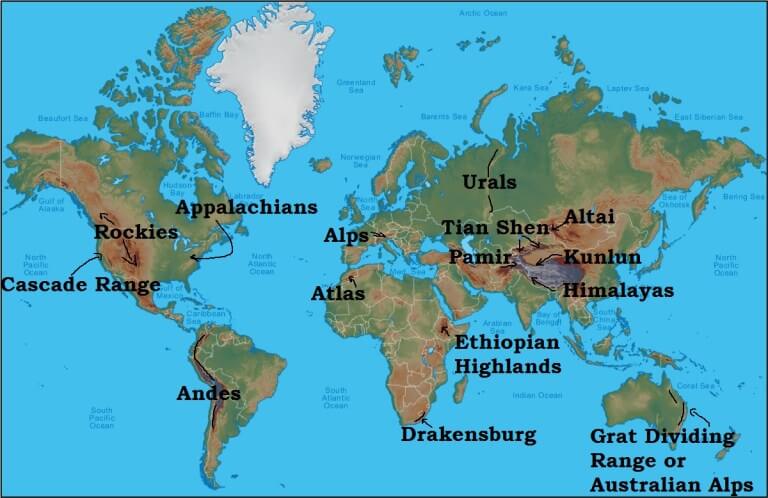
    Mountain Ranges

    Sr. No. Mountain Range Important/Highest Peaks Location Description
    1 Rocky Mountains Mt. Elbert (highest peak in the Rockies) North America It is one of the longest fold mountains in the world and extends from Canada to Western US (New Mexico State)
    2 Appalachian Mountains Mt. Mitchell, North Carolina, US (highest peak of Appalachian Mountains) North America It is a fold mountain with rich in mineral resources
    3 Alps Mont Blanc (French –Italian border) Europe It is a folded mountain and source for rivers like Danube, Rhine, etc.
    4 Sierra Nevada Mt. Whitney California, USA Habitat for many Red Indian tribes
    5 Alaska Range Mt. McKinley North America Mt. McKinley highest peak in North America
    6 Altai Mountains Belukha mountain Central Asia Young folded mountain which extends from Kazakhstan to northern China.
    7 Andes Mountains Mt. Aconcagua South America Longest mountain chain in the world
    8 Atlas Mountains Mt. Toubkal Northwestern Africa Young fold mountain spreading over Morocco and Tunisia.
    9 Drakensberg Mountains Mt. Lesotho South Africa Young folded mountain
    10. Caucasus Mountain Mt. Elbrus Europe Located between the Black Sea and the Caspian Sea
    11. Ural Mountains Mt. Narodnaya Russia This mountain range act as a boundary between Europe and Asia.
    12. Hindukush Mountains Mt. Trich Mir Pakistan and Afghanistan Folded mountain with rugged topography which makes it difficult for transportation.
    13. Himalayas Mt. Everest Asia Young fold mountains in Asia which separates Indian sub-continent from Asian plains
    14. Arakan Yoma Mt. Kennedy peak Myanmar It extends from north to south direction. Shifting cultivation is practised.
    15. Kunlun Mountains Mt. Muztag North of Tibetan plateau and western China It is one of the young folded mountains.
    16. Vosges Mt. Grand Ballon Eastern France, Europe Famous for the cultivation of grapes and manufacture of wines.
    17. Great Dividing Range Mt. Kosciuszko Australia This range is the source for the rivers Darling and Murray.


    Mountains-in-the-world

  • [Prelims Spotlight] Important Governor Generals and Viceroys


    Prelims Spotlight is a part of “Nikaalo Prelims 2020” module. This open crash course for Prelims 2020 has a private telegram group where PDFs and DDS (Daily Doubt Sessions) are being held. Please click here to register.


    9th March 2020

    With almost absolute power the Governor-General and viceroy played a significant role in the shaping history of the country. Following are some of these important figures and significant events and major reforms carried out by them.

            Governor Generals of                            Bengal/India

                        (Period)

                      Important events/Reforms


    Warren Hastings

    (1773-1785)


    Regulating Act of 1773.

    First Governor-General of Bengal.

    End of the dual system of administration (1765-1772).

    Supreme Court at Calcutta.

    Wrote Introduction to the first English translation of Gita.

    Founded Madarasa Aliya at Calcutta.


    Lord Cornwallis

    (1786-1793)


    Separation of three branches of service: commercial, judicial and revenue.

    Permanent Land Revenue Settlement of Bengal-1793.

    Reformed, modernised and rationalised the civil service.

    Introduced the Cornwallis Code.

    Sanskrit College, Varanasi.


    Lord Wellesley

    (1797-1805)


    Introduction of Subsidiary Alliance System.

    Fourth Anglo-Mysore war.

    Fort William College, Calcutta.


    Lord Hastings

    (1813-1823)


    Anglo-Nepal War-(1814-16)

    Third Anglo-Maratha War-(1817-19) and dissolution of Maratha confederacy.

    Introduction of Ryotwari System of Thomas Munro, Governor of Madras-1820.


    Lord William Bentinck

    (1828-1835)


    Charter Act of 1833.

    Abolition of Sati-1829.

    Resolution of 1835 and Education reforms and introduction of English as the official language.

    The annexation of Mysore-1831, Coorg, and Central Cachar-1831.


    Lord Dalhousie

    (1848-1856)


    Introduction of the Doctrine of Lapse and annexations of Satara-1848, Jaitpur and Sambhalpur-1849, Udaipur-1852, Jhansi-1853, Nagpur-1854 and Awadh-1856.

    Wood’s Dispatch of 1854.

    Railway Minute of 1853.

    Telegraph and Postal reforms.

    Widow Remarriage Act-1856.


    Lord Canning

    (1856-1857)


    Establishment of universities at Bombay, Madras and Calcutta.

    Mutiny of 1857.


           Governor-General                            and

             Viceroy of India

                    (Period)

                                   Important events/Reforms
     Lord Canning

    (1858-1862)

    Transfer of control from East India Company to the Crown by the Government of India Act 1858

    Indian Councils Act-1861


    Lord Mayo

    (1869-1872)


    Opening of Rajkot College in Kathiawad and Mayo College at Ajmer for political training of Indian Princes.

    Statistical Survey of India was established.

    Department of Agriculture and Commerce was established.

    Introduction of state railways.


    Lord Lytton

    (1876-1880)


    The great famine of 1876 affecting Bombay, Madras, Mysore, Hyderabad, Central India and Punjab.

    Appointment of Famine Commission under the presidency of Richard Strachey.

    Vernacular Press Act was passed- 1878.

    The Arms Act-1878.


    Lord Ripon

    (1880-1884)


    Education Commission 1882 under William Hunter-1882.

    Ilbert Bill controversy.

    Repeal of Vernacular Press Act in 1882.

    The First Factory Act in 1881 to improve labour conditions.

    Government resolution on local self government-1882.


    Lord Dufferin

    (1884-1888)


    Establishment of Indian National Congress.


    Lord Lansdowne

    (1888-1894)


    The categorisation of civil services into imperial, provincial and subordinate.

    Indian Councils Act-1892

    Durand Commission (1893) was set up to define the Durand Line between India and Afghanistan.


    Lord Curzon

    (1899-1905)


    Police Commission (1902) was appointed under Sir Andrew Frazer.

    University Commission (1902) was appointed and Universities Act (1904) was passed.

    Department of Commerce and Industry was established.

    Calcutta Corporation Act-1899

    Partition of Bengal (1905).


    Lord Minto-II

    (1905-1910)


    Popularisation of anti-partition and Swadeshi Movements.

    Split in Indian National Congress at Surat in 1907.

    Indian Muslim League was established by Aga Khan (1907)

    Morley-Minto reforms or Indian Councils Act 1909.


    Lord Hardinge-II

    (1910-1916)

     Transfer of capital from Calcutta to Delhi (1911).

    Establishment of Hindu Mahasabha (1915) by Madan Mohan Malviya.

          Lord Chelmsford

    (1916-1921)

    Home Rule League was formed by Annie Besant and Tilak (1916)

    Lucknow session of Congress (1916).

    Lucknow Pact between Congress and Muslim League (1916).

    Champaran Satyagraha (1918), and Satyagraha at Ahmadabad (1918).

    Montague’s August Declaration.

    Government of Indian Act- 1919

    Jallianwalla Bagh massacre (1919).

    Non-Cooperation and Khilafat Movements were launched.

    Foundation of Women’s University at Poona (1916) and Saddler’s Commission was appointed for reforms in educational policy.

    Appointment of S. P. Sinha as governor of Bihar first Indian to do so.


    Lord Reading

    (1921-1926)


    The Chaura-Chauri Incident-Feb5, 1922 and withdrawal of Non-Cooperation movement.

    Moplah rebellion in Kerala (1921).

    Repeal of the Press Act of 1910 and Rowlatt Act of 1919.

    Kakori train robbery (1925)

    Establishment of Swaraj Party (1922).

    The decision to hold a simultaneous examination for ICS in Delhi and London with effect from 1923.


    Lord Irwin

    (1926-1931)


    Simon Commission-1928

    Appointment of the Harcourt Butler Indian States Commission (1927)

    Murder of Saunders and Bomb blast in the Assembly Hall of Delhi-1929

    Lahore session of Congress 1929 and Purna Swaraj Resolution.

    Dandi March (12 March, 1929) and launch of Civil Disobedience Movement.


    Lord Willingdon

    (1931-1936)


    Second Round Table Conference and failure of the conference, resumption of the Civil Disobedience Movement.

    Announcement of the Communal Award (1932).

    Poona Pact (1932)

    Third Round Table Conference 1932.

    The Government of India 1935.

    Establishment of All India Kisan Sabha 1936.

    Establishment of Congress Socialist Party by Acharya Narendra Dev and Jayaprakash Narayan (1934)


    Lord Linlithgow

    (1936-1944)


    First general elections were held and Congress attained absolute majority (1936-1937).

    Congress ministers resigned (1937) after the outbreak of WW-II

    Subhash Chandra Bose elected as the president of Congress-1938.

    Lahore Resolution by Muslim League for the demand of separate state for Muslims.

    August Offer by the viceroy-1940.

    Cripp’s Mission to India

    Passing of the Quit India Resolution by Congress-1942


    Lord Wavell

    (1944-1947)


    C Rajgopalachari’s CR Formula (1944) and Gandhi-Jinnah Talks failed.

    Wavell Plan and the Shimla Conference (1942)

    Cabinet Mission and Congress accepted its plan 1946

    Observance of the ‘Direct Action Day’ (16 August 1946) by the Muslim League.

    Elections to the Constituent Assembly and formation of Interim Government by the Congress (September 1946).

    Announcement of the end of British rule in India by Clement Attlee on February 20, 1946


    Lord Mountbatten

    (1947-48)

    June Third Plan (June 3, 1947) announced.

    Introduction of Indian Independence Bill in the House of Commons.

    Appointment of two boundary commissions under Sir Cyril Radcliff for the partition of Bengal and Punjab.


  • Mission Nikaalo Prelims | Open Crash Course | Starts 6th March 2020

    Mission Nikaalo Prelims | Open Crash Course | Starts 6th March 2020


    Dear students,

    We are thrilled to launch the 3rd edition of our OPEN Crash Course [Nikaalo Prelims]. The last 2 editions have been immensely helpful to aspirants who wanted a fast-paced revision sequence. With Nikaalo Prelims you get our full commitment for the next 75 days with these 3 things: 

    1. Daily Doubt Sessions (2 hours of community doubt solving sessions)
    2. Prelims Spotlight (simplified, synthesized, byte-sized information collated in notes)
    3. Static & CA Tests (alternate days, 20 questions with rich explainers & active doubt resolution sessions)

    Note: If you want to see how our prelims test series have helped aspirants in the past, both in building capabilities, smart hacks and prediction (relevance), please read on this link


    • The registration will be done here: Click & Register here
    • Once you fill the fields, you will be enlisted in a close community Telegram Group where you will receive PDFs of Prelims Spotlight, Revision Tests and other value-added material
    • The telegram group will also be the only place where we will have DDS sessions
    • We start on 6th March 2020. 10 AM sharp.
    • Here’s the time table of the Nikaalo Prelims

    How is this program any different from the other “x-day revision programs”?

    There are many institutes and websites offering open crash courses (that too for free) and most of them have their heart & efforts in a good place. Like them, we also believed that drawing up a time table and collating questions together in one place will help in an effective revision.

    But we got to know better when we started having deeper interactions with our Decimate Prelims community. We started DDS (Daily Doubt Sessions) by inviting doubts from across the spectrum & study material. We aimed at resolving all doubts in 15 minutes or less and kept the discussion open in case students want to follow-up with subsequent questions and more.

    Here’s what we found:

    More doubts = more conversations = increased chances of multiple threads = revision & retention


    And now that we know better, we have decided to include a mini DDS for Nikaalo Prelims batch as well. And that’s what separates us from the rest.

    But that’s not it. We have upped our offerings in the static & dynamic revision modules as well. Here’s how:

    • Prelims SPOTLIGHT

    This initiative is meant to help you revise details and facts that can be asked in prelims. They are simplified, synthesized and prepared using most authentic sources. These can easily slip your mind or you can easily confuse these. Continuous Revision for the same is required. Dare you to miss the updates!

    You will get PDFs for these notes. Trust us, less is more. We won’t overwhelm. you with content just coz we can 🙂

    • Static Subject Revision and Tests 

    The timetable for the static subjects is released. Tests will start on the 6th of March. 

    Coverage and Relevance are the 2 Pillars of our Tests.

    1. You appear for a test every alternate day at 8 PM. 
    2. We believe some breathing time is necessary to ensure consistency and efficiency. Besides, a good revision also requires quality time commitment. 
    3. Instant score after you submit your test with proper explanations for the questions. 
    4. Top 10 Ranks will be announced for every test at the launch of the next test.  

    Please ensure you attempt the tests with utmost sincerity.

    • 3. Daily Doubt Sessions: There will be daily doubt sessions on a daily basis for your doubt resolutions regarding tests and prelims spotlights. This will ensure that all important topics are covered, you are not left with any confusion or doubt and get some additional information as well.

    Click here to register


  • [Prelims Spotlight] Various Defence Exercises in News


    Prelims Spotlight is a part of “Nikaalo Prelims 2020” module. This open crash course for Prelims 2020 has a private telegram group where PDFs and DDS (Daily Doubt Sessions) are being held. Please click here to register.


    7th March 2020

    Various Defence Exercises in News

    The defence is a major part of any country. Thus, every country tries and devotes half of its budget in defence. So, there are joint military exercises happening which benefits both the participating nations. Thus, in this article, we will discuss some of the important joint exercises in India like Indra and Maitree. Also, these exercises are important from learning as well as the strategic point of view for both the nations.

    India + XYZ Army Navy Air Force
    ASEAN + Force 18
    Australia AUSTRA HIND AUSINDEX / KAKADU
    Bangladesh Sampriti CORPAT
    China Hand in hand Chang Thang
    France Shakti Varuna GARUDA
    Indonesia GARUDA SHAKTI IND-INDO CORPAT

    And

    Samudra Shakti

    Japan Dharma Guardian Malabar (India, Japan, and the USA), Sahyog-Kaijin SHINYUU MAITRI
    Kazakhstan Prabal Dostyk and KAZIND
    Kyrgyzstan Khanjar
    Maldives Ekuverin
    Mongolia Nomadic Elephant / KHAN QUEST
    Nepal Surya Kiran (BIANNUAL)
    Oman AL NAGAH (SUCCESS) Naseem Al Bahr Eastern Bridge-IV
    Russia Indra INDRA NAVY AVIAINDRA-14
    Seychelles LAMITYE
    Singapore Ex AGNI WARRIOR and Ex BOLD KURUKSHETRA SIMBEX JOINT MILITARY TRAINING
    South Africa, Brazil IBSAMAR
    Sri Lanka Mitra Shakti SLINEX
    Thailand Maitree /  COBRA GOLD (Observer Plus) INDO-THAI CORPAT (Bi-annual) SIAM BHARAT
    UAE Desert Eagle-II
    UK Ajeya Warrior Konkan IndraDhanush -IV
    or “Rainbow”.
    USA YudhAbhyas/ Cope/

    Tiger Triumph

    VAJRA PRAHAR

    Malabar RIMPAC (Multilateral) Red Flag
    Brunei ADMM+ Exercise (Multilateral)
    Malaysia MAITREE ARF DIREx
    Myanmar IMBEX IMCOR
    Qatar Za’ir-Al-Bahr (Roar of the Sea)    
    Uzbekistan Dustlik    


    Other Important Exercise

    Exercise TSENTR 2019 China, Tajikistan, India, Kyrgyzstan, Kazakhstan, Pakistan and Uzbekistan Russia(Host)

  • Nikaalo Prelims | Over 100 doubts resolved in first session, don’t delay join us.

    Nikaalo Prelims | Over 100 doubts resolved in first session, don’t delay join us.

    Dear students,

    Yesterday we launched the 3rd edition of Nikaalo Prelims and we got a tremendous response. Click here to register

    Here is a summary of our first DDS session:

    • Over 300 students joined the group in a very short period of time.
    • Over 500 messages were interchanged during the session in which more than 100 doubts were resolved and several questions with Tikdam were discussed.
    • PDF of the prelims spotlight was shared.                                                                                                                                                                                                                                                                                                                                                                                                                                                                                                   The last 2 editions have been immensely helpful to aspirants who wanted a fast-paced revision sequence.  you get our full commitment for the next 75 days with these 3 things:                                                                                                   
    1. Daily Doubt Sessions (2 hours of community doubt solving sessions)
    2. Prelims Spotlight (simplified, synthesized, byte-sized information collated in notes)
    3. Static & CA Tests (alternate days, 20 questions with rich explainers & active doubt resolution sessions)

    Note: If you want to see how our prelims test series have helped aspirants in the past, both in building capabilities, smart hacks and prediction (relevance), please read on this link

    How is this program any different from the other “x-day revision programs”?

    There are many institutes and websites offering open crash courses and most of them have their heart & efforts in a good place. Like them, we also believed that drawing up a time table and collating questions together in one place will help in an effective revision.

    But we got to know better when we started having deeper interactions with our Decimate Prelims community. We started DDS (Daily Doubt Sessions) by inviting doubts from across the spectrum & study material. We aimed at resolving all doubts in 15 minutes or less and kept the discussion open in case students want to follow-up with subsequent questions and more.

    Here’s what we found:

    More doubts = more conversations = increased chances of multiple threads = revision & retention

    And now that we know better, we have decided to include a mini DDS for the Nikaalo Prelims batch as well. And that’s what separates us from the rest.

    But that’s not it. We have upped our offerings in the static & dynamic revision modules as well. Here’s how:

    • Prelims SPOTLIGHT

    This initiative is meant to help you revise details and facts that can be asked in prelims. They are simplified, synthesized and prepared using most authentic sources. These can easily slip your mind or you can easily confuse these. Continuous Revision for the same is required. Dare you to miss the updates!

    You will get PDFs for these notes. Trust us, less is more. We won’t overwhelm. you with content just coz we can 🙂

    • Static Subject Revision and Tests 

    The timetable for the static subjects is released. Tests will start on the 6th of March. 

    Coverage and Relevance are the 2 Pillars of our Tests.

    1. You appear for a test every alternate day at 8 PM. 
    2. We believe some breathing time is necessary to ensure consistency and efficiency. Besides, a good revision also requires a quality time commitment. 
    3. Instant score after you submit your test with proper explanations for the questions. 
    4. Top 10 Ranks will be announced for every test at the launch of the next test.  

    Please ensure you attempt the tests with utmost sincerity.

    • 3. Daily Doubt Sessions: There will be daily doubt sessions on a daily basis for your doubt resolutions regarding tests and prelims spotlights. This will ensure that all important topics are covered, you are not left with any confusion or doubt and get some additional information as well.

    Click here to register

  • *Get registered* for Open lectures on Union Budget 2020-21 and Economic Survey 2019-20 by Mr. Himanshu, Economist and Public policy specialist on 7-8 March 2020

    *Get registered* for Open lectures on Union Budget 2020-21 and Economic Survey 2019-20 by Mr. Himanshu, Economist and Public policy specialist on 7-8 March 2020

    Economic survey and Union budget are the two most important economic documents of the Government of India. They outline the vision for the Indian economy, government initiatives and schemes, challenges faced, and mitigating strategies.


    The importance of Union budget and economic survey can’t be overstated, not only for UPSC prelims but also for Mains and Essay as well, it is a not to be missed section for preparation. Even for UPSC interview candidates, these lecture series are very important.

    Two lectures are planned to be taken by Mr. Himanshu, Economist and Public policy specialist, he has worked at PMEAC in the past, has been a columnist in The Hindu and Indian Express, and is currently working at Parliament of India. 


    The lecture series will give students a detailed understanding of survey and budget, key issues, concept, technical ideas discussed in it. The course is designed for both students who have no background in economics and have some familiarity with economics. It will go beyond the survey and budget to make students understand the static theories behind the idea presented in the survey. 

    Details of the lectures:

    Lecture on Union Budget

    Date: 7th March 2020

    Time: 5 p.m. onwards (entry closes at 4:45 p.m.)


    Lecture on Economic survey

    Date: 8th March 2020

    Time: 5 p.m. onwards (entry closes at 4:45 p.m.)


    Venue: Civilsdaily IAS Center, 1LGF, Apsara Arcade, Karol Bagh


    Click here to get registered: https://forms.gle/EQ53tfBSqzpJpPwq7


    Note: Entry on a first-come, first-served basis. Limited seats are available.

    For any queries reach out to atul@civilsdaily.com

  • [Prelims Spotlight] Important Articles/ Schedules of the Constitution

    Prelims Spotlight is a part of “Nikaalo Prelims 2020” module. This open crash course for Prelims 2020 has a private telegram group where PDFs and DDS (Daily Doubt Sessions) are being held. Please click here to register.


    6th March 2020 

    Important Articles / Schedules of the Constitution.

    The Constitution of India is the supreme law of India. The document lays down the framework demarcating fundamental political code, structure, procedures, powers, and duties of government institutions and sets out fundamental rights, directive principles, and the duties of citizens. 

    It was adopted by the Constituent Assembly of India on 26 November 1949 and became effective on 26 January 1950. The constitution replaced the Government of India Act 1935 as the country’s fundamental governing document, and the Dominion of India became the Republic of India. To ensure constitutional autonomy, its framers repealed prior acts of the British parliament in Article 395. 

    The constitution declares India a sovereign, socialist, secular, democratic republic, assuring its citizens justice, equality and liberty, and endeavours to promote fraternity. The original 1950 constitution is preserved in a helium-filled case at the Parliament House in New Delhi. The words “secular” and “socialist” were added to the preamble in 1976 during the emergency.

    The Indian constitution is the world’s longest for a sovereign nation. At its enactment, it had 395 articles in 22 parts and 8 schedules. At about 145,000 words, it is the second-longest active constitution – after the Constitution of Alabama – in the world.

    Articles in Indian Constitution: As the written constitution is a compact document like a book, it has various parts, parts have various chapters, chapters have various articles.

    The constitution has a preamble and 395 articles, which are grouped into 25 parts. With 12 schedules and five appendices, it has been amended 103 times; the latest amendment became effective on 14 January 2019. Despite various amendments, the number of articles in the Constitution still remains 395. There is nothing like Article 396. The new articles are always inserted in between i.e. Article 31A.

    IMPORTANT TITBIT:  If counted separately there are 444 Articles but in the Constitution of India there are only 396 Articles. The rest are merely clauses or sub-clauses added later. The reason behind this is that there is a rule that no one can alter the basic structure of the COI. Now a problem came up, which was how to include more articles as you cannot add a 397th article as it would be against the Basic Structure Doctrine, so a solution that came up, which was that to include the new articles in clauses or sub-clauses of the existing articles.

    Here are the lists of various important Articles of the Indian Constitution. 

    S.No

    Article

    Deals with

    1 1 Name and Territory of Union
    2 3 New States Formation, Alteration of Boundaries, etc.
    3 13 Laws inconsistent with or in derogation of the Fundamental Rights
    4 14 Equality before Law (popularly known as Right to Equality)
    5 15 Prohibition of Discrimination (on basis of religion, race, caste, sex or place of birth)
    6 16 Equality in case of Public Employment
    7 17 Abolition of Untouchability
    8 18 Abolition of Titles
    9 19 Protection of Certain Rights to Freedom (popularly known as Right to Freedom)
    10 19a Freedom of Speech & Expression
    11 19b Right to Peaceful Assembly
    12 19c Freedom of Association
    13 19d Right to Move Freely through India
    14 19e Freedom of Settlement & Residence
    15 19f (Omitted as a fundamental right – governed by article 300A.) Right to Own Personal Property.
    16 19g Freedom to Practise any Profession, Occupation, Trade or Business
    17 21 Right to Life and Personal Liberty
    18 21A Right to Education
    19 23 Prohibition of Human Trafficking and Forced Labour
    20 24 Prohibition of Child Labour
    21 25 Freedom to Practise & Propagate Religion Freely
    22 29 Protection of Interests of Minorities
    23 32 Remedies for enforcement of Fundamental Rights including writs
    24 44 Uniform Civil Code
    25 50 Separation of Judiciary from Executive
    26 51 Promotion of International Peace and Security
    27 51A Fundamental Duties
    28 72 Powers of President to Grant Pardons etc.
    29 76 Attorney-General of India
    30 78 Duties of Prime Minister
    31 85 Sessions of Parliament, Prorogation and Dissolution
    32 93 The Speaker & Deputy Speaker of Lok Sabha
    33 100 Voting in Houses
    34 105 Powers, Privileges, etc. of Members of Parliament
    35 106 Salaries and Allowances of Members of Parliament
    36 108 Joint Sitting of both Houses of Parliament
    37 109-110 Money Bills
    38 112 Budget
    39 123 President’s Power to Promulgate Ordinance while Parliament in Recess
    40 127 Appointment of ad hoc Judges in the Supreme Court
    41 139 Supreme Court’s Powers to Issue Certain Writs
    42 141 Supreme Court’s Law Binding on All Courts
    43 148-149 Comptroller and Auditor-General of India
    44 155 Appointment of Governor
    45 161 Power of Governors to Grant Pardon etc.
    46 165 Advocate-General for the State
    47 167 Duties of Chief Minister
    48 224 Appointment of Additional & Acting Judges in High Courts
    49 224A Appointment of Retired Judges in High Courts
    50 226 Power of High Courts to issue writs
    51 280 Finance Commission
    52 312 All India Services
    53 324 Election Commission
    54 335 SCs and STs claim to Services and Posts
    55 343 Official Language
    56 352 National Emergency
    57 356 President’s Rule in case of Failure of Constitutional Machinery in States
    58 360 Financial Emergency
    59 368 Power of Parliament to Amend the Constitution
    60 370 Temporary provisions with respect to the state of Jammu and Kashmir
    61 392 Power of the President to remove difficulties


    Schedules of the Indian Constitution:

    Like a book contains appendices to explain things and provide extra info, the constitution contains various schedules. They are Lists that categorize and tabulate bureaucratic activity and policy of the Government. They are kept separate because it is a lengthy document and hence, not included in the original text of constitution but they are very much part of the constitution. 


    Important Titbits:

    1. Originally they were 8 in number, now they are 12. 
    2. The 4 new schedules were added: IX through the 1st Constitution Amendment Act 1951); X through Anti-Defection Law 52nd CAA 1985; XI through the 73rd CAA Panchayati Raj 1992 and XII through the 74th CAA Municipality 1992.
    3. Matters added to the 9th schedule after 24th April 1973 (Kesavananda Bharati Case) are not immune to judicial review (I.R. Coelho case)


    Schedules of Indian Constitution


    Numbers

    Subject Matter

    First Schedule
    1. Names of the States and their territorial jurisdiction.
    2. Names of the Union Territories and their extent.
    Second Schedule Provisions relating to the emoluments, allowances, privileges and so on of:

    1. The President of India
    2. The Governors of States
    3. The Speaker and the Deputy Speaker of the Lok Sabha
    4. The Chairman and the Deputy Chairman of the Rajya Sabha
    5. The Speaker and the Deputy Speaker of the Legislative Assembly in the states
    6. The Chairman and the Deputy Chairman of the Legislative Council in the states
    7. The Judges of the Supreme Court
    8. The Judges of the High Courts
    9. The Comptroller and Auditor-General of India
    Third Schedule Forms of Oaths or Affirmations for:

    1. The Union ministers

    2. The candidates for election to the Parliament

    3. The members of Parliament

    4. The judges of the Supreme Court

    5. The Comptroller and Auditor-General of India

    6. The state ministers

    7. The candidates for election to the state legislature

    8. The members of the state legislature

    9. The judges of the High Courts

    Fourth Schedule Allocation of seats in the Rajya Sabha to the states and the union territories.
    Fifth Schedule Provisions relating to the administration and control of scheduled areas and scheduled tribes.
    Sixth Schedule Provisions relating to the administration of tribal areas in the states of Assam, Meghalaya, Tripura and Mizoram.
    Seventh Schedule Division of powers between the Union and the States in terms of List I (Union List), List II (State List) and List III (Concurrent List). Presently, the Union List contains 100 subjects (originally 97), the state list contains 61 subjects (originally 66) and the concurrent list contains 52 subjects (originally 47).
    Eighth Schedule Languages recognized by the Constitution. Originally, it had 14 languages but presently there are 22 languages. They are: Assamese, Bengali, Bodo, Dogri (Dongri), Gujarati, Hindi, Kannada, Kashmiri, Konkani, Mathili (Maithili), Malayalam, Manipuri, Marathi, Nepali, Oriya, Punjabi, Sanskrit, Santhali, Sindhi, Tamil, Telugu, and Urdu. Sindhi was added by the 21st Amendment Act of 1967; Konkani, Manipuri and Nepali were added by the 71 st Amendment Act of 1992; and Bodo, Dongri, Maithili and Santhali were added by the 92nd Amendment Act of 2003.
    Ninth Schedule Acts and Regulations (originally 13 but presently 282) 19 of the state legislatures dealing with land reforms and the abolition of the zamindari system and of the. Parliament dealing with other matters. This schedule was added by the 1st Amendment (1951) to protect the laws included in it from judicial scrutiny on the ground of violation of fundamental rights. However, in 2007, the Supreme Court ruled that the laws included in this schedule after April 24, 1973, are now open to judicial review.
    Tenth Schedule Provisions relating to the disqualification of the members of Parliament and State Legislatures on the ground of defection. This schedule was added by the 52nd Amendment Act of 1985, also known as Anti-defection Law.
    Eleventh Schedule Specifies the powers, authority and responsibilities ofPanchayats. It has 29 matters. This schedule was added by the 73rd Amendment Act of 1992.
    Twelfth Schedule Specifies the powers, authority, and responsibilities of Municipalities. It has 18 matters. This schedule was added by the 74th Amendment Act of 1992.


  • 28th February 2020| Daily Answer Writing Enhancement

    Important Announcement: In the month of February, we will be covering UPSC Mains GS questions of 2019. This will give you real time experience of attempting GS questions of UPSC Mains.


    Question 1)

    Are we losing your local identity for the global identity? Discuss. (15 Marks)

    Question 2)

    What introduces friction into the ties between India and the United States is that Washington is still unable to find for India a position in its global strategy, which would satisfy India’s national self-esteem and ambitions’. Explain with suitable examples. (15 Marks)

    Question 3)

    The cross-border movement of insurgents is only one of the several security challenges facing the policing of the border in North-East India. Examine the various challenges currently emanating across the India-Myanmar border. Also, discuss the steps to counter the challenges. (15 Marks)

    Question 4)

    Edward Snowden, a computer expert, and former CIA administrator released confidential Government documents to the press about the existence of Government surveillance programs. According to many legal experts and the US Government, his action violated the Espionage act of 1971, which identified the leak of State secret as an act of treason. Yet, despite the fact that he broke the law, Snowden argued that he had a moral obligation to act. He gave a justification for his “whistleblowing” by stating that he had a duty “to inform the public as to that which is done in there name and that which is done against them.” According to Snowden, the Government’s violation of privacy had to be exposed regardless of legality since more substantive issues of social action and public morality were involved here. Many agreed with Snowden. Few argued that he broke the law and compromised national security, for which he should be held accountable. Do you agree that Snowden’s actions were ethically justified even if legally prohibited? Why or why not? Make an argument by weighing the competing values in this case (20 Marks)  

    Reviews will be provided in a week. (In the order of submission- First come first serve basis). In case the answer is submitted late the review period may get extended to two weeks.

    *In case your answer is not reviewed in a week, reply to your answer saying *NOT CHECKED*. If Parth Sir’s tag is available then tag him.

    For the philosophy of AWE and payment, check  here: Click2Join

  • *URGENT- Mock Interview this week(29 Feb & 1 Mar 2020)- Register now!

    We hope your preparation is going well. 

    Mock Interviews at Civilsdaily form a crucial part of UPSC interview preparation. The quality and diversity of the panel helps prepare an aspirant for the actual interview at UPSC. 

    Aspirants have benefited greatly from the mock interview and the feedback they got from the panel members after their mock interview. At the same time, we work with the aspirants to improve upon the areas highlighted by the panel.  

    Aspirants will also get a personalized DAF based questionnaire based on extensive research and linkages with the issues of national and international importance. 

    The schedule of Mock Interviews for this week has been fixed. 

    Date: 29th Feb and 1st March 2020 (Book your slot)   

    Time: 10 a.m. – 7 p.m.  

     Venue: Civilsdaily HQ, 1LGF, Apsara Arcade, Karol Bagh 

    Interview slots will be allocated on a first-come, first-served basis.  

    Special lectures and Group Discussion sessions have been planned at the Civilsdaily Center. Details will be updated soon on the website.

    Panelists for Mock Interviews: 

    1. Lt. Gen (retd.) Rameshwar Roy
    2. Shri R. P. Singh, IPS (retd.)
    3. Shri V. P. Singh, IRPS
    4. Shri T. N. Thakur, IAAS (retd.)
    5. Dr.MakhanSaikia, Senior Editor, The Pioneer  
    6. Mr. Rakesh Dalal, Core Faculty, Civilsdaily 
    7. Mrs.AditiGupta, Corporate Leadership Specialist 
    8. Mr. Himanshu Arora, Economist, JNU, PMEAC  

    Tentative: Shri Harsh V. Pant (Observer Research Foundation), Shri SN Tripathi, IAS (Director IIPA), Shri Yogesh Narain (Retd. Defence Secretary), Shri Dipankar Gupta (Indian Sociologist) and others.   

     You all are supposed to submit your DAFs and selfie videos answering four questions provided to you. These will form the basis for mock interviews, DAF analysis, and personalized DAF-based questionnaire.  

     Note- For any query/sending DAFs and videos reach out to atul@civilsdaily.com 


  • Get ready for the upcoming January Current Affairs Prelims Test on 29th February- sample questions highlighting our methodology

    Click here to enroll for the Prime Prelims TS

    Dear students,

    31st May 2020 is the D-day for all civil service aspirants.

    “Give me six hours to chop down a tree and I will spend the first four sharpening the ax.”

    This quote by Abraham Lincoln clearly sums up how one should prepare for that day. So before entering the battlefield alone should have enough practice. Our Prime Prelims Test series which shall enrich you to acquaint yourself with the pattern of CSE-2020, assess your abilities, rectify your mistakes and make you confident to appear on the examination day.

    Our Prime Prelims Test Series follows the same approach as that adopted by UPSC. Our team of experts is quite enriched with the UPSC pattern and focal point of the questions and hence creates more chances for the aspirants to crack civil service examination by appearing our Test Series.

    The key philosophy of our prelims TS is Evidence-based question making: The 3600 questions you face in our mocks have their relevance established in UPSC’s trend analysis. We focus on themes that are important as per UPSC so that we maximize your chances of questions overlap with the actual UPSC Prelims.

    Nothing speaks more than the facts itself rather than a mere jargon. Here is a list of 5 sample questions from the upcoming Current Affairs test which will help you in identifying the standards and approach we follow. (you can skip this if you want to attempt these directly in the test). 

    Noone but only you can assess how it will help you in being the top percentile of aspirants. You have to practice ruthlessly and civils Daily provides you with a platform to hone your skills.


    Q1. Consider the following statements with respect to ISRO’s satellite navigation system (NavIC):

    1. NavIC-based vehicle trackers mandatory for all commercial vehicles in the country from April 2019.
    2. The international body 3GPP (the mobile communications standards body) has approved NavIC to be included in mobiles.

    Which of the statements mentioned above is/are correct?

    a. 1 only

    b. 2 only

    c. Both of them

    d. Neither of them


    Q2. Consider the following statements with respect HSN (Harmonised System of Nomenclature):

    1. This system has been introduced for the systematic classification of goods all over the world.
    2. HSN code is a 9-digit uniform code.
    3. It was developed by the World Trade Organization (WTO) and it came into effect from 1988.

    Which of the statements mentioned above is/are correct?

    a. 1 only

    b. 2 and 3 only

    c. 1 and 3 only

    d. All of them


    Q3. An artificial satellite orbiting around the Earth does not fall down. This is so because of the attraction of Earth:

    a. does not exist at such distance

    b. is neutralized by the attraction of the moon

    c. provides the necessary speed for its steady motion

    d. provides the necessary acceleration for its motion


    Q4. Accretion burst event is related to:

    a. Activity related to the formation of a star

    b. A sudden increase in coral reef

    c. A large accumulation of rocks in Kuiper Belt

    d. None of the above


    Q5. As per the Medical Termination of Pregnancy Act 1971:

    1. The upper limit for termination of pregnancy is 20 weeks.
    2. The contraceptive-failure clause of the act includes for termination include “any women or her partner”.

    Which of the above statements is/are correct?

    a. 1 only

    b. 2 only

    c. Both of them

    d. Neither of them