GS-1 History of the world will include events from 18th century such as industrial revolution, world wars, redrawal of national boundaries, colonization, decolonization, political philosophies like communism, capitalism, socialism etc.— their forms and effect on the society.
GS-2 Important aspects of governance, transparency and accountability, Issues relating to development and management of Social Sector/Services relating to Health, Education, Human Resources.
GS-3 Public Distribution System- objectives, functioning, limitations, revamping
GS-4 Attitude: content, structure, function; its influence and relation with thought and behaviour; moral and political attitudes; social influence and persuasion.
HOW TO ATTEMPT ANSWERS IN DAILY ANSWER WRITING ENHANCEMENT(AWE)?
Daily 4 questions from General studies 1, 2, 3, and 4 will be provided to you.
A Mentor’s Comment will be available for all answers. This can be used as a guidance tool but we encourage you to write original answers.
You can write your answer on an A4 sheet and scan/click pictures of the same.
Upload the scanned answer in the comment section of the same question.
Along with the scanned answer, please share your Razor payment ID, so that paid members are given priority.
If you upload the answer on the same day like the answer of 11th February is uploaded on 11th February then your answer will be checked within 72 hours. Also, reviews will be in the order of submission- First come first serve basis
If you are writing answers late, for example, 11th February is uploaded on 13th February , then these answers will be evaluated as per the mentor’s schedule.
We encourage you to write answers on the same day. However, if you are uploading an answer late then tag the mentor like @Staff so that the mentor is notified about your answer.
*In case your answer is not reviewed, reply to your answer saying *NOT CHECKED*.
GS-1 Post-independence consolidation and reorganization within the country.
GS-2 Panchayats & Local Bodies
GS-3 Indian Economy
GS-4 Human Values – lessons from the lives and teachings of great leaders, reformers and administrators; role of family society and educational institutions in inculcating values.
HOW TO ATTEMPT ANSWERS IN DAILY ANSWER WRITING ENHANCEMENT(AWE)?
Daily 4 questions from General studies 1, 2, 3, and 4 will be provided to you.
A Mentor’s Comment will be available for all answers. This can be used as a guidance tool but we encourage you to write original answers.
You can write your answer on an A4 sheet and scan/click pictures of the same.
Upload the scanned answer in the comment section of the same question.
Along with the scanned answer, please share your Razor payment ID, so that paid members are given priority.
If you upload the answer on the same day like the answer of 11th February is uploaded on 11th February then your answer will be checked within 72 hours. Also, reviews will be in the order of submission- First come first serve basis
If you are writing answers late, for example, 11th February is uploaded on 13th February , then these answers will be evaluated as per the mentor’s schedule.
We encourage you to write answers on the same day. However, if you are uploading an answer late then tag the mentor like @Staff so that the mentor is notified about your answer.
*In case your answer is not reviewed, reply to your answer saying *NOT CHECKED*.
The Indian pharma sector supplies over 50 per cent of global demand for various vaccines, 40 per cent of generic demand in the US and 25 per cent of all medicine in the UK.
India is the largest provider of generic drugs globally.
India is the largest contributor in UNESC with over 50-60% share.
Feats achieved by India’s Pharma Sector
Surplus trade: The Pharma trade balance continues to be in India’s favour.
Worldwide production: India ranks 3rd worldwide for Pharmaceutical production by volume and 14th by value. The current market size is around USD 50 billion.
High competitiveness: Indian pharma companies enabled by their price competitiveness and good quality have made a global mark with 60% of the world’s vaccines and 20% of generic medicines coming from India.
Major destinations: India’s top 5 pharma export destinations are the USA, UK, South Africa, Russia and Nigeria.
Regulatory compliance: Around 55 % of our pharma exports from India cater to highly regulated markets. For instance, the largest number of FDA approved plants outside the US is in India.
India’s Pharma Sector: A Backgrounder
India enjoys an important position in the global pharmaceuticals sector.
The country has a large pool of scientists and engineers with the potential to steer the industry ahead to greater heights.
Presently, over 80% of the antiretroviral drugs used globally to combat AIDS (Acquired Immune Deficiency Syndrome) are supplied by Indian pharmaceutical firms.
Its evolution
Over the last few decades, the Indian pharmaceutical industry has experienced rapid expansion, which may be divided into four stages:
Foreign domination: The time before 1970 is considered as the first stage of the pharma industry. At that time, the Indian market was dominated by foreign companies.
Rise of domestic companies: The second stage covers 1970 to 1990 when several domestic companies began operations.
LPG reforms: 1990 to 2010 is the third stage, where liberalization led Indian components to launch operations in foreign countries.
Patent assisted boom: The introduction of the patent bill was one of the first advancements in the pharma industry. It allowed the Indian pharmaceutical sector to become less reliant on intellectual property laws in the US.
Rise of OTC drugs: Over-the-counter drugs (bought without prescriptions) constitute the next biggest segment with 21% of the market segment.
Market Size
According to the Indian Economic Survey 2021, the domestic market is expected to grow 3x in the next decade.
India’s domestic pharmaceutical market is at US$ 42 billion in 2021 and likely to reach US$ 65 billion by 2024 and further expand to reach ~US$ 120-130 billion by 2030.
India’s biotechnology industry comprises biopharmaceuticals, bio-services, bio-agriculture, bio-industry, and bioinformatics.
Who regulates Indian Pharma Sector?
The Drugs and Cosmetics Act, 1940 was the central legislation that regulates India’s drug and cosmetic import, manufacture, distribution and sale.
The Act clearly defines the spurious drugs, adulterated drugs and mis-branded drugs.
This also established the Central Drugs Standard Control Organization (CDSCO).
The Act establishes the regulatory control over the manufacture and sale of drugs.
State Health department has to regulate the manufacturing, sales and distribution of drugs.
Drug Inspectors will control the implementation at ground level.
What made India the world’s pharmacy?
Low manufacturing costs: Compared to other nations, the cost of manufacturing pharmaceutical goods in India is much lower and more effective.
Skilled workforce: India now has a highly-skilled workforce as a result of technological advancements.
R&D: India’s pharma industrial sector is also robust. Most pharma labs has turned into incubators.
Marketing benefits: With economic liberalization, India’s marketing and distribution system are likewise on the higher side. The sector is additionally strengthened by its diversified ecosystem.
Focus on generics: The companies broke into the worldwide market by exploring generic alternatives to costly proprietary medications.
Various govt. policies
FDI relaxation: The government has allowed 100% FDI in Greenfield pharmaceutical projects and 74% FDI in brownfield pharmaceutical projects.
PM Bhartiya Janaushadhi Pariyojana: The government had launched this scheme to supply low-cost pharma drugs to the economically weaker sections.
Bulk Drug Parks: In March 2020, the centre approved the establishment of mega ‘Bulk Drug Parks’ to provide common facilities like solvent recovery, effluent treatment, distillation, etc.
PLI scheme: The Cabinet also approved the ‘Production Linked Incentive Scheme’ for encouraging domestic manufacturing of drug intermediaries.
SPI Scheme: In March 2022, under the Strengthening of Pharmaceutical Industry (SPI) Scheme, a total financial outlay of Rs. 500 crore (US$ 665.5 million) for the period FY 21-22 to FY 25-26 were announced.
Various challenges
FDA mandate in US: The US accounts for more than a quarter of Indian pharmaceutical exports. Every medicine sold in the United States is subject to FDA monitoring and site visits by Indian businesses.
Hostile competition: There is stiff competition from firms in countries like China, Israel and Japan. Hostile and negative lobbying by the big players who frequently accuse Indian firms of violating patent laws.
Over-dependence on China: The industry is highly dependent on China for pharmaceutical raw materials. Indian drug-makers import around 70% of their total Active Pharmaceutical Ingredients (API) / bulk drug requirements from China.
Hollowing out: India today is preferred low-cost producer and exporter of simpler off-patent formulations, the road taken is ‘hollowing out’ manufacturing in raw material: API.
Plagiarism: Fake versions of high value and/or high volume brands of the pharma companies are adversely affecting their business performance. It can also create a health hazard.
Domestic drug price control: The GoI’s Drug Price Control Order put excessive pressure on product pricing, affecting pharmaceutical companies’ profitability. Small businesses face a danger from the new MRP-based excise duty structure.
Low spending on R&D: India’s current public expenditure on R&D consistently remains low, at less than 1% of gross domestic product (GDP).
Burden of new diseases: New diseases, curbing costs, medical infrastructure, and foreign regulations are some of the challenges being faced by the pharma industry.
Regulatory lacunae: Many states have an inadequate number of drug inspectors – sometimes even as high as 53% vacancies like in Karnataka. The CDSCO itself suffers from insufficient personnel with 22% vacancies.
Major contribution of Pharma Sector: Medical Diplomacy
Medical diplomacy is the state’s use of essential medicines’ trade and medical personnel’s dispatch to affected countries to improve its international relations.
India’s vaccine diplomacy during the pandemic also reaped huge praises all across the world.
India has been supplying essential drugs like hydroxychloroquine (HCQ) and paracetamol to different categories of countries ranging from USA, Russia, France and UK to African and Latin American countries like Zambia, Uganda, Niger, Kenya, Colombia and Uruguay.
In the neighborhood, the drugs are being supplied to Afghanistan, Bangladesh, Bhutan, Nepal, Maldives, Mauritius, Myanmar and Sri Lanka.
While some of these countries received the drugs on a commercial basis, others received it as grants from India.
Way forward
Harnessing global value-chain: Besides the volume share, India now needs to capture value share as well.
R&D boost: India will need to make exponential investments in R&D, manufacturing and digital transformations to become a global pharmaceutical innovation hub.
Incentivization: The government needs to urgently explore mechanisms to incentivize investment in R&D and evaluate various funding mechanisms that can help co-research.
Focus on API: This is also an opportunity to bring a much larger proportion of manufacturing of APIs back into India, so that the country is not dependent on imports of critical inputs.
Rational drug pricing: India needs to rationalize drug price control. Pharma companies must not be loaded with the cost public health.
UPSC Mains 2022 GS-4, Ethics paper is just over and our preliminary analysis reveals that almost 90% of questions were from CivilsDaily’s Mains test series and Samachar Manthan.
It takes sweat, dual-sided determination, and the hard work of both mentors and students. Doing the best in 2021 puts them in the best place for 2022.
Yes, 90% of Questions have directly come from Our Test Series & Smash Ethics Program
Civilsdaily will be conducting 2 days mega session dissecting UPSC GS Mains 2022 papers I-IV with Sajal sir and Sukanya ma’am. We will be discussing roadmap and strategy for UPSC 2023 aspirants.
They will be discussing how our Mains Test Series + Samachar Manthan+ Smash Ethics helped students to write better answer in 2022 mains. Because almost 90% of questions have been asked in the question papers simultaneously.
Don’t make resolutions without having a self-mentored action plan. The secret to success is right in your hand
UPSC Mains 2022 GS 3 paper is just over and our preliminary analysis reveals that almost 90% of questions were from CivilsDaily’s Mains test series and Samachar Manthan.
GS 2 UPSC Mains Paper 2022 can be easily solved by Samachar Manthan itself
Yashika, CivilsDaily’s Mentorship student
Do you know?
Civilsdaily will be conducting a 2-day mega session dissecting UPSC GS Mains 2022 papers I-IV with Sajal sir and Sukanya ma’am. We will be discussing the roadmap and strategy for UPSC 2023 aspirants.
They will be discussing how our Mains Test Series + Samachar Manthan helped students to write better answer in 2022 mains. Because almost 90% of questions have been asked in the question papers simultaneously.
1. बुनियादी ढाँचागत परियोजनाओं में सार्वजनिक निजी साझेदारी (पी.पी.पी.) की आवश्यकता क्यों है ? भारत में रेलवे स्टेशनों के पुनर्विकास में पी. पी. पी. मॉडल की भूमिका का परीक्षण कीजिए । (150 शब्दों में उत्तर दीजिए)
Why is Public Private Partnership (PPP) required in infrastructural projects? Examine the role of PPP model in the redevelopment of Railway Stations in India. (Answer in 150 words)
2. क्या बाज़ार अर्थव्यवस्था के अन्तर्गत समावेशी विकास संभव है ? भारत में आर्थिक विकास की प्राप्ति के लिए वित्तीय समावेश के महत्त्व का उल्लेख कीजिए । ( 150 शब्दों में उत्तर दीजिए )
Is inclusive growth possible under market economy? State the significance of financial inclusion in achieving economic growth in India. (Answer in 150 words)
3. भारत में सार्वजनिक वितरण प्रणाली ( पी. डी. एस.) की प्रमुख चुनौतियाँ क्या हैं ? इसे किस प्रकार प्रभावी तथा पारदर्शी बनाया जा सकता है ? ( 150 शब्दों में उत्तर दीजिए)
What are the major challenges of the Public Distribution System (PDS) in India? How can it be made effective and transparent? (Answer in 150 words )
4. भारत में खाद्य प्रसंस्करण उद्योग के कार्यक्षेत्र और महत्त्व का सविस्तार वर्णन कीजिए । (150 शब्दों में उत्तर दीजिए)
Elaborate on the scope and significance of the food processing industry in India. ( Answer in 150 words)
Q5. देश में आयु संभाविता में आई वृद्धि से समाज में नई स्वास्थ्य चुनौतियाँ खड़ी हो गई हैं । यह नई चुनौतियाँ कौन-कौन सी हैं और उनके समाधान हेतु क्या-क्या कदम उठाए जाने आवश्यक हैं ? (150 शब्दों में उत्तर दीजिए)
The increase in life expectancy in the country has led to newer health challenges in the community. What are those challenges and what steps need to be taken to meet them? (Answer in 150 words )
Q6. पृथ्वी की सतह पर प्रति वर्ष बड़ी मात्रा में वनस्पति पदार्थ, सेलुलोस, जमा हो जाता है । यह सेलुलोस किन प्राकृतिक प्रक्रियाओं से गुज़रता है जिससे कि वह कार्बन डाइऑक्साइड, जल तथा अन्य अंत्य उत्पादों में परिवर्तित हो जाता है ? (150 शब्दों में उत्तर दीजिए)
Each year a large amount of plant material, cellulose, is deposited on the surface of Planet Earth. What are the natural processes this cellulose undergoes before yielding carbon dioxide, water, and other end products? (Answer in 150 words)
7. इसके निर्माण, प्रभाव और शमन को महत्त्व देते हुए फोटोकेमिकल स्मॉग की विस्तारपूर्वक चर्चा कीजिए । 1999 के गोथेनबर्ग प्रोटोकॉल को समझाइए । ( 150 शब्दों में उत्तर दीजिए)
Discuss in detail the photochemical smog emphasizing its formation, effects, and mitigation. Explain the 1999 Gothenburg Protocol. ( Answer in 150 words)
8. भारतीय उपमहाद्वीप के संदर्भ में बादल फटने की क्रियाविधि और घटना को समझाइए । हाल के दो उदाहरणों की चर्चा कीजिए । ( 150 शब्दों में उत्तर दीजिए)
Explain the mechanism and occurrence of cloudburst in the context of the Indian subcontinent. Discuss two recent examples. (Answer in 150 words)
Q9. संगठित अपराधों के प्रकारों की चर्चा कीजिए । राष्ट्रीय और अंतर्राष्ट्रीय स्तर पर मौजूद संगठित अपराध और आतंकवादियों के बीच संबंधों का वर्णन कीजिए । ( 150 शब्दों में उत्तर दीजिए)
Discuss the types of organized crimes. Describe the linkages between terrorists and organized crime that exist at the national and transnational levels. (Answer in 150 words)
Q10. भारत में समुद्री सुरक्षा चुनौतियाँ क्या हैं ? समुद्री सुरक्षा में सुधार के लिए की गई संगठनात्मक, तकनीकी और प्रक्रियात्मक पहलों की विवेचना कीजिए । ( 150 शब्दों में उत्तर दीजिए)
What are the maritime security challenges in India? Discuss the organizational, technical, and procedural initiatives taken to improve maritime security. (Answer in 150 words)
11. “हाल के दिनों का आर्थिक विकास श्रम उत्पादकता में वृद्धि के कारण संभव हुआ है ।” इस कथन को समझाइए । ऐसे संवृद्धि प्रतिरूप को प्रस्तावित कीजिए जो श्रम उत्पादकता से समझौता किए बिना अधिक रोजगार उत्पत्ति में सहायक हो । ( 250 शब्दों में उत्तर दीजिए )
“Economic growth in the recent past has been led by increase in labour productivity.” Explain this statement. Suggest the growth pattern that will lead to creation of more jobs without compromising labour productivity. ( Answer in 250 words)
12. क्या आपके विचार में भारत अपनी ऊर्जा आवश्यकता का 50 प्रतिशत भाग, वर्ष 2030 तक नवीकरणीय ऊर्जा से प्राप्त कर लेगा ? अपने उत्तर के औचित्य को सिद्ध कीजिए । जीवाश्म ईंधनों से सब्सिडी हटाकर उसे नवीकरणीय ऊर्जा स्रोतों में लगाना उपर्युक्त उद्देश्य पूर्ति में किस प्रकार सहायक होगा ? समझाइए । ( 250 शब्दों में उत्तर दीजिए)
Do you think India will meet 50 percent of its energy needs from renewable energy by 2030? Justify your answer. How will the shift of subsidies from fossil fuels to renewables help achieve the above objective? Explain. (Answer in 250 words)
Q13. भारत में कृषि उत्पादों के विपणन की ऊर्ध्वमुखी और अधोमुखी प्रक्रिया में मुख्य बाधाएँ क्या हैं ? (250 शब्दों में उत्तर दीजिए)
What are the main bottlenecks in the upstream and downstream process of marketing agricultural products in India? (Answer in 250 words)
Q14. समेकित कृषि प्रणाली क्या है ? भारत में छोटे और सीमांत किसानों के लिए यह कैसे लाभदायक हो सकती है ? (250 शब्दों में उत्तर दीजिए)
What is Integrated Farming System? How is it helpful to small and marginal farmers in India? (Answer in 250 words)
Q15. 25 दिसम्बर, 2021 को छोड़ा गया जेम्स वेब अंतरिक्ष टेलीस्कोप तभी से समाचारों में बना हुआ है । उसमें ऐसी कौन-कौन सी अनन्य विशेषताएँ हैं जो उसे इससे पहले के अंतरिक्ष टेलीस्कोपों से श्रेष्ठ बनाती हैं ? इस मिशन के मुख्य ध्येय क्या हैं ? मानव जाति के लिए इसके क्या संभावित लाभ हो सकते हैं ? (250 शब्दों में उत्तर दीजिए)
Launched on 25th December 2021, James Webb Space Telescope has been much in the news since then. What are its unique features which make it superior to its predecessor Space Telescopes? What are the key goals of this mission? What potential benefits does it hold for the human race? (Answer in 250 words)
Q16. वैक्सीन विकास का आधारभूत सिद्धांत क्या है ? वैक्सीन कैसे कार्य करते हैं ? कोविड-19 टीकों के निर्माण हेतु भारतीय वैक्सीन निर्माताओं ने क्या-क्या पद्धतियाँ अपनाई हैं ? ( 250 शब्दों में उत्तर दीजिए)
What is the basic principle behind vaccine development? How do vaccines work? What approaches were adopted by the Indian vaccine manufacturers to produce COVID-19 vaccines? ( Answer in 250 words )
Q17. ग्लोबल वार्मिंग (वैश्विक तापन) की चर्चा कीजिए और वैश्विक जलवायु पर इसके प्रभावों का उल्लेख कीजिए । क्योटो प्रोटोकॉल, 1997 के आलोक में ग्लोबल वार्मिंग का कारण बनने वाली ग्रीनहाउस गैसों के स्तर को कम करने के लिए नियंत्रण उपायों को समझाइए । (250 शब्दों में उत्तर दीजिए)
Discuss global warming and mention its effects on the global climate. Explain the control measures to bring down the level of greenhouse gases which cause global warming, in the light of the Kyoto Protocol, 1997, ( Answer in 250 words )
Q 18. भारत में तटीय अपरदन के कारणों एवं प्रभावों को समझाइए । ख़तरे का मुकाबला करने के लिए उपलब्ध तटीय प्रबंधन तकनीकें क्या हैं ? (250 शब्दों में उत्तर दीजिए)
Explain the causes and effects of coastal erosion in India. What are the available coastal management techniques for combating the hazard? ( Answer in 250 words)
Q19. साइबर सुरक्षा के विभिन्न तत्त्व क्या हैं ? साइबर सुरक्षा की चुनौतियों को ध्यान में रखते हुए समीक्षा कीजिए कि भारत ने किस हद तक एक व्यापक राष्ट्रीय साइबर सुरक्षा रणनीति सफलतापूर्वक विकसित की है । ( 250 शब्दों में उत्तर दीजिए)
What are the different elements of cyber security? Keeping in view the challenges in cyber security, examine the extent to which India has successfully developed a comprehensive National Cyber Security Strategy. ( Answer in 250 words)
Q 20. नक्सलवाद एक सामाजिक, आर्थिक और विकासात्मक मुद्दा है जो एक हिंसक आन्तरिक सुरक्षा ख़तरे के रूप में प्रकट होता है। इस संदर्भ में उभरते हुए मुद्दों की चर्चा कीजिए और नक्सलवाद के ख़तरे से निपटने की बहुस्तरीय रणनीति का सुझाव दीजिए। ( 250 शब्दों में उत्तर दीजिए)
Naxalism is a social, economic, and developmental issue manifesting as a violent internal security threat. In this context, discuss the emerging issues and suggest a multilayered strategy to tackle the menace of Naxalism. ( Answer in 250 words)
UPSC Mains 2022 GS 2 paper is just over and our preliminary analysis reveals that almost 90% of questions were from CivilsDaily’s Mains test series and Samachar Manthan.
GS 2 UPSC Mains Paper 2022 can be easily solved by Samachar Manthan itself
Yashika, CivilsDaily’s Mentorship student
Civilsdaily will be conducting 2 days mega session dissecting UPSC GS Mains 2022 papers I-IV with Sajal sir and Sukanya ma’am. We will be discussing roadmap and strategy for UPSC 2023 aspirants.
They will be discussing how our Mains Test Series + Samachar Manthan helped students to write better answer in 2022 mains. Because almost 90% of questions have been asked in the question papers simultaneously.
Q1. भारत में आधुनिक कानून की सर्वाधिक महत्वपूर्ण उपलब्धि सर्वोच्च न्यायालय द्वारा पर्यावरणीय समस्याओं का संबिधानीकरण है।” सुसंगत बाद विधियों की सहायता से इस कथन की विवेचना कीजिए। (150 शब्दों में उत्तर दीजिए)
The most significant achievement of modern law in India is the constitutionalization of environmental problems by the Supreme Court” Discuss this statement with the help of relevant case laws.(Answer in 150 words)
Q2 “भारत के सम्पूर्ण क्षेत्र में निवास करने और विचरण करने का अधिकार स्वतंत्र रूप से सभी भारतीय नागरिकों को उपलब्ध है, किन्तु ये अधिकार असीम नहीं है।” टिप्पणी कीजिए । (150 शब्दों में उत्तर दीजिए)
“Right of movement and residence throughout the territory of India are freely available to the Indian citizens, but these rights are not absolute.” Comment. (Answer in 150 words)
Q3. आपकी राय में, भारत में शक्ति के विकेन्द्रीकरण ने जमीनी स्तर पर शासन परिदृश्य को किस सीमा तक परिवर्तित किया है ? (150 शब्दों में उत्तर दीजिए)
To what extent, in your opinion, has the decentralization of power in India changed the governance landscape at the grassroots? (Answer in 150 words)
Q4. राज्य सभा के सभापति के रूप में भारत के उप-राष्ट्रपति की भूमिका की विवेचना कीजिए । (150 शब्दों में उत्तर दीजिए)
Discuss the role of the Vice-President of India as the Chairman of the Rajya Sabha (Answer in 150 words)
Q5. राष्ट्रीय पिछड़ा वर्ग आयोग के सांविधिक निकाय से संवैधानिक निकाय में रूपांतरण को ध्यान में रखने हुए इसकी भूमिका की विवेचना कीजिए। (150 शब्दों में उत्तर दीजिए)
Discuss the role of the National Commission for Backward Classes in the wake of its transformation from a statutory body to a constitutional body.(Answer in 150 words)
Q6. गति-शक्ति योजना को संयोजकता के लक्ष्य को प्राप्त करने के लिए सरकार और निजी क्षेत्र के मध्य सतर्क समन्वय की आवश्यकता है। विवेचना कीजिए। (150 शब्दों में उत्तर दीजिए)
The Gati-Shakti Yojana needs meticulous coordination between the government and the private sector to achieve the goal of connectivity. Discuss. (Answer in 150 words)
Q7. दिव्यांगता के संदर्भ में सरकारी पदाधिकारियों और नागरिकों की गहन संवेदनशीलता के बिना दिव्यांगजन अधिकार अधिनियम, 2016 केवल विधिक दस्तावेज़ बनकर रह जाता है । टिप्पणी कीजिए । ( 150 शब्दों में उत्तर दीजिए)
The Rights of Persons with Disabilities Act, 2016 remains only a legal document without intense sensitization of government functionaries and citizens regarding disability. Comment. (Answer in 150 words)
Q8. प्रत्यक्ष लाभ अंतरण योजना के माध्यम से सरकारी प्रदेय व्यवस्था में सुधार एक प्रगतिशील क़दम है, किन्तु इसकी अपनी सीमाएँ भी हैं। टिप्पणी कीजिए। ( 150 शब्दों में उत्तर दीजिए)
Reforming the government delivery system through the Direct Benefit The transfer Scheme is a progressive step, but it has its limitations too. Comment. ( Answer in 150 words)
Q9. ‘भारत श्रीलंका का बरसों पुराना मित्र है ।’ पूर्ववर्ती कथन के आलोक में श्रीलंका के वर्तमान संकट में भारत की भूमिका की विवेचना कीजिए । (150 शब्दों में उत्तर दीजिए)
“India is an age-old friend of Sri Lanka.’ Discuss India’s role in the recent crisis in Sri Lanka in the light of the preceding statement. (Answer in 150 words)
Q10. आपके विचार में क्या बिमस्टेक (BIMSTEC ) सार्क (SAARC) की तरह एक समानांतर संगठन है ? इन दोनों के बीच क्या समानताएँ और असमानताएँ हैं ? इस नए संगठन के बनाए जाने से भारतीय विदेश नीति के उद्देश्य कैसे प्राप्त हुए हैं ? (150 शब्दों में उत्तर दीजिए)
Do you think that BIMSTEC is a parallel organization like the SAARC? What are the similarities and dissimilarities between the two? How are Indian foreign policy objectives realized by forming this new organization?( Answer in 150 words)
Q11. लोक प्रतिनिधित्व अधिनियम, 1951 के अन्तर्गत संसद अथवा राज्य विधायिका के सदस्यों के चुनाव से उभरे विवादों के निर्णय की प्रक्रिया का विवेचन कीजिए। किन आधारों पर किसी निर्वाचित घोषित प्रत्याशी के निर्वाचन को शून्य घोषित किया जा सकता है ? इस निर्णय के विरुद्ध पीड़ित पक्षको कौन-सा उपचार उपलब्ध है ? वाद विधियों का सन्दर्भ दीजिए । (250 शब्दों में उत्तर दीजिए )
Discuss the procedures to decide the disputes arising out of the election of a Member of the Parliament or State Legislature under The Representation of the People Act, 1951. What are the grounds on which the election of any returned candidate may be declared void? What remedy is available to the aggrieved party against the decision? Refer to the case laws. ( Answer in 250 words)
Q12. राज्यपाल द्वारा विधायी शक्तियों के प्रयोग की आवश्यक शर्तों का विवेचन कीजिए । विधायिका के समक्ष रखे बिना राज्यपाल द्वारा अध्यादेशों के पुनः प्रख्यापन की वैधता की विवेचना कीजिए । (250 शब्दों में उत्तर
दीजिए)
Discuss the essential conditions for the exercise of the legislative powers by the Governor. Discuss the legality of the re-promulgation of ordinances by the Governor without placing them before the Legislature. (Answer in 250 words)
Q 13. “भारत में राष्ट्रीय राजनैतिक दल केन्द्रीयकरण के पक्ष में हैं, जबकि क्षेत्रीय दल राज्य-स्वायत्तता के पक्ष में ।” टिप्पणी कीजिए। ( 250 शब्दों में उत्तर दीजिए) “While the national political parties in India favour centralisation, the regional parties are in favor of State autonomy.” Comment. (Answer in 250 words)
Q14. भारत और फ्रांस के राष्ट्रपति के निर्वाचित होने की प्रक्रिया का आलोचनात्मक परीक्षण कीजिए । (250 शब्दों में उत्तर दीजिए)
Critically examine the procedures through which the Presidents of India and France are elected. (Answer in 250 words)
Q15. आदर्श आचार संहिता के उद्भव के आलोक में, भारत के निर्वाचन आयोग की भूमिका का विवेचन कीजिए । (250 शब्दों में उत्तर दीजिए )
Discuss the role of the Election Commission of India in light of the evolution of the Model Code of Conduct. (Answer in 250 words)
Q16. कल्याणकारी योजनाओं के अतिरिक्त भारत को समाज के वंचित वर्गों और ग़रीबों की सेवा के लिए मुद्रास्फीति और बेरोज़गारी के कुशल प्रबंधन की आवश्यकता है। चर्चा कीजिए । (250 शब्दों में उत्तर दीजिए)
Besides the welfare schemes, India needs deft management of inflation and unemployment to serve the poor and the underprivileged sections of the society. Discuss. ( Answer in 250 words)
Q17. क्या आप इस मत से सहमत हैं कि विकास हेतु दाता अभिकरणों पर बढ़ती निर्भरता विकास प्रक्रिया में सामुदायिक भागीदारी के महत्त्व को घटाती है ? अपने उत्तर के औचित्य को सिद्ध कीजिए । (250 शब्दों में उत्तर दीजिए )
Do you agree with the view that increasing dependence on donor agencies for development reduces the importance of community participation in the development process? Justify your answer. (Answer in 250 words)
18 स्कूली शिक्षा के महत्त्व के बारे में जागरूकता उत्पन्न किए बिना, बच्चों की शिक्षा में प्रेरणा-आधारित पद्धति के संवर्धन में निःशुल्क और अनिवार्य बाल शिक्षा का अधिकार अधिनियम, 2009 अपर्याप्त है । विश्लेषण कीजिए । (250 शब्दों में उत्तर दीजिए)
The Right of Children to Free and Compulsory Education Act, 2009 remains inadequate in promoting an incentive-based system for children’s education without generating awareness about the importance of schooling. Analyze. (Answer in 250 words)
19. I2U2 (भारत, इज़रायल, संयुक्त अरब अमीरात और संयुक्त राज्य अमेरिका) समूहन वैश्विक राजनीति में भारत की स्थिति को किस प्रकार रूपांतरित करेगा ? (250 शब्दों में उत्तर दीजिए)
How will I2U2 ( India, Israel, UAE, and the USA) grouping transform India’s position in global politics? (Answer in 250 words)
20. ‘स्वच्छ ऊर्जा आज की ज़रूरत है ।’ भू-राजनीति के सन्दर्भ में, विभिन्न अन्तर्राष्ट्रीय मंचों में जलवायु परिवर्तन की दिशा में भारत की बदलती नीति का संक्षिप्त वर्णन कीजिए । (250 शब्दों में उत्तर दीजिए)
‘Clean energy is the order of the day.’ Describe briefly India’s changing policy towards climate change in various international fora in the context of geopolitics. (Answer in 250 words)
Civilsdaily firmly believes that a dream can’t become reality through magic. It takes sweat, dual-sided determination, and the hard work of both mentors and students. Doing the best in 2021 puts them in the best place for 2022.
Today we, the CD mentors team, once again have a claim on 85% of questions that came in theGS-1 paper of the UPSC mains 2022.
Yes, 85% of Questions have directly come from Our Test Series & Samachar Manthan
Ques1. स्पष्ट करें कि मध्यकालीन भारतीय मंदिरों की मूर्तिकला उस दौर के सामाजिक जीवन का प्रतिनिधित्व करती है। (150 शब्दों में उत्तर दें)
Ques 1. How will you explain that medieval Indian temple sculptures represent the social life of those days ? (Answer in 150 words)
Ques2. अधिकांश भारतीय सिपाहियों वाली ईस्ट इंडिया की सेना क्यों तत्कालीन भारतीय शासकों की संख्याबल में अधिक और बेहतर सुसज्जित सेना से लगातार जीतती रही ? कारण बताएँ । (150 शब्दों में उत्तर दें)
Why did the armies of the British East India Company – mostly comprising of Indian soldiers – win consistently against the more numerous and better equipped armies of the then Indian rulers ? Give reasons. (Answer in 150 words)
Ques3. औपनिवेशिक भारत की अठारहवीं शताब्दी के मध्य से क्यों अकाल पड़ने में अचानक वृद्धि देखने को मिलती है ? कारण बताएँ। (150 शब्दों में उत्तर दें)
Why was there a sudden spurt in famines in colonial India since the mid-eighteenth century? Give reasons. (Answer in 150 words)
4. प्राथमिक चट्टानों की विशेषताओं एवं प्रकारों का वर्णन कीजिए। (150 शब्दों में उत्तर दें)
Describe the characteristics and types of primary rocks. ( Answer in 150 words)
5. भारतीय मौसम विज्ञान विभाग द्वारा चक्रवात प्रवण क्षेत्रों के लिए मौसम-सम्बन्धी चेतावनियों के लिए निर्धारित रंग-संकेत के अर्थ की चर्चा करें। (150 शब्दों में उत्तर दें)
Discuss the meaning of color-coded weather warnings for cyclone-prone areas given by the India Meteorological Department. ( Answer in 150 words)
6. ‘दक्कन ट्रैप’ की प्राकृतिक संसाधन-सम्भावनाओं की चर्चा कीजिए । ( 150 शब्दों में उत्तर दें)
Discuss the natural resource potentials of Deccan Trap’. (Answer in 150 words)
7. भारत में पवन ऊर्जा की संभावना का परीक्षण कीजिए एवं उनके सीमित क्षेत्रीय विस्तार के कारणों को समझाइए। ( 150 शब्दों में उत्तर दें)
Examine the potential of wind energy in India and explain the reasons for their limited spatial spread. (Answer in 150 words)
8. पारिवारिक सम्बन्धों पर ‘वर्क फ्रॉम होम’ के असर की छानबीन तथा मूल्यांकन करें। (150 शब्दों में उत्तर दें)
Explore and evaluate the impact of ‘Work From Home on family relationships. (Answer in 150 words)
9. उपभोक्ता संस्कृति के विशेष परिप्रेक्ष्य में नव मध्यवर्ग के उभार से टीयर 2 शहरों का विकास। किस तरह सम्बन्धित है ? (150 शब्दों में उत्तर दें)
How is the growth of Tier 2 cities related to the rise of a new middle class with an emphasis on the culture of consumption ? (Answer in 150 words)
10. भारत के जनजातीय समुदायों की विविधताओं को देखते हुए किस विशिष्ट सन्दर्भ के अन्तर्गत उन्हें किसी एकल श्रेणी में माना जाना चाहिए ? (150 शब्दों में उत्तर दें)
Given the diversities among tribal communities in India, in which specific contexts 10 should they be considered as a single category? (Answer in 150 words)
11. राज्यों एवं प्रदेशों का राजनीतिक और प्रशासनिक पुनर्गठन उन्नीसवीं शताब्दी के मध्य से निरंतर चल रही एक प्रक्रिया है। उदाहरण सहित विचार करें। (250 शब्दों में उत्तर दें)
The political and administrative reorganization of states and territories has been a continuous ongoing process since the mid-nineteenth century. Discuss with examples. (Answer in 250 words)
12. भारतीय परम्परा और संस्कृति में गुप्त काल और चोल-काल के योगदान पर चर्चा करें । (250 शब्दों में उत्तर दें)
Discuss the main contributions of the Gupta period and the Chola period to Indian heritage and culture. (Answer in 250 words)
13. भारतीय मिथक, कला और वास्तुकला में सिंह एवं वृषभ की आकृतियों के महत्व पर विचार करें । (250 शब्दों में उत्तर दें)
Discuss the significance of the lion and bull figures in Indian mythology, art, and architecture. (Answer in 250 words)
14. समुद्री धाराओं को प्रभावित करने वाली शक्तियों कौन सी हैं ? विश्व के मत्स्य उद्योग में इनके योगदान का वर्णन करें। (250 शब्दों में उत्तर दें)
What are the forces that influence ocean currents? Describe their role in the fishing industry of the world. (Answer in 250 words)
15. रबर उत्पादक देशों के वितरण का वर्णन करते हुए उनके द्वारा सामना किए जाने वाले प्रमुख पर्यावरणीय मुद्दों को इंगित कीजिए। (250 शब्दों में उत्तर दें)
Describing the distribution of rubber-producing countries, indicate the major environmental issues faced by them. ( Answer in 250 words)
16. अंतर्राष्ट्रीय व्यापार में जलसंधि व स्थलसंधि के महत्त्व का उल्लेख कीजिए । (250 शब्दों में उत्तर दें)
Mention the significance of straits and isthmus in international trade. (Answer in 250 words)
17. क्षोभमंडल वायुमंडल का एक महत्त्वपूर्ण परत है जो मौसम प्रक्रियाओं को निर्धारित करता है। कैसे ? (250 शब्दों में उत्तर दें)
Troposphere is a very significant atmospheric layer that determines weather 15 processes. How? (Answer in 250 words)
18. भारतीय समाज में जाति, क्षेत्र तथा धर्म के समानांतर ‘पंथ’ की विशेषता की विवेचना कीजिए । (250 शब्दों में उत्तर दें)
Analyse the salience of ‘sect’ in Indian society vis-a-vis caste, region and religion. (Answer in 250 words)
19. क्या सहिष्णुता, सम्मिलन एवं बहुलता मुख्य तत्त्व हैं जो धर्मनिरपेक्षता के भारतीय रूप का निर्माण करते हैं ? तर्कसंगत उत्तर दें। (250 शब्दों में उत्तर दें)
Are tolerance, assimilation, and pluralism the key elements in the making of an Indian form of secularism? Justify your answer. ( Answer in 250 words)
20. अपर्याप्त संसाधनों की दुनिया में भूमंडलीकरण एवं नए तकनीक के रिश्ते को भारत के विशेष सन्दर्भ में स्पष्ट करें। (250 शब्दों में उत्तर दें)
Elucidate the relationship between globalization and new technology in a world of scarce resources, with special reference to India. (Answer in 250 words)
Civilsdaily is one of the top IAS mentoring Institutions, accredited by the news giant HINDU, Indian Express etc. Year after year thousands of aspirants fulfilled their IAS dream with us.
Work on your strengths, not your weakness. Our FREE mentorship is open to all. Now it is most crucial to take part in Our Super Mentorship Program
Don’t make resolutions without having a self-mentored action plan. The secret to success is right in your hand
To make this a holistic learning experience we have a special FREE preparatory package for you. Details below.
UPSC Prelims 2023 is scheduled for May 28th, 2023. That’s just 8 months away. As an aspirant, even if you are a beginner you might have already started preparation, some of you are taking a repeat attempt after a failed one in 2022.
You must understand the criticality of time. The next 8 months are crucial. Everything that you do must be under a plan, a strategy.
Time isn’t the main thing, it’s the only thing
For beginners who are going to have 2023 as their first UPSC attempt, we know you are confused and have a lot of questions in your mind. Not only on the best sources, the best strategy but also on how to execute and go about it.
You might have consulted numerous websites on the internet regarding your UPSC 2023 preparation, but even then, you end up confused as they only address skin-deep theories about dos and don’ts, generic advice, and all.
To help you strategize we have planned a Masterclass by senior UPSC Mentor Parth Verma sir.
UPSC Prelims Masterclass Details: 17th September, (Saturday) at 7 PM.
Key Takeaways of Masterclass with Parth Verma, Senior Mentor and Core faculty of Civilsdaily. Other than those mentioned above we will be discussing the following points:
1. Analysing the trend of UPSC and devising an evolving adaptive strategy.
2. How to cover the syllabus? The syllabus, not the books, must be completed. Focussing on the essentials first.
3. What are the best books to refer to? Based on a last 10-year UPSC-CSE paper analysis.
4. Recognize the UPSC requirement. What kinds of test series are useful? Which mock test series should be avoided?
5. Complete UPSC-CSE Preparation Timeline for a Working Professional
6. The skill of taking notes. What topics necessitate notes and which do not?
7. Working hard in the right direction vs. working hard in the wrong direction Is it possible to be successful solely by studying hard?
8. There are only two consolidated sources for current events. What exactly are they?
9. Revision techniques that are common, standard, and used frequently. What exactly are they?
Our senior most Civilsdaily’s Mentor and core faculty, Parth sir has been mentoring students since 2017. He has an admirable experience of attending UPSC-CSE interviews four times. Parth sir has always scored 400+ in all the 4 GS Mains Subjects. The secret of success according to him is consistency and time-management.
You will get a chance to discuss 1-1 with Parth sir in the Masterclass.
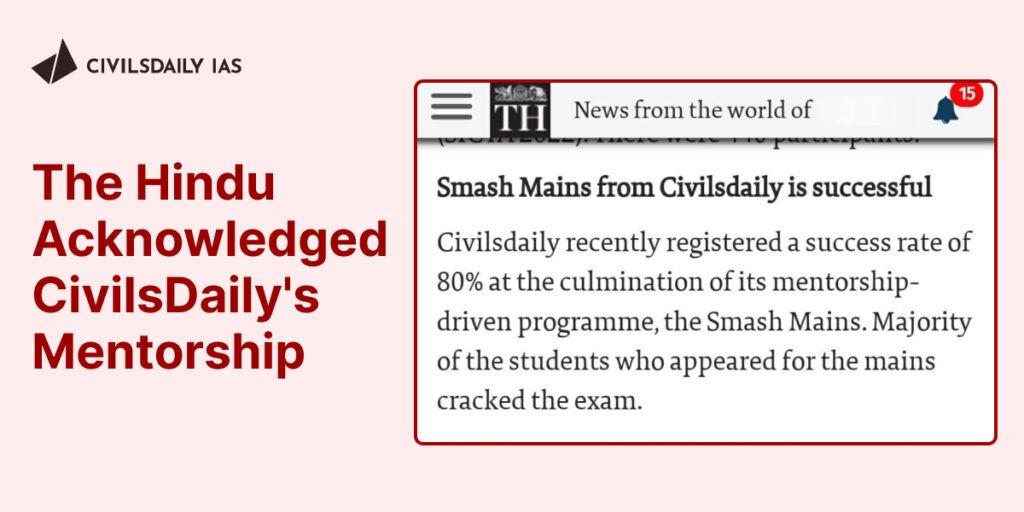
What The Hindu mentioned about Civilsdaily Mentorship
HOW TO ATTEMPT ANSWERS IN DAILY ANSWER WRITING ENHANCEMENT(AWE)?
Daily 4 questions from General studies 1, 2, 3, and 4 will be provided to you.
A Mentor’s Comment will be available for all answers. This can be used as a guidance tool but we encourage you to write original answers.
You can write your answer on an A4 sheet and scan/click pictures of the same.
Upload the scanned answer in the comment section of the same question.
Along with the scanned answer, please share your Razor payment ID, so that paid members are given priority.
If you upload the answer on the same day like the answer of 11th February is uploaded on 11th February then your answer will be checked within 72 hours. Also, reviews will be in the order of submission- First come first serve basis
If you are writing answers late, for example, 11th February is uploaded on 13th February , then these answers will be evaluated as per the mentor’s schedule.
We encourage you to write answers on the same day. However, if you are uploading an answer late then tag the mentor like @Staff so that the mentor is notified about your answer.
*In case your answer is not reviewed, reply to your answer saying *NOT CHECKED*.
The last known member of an indigenous tribes in the Amazon rainforest has died after living alone for decades.
The unidentified man from an uncontacted Indigenous tribe in Brazil was known as the ‘man of the hole’ because he was often spotted taking shelter in pits dug in the ground.
His death has now resulted in a lot of discussion among activists, once again bringing to the spotlight the need to protect the indigenous people.
Tribes in India
In India, most of the tribes are collectively identified under Article 342 as “Scheduled Tribes”.
There are 110 million tribals in the country, distributed across 18 states.
The tribal population is known to live sustainable lives, in harmony with nature.
However, with their numbers dwindling due to various contributing factors, the concern is on how not just to protect their population, but also to preserve their heritage, culture, language, art, traditions and sensibilities.
What’s being done towards the protection and economic upliftment of the tribals in India? How are their concerns & challenges being addressed?
Why do Tribal communities matter?
Safeguarding Biodiversity: India’s ethnic people have played a vital role in preserving the biodiversity of several virgin forests and have conserved flora and fauna in sacred groves of tribals.
Repository of traditional knowledge: They hold vital ancestral knowledge and expertise on how to adapt, mitigate, and reduce climate and disaster risks.
Sustainable livelihood practices: The crops grown by indigenous people are highly adaptable. They can survive drought, altitude, flooding, and any kind of extremes of temperature. As a result, these crops help create resilient farms.
Gender and social harmony: Tribal communities are one of the most liberal communities. Status of women is very high as they contribute substantially to primary subsistence activities.
Various Protection to tribes in India
(1) Constitutional Protection
The term ‘Scheduled Tribes’ first appears in the Constitution of India.
Article 366 (25) defined scheduled tribes as “such tribes or tribal communities or parts of or groups within such tribes or tribal communities as are deemed under Article 342 to be Scheduled Tribes for the purposes of this constitution”.
Article 342 prescribes procedure to be followed in the matter of specification of scheduled tribes.
Among the tribal groups, several have adapted to modern life but there are tribal groups who are more vulnerable.
The Dhebar Commission (1973) created a separate category “Primitive Tribal Groups (PTGs)” which was renamed in 2006 as “Particularly Vulnerable Tribal Groups (PVTGs)”.
As per Article 338-A of the Constitution of India, the National Commission for Scheduled Tribes has been set up.
(2) Civil Rights Protection
Protection of Civil Rights Act, 1955: It prescribes punishment for the preaching and practice of untouchability against the downtrodden sections of society.
Scheduled Castes and the Scheduled Tribes (Prevention of Atrocities) Act, 1989: It is an Act to prevent the Commission of offences of atrocities against the members of the SCs and STs; to provide for special Courts for the trial of such offences.
Provisions of the Panchayats (Extension to the Scheduled Areas) Act, 1996: It gives special powers to the Gram Sabhas in Scheduled Areas especially for the management of natural resources.
Scheduled Tribes and Other Traditional Forest Dwellers (Recognition of Forest Rights) Act, 2006: The rights provided to tribals under the Forest Rights Act seek to secure individual and community ownership on landholding, exploitation and habitation in forests by indigenous people in India.
(3) Protecting their Political Aspirations
Scheduled Areas are areas in India with a preponderance of tribal population subject to a special governance mechanism wherein the central government plays a direct role in safeguarding cultural and economic interests of scheduled tribes in the area.
The Fifth schedule deals with the administration and control of Scheduled Areas as well as of Scheduled Tribes residing in any State other than the States of Assam, Meghalaya, Tripura and Mizoram.
The Sixth Schedule consists of provisions for the administration of tribal areas in Assam, Meghalaya, Tripura and Mizoram, according to Article 244 of the Indian Constitution.
Issues faced by Tribal population in India
Acute Poverty: Many of indigenous communities live in extreme poverty. They suffer from malnutrition and lack access to basic education and health facilities. Ex. Melghat in Maharashtra.
Dwindling Population: Indigenous communities are facing a dwindling population. Most of them are desolated from their native places.
Degradation of Forests: Unrestrained development in forest areas has led to the degradation of the forest areas which account for the major basis for the survival of the tribal community.
Forest Rights Issues: Inability to recognize indigenous communities’ rights to forest resources is also a concern. This has given rise to left wing leanings.
Displacement: Acquisition of tribal land by the government for ‘development’ purposes has led to large scale displacement and alienation of tribal population.
Discrimination: The tribal people were compelled to perform duties that were considered inferior because of their economic backwardness and illiteracy.
Major challenges in the tribal areas
Remoteness: The tribal hamlets and habitations are located either in a valley or on the hill tops in most of the places. Due to which they are excludes from major developmental activities, improved cultivation practices, education and health facilities.
Exploitation: The agriculture produces, local non timber forest produce and other valuable forest resources are being siphoned out by the middlemen from the innocent tribals for the paltry prices thus leaving the tribals exploited financially.
Superstition: Poverty, health issues, illiteracy and underdevelopment is often ascribed to the fate, star and supernatural events. Even preventable deaths are sometimes construed as may be due to bad omen; the scientific temper is a remotest aspiration.
Road and Telecom lacunae: Due to tough terrain and difficult areas of tribal locations, it requires huge resources to establish connectivity to all the habitation. The telecom connectivity is also as sparse as the roads. Hence the penetration of digital literacy is hampered in typical tribal areas.
Lack of health awareness: Unscientific practices, local beliefs, self-medication, customary doctor etc. have deprived them from availing the institutional health facilities.
Illiteracy: It is the main hurdle in improving living standards of tribals in the tribal belts. The spill over effect of illiteracy is ‘lack of confidence’ to adopt progressive steps.
Primitive agriculture: The traditional areas where tribal live are mostly forests and hill terrains, having no proper potential for the adoption of modern agriculture on a large scale. Even now the PVTG’s are practicing shifting cultivation (Podu farming) on the hill slopes of eastern states.
Unemployment: Inability to catch up with the skilled jobs in the open market due to lack of exposure to formal skill training, the unemployment is haunting the qualified tribal youths.
Various welfare schemes for Tribals
Vanbandhu Kalyan Yojana: VKY aims at creating enabling environment for the need-based and outcome-oriented holistic development of the tribal people.
Minor Forest Produce (MFP): Scheme of Mechanism for Marketing of MFP through Minimum Support Price (MSP) and Development of Value Chain for MFP
Van Dhan Vikas Karyakram: The Van Dhan Scheme is an initiative of the Ministry of Tribal Affairs and TRIFED. It was launched on 14th April, 2018 and seeks to improve tribal incomes through the value addition of tribal products.
Higher education: Pre and Matric Scholarship Scheme for ST students, Eklavya Model Residential Schools
Classification as Particularly Vulnerable Tribal Groups (PVTGs):PVTGs have some basic characteristics -they are mostly homogenous, with a small population, relatively physically isolated, social institutes cast in a simple mould, absence of written language, relatively simple technology and a slower rate of change etc.
Way forward
There is a need to take up massive awareness creation activities among the tribal to make them realise their development potential.
Area based approach should be adopted to create infrastructure and road connectivity.
Effective monitoring of the funds meant for various tribal development activities is necessary.
Comprehensive skill development programs customized to the local tribal markets and local consumers have assured a future for the tribal youth.
Formal education and institutional finance through village institutions and Self Help Groups need to be intensified in the tribal areas by a focused approach.