💥Mains Ready By December. Smash Mains & Smash PYQ Admissions Open

Category: Ranker Webinars

  • UPSC Mains 2022-23 special: The art of writing answers to skyrocket your score in GS Mains papers – By Sajal sir, as published in The Indian Express

    UPSC Mains 2022-23 special: The art of writing answers to skyrocket your score in GS Mains papers – By Sajal sir, as published in The Indian Express

    Sajal sir has mentioned the Art of answer writing comprising 10 Principles for the UPSC Mains 2022-23.

    UPSC will be conducting the Main Stage Exams for Civil Services 2022 Recruitment from September 16. Mains are generally exhaustive in nature as UPSC examines the candidate on various subjects and on a very pertinent edge. However, the biggest challenge is learning the art of executing your knowledge when you put your pen on paper. 

    The exact answer-writing segments of the UPSC-CSE examination have diverged into three sections: Basic, semi-advanced, and On-demand rule of thumb. And to maintain this levels-ratio, apart from creating templates for different question-answer combinations worth remembering in a rush, you must follow these 15 arts of answer making.

    Read Sajal Sir’s article as published in the Indian Express


    Master the basic

    The body of answers addresses the minimum criteria for writing an exemplary answer. To create a good answer, you need to grasp a few basic techniques.

    Don’t deviate from your point:

    UPSC is very conscientious when it comes to evaluation. They prefer complex thoughts to be simplified and well presented. When one has that sagacity to write an answer without diverting from the point, it creates an unparalleled advantage for the aspirants.

    Dissect the questions

    Don’t get swayed by only seeing the theme of the question. Many aspirants write down everything they know. The value of your answer is not in its duration but in its contribution to the problems. Your answers must be relevant and useful enough. Only the good and the bad will not bring you signs.

    Key questions include instructions such as ‘Discuss/critically discuss/Comment/Examine/Critically examine/Analyze/evaluate/Critically evaluate/Elucidate, and you must be able to understand what each prompt includes. Therefore, it is important to break the question into smaller parts. While answering these questions, always check three elements to write an ideal answer – accuracy, brevity, and clarity. Specificity means lacing the answer with relevant subheadings, brevity will consist of short statements in your answer; And finally, maintaining overall transparency.

    Precise Presentation

    Don’t get overwhelmed. Points to be noted:

    • An opinion-based answer is to be written in paragraph
    • A fact-based answer is to be written in both paragraphs and bullets or a combination of both.

    The Intermediate intervention

    The semi-advanced segment will cover the second set of challenges that candidates face. This is a detailed section that assesses broad understanding and depth of knowledge. Consider these points:

    PESTLE Approach is needed in certain kinds of questions

    It means analyzing any issue from various angles eg:

    • Political
    • Economic
    • Social
    • Environmental
    • Legal
    • Technological
    • Administrative
    • Geographic
    • Historical

    Look for Keywords in the Question like 

    • Reasons
    • Implications
    • Importance
    • effects

    Always take a middle ground in your answers

    No scheme/Policy is a Magic bullet. Always conclude by Saying While XYZ is a step in the right direction but it needs to be supplemented by ABC’s further reforms

    It is to remember, that the Intermediate section will handle the second set of challenges that candidates face in the Mains exam.

    Understanding the core of the questions

    Every candidate should keep in mind that UPSC does not evaluate based on quantity, but rather based on quality. Answers should always create a solution to the main problem presented by the question.

    Comprehensive view

    ‘First impression is the last impression’- Every aspirant must be careful about their Introduction, Body, and conclusion. But, among them, Introduction works up to 75% work for you. Whether it’s GS paper 1, 2, or 3, or even Ethics (GS-4), ideally, the introduction should not only introduce mere the topic/issue/concept to the examiner but also (very) briefly describe the central premise of the answer.

    If the question has two or more parts, all parts must be presented shortly. Experts say, the introduction should not exceed 20% of the word limit at any price and its ideal length is about 10% of the word limit. For 200 words, 20-40 words should look for your introduction (and conclusion).


    Articulating the advanced answers

    The on-demand (advanced) sections bring us a comprehensive opportunity for aspirants to assert an understanding of the topics. This section tests a candidate’s ability to remember the most complex details, frame the best-refined answer and present it in the most concise possible manner. Some points are to be noted.

    Word limit is sacrosanct

    All 3 General Studies (GS) papers, excluding GS Paper IV which is Ethics Paper, have a limit of 200 words per question. This is a fair word limit that you are given when answering a question. The trick here is to write short sentences. Avoid Compound Sentences Although you may think you save time and words by joining two sentences with an ‘and’.

    GS Paper IV (Ethics) has 150, 250, and 300-word limits. 99% of the time questions are opinion based, so better to write answers in paragraphs. 

    Follow these 5 points:

    • Follow ARC reports & memorize only recommendations
    • Learn the major contributions of moral thinkers
    • Learn definitions, flowcharts, schematics
    • Examples of greater historical leaders’ action
    • Real-life case studies

    Entrench the Ethics of answer writing

    In GS paper IV, for the case study, your intention must not be to write an ingenious, extraordinary solution, but to write something practical and realistic and finish the paper no matter what.

    Directives to answer

    An advanced technique for writing successful answers is to create templates for different types of question-answers that you can recall at short notice.

    The art to approach essays

    In the essay, you have to write two essays of 1000-1200 words each. Writing a very good essay within the given time and word limit is very possible if you follow some basic rules. These basic rules are – brainstorming, outlining, idea/argument placement, and structuring. 

    Vantage view

    It is stated that composing answers is an art. The good news is that any kind of art may be learned with time. Will and effort, frequent practice, and some direction are all that is required. The cumulative conclusion is that the GS-1 always uses diagrams to explain and make sure you get the basics right. When we talk about GS-2, always try to include recommendations from a committee and mention development goals to consolidate your statements.

    In GS-3, be aware of terms used in space, nanotech, nuclear research, defense, biotech, and communications (LiFi, 5G, etc.). When articulating answers in the GS-4 paper, focus on ethical competence. The key to success in this paper entails transparency, accountability, and attitude.

  • 15th September 2022| Daily Answer Writing Enhancement(AWE)

    Topics for Today’s questions:

    GS-1      The Freedom Struggle — its various stages and important contributors/contributions from different parts of the country.

    GS-2      Bilateral, regional and global groupings and agreements involving India and/or affecting  India’s interests.

    GS-3        Issues relating to intellectual property rights.

    GS-4        Human Values – lessons from the lives and teachings of great leaders, reformers and administrators

    Question 1)


    Q.1 It is said that during Quit India Movement Mahatma Gandhi was willing to risk complete lawlessness in place of orderly disciplined anarchy of the British. Analyse. (10 Marks)
     

    Question 2)

    Q.2 Illustrate using examples India’s movement towards an “all-alignment” policy. How does India’s all alignment policy function within the Shanghai Cooperation Organisation (SCO) grouping? (10 Marks)

    Question 3)

    Q.3 The recent report of the Economic Advisory Council to the Prime Minister (EAC-PM) emphasizes upon the significance of a robust patent system for a knowledge economy. Highlighting some of the concerns in India’s patent ecosystem, mention suggestions to improve the same. (15 Marks)

    Question 4)  

    Q.4 Highlighting the factors responsible for social inequality in the country, discuss the role of Dr. BR Ambedkar in paving the way for social equity. (10 Marks)


    HOW TO ATTEMPT ANSWERS IN DAILY ANSWER WRITING ENHANCEMENT(AWE)?

    1. Daily 4 questions from General studies 1, 2, 3, and 4 will be provided to you.

    2. A Mentor’s Comment will be available for all answers. This can be used as a guidance tool but we encourage you to write original answers.

    3. You can write your answer on an A4 sheet and scan/click pictures of the same.

    4.  Upload the scanned answer in the comment section of the same question.

    5. Along with the scanned answer, please share your Razor payment ID, so that paid members are given priority.

    6. If you upload the answer on the same day like the answer of 11th  February is uploaded on 11th February then your answer will be checked within 72 hours. Also, reviews will be in the order of submission- First come first serve basis

    7. If you are writing answers late, for example, 11th February is uploaded on 13th February , then these answers will be evaluated as per the mentor’s schedule.

    8. We encourage you to write answers on the same day. However, if you are uploading an answer late then tag the mentor like @Staff so that the mentor is notified about your answer.

    *In case your answer is not reviewed, reply to your answer saying *NOT CHECKED*. 

    1. For the philosophy of AWE and payment: 

  • (Live Now) 5 most important areas for IAS Prelims 2023 and how to cover them for 120+ marks? | FREE Masterclass by Santosh sir (cleared UPSC Pre 6 times)

    (Live Now) 5 most important areas for IAS Prelims 2023 and how to cover them for 120+ marks? | FREE Masterclass by Santosh sir (cleared UPSC Pre 6 times)

    Join Zoom Meeting

    https://us06web.zoom.us/j/83064435194?pwd=d1Bld0VQZjVoNXpqcDgzVGhENDBOQT09

    Meeting ID: 830 6443 5194

    Passcode: 227695


    Block your Thursday (15th September), 2022 | Register and get FREE mentorship and Samachar Manthan’s current week’s module


    Some opine that the Prelims is the toughest stage in the UPSC exam. On the contrary, some toppers say that they cracked it on the very first attempt with 120+ marks. Is there any game of luck? Or the rankers are especially blessed by God!

    The simple answer is ‘NO!’ 99% of aspirants fail the IAS Prelims even in their last attempt because while keeping an eye on many things, they cannot pay attention to the real points. 

    UPSC exam is such a weird exam that only those who study for 6 hours a day & keep an alert-eye on these 5 points, can clear the exam with 120+ marks for 100% sure.

    Santosh Gupta heads the Smash Prelims program for CivilsDaily.

    Ascertaining the most problematic part of the exam, which the students face, we are conducting an on-demand MASTERCLASS where Prelims Guru, Santosh Gupta sir will be disclosing those 5 vital areas on which If you work, you will pass for sure. 


    UPSC Prelims Masterclass Details: 15th September, (Thursday) at 7 PM.

    Crucial 5 points will be discussed in the Masterclass

    • How to cover the syllabus as widely as possible. First, let’s divide everything into its respective topics because UPSC does not provide any syllabus for prelims. So, how to do a UPSC-Prelims-centric study will be discussed.
    • How to maintain a proper balance between memorization & understanding. Both are co-ordinating parts. So, how much you have to memorize will be discussed 1-1.
    • How to develop MCQs solving skills. One agrees or not, for UPSC prelims without developing MCQs solving skills, one returns home increasing negative marking. So, how to start solving MCQs without much -ve marking, is going to be discussed.
    • How not to lose hope if more offbeat questions come in the paper? UPSC Prelims trends to more offbeat questions. How to identify offbeat questions! And how to use the offbeat approach will be disclosed by Santosh Sir.
    • What is ‘Intelligent Guessing’ (TIKDAM)? How to utilize it. Intelligent guessing means finding clues in the question or options themselves. 
    • Many more untold secrets that only a UPSC Prelims expert can highlight.

    Think that CSP is more of a test of our skills than our knowledge base. As such, general knowledge is the most specialized skill for prelims. Many times, your learning from our masterclass will come to help and this is why we always insist on taking our session seriously. It helps you develop basic concepts, confidence, and a good self-image.


    Tavishi failed thrice in the Prelims before but after joining Santosh sir’s mentorship cleared Prelim 2022 in her 4th attempt.

    “You must be aware that clearing prelims are probably the toughest part of one’s CSE journey these days. Not only are the questions random and difficult, but even the options are also getting more mysterious every year.“

    So, apart from the above, some more extra crucial points will be discussed in the Masterclass

    • How to keep one source for one subject confidently

    • Learning to compile things; books, notes, test solutions

    • Revising PYQs as much as possible

    • Practicing the most useful MCQs

    • Making notes, especially for Prelims of daily current affairs


    What The Hindu mentioned about Civilsdaily Mentorship

  • 14th September 2022| Daily Answer Writing Enhancement(AWE)

    Topics for Today’s questions:

    GS-1      The Freedom Struggle — its various stages and important contributors/contributions from different parts of the country.

    GS-2      Bilateral, regional and global groupings and agreements involving India and/or affecting  India’s interests.

    GS-3        Indian Economy

    GS-4        Ethics and Human Interface: Essence, determinants and consequences of Ethics in-human actions; dimensions of ethics; ethics – in private and public relationships.

    Question 1)


    Q.1 The history of freedom struggle is replete with the saga of sacrifice, selflessness, bravery of women. Illustrate through examples. (10 Marks)


    Question 2)

    Q.2 India can take advantage of G20 for its economic growth and security architecture. Discuss. (10 Marks)

    Question 3)

    Q.3 What do you understand by IIP? How does it help us to understand economic health? (10 Marks)

    Question 4)  

    Q.4 In ethics, what we believe to be good or bad has implications on our actions. Discuss how different schools of ethics help us in making moral decisions. (10 Marks)


    HOW TO ATTEMPT ANSWERS IN DAILY ANSWER WRITING ENHANCEMENT(AWE)?

    1. Daily 4 questions from General studies 1, 2, 3, and 4 will be provided to you.

    2. A Mentor’s Comment will be available for all answers. This can be used as a guidance tool but we encourage you to write original answers.

    3. You can write your answer on an A4 sheet and scan/click pictures of the same.

    4.  Upload the scanned answer in the comment section of the same question.

    5. Along with the scanned answer, please share your Razor payment ID, so that paid members are given priority.

    6. If you upload the answer on the same day like the answer of 11th  February is uploaded on 11th February then your answer will be checked within 72 hours. Also, reviews will be in the order of submission- First come first serve basis

    7. If you are writing answers late, for example, 11th February is uploaded on 13th February , then these answers will be evaluated as per the mentor’s schedule.

    8. We encourage you to write answers on the same day. However, if you are uploading an answer late then tag the mentor like @Staff so that the mentor is notified about your answer.

    *In case your answer is not reviewed, reply to your answer saying *NOT CHECKED*. 

    1. For the philosophy of AWE and payment: 

  • [Sansad TV] Perspective: Russia’s Far East- Opportunities for India

    UPSC 2023 countdown has begun! Get your personal guidance plan now! (Click here)

    Context

    • PM Modi recently attended the Eastern Economic Forum, being held in the Russian city of Vladivostok. It was also attended by Russian President Vladimir Putin.
    • PM Modi recalled his participation at the forum summit physically in 2019, saying India had announced its “Act Far-East” policy at that time.
    • India iterated its keenness to strengthen its partnership with Russia on Arctic subjects and there is immense scope for cooperation in newer areas, particularly in the field of energy.

    Russia’s Far East and India

    • At the fifth summit of the Eastern Economic Forum (EEF) in 2019 at Vladivostok, PM Modi pledged a $1 billion Line of Credit for development of the Russian Far East.
    • This pledge has now become a key pillar of the ‘Special and Privileged Strategic Partnership’ between India and Russia.

    Russian Far-East Region: The geography

    russia
    • The Russian Far East is the easternmost part of Russia and the Asian continent; and is administered as part of the Far Eastern Federal District.
    • It is located between Lake Baikal in eastern Siberia and the Pacific Ocean.
    • The region’s largest city is Khabarovsk, followed by Vladivostok.
    • The region shares land borders with the countries of Mongolia, China, and North Korea to its south, as well as maritime boundaries with Japan to its southeast, and with the United States along the Bering Strait to its northeast.

    Why is the region under India’s consideration?

    • Although it is rich in natural resources including minerals, hydrocarbons, timber and fish, it is an economically underdeveloped region.
    • The region faces several challenges, including a:
    • Harsh climate
    • Sparse population
    • Increasing outmigration
    • Poor infrastructure and
    • Lacking connectivity

    Why focus on the Far East?

    • While the region is labor-scarce, it is resource rich.
    • The Russian Far East needs capital, technology and markets.
    • Meanwhile, India is a country with a labor-surplus and a resource-deficit, in need of energy, mineral resources and farming land.
    • Russia is in a position to meet Indian requirements and vice-versa.

    Economic significance of Far-East Region

    • Natural resources: The region occupying 40 per cent of Russia’s total territory is rich in natural resources, particularly diamonds, gold, oil, natural gas, coal, timber, silver, platinum, tin, lead, and zinc. It also has rich fishing grounds.
    • Agriculture: Indian interest has been focussed mainly on its need to tap into the region’s natural resources, including arable land. A recent Indian study identifies oil and natural gas, iron ore, copper, diamonds and gold, fresh water, timber and fish stocks as the resources of the region that would find an Indian market.
    • Blue Economy: It is in this context that the Chennai-Vladivostok sea route development has been proposed. This link would facilitate cargo transfers between the two eastern ports of the two countries in 24 days compared to 40 days that it now takes for ships that sail via Europe.
    • Employment opportunities: A lack of manpower is one of the main problems faced by the Far East and Indian professionals like doctors, engineers and teachers can help in the region’s development. Presence of Indian manpower will also help in balancing Russian concerns over Chinese migration into the region.
    • Energy Security: The area is rich hydrocarbon reserves in the region throw up immense opportunities for Indian companies. ONGC Videsh has already invested in the Sakhalin-1 project and its terminal is acknowledged as the best in Russia. India is set to get gas from Gazprom that will probably be liquefied at a plant near Vladivostok.
    • Scope for Small scale industries: For India, there is immense potential for mid-sized and small businesses who should be assisted to overcome language and cultural barriers so that they successfully adopt local business practices. The large diamond reserves in the region should be a magnet for the Indian diamond cutting and polishing industry, which is already facing tough competition in Africa from the Chinese.
    • Export destination for key sectors: Infrastructure, pharmaceuticals, and agriculture development are also areas of opportunity for Indian business and labour. Tele-medicine and long distance education are other areas where Indian companies can make a mark. It would also help in increasing India’s exports.

    Strategic importance

    • Opening to Indo-Pacific: The Russian Far East is at the forefront of geopolitics centred on the Indo-Pacific and is key in pivot to Asia.
    • Direct gateway to Japan: India’s ties with the Russian Far East could help cement Indo-Russian relations as well as bolster its ties with Central Asia and East Asia. It would connect India to East Asia especially Japan.
    • Confidence building with Russia: In the wake of the Ukraine crisis, the US-EU campaign to isolate Russia has gathered momentum. India’s simply cannot risk missing this opportunity to show its affinity for Russia. Although Russia needs Chinese investment it is uneasy with Chinese projects as they often use only Chinese workers.

    Countering China:  

    • China’s emergence as a major economic power in Asia, as a source of investment, a market for exports and, above all, the source of mass labour migration have altered both the ground situation.
    • At present, China is the leading investor in the region. Chinese investments account for nearly two-thirds of the total Foreign Direct Investment of $33 billion that has come to Russia’s Far East (RFE) in the last four years.
    • A larger footprint in the Russian Far East enhances India’s presence and influence in China’s immediate neighborhood.

    Various steps taken by India

    • While 2019 is the first time that India has participated in the EEF, it is not new to the Russian Far East.
    • India opened a consulate in Vladivostok in 1992, the first country in the world to do so.
    • In the decades since, its interest in the Far East region, especially its oil and gas reserves, has grown.
    • Indeed, back in 2001 India’s ONGC acquired a 20 percent stake in the Sakhalin reserves and over the last couple of years Indian companies have started announcing investments in the Russian Far East.
    • In December 2017, for instance, Tata Power announced that it had secured a $4.7-million mining license for a thermal coal mine in the Kamchatka peninsula.

    Note: Indian leadership was visionary even before the NDA-II regime!

    Way forward

    • A necessary pre-condition for increased trade and investment relations between India and the Russian Far East would be the development of necessary infrastructure aimed at improved connectivity between the two regions.
    • India and Russia should put in place a free trade agreement, easier visa norms and improved travel facilities. Connectivity is key to development in the modern world.
    • While land connectivity is impaired by several geopolitical and security constraints, developing sea connectivity is possible.
    • To maintain the momentum of this engagement, both governments must ensure that their respective private sector firms participate, going beyond oil and gas into manufacturing and agriculture.

    UPSC 2023 countdown has begun! Get your personal guidance plan now! (Click here)

  • How is ‘Personal Mentorship’ a new, key tool for UPSC-CSE preparation strategy?’ | The Indian Express explained CD’s approach | Get your personal IAS mentor

    How is ‘Personal Mentorship’ a new, key tool for UPSC-CSE preparation strategy?’ | The Indian Express explained CD’s approach | Get your personal IAS mentor

    CivilsDaily’s personalized and student-centric approach, due to its proven effectiveness and extraordinary result in the previous UPSC CSE exams, is attracting a lot of eyeballs. Every day we are flooded with hundreds of mentorship requests.

    Still, many aspirants lack clarity on what UPSC Mentorship actually stands for. They have a lot of doubts and queries about it. The Indian Express invited us to bring clarity on Mentorship for UPSC and Zeeshan Hashmi, senior UPSC Mentor at CivilsDaily gave an interview to the newspaper. Below are given excerpts from the interview. You can read the full interview here.

    What is Personal Mentorship for UPSC CSE?

    Interviewer: “Zeeshan, a new trend is being noticed that UPSC aspirants are opting for ‘personal mentors’ to crack their Civil services exams. What is ‘Personal Mentorship’?“

    Mentorship is a gradual process that takes the preparation level of each student into consideration. The core philosophy in a mentorship program is that ‘every student is a distinct batch’. Each aspirant has his or her own strengths and weakness and stands at different levels of preparation.

    Taking all those into consideration, a mentorship program devises a proper strategy and plan tailor-made for a particular candidate.

    In simple terms, the mentorship process is like a Google map, that suggests one of the best possible routes reach the destination depending on the position of the user.

    Similarly, a mentor guides an aspirant to the best possible route to attain success depending on his level of preparedness, strengths, and weaknesses. etc.

    Which one are you?

    Every student is a batch

    Core philosophy of CD Mentorship

    How is mentorship different from teaching?

    Interviewer: If a UPSC mentor is providing guidance to an aspirant, how he or she is different from a teacher/instructor?

    Students sometimes are confused between a teacher and a mentor. A teacher teaches topics, concepts, and ideas from the syllabus, textbooks or from some established scholarly works.

    A mentor is someone who guides an aspirant based on his own experience, learning, and insights. He has walked that path either as a senior aspirant or a selected candidate.

    Mourya had a personalized timetable, targets, and UPSC study plan as per his constraints like time availability and job

    Students should know that a mentor’s job is not to teach and complete the syllabus of static subjects. That is a job of a teacher. However, a mentor guides an aspirant by suggesting the best strategies that will suit the aspirant and cater to his or her problem. That strategy is not one size suit all approach.

    Parameters to choose a mentor?

    Interviewer: There are many coaching institutes providing mentorship programs. What parameters should an aspirant look into while choosing a mentor?

    Zeeshan sir answered that the two general parameters an aspirant should look at while deciding a mentor are:

    1. Statistics: How many students got selected through a mentor’s specific personalized mentorship program?
    2. Human element: This involves building up trust. One way to find out the trust factor is through webinars/videos which are available for free. During these webinars, a mentor answers many doubts and queries. If any aspirant as a viewer finds that a similar doubt, resonating with his or her is addressed, trust is developed.
    3. It is after these two factors, aspirants should approach a mentor, interact and select the program as per his or her requirements.

    Is it true that mentorship also involves counselling?

    It is true to some extent. many times a mentor receives calls from aspirants who have emotional outbursts and they are apprehensive of their preparedness. We must understand that UPSC aspirants come from diverse backgrounds and the preparation can take more than a few years. It can be frustrating. A mentor should be prepared to empathize with the anxieties of an aspirant and provide him or her with practical insights.

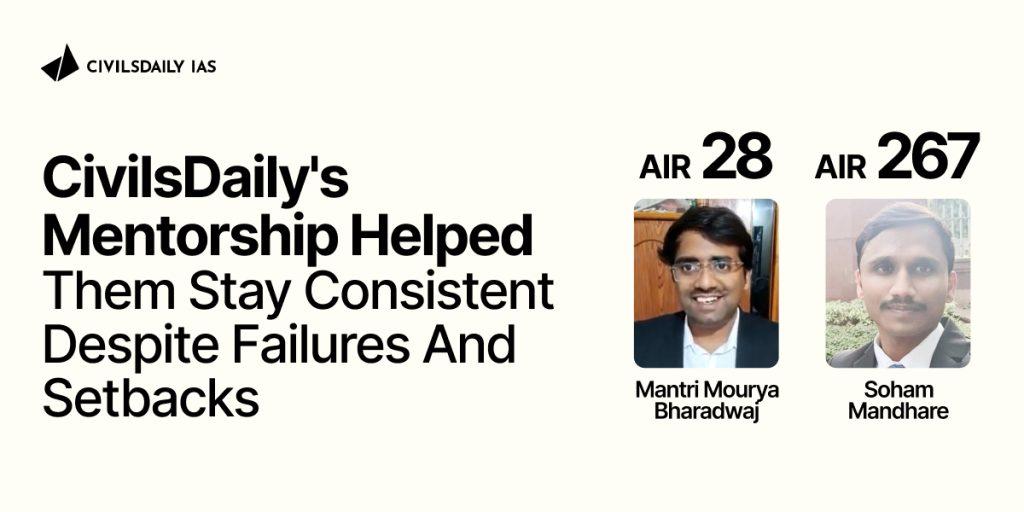
    Let me take the example of my former student Soham Mandhare who was suffering from stress and anxiety attacks and was advised by the doctors to quit the exam. But he decided to approach a personalized mentorship program and benefited from it. Sohum Mandhare, finally secured AIR 267 in UPSC-CSE 2021.

    However, a mentor should be careful and advise an aspirant to consult a qualified doctor when the situation of a candidate is serious and needs medical help.

    Which combination is more favorable for aspirants- coaching guidance + Mentorship or self-study + Mentorship?

    Depends upon where the student stands in his preparation.

    Coaching guidance + Mentorship: freshers find it important. It gives aspirants an apt environment, peer group preparation, etc.

    Self-study + Mentorship: Beneficial for aspirants who have financial constraints, housewives and professionals, selected candidates who want to improve ranks, and those who can not leave their homes due to personal circumstances.

    Tools and Strategies used by UPSC Mentors

    What are some of the tools used by a mentor which make the mentorship more personalized or most tailor-made for individual aspirants?

    1. Customized Timetable: Depending on how much time an aspirant can devote to the preparation due to the personal or professional conditions of an individual, a mentor helps to prepare a personalized timetable.
    2. Regular micro tests: Addressing personal apprehensions regarding the preparedness for exams, micro-tests a regular basis are designed, evaluated, and discussed. It involves going deep and understanding the thought process behind the candidates’ answers.
    3. Calls on demand: Listening patiently to aspirants’ queries and doubts, one on one, is an important element of the mentorship program.

    “Never take any results as a barometer for your success. Take results sportingly. only then one will be able to improvise and perform better in the next opportunity or attempt”.

    Zeeshan Hashmi

    It is not that UPSC-CSE preparation can not be done by self-study. Yet, a mentor is required at various tiers of this exam, whether an aspirant is going to regular coaching or not. 

    For the last 4 years, the most challenging exam of our country has been witnessing an inspirational transition in preparation strategy. ‘Personal Mentorship Program (PMP) is becoming increasingly popular among UPSC-CSE aspirants.

    Why do IAS aspirants prefer a mentor? The simple answer is that only an IAS mentor can understand the anxieties of a candidate. And he remains prepared to empathize and provides practical insights.

    Senior IAS CD mentor/faculty Zeeshan Hashmi sir’s core philosophy ‘every student is a distinct batch’ has gained currency in Indian Express.

    Read his exceptional interview:


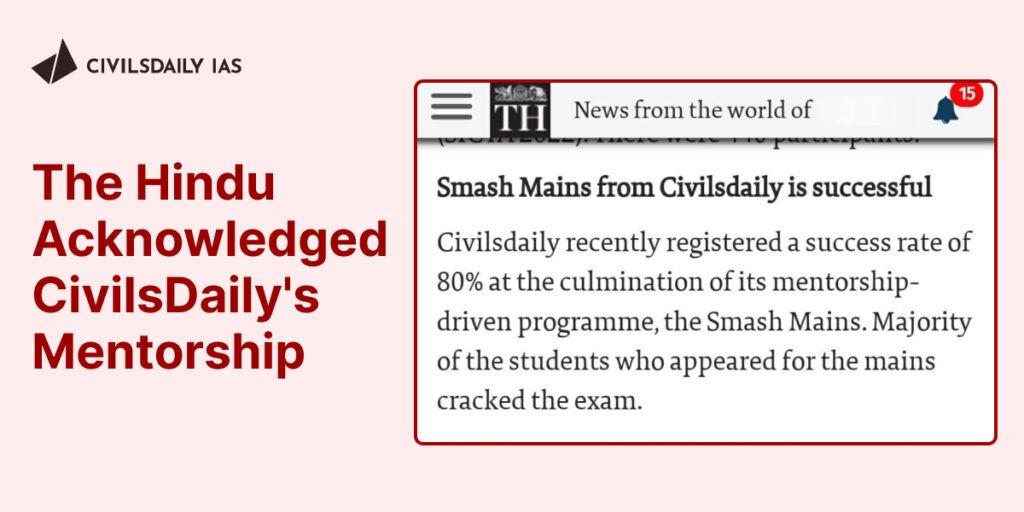
    The Hindu has acknowledged the 80% success rate of Civilsdaily’s mentorship Program

    All the aspirants now are all aware of the benefits that come with mentorship. In fact, some of the wretchedly failure-sufferers have changed their lives by clearing UPSC. To demonstrate such impact India’s top branded news giants repeatedly echoed ‘Civilsdaily’s One Branded Mentorship Program’


    Civilsdaily’s Mentorship is clearly one brand which sets us apart

    Civilsdaily mentorship toolkit helps you in 6 key components of your UPSC-CSE preparation

    1. Direction– Civilsdaily’s mentors are highly qualified, with at least one year of mentorship experience and two UPSC CSE Interviews under their belts. They are well-versed in the many stages of preparation. These mentors will assist you in developing both a comprehensive and micro schedule. They’ll put together a weekly programme for you, complete with mentorship calls. This schedule will be created based on a thorough examination of the importance of subjects as well as the interconnection of topics to make it easier for students to grasp the material.
    2. Discipline– The student will be held accountable to the mentor since he or she will be required to complete a weekly target set by the mentor.
    3. Consistency– Students can retain consistency in their preparation by having their mentor monitor them constantly and giving them regular tests. Furthermore, rational scheduling aids pupils in adopting an integrated approach to preparation..
    4. Value addition– Mentors also assist students with their questions and resources. Students become perplexed as to which resources to follow due to the abundance of content available on the market. Mentors can assist you in locating and referring to the most appropriate materials. This aids students in consolidating their resources and avoiding content overload. Mentors will also offer video assistance. Remember- the mantra to clear UPSC is MINIMUM RESOURCES, MAXIMUM REVISIONS.
    5. Evaluation– The UAP/foundation curriculum also contains a prelims and mains test series, as well as weekly 10 mains questions from Samachar Manthan (SM). Your mentor will go through each test with you and help you figure out your strengths and shortcomings. So, if you devote yourself to this programme, you will receive one-on-one assistance for more than 40 mains tests (including SM) and more than 30 prelims tests. Furthermore, each test will be examined twice by professional evaluators, with a mentor evaluating the results later.
    6. Motivation– When you’re feeling down or don’t feel like studying, you can reach out to your mentor, have a conversation, get motivated, and restart your studies. Mentor-recommended relaxation techniques can assist you in learning more effectively.

    How does Samanvaya Mentorship work? Introducing 3 layers of mentorship: Get IAS or UPSC ranker as your mentor

    1. 1st step starts with this Samanvaya call: Once you fill in the form, we get on a 30-40 minute call with you to understand your prep level, working/ study constraints, and current strategies and create a step-by-step plan for the next week, next month and so on.

    2. You are directed and given access to relevant resources and invite-only platform, Habitat where you can ask your daily doubts, discuss your test-prep questions and have real-time, live sessions on news and op-eds, and find your optional groups.

    Daily target monitoring.

    3. The third and the most personalized tier is the 1 on 1 mentor allotment who stays with you through the course of your UPSC preparation – always-on chat and on scheduled calls to help you assess, evaluate, and chart the next milestone of your IAS 2023-23 journey.

    We will also connect you to a UPSC ranker or IAS, who will mentor you in this journey.

    Layer 1: You will be assigned a dedicated in-house mentor who will keep track of our progress from start till your final interview.

    Layer 2: Sajal Singh sir and the team will be constantly with you through various programs like Samachar Manthan, Prelims, Essay, etc.

    Layer 3: A UPSC IAS ranker (one who has cleared this exam) will be supervising your progress as your super mentor.

  • 13th September 2022| Daily Answer Writing Enhancement(AWE)

    Topics for Today’s questions:

    GS-1      The Freedom Struggle — its various stages and important contributors/contributions from different parts of the country.

    GS-2       Appointment to various Constitutional posts, powers, functions and responsibilities of various Constitutional Bodies; Federalism

    GS-3        Effects of liberalization on the economy, changes in industrial policy and their effects on industrial growth. 

    GS-4        Ethics and Human Interface: Essence, determinants and consequences of Ethics in-human actions; dimensions of ethics; ethics – in private and public relationships.

    Question 1)


    Q.1 Satyagraha of Gandhi dispelled fear from the minds of masses and sealed the fate of imperialism in the country. Discuss. (10 Marks)


    Question 2)

    Q.2 Against the intentions of the constitution makers, the use of discretionary powers by governors has become a major source of tension in Centre–state relations. What are the discretionary powers of the Governor? Also, discuss the issues associated with them. (15 Marks)

    Question 3)

    Q.3 The Production Linked Incentive scheme (PLI) was launched with an intention to create a sustainable manufacturing base in India. Highlighting the need of the scheme, mention some of the advantages and concerns associated with it. (15 Marks)

    Question 4)  

    Q.4 Although ethics in private and public relations are different, they interact and influence each other. Discuss. (10 Marks)


    HOW TO ATTEMPT ANSWERS IN DAILY ANSWER WRITING ENHANCEMENT(AWE)?

    1. Daily 4 questions from General studies 1, 2, 3, and 4 will be provided to you.

    2. A Mentor’s Comment will be available for all answers. This can be used as a guidance tool but we encourage you to write original answers.

    3. You can write your answer on an A4 sheet and scan/click pictures of the same.

    4.  Upload the scanned answer in the comment section of the same question.

    5. Along with the scanned answer, please share your Razor payment ID, so that paid members are given priority.

    6. If you upload the answer on the same day like the answer of 11th  February is uploaded on 11th February then your answer will be checked within 72 hours. Also, reviews will be in the order of submission- First come first serve basis

    7. If you are writing answers late, for example, 11th February is uploaded on 13th February , then these answers will be evaluated as per the mentor’s schedule.

    8. We encourage you to write answers on the same day. However, if you are uploading an answer late then tag the mentor like @Staff so that the mentor is notified about your answer.

    *In case your answer is not reviewed, reply to your answer saying *NOT CHECKED*. 

    1. For the philosophy of AWE and payment: 

  • Mains Essential Program (MEP) 2023: Answer writing with personalized Mentorship | Replicating 85% Success Rate for Mains 2023 results | 2nd Batch Starts 17th September | Register here

    Mains Essential Program (MEP) 2023: Answer writing with personalized Mentorship | Replicating 85% Success Rate for Mains 2023 results | 2nd Batch Starts 17th September | Register here

    Guys, as wealth without work, is a greater sin, knowledge without practice is an unacceptable folly. To attain success, polishing your thought is a must and to catch up with the hands of the clock, practice and practice are the only things that matter the most to an IAS aspirant. 

    After receiving feedback from almost 500+ of our successful UPSC candidates, Civilsdaily can claim that 85% of the questions in UPSC Mains were already asked in our previous MEP tests. And this was the only strong reason that the success rate of our MEP program has been featured in famous newspapers. 

    “UPSC level questions, detailed evaluation, and in-depth discussion of tests (question by question) improved my score.”

    AIR 28, Mourya Bharadwaj UPSC 2021

    “Impressed by the efforts put in to improve my answer writing, structured phone calls. Grateful for personal guidance.”

    Karishma Nair, AIR 14, UPSC 2020

    To satisfy the high demand, we are fully prepared now to launch MEP 2nd batch on the 17th of September, 2022

    Table of Content:


    What is MEP 2023?

    Mains essential Program (MEP) 2023 is your solution to practicing Mains Answer writing. Don’t procrastinate answer writing, developing a skill does not happen magically after you clear prelims.

    Mains Essential Program 2023 is a Mentor guided comprehensive and intensive program for GS Mains papers. The focus is on making students understand the requirement of Mains Question, its elements, using information, and imparting answer writing skills for that.


    How MEP is needed for your IAS dream:

    Your knowledge is tested through your answers: If you have not learned the art to articulate your thoughts on paper, then that’s a disaster waiting to happen. Studying and writing answers is a symbiotic relationship and one reinforces the other.

    • Helps you retain concepts, facts, and figures.
    • Learning the trick to formulate the structure of the answer.
    • Helps to revise things and learn new things not covered by conventional books.
    • Improves your writing speed, and handwriting.

    Know-How Our Mains Test Program Stands Apart?

    1. Personalised Mentorship to correct you at each step

    We believe in personalized individual attention. A one-to-one discussion with your Mentor will not only highlight your weaknesses but will also help in tracking your improvements over the subsequent tests. It will also ensure consistency, continuity, and progressive improvement.

    Students usually get swayed by only seeing the theme of the question. The question is not about electoral bonds only. Many aspirants write everything they know about electoral bonds. You need to first mention how it will cleanse India’s electoral system. After that, link it with democracy. How it violates key features of democracy like transparency, accountability, and a level playing field. Writing only Pros and Cons will not fetch you marks.

    Just schedule a call with our mentor to clear all your doubts and queries.

    2. Quality standards of questions in our test series

    Our Test series questions have consistently proven to be similar to UPSC standards.

    Here’s the proof


    Program Inclusion Details:

    • 12 Sectional tests: The whole syllabus will be divided into portions like history, economics, and geography. The test will be spread over 8 months. This will ensure that your basic static preparation happens continuously alongside your mains answer writing program. Killing two birds with one stone!
    • 12 Full-length tests: After the prelims, it is time to go full gear.
    • Personalized discussion: You doubt why you are scoring less or how you can improve your score for the next paper. No worries! Just schedule a call with our mentor to clear all your doubts and queries.
    • Civilsdaily’s handholding: You will be provided membership to Mains 2023 club on Habitat. There you can put up your doubts and queries. Also can be used to interact with peers on strategies to improve your mains writing. You can also contact mentors like Sajal sir, Sukanya ma’am, Sudhanshu sir and Poornima Ma’am. They all have interview-level experience, so utilize their experience to your benefit.
    • Civilsdaily magazine: Your current affairs will be covered with access to our 1-year subscription. (June 2022 to May 2023)

    Our Philosophy behind MEP 2023

    1. Question Formulation

    It happens under a team of experienced Civilsdaily faculty. Questions framed are from the most important UPSC relevant themes and papers are based on the latest pattern of UPSC.

    Our questions specifically state:

    • Whether they are straightforward or thought-provoking/analytical.
    • Whether they have subparts.
    • Why this question – similar to previous year’s questions, the importance of the theme, etc.

    CD Innovation – Red-green highlight – to let you know about the necessary and innovative points.

    2. One-to-One Discussion

    We believe in personalized individual attention. This is the biggest reason why you should join our TS. Students can schedule a call within 2 days of receiving their checked copies.

    A one-to-one discussion with your Mentor will not only highlight your weaknesses but will also help in tracking your improvements over the subsequent tests. It will also ensure consistency, continuity, and progressive improvement.

    3. Answer Checking

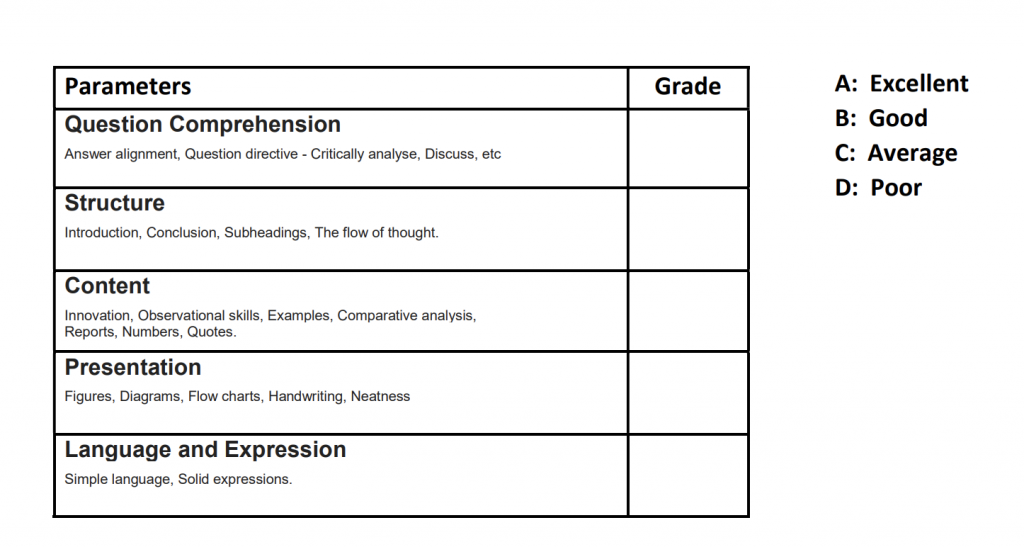
    Our evaluation focuses on multiple dimensions and parameters like structure, flow, presentation, contextuality, relevance to question, analytical excellence, and cross-domain inter-linkages than simply on superficial, memory-based lapses.

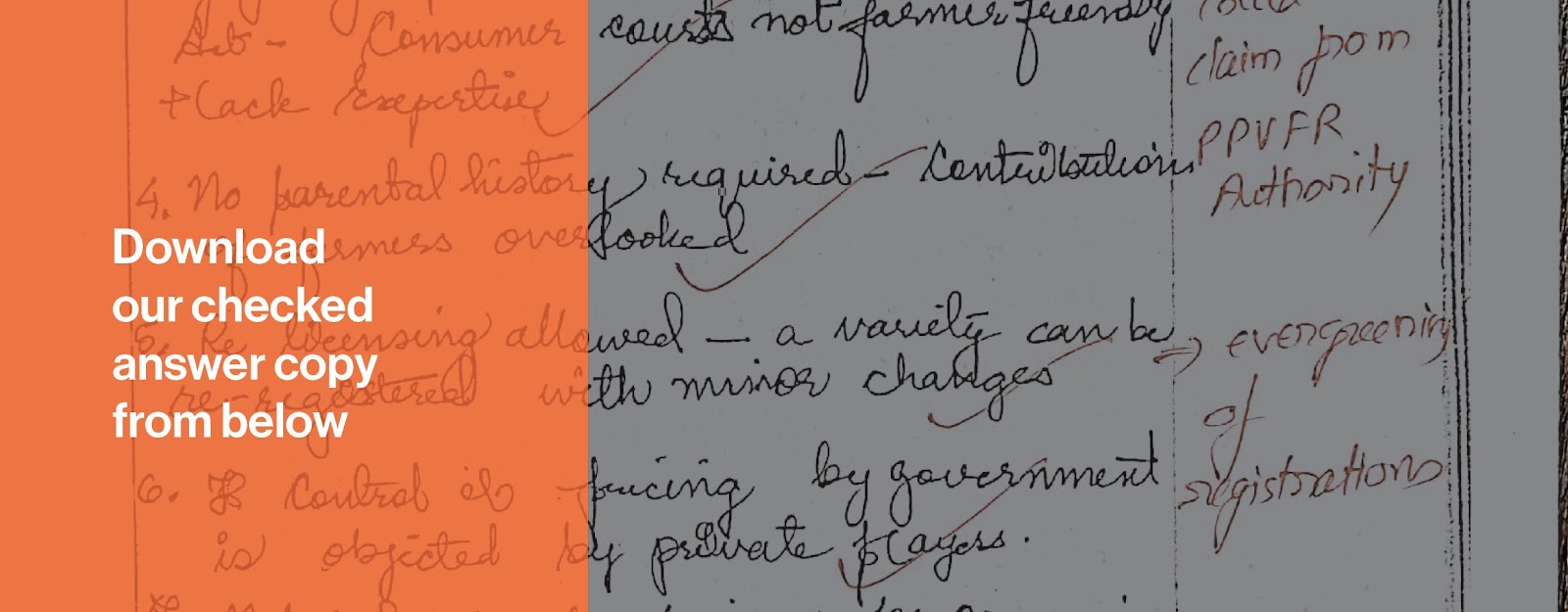
    Evaluated answer copy – 1 (Click to download)

    Evaluated answer copy – 2 (Click to download)

    Parameters we use to evaluate your answers

    4. Model Answers

    More than just simply providing information, our model answers cover all the aspects of a question and provide enriching points to the student. They also include:

    • For ‘thought-provoking/analytical’ type of questions, we’ll provide the best way to approach them.
    • Alternate introductions
    • Subheadings and categorization to enhance readability and answer structure.
    • Colour coding for main arguments, reports, data, scholars, etc.
      OTB – Out-of-the-box points for additional marks

    5. Civilsdaily’s Handholding

    You’ll be assigned to a special group on Civilsdaily’s Habitat, there you can interact with different mentors like Sajal Sir, Sukanya ma’am, Ajay Sir, Sudhanshu sir, and others.

    Civilsdaily’s Habitat – Desktop and Mobile view

    6. Value-added material

    Current affairs magazines – Civilsdaily’s Magazines are the best in terms of comprehensive coverage, superb design, and high readability.

    Listicles and other relevant study material – Supplementary content provided will help cover multiple related questions.


    About Mentor:

    Sukanya Rana:

    Sukanya ma’am has firsthand experience of 4 mains and 2 interviews of UPSC. In 2019, she scored 140 in ethics. She has also appeared in the State PCS interview. Before she worked as a Probationary officer in Canara bank. Now at Civilsdaily, she heads the Mains program and is engaged in a core team of Civilsdaily.

    As per need, we will also involve our Civilsdaily core mentors like Swatantra sir, Parth sir, etc.


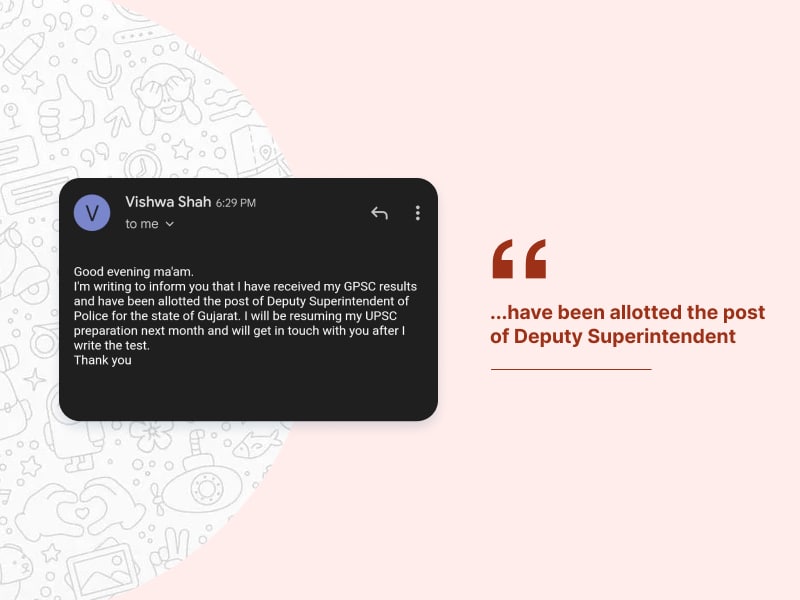
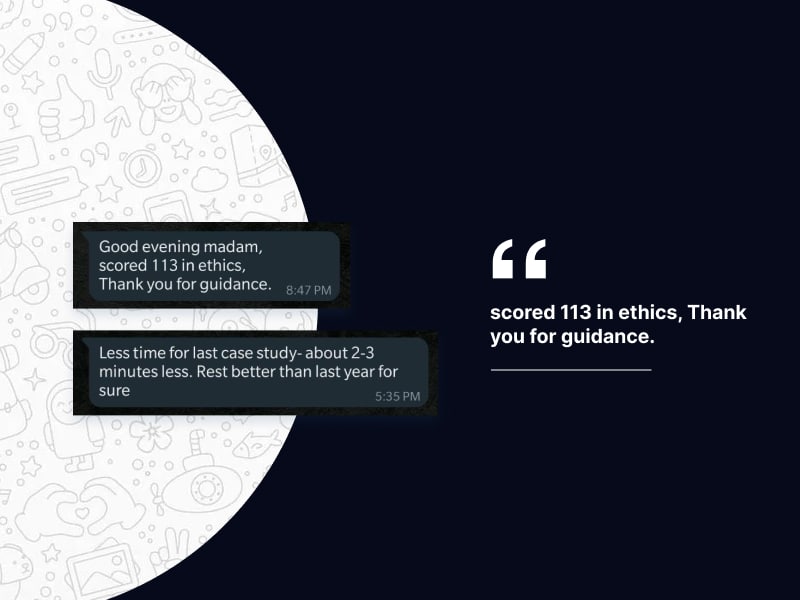
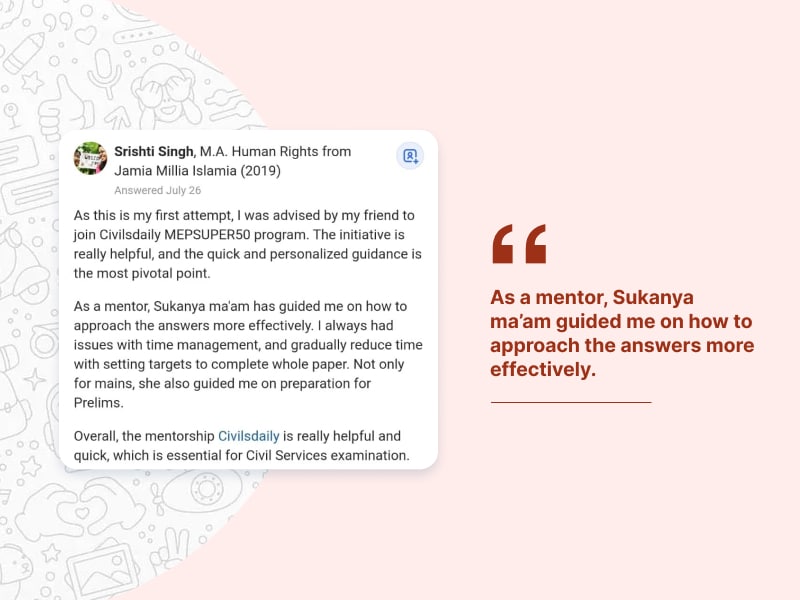
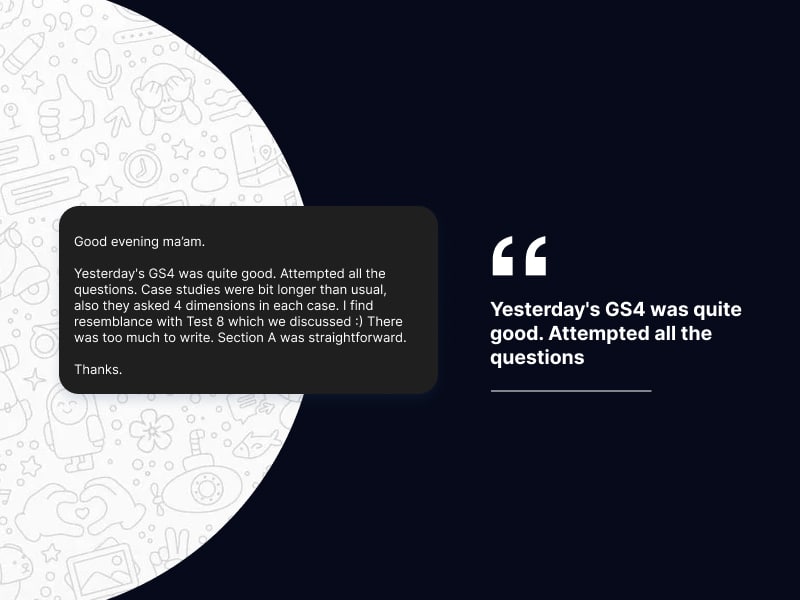
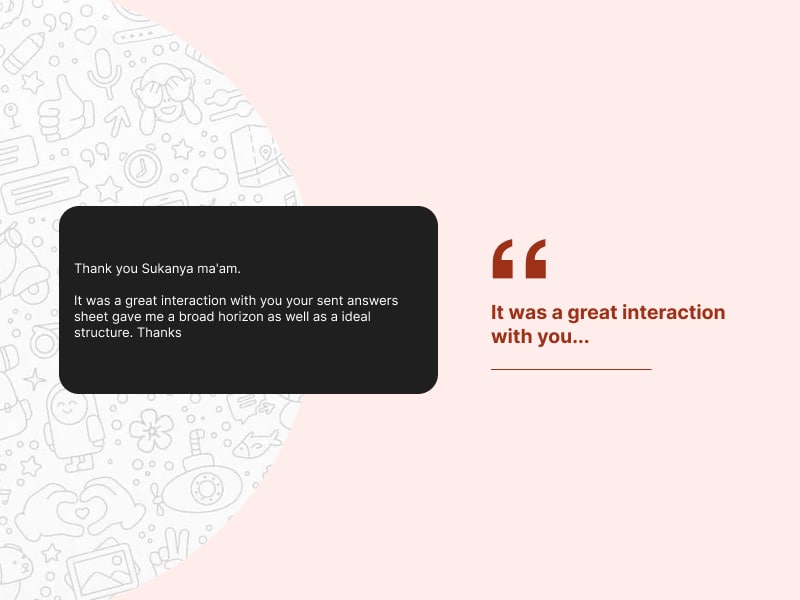
    This is what our students have to say…

    From Quora’s answer. (Read the full answer here)

  • CD Prelims Weekly: Most Important UPSC Prelims MCQs | Get Free PDF every week

    CD Prelims Weekly: Most Important UPSC Prelims MCQs | Get Free PDF every week

    We will email you the PDF on registration, every week. You will also get FREE Mentorship session.

    UPSC IAS preparation is not just about reading and re-reading information, concepts, books, etc. It is also about evaluating what you have studied and covered, and practicing MCQs and mocks.

    Civilsdaily has launched a free initiative to make out of the most important topics/MCQs for the UPSC prelims and pave the way to score 120+ in UPSC Prelims 2023-24

    FREE PDFs INCLUDE:

    • Most important topics based Prelims MCQs
    • UPSC relevant current affairs
    • GS topics and concepts linked with Current affairs
    • UPSC level questions

    From where can you register for the Prelims Weekly PDF.

    On CivilsDaily’s website click on Prelims Weekly. You will come to this page. Register here.

    Certain topics seem to be important for the UPSC prelims exam, but they are not asked in the exam. The UPSC primarily inquires about the context of current events. Ideally, UPSC asks about four aspects of a topic in one question with multiple options, with only one correct answer.

    We have considered this aspect of UPSC as well in framing the MCQs.

    The syllabus for the prelims exam does not go into great detail about the topics. Candidates should understand the prelims’ demand by analyzing the UPSC MCQs provided here.

    Overall preparation necessitates over a year of focused preparation in the right direction with the right strategy. Important Prelims exam topics are just the tip of the iceberg when it comes to the syllabus. Important topics guide will guide preparation in the right direction to sit for UPSC Mains 2023.

    So, our highly experienced toppers’ teachers & mentors group has prepared the most trusted list of the most important topics. 

    You will also get FREE Mentorship session with Senior mentors from CivilsDaily on registration.

    You can expect many questions in UPSC civil services Preliminary exam – 2023 from this compilation.

    What The Hindu mentioned about Civilsdaily Mentorship

  • 12th September 2022| Daily Answer Writing Enhancement(AWE)

    Topics for Today’s questions:

    GS-1        Modern Indian history from about the middle of the eighteenth century until the present – significant events, personalities, issues.

    GS-2        Issues relating to development and management of Social Sector/Services relating to Health, Education, Human Resources.

    GS-3        Major crops-cropping patterns in various parts of the country, – different types of irrigation and irrigation systems storage, transport and marketing of agricultural produce and issues and related constraints; e-technology in the aid of farmers.

    GS-4        Probity in Governance: Information sharing and transparency in government, Right to Information, Codes of Ethics, Codes of Conduct, Citizen’s Charters, Work culture, Quality of service delivery, Utilization of public funds, challenges of corruption.

    Question 1)


    Q.1 The Moplah rebellion 1921 was an expression of agrarian and political discontent which got intensified by religious identities. Examine. (10 Marks)


    Question 2)

    Q.2 Do you think we can eliminate TB by 2025? Discuss the roadmap and mention some affirmative actions taken by government. (15 Marks)

    Question 3)

    Q.3 Do you think there is urgent need to extend MSP to horticulture sector also? Discuss what can be done to solve the apple farmer crisis in Himachal Pradesh. (10 Marks)

    Question 4)  

    Q.4 Effective public service delivery requires a citizen centric system. Citizen’s Charter is seen as an important tool to ensure such a system, but it is not achieving its objectives. Why? Discuss measures to make it more effective? (10 Marks)


    HOW TO ATTEMPT ANSWERS IN DAILY ANSWER WRITING ENHANCEMENT(AWE)?

    1. Daily 4 questions from General studies 1, 2, 3, and 4 will be provided to you.

    2. A Mentor’s Comment will be available for all answers. This can be used as a guidance tool but we encourage you to write original answers.

    3. You can write your answer on an A4 sheet and scan/click pictures of the same.

    4.  Upload the scanned answer in the comment section of the same question.

    5. Along with the scanned answer, please share your Razor payment ID, so that paid members are given priority.

    6. If you upload the answer on the same day like the answer of 11th  February is uploaded on 11th February then your answer will be checked within 72 hours. Also, reviews will be in the order of submission- First come first serve basis

    7. If you are writing answers late, for example, 11th February is uploaded on 13th February , then these answers will be evaluated as per the mentor’s schedule.

    8. We encourage you to write answers on the same day. However, if you are uploading an answer late then tag the mentor like @Staff so that the mentor is notified about your answer.

    *In case your answer is not reviewed, reply to your answer saying *NOT CHECKED*. 

    1. For the philosophy of AWE and payment: