Preparing for UPSC prelims is like throwing pebbles into a pitcher partially filled with water. (Remember the story of the crow in Panchatantra?) Instant gratification and even a little lack of patience will get you nowhere. But, if you keep dropping those pebbles, you’ll see the water level rising!
Before everything, knowing and accepting the things that you have been doing in the wrong manner, is the first step towards making the change for eventual success.
If a pill couldn’t cure your disease, what would you do? Would you change your medicine? Or wait for the worst suffering?
Change is the key to success in UPSC CSE
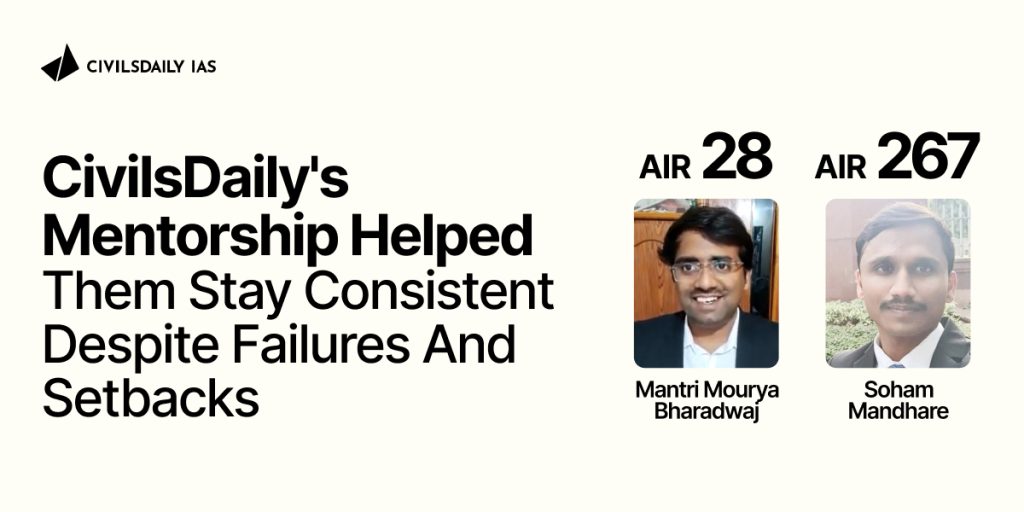
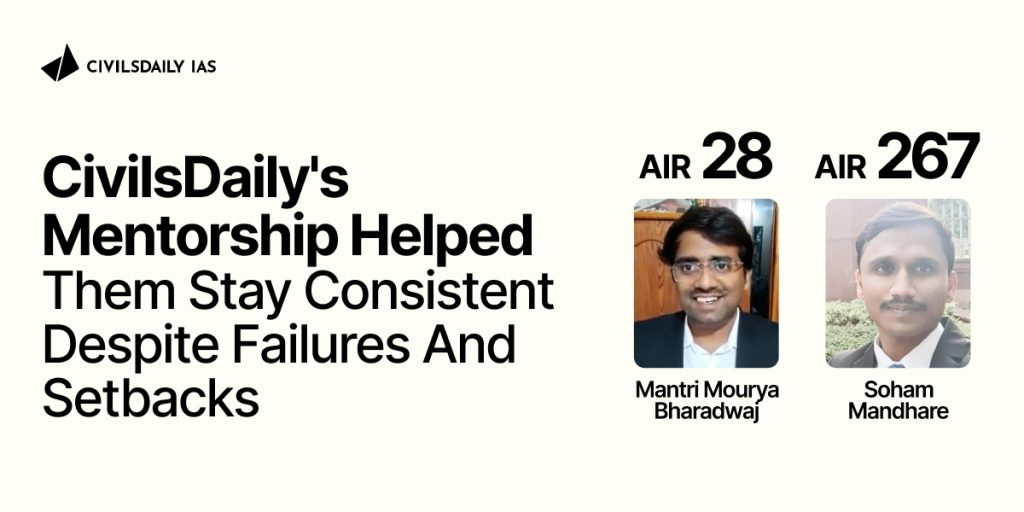
This was Mourya’s fifth attempt in which he secured an AIR 28
Even UPSC toppers have failed in the past but it was their ability to evolveand re-orient their strategy as per UPSC’s expectations that helped them succeed. Similarly, at that point, you should change your strategy. But, here you have to be extremely cautious. Because success will come only if your new strategy is better than the old one.
Ascertaining the need to ensure removing difficulties, the students face, we are conducting an on-demand Webinar by Vikash sir on How to change your UPSC Preparation strategy after a failed attempt?
The heat of fire turns gold ores into pure gold, and it is your time to shine.
About Vikash sir
Vikash Kumar sir is a senior IAS mentor at CivilsDaily. He has attempted 6 UPSC Mains and appeared in 3 UPSC interviews. He has cleared CAPF and UPPSC 2020 final exam. He has a rich experience in UPSC preparation and has been mentoring students for 4 years now. 50 of his students are writing UPSC Mains 2022.
From one of Vikash sir’s students
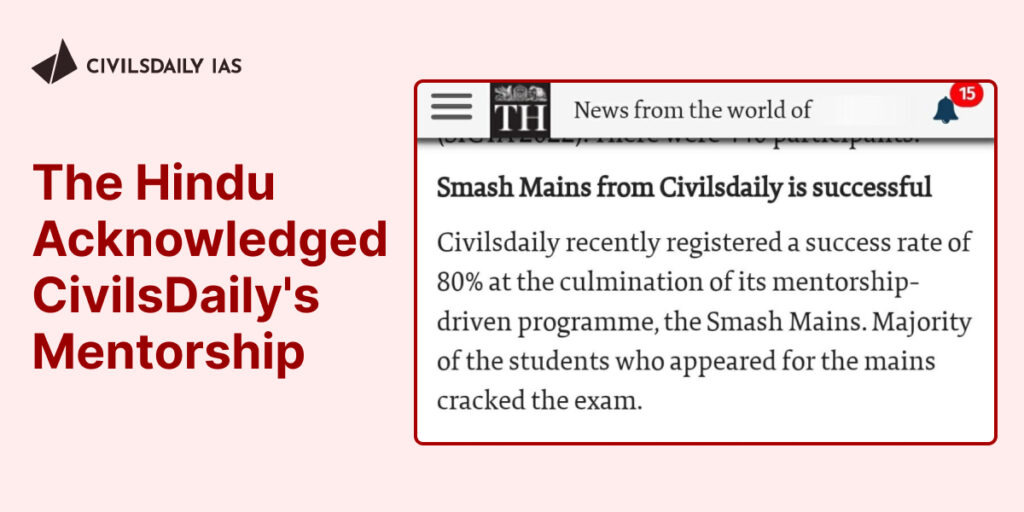
What The Hindu mentioned about Civilsdaily Mentorship
The 1750 marks of the Mains exam will decide your IAS destiny. Though UPSC has given a very detailed and crisp syllabus, it can’t resist the urge to add surprising elements in questions every year to keep candidates on their toes and to test their mettle.
In the Mains exam hall, it is all about execution. UPSC Toppers focus on certain fundamental principles and they follow them firmly and perfectly.
UPSC 2022 Mains are here. You must have covered everything by now, all notes revised or in the final lap, filling up the gaps and adding answer writing tricks/hacks, etc. Content or information-wise we are convinced that you are well equipped. However, in the exam hall, it is about the execution of whatever information you have read, gathered, scavenged, understood, and analyzed.
Aspirants can boost their Mains score by more than 100 marks. And that is enough to make the difference where a single mark can decide success and failure. This Masterclass was designed for CivilsDaily’s students only.
Acknowledging the need to ensure removing difficulties, the students face, we conducted an on-demand MASTERCLASS. How to boost your mains Score 2022, sticking to the basic sources, and practicing answer writing in expert-prescribed ways, even after many things are pending.
UPSC Score Booster Masterclass concluded on 8th September (Thursday), 7 PM
Main points were discussed:
1. Identifying and tackling directive words and tail words in the Mains Question. There are more than 30 directives and you must answer according to that only. We will discuss how to approach an answer wrt to these directives
2. When, where, and how to use diagrams, flowcharts, tables, etc?
It is a common notion that more diagrams = more marks, but this is not true. You must draw diagrams/flowcharts to address certain parts of the question only.
3. Understanding the core and non-core parts of the questions.
There is one part of the Mains question that is directly asked and is an obvious question. The non-core part at times might not be obvious but you must address that.
4. How to use anecdotes, facts, data, examples, and case studies? – even using the most common ones in the most impactful manner, in such a manner that it fetches you more marks
5. How to answer a question with limited content or knowledge? Basically – Bouncer/googly questions. Keywords in questions: Thoroughly explain what each keyword means. Analyzing critically is different from explaining or elaborating. So, how to read the question carefully and then start answering?
6. How to complete the paper in 3hours? And what should be the correct sequence of answering sections in the Mains paper?
This is very essential to maintain your speed as well as consistency in your thinking process.
7. Making a trade-off between quality and quantity in your answers. You might now be able to recall every info for all the answers.
8. When to write answers in Paragraph form and when to write in heading, subheading, and points? What should be the ideal length of a sentence, paragraph, and number of points?
9. What should be your strategy for the last week before Mains 2022?
10. How to go about the Final Revision before Mains 2022? Focus on making more revisions: If you can’t remember any points, how to put things in your notes during the exam. What are the exact ways to revise at least 10 times before the exam? Things must be your tips.
GS-1 Modern Indian history from about the middle of the eighteenth century until the present – significant events, personalities, issues.
GS-2 Development processes and the development industry —the role of NGOs, SHGs, various groups and associations, donors, charities, institutional and other stakeholders.
HOW TO ATTEMPT ANSWERS IN DAILY ANSWER WRITING ENHANCEMENT(AWE)?
Daily 4 questions from General studies 1, 2, 3, and 4 will be provided to you.
A Mentor’s Comment will be available for all answers. This can be used as a guidance tool but we encourage you to write original answers.
You can write your answer on an A4 sheet and scan/click pictures of the same.
Upload the scanned answer in the comment section of the same question.
Along with the scanned answer, please share your Razor payment ID, so that paid members are given priority.
If you upload the answer on the same day like the answer of 11th February is uploaded on 11th February then your answer will be checked within 72 hours. Also, reviews will be in the order of submission- First come first serve basis
If you are writing answers late, for example, 11th February is uploaded on 13th February , then these answers will be evaluated as per the mentor’s schedule.
We encourage you to write answers on the same day. However, if you are uploading an answer late then tag the mentor like @Staff so that the mentor is notified about your answer.
*In case your answer is not reviewed, reply to your answer saying *NOT CHECKED*.
Guys, the Maharashtra PSC pattern and syllabus has changed from 2023. Now the main exam will be subjective/descriptive (essay type answers) instead of objective (MCQ type) questions. Besides, an ethics paper has also been introduced, modern history will also be included.
In MPSC Mains we will now have 9 papers from the previous 6 papers, the total marks in Mains now stand at 1750, which closely resembles the pattern of UPSC.
So, it’s time to revamp your preparation full of Josh. But, how to prepare or start prepping for MPSC?
MPSC has been aligned with UPSC and aspirants preparing for UPSC as well must have an integrated preparation. To bring direction, efficiency, and 360-degree preparation Civilsdaily is launching Super Mentorship Program for MPSC 2023.
Without your involvement, you can’t succeed and with your involvement, you can not fail
This certainly makes MPSC Mains more comprehensive, requiring a wide range of knowledge similar to UPSC.
It will be easier for UPSC candidates to prepare for MPSC and vice versa.
It improves the appearance and UPSC clearing percentage of Marathi candidates as the paper pattern is almost the same.
It will provide equal opportunity to rural and urban areas. Now every candidate has to play on a level playing field.
For those UPSC aspirants who have exhausted their efforts, it will be easy to appear and crack MPSC.
Those appearing again in 2023 will have to treat it as a fresh attempt as they will have to study almost from scratch.
All this creates an opportunity as well as a challenge for the candidates but definitely calls for a change in strategy.
We know that not every MPSC aspirant has a bureaucrat uncle or Bhaiya to guide them in this MPSC journey. Moreover, due to the sheer competition in this exam, the vast and complex, new syllabus, and the same unpredictable nature that of UPSC, clearing this exam becomes a task, that not all can achieve.
Aspirants due to lack of guidance get stuck in a vicious cycle of back-to-back failures. We at CivilsDaily understand the importance of mentorship and we have upgraded our mentorship program to include three layers in Super Mentorship Program:
About Three Layered Super Mentorship Program
Layer 1: You will be assigned a dedicated in-house mentor who will keep track of our progress from start till your final interview.
Layer 2: Sajal Singh, Pravin sir and the team will be constantly with you through various programs like Samachar Manthan, Prelims, Essay, etc.
Layer 3: A UPSC MPSC ranker (one who has cleared this exam) from Maharasthra will be supervising your progress as your super mentor.
Batch 1 starting from 12th September 2022:
This is a limited-seat, invite-only program. Please fill up the form to register.
Answer writing practices through Civilsdaily’s Daily AWE program can reduce test anxiety and helps you ace the GS Mains answer writing. And what could be the better way to practice for MPSC Mains Examinations than attempting Questions which are the closest to the demands of the updated pattern of MPSC Mains Examination?
The more you are accustomed to sitting for a period of time, answering questions, and pacing yourself, the more comfortable you will feel when you actually sit down to take the real MPSC Mains examinations yourself.
We are working hard to make the program more effective and loaded with features, highlight the best answers, and show the competency levels of students.
Daily 4 questions from General studies 1, 2, 3, and 4 will be provided to you. A sample 2-week schedule is available below.
Weekly 3 hrs long discussion will be taken in Marathi by our renowned faculty/mentor- Every Saturday
Doubt clearing 24*7 via WhatsApp. You can also mail at staff@civilsdaily.com for doubt clearing
On Day 1 we post the questions with the mentor’s comments and on the next day, we provide the model answers for the previous day.
A Mentor’s Comment will be available for all answers. This can be used as a guidance tool but we encourage you to write original answers.
You can write your answer on the same day and attach a scanned copy. Within 72 hours, a review of your answer will be provided.
Also, write the Razor payment ID, when you attach your answer.
If you are writing answers late, then please tag the mentor, to let him know about your submission. These answers will be evaluated as per the mentor’s schedule.
GS-1 Indian culture will cover the salient aspects of Art Forms, literature and Architecture from ancient to modern times.
GS-2 Issues relating to Poverty & Hunger
GS-3 Issues related to direct and indirect farm subsidies and minimum support prices; Public Distribution System- objectives, functioning, limitations, revamping
GS-4 Probity in Governance: Information sharing and transparency in government, Right to Information, Codes of Ethics, Codes of Conduct, Citizen’s Charters, Work culture, Quality of service delivery, Utilization of public funds, challenges of corruption.
HOW TO ATTEMPT ANSWERS IN DAILY ANSWER WRITING ENHANCEMENT(AWE)?
Daily 4 questions from General studies 1, 2, 3, and 4 will be provided to you.
A Mentor’s Comment will be available for all answers. This can be used as a guidance tool but we encourage you to write original answers.
You can write your answer on an A4 sheet and scan/click pictures of the same.
Upload the scanned answer in the comment section of the same question.
Along with the scanned answer, please share your Razor payment ID, so that paid members are given priority.
If you upload the answer on the same day like the answer of 11th February is uploaded on 11th February then your answer will be checked within 72 hours. Also, reviews will be in the order of submission- First come first serve basis
If you are writing answers late, for example, 11th February is uploaded on 13th February , then these answers will be evaluated as per the mentor’s schedule.
We encourage you to write answers on the same day. However, if you are uploading an answer late then tag the mentor like @Staff so that the mentor is notified about your answer.
*In case your answer is not reviewed, reply to your answer saying *NOT CHECKED*.
Colonial administration tried to discourage the ideas against the established system.
Despite the suppression, human civilizations and culture have developed along with the freedom of ideas and resistance.
Literature against colonial rule reflects the zeal for freedom of the country and sacrifices to achieve the goal and suffering in the process.
Various moves by the British to suppress the Indian Press/Literature
Before 1857:
The First Censorship of Press Act, 1799 by Lord Wellesley
Licensing Regulations Act , 1823
Press Act/Charles Metcalfe Act, 1835
Licensing Act, 1857
Lala Lajpat Rai was sent to jail in Burma under Regulation III of 1818
After 1857:
Several newspapers in various Indian languages were banned or penalized during the 1857 war.
Mirza Bedar Bakht, an editor of the ‘Payam-e-Azadi’ paper was publicly hanged for supporting the war.
Sedition law was introduced in 1870 under Section 124A of IPC.
Sedition law was used to silence the likes of Mahatma Gandhi and Bal Gangadhar Tilak.
Bal Gangadhar Tilak was charged with sedition for exciting disaffection through an article he published in the Kesari. The Lokmanya was sentenced to imprisonment for 12 months.
The Vernacular Press Act (VPA) of 1878 was designed to ‘better control’ the vernacular press and effectively punish and repress seditious writing.
The Official Secrets Act, 1898, Indian Post Office Act, and Indian Customs Act, Indian Press Act, 1910, all controlled the books and publications.
Examples of Literature against Established Rule
Numerous poets and writers have written about several incidents of freedom struggle such as – 1857 War of Independence, 1919 Jallianwala Bagh Massacre, 1922 Chauri Chaura incident, 1927 Kakori robbery, and 1942 Quit India Movement.
‘Sare Jahan Se Acha’, an Urdu language patriotic song for children written by poet Muhammad Iqbal in the ghazal poetry of Urdu Poetry. The poem was published in the weekly journal ‘Ittehad’ on 16 August 1904.
‘Jhansi ki Rani’ by Subhadra Kumari Chauhan.
‘Pushp Ki Abhilasha’ by Makhanlal Chaturvedi.
‘Jhande Ka Geet’ by Shyamlal Gupt Parshad.
Revolutionaries like Ram Prasad Bismil and Ashfaqullah Khan wrote several poems expressing the innermost expressions of revolutionaries against British rule.
‘Bharath Prashasthi’ by Rabindranath Tagore.
‘Pyara Hindostan Hamara’ by poet Hamdam depicts Hindu-Muslim Unity during the freedom struggle.
Conclusion
The press played a notable role in the freedom struggle.
They helped in the dispersal of revolutionary ideas which helped in forming an opposition against the British government.
The newspapers also helped in spreading awareness about the extreme measures taken by the colonial government which further incited protests and revolutionary acts against the British.
HOW TO ATTEMPT ANSWERS IN DAILY ANSWER WRITING ENHANCEMENT(AWE)?
Daily 4 questions from General studies 1, 2, 3, and 4 will be provided to you.
A Mentor’s Comment will be available for all answers. This can be used as a guidance tool but we encourage you to write original answers.
You can write your answer on an A4 sheet and scan/click pictures of the same.
Upload the scanned answer in the comment section of the same question.
Along with the scanned answer, please share your Razor payment ID, so that paid members are given priority.
If you upload the answer on the same day like the answer of 11th February is uploaded on 11th February then your answer will be checked within 72 hours. Also, reviews will be in the order of submission- First come first serve basis
If you are writing answers late, for example, 11th February is uploaded on 13th February , then these answers will be evaluated as per the mentor’s schedule.
We encourage you to write answers on the same day. However, if you are uploading an answer late then tag the mentor like @Staff so that the mentor is notified about your answer.
*In case your answer is not reviewed, reply to your answer saying *NOT CHECKED*.
India can become an upper-middle-income country by 2047 if it manages to achieve a sustained growth rate of 7 to 7.5 percent for the next 25 years.
And at this growth rate, India can become a 20 trillion dollar economy by 2047.
This was asserted by the Chairman of the Economic Advisory Council to the PM, Bibek Debroy, while releasing ‘The Competitiveness Roadmap for India@100’.
What is the news?
With a GDP of 2.7 trillion dollars, India is currently the world’s sixth largest economy and is classified as a developing nation.
PM has set an ambitious target of making India a developed nation by 2047.
So what will it take India to achieve the status of a developed nation? What should be the roadmap for the country for the next 25 years?
What one means by a Developed Country?
A developed country is typically characterized by:
A relatively high level of economic growth,
General standard of living, and
Higher per capita income as well as
Performing well on the Human Development Index (HDI), which includes education, literacy and health
Highlights of the Report: Competitiveness Roadmap for India@100
Ref: Competitiveness Roadmap for India@ 100
The roadmap, which is a component of the India Competitiveness Initiative, will assist in the development of roadmaps for certain Indian states and industries.
The competitiveness framework created by Professor Michael E. Porter serves as the foundation for the Competitiveness roadmap for India@100.
The India@100 roadmap, which is based on a competitiveness strategy, lays the path for India to achieve high-income status by 2047 by implementing sector- and region-specific policies based on the “4 S” principles. The competitiveness strategy emphasizes productivity as a source of sustained prosperity.
What are the “4 S” guiding principles?
It emphasizes the need for prosperity growth thus redefining the approach to achieving prosperity:
to be matched by Social progress
to be shared across all regions of India
to be environmentally Sustainable and
to be Solid in the face of external Shocks
Key Points
The roadmap forecasts that India’s economy will reach USD 20 trillion by 2047, assuming average annual growth between 7 – 7.5% over the next 25 years.
The competitiveness framework that underpins the roadmap provides a strategic viewpoint on how to transform the diagnostics on a country’s competitiveness principles into valuable insights.
It will be the bedrock of India’s economic and social policies in order to sustain long-term economic growth.
It provides a complete diagnostic assessment of India’s current competitiveness level, the key issues faced, and growth potential.
Major maladies to the Indian Economy
Low per capita income
Huge dependence of population on agriculture
Heavy population pressure
Existence of chronic unemployment and under-employment
Slow rate of Capital Formation
Inequality in wealth distribution
Poor Quality of Human Capital
Digital divide
Under-utilisation of resources
Major highlighted challenges
The competitiveness diagnostics have revealed three particular challenges that India will have to address:
(1) Shared prosperity challenge
India’s headline GDP growth has been strong and even accelerating.
But weak social progress, rising inequality, and a lack of convergence across regions suggest that this growth has failed to translate into the expected improvements in quality of life for many Indians.
(2) Jobs challenge
India has a vast demographic opportunity with a young and growing working-age population.
But it has increasingly struggled to create jobs for a large part of its labour force, especially women and the less skilled.
(3) Policy implementation challenge
India’s government has pursued an ambitious agenda of economic reforms, largely focused on the relevant issues and based on mostly sound conceptual principles.
But the impact on job creation terms of job creation and the growth of firms has fallen short of ambitions.
(4) Others
India is facing a shifting external environment with rising geopolitical tensions and changing patterns of globalization, climate change and policies to achieve the transition to net zero, digital transformation and other technological changes all embedded in a complex macroeconomic context.
Way forward
India’s growing labour force, low debt levels and low household leverage have helped the economy escape major scarring from an exigency like coronavirus.
The push for Self-Reliance will also propel India’s growth trajectory in the future.
The undercurrents of change in the geopolitical arena have also put India in an advantageous position.
The coronavirus pandemic has made most of the developed countries see China as an adversary and the Indo-Pacific region is increasingly becoming a place what Middle East and Europe were at different points in time.
India now has become pivotal to Western economies in terms of strategic thinking.
GS-1 Important Geophysical phenomena such as earthquakes, Tsunami, Volcanic activity, cyclone. etc., geographical features and their location-changes in critical geographical features (including water-bodies and ice-caps) and in flora and fauna and the effects of such changes.
GS-2 Salient features of the Representation of People’s Act.
GS-3 Conservation, environmental pollution and degradation, environmental impact assessment; Agriculture and related issues
GS-4 Probity in Governance: Concept of public service; Philosophical basis of governance and probity
HOW TO ATTEMPT ANSWERS IN DAILY ANSWER WRITING ENHANCEMENT(AWE)?
Daily 4 questions from General studies 1, 2, 3, and 4 will be provided to you.
A Mentor’s Comment will be available for all answers. This can be used as a guidance tool but we encourage you to write original answers.
You can write your answer on an A4 sheet and scan/click pictures of the same.
Upload the scanned answer in the comment section of the same question.
Along with the scanned answer, please share your Razor payment ID, so that paid members are given priority.
If you upload the answer on the same day like the answer of 11th February is uploaded on 11th February then your answer will be checked within 72 hours. Also, reviews will be in the order of submission- First come first serve basis
If you are writing answers late, for example, 11th February is uploaded on 13th February , then these answers will be evaluated as per the mentor’s schedule.
We encourage you to write answers on the same day. However, if you are uploading an answer late then tag the mentor like @Staff so that the mentor is notified about your answer.
*In case your answer is not reviewed, reply to your answer saying *NOT CHECKED*.
GS-1 Important Geophysical phenomena such as earthquakes, Tsunami, Volcanic activity, cyclone. etc., geographical features and their location-changes in critical geographical features (including water-bodies and ice-caps) and in flora and fauna and the effects of such changes.
GS-2 India and its neighbourhood- relations.
GS-3 Infrastructure: Energy, Ports, Roads, Airports, Railways etc.
GS-4 Strengthening of ethical and moral values in governance; ethical issues in international relations and funding; corporate governance.
HOW TO ATTEMPT ANSWERS IN DAILY ANSWER WRITING ENHANCEMENT(AWE)?
Daily 4 questions from General studies 1, 2, 3, and 4 will be provided to you.
A Mentor’s Comment will be available for all answers. This can be used as a guidance tool but we encourage you to write original answers.
You can write your answer on an A4 sheet and scan/click pictures of the same.
Upload the scanned answer in the comment section of the same question.
Along with the scanned answer, please share your Razor payment ID, so that paid members are given priority.
If you upload the answer on the same day like the answer of 11th February is uploaded on 11th February then your answer will be checked within 72 hours. Also, reviews will be in the order of submission- First come first serve basis
If you are writing answers late, for example, 11th February is uploaded on 13th February , then these answers will be evaluated as per the mentor’s schedule.
We encourage you to write answers on the same day. However, if you are uploading an answer late then tag the mentor like @Staff so that the mentor is notified about your answer.
*In case your answer is not reviewed, reply to your answer saying *NOT CHECKED*.
![[Joining link inside] How to change your UPSC preparation strategy after failed attempts? Risk zone vs Safe side for UPSC CSE 2023-24 | FREE Webinar by PSC officer, Vikash sir, Senior IAS Mentor.](https://d18x2uyjeekruj.cloudfront.net/wp-content/uploads/2022/09/vikash.jpg)