💥Join UPSC 2027,2028 Mentorship (July Batch) + XFactor Notes & Microthemes PDF

Distribution: weekly

  • Permanent Commission to Women in Indian Army


    • The Supreme Court brought women officers in 10 streams of the Army on a par with their male counterparts in all respects, setting aside longstanding objections of the government.
    • The case was first filed in the Delhi High Court by women officers in 2003 and had received a favourable order in 2010. But the order was never implemented and was challenged by the government.

    Women in Army: Background of the case

    • The induction of women officers in the Army started in 1992.
    • They were commissioned for a period of five years in certain chosen streams such as Army Education Corps, Corps of Signals, Intelligence Corps, and Corps of Engineers.
    • Recruits under the Women Special Entry Scheme (WSES) had a shorter pre-commission training period than their male counterparts who were commissioned under the Short Service Commission (SSC) scheme.
    • In 2006, the WSES scheme was replaced with the SSC scheme, which was extended to women officers. They were commissioned for a period of 10 years, extendable up to 14 years.
    • Serving WSES officers were given the option to move to the new SSC scheme or to continue under the erstwhile WSES.
    • They were to be, however, restricted to roles in streams specified earlier — which excluded combat arms such as infantry and armoured corps.

    2 key arguments shot down

    • The Supreme Court rejected arguments against a greater role for women officers, saying this violated equality under the law.
    • They were being kept out of command posts on the reasoning that the largely rural rank and a file will have problems with women as commanding officers. The biological argument was also rejected as disturbing.
    • While male SSC officers could opt for permanent commission at the end of 10 years of service, this option was not available to women officers.
    • They were, thus, kept out of any command appointment, and could not qualify for government pension, which starts only after 20 years of service as an officer.
    • The first batch of women officers under the new scheme entered the Army in 2008.

    Arguments by the govt.

    • The government put forth other arguments before the Supreme Court to justify the proposal on the grounds of permanent commission, grants of pensionary benefits, limitations of judicial review on policy issues, occupational hazards, reasons for discrimination against women and rationalization on physiological limitations for employment in staff appointments.
    • The apex court has rejected these arguments, saying they are “based on sex stereotypes premised on assumptions about socially ascribed roles of gender which discriminate against women”.
    • It has also said that it only shows the need “to emphasise the need for change in mindsets to bring about true equality in the Army”.

    Implications of the judgement

    • The SC has done away with all discrimination on the basis of years of service for grant of PC in 10 streams of combat support arms and services, bringing them on a par with male officers.
    • It has also removed the restriction of women officers only being allowed to serve in staff appointments, which is the most significant and far-reaching aspect of the judgment.
    • It means that women officers will be eligible to tenant all the command appointments, at par with male officers, which would open avenues for further promotions to higher ranks for them.
    • It also means that in junior ranks and career courses, women officers would be attending the same training courses and tenanting critical appointments, which are necessary for higher promotions.

    Way Forward

    • The implications of the judgment will have to be borne by the human resources management department of the Army, which will need to change policy in order to comply.
    • But the bigger shift will have to take place in the culture, norms, and values of the rank and file of the Army, which will be the responsibility of the senior military and political leadership.
    • After the Supreme Court’s progressive decision, they have no choice but to bite the proverbial bullet.
  • RBI’s accounting year

    The Reserve Bank of India (RBI) is aligning its July-June accounting year with the government’s April-March fiscal year in order to ensure more effective management of the country’s finances.

    • Accordingly, the next accounting year will be a nine-month period which starts from July 2020 and ends on March 31, 2021. Thereafter, all the financial years will start from April every year, the RBI said.
    • The Bimal Jalan Committee on Economic Capital Framework (ECF) of the RBI had proposed a more transparent presentation of the RBI’s annual accounts and change in its accounting year from July to June to April to March from the financial year 2020-21.

    How did the RBI’s July-June accounting year come to be?

    • When it commenced operations on April 1, 1935, with Sir Osborne Smith as its first Governor, the RBI followed a January-December accounting year.
    • On March 11, 1940, however, the bank changed its accounting year to July-June.
    • Now, after nearly eight decades, the RBI is making another switch: the next accounting year will be a nine-month period from July 2020 to March 31, 2021, and thereafter, all financial years will start from April, as it happens with the central and state governments.
  • State of India’s Birds 2020 (SoIB) Assessment


    State of India’s Birds 2020 (SoIB) assessment was recently released.

    Highlights of the report


    • The SoIB was produced using a base of 867 species (among 1,333 birds ever recorded in India), and analysed with the help of data uploaded by birdwatchers to the online platform, eBird.
    • Adequate data on how birds fared over a period of over 25 years (long-term trend) are available only for 261 species.
    • Current annual trends are calculated over a five-year period.

    Alarming declines

    • The SoIB assessment raises the alarm that several spectacular birds, many of them endemic to the sub-continent, face a growing threat from loss of habitat due to human activity, widespread presence of toxins including pesticides, hunting and trapping for the pet trade.
    • Diminishing population sizes of many birds because of one factor brings them closer to extinction because of the accelerated effects of others, the report warned.
    • Over a fifth of India’s bird diversity, ranging from the Short-toed Snake Eagle to the Sirkeer Malkoha, has suffered strong long-term declines over a 25-year period.
    • More recent annual trends point to a drastic 80% loss among several common birds.

    Various species mentioned

    • Of 101 species categorised as being of High Conservation Concern — 59 based on range and abundance and the rest included from high-risk birds on the IUCN Red List.
    • Endemics such as the Rufous-fronted Prinia, Nilgiri Thrush, Nilgiri Pipit and Indian vulture were confirmed as suffering current decline.
    • And all except 13 had a restricted or highly restricted range, indicating greater vulnerability to man-made threats.
    • Peafowl, on the other hand, are rising in numbers, expanding their range into places such as Kerala, which is drying overall, and areas in the Thar desert where canals and irrigation have been introduced. Stricter protection for peacocks under law also could be at work.
  • Battle of Çanakkale/Gallipoli

    India issued a strong demarche to Turkey over its outspoken President Erdogan’s comments in Pakistan. Erdogan has criticised India’s policy in Jammu and Kashmir and compared it with that of Turkey during World War I.

    Gallipoli campaign

    • The Battle of Çanakkale, also known as the Gallipoli campaign or the Dardanelles campaign, is considered to be one of the bloodiest of World War I, during which the Ottoman army faced off against the Allied forces, leading to the slaughter of tens of thousands of soldiers on both sides.
    • In March 1915, with the war in Europe stalemated in the trenches, Winston Churchill, then Britain’s First Lord of the Admiralty, devised a plan to take control of the Dardanelles.
    • The plan was to capture strategic strait connecting the Sea of Marmara to the Aegean Sea and the Mediterranean Sea, and thus reach Constantinople (today’s Istanbul) at the mouth of the Bosporus.
    • By taking Constantinople, the Allies hoped to break the Turks, who had recently entered the war on the side of Germany.

    The massacre

    • The Allies carried out a heavy naval bombardment of Turkish forts along the shores of the Dardanelles, and when that failed, followed up with what was the biggest amphibious landing in military history at the time.
    • However, what the British and their allies had hoped would be the turning point in the war ended up as a catastrophe.
    • In the nine months upto January 1916, when the Allies called off the campaign and evacuated, more than 40,000 British soldiers had been killed, along with 8,000 Australians. On the Turkish side, some 60,000 had perished.

    Legacy of the battle

    • The battle resulted in a demotion for Churchill and the emergence on the Turkish side of the young military hero, Mustafa Kemal Ataturk.
    • But the legacy of Gallipoli goes far beyond its military aspects — the event is today one of the central pillars of the modern Turkish identity.
    • The campaign is also seen to have seeded Australian and New Zealand national consciousness — April 25, the anniversary of the Gallipoli landings, is observed as ANZAC Day, the day of national remembrance for the war dead.
  • Erstwhile State of Rampur

    Erstwhile royals of the state of Rampur in Uttar Pradesh are fighting over the assets and legacy of Nawab Raza Ali Khan, who acceded to the Indian Union at the time of Independence.  The Supreme Court ended India’s longest-running civil dispute last year, and the process of evaluating the inheritance is currently ongoing.

    The state of Rampur

    • The state of Rampur was founded by Nawab Ali Muhammad Khan, the adopted son of Sardar Daud Khan, the chief of the Rohillas in Northern India.
    • The Rohillas were Afghans who entered India in the 18th century as the Mughal Empire was in decline, and took control of Rohilkhand, at the time known as Katehr.
    • In 1737, Nawab Muhammad Khan received the territory of Katehr from Emperor Muhammad Shah, only to lose everything to Nawab Wazir of Oudh in 1746.
    • Two years later, he assisted Ahmad Shah Durrani in his conquest of India, recovering all his former possessions.
    • Over the next two centuries the Rampur royals, earlier a warring clan, struck deep roots, and with the blessings of the British, began to build one of the richest principalities in the country.

    Patrons of the arts, culture

    • The Rampur royals have played an important role in the socio-cultural history of the Ganga-Yamuna belt.
    • They run the Amir Raza library in Rampur, once known as the official darbar of the Nawab, which is home to some 15,000 manuscripts in Arabic, Urdu, Persian and Turkish, as well as a seventh-century Quran.
    • The library also houses 2,500 specimens of Islamic calligraphy, 5,000 miniature paintings, and 60,000 printed books, besides the extremely rare Persian translation of Valmiki’s Ramayana, which is believed to have been Emperor Aurangzeb’s personal copy.
    • In the 19th century, the royals established courts of law and a standing army, and built irrigation works. In the 20th century, they set up sugar and textile mills.
    • Many Hindus were employed in senior administrative positions in the state. Nawab Raza Ali Khan was known to have written poetry in Bhojpuri for Holi.
    • The Rampur court was also a great patron of the arts, and is known to have patronised Ghalib and Begum Akhtar, as well as the tabla player Ahmad Jan Thirakwa, sarangi player Bundu Khan, sarod player Fida Hussein Khan, been player Wazir Khan, and the kathak dancers Acchan Maharaj and Kalka Prasad.

    After Independence

    • Rampur, under Nawab Raza Ali, was the first kingdom to accede to India in 1949, becoming the only Muslim-majority district in Uttar Pradesh.
    • Soon after accession, the Nawab handed over the official royal residence, the Rampur Qila or Fort, built in 1775, to the Indian government, along with several other properties.
    • In return, the Indian government bestowed two key rights to the Nawab — he was granted full ownership of the properties, and guaranteed succession to the gaddi or rulership of the state based on customary law, which gave exclusive property rights to the eldest son.
    • When Raza Ali Khan died in 1966, he had three wives, three sons, and six daughters.
    • His eldest son Murtaza Ali Khan succeeded him as head of the state, as per custom.
    • The government recognised him as the sole inheritor of all his father’s private properties and issued a certificate to this effect. But his brother challenged this in the civil court.
  • National Groundwater Management Improvement Programme

    The Government of India and the World Bank have signed a $450 million loan agreement to support the national programme to arrest the country’s depleting groundwater levels and strengthen groundwater institutions.

    About the Programme

    • The World Bank-supported programme will be implemented in the states of Gujarat, Maharashtra, Haryana, Karnataka, Rajasthan, Madhya Pradesh, and Uttar Pradesh and cover 78 districts.
    • These states span both the hard rock aquifers of peninsular India and the alluvial aquifers of the Indo-Gangetic plains.
    • They were selected based on several criteria, including degree of groundwater exploitation and degradation, established legal and regulatory instruments, institutional readiness, and experience in implementing initiatives related to groundwater management.
    • This programme will contribute to rural livelihoods and in the context of climatic shifts, build resilience of the rural economy.

    Objectives

    The programme will, among others, enhance the recharge of aquifers and introduce water conservation practices; promote activities related to water harvesting, water management, and crop alignment; create an institutional structure for sustainable groundwater management; and equip communities and stakeholders to sustainably manage groundwater.

    Particulars of the programme

    • The programme will introduce a bottom-up planning process for community-driven development of water budgets and Water Security Plans (WSPs).
    • Water budgets will assess surface and groundwater conditions (both quantity and quality) and identify current and future needs.
    • The WSP, on the other hand, will focus on improving groundwater quantity and incentivize selected states to implement the actions proposed.
    • Such community-led management measures will make users aware of consumption patterns and pave the way for economic measures that reduce groundwater consumption.
    • Crop management and diversification will be the other focus areas.
  • Let’s think afresh about how to govern India’s gig workforce

     Context

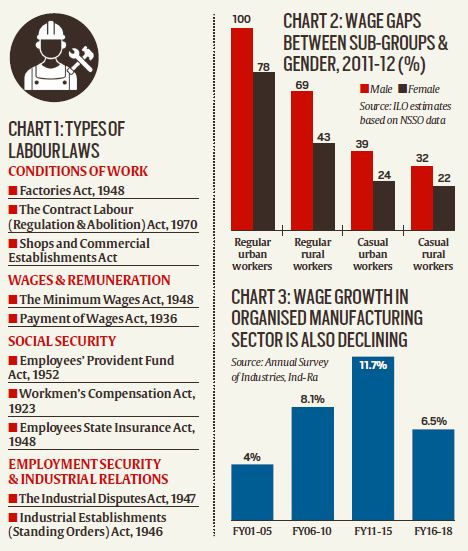
    The gig economy plays to employment patterns in India, where most of the workforce is engaged in “informal” jobs in the “unorganized” sector.

    Employment pattern in India

    • Non-contractual employment: A recent study of employment patterns over a 13-year period ended 2017 for the Prime Minister’s Economic Advisory Council finds that non-contractual employment grew by 68 million over the period.
      • And “has been a hero of employment generation growing by about 5% annually“.
      • There were 145 million people in non-contractual employment in 2017-18.
      • Professionals constituted the most rapidly growing occupations, with older, better educated and skilled witnessing higher growth.
    • Unorganised sector growing at much higher rate than organised sector: The study also found that unorganized sector employment grew by 65 million between 2004 and 2017, compared to only 27 million new jobs in the organized sector.
      • What does the asymmetric rate suggests? It suggests that businesses are finding it more convenient to sustain themselves when they are below the radar of the government.
    • Potential for growth of gig economy: As technology and business models take the gig economy across the country and implant it more deeply into the Indian economy, we can expect to see a lot more people find employment through online marketplaces and technology platforms.

    Regulation of labour laws and expanding the tax base

    • Social Security Code: In December, the government introduced legislation in Parliament that seeks to consolidate a number of labour laws into a Social Security Code.
      • Who will be covered in the code? The new statute encompasses self-employed professionals, freelancers and platform workers, such as those employed by taxi aggregators and food delivery companies.
    • Widening the tax base: The tax person is not far behind.
      • Recent reports suggest that revenue officials are leaning on platforms and aggregators to get gig workers registered with the goods and services tax (GST) network.
      • Need to reflect on how to govern the gig workforce? While it is just as well that the government is attempting to rationalize labour regulations and expand the country’s tax base, it is important to step back and reflect on how the gig workforce ought to be governed.

    The new approach to classification of jobs: Income and volatility

    • Classification on the basis of two fundamental characteristics: If we discard the mental model that has long classified jobs as formal and informal, and look at work afresh, we observe that jobs vary along with two fundamental characteristics:
      • The level of income they generate and-
      • The volatility of this income.
      • Example: A security guard at a company might earn a few thousand rupees a month, but with the assurance of a regular monthly paycheque.
    • More informative way: Instead of the old binary formulation of informal versus formal jobs, it is more informative to see jobs being distributed on a spectrum depending on how much they pay and how volatile the income flows they provide are.
      • Wherever a job lies in this spectrum, the objective of public policy ought to be to ensure a “trimurti”.

    Ensuring Trimurti

    • Frist-Providing dignified working conditions: Promoting dignified working conditions include-
      • Ensuring fairness.
      • Respect.
      • Safety.
      • Protection against exploitation and-
      • Arrangements for retirement.
      • Need to ensure the obligation from employers: This means that even as labour laws are rationalized to eliminate outdated and hard-coded regulations, it is necessary to ensure that all employers retain an obligation to promote the dignity of all their employees.
    • Second-Need to lower the barriers: Real wages grow not because the government imposes minimum wages, but when productivity rises.
      • Productivity growth occurs when barriers to trade, investment and travel are lowered.
      • A closed economy cannot be a successful gig economy.
    • Finally-A re-imagined social security system: A re-imagined social security system for the 21st century must tap government, corporate and social contributions for insurance and retirement accounts.
      • Such a multi-contribution system is possible today and the proposed Social Security Code is an opportunity to put in place such a future-proof framework.

    How to handle the dispute arising out of the gig economy

    • Start online dispute resolution system: The gig economy is perhaps the best place for India to start its first online automated dispute resolution system.
      • You can’t govern the 21st-century economy with 18th-century technology.

    Conclusion

    While ensuring the application of the labour code to the gig economy and bringing them in the tax net the government also ensure the conducive environment for the gig economy to flourish and contribute significantly in the growth of the country.


  • Person in news: Dara Shikoh


    The Ministry of Culture recently set up a panel of the Archaeological Survey of India (ASI) to locate the grave of the Mughal prince Dara Shikoh (1615-59) nearby Humayun’s Tomb complex in Delhi.

    Dara Shikoh’s legacy

    • The eldest son of Shah Jahan, Dara Shikoh was killed after losing the war of succession against his brother Aurangzeb.
    • Dara Shikoh is described as a “liberal Muslim” who tried to find commonalities between Hindu and Islamic traditions.
    • He translated into Persian the Bhagavad Gita as well as 52 Upanishads.

    Antithesis to Aurangzeb

    • Some historians argue that if Dara Shikoh had ascended the Mughal throne instead of Aurangzeb, it could have saved thousands of lives lost in religious clashes.
    • Dara Shukoh was the total antithesis of Aurangzeb, in that he was deeply syncretic, warm-hearted and generous — but at the same time, he was also an indifferent administrator and ineffectual in the field of battle.

    The remains of Dara Shikoh

    • According to the Shahjahannama, after Aurangzeb defeated Dara Shikoh, he brought the latter to Delhi in chains.
    • His head was cut off and sent to Agra Fort, while his torso was buried in the Humayun’s Tomb complex.
    • Italian traveller Niccolao Manucci gave a graphic description of the day in Travels of Manucci, as he was there as a witness to the whole thing. That is the basis of the thesis.
  • Urban Heat Islands in India


    A recent study from IIT Kharagpur called “Anthropogenic forcing exacerbating the urban heat islands in India” noted that the relatively warmer temperature in urban areas, compared to suburbs, may contain potential health hazards due to heat waves apart from pollution.

    About the study

    • The research did study the difference between urban and surrounding rural land surface temperatures, across all seasons in 44 major cities from 2001 to 2017.
    • It found evidence of mean daytime temperature of surface urban heat island (UHI Intensity) going up to 2 degrees C for most cities, as analysed from satellite temperature measurements in monsoon and post monsoon periods.
    • Other researchers from elsewhere have also noticed similar rise in daytime temperatures in Delhi, Mumbai, Bengaluru, Hyderabad and Chennai.

    What is an Urban Heat Island?

    • An urban heat island (abbreviated as UHI) is where the temperature in a densely populated city is as much as 2 degrees higher than suburban or rural areas.
    • This happens because of the materials used for pavements, roads and roofs, such as concrete, asphalt (tar) and bricks, which are opaque, do not transmit light, but have higher heat capacity and thermal conductivity than rural areas, which have more open space, trees and grass.
    • Trees and plants are characterised by their ‘evapotranspiration’— a combination of words wherein evaporation involves the movement of water to the surrounding air, and transpiration refers to the movement of water within a plant and a subsequent lot of water through the stomata (pores found on the leaf surface) in its leaves.
    • Grass, plants and trees in the suburbs and rural areas do this. The lack of such evapotranspiration in the city leads to the city experiencing higher temperature than its surroundings.

    Latent impacts

    • UHI s also decrease air quality in the cities, thanks to pollution generated by industrial and automobile exhaust, higher extent of particulate matter and greater amounts of dust than in rural areas.
    • Due to this higher temperature in urban areas, the UHI increases the colonization of species that like warm temperatures, such as lizards and geckos.
    • Insects such as ants are more abundant here than in rural areas; these are referred to as ectotherms.
    • In addition, cities tend to experience heat waves which affect human and animal health, leading to heat cramps, sleep deprivation and increased mortality rates.
    • UHIs also impact nearby water bodies, as warmer water (thanks to the pavements, rooftops and so on) is transferred from the city to drains in sewers, and released into nearby lakes and creeks, thus impairing their water quality.

    Control of UHIs and mitigation

    • Industrialization and economic development are vital to the country, but the control of UHIs and their fallouts are equally vital. Towards this, several methods are being, and can be, tried.
    • One of them is to use greener rooftops, using light-coloured concrete (using limestone aggregates along with asphalt (or tar) making the road surface greyish or even pinkish (as some places in the US have done); these are 50% better than black, since they absorb less heat and reflect more sunlight.
    • Likewise, we should paint rooftops green, and install solar panels there amidst a green background.
    • The other is to plant as many trees and plants as possible

    Why plant more trees?

    Relevant to the present context are:

    • they combat climate change; clean the surrounding air by absorbing pollutant gases (NXOy, O3, NH3, SO2, and others) and trapping particulates on their leaves and bark;
    • they cool the city and the streets; conserve energy (cutting air-conditioning costs by 50%); save water and help prevent water pollution; help prevent soil erosion; protect people and children from UV light;
    • they offer economic opportunities; bring diverse group of people together; encourage civic pride by giving neighborhoods a new identity; mask concrete walls, thus muffling sounds from streets and highways, and eye-soothing canopy of green; and the more a business district has trees, more business follows.
  • How countries play the tariff game

     Context

    It is important to have a stable tariff policy which would help to link effectively to global value chains.

    Why countries levy tariff?

    • The tariff is a tax levied on an imported good at the border.
    • Countries use tariffs to-
      • Provide easy market access or restrict them to protect domestic industry.
      • It also serves the purpose of revenue collection and-
      • To achieve some strategic objectives by giving/denying tariff concessions to countries.

    Harmonised System in international trade

    • What is it? Goods are classified at 2, 4, 6, 8 digits and some countries have even up to 10 digits, depending upon the level of trade potential of a country.
    • WCO’s system of codes: The classification of these codes is streamlined under an international coding system called ‘Harmonized System’ (HS) under World Customs Organization (WCO) to which 138 countries are contracting parties and about 200 customs authorities are signatories.
    • India’s national tariff lines are about 11,000 at HS 8-digit.

    Historic background of the tariffs

    • Colonial-era: During the colonial era tariffs were heavily used to protect the domestic industry, enjoy unbridled access to the colonized markets and raise tariffs against competitors.
    • Adam Smith’s advocacy of free trade: Adam Smith in 18th Century challenged this idea of regimented trade with his advocacy of free trade that was convincingly brought out in his seminal work ‘Wealth of Nations’.
    • Theory of comparative advantage: Further, in the 19th Century, David Ricardo, building on this concept, propagated the ‘theory of comparative advantage’.
      • The theory proposes that nations should remain focused on their specific areas of competence and allowed to trade freely with other countries.
      • This theory is against import substitution and considers raising tariffs as a drag on economic growth.
    • What proponents of high tariff said? Proponents of high tariffs assert that-
      • Developed countries dominated global markets for decades with high tariffs, developing countries should continue to enjoy differential tariff treatment until they catch up with the rest.

    How countries calibrate tariffs?

    • Each country calibrates its tariffs taking into account its-
      • Domestic production.
      • Demand and
      • Sensitivities.
    • Typically, tariff structures of a manufacturing country reveal a pattern:
      • Low tariffs on raw materials and intermediate goods in the range of 0-5%.
      • Slightly higher tariffs for finished goods in the range of 7-10%.
      • Higher tariffs for agriculture products at above 15%, sometimes up to bound rates as allowed under WTO.
      • As agriculture lines are politically sensitive, most countries zealously guard them with high tariffs.

    Export-import linkage and effects of high tariffs

    • How tariffs could harm export competitiveness: Availability of cheaper raw materials and intermediate products support making of competitively priced finished goods for export markets.
      • The challenge for an entrepreneur is to find these cheaper inputs.
      • If these inputs are not available domestically at competitive rates, they look to source them from outside.
      • But as high tariffs act as barriers to sourcing cheaper inputs, they undermine export competitiveness of a product.
    • Implications for MSMEs
      • For MSMEs (micro, small and medium enterprises), this dependency linkage is even more critical, without which they might close down their operations under threat of persistent losses or low returns.
      • Impact on jobs and economy: This would have consequential impact on jobs, income and consumer choices in an economy.
    • Inefficiency and corruption at entry points: High tariffs could breed inefficiency and corruption at the entry points as it leaves much scope for discretion at the hands of officials, circumvention through under/over-invoicing and violation of rules of origin.
    • Impairing demand: Overtime, high tariffs run the risks of impairing demand and paralyzing domestic manufacturing.
    • Maintaining judicious balance: Leveraging tariffs for benchmarking domestic prices is not an uncommon practice in any country.
      • But maintaining a judicious balance between the interests of primary producers and user industries is imperative, given that there exists an intimate link between imports and exports.

    India and Global Value Chain (GVC)

    • 80% trade through More than 80% of the global trade runs through Global Value Chains (GVCs) which have evolved extensively in various regions of the world.
      • Low tariffs help GVCs to thrive, essentially for the purpose of sourcing and accessing foreign markets.
    • Why stable tariff policy is important for India?
      • For India to emerge as a global hub for “networked products” and make every district an ‘export hub’ for a specific item, as envisaged in this year’s Budget, it is important to have a stable and predictable tariff policy which would help to link effectively to GVCs.
      • For investors: From an investor’s point of view a stable tariff policy is a huge motivation.

    Free-trade agreements and hope of getting market access

    • Market access: The assumption that tariff concessions under bilateral free trade agreements (FTAs) would help get market access is misplaced.
      • Why the assumption is misplaced? In reality, this may not happen as same concessions can be offered by a country to other trading partners in a trade arrangement or throw open to all countries on an MFN (most favoured nation) basis.
      • Inverted duties situation: Gradual tariff liberalization is a natural progression and failing to do so could result in a situation of inverted duties where finished products end up being cheaper than raw materials and intermediate goods
      • Thus, calling for tariff correction in course of time.

    Revenue Generation through tariffs

    • Why it is not a good idea? The domestic consumers ultimately end up absorbing import duties as they get passed onto products they consume.
    • Taxing own people: This is akin to taxing one’s own people in an indirect way by making them pay more for a product than in other markets.
    • Revenue generation from enhanced activities: For these reasons, the idea of revenue collection from import duties is losing steam, and instead, revenue generation from enhanced economic activity is gaining wider acceptance as a dynamic process.

    Conclusion

    Increasing tariffs on the import can end up hurting the economy than benefitting it in the long run, so the government must reconsider the policy of tariff increase.