💥Join UPSC 2027,2028 Mentorship (August Batch) + XFactor Notes & Microthemes PDF

Distribution: weekly

  • Indian Data Relay Satellite System (IDRSS)

    India plans to ring in its own era of space-to-space tracking and communication of its space assets this year by putting up a new satellite series called the Indian Data Relay Satellite System.

    Indian Data Relay Satellite System (IDRSS)

    • The IDRSS is planned to track and be constantly in touch with Indian satellites, in particular those in low-earth orbits which have limited coverage of earth.
    • In the coming years, it will be vital to ISRO whose roadmap is dotted with advanced LEO missions such as space docking, space station, as well as distant expeditions to moon, Mars and Venus.
    • It will also be useful in monitoring launches.
    • The first beneficiary would be the prospective crew members of the Gaganyaan mission of 2022 who can be fully and continuously in touch with mission control throughout their travel.
    • IDRSS satellites of the 2,000 kg class would be launched on the GSLV launcher to geostationary orbits around 36,000 km away.
  • What is Jus Cogens?

    The US has threatened to target few historical sites if Iran retaliates to attack US in revenge. This is a breach of JUS COGENS as targeting cultural sites amounts to a a war crime.

    Jus Cogens

    • The jus cogens rules have been sanctioned by the Vienna Conventions on the Law of Treaties of 1969 and 1986. According to both Conventions, a treaty is void if it breaches jus cogens rules.
    • Jus Cogens or ius cogens, meaning “compelling law” in Latin, are rules in international law that are peremptory or authoritative, and from which states cannot deviate.
    • These norms cannot be offset by a separate treaty between parties intending to do so, since they hold fundamental values.
    • Today, most states and international organisations accept the principle of jus cogens, which dates back to Roman times.

    What does the convention say?

    • Article 53 of the 1969 Convention says: “A treaty is void if, at the time of its conclusion, it conflicts with a peremptory norm of general international law.
    • For the purposes of the present Convention, a peremptory norm of general international law is a norm accepted and recognized by the international community of States as a whole as a norm.
    • From this no derogation is permitted and which can be modified only by a subsequent norm of general international law having the same character.
    • Article 64 says- If a new peremptory norm of general international law emerges, any existing treaty which is in conflict with that norm becomes void and terminates.
    • Besides treaties, unilateral declarations also have to abide by these norms.

    What is included in jus cogens?

    • So far, an exhaustive list of jus cogens rules does not exist.
    • However, the prohibition of slavery, genocide, racial discrimination, torture, and the right to self-determination are recognised norms.
    • The prohibition against apartheid is also recognised as a jus cogens rule, from which no derogation is allowed, since apartheid is against the basic principles of the UN.

    What is the problem with targeting cultural heritage?

    • Following the unparalleled destruction of cultural heritage in World War II, the nations of the world adopted at The Hague in 1954, The Convention for the Protection of Cultural Property in the Event of Armed Conflict.
    • It was the first international treaty focussed exclusively on the protection of cultural heritage during war and armed conflict.
    • The Convention defined cultural property as “movable or immovable property of great importance to the cultural heritage of every people, such as monuments of architecture, art or history, whether religious or secular; archaeological sites….”, etc.
    • There are currently 133 signatories to Convention, including countries that have acceded to and ratified the treaty.
    • Both the United States and Iran (as well as India) signed the Convention on May 14, 1954, and it entered into force on August 7, 1956.
    • The Rome Statute of 1998, the founding treaty of the International Criminal Court, describes as a “war crime” any intentional attack against a historical monument, or a building dedicated to religion, education, art, or science.
  • Ethical Veganism

    An employment tribunal in the UK has ruled that “ethical veganism” is a philosophical belief and has to be protected by law against discrimination.

    What’s the issue about?

    • A man was fired from an animal welfare charity for raising concerns about its pension funds’ alleged investment in companies that use animal testing.
    • He for gross misconduct on insisting to ban fox-hunting and other types of recreational hunting in Britain.
    • The tribunal had to determine if ethical veganism fit the criteria of a religious or philosophical belief.
    • The tribunal determined that ethical veganism meets the test required to be a philosophical belief, because of which it is protected under the British Equality Act, 2010.
    • Many vegetarians claimed that they were discriminated at workplace for not eating meat. In his case, the tribunal had dismissed the case, calling his vegetarianism a lifestyle choice.

    Veganism, ethical veganism, and ethical vegetarianism

    • Broadly, a vegan person does not consume meat products and also products that are derived from animals (such as milk, eggs, etc).
    • ‘The Ethical Case for Veganism’ in the Oxford Handbook of Food Ethics, loosely defines veganism as a lifestyle choice to refrain from eating meat as well as products made from or by animals.
    • Ethical veganism, on the other hand, has been defined as the view that attaches a positive ethical valuation to a vegan lifestyle.
    • Significantly, ethical veganism is different from ethical vegetarianism — the latter makes a distinction between products made from animals, such as meat, and products made by animals, such as milk.
    • Ethical vegetarianism is opposed to products made from animals in particular.
    • There is also an ethical omnivorism, which permits the use of some animal products and may restrict the use of others based on some ethical criterion, say the authors of the Food Ethics paper.

    Types of ethical veganism

    • They mention two types of ethical veganism: broad absolutist veganism, under which it is always wrong to use any product made by or from animals, and modest ethical veganism, under which it is typically wrong to use products made from or by a range of animals including cats, dogs, cows, pigs, etc.
    • An example of the former category is a person who would not press a leather button, “even if doing so were necessary in order to avert global nuclear war”.
    • The reasons for adopting veganism as a lifestyle can range from wanting a better and healthier lifestyle, environmental, or religious reasons.

    Britain’s Equality Act

    • The act protects people from discrimination in the workplace and in the wider society in the UK.
    • The Act offers a basic framework of protection against direct and indirect discrimination, harassment, and victimisation in services and public functions, etc.
    • Under the Act, a belief is defined as any religious or philosophical belief.
    • Since the tribunal has ruled that ethical veganism is a philosophical belief, it is a protected characteristic under the Act.
  • Places in news: Nankana Sahib

    Recently tension mounted in Pakistan after few goons vandalized the Nankana Sahib Gurdwara.

    Nankana Sahib

    • Nankana Sahib is a city of 80,000 in Pakistan’s Punjab province, where Gurdwara Janam Asthan (also called Nankana Sahib Gurdwara) is located.
    • The shrine is built over the site where Guru Nanak, the founder of Sikhism, was believed to be born in 1469.
    • It was constructed by Maharaja Ranjit Singh, after he visited Nankana Sahib in 1818-19 while returning from the Battle of Multan.
    • It is 75 kms to the west of Lahore, and is the capital of Nankana Sahib district.
    • The city was previously known as Talwandi, and was founded by Rai Bhoi, a wealthy landlord.
    • Rai Bhoi’s grandson, Rai Bular Bhatti, renamed the town ‘Nankana Sahib’ in honour of the Guru. ‘Sahib’ is an Arabic-origin epithet of respect.

    Historical significance

    • During British rule, the Gurdwara Janam Asthan was the site of a violent episode when in 1921, over 130 Akali Sikhs were killed after they were attacked by the Mahant of the shrine.
    • The incident is regarded as one of the key milestones in the Gurdwara Reform Movement, which led to the passing of the Sikh Gurdwara Act in 1925 that ended the Mahant control of Gurdwaras.
    • In 2014, Pakistan had a memorial for the massacre built.
  • [pib] Network for Scientific Co-operation for Food Safety and Applied Nutrition (NetSCoFAN)

    Union Health Minister has launched NetSCoFAN, a network of research & academic institutions working in the area of food & nutrition.

    NetSCoFAN

    • The NetSCoFAN would comprise of eight groups of institutions working in different areas viz. biological, chemical, nutrition & labelling, food of animal origin, food of plant origin, water & beverages, food testing, and safer & sustainable packaging.
    • FSSAI has identified eight Nodal Institutions who would develop a ‘Ready Reckoner’ that will have inventory of all research work, experts and institutions and would carry out and facilitate research, survey and related activities.
    • It would identify research gaps in respective areas and collect, collate and develop database on food safety issues for risk assessment activities.
    • The need for identify research gaps in respective areas and collect, collate and develop database on food safety issues for risk assessment activities, will be addressed by NetSCoFAN.
    • The NetSCoFAN directory would be covering detailed information of various heads/Directors and lead scientists of lead and associated partnering institutions.
  • Miyawaki Method

    Kerala Forest Dept. has adopted Miyawaki afforestation concept to be used in govt. offices, schools and puramboke land.

    Miyawaki Method

    • Miyawaki method is a method of urban afforestation by turning backyards into mini-forests.
    • It includes planting trees as close as possible in the same area which not only saves space, but the planted saplings also support each other in growth and block sunlight reaching the ground, thereby preventing the growth of weed.
    • Thus the saplings become maintenance-free (self sustainable) after the first three years.
    • It helps to create a forest in just 20 to 30 years while through conventional methods it takes anywhere between 200 to 300 years.

    The technique

    • The native trees of the region are identified and divided into four layers — shrub, sub-tree, tree, and canopy.
    • The quality of soil is analysed and biomass which would help enhance the perforation capacity, water retention capacity, and nutrients in it, is mixed with it.
    • A mound is built with the soil and the seeds are planted at a very high density — three to five sapling per square meter.
    • The ground is covered with a thick layer of mulch.
  • Carbon Stock in Indian forests

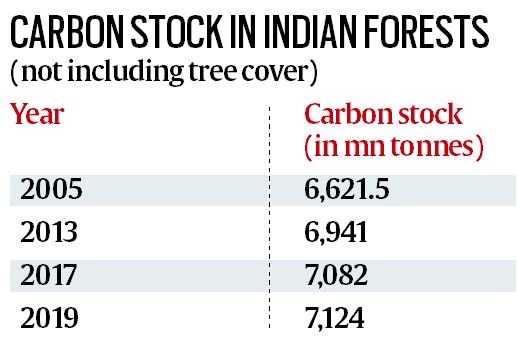
    • The State of Forest Report (SFR) 2019 has shown an increase in the carbon stock trapped in Indian forests in the last two years.
    • However it shows why it is going to be an uphill task for India in meeting one of its international obligations on climate change.

    India’s carbon commitment

    • India, as part of its contribution to the global fight against climate change, has committed itself to creating an “additional carbon sink of 2.5 to 3 billion tonnes of carbon dioxide equivalent” by 2030.
    • That is one of the three targets India has set for itself in its climate action plan, called Nationally Determined Contributions, or NDCs, that every country has to submit under the 2015 Paris Agreement.
    • The other two relate to an improvement in emissions intensity and an increase in renewable energy deployment.
    • India has said it would reduce its emissions intensity (emissions per unit of GDP) by 33% to 35% by 2030 compared to 2005.
    • It has also promised to ensure that at least 40% of its cumulative electricity generation in 2030 would be done through renewable energy.

    What is the relationship between forests and carbon?

    • Forests, by absorbing carbon dioxide from the atmosphere for the process of photosynthesis, act as a natural sink of carbon.
    • Together with oceans, forests absorb nearly half of global annual carbon dioxide emissions.
    • In fact, the carbon currently stored in the forests exceeds all the carbon emitted in the atmosphere since the start of the industrial age.
    • An increase in the forest area is thus one of the most effective ways of reducing the emissions that accumulate in the atmosphere every year.

    How do the latest forest data translate into carbon equivalent?

    • The latest forest survey shows that the carbon stock in India’s forests (not including tree cover outside of forest areas) have increased from 7.08 billion tonnes in 2017.
    • This translates into 26.14 billion tonnes of carbon dioxide equivalent as of now.
    • It is estimated that India’s tree cover outside of forests would contribute another couple of billion of tonnes of carbon dioxide equivalent.

    How challenging does this make it for India in meeting its target?

    • An assessment by the Forest Survey of India (FSI) last year had projected that, by 2030, the carbon stock in forests as well as tree cover was likely to reach 31.87 billion tonnes of CO2 equivalent.
    • An additional 2.5 to 3 billion tonnes of sink, as India has promised to do, would mean taking the size of the sink close to 35 billion tonnes of CO2 equivalent.
    • Considering the rate of growth of the carbon sink in the last few years, that is quite a stiff target India has set for itself.
    • In the last two years, the carbon sink has grown by just about 0.6%%. Even compared to 2005, the size of carbon sink has increased by barely 7.5%.
    • To meet its NDC target, even with most optimistic estimates of carbon stock trapped in trees outside of forest areas, the sink has to grow by at least 15% to 20% over the next ten-year period.

    Way Forward

    • There are two key decisions to be made in this regard — selection of the baseline year, and addition of the contribution of the agriculture sector to carbon sink.
    • When India announced its NDC in 2015, it did not mention the baseline year.
    • India’s emissions intensity target uses a 2005 baseline, so there is an argument that the forest target should also have the same baseline.
    • But there is a strong demand for a 2015 baseline as well, so that it results in some concrete progress in adding new forest cover.
    • The NDC specifically mentions that and “additional” 2.5 to 3 billion tonnes of carbon sink would be created through additional forest and tree cover by 2030 MoEFCC insist that tree cover outside forest areas must include agriculture as well.
    • India would also have to specify whether it wants to count the carbon sink in the agriculture sector in its target.
  • WHO prequalifies Serum’s low-cost Pneumococcal Vaccine

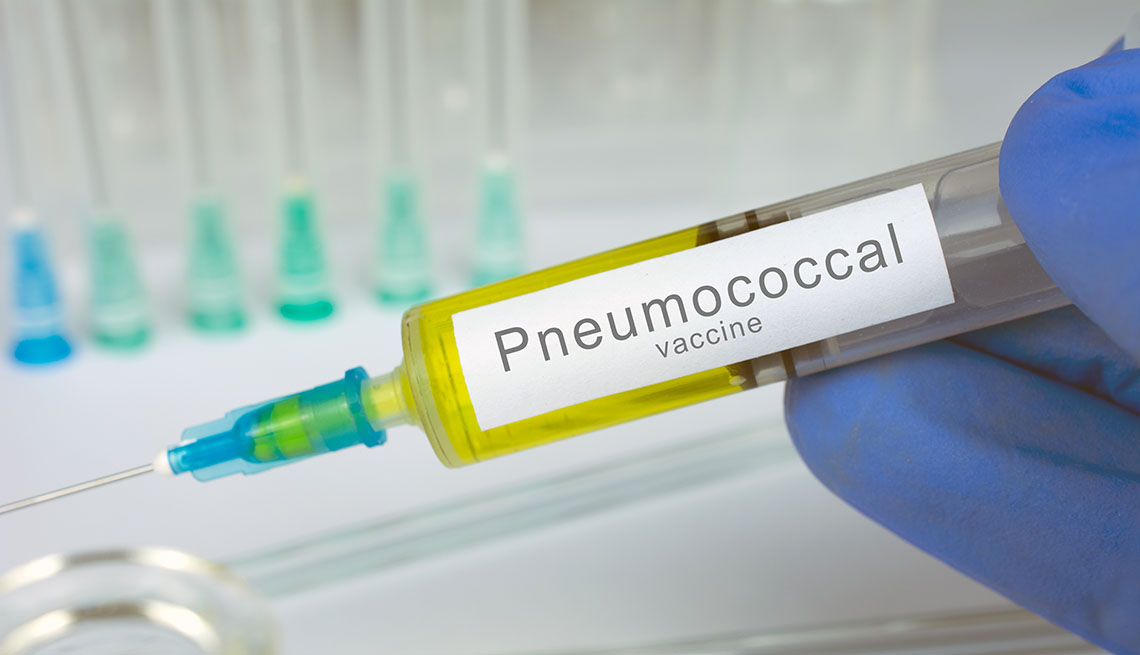
    Pneumococcal vaccine developed by the Pune-based Serum Institute of India has been pre-qualified by the World Health Organisation (WHO).

    Pneumococcal Vaccine

    • Pneumococcal vaccination is a method of preventing a specific type of lung infection (pneumonia) that is caused by the pneumococcus (Streptococcus pneumonia) bacterium.
    • There are more than 80 different types of pneumococcus bacteria – 23 of them covered by the vaccine.
    • The vaccine is injected into the body to stimulate the normal immune system to produce antibodies that are directed against pneumococcus bacteria.
    • This method of stimulating the normal immune system to be directed against a specific microbe is called immunization.
    • It does not protect against pneumonia caused by microbes other than pneumococcus bacteria, nor does it protect against pneumococcal bacterial strains not included in the vaccine.

    About the Vaccine

    • The pneumococcal vaccine PNEUMOSIL is a conjugate vaccine to help produce stronger immune response to a weak antigen.
    • Serum Institute had optimized an efficient conjugate vaccine manufacturing processes for its meningitis A vaccine (MenAfriVac).
    • It was used for manufacturing the pneumococcal vaccine. This helped the company reduce the manufacturing cost of pneumococcal vaccine.

    Why?

    • It pneumonia caused 1,27,000 deaths in India in 2018, the second highest number of child mortality under the age of five in the world.
    • In India, pneumonia and diarrhoea cause the most deaths in children under five years.
    • In 2017, pneumococcal conjugate vaccine was included in the under India’s Universal Immunisation Programme (UIP).
    • It has been introduced in a phased manner starting with Himachal Pradesh, parts of Bihar, Uttar Pradesh, Madhya Pradesh and Rajasthan.
    • The efficacy of the Serum vaccine was tested against an already approved pneumococcal vaccine (Synflorix).
  • [op-ed snap]Eradication of TB by 2025

    At the End TB summit, 2018 the prime minister of India made a bold commitment to end tuberculosis by 2025-five years ahead of the global target. Which is possible to achieve if the efforts are put at the level it was done in case of polio.

    The toll taken by TB

    • Despite the disease being fully curable, people still die from it.
    • TB usually affects people in their most productive years and drives families into debt.
    • It has a direct link to human suffering, discrimination and also poverty.
    • Due to its infectious spread, it directly affects our economic growth as well.
    • With resilience, sufficient investment, innovative approaches and strategies and the participation of all stakeholders, TB can be defeated.

    First Step- Awareness

    • The first step is the creation of awareness and empowering of communities.
    • TB affects millions, yet very few know enough about it.
    • Multilingual, multi-stakeholder awareness effort to ensure that all Indians knows about the challenges of TB and where to seek treatment is required.
    • With the expansion of the media and evolving technology, it is possible to reach everyone with the right information.

    Second Step- Access to diagnosis and treatment

    • Ensuring that every Indian get access to correct diagnosis and treatment for TB, regardless of their ability to pay for it is the second step.
    • To do so, working with the private sector is necessary as was done in the case of polio.
    • There are numerous innovative private-sector programmes and partnership schemes for TB.

    Role of  Private sector

    • Recently launched programmes for doctors and labs offer the private sector various incentives.
    • Even today, about half a million TB cases go unnotified, especially those seeking care in the private sector.
    • Those cases need to be tracked and ensured that everyone in the need of treatment and care gets it.
    • Organisations like Indian Medical Association and Indian Academy of Paediatrics are working with the private sector to ensure patient-centric care as per “Standards of TB Care in India” (STCI).

    Drug-resistant TB

    • A key challenge is building a forward-looking plan to address and control drug resistance.
    • Drug-resistant TB is a man-made menace that is a major roadblock in a fight against TB.
    • Every TB patient must be tested for drug resistance at the first point of care, whether in the public or private sector, to rule out any drug resistance.

    Efforts by the government

    • Nikshay Poshan Yojana -in which TB patients receive Rs 500 every month while on treatment was launched.
    • Nikshay Poshan Yojana ensure that the patients have economic support and nutrition during the required period.
    • ‘TB Harega Desh Jeetega Campaign’ was launched to accelerate the efforts to end TB by 2025.
    • The campaign aims to initiate preventive and promotive health approaches.
    • By applying “multi-sectoral and community-led” approach, the government is building a national movement to end TB by 2025.
    • Resource allocation towards the TB Elimination Programme has been increased by four-fold.
    • Sincere efforts need to be made to make our health systems more accessible and reliable.
    • It also required to ensure that those seeking care trust the healthcare system and get the appropriate care for completing treatment.
    • There is a need to create more labs, point of care tests, an assured drug pipeline, access to new drugs.
    • The government should also ensure counselling and support for those affected.
    • Every patient who is diagnosed late and does not receive timely treatment continues to infect others.
    • To break this cycle, government machinery at the field level should work with communities and provide free diagnosis and treatment to every affected individual.

    Conclusion

    With all the efforts, planning and resource put in place to eradicate the menace of TB from India, it is possible to achieve the goal by 2025.

  • India’s policies for ‘Urban Lakes’

    Context

    • Historically, cities were built along waterways or lakes.
    • Over time, human settlements near water bodies and lakes have transformed the natural environment into the towns and cities we see today.
    • Urban lakes are an important part of city ecosystems as they play a major role in providing environmental, social and economic services.

    Famous Urban Lakes in India

    Carambolim (Goa), Chilika (Odisha), Dal (Jammu and Kashmir), Deepor Beel (Assam), Khabartal (Bihar), Kolleru (Andhra Pradesh), Loktak (Manipur), Naini (Uttrakhand), Nalsarovar (Gujarat), and Vembanad (Kerala)

    Threats to these Lakes

    These lake ecosystems are presently endangered due to anthropogenic disturbances caused by Urbanisation as they have been heavily degraded due to pollution from disposal of untreated local sewage or due to encroachment, resulting in shrunken lakes.

    Why conserve them?

    • Lakes in urban areas provide us with prime opportunities for recreation, tourism and domestic purposes.
    • They hold historical and traditional values and at places are a source of water supply for a municipality.
    • Appropriate lake function can ease the impact of floods and droughts by storing large amounts of water and releasing it during shortages.
    • Lakes also help in replenishing groundwater level as they are essential receptors for groundwater recharge, positively influencing water quality of downstream watercourses and preserving the biodiversity and habitat of the surrounding area.
    • Lakes in urban areas are also used as a source of water for industries, irrigation and agriculture.

    Defining Urban Lakes

    • There is no specific definition for ‘urban lakes’ in India.
    • According to the National Lake Conservation Plan (NLCP), a water body having a minimum depth of three metres, spread over more than 10 hectares, and having no or very little aquatic vegetation, is considered as a lake.

    The definition provided by NLCP is based on broad hydrological and morphometry criteria of a lake:

    • The apparent definition of urban lakes seems to those located entirely within city limits (census town) and directly surrounded by urban developments, with some recreation facilities limited to the shoreline area (parks, playgrounds).

    OR

    • The lakes which are predominantly affected by urban human populations and their drainage basin is dominated by urbanisation, rather than geology, soils or agriculture. Such lakes are situated only partially within city limits, or attached but not necessarily surrounded, entirely by city development.

    Issues with the definition

    • One of the obstacles for effective protection of these interlinked lakes in cities is the lack of a clear definition of an ‘urban lake’ in the Indian context.
    • The definition provided under the guideline of NLCP acknowledges only broad hydrological criteria to define a water body as a lake.
    • This definition ignores the fact that the water depth and spread keep changing every year, depending on various environmental factors.
    • In fact, there are very few urban lakes that fit into this definition since most of them occupy a small area (<10 ha), are seasonal and shallow.

    Various policy measures

    Water (Prevention and Control of Pollution) Act in 1974

    • Planning interventions for water bodies started as early as 1927.
    • In the Water (Prevention and Control of Pollution) Act in 1974, directions were given to control the flow of sewage and industrial effluents into water bodies.

    Ramsar Convention

    • The need for lake conservation was felt when India became a signatory to the Ramsar Convention on Wetlands, 1982.
    • The Convention called for the conservation and wise use of wetlands (including water bodies).
    • Twenty-six Ramsar sites, covering an area of 689,000 ha, were identified in India.

    National Wetland Conservation Programme

    • The Indian government operationalised the Programme in closed collaboration with concerned state governments during 1985-86 under the MoEFCC notification.
    • Recognising the importance of lakes, the Ministry launched NLCP, a centrally sponsored scheme exclusively aimed at restoring the water quality and ecology of lakes in different parts of the country.
    • Under the programme, 115 wetlands were identified, which required urgent conservation and management initiatives.
    • The selection of lakes was on hydrological (Lake size over 10 acres or 3 acres if of religious and cultural importance and lake depth more than three metres), scientific and administrative criteria.
    • The scheme was approved by the Union government during the Ninth Plan (June 2001) as 100 per cent central grant.
    • From 100 per cent central funding, the costs are now shared according to a ratio of 70:30 between the Union and the concerned state government.

    Repair, Renovation and Restoration of Waterbodies’ Scheme

    • In continuation with the NLCP, the Centre had launched this Scheme in 2005,
    • The objectives of the scheme were comprehensive improvement and restoration of traditional waterbodies, including increasing tank storage capacity, ground water recharge, etc.

    National Plan for Conservation of Aquatic Eco-systems (NPCA)

    • Later, in 2016, the National Lake Conservation Plan was merged with National Wetlands Conservation Programme to form NPCA.
    • The principal objectives of NPCA are holistic conservation and the restoration of lakes and wetlands through an integrated and multidisciplinary approach with a common regulatory framework.
    • All lakes that were a part of NLCP, were brought under this scheme, and are being restored till date.

    Why Urban Lakes still needs more attention?

    • Even after 26 years of pollution abatement works, only ten per cent of waste water generated in the country is treated.
    • The rest collects as cess pools or is discharged into the 14 major, 55 minor and several hundred other rivers.
    • It is quite clear that the overall status of quality of water in rivers, lakes and its links to groundwater has not been adequately addressed.
    • Out of the 43 Indian guidelines passed by the central and state government, 41 per cent of those talk about conservation and restoration of waterbodies but only 10 per cent exactly describe the conservative measure.
    • Only 22 per cent of the guidelines are on subjects related to policies to be adopted by state government, urban local bodies etc.
    • This clearly identifies the missing links and marks the future prospects that India should adopt for the preparation of better and sustainable lake management plans.

    Need for a comprehensive Lake Management Plan

    • ‘Lake management planning’ is an approach for different stakeholders to come together with a common interest in improving and protecting their lake.
    • Focusing on planning process rather than quick-fix solutions makes lake rejuvenation a manageable process.
    • Moreover, it guides how time and resources are utilised, keeping future sustainability of the lake in account.  It includes:
    1. Encourages partnerships between concerned citizens, special interest groups, government body and water resources management practitioners
    2. Identifies the concerns regarding the catchment/watershed of the lake
    3. Sets realistic goals, objectives, and (short, medium and long-term) actions, and identifies needed funds and personnel.

    Conclusion

    • Under the Jal Shakti mission and AMRUT, the revival /rejuvenation of water bodies is in piecemeal approach, with short-term measures like beautification, enhancing recreational activities, addressing immediate solid waste dumping into waterbody etc.
    • Although cities have initiated to work towards water bodies’ rejuvenation, the long-term approach is still missing.

    Way Forward

    • Since a lake is a reflection of its catchment area, it is essential to first understand the significant changes or trends concerning the primary land uses within the catchment area / watershed draining into the lake.
    • There is no approach which defines the planning process for preparation of short, medium and long-term action plans for lake rejuvenation, considering its watershed area.
    • It is essential to have a document with clear understanding of the lake’s watershed area, with specific goals, objectives, producing time-bound action plans.
    • Conservation of Lakes and wetlands through an integrated and multidisciplinary approach with a common regulatory framework should be carried out.