💥Join UPSC 2027,2028 Mentorship (August Batch) + XFactor Notes & Microthemes PDF

Distribution: weekly

  • Explained: Voting at the GST Council

    • Breaking the tradition of consensus-based decisions in its 37 earlier meetings, the GST Council voted for the first time in its 38th meeting held on December 18.

    GST Council voting rules

    • As per The Constitution (One Hundred and First Amendment) Act, 2016, in case of a voting, every decision of the GST Council has to be taken by a majority of not less than three-fourths of the weighted votes of the members present.
    • The vote of the central government has a weightage of one-third of the total votes cast, and the votes of all the state governments taken together have a weightage of two-thirds of the total votes cast in that meeting.
    • As of now, out of the total 30 states and UTs (excluding J&K), 20 are ruled by the NDA.
    • This essentially means that a vote in the Council could largely be an academic exercise — unless a number of the BJP’s allies switch sides.

    Impacts of imbibing Voting

    • With the precedent of voting now established, consensus at the Council could be challenged again in the future.
    • The rules of voting in the GST Council are such that the odds are stacked in favour of the Centre in the normal course.
    • However, in case of a vote, any disagreements within the ruling coalition at the Centre may bring its support below the three-fourths majority that is needed for the passage of a decision.

    Way Forward

    • Differences of opinion are likely to crop up on proposals to raise rates, especially of the lower slabs, in the future — a concern that made most states rule out an immediate rate hike in the last Council meeting, even as they were in agreement over a broader overhaul of the GST structure.
    • So far, even if states voiced their differences over a proposal in the Council, all decisions had been taken by consensus in the meetings of the GST Council.
    • With a departure from the consensus approach having been made, there could be more instances of voting exercises going forward — especially as revenue-raising measures come up in future meetings.

    Back2Basics

    GST Council

    • The GST Council is a federal body that aims to bring together states and the Centre on a common platform for the nationwide rollout of the indirect tax reform.
    • It is an apex member committee to modify, reconcile or to procure any law or regulation based on the context of goods and services tax in India.
    • The GST Council dictates tax rate, tax exemption, the due date of forms, tax laws, and tax deadlines, keeping in mind special rates and provisions for some states.
    • The predominant responsibility of the GST Council is to ensure to have one uniform tax rate for goods and services across the nation.

    How is the GST Council structured?

    • The Goods and Services Tax (GST) is governed by the GST Council. Article 279 (1) of the amended Indian Constitution states that the GST Council has to be constituted by the President within 60 days of the commencement of the Article 279A.
    • According to the article, GST Council will be a joint forum for the Centre and the States. It consists of the following members:
    1. The Union Finance Minister will be the Chairperson
    2. As a member, the Union Minister of State will be in charge of Revenue of Finance
    3. The Minister in charge of finance or taxation or any other Minister nominated by each State government, as members.

    Terms of reference

    • Article 279A (4) specifies that the Council will make recommendations to the Union and the States on the important issues related to GST, such as, the goods and services will be subject or exempted from the Goods and Services Tax.
    • They lay down GST laws, principles that govern the following:
    1. Place of Supply
    2. Threshold limits
    3. GST rates on goods and services
    4. Special rates for raising additional resources during a natural calamity or disaster
    5. Special GST rates for certain States
  • [pib] Operation Sankalp

    Indian Navy has commenced Maritime Security Operations, code named Op SANKALP, in the Gulf region to ensure safe passage of Indian Flag Vessels transiting through the Strait of Hormuz.

    Op Sankalp

    • Indian Navy warships and aircraft were deployed to establish presence, provide a sense of reassurance to the Indian merchantmen, monitor the ongoing situation and respond to any emergent crises.
    • The operation is being progressed in close coordination with all stakeholders including Ministry of Defence, Ministry of External Affairs, Ministry of Shipping, Ministry of Petroleum and Natural Gas and DG, Shipping.
    • The Navy continues to monitor the situation in the Gulf region and is maintaining presence in the region to ensure security of our sea borne trade and the safety of Indian Flag Merchant Vessels transiting through the region.
  • Genome Sequencing of Cobra Venom

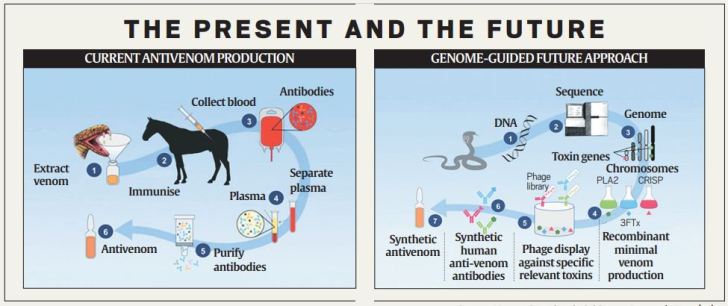
    This week, an international team of researchers reported that they have sequenced the genome of the Indian cobra, in the process identifying the genes that define its venom.  This has provided a blueprint for developing more effective antivenom.

    Big four in Snake bites

    • India alone accounts for about 50,000 deaths annually, and these are primarily attributed to the “big four”.
    • The challenge has been producing antivenom for the species known collectively as the “big four” — the Indian cobra (Naja naja), common krait (Bungarus caeruleus), Russell’s viper (Daboia russelii), and saw-scaled viper (Echis carinatus).
    • In India, common antivenom is marketed for the treatment of bites from the “big four”, but its effectiveness is questionable.
    • While the common antivenom worked as marketed against the saw-scaled viper and the common cobra, it fell short against some neglected species and also against one of the “big four” — the common krait.
    • Accidental contact with snakes leads to over 100,000 deaths across the world every year.

    What is antivenom?

    • Antivenom is currently produced by a century-old process — a small amount of venom is injected into a horse (or a sheep), which produces antibodies that are then collected and developed into antivenom.
    • This is expensive, cumbersome and comes with complications. Some of the antibodies raised from the horse may be completely irrelevant.

    Why has production of effective antivenom been challenging?

    • Venom is a complex mixture of an estimated 140-odd protein or peptides.
    • Only some of these constituents are toxins that cause the physiological symptoms seen after snakebite.
    • But antivenom available today does not target these toxins specifically.

    Issues with present antivenom

    • The horse also has a lot of antibodies floating in its blood that have nothing to do with the venom toxins.
    • One more problem with horse antibodies — our immune system recognises it as foreign and when antivenom is given our body mounts an antibody response. This leads to what is called serum sickness.
    • Also, next time if one is unlucky and has a snakebite incident (even if it is a different snake) and they are given a horse-derived antivenom, the body is going to have a severe allergic reaction.

    How does decoding the genome help?

    • In the Indian cobra genome, the authors identified 19 key toxin genes, the only ones that should matter in snakebite treatment.
    • They stress the need to leverage this knowledge for creation of antivenom using synthetic human antibodies.
    • Targeting these 19 specific toxins using synthetic human antibodies should lead to a safe and effective antivenom for treating Indian cobra bites.

    Back2Basics

    Genome Sequencing

    • Genome is an organism’s complete set of DNA, including all of its genes.
    • Each genome contains all of the information needed to build and maintain that organism. In humans, a copy of the entire genome—more than 3 billion DNA base pairs—is contained in all cells that have a nucleus.
    • Genome sequencing is figuring out the order of DNA nucleotides, or bases, in a genome—the order of As, Cs, Gs, and Ts that make up an organism’s DNA.
  • Person in news: Revolutionary Ashfaqullah Khan

    The Uttar Pradesh cabinet has approved a proposal for a zoological garden spread across 121 acres in Gorakhpur, to be named after the freedom fighter and revolutionary Ashfaqullah Khan.

    Ashfaqullah Khan

    • Khan was a freedom fighter who, along with Ram Prasad Bismil, was sentenced to death for the Kakori train robbery, commonly referred to as the Kakori conspiracy of 1925.
    • He was born on October 22, 1900, in Shahjahanpur, Uttar Pradesh.
    • He grew up at a time when Mahatma Gandhi had launched the non-cooperation movement and urged Indians not to pay taxes to the government or co-operate with the British.

    Moved by NCM withdrawal

    • Within about 1.5 years of the movement’s launch, in February 1922, the Chauri Chaura incident took place in Gorakhpur — a large number of non-cooperation protestors clashed with the police and set the police station on fire, killing roughly 22 policemen.
    • Opposed to violence, Gandhi called off the movement.
    • The youth of the country were greatly disappointed and disillusioned with this. Khan was one among these youths.
    • Subsequently, he joined the revolutionaries and became acquainted with Bismil.

    Ashfaqullah Khan and the Hindustan Socialist Republican Association

    • In the mid-1920s, Khan and Bismil went on to found the Hindustan Socialist Republican Association (HSRA), with the aim of winning freedom for the country through an armed revolution.
    • HSRA published its manifesto titled “The Revolutionary” in 1925.
    • It held that the immediate object of the revolutionary party in the domain of politics is to establish a federal Republic of United State of India by an organized and armed revolution.
    • The final constitution of this Republic shall be framed and declared at a time when the representatives of India shall have the power to carry out their decision.
    • But the basic principles of this Republic will be universal suffrage and abolition of all system which make the exploitation of man by man possible, e.g. the railways, the mines and other industries such as the manufacture of steel and ships all these shall be nationalised.

    The Kakori Conspiracy

    • In August 1925, an armed robbery took place on board the Kakori Express, going from Shahjahanpur to Lucknow, carrying money that had been collected at various railway stations and was to be deposited in Lucknow.
    • In this planned robbery, carried out to fund the activities of the HSRA, Bismil, Khan and over 10 other revolutionaries stopped the train and fled with the cash they found in it.
    • Within a month of the robbery, many members of the HSRA were arrested.
    • In September 1926, Bismil was arrested however Khan was on the run and was later arrested.
    • The trial for the case went on for about 1.5 years. It ended in April 1927, with Bismil, Khan, Rajendra Lahiri and Roshan Singh sentenced to death, and the others given life sentences.
  • [op-ed of the day] There is a design flaw with this military post

    Context

    Recently Chief of Defence Staff post was created by the Government. The utility of this post and the problem it could create are debated.

    History leading to the post

    • First World War brought to the fore the command and control dilemmas of concurrent conflicts.
    • During the colonial years of Great Britain, an issue that received consideration was the British higher command and control structures.
    • With the declaration of the Second World War, the responsibility of higher command fell on War Cabinet serviced by the Chiefs of Staff Committee.
    • Winston Churchill as prime minister given the supreme power but remained responsible to the parliament.
    • After the U.S. entered the war, a unified command required a single commander.
    • After the war ended and the Cold War started, Eisenhower became the supreme commander of NATO.
    • While political powers were vested in the NATO council.
    • Despite the experience of the World Wars the U.S. has not created CDS.
    • In the U.S., the military chain of command runs directly from theatre commanders to civilian secretaries to the President.
    • Britain, however, created the post of the Chief of Defence Staff.

    The outline for India

    • The three-tier defense management structure was adopted by Jawaharlal Nehru.
    • Cabinet Committee on security has served India for well over the years.

    Role of CDS

    • Department of Military Affairs, headed by CDS will deal with the Army, Navy and Air force and The Territorial Army.
    • Works related to procurement related exclusively to the services except for capital acquisition.
    • He will also act as a Principal Military Advisor to the Defence Minister.
    • CDS will not exercise any military command, including the three Service Chiefs, so as to be able to provide impartial advice to the political leadership.

    A subordination

    • There would be an implied subordination of the three service chiefs to the CDS notwithstanding any declaration to the contrary.
    • CDS is tasked with facilitating the restructuring of military commands.
    • Bringing about jointness in operations including through the establishment of joint/ theatre command.
    • This could encroach upon the domain of the service chiefs.
    • The CDS would outrank the three service chiefs even though all are four-star.
    • CDS could override the Service Chiefs on critical tactical and perhaps even strategic issues.

    Conclusion

    • The Department of Military Affairs would exercise control over the three services and also most problematic is the erosion of the civilian supremacy which could result with the creation of the post.
  • [op-ed snap] Children of lesser gods

    Context

    The deaths of nearly 200 children in Kota, from largely preventable diseases, lays bare the condition of the healthcare system in India.

    Where does India stand?

    • According to UNICEF’s ‘State of World’s Children 2019’ report, India reported the maximum number of deaths of children under five in the world in 2018.
    • 8,82,000 children under five died that year.
    • That means around 2,416 deaths per day.
    • The death of children due to largely-preventable illnesses is a matter of serious concern and calls for urgent introspection.

    Factors that govern child health

    • Most of the children who died in Gorakhpur, Muzaffarpur and Kota belong to the lowest strata of the society.
    • It won’t be wrong to conclude that they were victims of structural violence.
    • This structural violence is unleashed through a multitude of social, political and economic factors apathy of healthcare professionals, poor health services/infrastructure
    • And low rates of female literacy, economic inequality, the rigid caste system, social apartheid, lack of political will and patriarchy play role.
    • As a society, we have stopped looking at the deaths of our citizens through the prism of compassion and concern.
    • Structural violence influences the nature and distribution of extreme suffering.

    What is being done in the wrong way?

    • The government is considering the takeover of 750 district hospitals by private medical colleges through a public-private partnership (PPP) model.
    • This, despite ample evidence about the failure of the model in the country’s healthcare system.
    • Nobel laureate Kenneth Arrow demonstrated that profit and private involvement in healthcare lead to an erosion of trust.
    • An Individual’s demand for medical services is irregular and unpredictable, the involvement of a private market model for such services can be disastrous.
    • The U.S.’s experiences in the PPP model in healthcare have shone a light on the deficits in transparency and highlighted the lack of care of vulnerable groups.

    Conclusion

    • What urgently a sincere engagement by the state in matters concerning peoples’ health.
    • We need to question the government’s priorities in a country where nearly a million children die every year
  • Explained: First Advance Estimates (FAE)

    The First Advance Estimates (FAE) were recently released by the Ministry of Statistics and Programme Implementation (MoSPI).

    The First Advance Estimates and their significance

    • The First Advance Estimates (FAE) extrapolate a variety of data, such as the Index of Industrial Production (IIP), the financial performance of listed companies, first advance estimates of crop production etc., for the first 7 to 8 months to arrive at the annual figure.
    • The significance of the FAE is that this is the final bit of official data before the government presents its next Budget.
    • The sector-wise Estimates are obtained by extrapolation of indicators like-
    1. IIP of first 7 months of the financial year,
    2. financial performance of Listed Companies in the Private Corporate sector available upto quarter ending September, 2019
    3. 1st Advance Estimates of Crop production,
    4. accounts of Central & State Governments, information on indicators like Deposits & Credits, Passenger and Freight earnings of Railways, Passengers and Cargo handled by Civil Aviation, Cargo etc., available for first 8 months of the financial year”.

    Estimates for 2018-19

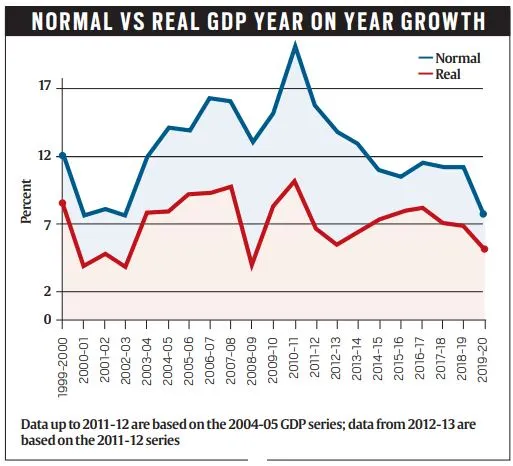
    • It estimated India’s GDP will grow by just 5 per cent in the current financial year (2019-20). Last financial year, 2018-19, the Indian economy grew at 6.8 per cent.
    • The gross value added (GVA), which maps the economic activity from the income side as against the GDP which maps it from the expenditure side, is expected to grow by 4.9 per cent in 2019-20 as against 6.6 per cent in 2018-19.

    Drivers of the GDP

    There are four main drivers of the GDP:

    • One, the private consumption expenditure – that is the expenditure that you and I make in our personal capacity. This category has grown by just 5.7 per cent in 2019-20 while it grew by 8 per cent last financial year.
    • The second driver is the expenditure made by the Government. This grew by 10.5 per cent, which is higher than the rate of growth (9.2 per cent) in the last financial year.
    • But the most disappointing number is the deceleration in business investments in the economy.
    • This driver, which is the key to sustainable long-term growth, grew by less than 1 per cent; last financial year it grew by 10 per cent.
    • This shows that while the private consumption demand is tepid, businesses have completely turned off the tap on new investments despite the government making a once-in-generation cut in corporate taxes.

    Performance in terms of GVA

    • The GVA data provides a detailed picture. Given that the overall GVA has decelerated sharply, almost all sectors have witnessed slower growth in economic activity.
    • Only “Public Administration, Defence and Other Services,“ which essentially measures how the government did, grew by 9.1 per cent.
    • All other sectors saw a GVA growth that was slower than the average growth in the last financial year.
    • The worst performing sectors are ‘Agriculture, Forestry and Fishing’, ‘Mining and Quarrying’, ‘Manufacturing’ and ‘Construction’, which are expected to see a GVA growth of 2.8 per cent, 1.5 per cent, 2.0 per cent and 3.2 per cent respectively.

    Back2Basics

    Real vs. Nominal GDP

    • GDP is the total market value of all goods and services produced in the economy during a particular year, inclusive of all taxes and subsidies on products.
    • The market value taken at current prices is the nominal GDP.
    • The value taken at constant prices — that is prices for all products taken at an unchanged base year (2011) — is the real GDP.
    • In simple terms, real GDP is nominal GDP stripped of inflation.
    • Real GDP growth thus measures how much the production of goods and services in the economy has increased in actual physical terms during a year.
    • Nominal GDP growth, on the other hand, is a measure of the increase in incomes resulting from rise in both production and prices.
  • UAE’s new 5-year visa scheme

    The United Arab Emirates (UAE) has announced a five-year multiple-entry visa scheme for all nationalities, in a move that is geared towards promoting tourism in the country.

    What is UAE’s new visa scheme?

    • According to the Dubai-based Gulf News, prior to this, tourists could get single or multiple-entry visas for a duration of 30 or 90 days.
    • In the new five-year multiple-entry system, visa holders may be allowed to stay for six months at a stretch.
    • The details of the scheme are yet to be announced. The country’s Federal Authority for Identity and Citizenship will be implementing the decision.
    • Travellers from Africa, some South American countries, Arab states outside the Gulf, and European states from outside the European Union and the former Soviet Union previously needed visas.
    • The UAE currently receives more 2.1 crore tourists annually, and has recently increased its pace of rolling out policies to boost its trade and tourism sectors.

    Other reforms

    • In July 2019, the UAE allowed women employed in the country to sponsor work permits for their husbands, fathers, and adult children, and reduced the fees for obtaining work permits by 50 per cent to 94 per cent for 145 services and transactions.
    • In the same month, the Emirate of Dubai said it would accept the Indian rupee (INR) for transactions at duty-free stores.
  • Species in news: Great Indian Bustard

    Since June last year, nine GIB eggs collected from the Desert National Park in Jaisalmer where a conservation centre has been set up, have hatched, and the chicks are reported to be doing well.

    Great Indian Bustard

    • The Great Indian Bustard, one of the heaviest flying birds, can weigh up to 15 kg and grow up to one metre in height.
    • It is considered the flagship grassland species, representing the health of the grassland ecology.
    • For long, conservationists have been demanding to secure this population, warning that the bird might get extinct in the coming decades.
    • It would become the first mega species to disappear from India after Cheetah in recent times.
    • Till 1980s, about 1,500-2,000 Great Indian Bustards were spread throughout the western half of India, spanning eleven states.
    • However, with rampant hunting and declining grasslands, their population dwindled.
    • In July 2011, the bird was categorised as “critically endangered” by the International Union for Conservation of Nature (IUCN).

    Various threats to GIBs

    I. General threats to GIB

    • Habitat loss & fragmentation, change of land use pattern, desertification, ill-thought plantation of exotic & invasive species in grassland ecosystems are some of the generic causes.
    • Neglect of state institutions due to classification of ‘grasslands’ as ‘wastelands’, conversion of grasslands to agriculture lands due to increasing irrigation potential and decline of nature/GIB-friendly agrarian practices, are all commonly and correctly blamed for the steady decline in India’s GIB population.

    II. Role of Noise Pollution

    • Noise pollution affects the mating and courtship practices of the GIB.
    • The male GIB inflates his ‘gular’ pouch (near the neck) which almost touches the ground, in order to produce a large booming sound which reverberates across the grassland.
    • The male GIB does this to attract GIB females and to inform them of his exact location in the vast expanse of the grassland.
    • Thus, the sound of the male GIB should be loud enough to transcend the walls of the sanctuary and be audible to female GIBs in the fields nearby.
    • The noise generated by human activities, whether be it by vehicles, tractors, music during processions, firecrackers, may interfere with the GIB’s mating call and drown it out.

    III. Other threats

    • The rate of reproduction amongst GIBs is very low; the female GIB lays only one egg per year.
    • This solitary egg is under threat from natural predators of the grasslands such as jackals, hyenas or foxes or invasive species such as crows or feral dogs.
    • In such a scenario, every opportunity the GIBs lose to mate pushes the species closer to extinction.

    Protection Measures

    • Birdlife International uplisted this species from Endangered to Critically Endangered (2011)
    • Protection under CITES Appendix I
    • Protection under Schedule I Wildlife (Protection) Amendment Act 2002
    • Project Great Indian Bustard (Rajasthan):  aims at identifying and fencing off bustard breeding grounds in existing protected areas as well as provide secure breeding enclosures in areas outside protected areas.
  • State can regulate minority institutions, says Supreme Court

    The Supreme Court has held that the state is well within its rights to introduce a regulatory regime in the “national interest” to provide minority educational institutions with well-qualified teachers in order for them to “achieve excellence in education.”

    Article 30 is not absolute

    • The verdict said that Article 30(1) (right of minorities to establish and administer educational institutions of their choice) was neither absolute nor above the law.
    • The regulatory law should however balance the dual objectives of ensuring standard of excellence as well as preserving the right of the minorities to establish and administer their educational institutions.
    • Regulations that embrace and reconcile the two objectives should be reasonable.
    • The managements of minority institutions cannot ignore such a legal regime by saying that it is their fundamental right under Article 30.

    Serving the national interest

    • A regulation framed in the national interest must necessarily apply to all institutions regardless whether they are run by majority or minority as the essence of Article 30(1) is to ensure equal treatment between the majority and minority institutions.
    • An objection can certainly be raised if an unfavorable treatment is meted out to an educational institution established and administered by minority.
    • But if ensuring of excellence in educational institutions is the underlying principle behind a regulatory regime and the mechanism of selection of teachers is so designed to achieve excellence in institutions, the matter may stand on a completely different footing.

    Striking a balance

    • The court explains how to strike a “balance” between the two objectives of excellence in education and the preservation of the minorities’ right to run their educational institutions.
    • For this, the court broadly divides education into two categories – secular education and education “directly aimed at or dealing with preservation and protection of the heritage, culture, script and special characteristics of a religious or a linguistic minority.”
    • When it comes to the latter, the court advocated “maximum latitude” to be given to the management to appoint teachers.
    • The court reasons that only “teachers who believe in the religious ideology or in the special characteristics of the concerned minority would alone be able to imbibe in the students admitted in such educational institutions, what the minorities would like to preserve, profess and propagate.”
    • However, minority institutions where the curriculum was “purely secular”, the intent must be to impart education availing the best possible teachers.