💥Join UPSC 2027,2028 Mentorship (August Batch) + XFactor Notes & Microthemes PDF

Distribution: weekly

  • Draft rules under the SHANTI Act open nuclear power to captive industrial use and a composite licence

    Why in the News

    The Department of Atomic Energy released draft rules under the Sustainable Harnessing and Advancement of Nuclear Energy for Transforming India (SHANTI) Act on 14 August 2026, opening nuclear power generation to private and captive users. Comments are invited until 4 September 2026.

    What is the SHANTI Act?

    • Replaces the earlier state monopoly framework with a licensing regime for non-government operators.
    • Covers private participation, captive generation, foreign reactor technology, safety and nuclear liability.
    • Provides a single composite licence for building, owning, operating and decommissioning a reactor.

    Key Provisions

    1. Captive nuclear power: Industries can generate nuclear electricity mainly for their own consumption.
    2. In-principle approval: Allows land acquisition and vendor negotiations before final licensing.
    3. Foreign technology: Imported designs must be certified by the regulator in the country of origin and already operational.
    4. Nuclear liability: Operators must maintain insurance or financial security; a Nuclear Liability Fund is proposed.
    5. Eligible users: Aluminium, cement, data centres, semiconductor fabs and Artificial Intelligence (AI) facilities.

    Key Concern

    • The country-of-origin certification may speed up safety approval but restrict technology sourcing to a few countries. Requiring continued support and retaining Intellectual Property Rights (IPR) with foreign developers could also limit technology transfer and indigenous reactor design.

    India’s Nuclear Programme

    • Stage 1: Pressurised Heavy Water Reactors (PHWRs) using natural uranium.
    • Stage 2: Fast Breeder Reactors (FBRs) using plutonium.
    • Stage 3: Thorium-based reactors using Uranium-233 (U-233).
    • Target: 100 GW nuclear capacity by 2047.

    Challenges

    • Supplier liability concerns
    • Limited regulatory independence
    • Land and public acceptance
    • Uranium and fuel constraints
    • Nuclear waste management
    • High project costs and long construction timelines

    Prelims Pointers

    • DAE: Department of Atomic Energy
    • AERB: Atomic Energy Regulatory Board
    • NPCIL: Nuclear Power Corporation of India Limited
    • BHAVINI: Bharatiya Nabhikiya Vidyut Nigam Limited
    • NPT: Nuclear Non-Proliferation Treaty
    • NSG: Nuclear Suppliers Group
    • India is not a signatory to NPT and received an NSG waiver in 2008.

    [2018, GS3, 15 marks] With growing energy needs should India keep on expanding its nuclear energy programme? Discuss the facts and fears associated with nuclear energy.”

    [2020]  In India, why are some nuclear reactors kept under “IAEA safeguards” while others are not ?

    a) Some use uranium and others use thorium
    b) Some use imported uranium and others use domestic supplies
    c) Some are operated by foreign enterprises and others are operated by domestic enterprises
    d) Some are State-owned and others are privately-owned
  • [15th August 2026] The Hindu OpED: [Financial femocracy, the Jan Dhan transformation]

    PYQ Relevance
    [UPSC 2016]
    Pradhan Mantri Jan-Dhan Yojana (PMJDY) is necessary for bringing unbanked to the institutional finance fold. Do you agree with this for financial inclusion of the poorer section of the Indian society? Give arguments to justify your option.
    Linkage: The PYQ tests whether PMJDY has translated bank-account access into substantive financial inclusion for the poor. The article extends the PYQ by examining the shift from account ownership to actual usage of savings, credit and insurance.

    Mentor’s Comment

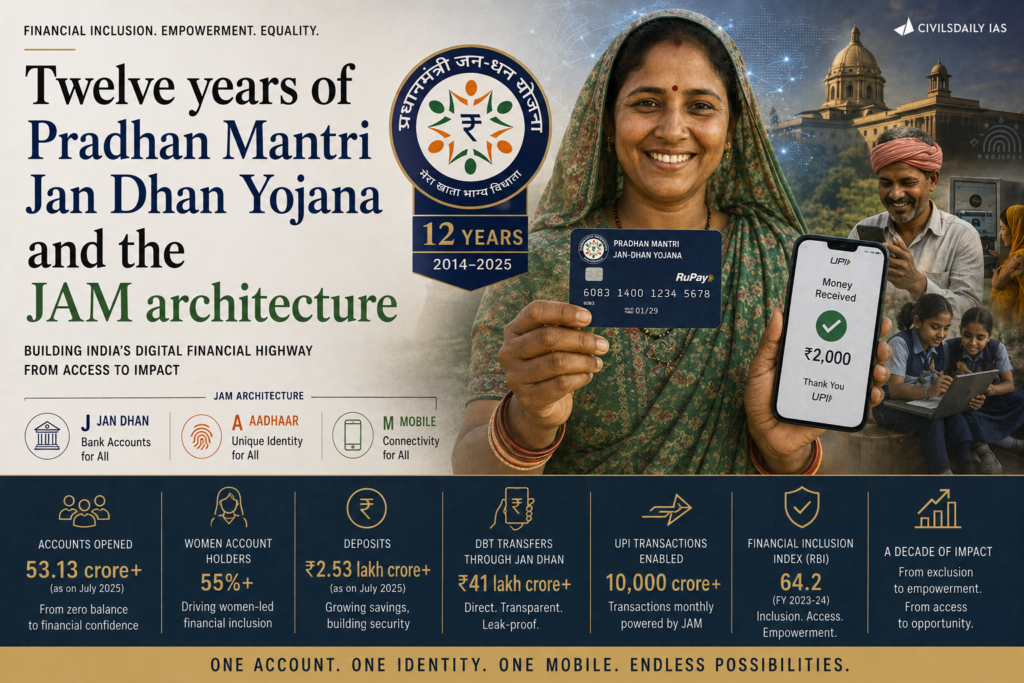
    The Pradhan Mantri Jan Dhan Yojana (PMJDY) completed twelve years on Independence Day 2026, having crossed 58 crore accounts with deposits of about ₹3 lakh crore. The milestone exposes the distance between owning a bank account and actually using savings, credit and insurance through it.

    What is the Pradhan Mantri Jan Dhan Yojana (PMJDY)?

    1. About: National financial inclusion mission announced from the ramparts of the Red Fort on 15 August 2014 and formally launched at Vigyan Bhawan on 28 August 2014.
    2. Core entitlement: Every household in India was to have a bank account, a RuPay debit card and insurance cover.
    3. Zero balance design: The account can be opened and held without any minimum balance requirement.
    4. Credit attachment: An overdraft facility of up to ₹10,000 is attached to the account so that it functions as more than a deposit box.
    5. Administering authority: The Department of Financial Services, Ministry of Finance, runs the scheme through public and private sector banks.

    What is Antyodaya?

    1. Definition: The principle that the most deprived person is the most deserving claimant on the fruits of development.
    2. Origin: The concept was propounded by both Mahatma Gandhi and Deendayal Upadhyaya.

    What is the JAM trinity?

    1. Definition: The linking of Jan Dhan bank accounts, Aadhaar digital identity and Mobile connectivity into one delivery rail.
    2. Function: It allows a government payment to reach a verified individual account without passing through any intermediate handling point.

    What is Direct Benefit Transfer (DBT)?

    1. Definition: The transfer of a subsidy or entitlement directly into the beneficiary’s bank account instead of through a physical distribution chain.
    2. Purpose: It removes the intermediate custody points at which cash and commodity leakage historically occurred.

    What is Digital Public Infrastructure (DPI)?

    1. Definition: Publicly governed digital rails for identity, payments and data sharing on which both government and private services are built.
    2. The Indian stack: Aadhaar supplies identity, the Unified Payments Interface (UPI) supplies payments, and Jan Dhan accounts supply the account layer.

    Why did political independence not deliver financial access to millions of Indians?

    1. A distant formal system: Decades after 1947, a bank account, formal credit, insurance and a reliable channel to receive government support could not be taken for granted.
    2. Leakage in delivery: A former Prime Minister acknowledged that when a rupee was sent from Delhi, only 15 paise reached the intended recipient.
    3. No delivery address: Without an account, a citizen had no address to which government money could be sent directly.
    4. Exclusion by balance: Minimum balance requirements made the formal banking system unusable for people whose incomes were small and irregular.
    5. Incomplete freedom: Political freedom remains incomplete where a citizen cannot save securely, receive money directly or reach the institutions through which economic opportunity flows.

    Why is access to formal finance treated as a responsibility of the state?

    1. The Chanakya formulation: The launch invoked Sukhasya moolam dharmah, Dharmasya moolam artha, Arthasya moolam rajyam, that the root of happiness is dharma, the root of dharma is artha, and the root of artha is the state.
    2. The claim it carries: Economic means are fundamental to human well being, so creating access to those means is a state obligation and not a discretionary favour.
    3. The Antyodaya test: The architecture was built on the rule that the last person in the queue should not remain outside the system.
    4. Entry point, not benefit: The account was designed as an entry point into the formal economy, not as one more transfer to be received.
    5. A second independence: Sixty seven years after 1947, financial and digital literacy was placed at the centre of the Independence Day address as unfinished national business.

    How was the Jan Dhan account designed so that the poorest could keep it?

    1. No entry cost: The zero balance account meant that having little money was no longer a reason to stay outside the banking system.
    2. A usable instrument: The RuPay debit card converted the account from a passbook into a transacting instrument.
    3. Small credit line: The overdraft facility gave the holder a formal alternative to the moneylender for a consumption shortfall.
    4. Embedded insurance: A ₹2 lakh accident insurance cover was attached to the RuPay card without a separate premium payment.
    5. Household unit: Coverage was defined at the household level, so the target was universality rather than a beneficiary list.

    What do twelve years of numbers show about the scale of the first step?

    1. Account base: The scheme had crossed 58 crore accounts by July 2026.
    2. Deposits held: Balances in these accounts run into about ₹3 lakh crore.
    3. Women’s share: More than half of all Jan Dhan accounts are held by women.
    4. Geographic spread: Roughly three fourths of the accounts are in rural and semi urban areas.
    5. Average balance: The two figures together imply an average balance of about ₹5,200 per account.

    How did a bank account become the first layer of a national digital infrastructure?

    1. First layer of JAM: Jan Dhan supplied the account layer on which Aadhaar identity and mobile connectivity were stacked.
    2. A direct channel: Once accounts were linked to identity and mobile, the government gained a direct route through which benefits could reach a named individual.
    3. Transformed transfers: This changed what Direct Benefit Transfer could actually do, from a pilot idea to the default mode of payment.
    4. Continuity with UPI: The same infrastructure carried the Unified Payments Interface into everyday retail payments.
    5. Cross border reach: A merchant accepting a UPI payment in France in 2026 and a first time account holder of 2014 sit on the same financial infrastructure.

    Does opening accounts amount to financial inclusion?

    1. The ownership side: With 58 crore accounts and near universal household coverage, the question of formal access has been settled.
    2. The usage side: Financial inclusion means participation in savings, payments, credit, insurance and economic opportunity, which an account count does not measure.
    3. What the balances say: An average balance of about ₹5,200 indicates that the account works mainly as a receiving channel rather than as a savings instrument.
    4. The credit gap: The overdraft remains the least used component of the design, so formal credit has not displaced the informal lender for most holders.
    5. Dormancy: Close to a fifth of Jan Dhan accounts have been reported inoperative, which means the rail exists but is not always carrying traffic.

    Why does a bank account function as a marker of identity?

    1. Recognition with respect: The account gave people from marginalised sections a formal record of existence that the system had rarely offered them.
    2. Visibility: It made those on the periphery visible and counted within the financial system.
    3. The scheme’s own framing: The tagline Mera khaata, bhagya vidhata, my account the destiny maker, states the claim that the account itself changes standing.
    4. Forward link: Financial inclusion is now positioned as an input into the Viksit Bharat 2047 goal.

    What are the challenges to the Pradhan Mantri Jan Dhan Yojana?

    1. Inoperative accounts: A large share of accounts records no customer induced transaction for long periods, e.g. the Finance Ministry ran a nationwide fresh KYC drive in 2024 covering roughly 11 crore inoperative Jan Dhan accounts.
    2. Overdraft under use: Banks sanction the overdraft to a small fraction of eligible holders because these borrowers carry no credit score, e.g. lenders treat a zero balance account with irregular inflows as an unscorable credit risk.
    3. Last mile agent viability: Business correspondents earn thin commissions on low value transactions, e.g. Bank Mitras in remote blocks handle deposits too small to cover travel and cash carrying costs.
    4. Duplicate accounts: The 2014 enrolment drive produced multiple accounts per household, e.g. families opened a second account to capture the accident cover, inflating the headline count.
    5. Unclaimed insurance: The accident cover lapses through ignorance of its conditions, e.g. holders do not know the RuPay card must have been used within a qualifying period before the accident for the claim to stand.
    6. Misuse of dormant accounts: Idle zero balance accounts are rented out as conduits for fraud proceeds, e.g. mule account networks flagged by the Indian Cyber Crime Coordination Centre have used dormant no frills accounts.

    Conclusion

    Twelve years of Jan Dhan have settled the question of access and left the question of use open. The visible achievement is 58 crore accounts; the durable one is the rail that now carries Direct Benefit Transfer and UPI. The unfinished work is converting a receiving account into a working relationship with savings, credit and insurance.

    Back2Basics:

    What is Financial Inclusion?

    1. About: Financial inclusion is the delivery of banking, payment, credit, insurance and pension services to every section of society at an affordable cost.
    2. Rationale: Exclusion from formal finance forces households into informal credit at punitive rates and denies the state a clean channel to transfer entitlements.
    3. Access: The first dimension is the availability of a formal account and a service point within reach of the household.
    4. Usage: The second dimension is the actual frequency and depth of transactions, savings and borrowing through that account.
    5. Quality: The third dimension covers consumer protection, grievance redress and financial literacy, and it is the dimension the Reserve Bank of India Financial Inclusion Index weights lowest.

    Laws and Rules Governing Financial Inclusion in India

    1. Reserve Bank of India Act, 1934: Establishes the central bank and its power to direct banking policy, including branch authorisation and priority sector norms.
    2. Banking Regulation Act, 1949: Governs the licensing and conduct of banks, and is the basis for the Basic Savings Bank Deposit Account norms that permit zero balance accounts.
    3. Aadhaar Act, 2016: Section 7 permits the use of Aadhaar authentication as a condition for receiving a subsidy or benefit funded from the Consolidated Fund of India.
    4. Payment and Settlement Systems Act, 2007: Gives the Reserve Bank authority to regulate payment systems, and is the legal basis for the National Payments Corporation of India operating UPI, RuPay and the Aadhaar Enabled Payment System.
    5. Prevention of Money Laundering Act, 2002 and Rules: Prescribe the customer identification and record keeping obligations that govern account opening and periodic verification.

    Pradhan Mantri Jan Dhan Yojana

    1. Ministry or Department: Ministry of Finance, Department of Financial Services.
    2. Launch year: 2014, announced on 15 August and launched on 28 August.
    3. Aims and objectives: Financial inclusion through zero balance accounts, insurance, overdraft and micro pension, forming the first leg of the JAM trinity.
    4. Targeted beneficiaries: Unbanked adults, with a household level coverage target.
    5. Key features: Basic Savings Bank Deposit accounts, an overdraft of up to ₹10,000, an accident cover of ₹2 lakh, and RuPay and Aadhaar Enabled Payment System interoperability.
    6. Record: The scheme holds a Guinness World Record for the most bank accounts opened in a single week during its 2014 rollout.

    Government Initiatives for Financial Inclusion

    1. Pradhan Mantri Jeevan Jyoti Bima Yojana: Renewable one year life cover for account holders aged 18 to 50 at a low annual premium.
    2. Pradhan Mantri Suraksha Bima Yojana: Accident death and disability cover for account holders aged 18 to 70 at a nominal annual premium.
    3. Atal Pension Yojana: Guaranteed minimum pension for unorganised sector workers, delivered through the same bank accounts.
    4. Pradhan Mantri Mudra Yojana: Collateral free institutional credit to micro enterprises under the Shishu, Kishore and Tarun categories.
    5. Stand Up India: Bank loans for greenfield enterprises promoted by Scheduled Caste, Scheduled Tribe and women entrepreneurs.
    6. PM SVANidhi: Working capital loans to street vendors, extending formal credit to a category with no collateral.

    Key Facts about Financial Inclusion in India

    1. JAM as a term: The JAM trinity entered official vocabulary through the Economic Survey that followed the launch of Jan Dhan.
    2. Financial Inclusion Index: The Reserve Bank publishes an annual composite index built on Access, Usage and Quality, with Usage carrying the largest weight.
    3. Priority Sector Lending: Scheduled commercial banks must direct 40 per cent of adjusted net bank credit to priority sectors, including weaker sections.
    4. Payments banks: A separate bank category was licensed to accept small deposits and offer payments without lending, expanding the service point network.
    5. Aadhaar Enabled Payment System: It allows cash withdrawal at a business correspondent point using fingerprint authentication alone, without a card or a branch.

    Challenges in Financial Inclusion in India

    1. Thin rural service points: Banking outlets remain concentrated in towns, e.g. aspirational districts in central India depend on a single business correspondent covering several villages.
    2. Low insurance penetration: Micro insurance uptake stays low despite nominal premiums, e.g. renewal rates for the low cost life and accident schemes fall sharply after the first auto debit year.
    3. Weak grievance redress: New account holders rarely reach an effective complaint channel, e.g. unauthorised debit complaints from rural holders often stop at the branch level and never reach the Banking Ombudsman.
    4. Connectivity failures: Authentication depends on network availability, e.g. Aadhaar Enabled Payment System withdrawals fail in hilly and forest blocks where mobile data is intermittent.
    5. Financial literacy gap: Holders do not understand interest, penalty and claim conditions, e.g. overdraft users treat the limit as a grant rather than as a loan carrying interest.
    6. Gendered control of accounts: Women hold accounts that male household members operate, e.g. transfers under women centred schemes are frequently withdrawn by another family member at the agent point.

    Way Forward

    1. Shift the metric: Measure the scheme on transaction frequency, credit uptake and insurance claims settled rather than on accounts opened.
    2. Build alternative credit scoring: Use account transaction history and Account Aggregator consented data to underwrite the overdraft for holders with no formal credit record.
    3. Fix agent economics: Revise business correspondent commissions to reflect distance and transaction cost so that remote service points remain viable.
    4. Run a dormancy clearance cycle: Institutionalise periodic verification and reactivation drives instead of one off campaigns.
    5. Embed literacy in delivery: Attach a short standardised explanation of overdraft interest and insurance claim conditions to every account and card issued.
    6. Harden the rail against misuse: Apply transaction pattern monitoring to dormant zero balance accounts to detect mule account recruitment early.

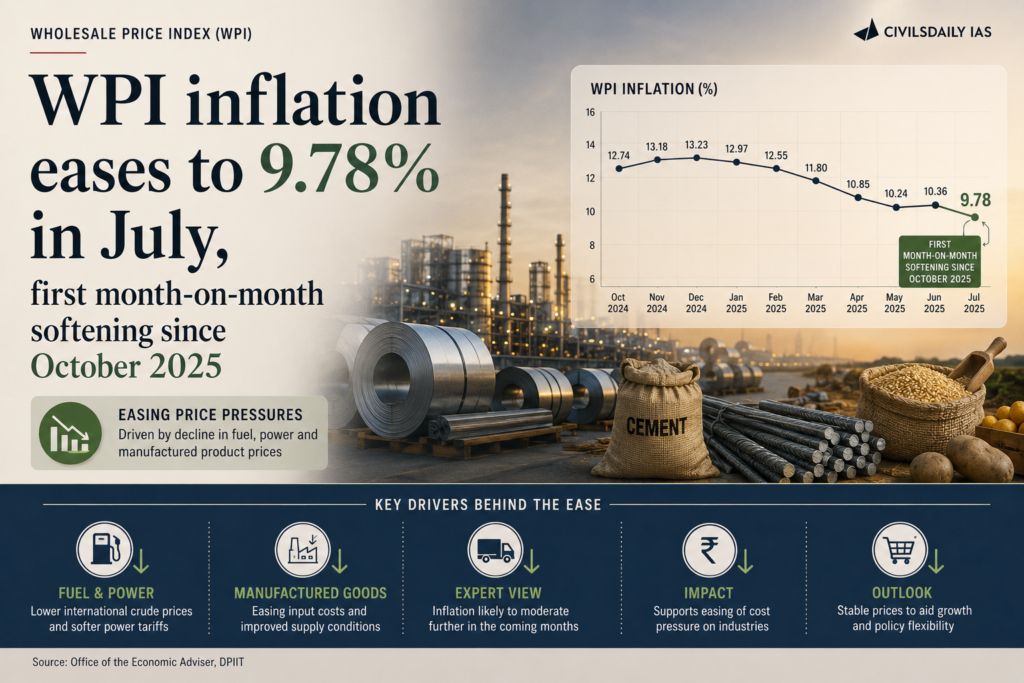
  • WPI inflation eases to 9.78% in July, first month-on-month softening since October 2025

    Why in the News

    Wholesale Price Index (WPI) inflation eased to 9.78% in July 2026 from 9.87% in June, mainly due to lower fuel and power inflation.

    What is WPI?

    • Measures price changes of goods traded in bulk between businesses.
    • Covers only goods, not services.
    • Three groups: Primary Articles, Fuel & Power, Manufactured Products.
    • Base year: 2011-12.
    • Released by the Office of the Economic Adviser, Ministry of Commerce and Industry.
    • Weights: Manufactured Products 64.23%, Primary Articles 22.62%, Fuel & Power 13.15%.

    July 2026 Trends

    • Fuel & Power: 20.05%, down from 27.41%.
    • Manufactured Products: 8.29%, up from 7.48%.
    • Food Articles: 5.44%, marginally down from 5.49%.
    • PPI: Producer Price Index remained at 9.6%.

    WPI vs CPI

    • WPI: Wholesale prices of goods; excludes services.
    • CPI: Retail prices of goods and services; used as India’s inflation-targeting anchor.
    • CPI target: 4% with a tolerance band of ±2%.

    Why is inflation a concern?

    • Imported crude oil shocks
    • Food price volatility
    • Supply-chain constraints
    • Fertiliser import dependence
    • Input cost pressures

    “[2010] With reference to India, consider the following Statements:

    1. The Wholesale Price Index (WPI) in India is available on a monthly basis only

    2. As compared to Consumer Price Index for Industrial Workers (CPI (IW)), the WPI gives less weight to food articles.

    Which of the statements given above is/are correct?

    (a) 1 only

    (b) 2 only

    (c) Both 1 and 2

    (d) Neither 1 nor 2.

  • White House transshipment report places India in Tier 1 of illegal transshipment risk

    Why in the News

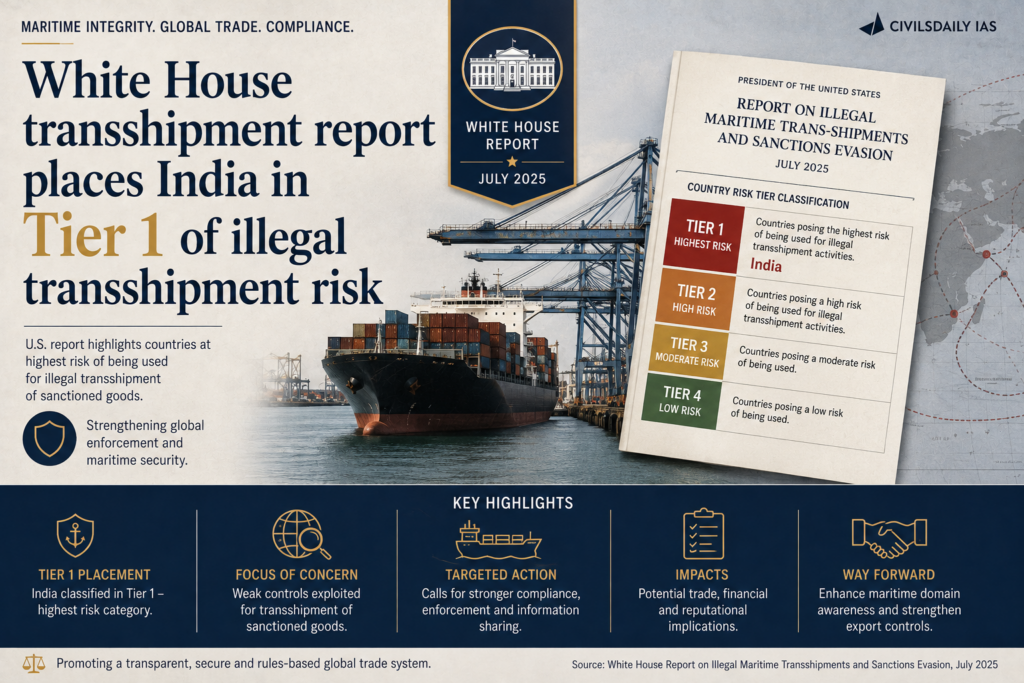
    A White House report, The Great Transshipment Scam, places India in Tier 1 for elevated illegal transshipment risk, alleging that some Chinese goods are routed through India to evade US tariffs.

    Key Definitions

    • Illegal Transshipment: Routing goods through a third country and making minimal changes to disguise their actual country of origin and avoid tariffs.
    • Tariff Arbitrage: Earning a profit by routing goods through a country with a lower tariff.
    • Rules of Origin: Rules used to determine the country of origin of a product, generally based on where substantial transformation occurs.
    • Substantial Transformation: A manufacturing process that changes a product sufficiently to give it a new identity, character or use.
    • Screwdriver Factory: A facility that mainly assembles imported components with minimal domestic value addition.
    • Section 301: US law allowing action against foreign trade practices considered unfair or discriminatory.
    • Trade Diversion: Shifting trade flows from one country or route to another due to tariffs, restrictions or other trade barriers.

    What does the US report allege?

    • India is placed in Tier 1.
    • The Pune, Gujarat and Chennai production belt is specifically mentioned.
    • Pumps and compressors are cited as examples.
    • India, Mexico and Vietnam together accounted for an estimated $67 billion of transshipped goods in 2025.
    • No punitive action has yet been announced.

    Why does it matter for India?

    • Greater scrutiny of Indian exports.
    • China Plus One manufacturing could face stricter origin verification.
    • Dependence on Chinese components may complicate origin claims.
    • Tariff action could affect India’s access to the US market.

    [2025, GS3, 10 marks] What are the challenges before the Indian economy when the world is moving away from free trade and multilateralism to protectionism and bilateralism? How can these challenges be met?”

    [2017] Consider the following statements:
    1. India has ratified the Trade Facilitation Agreement (TFA) of WTO.
    2. TFA is a part of WTO’s Bali Ministerial Package of 2013.
    3. TFA came into force in January 2016.
    Which of the statements given above is/are correct?

    (a) 1 and 2 only

    (b) 1 and 3 only

    (c) 2 and 3 only

    (d) 1, 2 and 3

  • RBI shuts FCNR(B) dollar-rupee swap window early after $52.3 billion inflow

    Why in the News

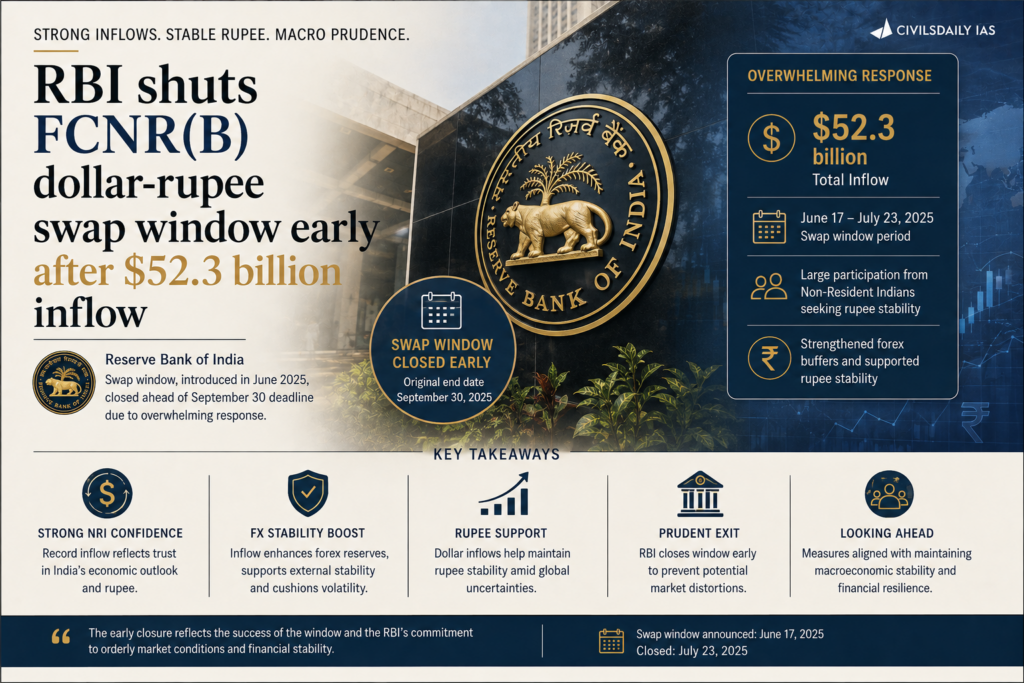
    The Reserve Bank of India (RBI) will close its special US dollar-rupee swap window for fresh Foreign Currency Non-Resident (Bank) [FCNR(B)] deposits on 31 August 2026, after attracting $52.3 billion.

    What is the FCNR(B) Swap Window?

    1. Banks mobilise fresh 3 to 5 year FCNR(B) deposits in foreign currency.
    2. Banks swap the dollars with the RBI for rupees at a concessional rate.
    3. The RBI returns the dollars when the swap matures.
    4. The concessional rate covers the bank’s hedging cost.

    Key Definitions

    • FCNR(B): Foreign Currency Non-Resident (Bank) term deposit held by NRIs or Persons of Indian Origin in foreign currency.
    • Hedging Cost: Cost incurred to protect against exchange-rate fluctuations.
    • ECB: External Commercial Borrowing, or loans raised by eligible Indian entities from non-resident lenders.
    • OFCB: Overseas Foreign Currency Borrowing, or foreign currency funds borrowed by Indian banks from overseas markets.
    • Balance of Payments (BoP): Record of all economic transactions between residents of a country and the rest of the world during a period.

    Why was the window closed early?

    • FCNR(B) route attracted $52.3 billion.
    • Total inflows through the three components reached $56.846 billion by 13 August.
    • High mobilisation indicated strong response.
    • Swaps against already mobilised deposits remain possible until 11 September.

    Impact on Forex Reserves

    • India’s foreign exchange reserves reached around $707 billion as of 7 August, with foreign currency assets driving much of the increase.
    • However, FCNR(B) inflows are debt creating and will eventually require repayment in foreign currency.

    “[2021] Consider the following:

    1. Foreign currency convertible bonds

    2. Foreign institutional investment with certain conditions

    3. Global depository receipts

    4. Non-resident external deposits.

    Which of the above can be included in Foreign Direct Investments?

    (a) 1, 2 and 3

    (b) 3 only

    (c) 2 and 4

    (d) 1 and 4.

  • States convert free-power subsidy into capital support for rooftop solar under PM Surya Ghar’s Utility-Led Aggregation model

    Why in the News

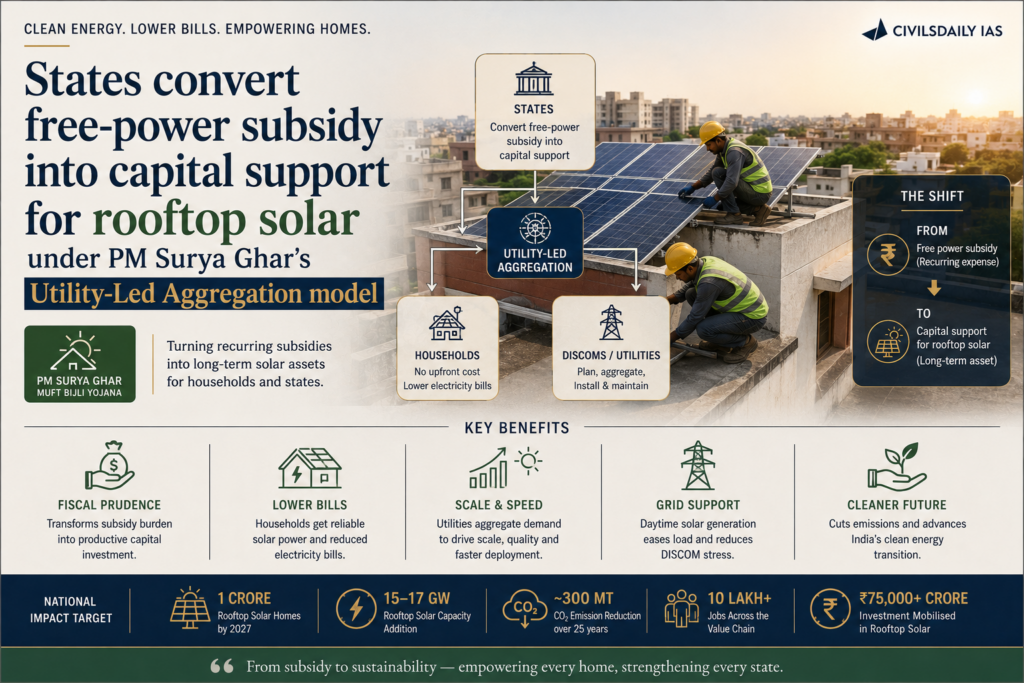
    States such as Uttar Pradesh, Andhra Pradesh and Bihar are shifting recurring free-power subsidies towards one-time capital support for rooftop solar under the Utility-Led Aggregation (ULA) model.

    What is PM Surya Ghar Yojana?

    • Ministry: Ministry of New and Renewable Energy (MNRE)
    • Launch: 13 February 2024
    • Target: 1 crore households with grid-connected rooftop solar by March 2027.
    • Outlay: ₹75,021 crore.
    • Benefit: Up to 300 units of free electricity per month.
    • Central subsidy: ₹30,000/kW up to 2 kW, plus ₹18,000 for the third kW, capped at ₹78,000.
    • Eligibility: Household must have a suitable roof and grid connection.

    What is ULA?

    • Utility-Led Aggregation (ULA) is a model where the distribution company (DISCOM) aggregates household demand and arranges rooftop solar installations at scale.
    • States convert recurring electricity subsidies into one-time capital support for installing solar systems.

    Why the Shift?

    • Reduces recurring State subsidy burden.
    • Creates a 25-year generating asset.
    • Reduces DISCOM’s cost of supplying subsidised daytime electricity.
    • Aggregated procurement can reduce installation costs.

    Current Progress

    • 52 lakh households had installed rooftop systems by 13 August.
    • About 2 lakh of 30 lakh ULA installations are complete.
    • Target: 1 crore households by March 2027.

    Key Definitions

    • Rooftop Solar: Solar photovoltaic system installed on a building roof and connected to the electricity distribution network.
    • Net Metering: Allows surplus rooftop electricity exported to the grid to be adjusted against electricity consumed.
    • DISCOM: Distribution Company responsible for electricity distribution.
    • ALMM: Approved List of Models and Manufacturers for eligible solar modules.

    Challenges

    • Financial stress of DISCOMs
    • High upfront installation costs
    • Limited rooftop access for tenants and apartment residents
    • No battery-storage subsidy
    • Grid and transformer capacity constraints
    • Dependence on imported solar cells and wafers

    “[2025] Consider the following statements about ‘PM Surya Ghar Muft Bijli Yojana’:

    I. It targets installation of one crore solar rooftop panels in the residential sector.

    II. The Ministry of New and Renewable Energy aims to impart training on installation, operation, maintenance and repairs of solar rooftop systems at grassroot levels.

    III. It aims to create more than three lakhs skilled manpower through fresh skilling and up-skilling, under scheme component of capacity building.

    Which of the statements given above are correct?

    (a) I and II only

    (b) I and III only

    (c) II and III only

    (d) I, II and III.

  • [14th August 2026] The Hindu OpED: Europe’s Al rules may become India’s opportunity

    PYQ Relevance
    [UPSC 2023]
    Introduce the concept of Artificial Intelligence (AI). How does AI help clinical diagnosis? Do you perceive any threat to privacy of the individual in the use of AI in healthcare?
    Linkage: The PYQ examines AI’s applications and its implications for privacy and individual rights. The EU AI Act shows how risk-based AI regulation can address privacy, safety and accountability concerns.

    Mentor’s Comment

    The European Union Artificial Intelligence Act becoming applicable creates an opportunity for India’s technology services. Its compliance demands could generate work Indian firms can supply.

    What is the EU AI Act?

    1. Risk-based law: The European Union Artificial Intelligence (AI) Act regulates AI systems by risk category.
    2. Applicability: It came into force in 2024 and its key obligations apply from 2 August 2026.
    3. High-risk systems: These require a conformity assessment before deployment.
    4. Extraterritorial reach: The Act can apply to entities outside the EU when their AI systems or models are placed on the EU market, used in the EU, or affect people in the EU.

    Risk Categories

    1. Unacceptable risk: Systems like social scoring or manipulative/exploitative AI are completely banned.
    2. High risk: Critical sectors like biometrics, employment, and healthcare require rigorous data governance, logging, and conformity assessments.
    3. Transparency (Limited) risk: Chatbots and deepfakes must clearly disclose to users that they are interacting with AI or synthetic media.
    4. Minimal risk: Most everyday utilities like video games or spam filters face no mandatory rules.

    Why does the EU regulate AI?

    1. Fundamental rights: Prevent discrimination, manipulation and unlawful surveillance.
    2. Safety: Ensure reliable and safe deployment of high-risk AI.
    3. Transparency: Help users distinguish AI-generated content from human-generated content.
    4. Trust: Create a predictable regulatory environment for responsible AI adoption.

    Why does it challenge India’s IT model?

    1. Bespoke services: India’s IT-services firms build customised systems, and any “substantial modification” can trigger a fresh assessment.
    2. Compliance cost: Repeated conformity checks raise the cost of serving EU clients.
    3. Data governance: High-risk AI requires stronger data quality, traceability, record-keeping and governance, requiring firms to upgrade systems.
    4. Talent gap: Compliance requires professionals combining AI, law, cybersecurity, risk assessment and auditing skills.
    5. Shift in competitive advantage: India’s traditional cost-based IT model must evolve towards trusted, auditable and regulation-ready AI services.

    Where is the opportunity?

    1. Compliance services: Demand rises for legal, technical, and audit services to meet the Act.
    2. Notified bodies: The India-EU Free Trade Agreement could let Indian conformity assessment bodies be recognised as EU “notified bodies”.
    3. First-mover edge: Early compliance capability positions India as a preferred AI-services partner.
    4. AI Assurance: Indian firms can offer AI risk assessment, algorithmic auditing, testing, documentation and certification support to global clients.
    5. Compliance-by-design: Indian IT companies can build EU-compliant AI systems from the development stage, turning regulatory expertise into a new export advantage.

    What are the challenges to capturing the opportunity?

    1. Standards gap: India lacks a mature domestic AI conformity-assessment ecosystem.
    2. Mutual recognition: Recognition of Indian bodies depends on the FTA’s regulatory-cooperation terms.
    3. Talent: Specialised AI-audit skills are scarce.
    4. Regulatory clarity: India’s own AI governance framework is still evolving.

    Conclusion

    The Act raises compliance costs but also creates a services market India can serve. Capturing it depends on the India-EU FTA delivering mutual recognition of conformity assessment bodies.

  • Seven-judge Bench to weigh privileges against free speech

    Why in the News

    A seven-judge Constitution Bench will hear from 6 October 2026 whether legislative privileges override the freedom of speech. The reference revives a dispute from the 2003 attempt by the Tamil Nadu Assembly to arrest journalists over a critical editorial.

    What is the constitutional question?

    1. Privilege versus speech: Whether privileges under Article 194 can override Article 19(1)(a) free speech.
    2. Interplay of Articles: The case engages Articles 194(3), 19, and 21 together.
    3. Origin: It stems from a 2003 Assembly resolution to arrest newspaper journalists.

    What are legislative privileges?

    1. Definition: Special rights of a legislature and its members to function without external interference.
    2. Article 194: Grants privileges to state legislatures, mirroring Article 105 for Parliament.
    3. Uncodified: Privileges remain largely uncodified, drawing on British parliamentary practice.

    Why is the tension unresolved?

    1. Two rights collide: A legislature’s authority to punish for contempt sits against a citizen’s free speech.
    2. Judicial review scope: Whether courts can review a House’s exercise of privilege is itself disputed.
    3. Chilling effect: Broad privilege can deter press criticism of legislatures.

    “[2023, GS2, 10] Discuss the role of Presiding Officers of state legislatures in maintaining order and impartiality in conducting legislative work and in facilitating best democratic practices.”

    [2017] Which one of the following statements is correct?

    [A] Rights are absolute and can never be restricted by the State.

    [B] Rights are legally enforceable claims that individuals have against the State

    [C] Rights are privileges granted by the government that can be revoked at any time.

    [D] Rights are moral values that do not require legal protection.

  • The constitutional limits on arrest, reaffirmed

    Why in the News

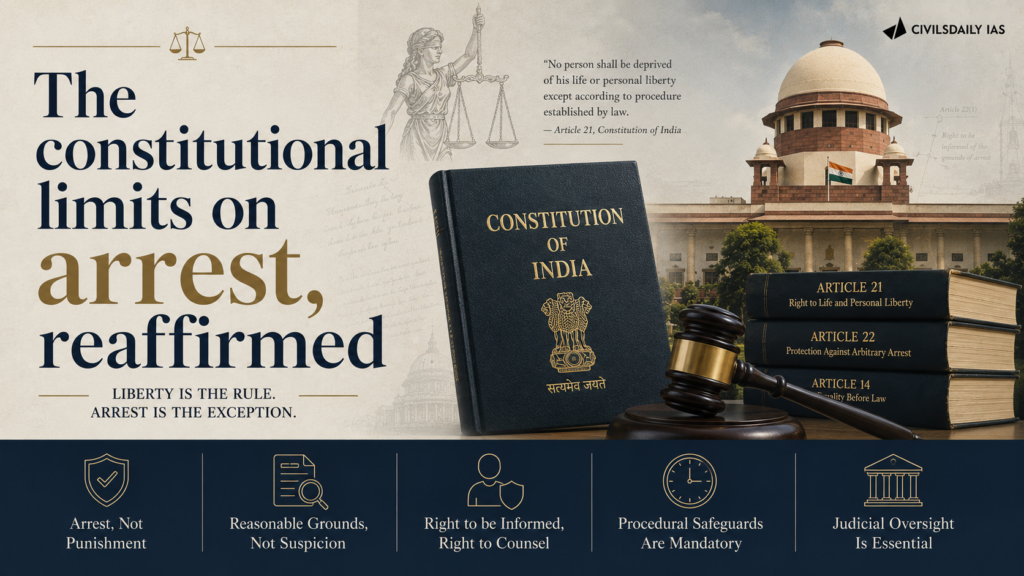
    An explainer revisits the constitutional limits on arrest after a 2025 Supreme Court ruling. It reaffirms that an arrested person must be meaningfully informed of the grounds of arrest.

    What does Article 22 guarantee on arrest?

    1. Grounds of arrest: Article 22(1) requires that grounds be communicated meaningfully, not as a formality.
    2. Legal counsel: The arrested person has the right to consult a lawyer of choice.
    3. Production before magistrate: Article 22(2) requires production within 24 hours of arrest.
    4. No prolonged custody: Continued detention beyond 24 hours requires Magistrate’s authorisation.
    5. Exception: These safeguards under Article 22(1) and 22(2) do not apply to enemy aliens and persons detained under preventive detention laws under Article 22(3).

    What did the recent ruling and precedents establish?

    1. Vihaan Kumar (2025): The Court held that failure to communicate grounds vitiates the arrest.
    2. Arnesh Kumar (2014): Arrest must be the exception for offences carrying up to seven years, not routine.
    3. D.K. Basu (1997): The Court prescribed safeguards including an arrest memo, informing relatives and medical examination to prevent custodial abuse.
    4. Arrest memo: Procedural safeguards require a documented arrest memo.

    What did the Supreme Court Rule in Vihaan Kumar Case?

    The judgment of the Supreme Court of India (Supreme Court) in the case of Vihan Kumar vs. State of Haryana (2025) marked a crucial milestone in protecting the fundamental rights of arrested persons.

    1. Mandatory information about the reasons for arrest: The Supreme Court has made it clear that the person arrested must be informed of the reasons for his arrest immediately. This is
      a fundamental right guaranteed under Article 22(1) of the Constitution.
    2. Arrest is invalid: If the accused is not informed of the reasons for the arrest, the arrest becomes illegal and unconstitutional.
    3. Cancellation of further proceedings: If fundamental rights are violated during the arrest process itself, subsequent remand orders issued by the courts or charge sheets filed by the police cannot rectify that mistake (Vitiated).
    4. Language awareness: The reasons for the arrest should be communicated in a language that the accused understands, and should not be a mere formality.

    Human rights and dignity (Article 21)

    1. Ban on shackles in hospitals: The Supreme Court has strongly condemned the practice of shackles and chains on Vihan Kumar when he was admitted to the hospital due to medical reasons.
    2. Right to Life: The court held that the right to live with dignity is part of Article 21 , and chaining the accused to a hospital bed falls under the category of human rights violation.

    How is preventive detention different?

    1. Without trial: Preventive detention permits custody without a charge to prevent an anticipated act.
    2. Advisory Board: Detention beyond three months requires review by an Advisory Board.
    3. Narrow safeguards: Several ordinary arrest protections under Article 22 do not apply to preventive detention.
    4. Preventive: Unlike ordinary detention, it is not punitive. It is intended to prevent an anticipated act prejudicial to specified interests.
    5. No 24-hour Magistrate requirement under Article 22(3).
    6. Grounds of detention must generally be communicated, subject to non-disclosure in public interest.

    What is the “Golden Triangle”?

    1. Articles 14, 19, 21: Together they form the core of personal liberty jurisprudence.
    2. Maneka Gandhi (1978): Established that a law depriving personal liberty must prescribe a procedure that is just, fair and reasonable.
    3. Article 22: Provides specific procedural safeguards against arbitrary arrest and detention, complementing the broader protection under Article 21.

    Conclusion

    The ruling restates settled safeguards and closes an enforcement gap on communicating arrest grounds. It sharpens the line between lawful arrest and arbitrary detention.

    PYQ Relevance

    [UPSC 2023] “The Constitution of India is a living instrument with capabilities of enormous dynamism. It is a constitution made for a progressive society.” Illustrate with special reference to the expanding horizons of the right to life and personal liberty.

    Linkage: The PYQ examines the expanding scope of the right to life and personal liberty under Article 21. Arrest safeguards and preventive-detention limits show how judicial interpretation strengthens protection against arbitrary deprivation of liberty.

  • Anti-paper-leak law amended amid exam-integrity protests

    Why in the News

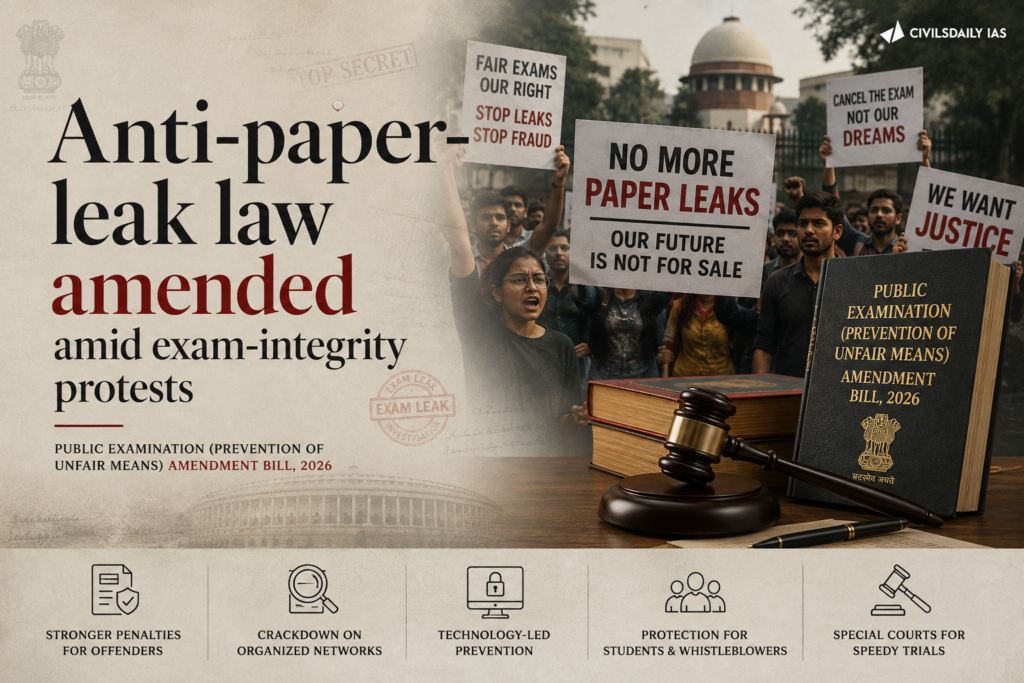
    The Public Examination (Prevention of Unfair Means) Amendment Bill, 2026 seeks to strengthen the 2024 law against organised cheating and examination paper leaks amid concerns over NEET and recruitment examination irregularities.

    What is the Public Examination Act, 2024?

    1. Objective: Criminalises organised cheating, paper leaks, impersonation and other unfair means.
    2. Coverage: Applies to major public examinations conducted by bodies such as UPSC, SSC and NTA.
    3. Penalties: Provides imprisonment and heavy fines for organised examination malpractice.
    4. Focus: Targets organised networks rather than genuine candidate errors.

    Why was it amended?

    • Exam-leak crisis: Repeated paper leaks and irregularities exposed weaknesses in examination governance.
    • Enforcement gaps: Strengthening was considered necessary after experience with the 2024 framework.
    • Public trust: Fair examinations are essential for merit-based recruitment and equal opportunity.

    What does the crisis reveal?

    • Aspiration-opportunity gap: Large numbers of candidates compete for limited government jobs.
    • Institutional trust deficit: Repeated leaks undermine confidence in recruitment institutions.
    • Governance challenge: Legal punishment alone cannot ensure examination integrity without secure technology, accountable agencies and speedy investigation.

    Prelims Pointers

    • Act: Public Examinations (Prevention of Unfair Means) Act, 2024
    • Ministry/Department: Department of Personnel and Training
    • Targets: Organised cheating, paper leaks and impersonation
    • Important distinction: The Act does not automatically cover all university or State board examinations unless the concerned government adopts the framework.

    “[2024, GS2, 15] What are the aims and objects of the recently passed and enforced, The Public Examination (Prevention of Unfair Means) Act, 2024? Whether University/State Education Board examinations, too, are covered under the Act?”

    [2021] With reference to the Union Government, consider the following statements:
    1. N. Gopalaswamy Iyengar Committee suggested that a minister and a secretary be designated solely for pursuing the subject of administrative reform and promoting it.
    2. In 1970, the Department of Personnel was constituted on the recommendation of the Administrative Reforms Commission, 1966, and this was placed under the Prime Minister’s charge.
    Which of the statements given above is/are correct?

    [A] 1 only

    [B] 2 only

    [C] Both 1 and 2

    [D] Neither 1 nor 2