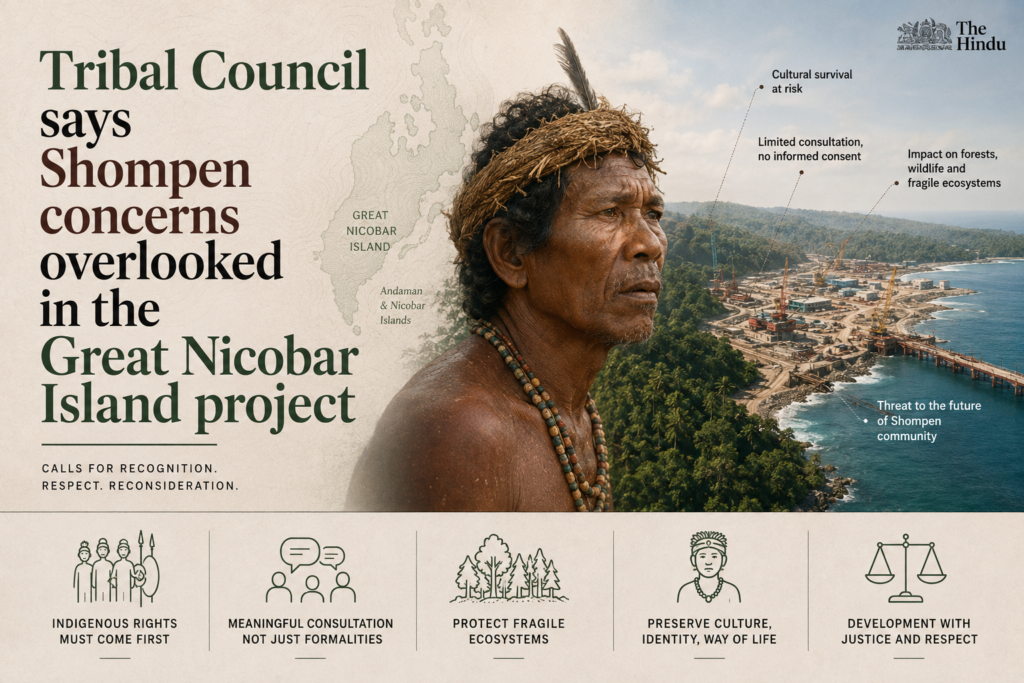
The Tribal Council of Great and Little Nicobar has raised concerns that the Great Nicobar Island (GNI) Project could lead to assimilation and disturbance of the Shompen, a Particularly Vulnerable Tribal Group (PVTG).
What is the GNI Project?
Large infrastructure and township project in Great Nicobar.
Estimated cost: around ₹91,000 crore.
Includes a proposed power plant at Galathea, near Shompen settlements.
Who are the Shompen?
Hunter-gatherer indigenous community.
Fewer than 300 members.
Recognised as a PVTG.
Their isolation makes contact, displacement and forced assimilation particularly sensitive.
What are PVTGs?
PVTG = Particularly Vulnerable Tribal Group: Identified based on characteristics such as:
Pre-agricultural technology
Low literacy
Stagnant or declining population
Economic backwardness
India recognises 75 PVTGs.
Key Concerns
Assimilation: Proposal to shift the Shompen towards a modern lifestyle.
Displacement: Concern over possible settlement and relocation.
Consent: Questions regarding consultation over wildlife reserves and project decisions.
Health risks: Contact with isolated communities can expose them to diseases and other risks.
Assurance gap: Earlier assurance stated that the project would not disturb or displace the Shompen.
Laws Protecting Tribal Rights
Forest Rights Act, 2006: Recognises individual and community forest rights.
PESA, 1996: Provides self-governance and consent provisions in Scheduled Areas.
Andaman and Nicobar Islands (Protection of Aboriginal Tribes) Regulation, 1956: Restricts entry into tribal reserves.
Government Initiatives
PM-JANMAN: Development of PVTG households and habitations.
Development of PVTGs Scheme: Habitat-specific support for 75 PVTGs.
“[2009] In which one of the following places is the Shompen tribe found?
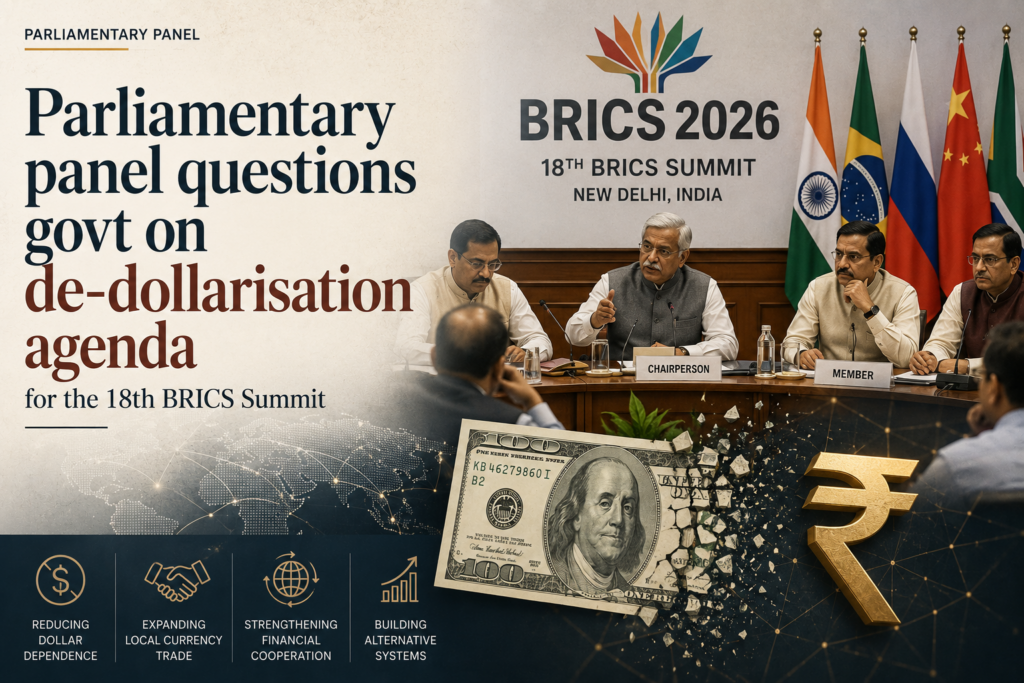
Members of the Parliamentary Standing Committee on External Affairs have asked the government whether it will push a de-dollarisation agenda at the 18th BRICS Summit, which New Delhi hosts in September 2026. The question exposes a tension between the pursuit of greater financial sovereignty and the risk of provoking US retaliation. India holds the rotating chairship of BRICS through 2026, which makes the host nation’s posture on the dollar a live diplomatic choice rather than an abstract one.
What is de-dollarisation?
About: De-dollarisation is a deliberate reduction in the use of the US dollar for international trade invoicing, cross-border settlement, and foreign exchange reserves.
Mechanism: Countries settle bilateral trade in their own national currencies or through a shared settlement arrangement, bypassing dollar clearing and dollar-denominated payment channels.
What is BRICS?
About: BRICS is an intergovernmental grouping originally of Brazil, Russia, India, China, and South Africa, later expanded to admit new members, that coordinates positions on trade, finance, and reform of global governance.
Chairship: The chairship rotates annually among members, and India assumed it on 1 January 2026 and leads the bloc until the end of the year.
What is a Central Bank Digital Currency (CBDC)?
About: A CBDC is a digital form of a country’s sovereign currency issued and backed by its central bank, distinct from private cryptocurrencies.
Relevance here: The Reserve Bank of India (RBI) has repeatedly advocated linking the official digital currencies of BRICS countries to facilitate cross-border trade and tourism payments.
Why is the parliamentary panel pressing the government?
Direct question posed: The panel asked whether the government plans to push a de-dollarisation agenda at the summit New Delhi hosts in September.
Financial sovereignty framing: Members questioned why the government was not pursuing greater financial sovereignty that could help countries bypass US sanctions.
Host-nation leverage: They sought to know whether India, as the host nation, would push a BRICS-led de-dollarisation agenda.
Stalled precedent cited: Members noted that India’s effort to establish a local currency trade mechanism with Russia had not taken off.
What is the case for reducing dollar reliance?
RBI framework: The central bank has argued that linking BRICS digital currencies could reduce reliance on the US dollar amid rising geopolitical tensions.
Sanctions insulation: A shared settlement mechanism would let member economies transact even when cut off from dollar clearing systems.
Payment efficiency: Direct local currency settlement lowers conversion costs in cross-border trade and tourism payments.
Why does a de-dollarisation push carry risks?
US retaliation threat: The US President has repeatedly warned BRICS countries against creating an alternative currency or challenging the dollar’s dominance, threatening punitive tariffs.
Weak internal record: India’s own local currency trade mechanism with Russia has not taken off, exposing the practical difficulty of moving away from the dollar.
Host-nation exposure: As chair and host, a visible Indian push would identify New Delhi with the agenda and concentrate any retaliatory response on it.
Conclusion
The panel has flagged the gap between the RBI’s advocacy for a BRICS payments architecture and the government’s caution on committing to de-dollarisation. The immediate status is that the government has not confirmed whether it will table the agenda. The next milestone is the 18th BRICS Summit in New Delhi in September 2026, where India’s posture as chair will become clear.
About BRICS
Origin: The term BRIC was coined in 2001, the first leaders’ summit was held in 2009, and South Africa joined in 2010 to make it BRICS.
Expansion: The bloc admitted new members from 2024 onward, widening its economic and geographic weight.
Institutions: BRICS created the New Development Bank (NDB), headquartered in Shanghai, and the Contingent Reserve Arrangement (CRA) to provide financing and liquidity support.
Weight: The grouping represents a large share of the world’s population and a substantial share of global output, giving it standing in debates over multilateral reform.
Back2Basics: New Development Bank (NDB)
Convening body: Established by BRICS members to fund infrastructure and sustainable development projects.
Headquarters: Shanghai, China.
Function: Lends to member and partner economies, part of the bloc’s push to build financial institutions parallel to the World Bank and the International Monetary Fund (IMF).
“[2025] Consider the following statements with regard to BRICS:
I. The 16th BRICS Summit was held under the Chairship of Russia in Kazan.
II. Indonesia has become a full member of BRICS.
III. The theme of the 16th BRICS Summit was Strengthening Multilateralism for Just Global Development and Security.
Which of the statements given above is/are correct?
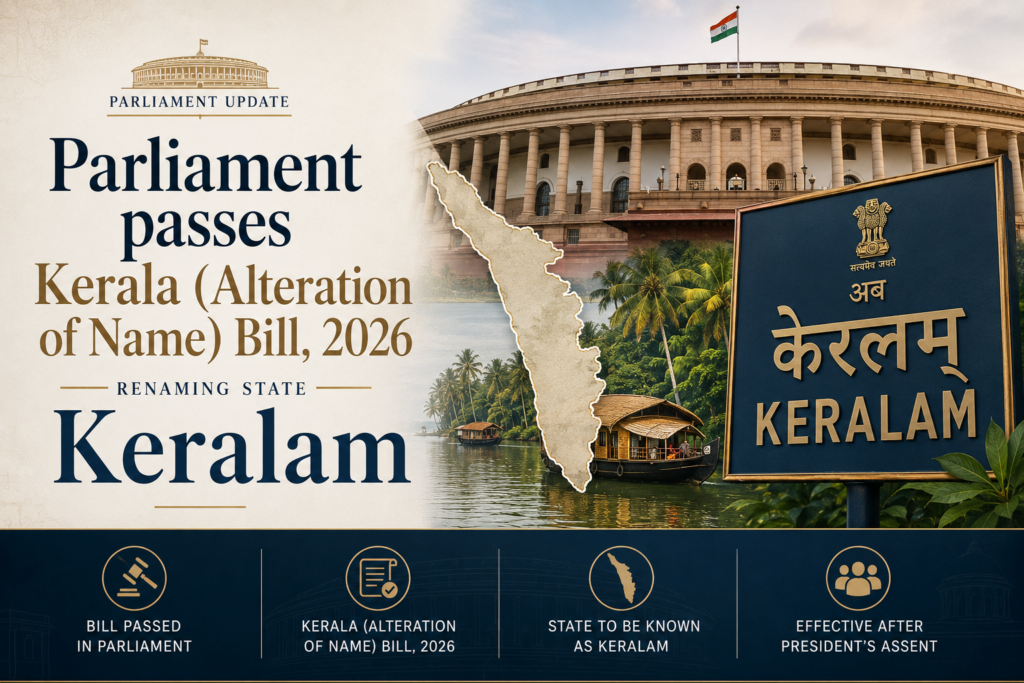
Parliament passed the Kerala (Alteration of Name) Bill, 2026, renaming the State Keralam and amending the First Schedule of the Constitution. The Rajya Sabha cleared the Bill by voice vote, over two years after the State Assembly unanimously resolved for the change. The measure has surfaced pending name change proposals from other States, including West Bengal’s request to become Bangla.
How is a State renamed under the Constitution?
Article 3 power: Parliament may by law alter the name of a State, and such a bill can be introduced only on the recommendation of the President.
State legislature reference: The President must refer the bill to the concerned State legislature for its views within a specified period, though those views are not binding.
First Schedule amendment: Renaming requires an amendment to the First Schedule, which lists the States and Union Territories, effected under Article 4 as an ordinary law.
What is the Kerala (Alteration of Name) Bill, 2026?
Core change: The Bill changes the name of the State from Kerala to Keralam and makes the consequential amendment to the First Schedule.
Origin: It continues the Kerala Assembly’s 2024 resolution urging the Union government to rename the State Keralam.
Passage: The Lok Sabha passed it on Tuesday and the Rajya Sabha by voice vote on Wednesday, with all MPs supporting the rename.
What is the current status of State name changes in India?
Precedents: Madras became Tamil Nadu, and several States and cities have been renamed over the decades.
Pending proposals: West Bengal’s proposal to become Bangla has been pending for eight years, and members sought renaming of other States, cities and railway stations.
Ordinary majority: A First Schedule amendment for renaming is passed as an ordinary law, not requiring the special majority reserved for other constitutional amendments.
Linguistic basis: Keralam is the Malayalam name of the State, and the change reflects respect for regional language identity.
Constitutional provisions related to State renaming:
Article 3: Empowers Parliament to form new States and to alter areas, boundaries or names of existing States.
Article 4: Provides that laws under Articles 2 and 3, including consequential First Schedule and Fourth Schedule amendments, are not deemed constitutional amendments under Article 368.
First Schedule: Lists the States and Union Territories and their territories, amended to record the new name.
Article 3 proviso: Requires presidential recommendation and reference to the State legislature before introduction.
What does the Bill do procedurally?
Amends the First Schedule: Substitutes Keralam for Kerala in the constitutional list of States.
Consequential amendments: Makes the necessary changes so that references in law read as Keralam.
Voice vote clearance: Passed in the Upper House by voice vote with cross party support during the Monsoon Session.
How does renaming differ from creating or altering a State?
Name only: Renaming changes only the label, leaving territory, boundaries and administrative structure intact.
Same Article, different effect: Article 3 covers both renaming and territorial reorganisation, but renaming carries no boundary or population change.
No special majority: Both are enacted by simple majority under Article 4, unlike amendments under Article 368.
What are the major debates surrounding State renaming?
Federal courtesy: Members urged that the Union work closely with States and respect regional languages, framing the change within cooperative federalism.
Pending parity: The eight year delay on West Bengal’s Bangla proposal raised the question of consistent and timely treatment of State requests.
Symbolic versus substantive: One member argued the Centre should change its behaviour on disaster funding, not just the name, contrasting symbolic recognition with substantive support.
Conclusion: Parliament has passed the Kerala (Alteration of Name) Bill, 2026, renaming the State Keralam and amending the First Schedule under Article 3. The change gives effect to the Kerala Assembly’s 2024 resolution and reflects the State’s Malayalam identity. The next step is presidential assent, after which the First Schedule stands amended.
Back2Basics: First Schedule and States reorganisation
First Schedule: Lists the 28 States and 8 Union Territories with their territorial extents.
States Reorganisation Act, 1956: Reorganised State boundaries largely on linguistic lines, the framework within which Kerala was formed.
Renaming precedents: Madras to Tamil Nadu (1969), Mysore to Karnataka (1973), Uttaranchal to Uttarakhand (2007), and Orissa to Odisha (2011).
Process anchor: Article 3 read with Article 4 governs formation, alteration and renaming of States.
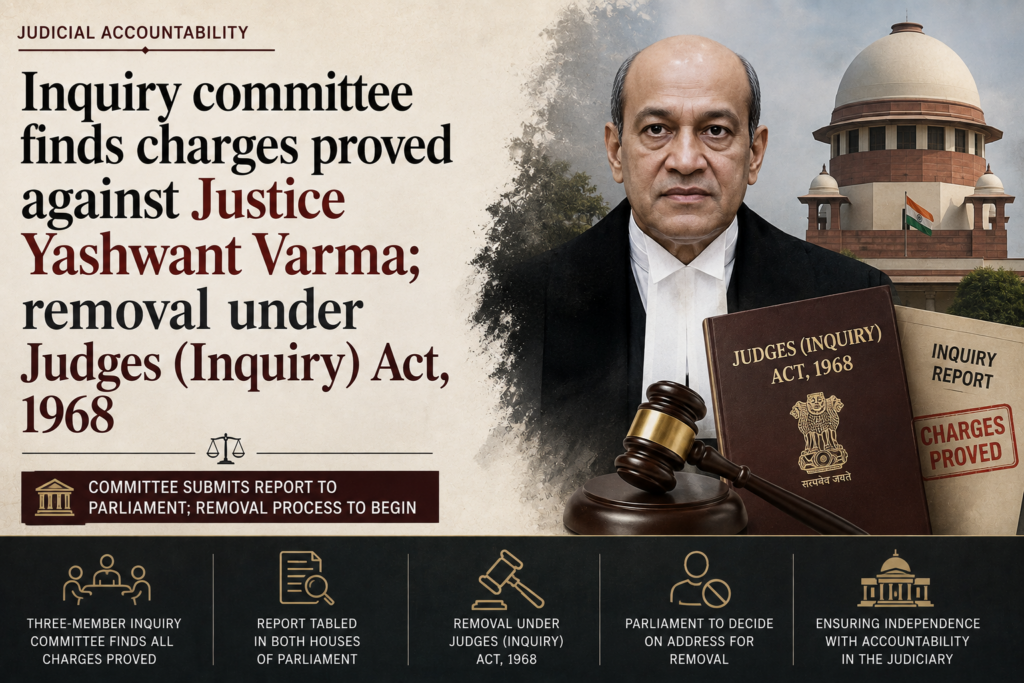
A three member inquiry committee found all three charges proved against former judge Justice Yashwant Varma over unexplained burnt currency found at his official residence. The key issue is whether Parliament can continue the removal process after his resignation.
Judicial Removal Process
Under the Judges (Inquiry) Act, 1968:
Motion: Signed by 100 Lok Sabha or 50 Rajya Sabha members.
Admission: Speaker/Chairman may admit or reject it.
Inquiry Committee: Supreme Court Judge, Chief Justice of a High Court, and Distinguished jurist
Parliamentary approval: Motion must pass in both Houses by:
Majority of total membership, and
2/3 of members present and voting
Final removal: President issues the removal order.
Constitutional Provisions
Article 124(4): Removal of Supreme Court judges for proved misbehaviour or incapacity.
Article 124(5): Parliament can regulate the inquiry procedure.
Articles 217 & 218: Apply the removal framework to High Court judges.
Article 121: Parliament cannot discuss a judge’s conduct except during a removal motion.
Varma Inquiry: Three Charges
Unexplained cash: Burnt currency found at his official residence.
Evidence preservation: Failure to preserve the material evidence.
Evasive explanations: Committee found his explanations misleading and unsupported.
Key Constitutional Issue
Removal motion was admitted before his resignation.
The law does not expressly clarify whether proceedings can continue after resignation.
The issue therefore exposes a legal gap concerning post resignation proceedings and consequences for pension and other benefits.
“[2019] Consider the following statements:
1. The motion to impeach a Judge of the Supreme Court of India cannot be rejected by the Speaker of the Lok Sabha as per the Judges (Inquiry) Act, 1968.
2. The Constitution of India defines and gives details of what constitutes “incapacity and proved misbehaviour” of the Judges of the Supreme Court of India.
3. The details of the process of impeachment of the Judges of the Supreme Court of India are given in the Judges (Inquiry) Act, 1968.
4. If the motion for the impeachment of a Judge is taken up for voting, the law requires the motion to be backed by each House of the Parliament and supported by a majority of total membership of that House and by not less than two-thirds of total members of that House present and voting.
Which of the statements given above is/are correct?
(a) 1 and 2 (b) 3 only (c) 3 and 4 only (d) 1, 3 and 4
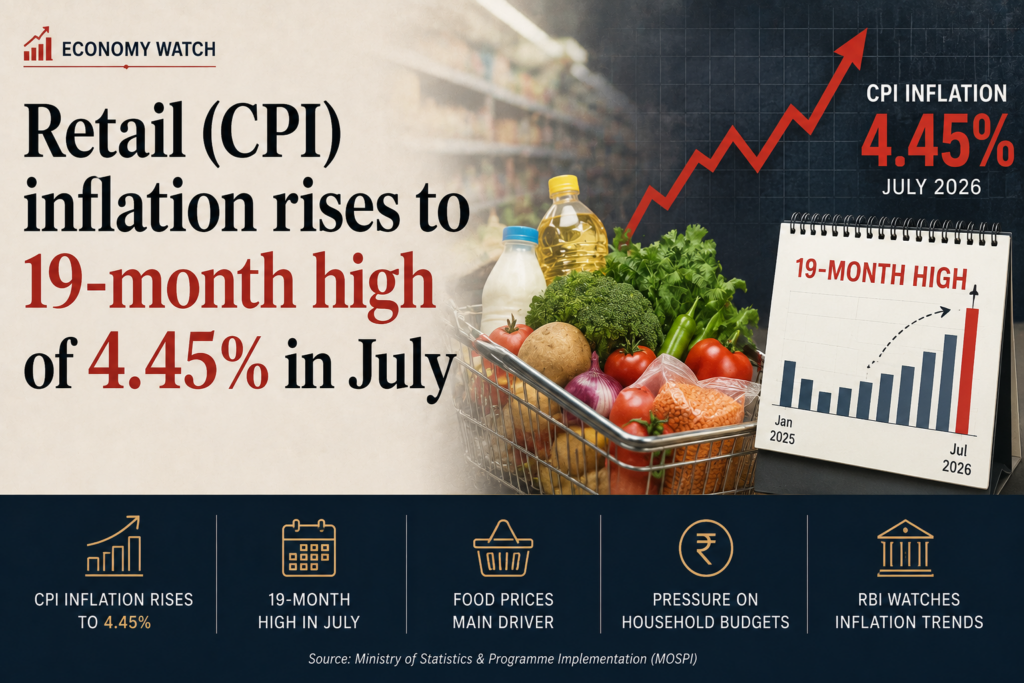
India’s CPI (Consumer Price Index) inflation rose to 4.45% in July, driven mainly by food and fuel prices, while remaining within the RBI’s tolerance band.
What is CPI?
CPI = Consumer Price Index
Measures changes in retail prices of a fixed basket of goods and services.
India’s CPI was rebased to 2024.
Sector-wise data under the new series is available from January 2026.
What Drove Inflation?
Food inflation: 5.52%.
Onion inflation: 22.54%.
Restaurants & accommodation: 7.7%.
Transport: 4.4%.
Personal care: 14.8%.
What Remained Stable?
Core inflation: 3.9%, excluding food and fuel.
Health inflation: 1.3%.
Recreation: 1.6%.
Stable core inflation suggests limited demand-pull pressure, with the current rise largely driven by supply-side factors.
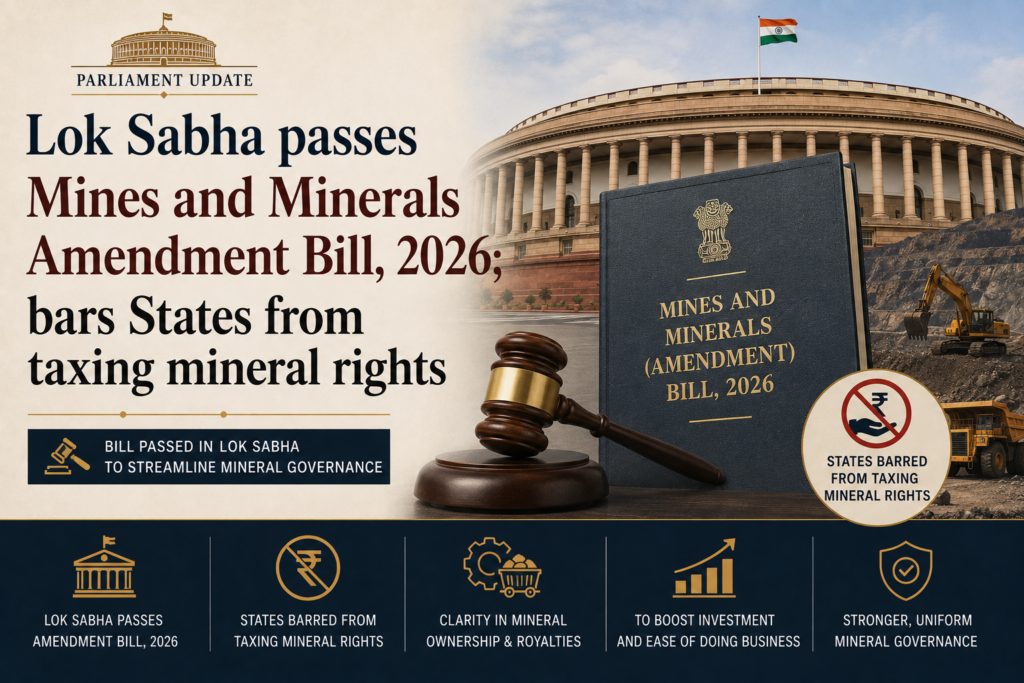
The Lok Sabha passed the Mines and Minerals (Development and Regulation) Amendment Bill, 2026 without debate, barring State governments from imposing additional taxes, cesses or levies on mineral rights and giving the Centre greater control over regulating mineral-laden lands. The move exposes a fiscal federalism clash, since it curtails a State taxation power the Supreme Court had upheld in 2024 and shifts fiscal authority over a Concurrent-domain resource toward the Union.
What does the Mines and Minerals (Development and Regulation) Amendment Bill, 2026 do?
Bars State levies: It prevents State governments from imposing additional taxes, cesses or levies on mineral rights.
Central control: It gives the Centre greater control over regulating mineral-laden lands.
Stated rationale: The Coal and Mines Minister argued that divergent fiscal levies by States had created uncertainty in the mineral sector.
Feared effects cited: The government said such divergence could raise costs, encourage imports and undermine domestic supply chains.
What is the Mines and Minerals (Development and Regulation) Act, 1957?
Purpose: The MMDR Act, 1957 is the principal law regulating the mining sector, governing the grant of mineral concessions, leases and the development and regulation of mines.
Federal scheme: It empowers the Centre to frame rules for major minerals, while States frame rules for minor minerals and grant concessions for minerals in their territory.
Current Status of State taxation power over minerals in India
State entitlement: States levy royalty on extracted minerals and, since a 2024 Supreme Court ruling, hold constitutional competence to tax mineral rights and mineral-bearing lands.
The 2024 judgment: A nine-judge Bench held that royalty is not a tax and that States have legislative power to tax mineral rights, a power the present Bill now seeks to restrict.
Revenue stakes: Mineral-rich States such as Jharkhand, Odisha and Chhattisgarh rely on mining royalties and cesses as a significant own-revenue source.
Constitutional Provisions related to mineral regulation and fiscal federalism
Entry 54, Union List: Regulation of mines and mineral development to the extent Parliament declares expedient in the public interest.
Entry 23, State List: Regulation of mines and mineral development subject to the Union List entry.
Entry 50, State List: Taxes on mineral rights subject to any limitations imposed by Parliament relating to mineral development.
Entry 49, State List: Taxes on lands and buildings, the basis on which States tax mineral-bearing land.
Article 246 and Seventh Schedule: Distribute legislative competence between the Union and the States across the three Lists.
Article 265: No tax shall be levied or collected except by authority of law.
Why does the Centre want to bar State levies?
Uniformity: A single fiscal regime is intended to remove the uncertainty created by State-by-State levies.
Cost competitiveness: The government links divergent levies to higher input costs for downstream industry and greater import dependence.
Supply chain security: Uniform charges are framed as protection for domestic mineral supply chains, including critical minerals.
Why do States and the Opposition see this as an assault on federalism?
Overriding the Court: The Bill legislatively narrows a taxation power the Supreme Court affirmed for States in 2024.
Erosion of own-revenue: Barring cesses and levies removes a fiscal lever that mineral-rich States use to fund local development.
Centralising trend: Critics place it within a wider pattern of the Union tightening control over resources located in State territories.
Process objection: The Bill was passed without debate amid protests, which the Opposition cited as a denial of scrutiny on a federalism-sensitive measure.
Major debates surrounding mineral taxation federalism
Royalty versus tax: Whether royalty is a tax and where the line lies between Union regulation of mineral development and State taxation of mineral rights.
Parliamentary limitation: How far Parliament’s power under Entry 50 to limit State mineral taxation can extend before it hollows out the State entry.
Distributive justice: Whether mineral-bearing States should retain fiscal upside from resources extracted within their borders.
Investment climate: Whether uniform central levies genuinely lower costs or merely redistribute fiscal space from States to industry.
Challenges to a centralised mineral fiscal regime
Vertical fiscal imbalance: Reduced own-revenue deepens State dependence on central transfers.
Litigation risk: A statutory override of a constitutional ruling invites fresh challenges before the Supreme Court.
Regional equity: Resource-rich but income-poor States lose a development financing tool.
Cooperative federalism strain: Bypassing State consent on a shared-domain subject weakens negotiated federalism.
Compliance uncertainty: Transition from varied State levies to a single regime creates short-term ambiguity for operators.
Conclusion
The Lok Sabha has cleared a Bill that removes the States’ power to levy additional taxes on mineral rights and centralises regulatory control over mineral lands. The current status is passage in the Lower House amid Opposition protest; the next milestone is its consideration in the Rajya Sabha and likely constitutional scrutiny given its tension with the 2024 Supreme Court ruling on State taxation of minerals.
What is Fiscal Federalism? (Foundational Context)
About: Fiscal federalism is the division of taxation powers, expenditure responsibilities and transfers between the Union and the States.
Rationale: It exists to match revenue-raising capacity with spending needs across tiers of government.
Named typology: It addresses vertical imbalance between the Union and States, horizontal imbalance across States, and weak third-tier finances at the local level.
Key Concerns Regarding Fiscal Federalism
Shrinking divisible pool: Rising cesses and surcharges reduce the shareable tax pool with States.
Eroded State autonomy: GST and central levies have narrowed independent State taxation.
Resource control: Central assertion over minerals and land in State territories limits State fiscal levers.
Weak local finances: Third-tier bodies remain underfunded and dependent.
Constitutional Framework Governing Mineral Regulation
Entry 54 (List I): Union regulation of mines and mineral development in the public interest.
Entry 23 (List II): State regulation of mines subject to the Union entry.
Entry 50 (List II): State taxes on mineral rights subject to parliamentary limitation.
Article 246: Allocation of legislative competence across the three Lists.
Article 265: Taxation only by authority of law.
Way Forward
Consultative design: Frame mineral fiscal policy through the GST Council model of negotiated federalism.
Revenue neutrality: Compensate mineral-rich States for lost cesses through predictable transfers.
Legal clarity: Reconcile the amendment with the 2024 ruling to avoid protracted litigation.
District mineral funds: Strengthen use of mining revenues for affected local communities.
“[2025] Consider the following statements:
Statement I: In India, State Governments have no power for making rules for grant of concessions in respect of extraction of minor minerals even though such minerals are located in their territories.
Statement II: In India, the Central Government has the power to notify minor minerals under the relevant law.
Which one of the following is correct in respect of the above statements?
(a) Both Statement I and Statement II are correct and Statement II explains Statement I
(b) Both Statement I and Statement II are correct but Statement II does not explain Statement I
(c) Statement I is correct but Statement II is incorrect
(d) Statement I is incorrect but Statement II is correct
A remark by the Prime Minister offering “forgiveness” to young women who protested over examination irregularities has reopened a basic constitutional question. The framing casts the state as a benevolent patriarch and the women as daughters to be corrected, rather than as citizens exercising a right. The dispute is whether women who protest are treated as rights bearing citizens or as wards whose speech must first be polite.
What does the right to free speech under Article 19 protect?
Scope:Article 19(1)(a) of the Constitution guarantees the freedom of speech and expression to every citizen, and this includes the right to protest and to dissent.
Provocative speech included: The right covers expression that is impolite, provocative, or even offensive, not only measured or agreeable speech.
Only reasonable restrictions: The right is limited solely by the reasonable restrictions in Article 19(2), such as public order, decency or morality, and defamation, incitement to an offence and not by a general demand for civility.
Why is the “forgiveness” framing seen as paternalistic?
State as patriarch: Offering forgiveness positions the state as a merciful patriarch dispensing pardon, rather than an authority answerable to its citizens.
Infantilising women: Describing protesting women as “daughters” who spoke wrongly reduces them to misguided children in need of correction.
Agency denied: It treats a woman’s political grievance as an error of conduct, shifting attention from the demand to the manner of its expression.
How does the double standard operate?
Men’s anger normalised: Aggressive language by men in protests, rallies, and legislatures is read as conviction and rarely becomes a national debate.
Women’s anger moralised: The same expression by women is recast as a question of morality and cultural shock, which invalidates the underlying political claim.
Burden shifts to the woman: The pattern mirrors sexual violence cases, where a woman’s character is examined before the offence itself is addressed.
Can free speech protect angry dissent?
Protest is born of frustration: Dissent by its nature arises from anger at the prevailing system, so citizens cannot be required to soften their anger before being heard.
Civility is not a legal test: Politeness is a social norm, not one of the grounds on which Article 19(2) permits the state to restrict speech.
The real offence was elsewhere: At the protests the demonstrable wrong was the assault, doxxing, and harassment of students, not the words some of them used.
What is the current Status of the freedom of speech and expression in India
Who it protects: Article 19(1)(a) extends to all citizens, and its protection of protest and criticism has been repeatedly affirmed by the judiciary.
Settled limits: Speech may be restricted only under the eight grounds in Article 19(2), including the sovereignty and integrity of India, security of the State, public order, decency or morality, defamation, contempt of court, friendly relations with foreign states and incitement to an offence.
Recognised expansions: Courts have read the right to include the right to know, the right to protest peacefully, and expression through diverse media.
What are the constitutional Provisions related to speech, agency, and equality
Article 19(1)(a): Guarantees the freedom of speech and expression.
Article 19(2): Lists the reasonable restrictions that alone may limit that freedom.
Article 21: Protects personal liberty and autonomy, the basis on which courts uphold a woman’s right to choose her partner, faith, and way of life.
Articles 14 and 15: Guarantee equality before the law and bar discrimination on the ground of sex, underpinning equal citizenship for women.
What are the major debates surrounding free speech and women’s agency
Civility versus liberty: Whether provocative or offensive protest speech can be curbed in the name of decorum, or only under Article 19(2).
Paternalism versus autonomy: Whether the state and courts may protect women in ways that override their own choices, as critiqued through the Hadiya case.
Unequal citizenship: The argument, drawn from political theorist Carole Pateman, that the formal citizenship of men counts for more than that of women because of patriarchal privilege.
Conclusion
The central claim is that women who protest are citizens exercising a right, not daughters awaiting pardon. Treating their speech as a question of civility, while men’s aggression passes as conviction, denies them equal citizenship and misreads a right that protects even uncomfortable expression. The remedy is to treat women as full rights bearing individuals and to judge protest speech only against the limits the Constitution actually sets.
Back2Basics:
Hadiya case (2018)
What it was: The Kerala High Court annulled the marriage of an adult woman on the assumption that she was weak and vulnerable.
What the Supreme Court held: It set aside the annulment and restored her fundamental right to make choices about her life, faith, and partner.
Why it matters: It is a leading illustration of courts correcting a paternalistic denial of a woman’s autonomy under Article 21.
Fundamental Rights in India (Foundational Context)
About: Fundamental Rights in Part III of the Constitution are justiciable guarantees that an individual can enforce against the state.
Rationale: They protect individual liberty and dignity and place limits on state power, and form part of the basic structure.
Key concerns: Recurring tensions include balancing liberty against public order, the scope of reasonable restrictions, and the unequal enjoyment of rights across gender and class.
Way Forward
Judge speech by Article 19(2) alone: Restrict protest speech only on the constitutional grounds, not on norms of politeness.
Protect protestors from harassment: Act against the doxxing, assault, and vilification of demonstrators rather than policing their tone.
Recognise women’s agency: Frame women in public life as citizens with political and personal autonomy, not as dependents to be protected.
PYQ Relevance
[UPSC 2014] What do you understand by the concept “freedom of speech and expression”? Does it cover hate speech also? Why do the films in India stand on a slightly different plane from other forms of expression? Discuss.
Linkage: The PYQ is directly relates to the constitutional scope of freedom of speech and expression under Article 19(1)(a). The article extends this debate to angry dissent, provocative speech, reasonable restrictions and women’s right to political expression.
The National Aeronautics and Space Administration (NASA) has invited the Indian Space Research Organisation (ISRO) to join its Moon Base programme, the effort to return humans to the Moon and set up a permanent settlement near the lunar South Pole. The invitation was extended at the ninth meeting of the India and United States Civil Space Joint Working Group, deepening a partnership that already spans the Artemis Accords and a joint radar satellite.
What was announced and what is the Moon Base programme?
The invitation: NASA invited ISRO to join its Moon Base programme, building on the two countries’ partnership under the Artemis Accords.
The venue: The offer was made at the ninth meeting of the India and United States Civil Space Joint Working Group, held in Bengaluru on 5 and 6 August.
The programme: The Moon Base programme aims to establish humanity’s first outpost on another celestial body, near the South Pole of the Moon.
Wider setting: The meeting advanced civil and commercial space cooperation under a strategic technology initiative aligned with the February 2025 Joint Leaders’ Statement.
What are the Artemis Accords?
Definition: The Artemis Accords are a United States led set of non binding principles to govern the peaceful civil exploration and use of outer space, including the Moon.
India’s role: India signed the Accords in 2023 as the 27th country, and a total of 70 countries are now part of them.
Relevance: The Moon Base invitation and agreed open scientific data sharing are being pursued under this framework.
What deepening ties does the invitation reflect?
NISAR mission: The two agencies last year launched the NASA and ISRO Synthetic Aperture Radar (NISAR) mission, a dual frequency radar satellite and a first of its kind joint venture.
Human spaceflight: An Indian astronaut flew to the International Space Station in 2025 through an Axiom mission, a result of a strategic framework for human spaceflight cooperation.
Data cooperation: Both sides agreed to advance open scientific data sharing and discussed joint missions to the Moon and beyond.
Outer space governance: They reaffirmed commitment to United Nations guidelines on the long term sustainability of outer space activities.
What are India’s own lunar and human spaceflight programmes?
Gaganyaan: ISRO is pursuing its human spaceflight programme to send Indian astronauts to low Earth orbit.
Moon landing target: India has stated plans to achieve a human landing on the Moon by 2040.
Chandrayaan legacy: India’s earlier lunar missions established its capability, including a South Pole region landing.
Complementary strengths: NISAR’s success is seen as a base for more complex joint missions, including the lunar base and human spaceflight.
Back2Basics: NISAR Mission
Full form: NASA and ISRO Synthetic Aperture Radar mission.
Nature: A joint Earth observation satellite using dual frequency radar, a first of its kind.
Purpose: Monitors changes in land surface, ice sheets, ecosystems and natural hazards.
Significance: Regarded as a landmark joint venture that could enable more complex India and United States space missions.
Government Initiatives / Programmes in Indian Space
Gaganyaan: India’s human spaceflight programme to send astronauts to low Earth orbit.
Chandrayaan Programme: Series of lunar missions advancing India’s Moon exploration.
IN-SPACe: Regulator and promoter enabling private sector participation in space.
Indian Space Policy 2023: Framework opening the sector to non governmental entities.
Key Facts about India and Global Space Cooperation
Artemis signatory: India was the 27th country to sign the Artemis Accords in 2023, now numbering 70 countries.
Working group: The invitation came at the ninth India and United States Civil Space Joint Working Group in Bengaluru.
Moon landing goal: India targets a human landing on the Moon by 2040.
South Pole focus: The Moon Base aims for humanity’s first outpost near the lunar South Pole.
“[2016] Consider the following statements: The Mangalyaan launched by ISRO
1. is also called the Mars Orbiter Mission
2. made India the second country to have a spacecraft orbit the Mars after USA
3. made India the only country to be successful in making its spacecraft orbit the Mars in its very first attempt
Which of the statements given above is/are correct?
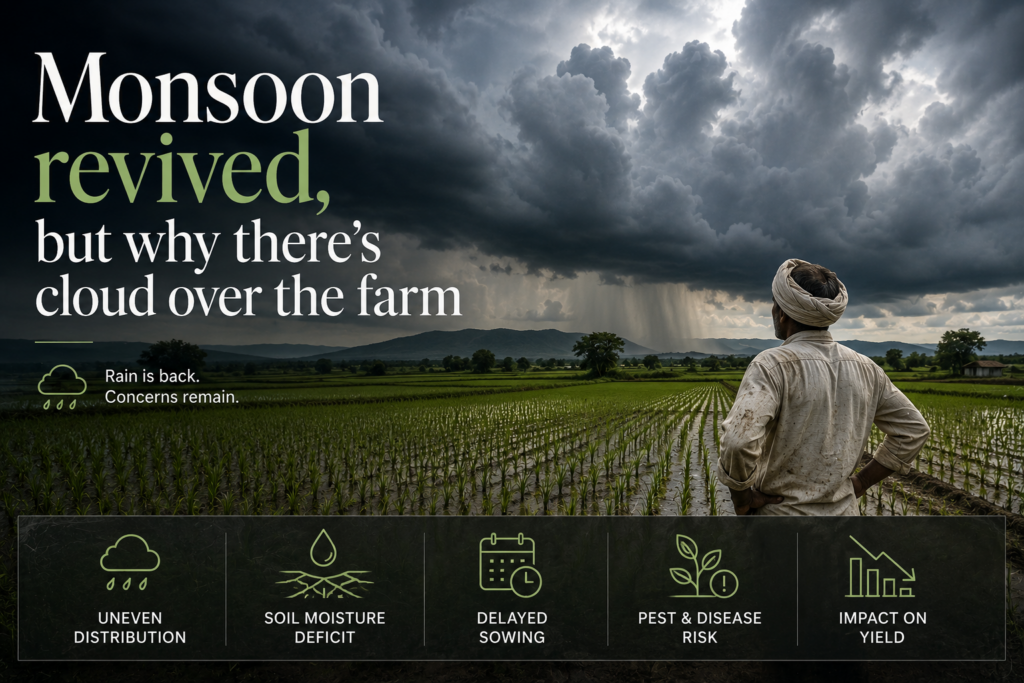
The southwest monsoon’s revival in July, despite a strengthening El Nino, has sharply narrowed the gap in area sown under kharif crops this season. The relief exposes a deeper tension between a recovering kharif and the mounting risks to the rabi season and to food inflation from El Nino’s lagged effect and a surge in global vegetable oil prices.
Why did a sowing gap open and how did July reverse it?
Weak start: Rainfall in June was 38 percent below the long period average, making it the sixth driest June in India since 1901, with not a single low pressure system forming.
Early shortfall: By 6 July farmers had planted only 350.85 lakh hectares, which was 20.8 percent below the 442.80 lakh hectares sown in the same period of 2025.
July turnaround: In July the country recorded four low pressure systems against a normal of three. These moved slowly, producing about 24 affected days against a normal of 14, lifting all India July rainfall to 2.4 percent above the average.
Recovery: By 7 August the 967.92 lakh hectares covered was only 1.8 percent lower than last year, with the pulses gap down to 1.8 percent, cotton to 0.4 percent, and oilseeds exceeding last year’s level.
What is El Nino and why does its effect lag?
Definition: El Nino is the abnormal warming of surface waters in the central and eastern Pacific Ocean off Peru and Ecuador that suppresses monsoon rainfall over India.
Lagged impact: El Nino’s effect on rainfall and temperatures comes with a lag of one to two months and can play out over five to six months or more.
Current phase: It intensified from a weak to moderate phase in June into a moderate to strong event in July, and global agencies expect it to turn very strong during October to December.
Why is the worst not yet over?
Late kharif needs rain:Crops need rainfall during August and early September for flowering and grain formation that determine yields. Meteorological Department has predicted a fresh low pressure system around 12 August.
Delayed hit: Because El Nino’s rainfall suppressing effect lags, its worst impact is still to come.
Rabi at risk: A strengthening El Nino raises temperatures, and a short warm winter harms wheat, mustard and potato yields, so the real threat is to the rabi season.
What does the FAO Food Price Index show?
Index high: The United Nations Food and Agriculture Organization (FAO) food price index touched 131.1 points in July, up 1 percent from July 2025 and the highest since the 131.4 of January 2023, a three and a half year high. This means food prices are now at their highest level in about 3½ years.
Vegetable oils drive it: The vegetable oils index reached 195.7 points, up 17.3 percent year on year and the highest since June 2022.
Mixed components: The cereals index was 113.8 points, up 6.9 percent, while dairy fell 24.8 percent, sugar fell 8 percent, and meat rose just 0.8 percent.
Causes: The rise is attributed to El Nino, heatwave hit crop yields in Europe, and supply disruptions from conflicts in West Asia and Ukraine.
Why are vegetable oils the real concern for India?
Import exposure: The combined value of India’s imports of oilseeds, pulses and cotton was close to 25 billion dollars in 2025-26, which El Nino could push to a new high.
Biofuel diversion: Firming vegetable oil prices stem mainly from diversion of palm, rapeseed and soyabean oil toward biofuel as petroleum prices harden.
Fuel substitution: These oils are used to make fatty acid methyl esters, a substitute for petroleum diesel, linking food and fuel markets.
Buffer available: The government held 92.6 million tonnes of rice and wheat on 1 July against a required minimum of 41.1 million tonnes, plus over 4 million tonnes of pulses, which can be offloaded to contain inflation.
Conclusion
The July monsoon revival has rescued the kharif season, cutting the sowing gap to under 2 percent even as El Nino strengthened. The central worry has shifted to the rabi season and to food inflation, since El Nino’s temperature and rainfall effects lag and global vegetable oil prices are at multi year highs. Ample public grain stocks give the government room to manage food inflation, but the rabi outlook and edible oil import bill remain the open risks.
Back2Basics:
Foundational Context: Climate Change and Food Security
About: Food security means reliable physical and economic access to sufficient, safe and nutritious food, which climate variability directly threatens.
Tropical vulnerability: Tropical countries face greater exposure because agriculture is rain dependent and heat sensitive.
India context: A large share of India’s cropped area is rainfed, tying output to monsoon performance.
Transmission channels: Erratic rainfall, heat stress, pest incidence and global price shocks each transmit climate risk to food systems.
FAO Food Price Index
Convening body: Published by the United Nations Food and Agriculture Organization (FAO).
What it measures: A weighted average of world prices of a basket of food commodities against a base period value taken as 100 for 2014 to 2016.
Components: Tracks separate indices for cereals, vegetable oils, dairy, meat and sugar.
Frequency: Released monthly.
Recent reading: Touched 131.1 points in July, a three and a half year high.
Government Initiatives for Agriculture and Edible Oils
National Mission on Edible Oils Oil Palm: Mission to raise domestic oil palm and edible oil production and cut import dependence.
PM-AASHA: Umbrella scheme assuring remunerative prices to farmers, especially for oilseeds and pulses.
Price Stabilisation Fund: Buffer stock mechanism to moderate volatility in pulses and other commodities.
Minimum Support Price: Price assurance to encourage sowing of pulses and oilseeds.
Key Facts about the Monsoon and Kharif Season
Sixth driest June: June 2026 was the sixth driest June since 1901.
July rainfall: All India July rainfall was 2.4 percent above the long period average.
Import bill: Oilseeds, pulses and cotton imports neared 25 billion dollars in 2025-26.
Grain stocks: 92.6 million tonnes of rice and wheat held on 1 July against a 41.1 million tonne minimum.
Challenges in Indian Agriculture
Rainfall dependence: A large rainfed area leaves output exposed to monsoon swings.
Import reliance: High dependence on imported edible oils and pulses exposes India to global prices.
Climate volatility: El Nino and heatwaves disrupt both kharif and rabi seasons.
Price transmission: Global food and fuel price shocks feed domestic inflation.
Storage and logistics: Post harvest losses and uneven buffer management persist.
Yield gaps: Low productivity in pulses and oilseeds constrains self sufficiency.
Way Forward
Raise oilseed output: Expand area and yields under the edible oils mission to cut imports.
Diversify cropping: Promote pulses and climate resilient varieties in rainfed regions.
Strengthen buffers: Use public grain and pulse stocks proactively to contain inflation.
Improve forecasting: Sharpen monsoon and El Nino forecasting for sowing decisions.
Invest in irrigation: Extend micro irrigation to reduce rainfall dependence.
PYQ Relevance
[UPSC 2023] Discuss the consequences of climate change on the food security in tropical countries.
Linkage: The PYQ directly addresses the impact of climate change and climatic variability on food security in tropical countries. El Niño, erratic monsoons, heat stress and global food prices show how climate risks affect India’s kharif, rabi and food inflation.
Civil society groups and mining affected communities have alleged that the Supreme Court appointed High Powered Committee (HPC) on the Aravallis left out several districts and did not adequately hear local people during its consultations. The dispute exposes the tension between expert led regulation of mining and genuine participation of the communities whose lands and livelihoods the decision will affect.
What is the High Powered Committee on the Aravallis?
Origin: The Supreme Court of India constituted a high-powered expert committee headed by Kanchan Devi to review the definition and delineation of the Aravalli hill range, guide mining regulations, and protect the fragile ecosystem from continuous environmental degradation.
Mandate: It is to submit a report that will shape decisions on mining and conservation across the range, with an August 31 deadline.
Consultation window: The panel held a 21 day period for stakeholders to submit comments, which has now ended.
Field visits: It conducted field visits in Gurgaon, Alwar, Ajmer and Udaipur between 6 and 10 August.
Why are activists challenging the consultation process?
Villages left out: The Aravalli Virasat Jan Abhiyan claims the HPC did not visit any mining affected villages to understand ground realities.
Urban centric hearings: Public hearings were held at urban centres that affected villagers could not reach, and information was not publicised in local newspapers, on radio, or at panchayat offices.
Lobby dominance: Around 80 percent of representations in Ajmer were pro mining, with a similar pattern elsewhere, and those speaking against mining were allegedly threatened.
Access failures: A scheduled Udaipur meeting for 10 August was moved to the evening of 9 August, making it hard for many to attend, and requested visits to villages hit by limestone mines and stone crushers did not happen.
Central demand: The group wants the HPC to seek an extension of the August 31 deadline and hold meaningful consultations across all 64 districts in Delhi, Haryana, Rajasthan, Uttar Pradesh and Gujarat.
What is an Eco Sensitive Zone?
Definition: An Eco Sensitive Zone is an area notified around protected areas or ecologically fragile landscapes where activities such as mining are regulated or prohibited to act as a shock absorber.
The National Wildlife Action Plan (2002-2016) recommended that State governments identify areas within 10 km of national parks and wildlife sanctuaries for declaration as Eco-Sensitive Zones (ESZs).
The recommendation was to be implemented under the Environment (Protection) Act, 1986, under the framework of the Ministry of Environment, Forest and Climate Change (MoEFCC).
Relevance: Regulation of mining in the Aravallis turns on how such protective boundaries and restrictions are drawn and enforced.
Why does the Aravalli range matter for mining regulation?
Ecological role: The Aravallis are India’s oldest mountain range and act as a barrier against desertification spreading eastward from the Thar.
Mining pressure:Limestone mines, stone crushers and other extraction have degraded stretches of the range.
Legal history: Courts have repeatedly intervened to restrict illegal and unregulated mining in the range.
Livelihood stakes: Rural and Adivasi communities depend on the hills, so decisions affect both ecology and livelihoods.
Why does the mining lobby versus affected communities tension shape the outcome?
Capture risk: Hearings dominated by pro mining representations risk producing a report that understates ground level harm.
Precedent invoked: Activists demand a systematic outreach approach similar to the one adopted a decade ago by the Western Ghats Ecology Expert Panel, which held direct public hearings.
Intimidation: Alleged threats to those opposing mining undermine the credibility of the consultation.
Deadline pressure: A fixed August 31 deadline discourages the fuller consultation the communities are demanding.
Conclusion
The current status is a contested consultation process, with affected communities demanding a deadline extension and direct village level hearings before the HPC finalises its report to the Supreme Court. The dispute turns on whether expert regulation of Aravalli mining can be legitimate without hearing the people most affected by it. The next milestone is whether the committee seeks an extension or submits its report by August 31 as scheduled.
Back2Basics:
Foundational Context: Mining in India
About: Mining is the extraction of minerals from the earth and is regulated as a hazard prone activity with significant environmental impact.
Scale: India produces a range of major and minor minerals, with states such as Rajasthan, Odisha and Jharkhand holding large reserves.
Environmental impact: Mining causes deforestation, dust and air pollution, groundwater depletion, and land degradation.
Governance: Mineral development is regulated under central law with clearances layered across environment, forest and pollution statutes.
Statutory Framework Governing Mining and the Aravallis
Mines and Minerals (Development and Regulation) Act, 1957: The principal law regulating the mining sector and grant of mineral concessions.
Environment (Protection) Act, 1986: Enables environmental clearances and the notification of Eco Sensitive Zones.
Forest (Conservation) Act, 1980: Requires clearance before diverting forest land for mining.
Air (Prevention and Control of Pollution) Act, 1981: Regulates dust and emissions from mining and crushing.
National Green Tribunal Act, 2010: Provides the forum for adjudicating mining and environmental disputes.
The Aravalli Range
Designation: India’s oldest fold mountain range, running across Delhi, Haryana, Rajasthan and Gujarat.
Location and extent: Stretches roughly 690 kilometres from Delhi to Gujarat, with Guru Shikhar as its highest peak.
Ecological function: Acts as a natural barrier checking the eastward spread of the Thar desert and supports groundwater recharge.
Distinguishing feature: Hosts unique biodiversity and forms the watershed for several rivers.
Current concern: Threatened by illegal mining, stone crushing and encroachment.
Government Initiatives for Aravalli and Land Restoration
Aravalli Green Wall Project: Initiative to create a green belt along the range to combat land degradation and desertification.
Compensatory Afforestation Fund: Funds afforestation to offset forest land diverted for mining and other uses.
National Afforestation Programme: Supports regeneration of degraded forest land.
Desertification action: India’s commitments under the United Nations Convention to Combat Desertification guide land restoration.
Key Facts about the Aravallis and Mining
Districts covered: The HPC’s mandate spans 64 districts across five states.
Oldest range: The Aravallis are among the oldest mountain systems in the world.
Deadline: The committee faces an August 31 report deadline.
Precedent: The Western Ghats Ecology Expert Panel is cited as a model of participatory consultation.
Weak consultation: Affected rural and Adivasi communities are inadequately heard.
Enforcement gaps: Overlapping jurisdictions weaken monitoring of mining bans.
Encroachment: Construction and settlement erode the range.
Desertification risk: Degradation of the range threatens its role as a desert barrier.
Intimidation of activists: Reported threats deter local opposition to mining.
Way Forward
Direct village outreach: Hold public hearings in affected villages, not only urban centres.
Extend timelines: Allow adequate consultation before finalising a decision of this scale.
Strengthen enforcement: Deploy satellite monitoring and strict penalties against illegal mining.
Protect participants: Ensure safety for community members opposing mining.
Restore degraded land: Scale up afforestation and green wall efforts across the range.
PYQ Relevance
[UPSC 2025] Mineral resources are fundamental to the country economy and these are exploited by mining. Why is mining considered an environmental hazard? Explain the remedial measures required to reduce the environmental hazard due to mining.
Linkage: The PYQ directly connects with the environmental hazards of mining and remedial measures for sustainable mineral extraction. The Aravalli case highlights illegal mining, ecological degradation, weak enforcement and the need for participatory conservation.