Madhya Pradesh plans to excavate and restore Vaishya Tekri in Ujjain, a major mound believed to contain a Mauryan-era stupa. ASI suggests it may have been larger than the Sanchi Stupa, but its association with Ashoka remains unproven.
What is Vaishya Tekri?
Located in Ujjain, an important Mauryan-era centre.
Excavated first in 1938-39 by the erstwhile Gwalior State.
Identified as a major stupa, not a natural mound.
1938 report estimated its base at about 350 ft diameter and height at 100+ ft.
Dating to the 3rd century BCE was suggested from brick dimensions and coins.
Key Archaeological Evidence
Core made of rammed blackish murum.
Exterior faced with brick masonry and mud mortar.
Finds included:
Punch-marked coin
Cast Avanti coin
A moat surrounded the stupa, with a western passage for worshippers.
An unusual bowl-shaped masonry base helped resist lateral thrust.
Ashoka Connection
Tradition associates Ujjain with Ashoka’s viceroyalty.
However, the 1938 excavation did not establish an Ashokan connection.
The report only stated that the stupa could possibly be one of the stupas attributed to Ashoka.
Brick size and coins establish a period, not the identity of the patron.
Prelims Quick Facts
Vaishya Tekri: Ujjain, Madhya Pradesh
Period: Mauryan, 3rd century BCE
Monument: Buddhist stupa
First excavation: 1938-39
Estimated diameter: ~350 ft
Sanchi Stupa height: ~54 ft
Key coin: Punch-marked coin
Agency: Archaeological Survey of India
“[2026] Which of the following statements on the Amaravati Stupa and its relief sculpture is/are correct? 1. It was located in the lower Krishna valley. 2. In India, it was next only to the Sanchi Stupa in size. 3. The Amaravati school of sculpture made a lasting impact on the later South Indian sculpture, and its products were carried to Sri Lanka and South-east Asia. (a) 1 only (b) 1 and 3 only (c) 2 and 3 only (d) 1, 2 and 3
The Ministry of Home Affairs (MHA) has asked all States and Union Territories to process extradition requests for fugitives abroad without delay, and to develop prison facilities in central jails that meet international standards. The instruction locates the failure inside India’s own investigating agencies rather than only in foreign courts. India has brought back 274 fugitives from 36 countries since 2021.
What is extradition?
About:Extradition is the formal surrender of a person by one state to another for trial or for serving a sentence in the requesting state.
Legal basis: It operates through the Extradition Act, 1962 read with a bilateral treaty or a notified arrangement with the country concerned.
Core conditions: The offence must be punishable in both countries, and the person tried only for the offence for which surrender was granted.
What decides the outcome: The foreign court applies its own domestic law and human rights obligations, not the requesting state’s assessment of the case.
What is an Interpol Red Notice?
About: A request to law enforcement worldwide to locate and provisionally arrest a person pending extradition, surrender or similar legal action.
Its legal weight: It is not an international arrest warrant, and each country decides what force to give it under its own law.
What is an Interpol Blue Notice?
About: A request to collect additional information about a person’s identity, location or activities in relation to a criminal investigation.
Why conversion matters: A Blue Notice does not support arrest, so it must be converted into a Red Notice before extradition action becomes possible.
What is a provisional arrest request?
About: An urgent request to a foreign state to arrest a located fugitive before the full extradition documentation is submitted.
The time limit: It holds the person only for a fixed period, after which the formal extradition request must arrive or the person is released.
What has the Home Ministry directed the States to do?
Timely processing: States and Union Territories must ensure timely processing of extradition requests for fugitives abroad.
Dossiers in advance: All States, Union Territories and law enforcement agencies must prepare extradition dossiers in advance in every case where an Interpol Red Notice has been issued.
Why in advance: The prepared dossier allows a provisional arrest or extradition request to be sent immediately once a fugitive is located or arrested abroad.
Prison upgrades: Central jails must develop prison facilities that meet international standards, and the status of such facilities has been sought from every State.
Case review: All pending extradition matters must be reviewed, and cases unsuitable for extradition identified or proposed for withdrawal.
Extradition cells: The review meeting discussed setting up extradition cells with sufficient staff and converting Interpol Blue Notices into Red Notices.
Why do extradition requests fail on India’s own side?
The observed pattern: Even after fugitives are traced or arrested abroad on the basis of Interpol notices, state police or investigating agencies delay sending provisional arrest or formal extradition requests to the ministry.
Who owns the document: Preparing a legally sound extradition request is primarily the responsibility of the investigating agency or state police concerned.
Consequence one, release: If the formal request does not arrive within the stipulated time, the fugitive may be released.
Consequence two, lapse: The period of provisional arrest lapses, ending the legal basis for custody.
Consequence three, flight: The person may flee that foreign jurisdiction, making tracing and arrest again extremely difficult.
Why the deadline binds: Foreign authorities are bound by their own domestic laws and treaty obligations and cannot extend custody to accommodate Indian delay.
Which agencies must coordinate for a single extradition?
The investigating agency or state police: Builds the case file and drafts the legally sound request.
The Central Bureau of Investigation: Routes the matter through Interpol, since it is India’s National Central Bureau.
The Ministry of Home Affairs: Processes and forwards the request as the nodal ministry.
The Ministry of External Affairs: Transmits the request through diplomatic channels.
The Indian mission concerned: Pursues the request with the host government and its courts.
The failure point: A chain of five actors means one slow link defeats the entire request, which is what the advisory targets.
Why do prison conditions decide extradition outcomes abroad?
The foreign test: Courts in requested states assess whether surrender would expose the person to treatment violating their own human rights obligations.
What is examined: Cell space, overcrowding, medical care, protection from violence and access to legal remedies in the specific jail proposed.
The Indian response so far: Assurances have been offered on a case by case basis, including video evidence of designated barracks.
Why the directive follows: Requiring central jails to meet international standards converts a case by case assurance into a standing capability.
The linked demand: The ministry has sought updated details on the status of internationally compliant prison facilities from every State.
Why has a withdrawal review been ordered?
Reluctance on certain cases: Some States and agencies have been reluctant to proceed with extradition in matrimonial disputes and other cases.
Their reasoning: Such cases, in their assessment, may not meet the legal threshold of an extraditable offence.
The reporting gap: Those decisions were not communicated to the ministry, leaving pending cases on the books without status.
The correction: Cases unsuitable for extradition must now be identified or formally proposed for withdrawal, so effort concentrates on viable requests.
Challenges to India’s Extradition Framework
Delay at the origin of the request: The window created by a foreign arrest closes before the paperwork arrives. e.g. an expired provisional arrest period releases the fugitive with no fresh basis for custody.
Prison conditions as a refusal ground: Foreign courts refuse surrender on human rights grounds relating to Indian jails. e.g. the United Kingdom High Court allowed an appeal against extradition in a tax and money laundering case in 2025 on prison conditions and treatment grounds.
Precedent of outright refusal: A refusal on custodial treatment grounds can end a case permanently. e.g. Denmark declined to extradite the principal accused in the Purulia arms drop case, citing risk of ill treatment.
Conditions attached to successful surrender: Assurances given to secure extradition bind Indian courts afterwards. e.g. the assurance given to Portugal limited the sentence in the case of a fugitive returned in 2005 to 25 years and excluded the death penalty.
Absence of a treaty with key jurisdictions: Fugitives shelter in states where India has no extradition treaty, only an arrangement or none at all. e.g. requests to jurisdictions without treaty coverage depend entirely on reciprocity and domestic discretion.
Capacity inside state police: Most state forces have no officer trained in drafting extradition documentation. e.g. the ministry has had to direct the creation of dedicated extradition cells with sufficient staff.
Threshold misjudgement: Requests are pursued in cases foreign courts will not accept as extraditable. e.g. matrimonial dispute cases that States themselves assess as below the legal threshold.
Notice type mismatch: A person is tracked on a notice that gives no power of arrest. e.g. Blue Notices pending conversion into Red Notices leave a located fugitive untouchable.
Conclusion
The advisory reframes extradition failure as a domestic sequencing problem, since the legal window opened by a foreign arrest is lost when the investigating agency’s dossier is not ready. India has brought back 274 fugitives from 36 countries since 2021, and the ministry now wants dossiers prepared the moment a Red Notice issues, dedicated extradition cells, and central jails built to international standards so that prison conditions stop functioning as a refusal ground. States must next report the status of compliant prison facilities and identify cases proposed for withdrawal from extradition proceedings.
Content generated by Claude will carry a machine readable marking, after Anthropic signed the transparency Code of Practice under Article 50(2) of the European Union Artificial Intelligence Act. The change extends watermarking from images and video to text itself, where the mark travels with copied text and detection is not reliable. The obligation arises from one regional law but the rollout is global.
What is Anthropic’s new watermarking system?
Trigger: The policy was introduced after Anthropic signed the EU AI Act’s Article 50(2) Code of Practice on Transparency of AI Generated Content.
Two forms of marking:Watermarks are embedded in text content produced by Claude. Signed provenance metadata is attached to supported files in formats such as .svg, .png and .jpg.
Applied at the model level: The text watermark is invisible to users. Anthropic has confirmed that it will not affect Claude’s response.
Persistence: The watermark is part of the text, so it travels with the text when it is copied and pasted elsewhere, and may persist through some editing.
Coverage of surfaces: Output from the Claude Platform (API), Claude, Claude Code, Claude Cowork and Claude Tag is set to carry the embedded watermarks. The same applies when Claude models are accessed through AWS, Google Cloud and Microsoft Foundry.
Detection still incomplete: Anthropic is still working on letting external parties detect the markings, and the rollout announcement did not reveal full technical details.
What is Article 50(2) of the European Union Artificial Intelligence Act?
Substance: It requires providers of AI systems that generate synthetic text, audio, image or video to mark their outputs in a machine readable format and make them detectable as artificially generated.
Code of Practice route: Signing the associated Code of Practice is the voluntary compliance instrument through which providers demonstrate that they meet the transparency duty.
What is signed provenance metadata?
About: It is a cryptographically signed record attached to a file that states the file’s origin and the tool that produced it, so a later viewer can verify where it came from.
Weak point: The record is stripped when the file format is converted, which breaks the chain of verification.
Why does watermarking text change the stakes for ordinary users?
Everyday written work is now in scope:Professional emails, personal messages, school assignments and workplace deliverables that could once pass as human made may carry an AI watermark.
Marginal AI involvement still marks the file: The mark can attach even where Claude’s involvement was close to negligible.
Second hand exposure: A human made file that is proofread, translated, summarised or converted by someone else using Claude can still carry a mark in the final output.
Non users are exposed: A person who never uses the tool can end up holding marked text produced by a collaborator, which has put non users on edge alongside users.
Workflow effect: Millions of customers are reconsidering their use of AI tools and debating at what point human content becomes AI content.
Why does the mark not settle the question of authorship?
Both error types admitted: Detecting a Claude mark does not confirm that the work was created by AI. The absence of a mark does not confirm that the work was fully human made.
Short text:Short text lengths can throw off the result, since a watermark needs sufficient text to be carried.
Post processing edits:Content changes made after Claude processed the text can degrade the signal.
Format conversion:Metadata is stripped when a file format is converted, removing the provenance record for images and documents.
Unsupported surfaces: Use of a Claude offering that does not yet support AI marking leaves the output unmarked.
What new risks has the announcement itself created?
A removal market: Multiple dubious websites offering watermark “removal” or “clean up” services came online within days of the announcement.
A repeat of the detector cycle: The earlier rise of AI text detectors was followed by AI text humanisers built to deceive those same detectors.
Reputational damage already recorded: Detector outputs have been involved in cases leading to cancelled book deals and social media trolling for authors and bloggers.
Tool quality: AI text detection tools remain experimental, fallible and prone to errors, yet are treated as evidence.
Credential risk: Users now face the prospect that their own tool damages their professional credentials.
Why do watermarks work for images but not yet for text?
Images and video are the solved case: Watermarks give regulators, fact checkers and journalists a reliable way to verify the origin of an image or video and trace it to a specific provider.
Text is not: Accurately detecting AI generated text remains uncharted territory, so the same verification logic does not transfer.
Circulation outruns labelling: AI generated content is circulated thousands of times on social media unchecked, as content moderation rules have been loosened across the Meta family of apps and X.
Users do not look: The average internet user scrolling on a phone misses even visible AI watermarks, and an invisible mark is weaker still.
Regulator dependence: A tangible reduction in misinformation and deepfakes requires technology providers and regulators to act together, not a marking standard alone.
Challenges to AI content watermarking
Adversarial removal: Paraphrasing, translation and dedicated stripping tools defeat statistical text watermarks. e.g. the removal and clean up websites that appeared within days of the Anthropic announcement.
No interoperable standard across providers: A mark from one model tells nothing about content from another, so an unmarked file proves nothing. e.g. the Coalition for Content Provenance and Authenticity (C2PA) standard is adopted by some providers and open source models remain outside it.
False accusation of students and writers: Detector outputs are used as disciplinary evidence despite admitted error rates. e.g. OpenAI withdrew its own AI Text Classifier in July 2023 citing low accuracy.
Open weight models cannot be compelled: A provider level obligation does not reach models that run on a user’s own machine. e.g. freely downloadable open weight models can generate unmarked text offline.
Jurisdictional mismatch: A duty created by one region’s law governs the provider, not the harm suffered elsewhere. e.g. an Indian user injured by unmarked synthetic content depends on a European regulator’s enforcement.
Labelling does not stop the harm: A deepfake remains persuasive even when correctly labelled, because the first viewing shapes belief. e.g. the November 2023 deepfake video of an Indian film actor circulated widely before any advisory was issued.
Conclusion
A transparency duty designed for synthetic images and video has been extended to text, where detection is unreliable and the mark attaches to work that may be substantially human. The result is a signal that users cannot see, verify or contest, carrying real reputational consequences. Labelling will reduce misinformation only if detection tools become accurate and platforms act on the marks, neither of which is settled.
Artificial Intelligence Governance in India
About: AI governance covers the rules on how AI systems are built, trained, deployed and labelled, and who is liable when they cause harm.
No dedicated statute: India regulates AI through existing law and subordinate rules rather than a single AI Act, unlike the European Union’s risk tiered model.
Scale: India has one of the largest AI talent pools and developer bases globally and is among the largest markets for consumer AI applications.
Institutional anchor: The Ministry of Electronics and Information Technology (MeitY) is the nodal ministry, working through the IndiaAI Mission and advisories to intermediaries.
Global positioning: India hosted the AI Impact Summit in New Delhi in February 2026, the successor to the AI Safety Summit series, and is a founding member of the Global Partnership on Artificial Intelligence (GPAI).
Laws and Rules Governing AI Generated Content in India
Information Technology Act, 2000: The parent statute for electronic records, intermediary liability and cyber offences.
Section 79 grants intermediaries safe harbour subject to due diligence, which is the hook for content labelling duties.
Section 66D penalises cheating by personation using a computer resource, used against deepfake impersonation.
Information Technology (Intermediary Guidelines and Digital Media Ethics Code) Rules, 2021: Impose due diligence, grievance redress and takedown timelines on intermediaries and significant social media intermediaries.
Amendment Rules on synthetically generated information, 2026: Require platforms to label synthetically generated information prominently and to obtain user declarations on whether uploaded content is synthetic.
Digital Personal Data Protection Act, 2023: Governs processing of personal data, including data used to train and prompt AI models, with consent and purpose limitation duties.
Bharatiya Nyaya Sanhita, 2023: Covers forgery, defamation and obscenity offences that synthetic media can constitute.
Copyright Act, 1957: Governs authorship and infringement questions raised by training data and machine generated output.
Back2Basics: European Union Artificial Intelligence Act
What it is: The world’s first comprehensive horizontal law on artificial intelligence, adopted by the European Union.
Entry into force:1 August 2024, with obligations applying in phases.
Approach: A risk based classification into unacceptable risk, high risk, limited risk and minimal risk, with duties scaled to the tier.
Prohibited practices: Social scoring by public authorities, untargeted scraping of facial images and manipulative techniques exploiting vulnerabilities.
Article 50: Sets transparency obligations for AI systems that interact with people or generate synthetic content, including machine readable marking of outputs.
Extraterritorial reach: It binds providers placing systems on the EU market irrespective of where they are established, which is why compliance measures are rolled out globally.
Government Initiatives
IndiaAI Mission: Approved in March 2024 with an outlay of about Rs 10,371.92 crore, built on seven pillars covering compute capacity, innovation centre, datasets platform, application development, future skills, startup financing and safe and trusted AI.
Safe and Trusted AI pillar: Funds work on deepfake detection, algorithmic bias audits and AI governance frameworks, and underpins the proposed AI Safety Institute.
National Strategy for Artificial Intelligence, 2018: NITI Aayog’s framework identifying healthcare, agriculture, education, smart mobility and smart cities as focus sectors under the AI for All approach.
Bhashini: The National Language Translation Mission building open speech and translation datasets across Indian languages.
Responsible AI for Youth: A skilling programme for government school students to build AI literacy at scale.
Digital India Act consultations: Proposed successor to the Information Technology Act, 2000, intended to address emerging technologies including AI and deepfakes.
Key Facts about AI Content Provenance
C2PA: The Coalition for Content Provenance and Authenticity is the main cross industry technical standard for attaching tamper evident provenance to media files.
SynthID: Google’s watermarking system for AI generated images, audio, video and text.
Deepfake: Synthetic media in which a person’s likeness or voice is replaced or generated, typically using generative adversarial networks or diffusion models.
Turing Test: The 1950 benchmark for machine indistinguishability from a human, now inverted by the problem of detecting machine authorship.
GPAI: The Global Partnership on Artificial Intelligence was launched in June 2020 with India as a founding member, and India held its chair in 2024.
Challenges in AI Governance in India
No binding statutory framework: India governs AI through advisories and subordinate rules that carry weaker enforceability than a statute. e.g. the March 2024 MeitY advisory on under tested AI models was revised within weeks after industry objections.
Compute dependence: Frontier model training depends on imported accelerators and foreign cloud capacity. e.g. the IndiaAI Mission empanelled over 18,000 graphics processing units in its first round in January 2025 to close this gap.
Data protection enforcement capacity: The Data Protection Board must supervise a very large volume of processors with limited staff. e.g. the Digital Personal Data Protection Act, 2023 rules were notified only in November 2025, years after enactment.
Copyright and training data disputes: Ownership of material used to train models is unresolved in Indian law. e.g. the news agency ANI’s suit against OpenAI in the Delhi High Court filed in November 2024.
Election integrity: Synthetic audio and video can be deployed at scale during compressed campaign periods. e.g. AI generated voice clips of political leaders circulated during the 2024 Lok Sabha campaign.
Algorithmic bias in public service delivery: Models trained on unrepresentative data misclassify beneficiaries. e.g. facial authentication failures for manual workers under Aadhaar based attendance systems.
Skill and audit gap: India lacks a trained cadre of independent AI auditors to test high risk deployments. e.g. no statutory conformity assessment body exists comparable to the notified bodies under the EU AI Act.
Way Forward
Enact a risk tiered statute: Replace advisory based governance with a law that classifies AI uses by risk and fixes provider and deployer liability.
Mandate interoperable provenance: Require adherence to a common content credential standard so a mark from one provider is readable by all platforms.
Build public detection capacity: Fund an independent testing facility to benchmark deepfake and text detectors and publish accuracy rates.
Protect against false accusation: Bar educational institutions and employers from acting on detector output alone, and require corroborating evidence.
Expand sovereign compute: Scale domestic graphics processing unit capacity and public datasets so Indian models are not fully dependent on foreign infrastructure.
Strengthen platform duties: Require prominent labelling at the point of display, not only in file metadata, and fix takedown timelines for unlabelled synthetic media.
Invest in digital literacy: Run sustained public campaigns so users check provenance labels rather than react to content at first sight.
“[2023, GS3, 10 marks] Introduce the concept of Artificial Intelligence (AI). How does AI help clinical diagnosis? Do you perceive any threat to privacy of the individual in the use of AI in healthcare?”
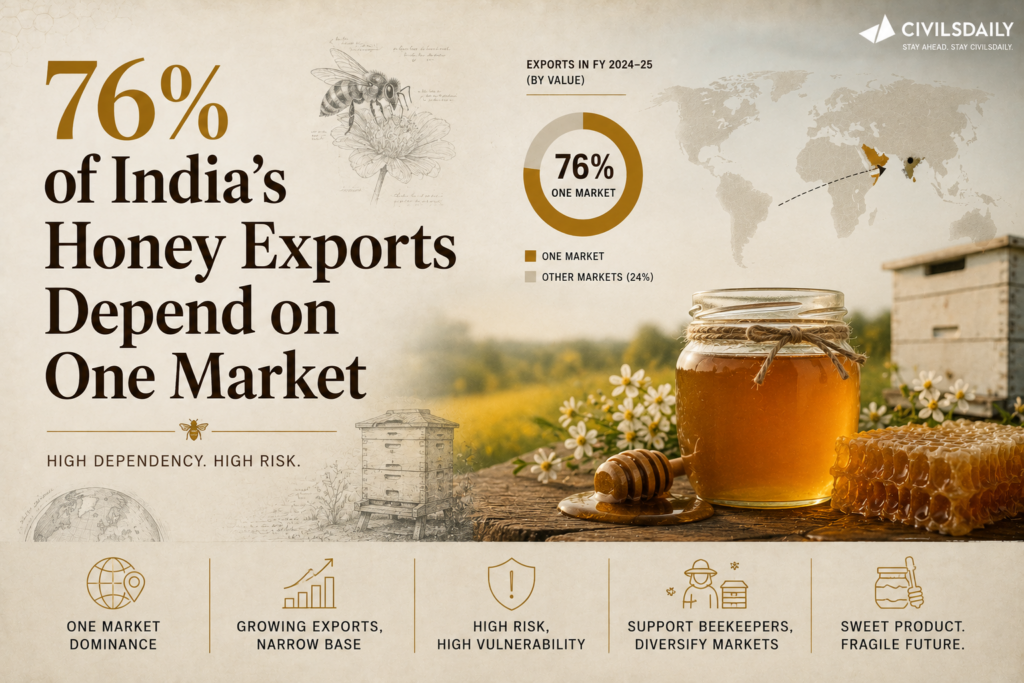
India is the 2nd largest honey producer and 3rd largest exporter by value. However, around 76% of exports go to the U.S., while India’s honey has a relatively low unit value of about $1,858/tonne.
What is Apiculture?
Apiculture is the scientific rearing of honey bees in artificial hives for honey, hive products and pollination.
Apis mellifera: Italian bee
Apis cerana indica: Indian hive bee
Apis dorsata: Rock bee
Apis florea: Little bee
Products include honey, beeswax, propolis, royal jelly, pollen and bee venom.
Pollination: Bees contribute to 87 of 115 major food crops.
Domestic consumption: only ~37 g/person/year
What is NMR Testing?
Nuclear Magnetic Resonance (NMR) testing analyses the molecular profile of honey to detect: Added sugar syrups, Botanical origin, and Geographical origin. It is increasingly important for accessing premium export markets.
Major Challenges
Adulteration: Sugar syrup contamination
Limited NMR testing infrastructure
Pesticide and antibiotic residue concerns
Heavy dependence on the U.S. market
Low-value bulk exports
Weak traceability and branding
Competition from China and premium brands such as New Zealand’s Manuka honey
Way Forward
Expand NMR-capable laboratories
Develop cluster-based processing and packaging
Promote GI-tagged honey
Strengthen Farmer Producer Organisations (FPOs)
Diversify into beeswax, propolis and royal jelly
Strengthen the National Beekeeping and Honey Mission
Promote domestic honey consumption
Protect bee health through scientific beekeeping and pesticide management
“[2018, GS3, 15 marks] Assess the role of National Horticulture Mission (NHM) in boosting the production, productivity and income of horticulture farms. How far has it succeeded in increasing the income of farmers?”
[2023] Which of the following organisms perform waggle dance for others of their kin to indicate the direction and the distance to a source of their food?
A draft United States letter warns the 35 signatories of its artificial intelligence (AI) Opportunity Statement that signing up to Beijing’s competing framework will exclude them from the American led Pax Silica coalition. The demand converts a supply chain initiative into a test of exclusive alignment. Kazakhstan, a potential source of critical minerals that has joined both coalitions, is the immediate trigger.
What is the Pax Silica initiative?
About:Pax Silica was launched by Washington last year to secure supply chains for AI models, semiconductors and critical minerals.
Purpose: It was built for the technology rivalry with Beijing, treating minerals and chips as the inputs that decide who builds the most capable AI.
Membership:About two dozen countries have joined, including close allies Japan, Australia and South Korea.
Legal character: The framework is not binding, so membership carries no treaty obligation.
The new condition: Members that also join Beijing’s rival body face exclusion from the coalition.
What is the AI Opportunity Statement?
About: A United States statement signed in June by 35 countries that wish to align AI cooperation with Washington.
Coverage: Its signatories include members of the Pax Silica framework and other countries outside it, and the draft warning letter is addressed to this full list.
What is the World Artificial Intelligence Cooperation Organization?
About: A rival body launched in July by the Chinese President as a challenge to United States influence over the AI sector.
Its offer: It promotes China’s open weight technology, positioning access to models rather than access to chips as the basis of membership.
What are open weight AI models?
About: Models whose trained parameters are published for download, allowing anyone to run and adapt them on their own hardware.
Why it matters strategically: Adoption does not require a continuing commercial relationship with the developer, so influence spreads without any agreement being signed.
What does the draft letter actually demand?
A binary choice: Dozens of countries are to be told they must pick sides in the AI race with China.
The penalty: Signing Beijing’s competing framework means exclusion from the United States led coalition.
The stated objective: Washington hopes to starve China of resources in the race to build the most sophisticated AI.
Why that matters: The most capable models are treated as usable for military or economic dominance, which is what makes inputs a security question.
The evidentiary basis: The warning rests on an internal draft and a United States official, not on a published policy.
Why do critical minerals sit at the centre of the AI race?
Minerals precede chips: Semiconductors, servers and power systems depend on rare earths, gallium, germanium and graphite before any model can be trained.
Refining, not mining, is the chokepoint: China dominates the midstream separation and refining stages even for ore mined elsewhere.
Export controls as leverage: Beijing has used licensing of gallium, germanium, graphite and rare earth magnets as a direct policy instrument.
Why Kazakhstan matters: It is a key potential source of critical minerals, which is why its dual membership set off alarm in Washington.
The self limiting problem: Excluding a supplier country does not create refining capacity anywhere else.
What do the individual signatories’ positions show about the cost of forcing a choice?
Kazakhstan, the hedger: It is the only country so far known to have joined both initiatives, using its mineral endowment to sell access to both blocs rather than choose.
Japan, the equipment supplier: A Pax Silica member whose firms control critical semiconductor manufacturing equipment, photoresists and wafer materials that no bloc can replace quickly.
South Korea, the memory chip producer: A Pax Silica member whose memory chip makers run large fabrication capacity inside China, so exclusivity carries a direct commercial cost.
Australia, the mining leg: A Pax Silica member with rare earth deposits and a dedicated critical minerals financing facility, but with separation capacity that has historically depended on offshore processing.
China, the rival architecture: Beijing counters chip and minerals leverage with the World Artificial Intelligence Cooperation Organization and freely downloadable models.
United States, the coalition builder: Washington combines export controls on advanced chips with Pax Silica membership, and now with the threat of exclusion.
Why does the exclusivity demand cut against the United States’ own supply goal?
Suppliers gain from hedging: A mineral rich state earns more by selling access to both coalitions than by picking one.
A framework with no enforcement:Pax Silica is not binding, so exclusion is the only available lever and it is a blunt one.
Open weight models cannot be fenced: Chinese models spread by download, so denying a country coalition membership does not deny it Chinese technology.
Refining dependence persists: The coalition can exclude a supplier and still find that separation and processing run through China.
Retaliation risk: Beijing can curtail exports of critical minerals essential to advanced technology production while Western supply chains are still being built.
Where does India stand in the AI and critical minerals contest?
Minerals Security Partnership: India joined the Minerals Security Partnership in June 2023, a United States convened grouping to catalyse investment in critical mineral supply chains.
National Critical Mineral Mission: Approved in January 2025 with an outlay of about 16,300 crore rupees, it targets exploration, recovery from tailings and overseas asset acquisition.
IndiaAI Mission: Approved in March 2024 with about 10,371 crore rupees, covering compute capacity, datasets, foundation model support and safe AI.
Summit diplomacy: India chaired the Global Partnership on Artificial Intelligence and hosted its summit in New Delhi in December 2023, and was named the next AI summit host after the Paris AI Action Summit of February 2025.
The strategic autonomy problem: India sits in United States aligned mineral platforms and in BRICS and the Shanghai Cooperation Organisation alongside China, so an exclusivity demand of the Pax Silica kind directly conflicts with its standing position.
Challenges to Pax Silica
No enforcement mechanism: A framework that is not binding cannot police dual membership. e.g. Kazakhstan has joined both Pax Silica and the Chinese body without penalty so far.
Substitution by the rival supplier: Excluded states can buy the same inputs and models from Beijing. e.g. China’s export licensing of rare earth magnets from April 2025 halted assembly lines at European car plants, demonstrating who controls the flow.
Cost falls on allies first: Export control regimes hit allied firms’ revenues before they hit the target. e.g. Dutch lithography equipment makers lost a large share of their China sales after successive export restrictions.
Midstream capacity cannot be built quickly: Mining new deposits does not solve separation and refining. e.g. Australian rare earth concentrate was long shipped to Malaysia for separation rather than processed at home.
Price volatility deters new investment: Mineral projects need long horizons that commodity cycles destroy. e.g. lithium prices fell sharply from their 2022 peak, stalling announced projects worldwide.
Open weight diffusion defeats membership rules: Model access spreads independently of any coalition. e.g. a Chinese open weight reasoning model released in January 2025 was downloaded and self hosted worldwide within weeks.
Third country resistance to bloc politics: Middle powers resist being made to choose. e.g. several Global South states hold membership of both Western and Chinese digital and minerals platforms simultaneously.
Conclusion
The AI contest has moved from controlling exports of chips to controlling membership of coalitions, and the United States is testing whether exclusivity can be enforced on countries that hold the minerals. The instrument is weak, since Pax Silica binds no one, open weight models spread by download, and refining capacity stays with China regardless of who is excluded. Kazakhstan’s dual membership is the first demonstration that suppliers will hedge. For India, an exclusivity demand of this type collides directly with a foreign policy built on membership of competing platforms.
“[2025] Consider the following statements: I. India has joined the Minerals Security Partnership as a member. II. India is a resource-rich country in all the 30 critical minerals that it has identified. III. The Parliament in 2023 has amended the Mines and Minerals (Development and Regulation) Act, 1957 empowering the Central Government to exclusively auction mining lease and composite license for certain critical minerals. Which of the statements given above are correct? (a) I and II only (b) II and III only (c) I and III only (d) I, II and III
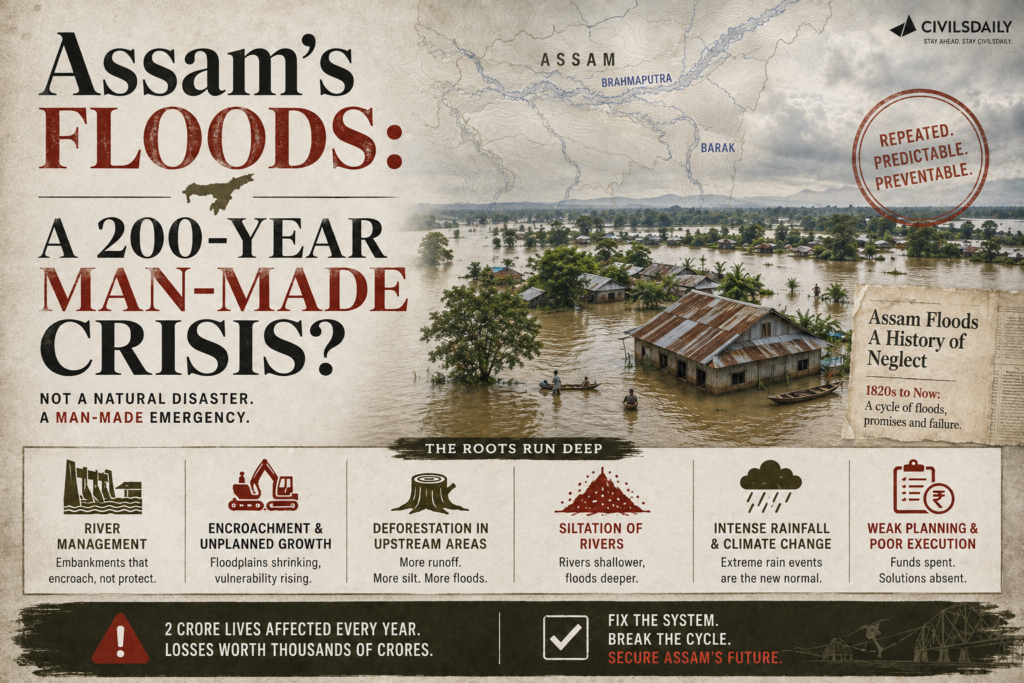
In the third week of July, several south bank rivers of Upper Assam rose with extreme speed, swallowed paddy fields and grazing lands, and swept through villages and towns in districts that had not previously faced catastrophic floods. The event exposes a conflict between two explanations of the disaster, one that treats the flood as a hydrological event to be excluded by engineering, and one that treats it as the outcome of a landscape whose capacity to absorb rain has been dismantled over two centuries.
What is embankment based flood control?
About: An embankment is an earthen barrier raised along a river to confine its flow within the channel and shield the settled floodplain from inundation.
When it was adopted in Assam: A techno bureaucratic campaign in the mid 20th century set out to shield settled floodplains from floods that had until then been treated as predictable and nourishing for agriculture.
The design assumption: The approach treats the flood as an external event to be kept out, rather than as the process that builds the plain it inundates.
The sediment consequence: These barriers interrupted the flow of sediment onto the floodplain, confining silt to the channel instead of spreading it across the fields.
The coverage limit: By 1988, even after thousands of kilometres of embankments had been built, two thirds of the valley still lay open to flooding.
What are the south bank tributaries of Upper Assam?
About: The south bank tributaries are the rivers that rise in the hills south and east of the Brahmaputra valley and join the main river from its right bank, including the Buridihing, Disang, Dikhow, Jhanji and Dhansiri.
Why they matter here: They are fed by rainfall over the Naga Hills and eastern Arunachal Pradesh, so their flood peaks are set by rain falling outside Assam’s own boundaries.
What is riverbed aggradation?
About:Aggradation is the raising of a riverbed by deposition of sediment that the river can no longer carry downstream.
Why it worsens flooding: A raised bed reduces the channel’s carrying capacity, so the same discharge overtops the banks at a lower volume than before.
What is a flash flood?
About: A flash flood is a rapid rise in water level within hours of intense rainfall, typical of steep catchments where runoff reaches the channel before it can infiltrate the soil.
The determining factor: The severity depends on how quickly the catchment sheds water, which is a function of forest cover and soil condition rather than rainfall volume alone.
What made the July flood different from a routine Brahmaputra flood?
Damage before the main river peaked: Upper Assam felt the brunt of the disaster before the Brahmaputra swelled to its highest, which rules out the main channel as the primary cause.
Rain fell outside Assam: Relentless rain pounded the Naga Hills and Arunachal Pradesh, soaked the slopes and unleashed sudden torrents into the southern tributaries.
New districts affected: Several districts once strangers to such catastrophic floods found themselves engulfed.
Extraction accelerated the runoff:Stone and boulder extraction from riverbeds and hillsides, common in both highlands and lowlands, was identified as a factor that hastened the rainfall’s journey downstream.
The regional setting: Assam is cushioned between the Eastern Himalaya to the north, the Patkai and Barail ranges to the east and the Bay of Bengal to the south, so the southwest monsoon links highlands, floodplains, billions of tonnes of sediment and the shifting channels of hundreds of rivers into a single interdependent system.
What has changed in the highland catchments that feed Upper Assam?
Shorter cultivation cycles: Growing populations in the highlands of Nagaland and eastern Arunachal Pradesh have made cultivation cycles shorter and more intense, cutting the fallow period that allowed soil to recover.
Small scale coal mining: Mining woven into local economies now competes with the highland agrarian economy and operates through complex networks of speculators.
Relentless logging: Continued removal of tree cover strips the canopy and root systems that slow rainfall reaching the ground.
Expanding infrastructure: New construction seals and compacts surfaces, adding to runoff.
The combined effect: This pressure on the uplands erodes the land’s ability to absorb rainfall, so a given storm now delivers more water, faster, to the tributaries below.
How did the south bank lose its historic resilience?
The earlier condition: The south bank districts of Upper Assam were once among the Brahmaputra valley’s most resilient regions, defined by thick forests, scattered settlements and a safe distance from the Brahmaputra’s main channel.
The colonial turn: The calm began to unravel in the mid 19th century, when these areas drew the attention of colonial tea planters.
The land use conversion: Land where rain once vanished quietly into the forest floor was transformed into plantations, sites of mineral extraction and farms.
The hydrological result: The converted land could no longer hold back the water, which shifted the flood response of the whole south bank.
What did the embankment campaign change?
The reversal of the flood’s meaning: Floods that had been seen as predictable and nourishing for agriculture were reclassified as a hazard to be excluded.
The sediment interruption: The barriers cut off the annual deposition of silt that had renewed floodplain fertility.
The incomplete shield: By 1988, thousands of kilometres of embankments still left two thirds of the valley exposed.
The failure mode in July: Embankments along the southern tributaries gave way before the main river crested, producing sudden breaches.
Why a breach is worse than a flood: The breach released a fall of water onto an unembanked plain, concentrating the discharge instead of spreading it.
How is the monsoon itself changing?
Greater unpredictability: India’s rainy season has become more unpredictable, marked by sudden downpours separated by long dry spells rather than simply more rain overall.
Corroboration for the Northeast: Studies focused on Northeast India echo these findings.
The explanatory shift: The gap between intense rainfall and a weakened landscape explains the flash floods more fully than the quantity of rain alone.
Why the distinction matters: A landscape that once absorbed a heavy monsoon now converts the same rainfall into a peak discharge, so historical rainfall thresholds no longer predict damage.
Do embankments protect the floodplain or deepen its exposure?
The protection is real but partial: Embankments shielded settled floodplains and made permanent cultivation and settlement possible on land that had flooded annually.
The cost is the sediment: The same barriers interrupted sediment flow, denying the plain the silt that renewed it and confining deposition to the channel bed.
Protection invites exposure: A shielded plain attracts denser settlement, which raises the population and assets at risk when a breach occurs.
Failure is concentrated, not gradual: An unembanked plain floods slowly and predictably, while an embanked one stays dry until the barrier gives way and then receives the full discharge at once.
The measure of the approach: After thousands of kilometres of construction, two thirds of the valley remained open to flooding, which shows the strategy could not be completed at the scale it assumed.
The deeper limitation: The state’s ecology has been treated as a puzzle for engineers, with each crisis examined in isolation, so the cumulative loss of catchment capacity is never entered into the calculation.
Challenges to flood management in Assam
Ageing embankments past their design life: Most of Assam’s embankment network was built decades ago and now fails at multiple points each season. e.g. the breach of the Bethukandi embankment on the Barak in June 2022, which submerged Silchar town for days.
Bank erosion and permanent land loss: The braided Brahmaputra shifts its channels and consumes cultivated land and villages every year. e.g. Majuli, the large river island in Assam, which has lost a substantial part of its area to erosion since the 1950s.
A catchment that lies outside the State’s jurisdiction: The rainfall that determines Assam’s flood peak falls in Arunachal Pradesh, Nagaland and beyond the international border. e.g. the July flood peak on the south bank tributaries generated by rain over the Naga Hills.
Sudden releases from upstream hydropower projects: Reservoir operation upstream can add a flood wave to an already rising river. e.g. water released from the Ranganadi project in Arunachal Pradesh flooding parts of Lakhimpur district.
Loss of wetlands that once absorbed flood water: The valley’s beels have been filled for construction and encroached upon. e.g. shrinkage of Deepor Beel, the Ramsar site adjoining Guwahati, which has intensified urban flooding in the city.
Relief centred rather than mitigation centred spending: Public expenditure concentrates on camps, compensation and post flood repair rather than catchment restoration. e.g. annual embankment repair works sanctioned after each season’s breaches rather than a basin wide restoration programme.
Riverbed and hillside extraction: Removal of stone, boulders and sand strips the roughness that slows runoff and destabilises slopes. e.g. boulder extraction from riverbeds in the foothills feeding the south bank tributaries.
Conclusion
The July flooding in Upper Assam is the outcome of vulnerabilities built over two centuries, not a seasonal misfortune produced by a river’s behaviour. Plantation conversion from the mid 19th century, embankment construction from the mid 20th century and current highland extraction have each reduced the landscape’s capacity to absorb rain, while the monsoon has shifted towards sudden concentrated downpours. Assam’s environment is approaching a tipping point and is not yet beyond repair. What remains unresolved is the framing itself, since the connections between highland and lowland, water and land, and forests and floodplains cannot be rebuilt by engineering alone.
“[2017, GS1, 15 marks] In what way can floods be converted into a sustainable source of irrigation and all-weather inland navigation in India?”
A collective defence pact signed in Mecca between Saudi Arabia, Turkiye and Pakistan has altered the security architecture of West Asia. The pact pools Saudi capital, Pakistani military strength and Turkish defence technology, and is aimed at deterring Israel rather than Iran. India built a decade of gains in the region and now has no declared strategy to answer this realignment.
What did India build in West Asia over the past decade?
2016, Saudi recognition:Saudi Arabia awarded India’s Prime Minister its highest civilian honour, marking a shift in the political relationship.
2021, I2U2: The I2U2 agreement was signed, tying India into a grouping with Israel, the United States and the UAE.
2024, Chabahar:Iran leased Chabahar port to India, giving overland access towards Afghanistan and Central Asia that bypasses Pakistan.
The UAE relationship: India cultivated a special relationship with the UAE built on remittances from Indian expatriate workers, investments by Indian business in the UAE, and UAE strategic investments in India.
Where they stand now: These are gains from the past, and India’s footprint is contracting one country at a time.
Why is the region’s security order breaking down now?
A war that spread: In the last four months the United States and Israel war with Iran escalated into a regional conflict.
Iran against the Gulf: Iran attacked GCC countries, ending the assumption that the Gulf monarchies sit outside the fighting.
Saudi strikes in Iraq: Saudi Arabia hit Iraqi militias.
Attacks at sea: The Houthis attacked Saudi ships.
Israeli strikes: Israel carried out strikes in multiple countries.
The American umbrella in doubt: Gulf states are rethinking the efficacy of the United States security umbrella and now see a threat from both Iran and Israel.
A schism over method: The Gulf is split between handling that threat through engagement, the UAE approach, and through deterrence, which Saudi Arabia is contemplating.
How has Pakistan converted the regional crisis into diplomatic capital?
The mediator role: Pakistan’s role as mediator in the United States and Iran conflict is earning it reputational benefits across the region.
The timing: It entered when no one else could bring the United States President and the Iranians to the table.
Who had failed first:Turkiye, Qatar and Egypt had all attempted mediation without success.
The pact as the payoff: The Mecca collective defence pact follows directly from that diplomatic moment.
The Israel risk for India: A future Israel and Pakistan war would draw India in, given the close India Israel partnership.
The Turkiye risk for India: Greater Turkish support for Pakistan in a future India Pakistan conflict cannot be ruled out.
What do the positions of individual regional states reveal about the new architecture?
Saudi Arabia, deterrence and a new maritime force: Riyadh is moving from engagement to deterrence, supplies the capital leg of the Mecca pact, and is raising a Saudi led maritime force for the Red Sea that India is not part of.
Turkiye, technology as leverage: Ankara contributes defence technology to the pact and runs a deepening military relationship with Pakistan that India has no channel to discuss.
Pakistan, military manpower as currency: Islamabad supplies the military strength the pact rests on, converting an army into diplomatic capital with Gulf financiers.
United Arab Emirates, engagement over deterrence: Abu Dhabi manages the Iran and Israel threat through engagement, and carries mounting differences with Saudi Arabia plus positions against United Nations recognised governments in conflicts as far away as Sudan.
Iran, from partner to belligerent: Tehran leased Chabahar to India in 2024 and has since attacked GCC states, putting India’s connectivity asset inside an active war zone.
Israel, strikes that created the pact: Israeli operations across multiple countries made three regional states conclude they are next, which is the design logic of the Mecca pact.
Why does India’s current posture carry risk?
The Israel bet: India’s approach rests on confidence in Israel’s victory, drawn from Israel’s proximity to the United States.
The American consensus is shifting: Both Make America Great Again Republicans and Democratic Socialists now question the once unquestioned United States support for Israel.
Israel alone: Whether Israel can prevail without assured American backing is unsettled.
The UAE bet: The second pillar of India’s regional position is the UAE relationship, resting on remittances, elite investment and Emirati investment in India.
UAE exposure: The UAE’s differences with Saudi Arabia and its Sudan positions place that pillar at risk.
What are the choices before India?
Formal alignment: India can sign military alliances with Israel and the UAE.
The cost of alignment: That would damage what is left of India’s relationships with Iran and Saudi Arabia.
Continued inaction: India can do nothing, which is the current position.
Cost of inaction, seafarers: Indian merchant mariners continue to be killed in the Strait of Hormuz.
Cost of inaction, shipping: More Indian ships sink in the Bab-el-Mandeb.
Reputational cost: A great power in the making appears hobbled in its own immediate maritime neighbourhood.
The third way: India can devise an active regional political strategy instead of choosing between alignment and drift.
What would an active Indian regional strategy involve?
Renewed engagement with Saudi Arabia: India has no explicit differences with Riyadh, which makes it the cheapest relationship to rebuild.
Arab and Iran trust building: India can work to rebuild trust between Arab states and Iran, beginning with the UAE and Iran relationship.
Jordan’s security: India can offer defensive technologies to Jordan at a time when United States munitions are running low.
Lebanon peacekeeping: India can take a role in the future UN peacekeeping presence in Lebanon, with UNIFIL forecast to end.
A back channel with Turkiye: India can share its red lines on Turkiye’s relationship with Pakistan through a quiet channel.
Red Sea shipping with Egypt: If India cannot join the Saudi led maritime force, it can work with Egypt on a parallel effort to protect India bound shipping from the Suez Canal to Bab-el-Mandeb.
A military presence: India can examine a presence in the Red Sea region, in Somaliland or Socotra.
Exercises with the region: Existing military training exchanges can be scaled into joint drills and exercises with a range of regional states.
A Special Envoy for West Asia: India can appoint one who draws all the threads together, rather than one confined to the Israel and Palestine peace process.
Challenges to India’s West Asia Strategy
The alliance trap: Any formal military alignment with one camp forecloses the other, since Iran and Saudi Arabia both read Indian alignment as a choice against them. e.g. India’s Chabahar development slowed each time United States sanctions pressure on Iran tightened.
The Turkiye and Pakistan axis: Turkish defence technology transfers to Pakistan directly degrade India’s conventional edge. e.g. Turkish origin Songar armed drones were used against Indian positions during the May 2025 hostilities.
Chokepoint exposure: India’s trade and energy routes converge on two narrow straits it cannot secure alone. e.g. Houthi attacks from late 2023 forced Indian bound shipping to reroute around the Cape of Good Hope, raising freight and insurance costs.
Attacks on Indian crewed shipping: Indian seafarers crew a large share of global merchant vessels and absorb the human cost of regional escalation. e.g. the drone strike on MV Chem Pluto off Porbandar in December 2023.
Evacuation burden: Every escalation converts India’s diaspora presence into a mass evacuation operation. e.g. Operation Kaveri from Sudan in 2023 and Operation Sindhu from Iran and Israel in June 2025.
No standing regional mechanism: India has no dedicated envoy or regional platform to convert bilateral goodwill into collective influence. e.g. the piece’s own recommendation for a Special Envoy for West Asia has no existing counterpart in the Indian system.
Exclusion from new regional security structures: New arrangements are being built without Indian participation. e.g. the Saudi led Red Sea maritime force, which India is not part of.
Conclusion
West Asia’s security architecture is being rebuilt around a Saudi Arabia, Turkiye and Pakistan pact designed to deter Israel, and India has no strategy that matches the scale of that change. Formal alignment with Israel and the UAE costs India Iran and Saudi Arabia, and inaction costs it seafarers, ships and standing. The workable route is an active regional political strategy built on renewed engagement with Riyadh, trust building between the Arab states and Iran, and a dedicated envoy. India’s capacity to shape the region survives, its window does not.
West Asia in India’s Foreign Policy
About: West Asia covers the Gulf monarchies, Iran, Iraq, Israel, Turkiye and the Levant, treated in Indian policy as an extended neighbourhood rather than a distant theatre.
Policy label: India’s approach shifted from Look West to Link West, moving beyond oil and labour transactions towards defence, technology and investment partnerships.
Energy: West Asia remains a principal source of India’s crude oil imports, and Qatar is India’s largest supplier of liquefied natural gas.
Diaspora: About 9 million Indians live and work in the Gulf, the largest concentration of the Indian diaspora anywhere.
Remittances: India is the world’s largest recipient of remittances, receiving over 100 billion dollars annually, with the Gulf a major contributor.
Trade: The UAE is among India’s top three trading partners, and the India UAE Comprehensive Economic Partnership Agreement took effect in May 2022.
Connectivity: The India Middle East Europe Economic Corridor (IMEC) was announced on the margins of the G20 New Delhi Summit in September 2023.
Back2Basics: Gulf Cooperation Council
Formation: Established in 1981 at Abu Dhabi.
Headquarters:Riyadh, Saudi Arabia.
Members: Saudi Arabia, the United Arab Emirates, Kuwait, Qatar, Bahrain and Oman.
Mandate: Coordination and integration among members in economic, defence, security and cultural affairs.
Military arm: The Peninsula Shield Force, a joint military force raised in 1984.
Economic instrument: A unified economic agreement and a customs union among the six members.
India link: India is not a member, and engages the bloc through bilateral strategic partnerships and an India GCC ministerial mechanism.
Government Initiatives for India’s West Asia Engagement
Link West Policy: Reframes the Gulf and West Asia as a zone of strategic partnership rather than an energy and labour market alone.
I2U2: Joint investment platform with Israel, the United States and the UAE across food security, clean energy and health.
India Middle East Europe Economic Corridor: Rail and shipping corridor linking India to Europe through the Gulf, announced in September 2023.
India UAE Comprehensive Economic Partnership Agreement, 2022: India’s first Gulf trade agreement, cutting tariffs on the bulk of traded goods.
Chabahar long term contract, 2024: A ten year agreement for operating the Shahid Beheshti terminal, giving India a port outside the Strait of Hormuz.
eMigrate portal and Pravasi Bharatiya Bima Yojana: Registration and mandatory insurance cover for Indian workers emigrating to Gulf destinations.
Evacuation operations: Operation Sindhu, Operation Ajay and Operation Kaveri, evacuating Indians from Iran and Israel, Israel and Sudan respectively.
Operation Sankalp: Indian Navy deployment in the Gulf of Oman and the Persian Gulf to escort Indian flagged merchant shipping.
Key Facts about India and West Asia
The Strait of Hormuz carries roughly a fifth of global oil consumption and has no practical bypass for most Gulf exporters.
The Bab-el-Mandeb is the southern gate of the Red Sea and the compulsory approach to the Suez Canal.
Chabahar is Iran’s only oceanic port, on the Gulf of Oman, and lies outside the Strait of Hormuz.
India’s overseas military logistics access includes Duqm in Oman, agreed in 2018.
I2U2 was agreed in 2021 and held its first leaders summit in July 2022.
India is not a member of the Organisation of Islamic Cooperation, and was invited as guest of honour to its foreign ministers meeting at Abu Dhabi in 2019.
The GCC has six members; the wider Arab League has 22.
“[2025, GS2, 15 marks] “Energy security constitutes the dominant kingpin of India’s foreign policy, and is linked with India’s overarching influence in Middle Eastern countries.” How would you integrate energy security with India’s foreign policy trajectories in the coming years?”
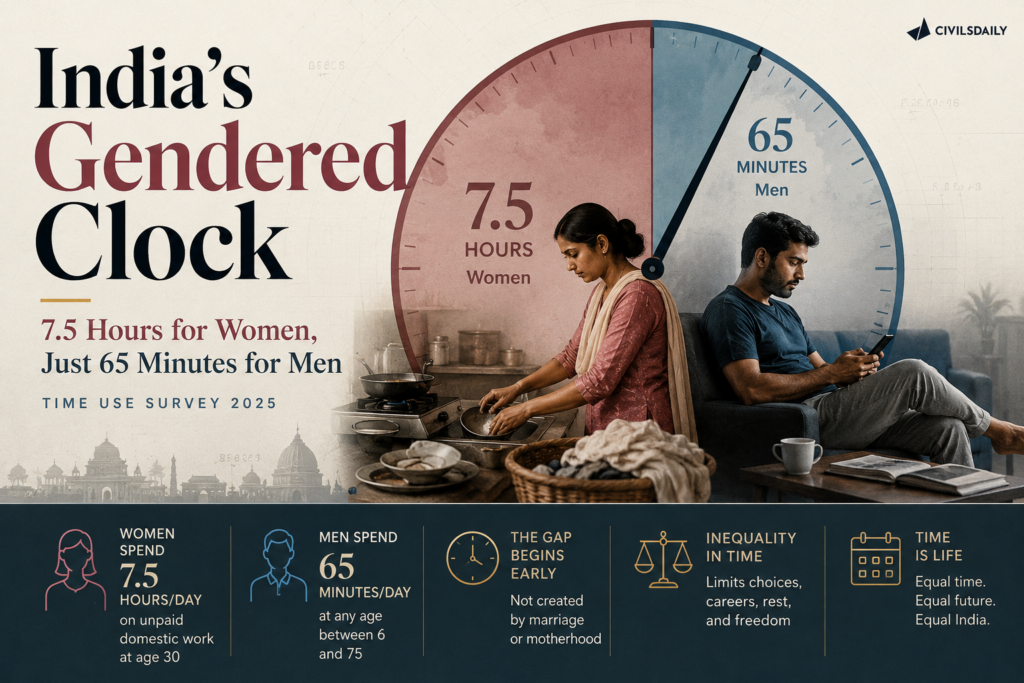
India’s Time Use Survey (2025) shows the time women spend on housework rising from about age 10 to a peak of nearly 460 minutes a day, over 7.5 hours, around age 30, while the male curve never crosses 65 minutes at any age between six and 75. The gap is not created by marriage or motherhood, it is assembled in childhood, which places it outside the reach of policies aimed at adult women.
What is the Time Use Survey?
About: The Time Use Survey is a national household survey conducted by the National Statistics Office under the Ministry of Statistics and Programme Implementation, which records how members of a household allocate their 24 hours across activities on a reference day.
What it captures: It measures activities that no other survey counts, including unpaid domestic services, unpaid caregiving, learning, leisure, self care and volunteer work, alongside paid employment.
Why it exists: Employment surveys count only work inside the production boundary, so time spent cooking or caring for a child disappears from official statistics unless a time use survey records it.
What is unpaid domestic and caregiving work?
About: Unpaid domestic and caregiving work covers cooking, cleaning, laundry, shopping, collection of water and fuel, minor repairs, and the care of children, the sick and the elderly performed for one’s own household without payment.
Its statistical treatment: These services are produced by households for their own consumption and fall outside the production boundary of the System of National Accounts, so they contribute nothing to measured Gross Domestic Product despite being economically essential.
What is the Periodic Labour Force Survey?
About: The Periodic Labour Force Survey (PLFS) is the National Statistics Office’s regular survey of employment and unemployment, which estimates the labour force participation rate, worker population ratio and unemployment rate.
Its relevance here: It records the reason given for staying outside the labour force, which is where unpaid domestic responsibility appears as a measured cause of women’s non participation.
What does the lifetime housework curve show?
The female curve: Time spent on housework begins to rise around age 10, continues through the late teens and twenties, and peaks at nearly 460 minutes a day, over 7.5 hours, around age 30.
The male curve: It never crosses 65 minutes at any age between six and 75, so there is no stage of the male life cycle at which domestic work becomes a substantial claim on time.
Timing of the peak: The peak falls in the prime working years, which is precisely when paid work, promotion and enterprise building compete for the same hours.
The continuity point: Adolescence is not separate from adulthood in this data, it is the stage at which the adult pattern begins to take shape.
How early does the gender gap in domestic work open?
Parity at age six: Indian boys and girls both spend about five minutes a day on domestic and care work at age six, and their trajectories remain close through early childhood.
The girls’ curve: Girls spend about 15 minutes a day at age 10, 75 minutes at 15, and around 130 minutes by 17.
The boys’ curve: Boys move from roughly five minutes at age six to only about 17 minutes by the end of childhood.
The widening ratio: The girl to boy ratio in unpaid work rises from 1.6 among children aged 6 to 9, to 4.5 among those aged 10 to 14, and to 7.5 among adolescents aged 15 to 17.
The divergence point: The curves separate sharply from around age 10, which is the same age at which the adult female housework curve begins its climb.
Why is leisure, not schooling, the real cost?
The trade off is usually framed wrongly: The cost of girls’ domestic work is normally argued as a trade off with schooling and education, and the data does not support that framing.
Girls are not losing study time: Girls spend slightly more time on learning than boys at most ages, so they remain in school while carrying the additional work.
Leisure absorbs the burden: Between ages six and 17, girls’ housework rises by roughly 124 minutes a day while their leisure time falls by around 115 minutes a day.
The boys’ pattern: For boys the decline in leisure is much smaller and the time spent on housework changes relatively little.
Why leisure is not residual: Sport, friendships, rest and exploration are how children build confidence, social networks, physical capability and a sense of agency, all of which shape later career trajectories.
The measurement blind spot: School enrolment and learning outcome data register no problem at all, because the loss is entirely in discretionary time.
Why does cooking sit at the centre of the divergence?
Participation gap in cooking: Among adolescents aged 15 to 17, 42.4 percent of girls report cooking, against only 2.9 percent of boys.
Time gap in cooking: Girls in this age group spend close to an hour cooking, while boys spend just two minutes.
Other gendered tasks:Cleaning and laundry also become increasingly gendered through adolescence, with wide gaps in both participation and time spent.
Where boys match or exceed girls: The only tasks are farm work and shopping, which are outward facing towards the field and the market rather than inward facing into the kitchen.
The full task set measured: Participation is recorded across childcare, cleaning, cooking, farm work, laundry, repairs, shopping and collection of water and fuel, and the inward facing tasks are the ones that carry the gap.
What the allocation trains: Girls are being trained for the household and boys for the world outside, which is how the pattern later appears as an efficient gendered allocation of household work.
How does childhood conditioning surface in the labour market?
The stated reason for non participation: In the 2025 PLFS, childcare and domestic responsibilities were the single most cited reason women gave for staying out of the labour force.
The urban and rural split: The reason was reported by 52.5 percent of urban women and 40 percent of rural women.
The male comparison:Less than 1 percent of men gave the same reason, so the constraint is not a household constraint but a gendered one.
The field observation behind the data: Among rural women in Haryana aspiring to become entrepreneurs, the biggest practical constraint on doing more paid work was time tied up in cooking and household chores, and their daughters rather than their sons were already sharing that burden.
Why do current policy interventions arrive too late?
Where policy currently intervenes: Most interventions address women’s unpaid work in adulthood, through childcare services, community kitchens, safe mobility infrastructure, flexible work and social protection.
What that misses: The unequal assignment of domestic work between boys and girls has already been completed before any of these instruments touch a woman’s life.
The correct objective: The aim is not to remove domestic work from children’s lives, but to remove its gender assignment.
The school as the instrument: Schools can give every child, boy or girl, equal opportunity to learn practical life skills, from cooking and home management to stitching, carpentry and financial management.
The gap in India’s own success: India has invested heavily in keeping girls in school and improving their educational outcomes, and paid no comparable attention to what happens to their time outside school.
Challenges to removing the gender assignment of domestic work
Norms are transmitted inside the household, where policy has no instrument: No scheme reaches the daily decision about which child is called into the kitchen. e.g. mothers in rural Haryana who identified their own time poverty still passed the chores to daughters rather than sons.
The burden is invisible in every headline indicator: Enrolment, learning outcomes and even attendance stay unaffected while leisure collapses. e.g. girls in the survey spend slightly more time learning than boys even while doing seven times the domestic work at 15 to 17.
Infrastructure deficits convert directly into girls’ time: Where water, fuel and sanitation are distant, the collection task falls on girls. e.g. households without piped water where fetching water is a daily pre school chore.
School curricula reinforce the split rather than break it: Vocational and life skill options remain gender typed in practice. e.g. home science and tailoring offered to girls while carpentry, electrical work and workshop practice fill with boys.
Measurement is infrequent: Time use data arrives too rarely to evaluate whether an intervention shifted the allocation. e.g. India ran a pilot time use survey in 1998 to 1999 and its first full national round only two decades later.
Care substitutes are absent for adolescent siblings: Where creche and elder care services are missing, the eldest daughter becomes the default carer. e.g. adolescent girls withdrawn from leisure and play to mind younger siblings while parents do wage work.
Employment law does not reach unpaid household work: No labour statute assigns rights, hours or rest to domestic work performed inside one’s own home. e.g. maternity and creche entitlements under labour law apply to formal employment, covering a small minority of working women.
Conclusion
The gender gap in unpaid work is not a marriage effect or a motherhood effect, it is set in place between the ages of 10 and 17 and simply expands afterwards to 7.5 hours a day by age 30. The price girls pay is measured in leisure rather than schooling, which is why India’s success in keeping girls in school has concealed it. Policy instruments built for adult women arrive after the allocation is fixed. The intervention point is the childhood assignment of domestic tasks, and schools that teach cooking, home management, carpentry and financial management to every child are the instrument available now.
[2024, GS1, 10 marks] Distinguish between gender equality, gender equity and women’s empowerment. Why is it important to take gender concerns into account in programme design and implementation?
India’s 10-year government bond yield rose only 8 basis points in six months, compared with much larger increases in major advanced and emerging economies. The RBI relied more on foreign exchange and liquidity management than policy-rate hikes.
Term deposits held by NRIs in permitted foreign currencies.
Principal and interest are repaid in the same foreign currency, protecting depositors from exchange-rate risk.
Banks can bring these foreign currency funds into India and swap them with the RBI.
This increases forex reserves and rupee liquidity.
It is a borrowed inflow with fixed maturity, not permanent capital.
2. 10-Year Benchmark Bond Yield
Return earned on the most actively traded 10-year government security.
Bond price and yield move inversely:
Bond price ↓ → Yield ↑
Bond price ↑ → Yield ↓
It influences pricing of corporate bonds and long-term loans.
1 basis point = 0.01 percentage point.
3. RBI’s Policy Corridor
The overnight money-market rate operates within a corridor around the repo rate.
MSF → Upper ceiling; banks borrow from RBI.
SDF → Lower floor; banks park surplus funds with RBI.
The corridor is 25 basis points on either side of the repo rate.
4. Certificate of Deposit
A short-tenor negotiable money-market instrument issued by banks to raise funds.
Rising CD issuance can indicate credit growth exceeding deposit growth.
Falling issuance suggests deposits are sufficient to finance lending.
5. Bloomberg Global Aggregate Index
A global benchmark bond index tracked by passive funds.
Inclusion of Indian government bonds would lead index-tracking funds to purchase Indian bonds.
India’s inclusion was deferred, postponing potential index-driven inflows.
What Did the RBI Do?
Instead of aggressively raising the policy rate, the RBI used targeted measures to attract foreign currency:
FCNR(B) deposits
External Commercial Borrowings
Overseas foreign-currency borrowings
These measures attracted about $56.8 billion between 8 June and 13 August, with $52.3 billion through FCNR(B).
Impact on Banking Liquidity
Overnight rates moved below the repo rate towards the SDF floor.
Deposits increased.
Banks relied less on market borrowing.
Certificate of Deposit issuance declined.
Banking-system surplus liquidity increased.
“[2022] With reference to the Indian economy, consider the following statements: 1. If the inflation is too high, Reserve Bank of India (RBI) is likely to buy government securities. 2. If the rupee is rapidly depreciating, RBI is likely to sell dollars in the market. 3. If interest rates in the USA or European Union were to fall, that is likely to induce RBI to buy dollars. Which of the statements given above are correct? (a) 1 and 2 only (b) 2 and 3 only (c) 1 and 3 only (d) 1, 2 and 3
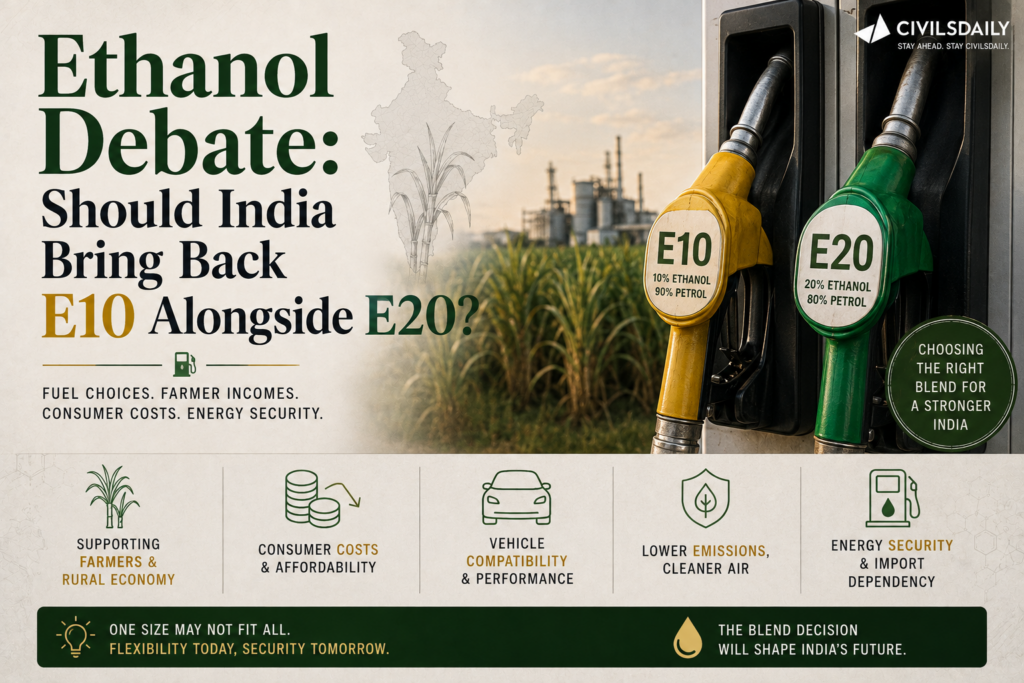
A public campaign claiming that E20 petrol wrecks engines and empties fuel tanks faster has been answered with test evidence showing no increased engine wear. The rebuttal has exposed the question the blending debate has avoided, which is whether pushing the blend beyond 20 percent moves land and water from food to fuel.
What is the Ethanol Blended Petrol Programme?
About: The programme mandates the blending of ethanol, an alcohol produced from crops, into petrol sold by oil marketing companies. E20 denotes a fuel that is 20 percent ethanol by volume and 80 percent petrol.
Origin: It was rolled out nationally from 2003 and expanded through the National Policy on Biofuels, 2018.
Feedstock routes: Ethanol is produced from sugarcane juice, B heavy and C heavy molasses, maize, damaged food grains and surplus rice.
Stated objectives: It aims to cut the crude oil import bill, reduce tailpipe emissions and give cane and grain growers an assured market.
Price setting: Oil marketing companies buy ethanol at administered prices that differ by feedstock route rather than at a single market price.
What is the distinction between green water and blue water?
Green water: This is rainfall held in the soil and taken up by the crop, water the field would have received in any case.
Blue water: This is water drawn from rivers, canals, groundwater pumps and wells. It is the scarce component, because withdrawing it denies the same unit to another user.
What are Distillers Dried Grains with Solubles?
About: These are the residual grain solids left over after ethanol is distilled from maize or rice.
Where they go: They are sold as protein rich animal feed and compete directly with soybean meal in the same market.
Why does the charge that E20 damages engines not hold up?
Lower energy density is real: Ethanol carries about two thirds the energy of petrol. A litre of E20 therefore takes a vehicle slightly less far.
The size of the penalty is small: Ethanol is only a fifth of the blend, so the energy loss is around 6 to 7 percent. The 30 percent figure circulating online is wrong.
Emissions improve:Carbon monoxide and unburnt hydrocarbons fall on E20, which is an environmental gain.
Domestic durability testing agrees: Testing by the Automotive Research Association of India (ARAI), the petroleum institute and Indian Oil found no increased wear attributable to the blend.
The fear is misplaced, the concern is not: Loss of range is not a malfunction. The genuine problem lies elsewhere in the fleet.
Which vehicles are the genuine exception to that record?
Scale of the exposed fleet: India has roughly 75 million to 80 million two wheelers built before the BS4 norms that run on carburettors.
Why a carburettor cannot adjust: A carburettor cannot sense the extra oxygen the blend carries. The engine then draws too little fuel for the air it takes in and runs hot.
Seal degradation is a separate defect: Older rubber seals not rated for ethanol degrade on contact with the fuel. This happens irrespective of engine temperature.
Retrofitting is cheap but slow: Replacing seals with ethanol compatible ones costs little. Covering 75 million to 80 million two wheelers happens one vehicle at a time and will take years.
The protection fuel went missing: The original roadmap asked that a lower blend stay on sale for these vehicles. That fuel quietly vanished from the pumps.
What restoring E10 would achieve: Selling E10 alongside E20 would protect the legacy fleet while the retrofit programme catches up. It would also lower total ethanol use rather than raise it.
Why is the edible oil import gap a better target than the crude oil bill?
Scale of the crude bill: India’s crude oil import bill runs at around Rs 11 lakh crore to Rs 12 lakh crore a year.
Scale of the edible oil bill: The edible oil import bill is far smaller, at roughly Rs 1.6 lakh crore to Rs 1.75 lakh crore.
What E20 actually saves: Ethanol at E20 trims only 3 to 4 percent of the crude bill.
The edible oil gap is closeable: India already produces about 40 percent of its cooking oil and aims to reach 72 percent by financial year 2031.
The test of a good target: A gap the government can close fully and then stop subsidising is worth more than one it can only reduce at the margin forever.
How has the shift in feedstock turned a distant trade off into a direct one?
Grain now dominates the feedstock mix:Maize supplies about half of India’s ethanol. Grains together supply nearly 67 percent.
Direct competition for the same fields: Maize competes with soybean, groundnut and mustard for identical acreage.
First pull, the administered price: Ethanol from maize is procured at a fixed price well above the sugarcane route. That keeps maize attractive whatever the open market pays.
Second pull, the feed by product: The leftover grain from distillation is sold as animal feed and undercuts soybean meal.
The oilseed farmer loses twice: Weaker meal prices drag down soybean prices. The grower loses on acreage and then again on price.
Why do the water and climate claims not settle the case for a higher blend?
The headline figure mixes two things: Quoted totals of thousands of litres of water per litre of ethanol combine green water and blue water into one alarming number.
Only the blue component is scarce: Rain the crop would have received anyway does not represent a withdrawal from a contested source.
Where the pressure actually falls: Cane in Maharashtra and Karnataka draws heavily on already stressed rivers, canals and groundwater.
What the rule should measure: A water norm for ethanol should target blue water use, not the frightening aggregate.
The climate evidence is unsettled: Indian life cycle studies do not agree on whether grain ethanol is cleaner than the alternatives once cultivation and processing are counted.
Consequence for the green case: The environmental argument for going beyond E20 does not survive close scientific scrutiny.
What does experience abroad show about the limits of high ethanol blends?
United States, Oak Ridge National Laboratory: The laboratory ran 86 vehicles for a cumulative 10 million kilometres on blends up to E20 and found no increased wear in cars not rated for E20.
United States, multiple blends at the pump: American pumps sell E10 and E15 side by side, so owners of older vehicles retain a compatible option. This is the design India’s roadmap intended and then lost.
United States, Renewable Fuel Standard: The mandate fixes volumes of renewable fuel in transport fuel. Its corn ethanol component drew sustained criticism for raising feed and food grain prices.
Brazil, the Proalcool programme: Brazil built blending on sugarcane and on flex fuel vehicles able to run on any blend up to pure ethanol. The fleet, rather than the fuel specification, absorbs changes in the blend.
Why is holding at E20 not a costless option either?
Cane arrears were cleared: Ethanol demand gave sugar mills the cash flow to settle sugarcane dues owed to farmers.
Rural incomes rose: The programme lifted incomes and built an assured market for cane and grain growers.
Distillery capacity was built for more: Capacity now in place was created on the expectation of blends above E20.
Loans were taken against expected demand: Those investments carry debt to be serviced against demand a freeze would not deliver.
The sugar surplus needs an outlet: Ethanol absorbs a structural sugar surplus that would otherwise depress domestic prices.
Both sides belong in the reckoning: The honest course weighs the cost of holding against the cost of advancing, rather than assuming either away.
Why should reversibility decide the sequence of policy moves?
Instruments that can change within a season: The ethanol procurement price, the protection fuel at the pump, the water rules and the import duty on edible oil can all be altered and reversed if evidence turns.
The one instrument that cannot: The blend level is not reversible on the same timescale.
Why the blend locks in: Once land and water are committed to fuel, cropping patterns and distillery investment are built around that commitment.
The sequencing principle: Prudence says to move the reversible instruments first and hold off on the irreversible one until a thorough cost benefit analysis is complete.
What the recommendation amounts to: Restore E10 for the older fleet, correct the price and water distortions favouring maize, revisit the edible oil import duty, and hold at E20.
Challenges to the Ethanol Blended Petrol Programme
Feedstock concentration in water intensive crops: Cane and maize both carry heavy irrigation demand in already stressed basins. e.g. Latur in Maharashtra received drinking water by train during the 2016 Marathwada drought while cane crushing continued in the region.
Diversion of food grain to fuel: Grain routed to distilleries competes with the public distribution and feed markets. e.g. the release of surplus rice by the Food Corporation of India to distilleries was repeatedly started and stopped between 2023 and 2024 as open market rice prices rose.
Material compatibility in the legacy fleet: Older engines and fuel lines were never certified for a 20 percent blend. e.g. two wheelers manufactured before the BS4 norms of 2017 use carburettors and non compliant elastomer seals.
Blending logistics and evacuation: Ethanol absorbs water and cannot move through existing multiproduct petroleum pipelines. e.g. supply moves by road tanker from distillery clusters in Uttar Pradesh and Maharashtra to deficit states in the south and the east.
Second generation ethanol has not scaled: Cellulosic ethanol from crop residue remains commercially fragile. e.g. the Panipat second generation bioethanol refinery based on paddy straw has struggled with feedstock aggregation since its commissioning in 2022.
Administered price distortion across routes: A fixed price above the cane route pulls acreage towards maize regardless of demand. e.g. maize acreage has expanded in Bihar and Madhya Pradesh at the expense of oilseeds.
Consumer trust and labelling: Buyers cannot easily tell which blend they are purchasing or whether their vehicle is rated for it. e.g. the 2026 online campaign over E20 mileage produced public demands for a lower blend option at pumps.
Conclusion
The engine controversy was never the real argument. The decision that matters is the blend level itself, because procurement prices, water rules, the protection fuel and import duties can be reversed within a season while committed land, cropping patterns and distillery capacity cannot. Restoring E10 for the older fleet and holding at E20 until the food versus fuel trade off is properly costed keeps every reversible option open. The unresolved question is what India chooses to grow, and what it will not be able to take back.
Biofuels and Ethanol Blending in India
About: Biofuels are liquid or gaseous fuels produced from biomass and used to substitute petroleum products in transport.
Categories: They run from first generation fuels made from food crops, to second generation fuels from agricultural residue, third generation fuels from algae and fourth generation fuels using carbon capture.
Blending record: Average ethanol blending rose from 1.53 percent in financial year 2014 to 20 percent in 2025, achieved five years ahead of the 2030 target.
Global standing: India is among the largest ethanol producers and consumers in the world, after the United States and Brazil.
Scale of the fuel base: India consumes roughly 40 million tonnes of petrol a year, which sets the size of the ethanol requirement at any given blend.
Claimed gains: Official statements place foreign exchange savings from ethanol blending at over Rs 1 lakh crore since 2014.
Structural feature: Ethanol is the only large scale biofuel India has commercialised, while biodiesel and compressed biogas remain far below their targets.
Laws and Rules Governing Biofuels in India
National Policy on Biofuels, 2018: Categorises biofuels, widens the permitted feedstock list and sets indicative blending targets.
2022 amendment: Advanced the 20 percent ethanol blending target to the 2025 26 ethanol supply year and permitted additional feedstocks.
Industries (Development and Regulation) Act, 1951: Provides the regulatory basis for distilleries and for the Centre’s control over industrial and denatured alcohol.
Judicial position: A nine judge Bench of the Supreme Court held in October 2024 that “intoxicating liquor” under Entry 8 of the State List covers industrial alcohol, preserving State regulatory power.
Essential Commodities Act, 1955: Enables control over the movement, storage and pricing of molasses and ethanol.
Environment (Protection) Act, 1986: Governs distillery effluent standards, including zero liquid discharge norms for molasses based units.
Motor Vehicles Act, 1988 and Central Motor Vehicles Rules, 1989: Set emission norms and material compatibility requirements for vehicles rated to run on E20.
Bureau of Indian Standards specifications: IS 2796 governs motor gasoline and IS 15464 governs anhydrous ethanol, with a separate notified specification for E20 fuel.
Back2Basics: National Policy on Biofuels, 2018
Nodal ministry: Ministry of Petroleum and Natural Gas.
Approval and revision: Approved by the Union Cabinet in 2018 and amended in 2022.
Categorisation: Divides biofuels into Basic Biofuels, meaning first generation bioethanol and biodiesel, and Advanced Biofuels, meaning second generation ethanol, municipal solid waste to drop in fuels, third generation biofuels and bio compressed natural gas.
Permitted raw materials for ethanol: Sugarcane juice, sugar beet, sweet sorghum, corn, cassava, damaged food grains such as wheat and broken rice, and rotten potatoes unfit for human consumption.
Blending targets: 20 percent ethanol in petrol and 5 percent biodiesel in diesel by 2030, with the ethanol target later advanced to the 2025 26 supply year.
Surplus grain clause: Allows use of surplus food grains for ethanol production with the approval of the National Biofuel Coordination Committee, chaired by the Minister of Petroleum and Natural Gas.
Financial support: Provides viability gap funding for second generation ethanol refineries and additional incentives for advanced biofuels.
Government Initiatives for Biofuels and Ethanol
Ethanol Blended Petrol Programme, 2003: Mandates blending of ethanol in petrol supplied by oil marketing companies across notified states and Union Territories.
Pradhan Mantri JI-VAN Yojana, 2019: Provides viability gap funding to commercial and demonstration second generation bioethanol projects using lignocellulosic biomass.
SATAT initiative, 2018: Sustainable Alternative Towards Affordable Transportation invites entrepreneurs to set up compressed biogas plants and sell the output to oil marketing companies.
GOBARdhan scheme: Converts cattle dung and agricultural waste into biogas and organic manure, targeted at rural households and dairy clusters.
Ethanol Interest Subvention Scheme: Subsidises interest on loans taken by sugar mills and standalone distilleries to expand ethanol capacity.
Global Biofuels Alliance: Launched at the G20 New Delhi Summit in September 2023 with India, the United States and Brazil as founding members, to accelerate global biofuel trade and technology transfer.
National Mission on Edible Oils, Oil Palm, 2021, and the Oilseeds Mission: Target domestic self sufficiency in cooking oil, which is the competing claim on the same land the ethanol programme draws from.
Key Facts about Ethanol Blending
World Biofuel Day is observed on 10 August, marking the day in 1893 an engine was run on peanut oil by Rudolf Diesel.
The Ethanol Supply Year runs from 1 November to 31 October, not the financial year.
E20 is 20 percent ethanol by volume, E85 is 85 percent, and E100 denotes ethanol used as a standalone fuel.
India achieved 20 percent average blending in 2025, five years ahead of the 2030 target set in the 2018 policy.
Flex fuel vehicles are engineered to run on any blend up to E85 or E100 without modification.
Ethanol procurement uses differential administered prices by feedstock route, with the sugarcane juice route priced highest among cane routes.
The National Biofuel Coordination Committee clears the use of surplus food grains for ethanol.
Challenges in the Biofuel Sector
Biodiesel blending has barely moved: Against a 5 percent target, biodiesel blending has remained close to negligible. e.g. used cooking oil collection under the Repurpose Used Cooking Oil initiative covers only a fraction of India’s restaurant and hotel supply chain.
Sugar cycle volatility disrupts contracts: Ethanol supply from cane is hostage to sugar availability decisions taken mid season. e.g. the 2023 restriction on diverting cane juice to ethanol was imposed to protect domestic sugar supply and stranded distillery offtake plans.
Centre and State conflict over alcohol regulation: Regulatory authority over industrial alcohol is contested and affects distillery licensing. e.g. the Supreme Court’s nine judge ruling of October 2024 held that States retain power over industrial alcohol under Entry 8 of the State List.
Compressed biogas offtake and evacuation: Plant commissioning lags the announced targets because feedstock aggregation and gas evacuation are unresolved. e.g. SATAT set a target of 5,000 compressed biogas plants and actual commissioning has run far behind.
Water footprint of the feedstock base: Blending demand is concentrated in crops grown in drought prone tracts. e.g. Maharashtra’s cane belt draws on stressed groundwater in districts that carry recurring drought declarations.
Vehicle fleet compatibility lag: Only recent vehicles are certified for the mandated blend. e.g. only vehicles manufactured from April 2023 are E20 material compliant, leaving the older fleet dependent on a lower blend that is no longer sold.
Absence of a settled national life cycle assessment: Without an agreed carbon accounting method, the climate benefit claimed for each blend level cannot be verified. e.g. Indian studies differ on whether maize ethanol lowers emissions once fertiliser and processing energy are counted.
Way Forward
Restore a lower blend at the pump: Sell E10 alongside E20 nationally until the retrofit of pre BS4 two wheelers is substantially complete.
Correct the administered price: Reprice ethanol by feedstock so that maize does not carry an artificial advantage over oilseeds.
Regulate blue water, not aggregate water: Set distillery and feedstock water norms on measured groundwater and canal withdrawal, with metering at the distillery gate.
Fund oilseed self sufficiency: Direct the incentive structure towards closing the edible oil import gap, which is smaller and fully closeable.
Scale second generation ethanol: Build residue aggregation networks so that paddy straw and bagasse substitute for grain feedstock.
Mandate flex fuel capability: Require new vehicles to be flex fuel rated so that future blend changes are absorbed by the fleet rather than by the fuel specification.
Publish a national cost benefit study: Complete a transparent food versus fuel accounting, covering land, blue water and life cycle emissions, before any move to E27 or E30.
“[2020] According to India’s National Policy on Biofuels, which of the following can be used as raw materials for the production of biofuels? 1. Cassava 2. Damaged wheat grains 3. Groundnut seeds 4. Horse gram 5. Rotten potatoes 6. Sugar beet Select the correct answer using the code given below: (a) 1, 2, 5 and 6 only (b) 1, 3, 4 and 6 only (c) 2, 3, 4 and 5 only (d) 1, 2, 3, 4, 5 and 6