💥Join UPSC 2027,2028 Mentorship (August Batch) + XFactor Notes & Microthemes PDF

Distribution: weekly

  • On antibiotics, problem isn’t just overprescribing

    Why in the News?

    A new global study in The Lancet Public Health has again found that India consumes too many broad-spectrum “watch” antibiotics and too few first-line “access” antibiotics, with total antibiotic consumption above the optimal target. The deeper problem is not physician irrationality but the systemic conditions that push doctors toward broader antibiotics in the first place.

    What does the Lancet study find about India’s antibiotic use?

    1. Consumption above target: India’s antibiotic consumption is higher than the optimal target identified in the study.
    2. Skewed drug mix: India’s antibiotic mix is skewed toward “watch” category broad-spectrum drugs that should ideally be reserved for more serious infections, rather than first-line “access” antibiotics.
    3. Documented pattern: This overuse of broad-spectrum antibiotics has been repeatedly documented over the past two decades through surveillance studies, hospital audits and national AMR programmes.

    Why do doctors keep prescribing broad-spectrum antibiotics despite knowing the risk?

    1. Late presentation: Doctors often prescribe antibiotics before a definitive diagnosis is available because patients present late in their illness.
    2. Diagnostic unreliability: Limited or unreliable diagnostic facilities mean treatment decisions cannot always wait for confirmatory tests.
    3. Healthcare-associated infection risk: Inadequate infection prevention and control in healthcare facilities increases the likelihood of healthcare-associated infections, pushing clinicians toward broader-spectrum agents from the outset.
    4. The reframing: In the article’s own terms, antibiotics are often used to compensate for systemic weaknesses in diagnosis and infection control, not administered out of irrational prescribing habits.

    What structural reforms does the article call for?

    1. Infection prevention first: Better water, sanitation and hygiene, wider vaccine coverage, and sustained investment in infection prevention and control programmes in hospitals would reduce the burden of infections that require antibiotics at all.
    2. Diagnostic capacity: India has begun building this through the National Health Mission, the Free Diagnostics Service Initiative and the National Essential Diagnostics List, but laboratory quality, accreditation and turnaround time still need improvement.
    3. Stewardship training: Clinicians need training in antimicrobial stewardship and evidence-based prescribing, alongside community education that antibiotics do not treat viral infections.

    Has India actually made no progress, as the “overprescribing” framing implies?

    1. Reforms already underway: India has established a National Action Plan on AMR, expanded surveillance through the National Centre for Disease Control and the Indian Council of Medical Research (ICMR), introduced antimicrobial stewardship initiatives, and regulated fixed-dose combinations.
    2. Scale argument: A country with nearly one-fifth of the world’s population and one of its largest public health systems cannot transform antibiotic use overnight, and progress should be judged by the direction of ongoing reforms, not only current consumption levels.

    Conclusion

    India’s antibiotic overuse is a systemic problem rooted in late diagnosis, weak infection control and unreliable laboratories, not a simple failure of physician judgment that fewer prescriptions alone would fix. What must change is investment in diagnostics and infection prevention capacity, since asking doctors to prescribe less without fixing those underlying gaps risks costing lives rather than curbing resistance.

    Back2Basics:

    Antimicrobial Resistance (AMR)

    1. Definition: AMR occurs when bacteria, viruses, fungi and parasites evolve to resist the drugs designed to kill them, making infections harder to treat.
    2. India’s National Action Plan: India’s National Action Plan on AMR, coordinated by the Ministry of Health and Family Welfare, covers surveillance, infection prevention, stewardship, research and international collaboration.
    3. Surveillance network: The National Centre for Disease Control and the Indian Council of Medical Research (ICMR) run India’s national AMR surveillance network across sentinel hospital sites.
    4. WHO classification: The WHO’s AWaRe classification divides antibiotics into Access (first-line, low resistance risk), Watch (broader-spectrum, higher resistance risk) and Reserve (last-resort) categories.

    PYQ Relevance

    [UPSC 2014] Can overuse and the availability of antibiotics without doctor’s prescription be the contributors to the emergence of drug resistant diseases in India? What are the available mechanisms for monitoring and control? Critically discuss the various issues involved.

    Linkage: The PYQ examines antimicrobial resistance caused by antibiotic misuse and the mechanisms needed for its monitoring and control. The article extends the PYQ by explaining that irrational antibiotic use is driven by systemic gaps in diagnostics, infection control and stewardship, and highlights ongoing AMR reforms in India.


  • ‘Virtual magnet’ claims reveal why EVs need their rare-earths

    Why in the News?

    A Bengaluru startup, Vimag Labs, has claimed to replace rare-earth permanent magnets in electric motors with software-controlled “virtual” magnets built from copper coils and electromagnets. The claim describes a decades-old electromagnet design rather than a genuine breakthrough, and that it does not resolve the efficiency, cost and rare-earth dependency problems facing India’s electric vehicle (EV) motor supply chain.

    What is the startup actually claiming to have built?

    1. The claim: Vimag Labs says it removes permanent magnets from a motor, replaces them with copper coils, and uses software to generate magnetic fields inside the motor.
    2. What this technically is: Passing current through copper coils wound around a ferromagnet to temporarily create a magnetic field is an electromagnet, a design used in large hydroelectric, thermal and nuclear power plant generators for more than 135 years.
    3. No novelty in the mechanism: The software in this design does not create magnetism; it only regulates how much current flows through the electromagnets, controlling the strength and direction of the existing magnetic field.

    Why do permanent magnets remain more efficient than electromagnets in EV motors?

    1. One-step versus multi-step process: A permanent magnet establishes a magnetic field in a single step with no additional electrical energy, while an electromagnet requires the field to be established and continuously modulated by software, consuming energy at every step.
    2. Energy losses compound: Electromagnet-based motors face core losses in the ferromagnetic core, resistance losses in copper conductors, and switching and conduction losses in electronic switches, making them unlikely to match a permanent magnet motor’s efficiency.
    3. Efficiency drives EV range: Every 0.1% increase in motor drive efficiency improves range for a given battery size, since the battery pack is the costliest and heaviest component of an EV, which is why permanent magnet synchronous motors dominate the EV market today.

    What is India’s underlying rare-earth dependency problem that this claim does not solve?

    1. No alternative has matched permanent magnets: BMW and Renault have tried electrically excited motors, and Tesla’s first Model S used an induction motor in 2012, but neither matched permanent magnet efficiency.
    2. Other alternatives face their own limits: The switched reluctance motor (SRM), which uses neither permanent magnets nor copper coils in its rotor, avoids rare-earth dependency but suffers from noisier, less efficient, spurt-like torque delivery, an approach Honda and Hitachi Astemo are still trying to refine.
    3. Conclusion of the constraint: Efficiency, starting torque capability and maximum achievable speed remain the constraints that have kept non-permanent-magnet motors out of mainstream EVs, meaning India’s EV motor supply chain still depends on rare-earth magnets regardless of this claim.

    Conclusion

    The Bengaluru startup’s “virtual magnet” is an established electromagnet design, not a new way to escape rare-earth dependency, since electromagnets remain less efficient than permanent magnets for the reasons physics has established for decades. India’s EV motor strategy must therefore continue to treat rare-earth and critical mineral access as a supply chain problem to be solved directly, rather than expect a software fix to remove the need for these magnets.

    Back2Basics:

    Rare Earth Elements (REEs)

    1. What they are: Rare Earth Elements are a set of 17 metallic elements used in permanent magnets, electronics, and clean energy technologies, valued for their magnetic and conductive properties.
    2. China’s dominance: China holds the largest share of global rare earth mining and processing capacity, giving it significant leverage over EV motor and electronics supply chains worldwide.
    3. India’s response: India launched the National Critical Mineral Mission (NCMM) in 2025 to build a framework for self-reliance in critical minerals, including rare earths, reducing import dependency for strategic sectors such as EVs and electronics.

    Back2Basics

    Role of Permanent magnets in Electric Vehicles:

    They are vital for electric vehicles because they provide high energy efficiency, maximum torque density, and compact motor sizing. They are primarily used in the main traction motor, power steering, and auxiliary systems.

    Core Functions in EV Motors

    1. Creating Constant Fields: They produce a strong, permanent magnetic field without needing extra electricity.
    2. Energy Conversion: They interact with electrical coils to turn electric energy into physical motion that spins the wheels.
    3. Regenerative Braking: They help capture energy back when the car slows down

    PYQ Relevance

    [UPSC 2026] Which of the following statements about Rare Earth Elements (REEs) and Critical Minerals is/are correct?

    1. Modern technological innovations including Artificial Intelligence, robotics and space exploration extensively utilise Rare Earth Elements (REEs).

    2. China has the highest share in mining of REEs followed by India.

    3. The Government of India launched the National Critical Mineral Mission (NCMM) in 2025 to establish a robust framework for self reliance in the critical mineral sector.

    4. Rare Earth Elements are a set of 13 metallic elements.

    (a) 1 and 3 only

    (b) 3 only

    (c) 1, 3 and 4

    (d) 1, 2 and 4″

    Answer: (a)

  • India Becomes Free from Left Wing Extremism (LWE)

    Why in News?

    The Ministry of Home Affairs (MHA) announced that India became free from Left Wing Extremism (LWE) in March-April 2026, following sustained implementation of the National Policy and Action Plan (2015).

    Key Highlights

    • No district is currently categorized as LWE-affected.
    • LWE-affected districts reduced from: 126 (2014)90 (2018)70 (2021)38 (2024)8 (2025)0 (2026).
    • 37 districts are now classified as Legacy & Thrust Districts for continued security and development support.
    • 1 district remains a District of Concern for continued surveillance.

    National Policy and Action Plan (2015)

    • Adopts a Whole-of-Government Approach focusing on: Security operations. Infrastructure and connectivity. Welfare and development. Protection of tribal rights. Good governance and financial inclusion.

    Major Government Initiatives

    Security Measures

    • Security Related Expenditure (SRE) Scheme.
    • Modernisation of Police Forces (MPF).
    • Special Infrastructure Scheme (SIS).
    • Assistance to Central Agencies for LWE Management (ACALWEMS).
    • Surrender-cum-Rehabilitation Policy for Maoist cadres.

    Development Measures

    • 15,189 km roads constructed in LWE areas.
    • 9,497 telecom towers commissioned.
    • 179 Eklavya Model Residential Schools (EMRS) functional.
    • 47 ITIs and 49 Skill Development Centres established.
    • 6,025 post offices with banking services opened.
    • Security camps are being converted into Jan Suvidha Kendras.

    Other Initiatives

    • Special Central Assistance (SCA) for infrastructure.
    • Tribal Youth Exchange Programme (TYEP).
    • Civic Action Programme (CAP) to improve community engagement.
    • Distribution of over 21 lakh Forest Rights Act title deeds.

    [2023] Consider the following statements:
    1. According to the Constitution of India, the Central Government has a duty to protect States from internal disturbances.
    2. The Constitution of India exempts the States from providing legal counsel to a person being held for preventive detention.
    3. According to the Prevention of Terrorism Act, 2002, confession of the accused before the police cannot be used as evidence.
    How many of the above statements are correct?

    [A] Only one

    [B] Only two

    [C] All three

    [D] None

  • Celebrating 25 Years of the Himalayan Chandra Telescope (HCT)

    Why in News?

    The Himalayan Chandra Telescope (HCT) at Hanle, Ladakh, completed 25 years of operation. The occasion was marked by a conference highlighting its scientific achievements and future expansion plans.

    Key Highlights

    • Location: Indian Astronomical Observatory (IAO), Hanle, Ladakh (4,517 m).
    • Managed by: Indian Institute of Astrophysics (IIA) under the Department of Science and Technology (DST).
    • First Light: 26 September 2000; dedicated to the nation in 2001.
    • Named after Subrahmanyan Chandrasekhar.
    • Operated remotely from Bengaluru via INSAT-3B since 2001.

    Why is Hanle Important?

    • Over 250 clear nights annually.
    • Very low atmospheric water vapour and minimal light pollution.
    • Ideal for optical and near-infrared astronomy.
    • Protected under the Hanle Dark Sky Reserve.

    Major Scientific Contributions

    • Studies of gamma-ray bursts, comets, exoplanets, supernovae, variable stars, galaxies, and active galactic nuclei (AGN).
    • Contributed to the discovery of TRAPPIST-1b.

    Key Instruments

    • HFOSC – Optical camera and spectrograph.
    • uTIRSPEC – Near-infrared spectrometer.
    • HESP – High-resolution Echelle spectrograph.

    Future Plans

    The Union Budget announced:

    • 3.7-m Upgraded Himalayan Chandra Telescope (UHCT).
    • 13.7-m National Large Optical-Infrared Telescope (NLOT) at Hanle.

    Prelims Facts

    • HCT: 2-m optical telescope at Hanle, Ladakh.
    • Nodal Agency: Indian Institute of Astrophysics (IIA).
    • Administrative Ministry: Department of Science and Technology (DST).
    • Hanle Dark Sky Reserve: India’s first Dark Sky Reserve.

    [2016] With reference to ‘Astrosat’,’ the astronomical observatory launched by India, which of the following statements is/are correct?
    1. Other than USA and Russia, India is the only country to have launched a similar observatory into space.
    2. Astrosat is a 2000 kg satellite placed in an orbit at 1650 km above the surface of the Earth.
    Select the correct answer using the code given below.

    [A] 1 only

    [B] 2 only

    [C] Both 1 and 2

    [D] Neither 1 nor 2

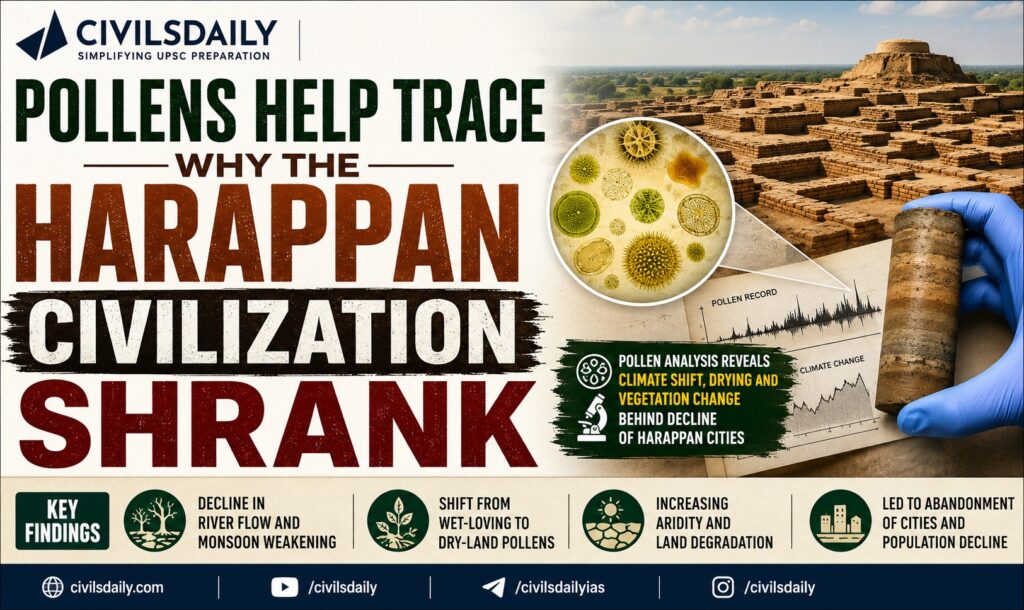
  • Pollens Help Trace Why the Harappan Civilization Shrank

    Why in News?

    A study by the Birbal Sahni Institute of Palaeosciences (BSIP) has used pollen preserved in lake sediments from Deoria Tal (Garhwal Himalaya) to reconstruct past climate. The findings suggest that a prolonged weakening of the Indian Summer Monsoon (ISM) and the 4.2 ka climatic event contributed to the decline and eastward migration of the Harappan Civilization.

    Key Findings

    • Analysis of pollen and spores reconstructed vegetation and monsoon history over the last ~5,100 years.
    • Around 4200 years BP [Before Present](4.2 ka event), the region experienced an abrupt cool and dry climate with a weakened ISM.
    • Reduced monsoon weakened the perennial river systems of the Indus and Ghaggar-Hakra, making agriculture difficult.
    • This likely triggered the migration of Harappan populations towards the Ganga plains, contributing to the shrinking of the civilization.
    • The study establishes a strong link between abrupt climate change and changes in ancient human settlements.

    How Did Scientists Reconstruct the Past?

    • Sediment core collected from Deoria Tal in Uttarakhand.
    • Pollen analysis (Palynology) reconstructed past vegetation and climate.
    • Chronology established using 10 AMS Radiocarbon (¹⁴C) dates on Trapa (water chestnut) seed cases.
    • Changes in the Oak/Pine pollen ratio served as an indicator of changing temperature and monsoon strength.

    What is the 4.2 ka Event?

    • A major global climatic event that occurred around 4200 years ago.
    • Characterized by:
      • Weak Indian Summer Monsoon.
      • Cooler and drier climate.
      • Widespread droughts across several ancient civilizations.
    • Linked to the decline of civilizations such as Harappan Civilization, Akkadian Empire, and Old Kingdom of Egypt

    Why Did the Monsoon Weaken?

    Researchers attribute the weakened ISM to multiple interacting climatic factors:

    • Southward shift of the Inter Tropical Convergence Zone (ITCZ).
    • Strong El Niño conditions.
    • Strong negative phase of the Indian Ocean Dipole (IOD).
    • Reduced Northern Hemisphere summer insolation.

    Other Climate Phases Identified

    • Roman Warm Period (2500 to 1450 cal yr BP): Strong ISM and higher agricultural productivity.
    • Medieval Climate Anomaly (1050 to 650 cal yr BP): Strong monsoon due to northward ITCZ.
    • Little Ice Age (650 to 100 cal yr BP / CE 1350 to 1850): Weak ISM associated with stronger westerlies, ENSO and southward ITCZ.

    [2026] Consider the following statements about the archaeological findings in Harappan towns:
    I. There is wide occurrence of spindle-whorls in the houses but absence of spinning wheels.
    II. Weights and measurement scales, complete with graduations have been discovered.
    III. There are houses built in large part with baked bricks, around relatively spacious courtyards, with their own wells, bathing platforms, and large rooms.
    Which of the following inferences can be drawn from the above statements?
    1. Statement I suggests that spinning was a laborious activity done at home.
    2. Statement II suggests the extent of the scientific knowledge that the Harappans possessed.
    3. Statement III suggests the emergence of a common property system.
    Select the answer using the code given below :

    [A] 1 and 2 only

    [B] 2 and 3 only

    [C] 1 and 3 only

    [D] 1, 2 and 3

  • [29th July 2026] The Hindu OpED: Iran’s Afghan balancing act amid regional upheaval

    PYQ Relevance
    [UPSC 2013]
    The proposed withdrawal of the International Security Assistance Force (ISAF) from Afghanistan in 2014 is fraught with major security implications for the counters of the region. Examine in light of the fact that India is faced with a plethora of challenges and needs to safeguard its own strategic interests.
    Linkage: The PYQ examines the regional security fallout of a foreign military withdrawal from Afghanistan. The article traces how the 2021 US withdrawal reshaped Iran’s Afghan calculus, a parallel instance of a withdrawal reordering regional strategic behaviour.

    Mentor’s Comment

    Delegations from both the Taliban and the rival Northern Alliance attended the funeral of Iran’s Supreme Leader Ayatollah Ali Khamenei in Tehran. This dual presence exposed Iran’s continued refusal to fully commit to the Taliban government despite deep economic and diplomatic engagement with Kabul. The visit occurred while Iran was fighting a war in the west, raising the stakes of managing its eastern flank.

    Why does Iran’s history with the Northern Alliance still shape its Taliban policy today?

    1. Pre-2001 alignment: Iran backed the Northern Alliance against the Taliban through the 1990s, alongside India, Russia, and Tajikistan.
    2. Post-9/11 recalibration: Iran’s view of the Taliban shifted after the 9/11 attacks brought sustained Western military deployment to its borders.
    3. Non-recognition persists: Iran has built the strongest external influence in Kabul since 2021 but still withholds formal recognition of the Taliban government.
    4. Dual channel maintained: Iran hosted Taliban Deputy Prime Minister Mullah Abdul Ghani Baradar and Foreign Minister Amir Khan Muttaqi alongside Northern Alliance leader Ahmed Massoud at the same funeral.

    How did the US withdrawal from Afghanistan reshape Iran’s regional calculus?

    1. Border threat removed: The August 2021 US withdrawal ended a two-decade military presence on Iran’s eastern border.
    2. Competing patronage exposed: Pakistan simultaneously backed the Taliban and the US-led war on terror, producing overlapping and contradictory interests.
    3. Contradiction on record: Osama bin Laden was found in Abbottabad in May 2011, in a house and not a cave, pointing to this dual role.
    4. A quieter front sought: Iran calculated that reducing conflict on its Afghan front would free up resources for other priorities.
    5. Limited patronage offered: Iran could offer the Taliban political legitimacy but only a limited amount of material patronage.

    Why does Iran keep hedging despite the Taliban’s declared wartime support?

    1. Support pledged: A Taliban spokesman close to emir Hibatullah Akhundzada said the group would support Iran if it came under attack. The extent of this support remains undefined.
    2. Access granted: The Taliban gave Iran access to Afghanistan’s civilian airports over the past year.
    3. Durability doubted: Iran treats an insurgency-turned-government as carrying a persistent question mark over its long-term stability.
    4. Internal fissures noted: Ideological and tribal divisions inside the Taliban require constant micromanagement.
    5. Power still consolidating: The Taliban is still solidifying control between Kabul, its political capital, and Kandahar, its ideological one.
    6. Institutional memory at play: Quds Force chief Esmail Qaani’s operational history traces back to the 1990s Taliban-Northern Alliance conflict. This history informs his current caution.

    Why does Iran engage both the Taliban and its opposition at once?

    1. Hedging strategy: Engaging both the recognised Taliban government and the Northern Alliance lets Iran preserve influence regardless of which side gains ground in Afghanistan’s internal balance of power.
    2. Border security concern: Iran shares a long border with Afghanistan, and instability on either side directly affects Iranian security, giving Tehran incentive to maintain channels with all major Afghan actors.
    3. Pakistan factor: Iran’s Afghanistan policy is shaped in part by its complex relationship with Pakistan, which has its own competing interests in Afghan internal politics.
    4. Regional war context: The West Asia war constrains Iran’s bandwidth and resources, making a flexible, multi track Afghan policy more practical than committing exclusively to one Afghan faction.

    What does the Iran-Pakistan wartime “brotherhood” reveal about the limits of regional alliances?

    1. Mediator role assumed: Pakistan positioned itself as a mediator between Tehran and Washington during the war.
    2. Divergent aims surfaced: Pakistan seeks favour with the US and Gulf partners, shown by its troop deployment in Saudi Arabia.
    3. Instrumental use by Iran: Iran uses the relationship as a channel to reach the US through a neighbour it knows, though does not fully trust.
    4. Bilateralism made incidental: The Iran-Pakistan relationship itself is secondary to each country’s separate external objectives.

    Conclusion

    Iran’s simultaneous engagement with the Taliban and the Northern Alliance is a hedging strategy shaped by the West Asia war’s demands on its resources and by its complicated relationship with Pakistan. The approach preserves Iranian influence in Afghanistan without requiring Tehran to bet its regional position on one Afghan faction’s success.

    Back2Basics

      Key Terms

      1. IRGC (Islamic Revolutionary Guard Corps): Iran’s ideological military force, separate from its regular armed forces.
      2. Quds Force: IRGC’s branch handling external operations and foreign militant networks.
      3. Northern Alliance: A coalition of anti-Taliban Afghan factions, historically backed by Iran, India, and Russia.

    1. Delhi High Court’s ANI v OpenAI ruling offers a better path on copyright and AI than a training licensing regime

      Why in the News?

      The Delhi High Court’s ruling in ANI v OpenAI, addressing technological neutrality and the research exemption, offers a framework for copyright and AI. At the same time, there is a growing criticism about the Department for Promotion of Industry and Internal Trade (DPIIT) committee’s proposed AI training licensing regime as potentially harmful to innovation.

      What did the Delhi High Court’s ANI v OpenAI ruling establish?

      1. Technological neutrality: The ruling applies existing copyright principles to AI training without creating a separate, more restrictive legal category just because the technology involved is new.
      2. Research exemption: The ruling recognises a research exemption relevant to how AI systems process copyrighted content during training, rather than treating every instance of AI training on copyrighted material as infringement by default.

      How is the DPIIT new hybrid licensing system (One Nation – One License – One Payment) different from the Delhi High Court (ANI v OpenAI) judgment?

      1. DPIIT Proposal: AI seeks to bring in a statutory licensing mechanism that requires companies to pay compensation (royalties) to content creators through a centralized government system.
      2. Delhi High Court verdict: The court in its latest order refused to impose any strict or prior licensing norms, stating that AI training can be considered ‘fair dealing’ (under research purposes).

      Why does the proposed licensing regime as a step backward?

      1. Compliance burden: A mandatory AI training licensing regime would require AI developers to negotiate and pay for licenses before training on copyrighted content, raising the cost of building AI systems in India.
      2. Innovation chilling effect: Smaller AI developers and startups, unable to absorb licensing costs at the scale large technology companies can, would face a higher barrier to entry than the court’s technological neutrality approach imposes.
      3. Inconsistency with the ruling: A DPIIT-driven licensing regime would move policy in a more restrictive direction than the judiciary’s own reading of technological neutrality and the research exemption, creating a mismatch between executive rule making and judicial precedent.

      Conclusion

      The Delhi High Court’s ANI v OpenAI ruling offers a workable copyright and AI framework built on existing legal principles rather than new restrictions. DPIIT’s proposed licensing regime would discard that workable framework in favour of a compliance heavy structure that risks innovation without a clear corresponding gain for rights holders.

      Back2Basics

      The Proposed Licensing system by DPIIT:

      The Department for Promotion of Industry and Internal Trade (DPIIT) proposed a new hybrid licensing systemin December 2025 called “One Nation – One License – One Payment”. Its main purpose is to strike a balance between creators’ rights and technological innovation on the use of copyrighted content for artificial intelligence (AI) training.

      The important aspects and provisions of this proposed policy are as follows:

      Mandatory Blanket License

      1. Data usage rights: AI developers can use any copyrighted content that is legally accessible (for example, freely available online) to train their models without seeking separate permission. [1, 2]
      2. No Opt-Out: Content creators or organizations do not have the right to opt-out of having their content used for AI training.

      Royalty Structure

      1. Payment after commercialization: AI developers do not have to pay any fees upfront. Royalties apply only after the AI ​​tool or product starts generating revenue commercially.
      2. Centralized Body: The government will set up a non-profit centralized nodal agency called “Copyright Royalties Collective for AI Training” (CRCAT) to collect royalties and distribute them to copyright holders .
      3. Pricing: Royalty rates are determined independently by a special expert committee appointed by the government

      Department for Promotion of Industry and Internal Trade (DPIIT)

      1. It is a Union government department under the Ministry of Commerce and Industry.
      2. It is responsible for industrial policy, including the committee that proposed the AI training licensing regime referenced here.

      PYQ Relevance

      [UPSC 2024] What is the present world scenario of intellectual property rights with respect to life materials? Although India is second in the world to file patents, still only a few have been commercialized. Explain the reasons behind this less commercialization.

      Linkage: The PYQ examines India’s intellectual property rights framework and the balance between protection of intellectual property and innovation. The article discusses whether India’s copyright framework should promote AI innovation through existing legal principles or impose a mandatory licensing regime. It highlights the broader challenge of designing an IPR regime that protects creators without discouraging technological innovation.

    2. The urban nightmare: a fire with no escape 

      Why in the News?

      Repeated urban fire tragedies, in Lucknow and Delhi, are rooted in illegal construction, weak enforcement, and fragmented urban local governance. There is a growing need of empowering local bodies as the structural fix.

      Why do fire tragedies keep recurring despite each one prompting an inquiry?

      1. Illegal construction persists: Buildings that violate fire safety norms continue to be built and occupied because enforcement action rarely follows a violation before a tragedy occurs.
      2. Fragmented authority: Fire safety clearance, building plan approval, and municipal enforcement are split across different agencies, none of which holds end to end accountability for a building’s safety compliance.
      3. Post-tragedy pattern: Each fire triggers an inquiry and short term crackdown, but enforcement lapses again once public attention moves on, indicating the response is reactive rather than preventive.
      4. Weak local body capacity: Urban local bodies, the level of government closest to individual buildings, lack the staffing and financial autonomy to conduct sustained enforcement.

      How does fragmented urban governance weaken accountability?

      1. Multiple agencies: Urban functions are divided among municipal corporations, development authorities, water boards, PWDs and transport agencies.
      2. No single authority: Responsibility is dispersed, making accountability difficult after disasters.
      3. Weak Urban Local Bodies: Municipal corporations have responsibilities but limited administrative and financial powers.
      4. State dominance: Major urban decisions remain under State governments rather than elected city governments.
      5. Governance vacuum: Citizens face one government, but responsibility is split among several agencies.

      Why is empowering Urban Local Bodies more important than launching new schemes?

      1. Constitutional basis: The 74th Constitutional Amendment, 1992 envisages democratic and empowered urban governance.
      2. Authority mismatch: Local bodies have functions but lack adequate powers and resources.
      3. Professional management: Cities require specialised urban planning and enforcement capacity.
      4. Clear accountability: One authority must be responsible for urban safety and regulation.
      5. Fearless enforcement: Building and fire safety laws must be insulated from political influence.

      Conclusion

      Illegal construction and weak enforcement are the proximate causes, but fragmented urban local governance is the structural one, since no single empowered local authority is accountable for preventing violations before they turn fatal. Empowering urban local bodies with real enforcement authority and resources is the fix the piece argues has been avoided.

      Back2Basics

      International fire safety and urban risk management rely on universally recognized frameworks and codes established by global organizations. These function as the benchmark for local building laws worldwide.

      Global Core Frameworks

      1. IFSS-CP (International Fire Safety Standards – Common Principles): Developed by a global coalition and published by the United Nations Economic Commission for Europe (UNECE), this framework provides a benchmark for life safety. It sets 5 Universal Pillars for building design and management:
        1. Prevention: Minimizing ignition risks.
        2. Detection and Communication: Fast warning systems.
        3. Occupant Protection: Safe, unhindered evacuation routes.
        4. Containment: Sectioning buildings with fire-resistant barriers to stop spread.
        5. Extinguishment: Active suppression systems (sprinklers/suppression).
      2. ISO Fire Safety Standards: The International Organization for Standardization (ISO) sets global rules for equipment and risk management. This includes ISO 7240 (fire detection/alarm systems) and ISO 31000 (integrating systemic risk management directly into urban planning).

      Widely Adopted National/Model Codes

      Many countries explicitly adopt or adapt established model codes into their local municipal bylaws:

      1. NFPA Codes (USA): Developed by the National Fire Protection Association (NFPA), these are the most globally replicated fire codes.
        • NFPA 1 (Fire Code): Total oversight rules governing building safety, hazardous materials, and structural fire protection.
        • NFPA 101 (Life Safety Code): The absolute blueprint for building design, specifying safe egress, travel distances to exits, and minimum corridor widths based on occupancy types.
      2. International Building Code (IBC): Published by the International Code Council (ICC), the IBC integrates strict structural engineering rules with active fire protection. It mandates specific automatic sprinkler thresholds (NFPA 13 standards) depending on building height and density.
      3. British Standards (UK): BS 9999 is an international code of practice for fire safety in building design and management. It uses a flexible, risk-based approach that balances architectural design with automated safety measures.

      PYQ RELEVANCE

      [UPSC 2020] The strength and sustenance of local institutions in India has shifted from their formative phase of ‘Functions, Functionaries and Funds’ to the contemporary stage of ‘Functionality’. Highlight the critical challenges faced by local institutions in terms of their functionality in recent times.

      Linkage: The PYQ examines whether Urban Local Bodies have the functional capacity and accountability to deliver effective urban governance. The article argues that repeated urban fire disasters stem from fragmented governance, weak Urban Local Bodies, poor inter-agency coordination, and lack of accountability, showing that the real challenge is the functionality of urban institutions rather than the absence of laws.

    3. “Tigers Outside Tiger Reserves” initiative targets the 35 to 40% of India’s tigers living outside protected areas

      Why in the News

      The Ministry of Environment, Forest and Climate Change’s (MoEFCC) new “Tigers Outside Tiger Reserves” (TOTR) initiative addresses the 35 to 40% of India’s tiger population living outside formally protected areas. It is built on two pillars, conflict reduction and community coexistence, across 40 forest divisions in nine states.

      Pillars of the Tigers Outside Tiger Reserves (TOTR) initiative

      1. Conflict reduction: The first pillar focuses on reducing human-tiger conflict incidents in forest divisions where tigers range outside the boundaries of formally notified reserves.
      2. Community coexistence: The second pillar builds mechanisms for local communities to coexist with tigers present in shared, non-reserve landscapes, rather than treating their presence as purely a conservation enforcement problem.
      3. Coverage: The initiative spans 40 forest divisions across nine states, reflecting the geographic spread of India’s tiger population beyond reserve boundaries.

      Why does India need a policy specifically for tigers outside reserves?

      1. Population share at stake: With 35 to 40% of India’s tiger population living outside protected areas, conservation policy focused only on reserve boundaries misses a large share of the actual tiger population.
      2. Corridor dependence: Tigers outside reserves typically use forest corridors connecting reserves, and conflict in these corridors threatens the genetic connectivity between reserve populations.
      3. Land use pressure: Non-reserve forest divisions face agricultural and settlement pressure that formally protected reserves do not, making conflict management here structurally harder than inside a reserve.

      Conclusion

      1. The Tigers Outside Tiger Reserves initiative extends India’s tiger conservation focus beyond reserve boundaries to the corridors and shared landscapes where a large share of the tiger population actually lives. Its success will depend on whether conflict reduction and community coexistence measures can be sustained in areas without a reserve’s formal protection status.

      Back2Basics

      Conservation Status

      • IUCN Red List: Endangered (EN)
      • Wildlife (Protection) Act, 1972: Schedule I species (highest level of legal protection).
      • CITES: Appendix I.

      Tiger Reserves in India

      • Total Tiger Reserves: 58 (under the National Tiger Conservation Authority).
      • Largest Tiger Reserve: Nagarjunsagar Srisailam Tiger Reserve (Andhra Pradesh & Telangana).
      • Smallest Tiger Reserve: Bor Tiger Reserve (Maharashtra).
      • State with the most Tiger Reserves: Madhya Pradesh (9).
      • Latest Tiger Reserve: Madhav Tiger Reserve (Madhya Pradesh), notified in 2025.

      Tiger Population

      • India’s tiger population increased from 1,411 (2006) to 3,682 (2022), reflecting the success of sustained conservation efforts under Project Tiger and landscape-based protection.
      • India is home to over 70% of the world’s wild tiger population, making it the global stronghold for tiger conservation.

      Project Tiger

      • Launched in 1973 by the Government of India to ensure a viable population of tigers in their natural habitats through habitat protection, anti-poaching measures, scientific monitoring, and community participation.

      National Tiger Conservation Authority (NTCA)

      • The NTCA is a statutory body established under the Wildlife (Protection) Act, 1972 (through the 2006 amendment) under the Ministry of Environment, Forest and Climate Change.
      • It formulates policies and standards for tiger conservation, oversees the management of Tiger Reserves, approves reserve notifications, and monitors implementation of Project Tiger across the country.
    4. Over 70% of police personnel favour immunity for use of force, “Status of Policing in India 2025” finds

      Why in the News

      The “Status of Policing in India 2025” report finds that over 70% of police personnel favour immunity for using force without accountability. The report also flags that National Crime Records Bureau (NCRB) custodial injury data is unreliable, undermining independent verification of police conduct.

      Why does the immunity preference expose an accountability gap?

      1. Majority preference: A 70% plus preference for immunity among serving police personnel indicates the demand for accountability protection is not a fringe view but a majority institutional stance.
      2. Data unreliability: If NCRB custodial injury data is unreliable, external oversight bodies cannot independently verify whether force used against civilians was proportionate, regardless of internal police attitudes.
      3. Compounding effect: An accountability averse police culture combined with unreliable official data on custodial injury creates a structure where excessive force is both preferred by personnel and difficult to prove externally.

      Conclusion

      1. The central idea is that police demand for immunity and unreliable custodial injury data reinforce each other, since neither internal culture nor official data currently supports independent verification of force used against civilians. Addressing this requires fixing NCRB data reliability before any accountability reform on use of force can be meaningfully enforced.

      Back2Basics

      National Crime Records Bureau (NCRB): Statutory body under the Ministry of Home Affairs that compiles crime and criminal justice statistics across India, including custodial injury and death data.