💥Join UPSC 2027,2028 Mentorship (August Batch) + XFactor Notes & Microthemes PDF

Distribution: weekly

  • How common are cloudbursts in India?

    Why in the News?

    Flash floods triggered by a cloudburst struck Pahalgam in Anantnag on 12 July. Last week, the India Meteorological Department (IMD) rejected claims that cloudbursts caused the recent floods in Assam and Nagaland. The two events have renewed attention on the scientific definition of a cloudburst and its frequent misuse in public discourse.

    What counts as a cloudburst under the IMD’s definition?

    1. Threshold: The IMD defines a cloudburst as 10 centimetres or more of rainfall in an hour over a small area of around 20 to 30 square kilometres.
    2. Scale comparator: Indore receives about 1,062 millimetres of rain in an average year, so a single cloudburst can dump close to 10% of a full year’s rainfall in 60 minutes.
    3. Related category: Some scientists have proposed a mini cloudburst category for 5 centimetres of rain in an hour over the same area, since local topography can make even this devastating.

    How does a cloudburst form?

    1. Initial lift: Warm, moist air rises rapidly through convection, and in mountainous terrain this rise is intensified by orographic lifting, where monsoon winds are forced upward by steep slopes.
    2. Cloud growth: As the rising air cools, water vapour condenses into towering cumulonimbus clouds that can reach up to 15 kilometres in height.
    3. Suspension: Strong upward currents keep forming raindrops suspended in the cloud for longer instead of letting them fall immediately.
    4. Discharge: When the weight of accumulated water exceeds what the updraft can hold, or the updraft weakens, the suspended water falls in one release rather than as steady rain.

    How common are cloudbursts in India, and why are they hard to count?

    1. Historical count: Parliament was told in 2019 that the IMD recorded only around 30 cloudburst incidents between 1970 and 2016, a figure many experts consider an underestimate.
    2. Rising frequency: Global warming increases the amount of moisture the atmosphere can hold, making cloudbursts more frequent even though they remain rare compared with ordinary heavy rain.
    3. Monitoring gap: Most cloudbursts occur in remote, high altitude regions where rain gauges and weather stations are sparse, so an event even a few kilometres from a monitoring station may go officially unrecorded despite causing large scale destruction downstream.
    4. Regional concentration: Uttarakhand, Himachal Pradesh, and Jammu and Kashmir have reported a recent surge in events described locally as cloudbursts, particularly in July and August.

    Does the label obscure accountability for poor planning?

    1. Blame diffusion: Calling a heavy downpour a cloudburst turns it into a singular, unforeseeable act of nature, which is harder to do when the stated cause is heavy rain combined with poor drainage.
    2. Dharali precedent: During the 2025 Dharali floods in Uttarakhand, initial reports blamed a cloudburst, but meteorological data later showed the rainfall rate was well below the cloudburst threshold. The underlying causes were illegal construction on riverbeds, deforestation that left soil vulnerable to erosion, and the absence of drainage infrastructure along new all weather roads.
    3. Assam and Nagaland claims: The IMD last week rejected reports that cloudbursts caused recent floods in Assam and Nagaland, including the Upper Assam floods.
    4. Accountability questions avoided: Had the Dharali downpour genuinely been a cloudburst, officials could have avoided questions about why the state permitted construction in high risk zones and why early warning systems failed.

    Why are cloudbursts difficult to forecast?

    1. Model resolution: Weather models estimate average conditions across grid cells, while a cloudburst occurs over an area smaller than a single cell, so detecting one requires high resolution models needing computing power not always available.
    2. Speed of formation: Cloudbursts develop and strike quickly, unlike cyclones or monsoon systems that can be tracked for weeks, leaving forecasters far less data to work with.
    3. Terrain interference: Doppler weather radars emit and receive beams that mountains can block, creating blind spots in exactly the high altitude terrain where cloudbursts are most common.
    4. Sparse instrumentation: Rugged terrain also means fewer automatic weather stations, leaving fewer ground sensors to feed real time data into short term prediction.

    What is India doing to improve cloudburst forecasting?

    1. Nowcasting: The IMD is developing nowcasting technology to issue short term alerts every few hours rather than long range forecasts.
    2. Mission Mausam: Under the government’s Mission Mausam programme, India plans to more than double its radar network from about 40 radars currently and use artificial intelligence to better predict hyperlocal events.
    3. Persistent limits: Even with better technology, a cloudburst is expected to remain harder to predict than a typical rainstorm because of how localised and fast forming it is.

    Conclusion

    A cloudburst is a specific meteorological event defined by the IMD’s own rainfall threshold, not a synonym for any destructive downpour. Attributing flood damage to a cloudburst without checking recorded rainfall data lets authorities treat the disaster as an unforeseeable act of nature rather than examine illegal construction, deforestation and drainage failure. India’s forecasting improvements under Mission Mausam target the science of prediction, but they do not by themselves fix the planning failures the label has repeatedly been used to obscure.

    Back2Basics:

    Mission Mausam

    1. Nodal ministry: Ministry of Earth Sciences.
    2. Launch year: 2024.
    3. Aim: Improve weather and climate forecasting through expanded observation networks, high performance computing and artificial intelligence based prediction.
    4. Key features: Expansion of Doppler weather radar coverage, next generation satellites, and impact based forecasting for more precise, localised warnings.

    PYQ Relevance

    [UPSC 2024] What is the phenomenon of ‘cloudbursts’? Explain.

    Linkage: The PYQ explains cloudbursts, their causes, and forecasting challenges. It updates the topic with IMD clarifications, Mission Mausam, and disaster accountability.


  • ISRO and Japanese scientists review mission Chandrayaan 5 preparation

    Why in the News?

    An ISRO–JAXA delegation reviewed preparations for Chandrayaan-5 (LUPEX), India’s joint lunar mission with Japan, targeted for 2028. ISRO also informed Parliament that the Crew and Service Modules for the Gaganyaan-1 uncrewed mission are nearing completion.

    What is Chandrayaan-5 (LUPEX)?

    • Full Name: Lunar Polar Exploration Mission (LUPEX).
    • A joint lunar mission of ISRO and JAXA.
    • Target Launch: 2028.
    • Objective: Explore and study water and water ice at the Moon’s south polar region.

    Mission Components

    • Lander: Developed by ISRO.
    • Rover: Developed by JAXA.
    • Launch Vehicle: Japan’s H3 Rocket.
    • Scientific Payloads:
      • NASA: Neutron Spectrometer.
      • ESA: Mass Spectrometer.
    • Mission Duration: Around 100 days.
    • Scientific Instruments: 7 across the lander and rover.

    Mission Objectives

    • Detect and analyse surface and subsurface water ice.
    • Study the lunar south pole.
    • Support future human lunar exploration and resource utilisation.

    What is the status of Gaganyaan-1?

    • Gaganyaan-1 is an uncrewed precursor mission.
    • Crew and Service Modules are in the final stages of assembly and testing.
    • Intended to validate: Crew Module, Service Module, Crew Escape System, Life Support Systems
    • Launch has been delayed, and a revised schedule is yet to be announced.

    Significance

    • Strengthens India–Japan space cooperation.
    • Demonstrates multi-agency collaboration involving ISRO, JAXA, NASA, and ESA.
    • Advances lunar science and technologies for future exploration.
    • Supports India’s long-term human spaceflight ambitions under Gaganyaan.

    Challenges

    • Budget and resource constraints across multiple space missions.
    • Integration of ISRO’s lander with JAXA’s rover.
    • Dependence on Japan’s H3 launch vehicle.
    • Delays in the Gaganyaan programme.

    Chandrayaan Missions

    • Chandrayaan-1 (2008): Confirmed the presence of water molecules on the Moon.
    • Chandrayaan-2 (2019): Orbiter remains operational; lander hard-landed.
    • Chandrayaan-3 (2023): India became the first country to achieve a soft landing near the lunar south pole.
    • Chandrayaan-4: Planned Indian mission for lunar sample return.
    • Chandrayaan-5 (LUPEX): Joint ISRO–JAXA mission to explore lunar polar water ice.

    Gaganyaan Programme

    • India’s first human spaceflight mission.
    • Objective: Demonstrate the capability to send Indian astronauts to Low Earth Orbit (LEO) and return them safely.
    • Implemented by ISRO.

    ISRO’s Major International Collaborations

    • JAXA: Chandrayaan-5 (LUPEX).
    • NASA: NISAR mission and Chandrayaan payloads.
    • ESA: Scientific payloads and deep-space support.

    [2025] Consider the following space missions:
    I. Axiom-4
    II. SpaDeX
    III. Gaganyaan
    How many of the space missions given above encourage and support microgravity research?

    [A] Only one

    [B] Only two

    [C] All the three

    [D] None

  • RBI tightens transparency norms on bulk deposit rates, allows LCR linked pricing

    Why in the News?

    The RBI has mandated daily disclosure of bulk deposit interest rates while allowing LCR-linked differential pricing. The move follows the MSRDC interest payment controversy, which exposed opaque pricing practices for large depositors.

    What are the new RBI norms?

    • Banks must publish bulk deposit rates daily.
    • Interest rates must be uniform for deposits of the same amount accepted on the same day.
    • Differential rates are allowed only under the Liquidity Coverage Ratio (LCR) framework.
    • Applicable to bulk deposits, wholesale funding, and rupee deposits of non-residents.

    What is the Liquidity Coverage Ratio (LCR)?

    • A Basel III liquidity standard ensuring banks hold sufficient High Quality Liquid Assets (HQLA) to meet 30-day stressed cash outflows.
    • Minimum LCR in India: 100%.
    • Current run-off rate: 12.5% (including 2.5% for digital deposits).

    What triggered the reform?

    • A bank allegedly disguised ₹45 crore paid to MSRDC as marketing expenditure during 2023–25.
    • The irregularity was detected through an internal audit, leading to a vigilance probe and the resignation of the bank’s chairman.

    Key Challenges

    • Hidden arrangements may still require internal audits to detect.
    • Daily disclosures cannot eliminate all off-book incentives.
    • Digital deposits may require periodic revision of run-off rates.
    • Stronger oversight of deposits by government entities is needed.

    Conclusion

    The RBI’s reforms improve transparency and fairness in bulk deposit pricing by replacing opaque negotiations with a rule-based disclosure system, though effective supervision remains critical.

    Value Addition

    • Liquidity Coverage Ratio (LCR) = High Quality Liquid Assets (HQLA) ÷ Net Cash Outflows (30 days) × 100. Minimum requirement: 100%
    • High Quality Liquid Assets (HQLA): Cash, RBI balances, and Government Securities (G-Secs)
    • Basel III: Introduced after the 2008 Global Financial Crisis. Strengthens capital adequacy, liquidity, and bank resilience.
    • Bulk Deposits: Large-value deposits accepted from corporates, institutions, trusts, and government entities, carrying higher liquidity risk than retail deposits.

    [2015] Basel III Accord’ or simply ‘Basel III’ often seen in the news, seeks to

    (a) develop national strategies for the conservation and sustainable use of biological diversity

    (b) improve banking sector’s ability to deal with financial and economic stress and improve risk management

    (c) reduce the greenhouse gas emissions but places a heavier burden on developed countries

    (d) transfer technology from developed countries to poor countries to enable them to replace the use of chlorofluorocarbons in refrigeration with harmless chemicals

  • National Advisory Board on Management of Genetic Resources (NABMGR)

    Why in the News?

    The reconstituted National Advisory Board on Management of Genetic Resources (NABMGR) held its first meeting on 29 July 2026 at ICAR–National Bureau of Plant Genetic Resources (NBPGR), New Delhi, to strengthen India’s agrobiodiversity conservation and promote the sustainable utilization of genetic resources for food security, climate resilience, and Viksit Bharat.

    What is NABMGR?

    • A national advisory body constituted by the Indian Council of Agricultural Research (ICAR).
    • First constituted: 2011. Reconstituted: 2026.
    • Chairman: Dr. R.S. Paroda. Co-Chairman: Dr. M.L. Jat (Secretary, DARE & DG, ICAR).

    Objectives

    • Recommend national policies on agrobiodiversity.
    • Promote integrated management of Plant genetic resources, Animal genetic resources, Fish genetic resources, Microbial genetic resources, and Insect genetic resources
    • Advise on national and international issues related to genetic resources.

    Key Recommendations

    • Strengthen pre-breeding programmes to utilize conserved germplasm.
    • Identify unexplored regions for systematic germplasm collection (2026–2031).
    • Develop an integrated national genetic resources management framework.
    • Mainstream traditional and underutilized crop varieties, animal breeds, fish species, microbes, and insects.
    • Strengthen implementation of Access and Benefit Sharing (ABS) under the Biological Diversity Act, 2002.
    • Expedite establishment of the National Safety Genebank (NSG) before ICAR’s centenary (2028–29).
    • Enhance international collaboration, especially with Central Asia and South-East Asia, for germplasm exchange.

    Significance

    • Conserves India’s rich agrobiodiversity.
    • Broadens the genetic base for developing climate-resilient, high-yielding crops and livestock.
    • Strengthens food, nutrition and livelihood security.
    • Supports sustainable agriculture and achievement of the Sustainable Development Goals (SDGs).
    • Promotes scientific collaboration and evidence-based policy making.

    Important Institutions Mentioned

    • ICAR – Indian Council of Agricultural Research
    • ICAR-NBPGR – National Bureau of Plant Genetic Resources
    • National Biodiversity Authority (NBA)
    • Department of Biotechnology (DBT)
    • Ministry of Environment, Forest and Climate Change (MoEFCC)
    • Botanical Survey of India (BSI)
    • National Medicinal Plants Board (NMPB)

    Value Addition

    • Agrobiodiversity: It refers to the variety and variability of plants, animals, fish, microorganisms and insects used directly or indirectly for food, agriculture and ecosystem services.
    • Germplasm: The hereditary genetic material (seeds, tissues, pollen, embryos, etc.) preserved for crop and livestock improvement.
    • Pre-breeding: The process of transferring useful genes from wild relatives or unadapted genetic resources into breeding materials to develop improved varieties.
    • Access and Benefit Sharing (ABS): A mechanism under the Biological Diversity Act, 2002, ensuring fair and equitable sharing of benefits arising from the use of biological resources and associated traditional knowledge.
    • National Safety Genebank (NSG): A secure backup repository for conserving valuable genetic resources against natural disasters or accidental loss.

    [2012] How does the National Biodiversity Authority (NBA) help in protecting the Indian agriculture?
    1. NBA checks the biopiracy and protects the indigenous and traditional genetic resources.
    2. NBA directly monitors and supervises the scientific research on genetic modification of crop plants.
    3. Application for Intellectual Property Rights related to resources genetic/biological cannot be made without approval of NBA.
    Which of the statements given above is/are correct?

    (a) 1 Only

    (b) 2 and 3 only

    (c) 1 and 3 only

    (d) 1, 2 and 3

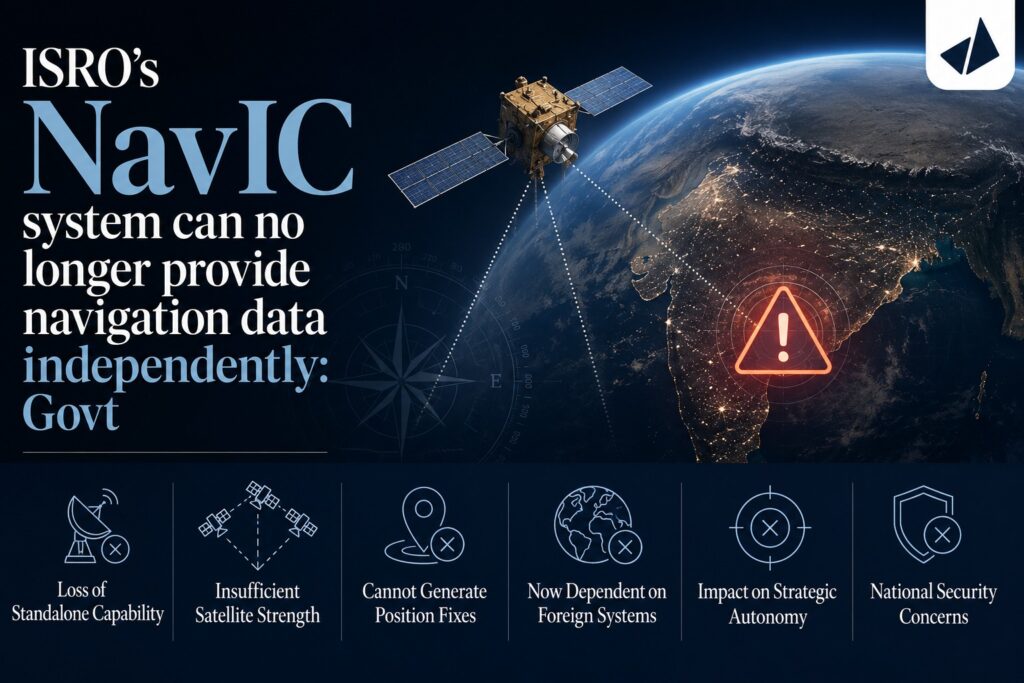
  • ISRO’s NavIC System Can No Longer Provide Standalone Navigation Services

    Why in the News?

    For the first time, the Government has admitted in Parliament that India’s NavIC (Navigation with Indian Constellation) cannot currently provide standalone positioning services, as only 3 operational satellites are available for navigation, while at least 4 satellites are required.

    What is the issue?

    • IRNSS-1F, launched in March 2016, completed its mission life and its onboard atomic clock failed, reducing the operational navigation satellites.
    • At present, only IRNSS-1B, IRNSS-1I, and NVS-01 are providing Positioning, Navigation and Timing (PNT) services.
    • As a result, NavIC cannot independently provide positioning services, though its timing service remains functional.

    What is NavIC?

    • NavIC (Navigation with Indian Constellation) is India’s regional satellite navigation system, developed by ISRO under the Indian Regional Navigation Satellite System (IRNSS).
    • It provides Positioning, Navigation and Timing (PNT) services over:
      • India, and
      • up to 1,500 km beyond its borders.
    • The original constellation was designed with 7 satellites.

    Why are four satellites necessary?

    • A navigation receiver determines its position through trilateration.
    • At least 4 satellites are required to accurately calculate Latitude, Longitude, Altitude, and Time correction
    • Without four operational satellites, standalone navigation becomes unreliable.

    Does this affect users?

    • No major impact on most users.
    • Smartphones, aircraft, ships and vehicles use multi-constellation GNSS receivers, combining signals from GPS (USA), Galileo (European Union), GLONASS (Russia), BeiDou (China), and NavIC (India)
    • Hence, navigation services continue without significant disruption.

    Current status

    • Standalone positioning: Not available.
    • Timing service: Functional.
    • Emergency message broadcasting: Functional.
    • Armed Forces: Continue using NavIC as part of a multi-constellation GNSS framework.

    Future roadmap

    • NVS-03 is ready for launch.
    • NVS-04 and NVS-05 are in advanced stages of development.
    • These satellites are expected to restore NavIC’s independent navigation capability.

    Significance of NavIC

    • Enhances strategic autonomy by reducing dependence on foreign navigation systems.
    • Supports: Defence operations, Disaster management, Maritime navigation, Aviation, Railways, Road transport, Precision agriculture, and Surveying and mapping
    • Provides secure and reliable navigation during emergencies or geopolitical conflicts.

    [2023] Which one of the following countries has its own Satellite Navigation System?

    [A] Australia

    [B] Canada

    [C] Israel

    [D] Japan

  • A medical education more inclusive

    Why in the News

    The National Medical Commission (NMC) issued revised guidelines on 27 July 2026 for admitting persons with disabilities to MBBS courses, replacing certificate-based disqualification with a functional assessment of whether a candidate can acquire the competencies needed to practise medicine. The change follows repeated legal challenges, including before the Supreme Court, to the earlier guidelines’ blanket exclusions.

    Key Highlights

    • Shift to Functional Assessment
      • MBBS eligibility will now be based on an applicant’s functional ability rather than the disability certificate alone.
      • Assessment will determine whether the candidate can acquire the competencies required to practise medicine.
      • Designated medical boards will conduct individual functional assessments.
    • Recognition of Reasonable Accommodation
      • Disability itself is not a ground for disqualification.
      • The guidelines recognise that: Assistive technology. Institutional support. Accessible infrastructure can enable candidates to successfully complete medical education.

    Why Were the Earlier Guidelines Challenged?

    • Earlier guidelines relied on fixed disability categories and thresholds.
    • Candidates could be declared ineligible solely because of the nature or extent of disability.
    • Petitioners argued that such blanket exclusions violated the Rights of Persons with Disabilities (RPwD) Act, 2016.
    • The Supreme Court observed that systemic discrimination against persons with benchmark disabilities should be eliminated.

    Significance

    • Promotes inclusive medical education.
    • Aligns with the Rights of Persons with Disabilities (RPwD) Act, 2016.
    • Shifts from a disability-based to a competency-based admission framework.

    Rights of Persons with Disabilities (RPwD) Act, 2016

    • Replaced the Persons with Disabilities Act, 1995.
    • Expanded recognised disabilities from 7 to 21.
    • Provides 4% reservation in government jobs and 5% reservation in higher educational institutions for persons with benchmark disabilities.
    • Administered by the Department of Empowerment of Persons with Disabilities, Ministry of Social Justice and Empowerment.

    National Medical Commission (NMC)

    • Established under the National Medical Commission Act, 2019.
    • Replaced the Medical Council of India (MCI).
    • Regulates medical education and medical professionals in India.

    [2026] Which of the following statements with regard to the persons with disabilities in India is/are correct?
    1. The Rights of Persons with Disabilities Act, an Act passed by the Parliament of India in 2018, mandates reservation in education and employment, places a legal duty on Governments to ensure accessibility and non-discrimination.
    2. The Sugamya Bharat Abhiyan focuses on achieving universal accessibility for Persons with Disabilities across three key domains – built infrastructure, transport systems and information and communication technology.
    3. The National Divyangjan Finance and Development Corporation (NDFDC) is a public sector organization set up by the Ministry of Corporate Affairs as a not-for-profit company to promote entrepreneurship among Persons with Disabilities (PwDs).
    Select the answer using the code given below:

    [A] 1 and 2

    [B] 2 only

    [C] 1 and 3

    [D] 1 only

  • [30th July 2026] The Hindu OpED: India’s refusal to uphold a global gig work law

    PYQ Relevance
    [UPSC 2024]
    Discuss the merits and demerits of the four ‘Labour Codes’ in the context of labour market reforms in India. What has been the progress so far in this regard?
    Linkage: The PYQ asks for an evaluation of the four Labour Codes, including the Code on Social Security, and their implementation progress. The article’s account of the un-operationalised gig worker fund under the Code on Social Security directly answers the “progress so far” component of this question.

    Mentor’s Comment

    On June 12, the International Labour Conference adopted Convention No. 193 on Decent Work in the Platform Economy by a vote of 406 to 8. India’s government delegate abstained even as India’s own employer and worker delegates voted in favour. The abstention exposes a gap between India’s stated commitment to gig worker welfare through its domestic Labour Codes and its long-standing refusal to accept binding international obligations that courts could enforce.

    What floor of rights does Convention No. 193 set that Indian law currently denies gig workers?

    1. Rights regardless of classification: The Convention extends minimum pay, on-time payment, occupational safety and social security to platform workers whatever a company calls them, whether “employee” or “independent partner.”
    2. Algorithmic management disclosure: Platforms must disclose significant automated decisions in writing and keep a human in the loop. Algorithmic management: the software that allocates work, sets pay, monitors performance and can deactivate accounts. No prior global labour standard has regulated this domain.
    3. Correct classification mandate: Article 9 requires governments to classify workers by the facts of the work performed, not by the label a platform assigns.
    4. Enforceability through ratification: A worker in a ratifying country can sue a platform for redress once the Convention is written into domestic law. India’s abstention forecloses that route.
    5. Limited but real floor: The Convention does not resolve every gig work dispute. It sets a minimum below which no ratifying country can fall.

    How large and precarious is India’s gig workforce today?

    1. Scale: India’s gig workforce stood at roughly 7.7 million in 2020-21. NITI Aayog projects it will reach 2.35 crore by 2029-30, about 6.7% of the non-agricultural workforce.
    2. Wage distribution: About 39% of gig workers earn ₹10,000-₹25,000 a month. Another 34% earn ₹25,000-₹40,000.
    3. Unpaid costs: Workers cover fuel costs themselves and work 12-hour shifts with no overtime. Overtime requires an employer to exist in law.
    4. Social security gap: Only about 15% of gig workers have any social security cover.
    5. Algorithmic exposure: An algorithm can deactivate a worker’s account and cut off income without explanation. Workers have no accident cover, sick pay or pension to fall back on.

    Does India’s Code on Social Security, 2020 already deliver what Convention No. 193 promises?

    1. Early definitional step: The Code on Social Security, part of the four Labour Codes in force from November 2025, was among the world’s first central laws to define “gig worker” and “platform worker.”
    2. Funding mechanism on paper: Aggregators must pay 1%-2% of annual turnover, capped at 5% of worker payouts, into a social security fund.
    3. Unspecified benefits: Neither the central law nor most state laws specify the nature, quantum or eligibility of benefits.
    4. Un-operationalised contribution: The contribution mechanism remains largely unimplemented. The schemes remain notional.
    5. Gap between claim and delivery: The law reads as leadership on paper. It functions as a promise that has not been converted into disbursed protection.

    Who is actually legislating gig worker protection: the Centre or the states?

    1. Rajasthan’s model: The Rajasthan Platform-Based Gig Workers Act, 2023 is a standalone state law establishing gig worker registration and welfare mechanisms.
    2. Karnataka and Telangana boards: Both states have drafted welfare boards for platform workers independent of central action.
    3. Federalism argument tested: The Centre cites labour as a concurrent subject to justify caution. States are already exercising that same concurrent jurisdiction.
    4. Centre-state asymmetry: The Centre abstains in Geneva while states legislate at home. This reverses the usual expectation that national commitments lead subnational implementation.

    Is India’s abstention a one-off caution or a settled institutional posture?

    1. Founding member, selective ratifier: India is a founding member of the ILO and has ratified six of eight core conventions. It has not ratified Convention 87 on Freedom of Association or Convention 98 on the Right to Organise and Collective Bargaining.
    2. Domestic rule conflict: India has not ratified Conventions 87 and 98 because they would grant government servants the right to strike. Domestic rules bar that right.
    3. Violence and harassment convention untouched: India has also not ratified Convention 190 on violence and harassment at work.
    4. Reversed sequence: India ratifies conventions only once domestic law is already in full conformity. This reverses the sequence in which ratification typically drives domestic reform.
    5. A settled choice: A founding member of the ILO that will not sign the ILO’s own guarantees is not acting out of unfamiliarity. It is exercising a settled choice to endorse principles without accepting enforceable obligations.

    What does the abstention cost gig workers and India’s global standing?

    1. Lost legal recourse: Ratification would let a worker sue a platform for redress. Abstention forecloses that possibility inside India.
    2. Signal to aggregators: The abstention tells every aggregator operating in India that calling workers “partners” rather than employees remains a safe classification.
    3. Cross-country disparity: A delivery worker in China will have enforceable rights under the Convention. A worker in Chennai will not.
    4. A choice by default: The government chose neither the worker nor the platform in a forum where one side holds the app and the other holds the handlebars. That default functions as choosing the platform.
    5. Scale of the stake: The World Bank estimates 154-435 million people already earn through platforms worldwide. 2.35 crore of them will be Indian by 2030.

    Conclusion

    India’s abstention on Convention No. 193 is not an isolated diplomatic caution. It follows the same pattern as its non-ratification of Conventions 87, 98 and 190: endorse the principle in domestic law, withhold the obligation that would make it enforceable. Gig workers are left with a social security fund that exists on paper but not in disbursement, while individual states legislate protections the Centre will not commit to nationally. Until India converts stated intent into binding law, its 2.35 crore gig workers by 2030 will remain outside the floor of rights their counterparts elsewhere now hold.

  • RS passes Bill to criminalise disrespect to Vande Mataram

    Why in the News

    The Rajya Sabha passed the Prevention of Insults to National Honour (Amendment) Bill, 2026 on 29 July 2026, in the absence of most Opposition members who staged a walkout. The Bill extends criminal punishment for disrespecting national symbols to the National Song, Vande Mataram, placing it on the same legal footing as the National Anthem for the first time since the original 1971 law.

    What does the Prevention of Insults to National Honour (Amendment) Bill, 2026 change?

    1. Original law: The Bill amends the Prevention of Insults to National Honour Act, 1971, which criminalises insults to the National Flag, the Constitution and the National Anthem.
    2. New provision: The amendment extends criminal punishment to acts of obstruction or disturbance during the singing of the National Song, Vande Mataram.
    3. Penalty: Intentionally preventing the singing of the National Song, or causing disturbance to an assembly singing it, will be punishable with imprisonment up to three years, or a fine, or both.
    4. Legislative path: The Bill was introduced in the Rajya Sabha on 24 July by Minister of State for Home Affairs Nityanand Rai and will now go to the Lok Sabha for consideration and passage.

    What is the historical background to Vande Mataram’s status?

    1. Origin: Vande Mataram was composed by Bankim Chandra Chatterjee in 1875, but only two stanzas were adopted as the National Song.
    2. Adoption decision: Congress leader Jawaharlal Nehru limited the National Song to two stanzas in 1937, years before he became independent India’s first Prime Minister.
    3. Constituent Assembly reference: On 24 January 1950, Rajendra Prasad told the Constituent Assembly that Vande Mataram should be honoured on par with Jana Gana Mana, the National Anthem.

    What was the political dispute around the Bill’s passage?

    1. Government framing: Minister of State for Home Affairs Nityanand Rai said the Bill represents “India’s soul, national awareness, and cultural heritage” and accused the Congress of engaging in appeasement politics by opposing it.
    2. Opposition’s walkout reason: Nearly all Opposition members walked out demanding Union Home Minister Amit Shah’s statement on the police action against students protesting paper leaks at Jantar Mantar, rather than opposing the Bill’s substance.
    3. Cross-party support noted: The Aam Aadmi Party’s Sanjay Singh said his party supports the Bill while also demanding a law against insulting the National Anthem and the Tricolour.

    Conclusion

    The Rajya Sabha has passed the Bill giving Vande Mataram the same criminal protection as the National Anthem, with the Lok Sabha’s consideration as the next legislative step. The Opposition’s walkout centred on demanding accountability for the police action against student protesters rather than opposing the Bill on its merits.

    Back2Basics:

    Prevention of Insults to National Honour Act, 1971

    1. Enactment: The original Act was passed in 1971 to penalise insults to the National Flag, the Constitution of India, and the National Anthem.
    2. Scope: It covers acts such as burning, mutilating or defacing the National Flag, and preventing or disturbing the singing of the National Anthem.
    3. Amendment history: The Act has been amended before, including through the Prevention of Insults to National Honour (Amendment) Act, 2005, to add flag code violations.

  • SC restricts ‘retrospective’ green clearances

    Why in the News?

    The Supreme Court on 29 July 2026 quashed, with prospective effect, the Centre’s 2021 Office Memorandum (OM) that allowed ex post facto environmental clearances for projects built without prior approval. It held that the government cannot alter the mandatory environmental clearance regime through a mere administrative instruction. The ruling closes a route that had let project proponents regularise unauthorised construction through a recurring “amnesty,” while leaving open a narrow exception issued through proper notification.

    What did the 2021 Office Memorandum allow, and why did the court strike it down?

    1. What the OM did: The 2021 OM created a standard operating procedure allowing perpetual, recurring ex post facto environmental clearance for projects undertaken without prior environmental clearance under the Environment (Protection) Act, 1986.
    2. Why it failed the legal test: The Bench, led by Chief Justice of India Surya Kant, held that the OM was “an administrative order” that “envisages a perpetual regime” and “supplants an earlier delegated legislation through an administrative instruction, which is impermissible in law.”
    3. No selection criteria: The OM applied indiscriminately to all permissible projects without laying down an intelligible differentia connecting selection to “supervening public interest,” making it disproportionate and violative of Articles 14 and 21 of the Constitution.
    4. Weakened deterrence: The decriminalisation of the offence of breaching the prior clearance regime through the Jan Vishwas (Amendment of Provisions) Act, 2023 compounded the problem, since violators earlier faced up to five years’ imprisonment or a fine, before the offence became a civil liability.

    What can the government still do to grant retrospective clearance?

    1. Narrow exception preserved: The Court held the Centre retains power under Section 3 of the Environment (Protection) Act, 1986 to issue an appropriate, narrowly tailored amnesty notification in supervening public interest, as an exception to the 2006 notification, but not through an administrative memorandum.
    2. Selection requirement: Any future amnesty scheme must make a distinct, reasoned selection of projects, tested against proportionality and public interest, rather than covering all non-compliant projects uniformly.
    3. Accountability demand: The Court ordered that future amnesty schemes must provide effective deterrent measures against individual public servants, including disciplinary action and personal liability, wherever the state or its own instrumentalities violate the prior clearance regime.

    What happens to projects that already received clearance under the quashed OM?

    1. Prospective effect only: The Court quashed the 2021 OM prospectively, to avoid disrupting ongoing projects including the AIIMS Medical College and Hospital building in Odisha, the Centre of Excellence for Cancer Diseases in Tamil Nadu, Vijayapura Airport in Karnataka, and various medical colleges, slum rehabilitation and irrigation projects.
    2. Existing clearances remain valid: Retrospective clearances already granted under the 2017 notification and the 2021 OM remain valid unless individually challenged in accordance with law.
    3. Litigation history: The ruling follows a back-and-forth: a May 2025 Division Bench judgment called such clearances a “gross illegality,” a November 2025 larger Bench recalled that ruling citing the “devastating effect” on public projects worth thousands of crores, and the present July 2026 judgment on review petitions restores the stricter position on the OM specifically.

    Does closing the OM route resolve the tension between environmental compliance and project continuity?

    1. Unresolved incentive: Because existing ex post facto clearances remain valid unless individually challenged, project proponents that already built without clearance retain the benefit of past regularisation, even as the route for future violators is closed.
    2. Enforcement gap remains: With the 2023 Jan Vishwas Act having decriminalised breaches of the prior clearance regime, the deterrent effect of closing the administrative amnesty route depends on how strictly future violations are now penalised as civil liabilities.

    Conclusion

    The Supreme Court has closed the administrative route for open-ended retrospective environmental clearance while preserving a narrow, notification-based exception for genuine public interest cases. Whether this actually curbs future violations depends on how strictly the Centre applies the “narrowly tailored” and “intelligible differentia” tests the Court has now set, and whether civil penalties under the Jan Vishwas Act carry enough deterrent weight.

    Back2Basics:

    Environment (Protection) Act, 1986

    1. Enactment: The Environment (Protection) Act, 1986 was enacted after the 1984 Bhopal gas tragedy, giving the Central government overarching powers to protect and improve the environment.
    2. EIA notification: The Environmental Impact Assessment (EIA) Notification, 2006, issued under Section 3 of this Act, mandates prior environmental clearance for specified categories of projects before construction begins.
    3. Jan Vishwas Act, 2023: This Act decriminalised minor offences across 42 laws, including converting the penalty for breaching the prior environmental clearance requirement from imprisonment to a civil liability.

    PYQ Relevance

    [UPSC 2020] How does the draft Environment Impact Assessment (EIA) Notification, 2020 differ from the existing EIA Notification, 2006?

    Linkage: The PYQ examines India’s Environmental Impact Assessment (EIA) framework and the legal requirements governing environmental clearances. The article builds on the PYQ by analysing the Supreme Court’s decision to invalidate open-ended ex post facto environmental clearances, reinforcing prior approval as the cornerstone of the EIA regime.

  • The IACS and the making of modern Indian science

    Why in the News?

    The Indian Association for the Cultivation of Science (IACS) marked its 150th anniversary this year. It was established on 29 July 1876 as India’s first national institution dedicated to scientific research by Indians.

    What is the Indian Association for the Cultivation of Science (IACS)?

    1. Founding: The IACS was established on 29 July 1876 in Calcutta by Mahendralal Sircar, as the country’s first institution dedicated to scientific research led by Indians.
    2. Founding vision: Sircar proposed the IACS in an 1869 article in the Calcutta Journal of Medicine, arguing that scientific education was indispensable for India’s intellectual and societal progress.
    3. Colonial context: Sircar’s founding was a direct response to what he described in 1872 as the colonial government’s failure to “afford any opportunity” or “encouragement to the pursuit of science by the native of this country.”

    How did the IACS produce Raman’s discovery of the Raman effect?

    1. Raman’s introduction to IACS: After joining the Accountant General’s Office in Calcutta in 1907, C V Raman discovered the IACS and was given open access to its laboratories by Amrit Lal Sircar, the founder’s son.
    2. Dual life as scientist and officer: For nearly a decade, Raman worked at the IACS laboratory in the early mornings and evenings while serving as a government officer during the day, continuing even after he became Palit Professor of Physics at Calcutta University in 1917.
    3. The discovery: Raman made his most celebrated discovery, the Raman effect, in the IACS laboratories, announcing it to the world on 28 February 1928.
    4. Nobel recognition: The discovery earned Raman the Nobel Prize in Physics in 1930, making him the first Asian scientist to win a Nobel Prize in the sciences.

    What does IACS’s history reveal about colonial-era Indian science?

    1. Institutional gap Sircar identified: Sircar’s founding case rested on the argument that Indians needed their own institution because the colonial state had not created one, showing that India’s earliest scientific self-reliance was born out of exclusion rather than official support.
    2. Vision fulfilled: Raman’s Nobel Prize, won through work conducted at an institution founded and funded by Indians, is presented as the fulfilment of Sircar’s original claim that such an institution could produce discoveries of international significance without depending on colonial institutional support.

    Conclusion

    The IACS’s 150-year history runs from Mahendralal Sircar’s 1876 founding, born of colonial neglect of Indian scientific talent, to C V Raman’s 1930 Nobel Prize, won through research conducted entirely within that institution. The anniversary is presented as a reminder that India’s earliest scientific self-reliance predates independence by seven decades.

    Back2Basics:

    1. National Science Day: India observes National Science Day on 28 February each year to mark the anniversary of the announcement of the Raman effect.
    2. Present role: IACS continues to function as an autonomous research institute under the Department of Science and Technology, focused on basic sciences.