💥Join UPSC 2027,2028 Mentorship (August Batch) + XFactor Notes & Microthemes PDF

Distribution: weekly

  • Road ministry notifies new rules on BH Series registration mark for vehicles

    bh series

    The Ministry of Road Transport and Highway has notified new rules to further increase the scope of implementation of the BH series registrations for vehicles.

    What is the update?

    The transport ministry has proposed new rules that would permit transfer of vehicles with BH series registration mark to other persons, who are eligible or ineligible for the getting the series.

    What is Bharat series (BH-series)?

    • There was a procedure of re-registration of a vehicle while moving to another state.
    • A vehicle bearing BH registration mark shall not require assignment of a new registration mark when the owner of the vehicle shifts from one State to another.
    • Format of Bharat series (BH-series) Registration Mark –

    Registration Mark Format:

    1. YY BH #### XX
    2. YY – Year of first registration
    3. BH- Code for Bharat Series
    4. ####- 0000 to 9999 (randomized)
    5. XX- Alphabets (AA to ZZ)

    Why such move?

    • Station relocation occurs with both Government and private sector employees.
    • Such movements create a sense of unease in the minds of such employees with regard to transfer of registration from the parent state to another state.
    • Under section 47 of the Motor Vehicles Act, 1988, a person is allowed to keep the vehicle for not more than 12 months in any state other than the state where the vehicle is registered.

    Who can get this BH series?

    • BH-series will be available on voluntary basis to Defense personnel, employees of Central Government/ State Government/ Central/ State PSUs and private sector companies/organizations.
    • The motor vehicle tax will be levied for two years or in multiple of two.
    • This scheme will facilitate free movement of personal vehicles across States/UTs of India upon relocation to a new State/UT.
    • After completion of the fourteenth year, the motor vehicle tax shall be levied annually which shall be half of the amount which was charged earlier for that vehicle.


    Click and get your FREE Copy of CURRENT AFFAIRS Micro Notes

    (Click) FREE 1-to-1 on-call Mentorship by IAS-IPS officers | Discuss doubts, strategy, sources, and more

  • India’s Current Account Deficit (CAD) Strategy amidst the Global Uncertainty

    Deficit

    Context

    • There seems to be considerable optimism about India’s near-term growth prospects now that the major global energy and commodity shocks have subsided. Even if these shocks have subsided, India still faces one big problem of its large current account deficit (CAD). How will this be managed? It turns out that the answer to both questions lies in one word exports.

    Click and get your FREE Copy of CURRENT AFFAIRS Micro Notes

    Deficit

    What is Current Account Deficit (CAD)?

    • A current account is a key component of balance of payments, which is the account of transactions or exchanges made between entities in a country and the rest of the world.
    • This includes a nation’s net trade in products and services, its net earnings on cross border investments including interest and dividends, and its net transfer payments such as remittances and foreign aid.
    • A CAD arises when the value of goods and services imported exceeds the value of exports, while the trade balance refers to the net balance of export and import of goods or merchandise trade.
    • CAD = Trade Deficit + Net Income from Abroad + Net transfers

    What has been the recent trend?

    • Swelling CAD: Over the past year, the post-pandemic normalisation has caused the current account deficit to swell to exceptional proportions.
    • Decline in demand abroad: At home, normalisation has spurred a renewed demand for imported inputs. But abroad, it has had the opposite effect, leading to a decline in demand.
    • India’s import soared while exports fell: Foreign households are no longer demanding so many goods now that the lockdowns that kept them in their houses and the fiscal stimuli that gave them the money to spend have both ended. So, India’s imports have soared just at a time when its merchandise exports have started to fall.
    • Statistics for instance: The difference between the value of goods imported and exported fell to $54.48 million in Q4FY 2021-22 from $59.75 million in Q3 FY2021-22.
    • Service sector is saviour: However, based on robust performance by computer and business services, net service receipts rose both sequentially and, on a year, -on-year basis.

    Future projections

    • Looking ahead, the situation seems set to worsen: Foreign demand will slow further as advanced countries slip into what now seem like inevitable recessions.
    • In the backdrop of recession India’s CAD could widen further: In that case, India’s CAD could widen even further, possibly to four per cent of GDP in 2022-23, double the level that the Reserve Bank of India (RBI) traditionally regards as “safe”.

    Deficit

    Analysis: How should India respond?

    1. Attracting foreign capital inflow: Attract foreign capital inflows worth at least four per cent of GDP.
    • Is this realistic in time of global uncertainty: The world is currently facing unprecedented levels of uncertainty. Two years of the pandemic, now a land war in Europe, inflation and energy crisis in Europe, interest rate hikes in the history of the US Federal Reserve, slowdown in china, etc. In such an uncertain environment, foreign investors prefer to invest in safe assets such as US government bonds rather than emerging markets like India. As a result, India has witnessed large outflows of foreign capital in 2022-23
    1. Deploying RBI’s Forex to pay for imports: If India cannot attract the required amount of capital inflows, the RBI’s foreign exchange reserves could be deployed to pay for imports.
    • Is this strategy sustainable: The country’s reserves are meant to tide the country over short-term problems, such as commodity price spikes. India’s merchandise exports have been structurally weak, stagnating for the past decade, until the pandemic induced a short-lived boom.

    Deficit

    How depreciating rupee could be helpful?

    • Price needs to be adjusted by depreciating rupee: This means that something fundamental needs to change. Ultimately, India’s CAD reflects a mismatch between the demand and supply of foreign exchange. To restore balance, first and foremost, the price needs to adjust, that is, the rupee needs to depreciate.
    • Exporting becomes more profitable: When this happens, exporting becomes more profitable, inducing more and more firms to explore foreign markets. Meanwhile, foreign demand improves, because the rupee depreciation makes India’s products more price-competitive. As a result, exports increase and the CAD falls.
    • Exchange rate depreciation is helpful in sustained growth: The recovery of the Indian economy from the pandemic was largely fuelled by exports. But with exports now declining, this crucial source of growth has now become uncertain for India. Strengthening the export sector is, therefore, critical for sustaining growth.

    Way forward

    1. Allow the rupee to depreciate,
    2. Encourage foreign firms to produce in India by letting them access their supply chains,
    3. Encourage domestic firms to step up to the competition, and
    4. Create a level playing field for all players.

    Conclusion

    • The large CAD, however, is not a short-term problem: It is a long-term problem requiring a long-term solution. By adopting the discussed strategy, India could potentially solve its two most important macroeconomic problems that are reducing the large CAD and securing rapid, sustained growth.

    Mains question

    Q. What is Current account deficit (CAD)? In a time of global uncertainty How India can reduce its large CAD and secure sustained growth. Analyze

    (Click) FREE1-to-1 on-call Mentorship by IAS-IPS officers | Discuss doubts, strategy, sources, and more

  • States can enact laws on Uniform Civil Code (UCC): Union Law Minister

    States are empowered to enact personal laws that decide issues such as succession, marriage and divorce, in their endeavor to secure a uniform civil code (UCC), Law Minister informed the Rajya Sabha.

    What did Law Minister say?

    • Personal laws such as intestacy and succession; wills; joint family and partition; marriage and divorce, relate to Entry 5 of List-III-Concurrent List of the Seventh Schedule to the Constitution.
    • Hence, the States are also empowered to legislate upon them.
    • And many states are announcing the implementation of UCC in the election manifestos.

    What is a Uniform Civil Code (UCC)?

    • A UCC is one that would provide for one personal civil law for the entire country.
    • This would be applicable to all religious communities in their personal matters such as marriage, divorce, inheritance, adoption etc.

    Basis for UCC

    • Article 44, one of the Directive Principles of the Constitution lays down that the state shall endeavour to secure a UCC for the citizens throughout the territory of India.
    • These, as defined in Article 37, are not justiciable (not enforceable by any court) but the principles laid down therein are fundamental in governance.

    UCC vs. Right to Freedom of Religion

    1. Article 25 lays down an individual’s fundamental right to religion
    2. Article 26(b) upholds the right of each religious denomination or any section thereof to “manage its own affairs in matters of religion”
    3. Article 29 defines the right to conserve distinctive culture

    Reasonable restrictions on the Freedom of Religion

    • An individual’s freedom of religion under Article 25 is subject to “public order, health, morality” and other provisions relating to FRs, but a group’s freedom under Article 26 has not been subjected to other FRs.
    • In the Constituent Assembly, there was division on the issue of putting UCC in the fundamental rights chapter. The matter was settled by a vote.
    • By a 5:4 majority, the fundamental rights sub-committee headed by Sardar Patel held that the provision was outside the scope of FRs and therefore the UCC was made less important.

    Enacting and Enforcing UCC

    • Fundamental rights are enforceable in a court of law.
    • While Article 44 uses the words “state shall endeavour”, other Articles in the ‘Directive Principles’ chapter use words such as “in particular strive”; “shall in particular direct its policy”; “shall be obligation of the state” etc.
    • Article 43 mentions “state shall endeavour by suitable legislation” while the phrase “by suitable legislation” is absent in Article 44.
    • All this implies that the duty of the state is greater in other directive principles than in Article 44.

    What are more important — fundamental rights or directive principles?

    • There is no doubt that fundamental rights are more important.
    • The Supreme Court held in Minerva Mills (1980): Indian Constitution is founded on the bed-rock of the balance between Parts III (Fundamental Rights) and IV (Directive Principles).
    • To give absolute primacy to one over the other is to disturb the harmony of the Constitution.
    • Article 31C inserted by the 42nd Amendment in 1976, however, lays down that if a law is made to implement any directive principle, it cannot be challenged on the ground of being violative of the FRs under Articles 14 and 19.

    What about Personal Laws?

    • Citizens belonging to different religions and denominations follow different property and matrimonial laws which are an affront to the nation’s unity.
    • If the framers of the Constitution had intended to have a UCC, they would have given exclusive jurisdiction to Parliament in respect of personal laws, by including this subject in the Union List.
    • “Personal Laws” are mentioned in the Concurrent List.

    Various customary laws

    • All Hindus of the country are not governed by one law, nor are all Muslims or all Christians.
    • Muslims of Kashmir were governed by a customary law, which in many ways was at variance with Muslim Personal Law in the rest of the country and was, in fact, closer to Hindu law.
    • Even on registration of marriage among Muslims, laws differ from place to place.
    • In the Northeast, there are more than 200 tribes with their own varied customary laws.
    • The Constitution itself protects local customs in Nagaland. Similar protections are enjoyed by Meghalaya and Mizoram.
    • Even reformed Hindu law, in spite of codification, protects customary practices.

     Why need UCC?

    • UCC would provide equal status to all citizens
    • It would promote gender parity in Indian society.
    • UCC would accommodate the aspirations of the young population who imbibe liberal ideology.
    • Its implementation would thus support the national integration.

    Hurdles to UCC implementation

    • There are practical difficulties due to religious and cultural diversity in India.
    • The UCC is often perceived by the minorities as an encroachment of religious freedom.
    • It is often regarded as interference of the state in personal matters of the minorities.
    • Experts often argue that the time is not ripe for Indian society to embrace such UCC.

    These questions need to be addressed which are being completely ignored in the present din around UCC.

    1. Firstly, how can uniformity in personal laws are brought without disturbing the distinct essence of each and every component of the society.
    2. Secondly, what makes us believe that practices of one community are backward and unjust?
    3. Thirdly, has other uniformities been able to eradicate inequalities which diminish the status of our society as a whole?

    Way forward

    • It should be the duty of the religious intelligentia to educate the community about its rights and obligations based on modern liberal interpretations.
    • A good environment for the UCC must be prepared by the government by explaining the contents and significance of Article 44 taking all into confidence.
    • Social reforms are not overnight but gradual phenomenon. They are often vulnerable to media evils such as fake news and disinformation.
    • Social harmony and cultural fabric of our nation must be the priority.


    Click and get your FREE Copy of CURRENT AFFAIRS Micro Notes

    (Click) FREE 1-to-1 on-call Mentorship by IAS-IPS officers | Discuss doubts, strategy, sources, and more

  • [pib] Social Progress Index (SPI) for states and districts

    Economic Advisory Council to Prime Minister (EAC-PM) will release the Social Progress Index (SPI) for states and districts of India on December 20, 2022.

    Social Progress Index (SPI) Report

    • SPI is a comprehensive tool intended to be a holistic measure of the Social Progress made by the country at the national and sub-national levels.
    • The report has been prepared by Institute for Competitiveness, headed by Dr Amit Kapoor and the Social Progress Imperative, headed by Michael Green.
    • It was mandated by Economic Advisory Council to the Prime Minister of India.

    Objectives of the report

    • With state and district-wise rankings and scorecards, the report aims to provide a systematic account of the social progress made at all levels in the country.
    • The report also sheds light on the achievements of the districts that have performed well on the index and the role of the states in achieving social progress.
    • A special section of the report provides an analysis of the Aspirational Districts of India, leading to a broader understanding of the social progress at the grassroots level.
    • The report will act as a critical enabler and tool for policymakers in the coming years for achieving sustained socio-economic growth.

    Components of SPI

    SPI assesses the performance of states and districts on three dimensions of social progress:

    1. Basic Human Needs: It assesses the performance of states and districts in terms of Nutrition and Basic Medical Care, Water and Sanitation, Personal Safety and Shelter.
    2. Foundations of Wellbeing: It evaluates the progress made by the country across the components of Access to Basic Knowledge, Access to Information and Communication, Health and Wellness, and Environmental Quality.
    3. Opportunity: It focuses on aspects of Personal Rights, Personal Freedom and Choice, Inclusiveness, and Access to Advanced Education.

    (This newscard will be updated once the report is published.)

    Need for SPI

    • GDP is not a holistic measure of a nation’s development: It would be incorrect to state that the economic progress is completely divorced from progress made in areas mentioned above.
    • Social outcomes of developmental economics: The primary goal of the SPI is to provide a rigorous tool to benchmark progress and stimulate progress within countries.
    • No single holistic parameter available: Several indicators, like GHI and HDI, go beyond GDP, but none captures social progress as finely as SPI.
    • Doing away with biased reports: India does not display a respectable position in the index, as even the small neighbours like Nepal have a better rank. India is also the lowest rank holder in BRICS.


    Click and get your FREE Copy of CURRENT AFFAIRS Micro Notes

    (Click) FREE 1-to-1 on-call Mentorship by IAS-IPS officers | Discuss doubts, strategy, sources, and more

  • Committee to Protect Journalists (CPJ) Report

    The number of journalists jailed around the world for practicing their profession has touched a record high, with 363 reporters deprived of their freedom as of December 1, 2022, according to the 2022 prison census released by the Committee to Protect Journalists (CPJ).

    About Committee to Protect Journalists (CPJ)

    • The CPJ is an American independent non-profit, non-governmental organization, based in New York City, New York, with correspondents around the world.
    • CPJ promotes press freedom and defends the rights of journalists.
    • It is often called as the “Journalism’s Red Cross.”
    • Since late 1980s, the organization has been publishing an annual census of journalists killed or imprisoned in relation to their work.

    Key highlights of CPJ report

    • This year’s top five jailers of journalists were Iran, China, Myanmar, Turkey, and Belarus, respectively.
    • New ‘fake news’ laws, criminal defamation, and abuse of judiciary are also tactics used to clamp down on press freedom.
    • This year’s top five jailers of journalists were Iran, China, Myanmar, Turkey, and Belarus, respectively.
    • These govt aimed to keep the lid on broiling discontent in a world disrupted by COVID-19 and the economic fallout from Russia’s war on Ukraine.
    • In China, too, another ‘worst offender’, many imprisoned journalists were Uighurs from Xinjiang.

    What did it say about India?

    India continues to draw criticism over its treatment of the media, in particular its use of-

    1. Jammu and Kashmir Public Safety Act,
    2. Preventive detention law- to keep journalists behind bars after they were granted court-ordered bail in separate cases,
    3. Terrorism-related Unlawful Activities (Prevention) Act to investigate and charge the journalists.

    Why does this report matter?

    • Earlier this year, India has reached 150th position in the World Press Freedom Index, dropping further from its last year’s 142nd rank out of 180 countries.
    • The safety of journalists is a grave concern in the Indian media landscape.

    Conclusion

    • The right occasion to deliberate about the much-needed reforms in the media ecosystem in the country is due.
    • Establishing plurality in ownership, better legal frameworks to protect journalists, and steps to reduce the influence of vested interest groups in Media operations are the immediate steps required.

    Back2Basics: Freedom of Press and Constitutional Provisions

    • The Supreme Court in Romesh Thappar v. the State of Madras, 1950 observed that freedom of the press lay at the foundation of all democratic organisations.
    • It is guaranteed under the freedom of speech and expression under Article 19, which deals with ‘Protection of certain rights regarding freedom of speech, etc.
    • Freedom of the press is not expressly protected by the Indian legal system but it is impliedly protected under article 19(1) (a) of the constitution.
    • The freedom of the press is also not absolute.

    Reasonable restrictions

    • A law could impose only those restrictions on the exercise of this right, it faces certain restrictions under article 19(2), which is as follows:
    1. Sovereignty and integrity of India
    2. Security of the State,
    3. Friendly relations with foreign States
    4. Public order, decency or morality
    5. Contempt of court
    6. Defamation
    7. Incitement to an offence


    Click and get your FREE Copy of CURRENT AFFAIRS Micro Notes

    (Click) FREE 1-to-1 on-call Mentorship by IAS-IPS officers | Discuss doubts, strategy, sources, and more

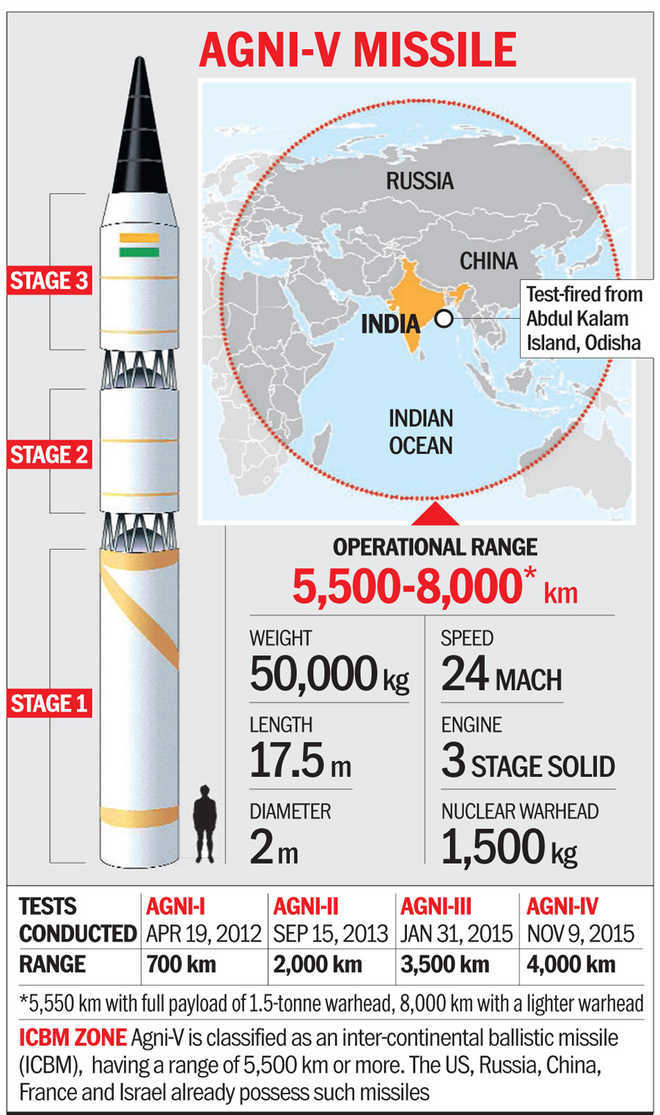
  • India test-fires Agni-V Ballistic Missile amid LAC heat

    agni

    India successfully carried out the night trials of the Agni V nuclear-capable ballistic missile days after Indian and Chinese troops clashed in Tawang district of Arunachal Pradesh.

    Why in news?

    • It was a midnight test fire.
    • And there are rumours about the increased range and stealth capabilities of Agni-V missile.

    Agni Missiles

    agni

    • Agni missiles are long range, nuclear weapons capable surface to surface ballistic missile.
    • The first missile of the series, Agni-I was developed under the Integrated Guided Missile Development Program (IGMDP) and tested in 1989.
    • After its success, Agni missile program was separated from the IGMDP upon realizing its strategic importance.
    • It was designated as a special program in India’s defence budget and provided adequate funds for subsequent development.

    Variants of Agni missiles

    1. Agni I: It is a Medium Range Ballistic Missile with a Range of 700-800 km.
    2. Agni II: It is also a Medium Range Ballistic Missile with a Range more than 2000 km.
    3. Agni III: It is also an Inter-Medium Range Ballistic Missile with Range of more than 2,500 Km
    4. Agni IV: It is also an Inter-Medium Range Ballistic Missile with Range is more than 3,500 km and can fire from a road mobile launcher.
    5. Agni-V: Currently it is the longest of Agni series, an Inter-Continental Ballistic Missile (ICBM) with a range of over 5,000 km.
    6. Agni- VI: The longest of the Agni series, an Inter-Continental Ballistic Missile (ICBM) with a range of ICBM 11,000–12,000 km.

    Strategic significance of Agni Missiles

    • The success of AGNI missiles is in line with India’s stated policy to have ‘credible minimum deterrence’ that underpins the commitment to ‘No First Use’.
    • What makes Agni 5 agile is that it is a “canisterised” missile. It means that the missile can be launched from road and rail platforms, making it easier for it to be deployed and launched at a quicker pace.
    • The canisterisation also gives the missile a longer shelf life, protecting it from the harsher climatic conditions.
    • While India is among the handful of nations with ICBM capability.
    • The next generation of the missile, Agni VI, under development, is expected to have a range of around 8,000 km.


    Click and get your FREE Copy of CURRENT AFFAIRS Micro Notes

    (Click) FREE 1-to-1 on-call Mentorship by IAS-IPS officers | Discuss doubts, strategy, sources, and more
  • The silent revolution of “Nari Shakti”

    revolution

    Context

    • On the occasion of the 75th year of India’s independence, the Prime Minister articulated a bold vision that in the coming 25 years, “Nari Shakti” would play a vital role in India’s socio-economic developmental journey.

    Click and get your FREE Copy of CURRENT AFFAIRS Micro Notes

    Background: Status of women In India

    • Elevated status in ancient texts and thoughts: Culturally and mythologically, women have enjoyed an elevated status in India. For example, it is mentioned in the Kena Upanishad that it was the goddess Uma who enlightened the three powerful but ignorant gods, Indra, Vayu, and Agni, to the profound mystery of Brahman.
    • Experience of women in modern era is far from ideal: Women have faced discrimination in the household and at jobs, and for a long time, they were victims of political indifference and neglect.
    • Recognizing the Nari Shakti: In recent decades, “Nari Shakti” has been reasserted through micro and silent revolutions. There are some silent women-led changes transforming our society politically and economically But there is need to highlight the challenges that remain in women fulfilling their true potential as modern nation-builders of India.

    revolution

    Nari Shakti The silent revolution: Role of Women in Indian democracy

    • Gender gap in voter turnout is diminishing rapidly as women often exceeds male voter turnout: Research on women voters using historical data has revealed that since 2010, the gender gap in voter turnout has diminished significantly and the recent trends show women voter turnout often exceeds male voter turnout. This massive increase is a nationwide phenomenon and is also observed in less developed regions of the country where traditionally, the status of women has been significantly lower.
    • Dramatic increase in women contesting election particularly in panchayat level: Since 2010, many more women have been contesting elections. To put this in perspective, in the 1950s, in the state assembly elections, women contested elections in approximately 7 per cent of the constituencies, but by the 2010s, women were competing in 54 per cent of the constituencies. This is particularly remarkable at the grass roots panchayat level where 50 per cent seats have been reserved for women for over a decade now.

    Results of this positive change

    • Women voters can no longer be neglected or marginalized: A key implication of this is that women voters can no longer be marginalised or neglected; they demand respect and command attention.
    • Political entrepreneurs compelled to address women issues: This silent revolution has compelled political entrepreneurs and grounded leaders to design policies addressing issues that women care about. It is not surprising that some of the most dramatic policy changes concerning poverty reduction since 2015-16 have been in the form of networking of households across the nation through amenities such as cooking fuel, sanitation, water, and electricity. These are also the key drivers of long-term economic growth.
    • Rising women voters compelled political parties to make law and order a critical issue: In less developed regions where women and children have been the biggest victims of lawlessness, the silent revolution of rising women voters has compelled political parties to make law and order a critical political issue.
    • Positive response by political parties: Political parties and leaders are now responding to this by improving access and affordability to basic needs of ordinary people like amenities and infrastructure rather than focusing on the rhetoric of caste and communalism. This is in sharp contrast to the “democratic recession” that is being experienced in the rest of the world.

    revolution

    Challenges ahead

    • Women employment a biggest challenge: According to World Bank data, the female labour force participation rate has declined from 32 per cent in 2005 to 19 per cent in 2022. Labour force participation does not consider unpaid domestic services, which include household services such as taking care of the children and the elderly.
    • More hours spent is in unpaid domestic services: Our research based on data from the time use surveys in India in 2018–19 reveals that women in the age group of 25 to 59 years spend approximately seven hours daily in unpaid domestic services.
    • Double burden of working is one of the reasons behind decline of women labour participation: Double burden of working women perhaps is one of the critical reasons for the decline in the women’s labour force participation rate. In sharp contrast, working or non-working men in the same age group spend less than 45 minutes on unpaid domestic or caregiving services.
    • Declined fertility rate: Fertility rates have declined dramatically below the replacement rate, the share of the ageing population has increased, and there is an alarming increase in the percentage of kinless elderly.

    Did you know Baumol Cost Disease?

    • The care industry is labour-intensive and, therefore, subject to Baumol Cost Disease, implying that the cost of providing care would keep rising over time.

    Way ahead

    • On labour force participation: It is essential to look at the experience of advanced countries, where increased participation of women in the labour force has come at the expense of family structure.
    • On dynamics of household and elderly care, sharing burden by men is a necessity: If we want more women to participate in the labour force, and at the same time preserve the family structure, then men would have to share the burden of unpaid domestic services. This would require a break from tradition and the creation of new modern narratives and myths.

    revolution

    Conclusion

    • As India takes over the presidency of G20, it is an occasion to celebrate “Nari Shakti” and political empowerment a stupendous increase in women voter turnout in the decade has strengthened and made our democracy more progressive. Women’s political empowerment has been a bottom-up revolution in India and holds lessons for other countries.

    Mains question

    Q. Culturally and mythologically, women hold a high position in India. However, there are still challenges in women fulfilling their true potential as India’s modern nation-builders. Discuss.

    (Click) FREE1-to-1 on-call Mentorship by IAS-IPS officers | Discuss doubts, strategy, sources, and more

  • India’s experience under colonial rule: A study by Dylan Sullivan and Jason Hickel

    colonial

    Context

    • A recent study of India’s experience under colonial rule by Dylan Sullivan and Jason Hickel concludes that data from the Census of India reveal that between 1880 and 1920 approximately 100 million Indians died due to British policy in India. Their method is to calculate the excess mortality, being the difference between the actual deaths and the deaths that may be expected.

    Click and get your FREE Copy of CURRENT AFFAIRS Micro Notes

    What are assumptions made by their study?

    • Mortality rate before colonial rule: Before colonial rule, the mortality rate of India is unlikely to have been very different from that of contemporary England.
    • Deaths due to colonial policies during the period of 1880-1920: The resulting estimates for excess deaths during 1880-1920 are 50 million in the first case and 160 million in the second one, respectively. The authors settle for the midway figure of approximately 100 million for the deaths caused in India due to colonial policy.
    • Figure is greater than deaths from famine in other countries: For perspective, they point out that this figure is greater than the death from famine in “the Soviet Union, Maoist China, North Korea, Pol Pot’s Cambodia, and Mengistu’s Ethiopia”. In their view, this provides a direct assessment of the consequences of the Raj for India.

    Study quantifying the impact of colonial rule in India

    • Change in national income as a basis to quantify impact of colonial rule is non-existent: Attempts to quantify the impact of colonial rule in India have mostly relied on the change in national income. But reliable income data for the nineteenth century are almost non-existent. Population figures, though, are available from the time of the first Census of India in 1871.
    • Steady rise in mortality rate: The mortality rate in British India is seen to rise steadily after 1881, recording an increase of close to 20% by 1921. As it is unusual for the mortality rate of a country to rise continuously due to natural causes, this suggests that the living conditions worsened during this period.
    • Mortality rate dipped in last census in British India but famine is not recorded: The mortality rate dipped in 1931, which was the last census conducted in British India, but the last famine recorded in the country was yet to come. It took place in Bengal in 1943, in the last five years of the close to two centuries of British colonial rule.

    colonial

    How recurring famines are recorded?

    • British arguments for the empire: Arguments include “English forms of land tenure, the English language, banking, the common law, Protestantism, team sports, the limited state, representative assemblies, and the idea of liberty”, have been advanced by the Harvard historian Niall Ferguson.
    • No mention of the famines: There is no mention of the famines which started almost at the onset of rule by the East India Company in Bengal, the de-industrialisation of India in the nineteenth century, the drain of wealth, or the worsening food security as India’s peasants were forced to grow commercial crops for export so that Britain could balance its trade.
    • Population explosion but the life expectancy increased: The belief that British policy in India caused repeated famines is bolstered by the fact that there has not been a single famine since 1947. This is despite a population explosion following a sharp fall in death rates. The decline in the mortality rate surely signals improved living conditions. The Census shows that in the 1950s, life expectancy at birth of Indians increased by more than it did in the previous seventy years.

    Census as a double-edged sword

    • Worsening gender inequality in India after 1947: It points to a worsening gender inequality in India. A simple indicator of this would be the ratio of females to males in the population. It is believed that in the absence of factors that lower the life chances of women, including foeticide, this ratio would tend to one. The Census of India shows that we have not attained that level in our recorded history, except in pockets within the country.
    • Trend in gender inequality: While this is disturbing in itself what is more so is that this ratio has steadily declined after 1947. After declining for four decades from 1951 it started inching up in 1991. But in 2011, it was yet lower than what it was in 1951.
    • Life expectancy faster for man than women: So, even though life expectancy increased soon after Independence, in the early years at least it increased faster for men than it did for women.

    Conclusion

    • The Census of India not only helps understand the perils of British rule, but also flags the roadblocks lying ahead. As India chants Vasudhaiva Kutumbakam at the G-20, implying that the nations of the world are a family, it behooves us to ensure that all the persons in our own family enjoy the same freedoms.

    Mains Question

    Q. According to the census of the time discuss the impact of colonial rule in India. The Census of India not only helps understand the perils of British rule, but also flags the roadblocks lying ahead. Discuss.

    (Click) FREE1-to-1 on-call Mentorship by IAS-IPS officers | Discuss doubts, strategy, sources, and more

  • What is Public Financial Management System (PFMS)?

    pfms

    The Public Accounts Committee (PAC), in its report found that the tasks related to the implementation of the PFMS appeared to have been dealt with a casual approach and there was no proper financial planning.

    Public Finance Management System (PFMS)

    • PFMS is an online platform developed and implemented by the office of the Controller General of Accounts (CGA) under the Union Ministry of Finance.
    • The PFMS portal is used to make direct payments to beneficiaries of government schemes.
    • PFMS initially started as a Plan scheme named CPSMS of the Planning Commission in 2008-09 as a pilot in four States of Madhya Pradesh, Bihar, Punjab and Mizoram.
    • It was for four Flagship schemes e.g. MGNREGS, NRHM, SSA and PMGSY.
    • In December, 2013 the Union Cabinet approved the national roll out of PFMS for all States.

    Mandate of PFMS

    PFMS has been mandated the following:

    • It acts as a financial management platform for all plan schemes and allows for efficient and effective tracking of fund flow to the lowest level of implementation for the planning scheme of the Government.
    • It is mandated to provide information on fund utilization leading to better monitoring, review, and decision support system to enhance public accountability in the implementation of plan schemes.
    • To result in effectiveness and economy in Public Finance Management through better cash management for Government transparency in public expenditure and real-time information on resource availability and utilization across schemes.

    Achievements of PFMS

    • PFMS can be credited to the transformation of Direct Beneficiary Transfers space in financial governance in India.
    • An estimated 102 crore DBT transactions were done through PFMS in FY 19-20 amounting to about ₹2.67 lakh crore.
    • Through efficient use of technology, PFMS is estimated to have saved about ₹1 lakh crore in direct beneficiary transfers.

    Factors that could determine the successful evolution of PFMS in future

    • Agility in terms of Onboarding/Integrating all Govt. accounts: Only after ensuring significant coverage, the true execution of the concept will take place.
    • Effective data management capabilities: PFMS will have to add significant data management capabilities in order to ensure better monitoring/review to deliver on the idea of a decision support system for effective cash management or management of idle float in the system.
    • Constantly upgrading: Adaption to rapid changes in technology is another key area that would call for a considerable amount of focus both in terms of gradation and monitoring.
    • Collaboration with the banking system: Lastly, one of the most critical factors for the successful execution of PFMS is its integration with the banking systems.

    What did PAC observe now?

    • PAC is concerned over data security of PFMS.
    • It observed that in the absence of a dedicated workforce, a key strategic system like the PFMS could possibly encounter new threats every now and then owing to the advancements in technology.
    • It stressed the need for a thorough assessment of physical and technical infrastructure along with back-up arrangements required in the PFMS scheme.

    Conclusion

    • The PFMS has revolutionized the ways public finances are managed in the country.
    • With constant improvement and increasing coverage, the scope of PFMS is ever-increasing.

    Back2Basics: Public Accounts Committee

    • The PAC is a committee of selected members of parliament constituted for the purpose of auditing the revenue and the expenditure of the Government of India.
    • It was established in 1921 after its first mention in the Government of India Act, 1919.
    • PAC is one of the parliamentary committees that examine the annual audit reports of CAG, which the President lays before the Parliament of India.
    • It seeks to examines public expenditure.
    • Those three reports submitted by CAG are:
    1. Audit report on appropriation accounts
    2. Audit report on finance accounts
    3. Audit report on public undertakings

    Its members-

    • It consists of not more than twenty-two members, fifteen elected by Lok Sabha and not more than seven members of Rajya Sabha, the upper house of the Parliament.
    • The members are elected every year from amongst its members of respective houses according to the principle of proportional representation by means of single transferable vote.
    • None of its members are allowed to be ministers in the government.


    Click and get your FREE Copy of CURRENT AFFAIRS Micro Notes

    (Click) FREE 1-to-1 on-call Mentorship by IAS-IPS officers | Discuss doubts, strategy, sources, and more

  • Draft cybersecurity strategy has been formulated: Centre

    The National Security Council Secretariat (NSCS) has formulated a draft National Cyber Security Strategy, which holistically looks at addressing the issue of security of national cyberspace, the government informed the Lok Sabha.

    What is the National Cyber Security Strategy?

    Conceptualised by the Data Security Council of India (DSCI), the report focuses on 21 areas to ensure a safe, secure, trusted, resilient, and vibrant cyberspace for India.

    The main sectors of focus of the report are:

    • Large scale digitisation of public services: There needs to be a focus on security in the early stages of design in all digitisation initiatives and for developing institutional capability for assessment, evaluation, certification, and rating of core devices.
    • Supply chain security: There should be robust monitoring and mapping of the supply chain of the Integrated circuits (ICT) and electronics products. Product testing and certification needs to be scaled up, and the country’s semiconductor design capabilities must be leveraged globally.
    • Critical information infrastructure protection: The supervisory control and data acquisition (SCADA) security should be integrated with enterprise security. A repository of vulnerabilities should also be maintained.
    • Digital payments: There should be mapping and modelling of devices and platform deployed, transacting entities, payment flows, interfaces and data exchange as well as threat research and sharing of threat intelligence.
    • State-level cyber security: State-level cybersecurity policies and guidelines for security architecture, operations, and governance need to be developed.

    What steps does the report suggest?

    To implement cybersecurity in the above-listed focus areas, the report lists the following recommendations:

    • Budgetary provisions: A minimum allocation of 0.25% of the annual budget, which can be raised up to 1% has been recommended to be set aside for cyber security.
    • Ministry-wise allocation: In terms of separate ministries and agencies, 15-20% of the IT/technology expenditure should be earmarked for cybersecurity.
    • Setting up a Fund of Funds: The report also suggests setting up a Fund of Funds for cybersecurity and to provide central funding to States to build capabilities in the same field.
    • R&D, skill-building and technology development: The report suggests investing in modernisation and digitisation of ICTs, setting up a short and long term agenda for cyber security via outcome-based programs and providing investments in deep-tech cyber security innovation.
    • National framework for certifications: Furthermore, a national framework should be devised in collaboration with institutions like the National Skill Development Corporation (NSDC) and ISEA (Information Security Education and Awareness) to provide global professional certifications in security.
    • Creating a ‘cyber security services’: The DSCI further recommends creating a ‘cyber security services’ with cadre chosen from the Indian Engineering Services.
    • Crisis management: For adequate preparation to handle crisis, the DSCI recommends holding cybersecurity drills which include real-life scenarios with their ramifications. In critical sectors, simulation exercises for cross-border scenarios must be held on an inter-country basis.
    • Cyber insurance: Cyber insurance being a yet to be researched field, must have an actuarial science to address cybersecurity risks in business and technology scenarios as well as calculate threat exposures.
    • Cyber diplomacy: Cyber diplomacy plays a huge role in shaping India’s global relations. To further better diplomacy, the government should promote brand India as a responsible player in cyber security and also create ‘cyber envoys’ for the key countries/regions.
    • Cybercrime investigation: It also suggests charting a five-year roadmap factoring possible technology transformation, setting up exclusive courts to deal with cybercrimes and remove backlog of cybercrimes by increasing centres providing opinion related to digital evidence under section 79A of the IT act.
    • Advanced forensic training: Moreover, the DSCI suggests advanced forensic training for agencies to keep up in the age of AI/ML, blockchain, IoT, cloud, automation.
    • Cooperation among agencies: Law enforcement and other agencies should partner with their counterparts abroad to seek information of service providers overseas.

    What next?

    • India has to contend with the importance and necessity of cyber offences as much as cyber defence.
    • As of today, India’s primary or possibly only response measures appear to be defensive.
    • India has to also invest in more offensive cyber means as a response.


    Click and get your FREE Copy of CURRENT AFFAIRS Micro Notes

    (Click) FREE 1-to-1 on-call Mentorship by IAS-IPS officers | Discuss doubts, strategy, sources, and more