💥Join UPSC 2027,2028 Mentorship (August Batch) + XFactor Notes & Microthemes PDF

Distribution: weekly

  • What is Base Editing?

    A teenage cancer patient suffering from T-cell acute lymphoblastic leukaemia (T-ALL) has defeated her seemingly incurable cancer with the help of base editing technique.

    Base Editing

    • Bases are the language of life. The four types of base – adenine (A), cytosine (C), guanine (G) and thymine (T) – are the building blocks of our genetic code.
    • Just as letters in the alphabet spell out words that carry meaning, the billions of bases in our DNA spell out the instruction manual for our body.
    • Base editing allows scientists to zoom to a precise part of the genetic code and then alter the molecular structure of just one base, converting it into another and changing the genetic instructions.
    • The large team of doctors and scientists used this tool to engineer a new type of T-cell that was capable of hunting down and killing cancerous T-cells.

    base-editing

    What is T-Cell?

    • T (thymus) cells are type of white blood cell.
    • They are part of the immune system and develop from stem cells in the bone marrow.
    • They help protect the body from infection and may help fight cancer.
    • Also called T lymphocyte and thymocyte.

    How base editing helped this teenage cancer patient?

    • Doctors started with healthy T-cells that came from a donor and set about modifying them.
    • The first base edit disabled the T-cells targeting mechanism so they would not assault patient’s body.
    • The second removed a chemical marking, called CD7, which is on all T-cells.
    • The third edit was an invisibility cloak that prevented the cells being killed by a chemotherapy drug.
    • The final stage of genetic modification instructed the T-cells to go hunting for anything with the CD7 marking on it so that it would destroy every T-cell in patient’s body – including the cancerous ones.
    • That’s why this marking has to be removed from the therapy – otherwise it would just destroy itself.
    • If the therapy works, the patient’s immune system – including T-cells – will be rebuilt with the second bone-marrow transplant.


    Click and get your FREE Copy of CURRENT AFFAIRS Micro Notes

    (Click) FREE 1-to-1 on-call Mentorship by IAS-IPS officers | Discuss doubts, strategy, sources, and more

  • In news: Geminids meteor shower

    geminids

    Bengalurians are all set to witness the annual Geminids meteor shower.

    What are meteor showers?

    • Meteors are usually fragments of comets.
    • As they enter the Earth’s atmosphere at high speed, they burn up, creating a spectacular “shower”.
    • Meteors come from leftover comet particles and bits from asteroids.
    • When these objects come around the Sun, they leave a dusty trail behind them.
    • Every year Earth passes through these debris trails, which allows the bits to collide with our atmosphere where they disintegrate to create fiery and colorful streaks in the sky.

    What makes the Geminids unique?

    • Geminids is one of the brightest and most reliable annual meteor showers.
    • They are unique because unlike most meteor showers, they originate not from a comet, but from an asteroid, the 3200 Phaethon.
    • The 3200 Phaethon was discovered on October 11, 1983.
    • It is named after the Greek mythology character Phaethon, son of the Sun God Helios.
    • It takes 1.4 years to complete one round of the Sun.
    • As the 3200 Phaethon moves close to the Sun while orbiting it, the rocks on its surface heat up and break off.
    • When the Earth passes through the trail of this debris, the Geminids are caused.

    Why are they called Geminids?

    • That comes from the constellation Gemini, from whose location in the sky the meteor shower appears to originate.
    • The constellation for which a meteor shower is named only serves to aid viewers in determining which shower they are viewing on a given night.
    • The constellation is not the source of the meteors.

    Back2Basics:

    gemenids


  • India-UK Free Trade Agreement (FTA) is good for both countries

    UK

    Context

    • The ties between India and the UK are often described as a Living Bridge, a dynamic economic force of people, businesses and ideas. As Prime Minister Narendra Modi drives forward plans to make India a developed nation within the next 25 years and the UK forges deeper trade relationships around the globe, our connections are growing stronger every day.

    Click and get your FREE Copy of CURRENT AFFAIRS Micro Notes

    Background: How India-UK trade relationship taking shape in recent time?

    • Enhanced trade relationship: India and the UK are two of the largest economies on the planet. Economic relationship between the two is reaching new heights with an enhanced trade partnership.
    • Minimised trade barriers: Both have lowered several trade barriers, pledged to bring down many more and set an ambitious target to double the value of India-UK trade by 2030.
    • Opening up opportunities in UK: Since then, Indian firms, including established businesses and recent startups, have been finding opportunities in the UK.
    • Business and investment in India: British businesses in fields ranging from food to financial services are expanding and investing in India. The car manufacturer, McLaren, which has just opened a showroom in Mumbai, is one example.
    • FTA’s beneficial for future and mutual growth: An India-UK free trade agreement is a natural next step for both, bringing two nations with extraordinary plans for their futures closer still.

    UK

    What are Free trade agreements (FTA)?

    • Free trade agreements are agreements between the two or more countries or trading blocks that primarily agrees to eliminate or reduce customer tariff and non-tariff barriers on substantial trade between them.

    Importance of Free Trade Agreements

    • FTA include multiple trade aspects: FTAs cover a wide array of topics such as tariff reduction impacting the entire manufacturing and the agricultural sector; rules on services trade; digital issues such as data localization; intellectual property rights that may have an impact on the accessibility of drugs; and investment promotion, facilitation, and protection.
    • Great impact on economy and society: Consequently, an FTA has a far-reaching impact on the economy and society. Given this, one legitimately expects transparency and greater scrutiny of the FTA process both during and after the negotiations.

    UK

    How a Free trade agreement with UK will benefit India?

    • Greater market access works both ways: Prime Minister Modi has urged Indian businesses to export their products to the world with “zero-effect, zero-defect”. In other words, high-quality goods with no environmental impact. A free trade agreement between our nations could further help achieve this target. It would help Indian firms to sell to a market that imported almost £820 billion of goods and services from around the world in the last 12 months on record.
    • UK will aid in the ongoing India’s economic progress: The Indian economy’s future is an exciting one, with the prospect of new technologies, growing businesses and better jobs for its citizens. The UK has the skills and experience to aid this progress. A deal that’s right for both could make it cheaper and easier for ambitious Indian businesses to tap into this expertise. It is also only right that the millions of SMEs that power India’s economy benefit from a deal.
    • Investment in one another’s economy will multiply the opportunities: The British cybersecurity solutions firm, Telesoft Technologies, has just said it will pump £10 million into its India subsidiary over the next five years supporting a growing telecoms sector. A free trade agreement that smooths British and Indian firms’ path to invest in one another’s economy would mean such opportunities multiply.
    • FTA can be a force of primary economic growth in uncertain times: A free trade agreement’s value cannot be measured entirely in rupees and pounds. Covid-19’s impact on supply chains, slow global economic growth and volatile markets mean we are living in uncertain times, where free trade could be the primary force of prosperity throughout history. It will help to build the long-term security that people around the world need right now.

    UK

    Conclusion

    • In the economic uncertainty, free trade can be considered as answer to building the long-term security that people around the world need right now. In this, the year of its 75th anniversary since Independence and its G20 Presidency, India is on a path to a new economic future. It would be great to have UK alongside on this journey, as we together can use trade to benefit our citizens and the world.

    Mains question

    Q. Trade between India and UK is on upward trend. Free trade agreement between the two will surely benefit both the countries. How India can take advantage of the FTA between the two?

    (Click) FREE1-to-1 on-call Mentorship by IAS-IPS officers | Discuss doubts, strategy, sources, and more

  • Curbing individualism in public health

    public

    Context

    • A failure to examine and interpret public health problems from a population perspective is leading to ineffective and unsustainable solutions as far as complex public health problems are concerned. There is a strong tendency in public health to prioritise individual-oriented interventions over societal oriented population-based approaches, also known as individualism in public health.

    Click and get your FREE Copy of CURRENT AFFAIRS Micro Notes

    What are the problems in public health approach?

    • Micronutrient supplementation at Individualistic level instead sustainable approach at public level: Problems such as undernutrition, for which individualist solutions such as micronutrient supplementation and food fortification have been proposed as solutions in lieu of sustainable approaches such as a strengthening of the Public Distribution System, supplementary nutrition programmes, and the health services.
    • Diagnosis and treatment than the solutions that modify health behaviours: Similar is the case with chronic disease control, wherein early diagnosis and treatment is the most popular solution, with little scope for solutions that can modify health behaviours (through organised community action).

    Recent evidences that show individualism is preferred over population-based approach

    1. Pradhan Mantri Jan Arogya Yojana (PMJAY): A nationwide publicly-funded insurance scheme, the Pradhan Mantri Jan Arogya Yojana (PMJAY) falls under Ayushman Bharat. It is the largest health insurance scheme in the country covering hospitalisation expenses for a family for ₹5 lakh a year. The goal is to ensure ‘free’ curative care services for all kinds of hospitalisation services so that there is no financial burden to the beneficiary.
    • Approach needed: What is not talked about in the entire scheme is the need for hospitalisation services per year for any population.
    • Approach preferred: Instead, every individual is given an assurance that if there is a need for hospitalisation expenses, the scheme will cover the expenses, highlighting the risk/probability of every individual facing hospitalisation in a year.
    • Individualistic response: This is an individualistic response to the problem of hospitalisation expenditure faced by populations. This becomes obvious when one examines the data on annual hospitalisation across populations.
    1. vaccination for COVID-19 unlike other vaccinations: It was evident that a COVID-19 vaccine cannot prevent people from getting the disease but only reduce hospitalisation and deaths in the event of contracting COVID-19.
    • Approach needed: To effectively manage COVID-19, what was needed was to have primary, secondary, and tertiary health-care facilities to manage the above proportion of cases. This is what a population-based approach to epidemic would be focusing on.
    • Approach preferred: Instead, by focusing on a vaccination programme for the entire population, it is again an assurance and a promise to every individual that even if you get COVID-19, you will not need hospitalisation and not die. Even after the entire crisis, not much is talked about in terms of the grossly inadequate health-care infrastructure to ensure the necessary primary, secondary and tertiary care services for COVID-19 patients, in turn leading to many casualties.
    • Individualistic response: The entire focus has been on the success story that every individual is protected from hospitalisation and death achieved through vaccine coverage. Most of the deaths due to COVID-19 are a reflection of the failure to offer ventilator and ICU support services to the 1%-2% in desperate need of it. Curative care provisioning is never planned at an individual level as epidemiologically, every individual will not necessarily need curative care every time. The morbidity profile of a population across age groups is an important criterion used to plan the curative care needs of a population.

    What the data on population hospitalization suggests?

    • Episode of hospitalization a year: Data from the National Sample Survey Organisation (75th round) show that on an average, only 3% of the total population in India had an episode of hospitalisation in a year (from 1% for Assam to 4% for Goa and 10% for Kerala the need also a function of availability). The proportion hovers around 3%-5% across most Indian States.
    • Population based healthcare planning is necessary: This is population-based health-care planning. Instead, giving an assurance to every individual without ensuring the necessary health-care services to the population is not really helping in a crisis.

    Determinants of individualistic approach

    • Misconception in philosophy of public health: The dominance of biomedical knowledge and philosophy in the field of public health with a misconception that what is done at an individual level, when done at a population level, becomes public health. This is despite the contrasting philosophy and approaches of clinical medicine and public health and the evidence that support the latter and must be based on population characteristics and economic resources.
    • Visibility impact and mistake of judging a population’s characteristics: Health effects are more visible and appear convincing at the individual level, wherein improvements at the population level will be clear only after population-level analysis; this needs a certain level of expertise and orientation about society an important skill required for public health practitioners.
    • Market’s role and the effect of consumerism in public health practice: The beneficiaries for a programme become the maximum when 100% of the population is targeted. Instead of making efforts to supply evidence of the actual prevalence of public health problems, market forces would prefer to cast a wide net and cover 100% of beneficiaries. Propagating individualism has always been a characteristic feature of a consumerist society as every individual can then be a potential ‘customer’ in the face of risk and susceptibility.

    public

    Conclusion

    • The need of the hour is population-level planning, which means, population as a single unit needs to be considered. All forms of individualistic approaches in public health need to be resisted to safeguard its original principles of practice, viz. population, prevention, and social justice.
  • Indian Army and PLA clash near Arunachal Border

    arunachal-lac

    The Indian troops deployed in the area of face-off in Tawang sector gave a befitting response to the Chinese troops and the number of Chinese soldiers injured in the clash is more than the Indian soldiers.

    Increased clashes at LAC

    • In January 2021, Indian and Chinese troops were involved in a face-off in a disputed stretch in Nakula area of North Sikkim.
    • In 2017, troops of India and China were engaged in a 73-day stand-off in Doklam tri-junction area which even triggered fears of a war between the two neighbours.

    What is LAC- the Line of Actual Control?

    • The LAC is the demarcation that separates Indian-controlled territory from Chinese-controlled territory.
    • India considers the LAC to be 3,488 km long, while the Chinese consider it to be only around 2,000 km.
    • It is divided into three sectors: the eastern sector which spans Arunachal Pradesh and Sikkim, the middle sector in Uttarakhand and Himachal Pradesh, and the western sector in Ladakh.
    • The LAC is only a concept – it is not agreed upon by the two countries, neither delineated on a map nor demarcated on the ground.

    When did India accept the LAC?

    • The LAC was discussed during Chinese Premier Li Peng’s 1991 visit to India, where PM P V Narasimha Rao and Li reached an understanding to maintain peace and tranquillity at the LAC.
    • India formally accepted the concept of the LAC when Rao paid a return visit to Beijing in 1993 and the two sides signed the Agreement to Maintain Peace and Tranquillity at the LAC.
    • The reference to the LAC was unqualified to make it clear that it was not referring to the LAC of 1959 or 1962 but to the ‘LAC’ at the time when the agreement was signed.
    • To reconcile the differences about some areas, the two countries agreed that the Joint Working Group on the border issue would take up the task of clarifying the alignment of the LAC.

    Issues with LAC

    • India’s claim line is the line seen in the official boundary marked on the maps as released by the Survey of India, including both Aksai Chin and Gilgit-Baltistan.
    • In China’s case, it corresponds mostly to its claim line, but in the eastern sector, it claims entire Arunachal Pradesh as South Tibet.
    • However, the claim lines come into question when a discussion on the final international boundaries takes place, and not when the conversation is about a working border, say the LAC.

    Why is LAC so disputed?

    • The delineation of the LAC has also not been done based on the accepted norms of control.
    • This has resulted in the existence of a number of areas of differing perceptions all across the LAC which is the primary cause of conflict.
    • China has changed its documented stance and has been looking for justifications for the conflict escalation.

    Worry for India

    • China is developing infrastructure in the Indian-claimed areas.
    • Moreover, it is being developed at an unprecedented pace by China in these areas.
    • These are potential sovereignty markers which will be a restricting factor for future negotiations.


    Click and get your FREE Copy of CURRENT AFFAIRS Micro Notes

    (Click) FREE 1-to-1 on-call Mentorship by IAS-IPS officers | Discuss doubts, strategy, sources, and more

  • What are Western Disturbances?

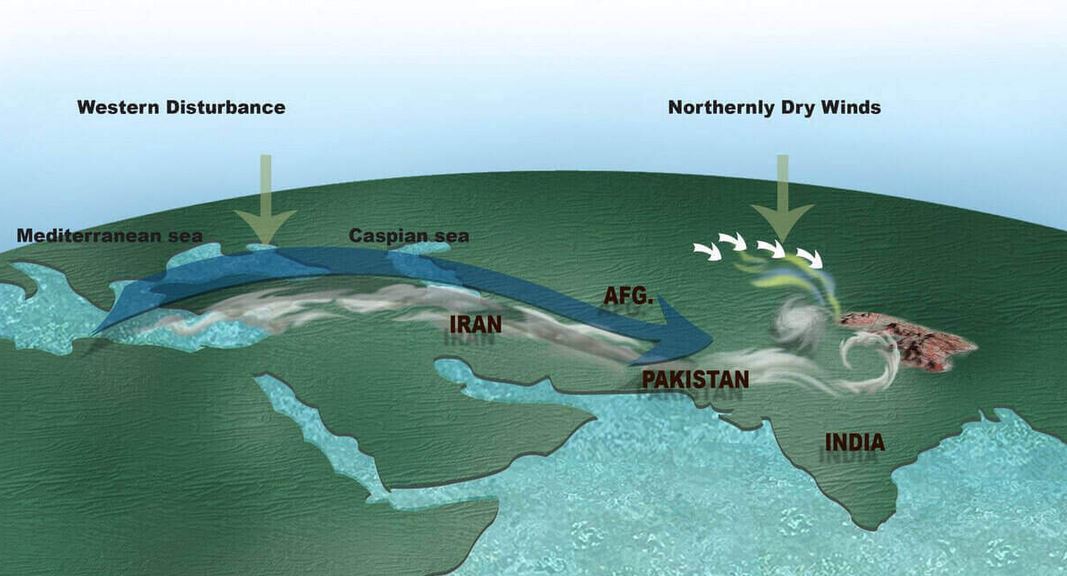
    disturbance

    The days have been unusually warm for winter in New Delhi with the maximum temperature remaining above normal mostly on account of fewer western disturbances affecting this year.

    Western Disturbances

    • A western disturbance is an extratropical storm originating in the Mediterranean region that brings sudden winter rain to the northwestern parts of the Indian subcontinent.
    • They are labelled as an extra-tropical storm originating in the Mediterranean, is an area of low pressure that brings sudden showers, snow, and fog in northwest India.
    • In the term “extra-tropical storm”, storm refers to low pressure. “Extra-tropical” means outside the tropics. As the WD originates outside the tropical region, the word “extra-tropical” has been associated with them.
    • It is a non-monsoonal precipitation pattern driven by the westerlies.
    • The moisture in these storms usually originates over the Mediterranean Sea, the Caspian Sea and the Black Sea.
    • Extratropical storms are global phenomena with moisture usually carried in the upper atmosphere, unlike their tropical counterparts where the moisture is carried in the lower atmosphere.
    • In the case of the Indian subcontinent, moisture is sometimes shed as rain when the storm system encounters the Himalayas.
    • Western disturbances are more frequent and strong in the winter season.

    Impact: Winter Rainfall and Extreme Cold

    • Western disturbances, specifically the ones in winter, bring moderate to heavy rain in low-lying areas and heavy snow to mountainous areas of the Indian Subcontinent.
    • They are the cause of most winter and pre-monsoon season rainfall across northwest India.
    • An average of four to five western disturbances forms during the winter season.

    Its significance

    • Precipitation during the winter season has great importance in agriculture, particularly for the rabi crops.
    • Wheat among them is one of the most important crops, which helps to meet India’s food security.

    Try this PYQ:

    Consider the following statements:

    1. The winds which blow between 30°N and 60°S latitudes throughout the year are known as westerlies.
    2. The moist air masses that cause winter rains in the North-Western region of India are part of westerlies.

    Which of the statements given above is/are correct?

    (a) Only 1

    (b) Only 2

    (c) Both 1 and 2

    (d) Neither 1 nor 2


    [wpdiscuz-feedback id=”uouc14yg8a” question=”Please leave a feedback on this” opened=”1″]Post your answers here.[/wpdiscuz-feedback]


    Click and get your FREE Copy of CURRENT AFFAIRS Micro Notes

    (Click) FREE 1-to-1 on-call Mentorship by IAS-IPS officers | Discuss doubts, strategy, sources, and more

  • [pib] 150th birth anniversary of Sri Aurobindo’s

    aurobindo

    PM will participate in a program commemorating Sri Aurobindo’s 150th birth anniversary.

    Sri Aurobindo (1872 –1950)

    • Sri Aurobindo Ghose was a philosopher, yogi, maharishi, poet, and Indian nationalist.
    • He was also a journalist, editing newspapers such as Vande Mataram.
    • He joined the Indian movement for independence from British colonial rule, until 1910 was one of its influential leaders.

    Major activities                

    • Aurobindo studied for the Indian Civil Service at King’s College, Cambridge, England.
    • After returning to India he took up various civil service works under the Maharaja of the Princely state of Baroda.
    • He became increasingly involved in nationalist politics in the Indian National Congress and the nascent revolutionary movement in Bengal with the Anushilan Samiti.
    • He was arrested in the aftermath of a number of bombings linked to his organization in a public trial where he faced charges of treason for Alipore Conspiracy.
    • However, Sri Aurobindo could only be convicted and imprisoned for writing articles against British colonial rule in India.


    Try this PYQ:

    Q. What was the main reason for the split in the Indian National Congress at Surat in 1907?

    (a) Introduction of communalism into Indian politics by Lord Minto

    (b) Extremists’ lack of faith in the capacity of the moderates to negotiate with the British Government

    (c) Foundation of Muslim League

    (d) Aurobindo Ghosh’s inability to be elected as the President of the Indian national Congress


    [wpdiscuz-feedback id=”3p7o9675ds” question=”Please leave a feedback on this” opened=”1″]Post your answers here.[/wpdiscuz-feedback]


    Click and get your FREE Copy of CURRENT AFFAIRS Micro Notes

    (Click) FREE 1-to-1 on-call Mentorship by IAS-IPS officers | Discuss doubts, strategy, sources, and more

  • Is it Jawaharlal Nehru’s fault?

    Nehru

    Context

    • Jawaharlal Nehru has recently come under criticism for declining to accept the Kashmir Maharaja’s initial offer to accede to India in September 1947, several weeks before the tribal invasion. Even great statesmen make occasional mistakes and Nehru was no exception. However, a careful examination of the historical background shows that Prime Minister Nehru cannot be faulted in this case.

    Click and get your FREE Copy of CURRENT AFFAIRS Micro Notes

    Background: Jammu and Kashmir’s Maharaja Hari Singh and his stand on accession

    • Stand against accession with either India or Pakistan: Maharaja Hari Singh of Jammu and Kashmir was one of the few princely rulers who had held out against accession to either India and Pakistan before the partition of British India.
    • Lord Mountbatten visit and assurance: a couple of months prior to the partition, the Viceroy, Lord Mountbatten, visited Srinagar in an attempt to persuade the Maharaja to opt for one or the other of the two states, offering him an assurance from Sardar Patel that India would raise no objection if the ruler were to opt for Pakistan.
    • Maharaja evaded discussion and hopes for an independent state: The Maharaja entertained his guest in regal style but evaded any discussion on the political issue, pleading a stomach ailment. Hari Singh evidently hoped that, with the lapse of British paramountcy, he would become the ruler of an independent and sovereign state.

    How Maharaja’s hope of a sovereign state got dashed?

    • Uprising assisted by Pakistan: An uprising in Poonch assisted by Pakistani elements.
    • Economic sanctions by Pakistan: an undeclared economic embargo imposed by the Pakistani authorities. Since Kashmir’s main trade exchanges in those days were with Pakistan, the unofficial embargo resulted in great hardship.

    How Maharaja revised his position on accession?

    • Decided to talk on terms of accession and a message to Nehru: Maharaja asked Justice Mehr Chand Mahajan, his prime minister-designate, to convey to Nehru the terms on which he was prepared to accede to India.
    • Nehru urging Maharaja to induct Sheikh Abdullah into state government: Nehru had been urging the Maharaja to induct Sheikh Abdullah, the leader of the secular National Conference, into the state government in order to ensure popular support for the administration.
    • Reluctant to have immediate administrative reforms Maharaja refused: The Maharaja was not agreeable to introducing immediate reforms in the administration of the state. The Maharaja indicated that he was not prepared to do so, at least at this stage.
    • Nehru reiterated to associate Abdullah with the governance of the state: When Mahajan conveyed these terms to Nehru in the third week of September, the latter reiterated that Abdullah should be freed from prison and associated with the governance of the state.

    Nehru

    Why did Nehru insist on bringing Sheikh Abdullah into the administration?

    • He anticipated the armed intervention by Pakistan and armed rebellion: Nehru anticipated armed intervention by Pakistan in Kashmir and foresaw that this could be repulsed only by a government that enjoyed popular support.
    • A letter to Sardar patel before a month before tribal invasion: He set out his views in a letter to Sardar Patel on September 27, 1947, nearly a month before the tribal invasion. This remarkable letter has not received the attention it deserves.
    • Anticipating the demand of the time, he confirmed his way: Nehru, therefore, concluded that the only acceptable course was for the Maharaja to seek the cooperation of Sheikh Abdullah and the National Conference while acceding to India. This was the only effective way of countering Pakistani designs.

    Interesting: Nehru’s letter to Sardar Patel a month before tribal invasion assisted by Pakistan

    • “The Muslim League in the Punjab and the NWFP are making preparations to enter Kashmir in considerable numbers. The approach of winter is going to cut off Kashmir from the rest of India,” he wrote. “I understand that the Pakistan strategy is to infiltrate into Kashmir now and to take some major action as soon as Kashmir is more or less isolated because of the coming winter. I rather doubt if the Maharaja and the State forces can meet the situation by themselves without some popular help… Obviously the only major group that can side with them is the National Conference under Sheikh Abdullah’s leadership.”

    Nehru

    Rest is the story of accession

    • Nehru’s assessment confirmed and Maharaja agreed to his advice: Nehru’s assessment of Pakistan’s plans to invade Kashmir were confirmed within three weeks. It was only at this stage that the Maharaja heeded Nehru’s advice. He inducted Sheikh Abdullah into the government and acceded to India. This had momentous consequences for the defence of Kashmir against the invaders.
    • Resistance against Pakistani invaders: The normal administrative machinery had broken down and responsibility for maintaining law and order had been taken over by National Conference volunteers. Abdullah and his followers organised the popular resistance against the Pakistani invaders.
    • Advance of raiders and then Indian troops were airlifted to assist and protect the state: With the advance of the raiders towards Srinagar, the Maharaja’s administration had virtually collapsed. By the time Indian troops were airlifted to Srinagar on October 27, 1947, the Maharaja had departed to Jammu for safety. The first batches of Indian troops who had been airlifted to Srinagar had arrived without transport vehicles.

    Conclusion

    • Far from being a blunder, Jawaharlal Nehru’s insistence on linking accession to the installation of a popular government in Jammu and Kashmir bears testimony to his foresight and statesmanship.
  • Why are nitrogenous fertilizers still a first choice of farmers?

    fertilizers

    Context

    • Two ambitious schemes of the Central government such as Soil Health Card and mandatory neem-coating of urea were supposed to promote balanced use of fertilisers. However, far from weaning farmers from urea, annual consumption of this nitrogenous fertiliser has only risen from 30 to 35 million tonnes (mt) in the last five years.

    Click and get your FREE Copy of CURRENT AFFAIRS Micro Notes

    Rise in the sales of nitrogenous fertilizers

    • Rise in sales of not only urea but also DAP: This year, not only have urea sales gone up by 3.7 per cent during April-October over the same period of 2021, it has grown even more, at 16.9 per cent, for di-ammonium phosphate (DAP).
    • Sales are not in correct proportion: It has come even as sales of all other fertilisers including complexes containing nitrogen (N), phosphorus (P), K (potash) and sulphur (S) in different proportions have fallen.
    • Urea and DAP are the dominant choice of Indian farmers: In other words, instead of balanced use of plant nutrients based on soil testing and specific crop requirement, Indian farmers are effectively applying just urea and DAP both high-analysis fertilisers containing 46 per cent N and P respectively.

    Fertilizers

    What are the reasons for increasing use of Urea and DAP Fertilizers?

    • The non-urea fertiliser is decontrolled or fixed by the companies: The government has fixed the maximum retail price (MRP) of urea at Rs 5,628 per tonne. The MRPs of other fertilisers are technically decontrolled, but companies have been “told” not to charge more than Rs 27,000/tonne for DAP.
    • Informally fixed prices are higher: The informally-fixed MRPs are higher at Rs 29,000-31,000 and Rs 34,000 per tonne for NPKS complexes and muriate of potash (MOP) respectively, but farmers have little incentive to buy at these prices.
    • DAP is cheaper to apply: Farmers are reluctant to apply complexes such as 10:26:26:0, 12:32:16:0 and 20:20:0:13 when DAP is cheaper and has 46 per cent P as well as 18 per cent N.
    • Price is the primary concern for over micronutrients: The fact that DAP does not contain K, S or other macro and micro nutrients wouldn’t matter to a majority of farmers. For them, choice of fertilisers is primarily a function of prices.
    • Subsidies on individual ferlizers are to be blamed: Underpricing of urea (a historical phenomenon) and DAP (recent) is a product of subsidy-induced market distortions, for which the blame lies squarely with the Government.

    Ideal ratio for N:P:K and effects of excessive use

    • Ideal ratio v/s current NPK ratio: The effects of these the current NPK ratio is about 13:5:1, as against the ideal 4:2:1 would ultimately show up in crop yields.
    • Plants will respond poorly: Plants, like humans, will respond poorly to fertilisers if only one or two nutrients are given in excess.
    • Disturbs soil health: Excessive use of chemical fertilizers kills all the microorganisms available in the soil, which are so essential for maintaining soil health

    What the government can do?

    • Changing the subsidy policies: The Government should replace subsidies on individual fertiliser products with a flat per-hectare cash transfer, maybe twice a year.
    • E- wallet account for money transfer only to purchase fertilizers: Every farmer can have an e-wallet account into which this money can be credited before the kharif and rabi planting seasons. The e-wallet may be used only for the purchase of fertilisers.
    • Maintaining stock of basic fertilizers: The government can maintain a stock of basic fertilisers, including urea and DAP, to ensure no untoward price rise even in a decontrol scenario.

    Fertilizers

    Have you heard? “PM PRANAM” scheme

    • In order to reduce the use of chemical fertilisers by incentivising states, the Union government plans a new scheme – PM PRANAM, which stands for PM Promotion of Alternate Nutrients for Agriculture Management Yojana.
    • The proposed scheme intends to reduce the subsidy burden on chemical fertilisers.
    • This burden if uneased, is expected to increase to Rs 2.25 lakh crore in 2022-2023, which is 39% higher than the previous year’s figure of Rs 1.62 lakh crore.
    • The scheme will not have a separate budget and will be financed by the “savings of existing fertiliser subsidy” under schemes run by the Department of fertilisers.

    Conclusion

    • The compulsions of electoral politics have clearly trumped concerns over soil nutrient imbalances. Price distortions in fertilisers will not help farming in the long run. Govt can offer acreage-based cash transfers.

    Mains Question

    Q. Despite government efforts to reduce nitrogenous fertilizers, the annual consumption of these fertilizers is increasing. Discuss the reasons and what government can do more?

    (Click) FREE1-to-1 on-call Mentorship by IAS-IPS officers | Discuss doubts, strategy, sources, and more

  • End-to-end Encryption and related issues

    encrypt

    Apple recently announced that it will be increasing the number of data points protected by end-to-end encryption on iCloud.

    What is end-to-end encryption?

    encrypt

    • End-to-end encryption is a communication process that encrypts data being shared between two devices.
    • It prevents third parties like cloud service providers, internet service providers (ISPs) and cybercriminals from accessing data while it is being transferred.
    • The process of end-to-end encryption uses an algorithm that transforms standard text into an unreadable format.
    • This format can only be unscrambled and read by those with the decryption keys, which are only stored on endpoints and not with any third parties including companies providing the service.
    • This encryption has long been used when transferring business documents, financial details, legal proceedings, and personal conversations.
    • It can also be used to control users’ authorisation when accessing stored data, which seems to be what Apple intends to do.

    Where is it used?

    • End-to-end encryption is used to secure communications.
    • Some of the popular instant-messaging apps that use it are Signal, WhatsApp, iMessage, and Google messages.
    • However, instant messaging is not the only place where user data is protected using end-to-end encryption.
    • It is also used to secure passwords, protect stored data and safeguard data on cloud storage.

    Why are tech companies using it?

    • Preventing data breach: Tech companies often cite data breach issue.
    • Extra protection: Encryption puts extra layer of protection that would protect valuable digital information against hacking attacks.
    • Prevent snooping: It is also seen as a technology that secures users’ data from snooping by government agencies, making it a sought-after feature by activists, journalists, and political opponents.
    • Capital generation: It showcases any company’s position as a provider of secure data storage and transfer services.

    What does it mean for users?

    • End-to-end encryption ensures that user data is protected from unwarranted parties including service providers, cloud storage providers, and companies that handle encrypted data.
    • Encrypted data can only be decrypted by trusted devices.
    • No one else can access this data and it remains secure even in the case of a data breach in the cloud storage.

    Why are government agencies unhappy with it?

    • The FBI in a statement expressed displeasure at the idea of increasing use of end-to-end encryption by technology companies.
    • It said that while it remains a strong advocate of encryption schemes that give “lawful access by design”, that would enable tech companies “served with a legal order” to decrypt data.
    • Attempts by government agencies across the globe, in the past, to access encrypted data hosted and stored by tech companies have met with strong resistance.
    • Law enforcement agencies seeks to weaken encryption with backdoors.
    • Thus is considered ill-advised and could compromise the reliability of the internet.


    Click and get your FREE Copy of CURRENT AFFAIRS Micro Notes

    (Click) FREE 1-to-1 on-call Mentorship by IAS-IPS officers | Discuss doubts, strategy, sources, and more