💥Join UPSC 2027,2028 Mentorship (July Batch) + XFactor Notes & Microthemes PDF

Distribution: yearly

  • Commission on Genetic Resources for Food and Agriculture (CGRFA)

    Why in the News?

    The 20th meeting of the Commission on Genetic Resources for Food and Agriculture (CGRFA-20) is currently underway in Rome.

    About Commission on Genetic Resources for Food and Agriculture (CGRFA)

    • The CGRFA is the only permanent intergovernmental body addressing all components of biodiversity-related to food and agriculture.
    • It was established in 1983 as the Commission on Plant Genetic Resources for Food and Agriculture.
    • It operates under the Food and Agriculture Organization (FAO) of the United Nations.
    • It aims to create international consensus on managing biodiversity in food systems and ensuring the fair and equitable sharing of benefits from these genetic resources.
    • Membership: 179 countries (including India) and the European Union
    • Focus: Coordinates global efforts on biodiversity affecting agriculture, forestry, livestock, and aquatic species, including pollinators, soil organisms, and other vital species for food production.

    Structure and Mandate

    • Structure:
      • Governed by a biennial session where member countries discuss and make decisions.
      • A bureau, elected by member states, guides the Commission’s work.
      • The CGRFA Secretariat, hosted by FAO, offers technical and logistical support.
    • Mandate:
      • Policy Formulation: Develops global action plans, codes of conduct, and policy instruments for sustainable use and conservation of genetic resources for food and agriculture.
      • Global Assessments: Guides preparation of periodic assessments to monitor the status and trends of genetic resources and biodiversity.
      • Sustainable Use of Biodiversity: Promotes biodiversity use for food security, sustainable agriculture, and climate adaptation.
      • Fair and Equitable Benefit Sharing: Ensures fair distribution of benefits from genetic resources, especially plant materials under international treaties.
    • Achievements:
      • International Treaty on Plant Genetic Resources for Food and Agriculture (ITPGRFA): Adopted in 2001, it recognizes farmers’ contributions to crop diversity and provides a global system for accessing plant genetic materials for breeders, farmers, and scientists.
    [UPSC 2014] Consider the following international agreements:

    1. The International Treaty on Plant Genetic Resources for Food and Agriculture

    2. The United Nations Convention to Combat Desertification

    3. The World Heritage Convention

    Which of the above has / have a bearing on the biodiversity?

    Options: (a) 1 and 2 only (b) 3 only (c) 1 and 3 only (d) 1, 2 and 3


  • 50 Years of Farakka Barrage

    Why in the News?

    It was nearly 50 years ago, that India had completed the construction of the Farakka Barrage.

    About Farakka Barrage

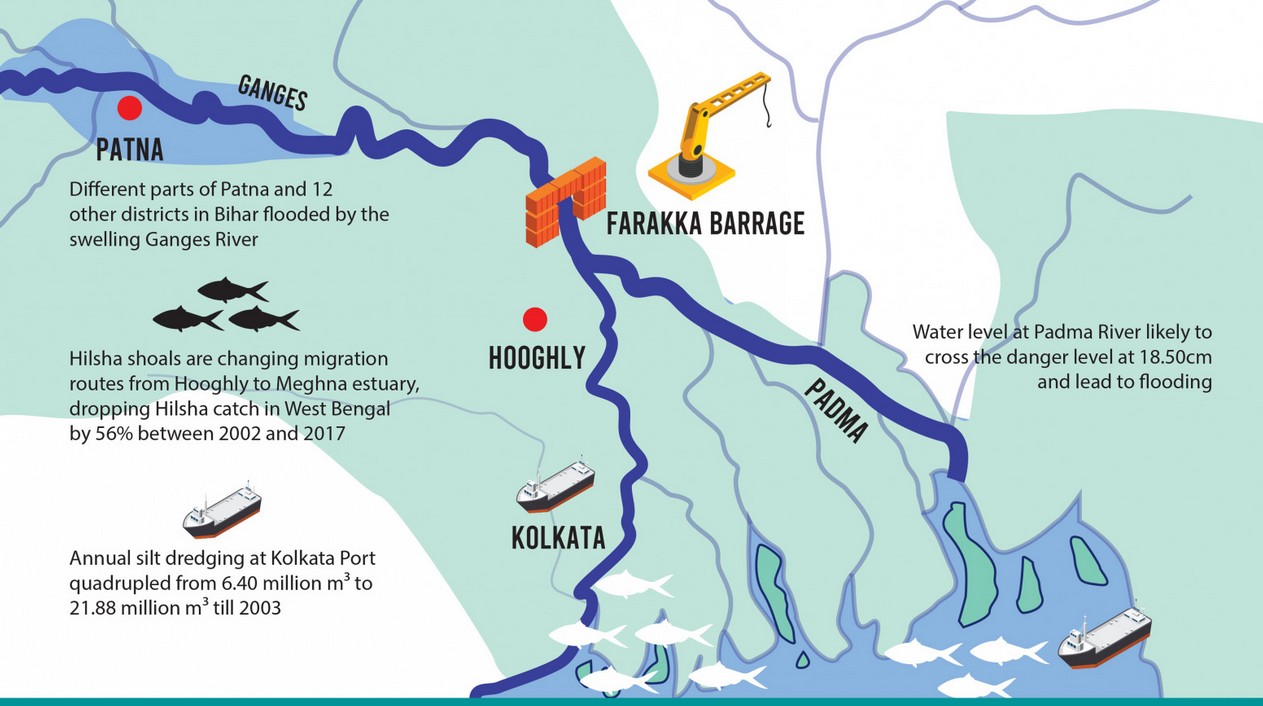
    • The Farakka Barrage is located on the Ganges River in Murshidabad District, West Bengal, India, about 18 km from the Bangladesh border.
    • The barrage measures 2,304 meters (7,559 feet) in length.
    • Its construction began in 1962 and was completed in 1970 at a cost of 1 billion dollars. It became operational on April 21, 1975.
    • The Feeder Canal is approximately 42 km long, connecting the barrage to the Hooghly River.
    • Purpose:
      • It diverts water to the Hooghly River to maintain the navigability of Kolkata Port and to flush out sediment from the river.
      • It diverts 1,800 cubic meters per second of water from the Ganges.
    • Construction Details:
      • Built by Hindustan Construction Company, it consists of 109 gates, with 108 over the river and one over low-lying land as a precaution.
      • Supports the Farakka Super Thermal Power Station.
    • The 1996 Ganges Water Sharing Treaty ensured fair water distribution:
      • 70,000 cusecs or less: 50% to both India and Bangladesh.
      • 70,000 – 75,000 cusecs: India gets 35,000 cusecs, Bangladesh the balance.
      • 75,000 cusecs or more: India receives 40,000 cusecs, Bangladesh gets the remainder.

    Significance in India-Bangladesh Water Sharing:

    • The Farakka Barrage is crucial for irrigation in West Bengal, supporting agriculture during the dry season.
    • Bangladesh, particularly Mongla and Khulna, depends on the Ganges for water.
    • The diverted water has led to water scarcity, impacting agriculture, fisheries, and livelihoods in Bangladesh, causing diplomatic tensions.
    • This treaty ensures equitable distribution and guarantees a minimum flow for Bangladesh.
    • Issues: 
      • Water diversion has led to salinization and soil degradation in Bangladesh, affecting agriculture and freshwater supplies.
      • Biodiversity loss and damage to the Sundarbans mangrove forests have been significant environmental impacts.
    [UPSC 1997] The canal-carrying capacity of Farakka is:

    (a) 40,000 cusecs (b) 60,000 cusecs (c) 80,000 cusecs (d) 100,000 cusecs


  • Exercise ‘AIKEYME’

    Why in the News?

    India is set to strengthen its military and maritime ties with African nations through two significant initiatives—Exercise Aikeyme (Africa-India Key Maritime Engagement) and IOS Sagar (Indian Ocean Ship Sagar).

    About Exercise Aikeyme 

    • Aikeyme is India’s first-ever multilateral naval exercise with 10 African nations, aimed at improving maritime cooperation, enhancing maritime security, and addressing regional threats.
    • It will be held off Dar-es-Salaam, Tanzania, from April 13 to 18, 2025.
    • The nations taking part include Tanzania (co-host), Comoros, Djibouti, Eritrea, Kenya, Madagascar, Mauritius, Mozambique, Seychelles, and South Africa.
    • It is aimed at increasing interoperability between the Indian Navy and African navies, with a focus on combating common threats like piracy and drug trafficking.
    • The goal is to make this exercise a biennial event and expand participation in future editions to include West African nations.
    • Key Features:
      • Visit Board Search and Seizure (VBSS) drills.
      • Arms firing exercises.
      • Helicopter operations.
      • Search and rescue missions.
      • Table-top and command post exercises on anti-piracy operations and information-sharing.

    IOS Sagar (Indian Ocean Ship) Initiative

    • The IOS Sagar initiative focuses on deepening India’s maritime cooperation with IOR countries.
    • It involves the deployment of the Indian Navy’s INS Sunayna, which will be manned by a combined crew of Indian sailors and 44 personnel from nine African countries.
    • The initiative will take place from April 5 to May 8, 2025.
    • Key Participating Countries: Sri Lanka, Maldives, Mauritius, Comoros, Kenya, Madagascar, Mozambique, Seychelles, and South Africa.
    • Activities:
      • The ship will undertake port calls at Dar-es-Salaam, Nacala, Port Louis, Port Victoria, and Male.
      • The ship will also engage in joint surveillance of the Exclusive Economic Zones (EEZs) of Tanzania, Mozambique, Mauritius, and Seychelles.
      • The personnel will undergo two-week training capsules at Kochi, including sea training, watchkeeping, and other professional naval activities.
  • Lapis Lazuli and its Ancient Significance

    Why in the News?

    This newscard is an excerpt from the original article published in ‘The Hindu’.

    Lapis Lazuli and its Ancient Significance

    About Lapis Lazuli

    • Lapis lazuli is a deep-blue metamorphic rock prized for its vibrant colour, often used in jewellery and decorative items.
    • It is composed mainly of lazurite, with other minerals like calcite and pyrite, which give it its characteristic golden specks.
    • It is mainly found in Afghanistan’s Badakhshan province, though it is also present in Chile, Russia, and the US.
    • It has been valued since ancient times, particularly in Egypt, Mesopotamia, and Greece, and is known for its use in making pigments, especially ultramarine.

    Lapis Lazuli and its Ancient Significance

    Lapis Lazuli in Indus Valley Civilization (IVC):

    • The Indus Valley Civilization (IVC) (3300-1900 BC) had extensive trade with Mesopotamia and Afghanistan, where lapis lazuli was imported.
    • It was used for beads and ornaments found at Mohenjo-daro and Harappa, underscoring its value in Indus jewellery.
    • It was a sacred stone, often used in beads, pendants, and amulets, symbolizing spirituality and high social status.
    • It was likely associated with religious ceremonies and used to represent the gods.
    • The Indus people were skilled at bead-making, often combining lapis lazuli with other stones, such as gold.
    • The intricate designs, including incised or painted beads, reflect their technical expertise.

    Other Semi-Precious Stones Found in IVC:

    Several semi-precious stones were used by the IVC to create jewellery and ornaments:

    • Carnelian beads were made into pendants and rings, valued for their reddish-orange hue and durability.
    • Amethyst beads, a purple quartz variety, were also used, likely imported from other regions.
    • Jasper, a chalcedony variety, was used for beads and pendants, valued for its earthy tones.
    • Turquoise was used in beads, often combined with lapis lazuli and carnelian.
    • Steatite (Soapstone) was used for seals and beads, often engraved with animal motifs or symbols.
    • Crystal and quartz were used for translucent beads, adding a mystical quality to jewelry.
    • Gold, combined with semi-precious stones like lapis lazuli, carnelian, and turquoise, was extensively used in necklaces, bracelets, and earrings.


    [UPSC 2023] Lothal, a significant site of the Indus Valley Civilization, was particularly well-known as a:

    (a) major agricultural centre

    (b) centre for textile production

    (c) major trade hub for beads, gems, and ornaments

    (d) site with extensive fire altars


  • [ 24th March 2025] The Hindu Op-ed: The need for universal and equitable health coverage

    PYQ Relevance:

    Question: Besides being a moral imperative of a Welfare State, primary health structure is a necessary precondition for sustainable development.’ Analyse (UPSC IAS 2021)

    Reason:  A strong primary health structure, as highlighted in this question, is fundamental for achieving equitable access to healthcare. It serves as the first point of contact and helps in early detection and management of health issues across all sections of society.

    Mentor’s Comment: UPSC usually focuses on the primary health structure in 2021 and Public healthcare system in 2024.

    India has made significant progress in TB care by expanding rapid molecular testing, introducing the shorter all-oral BPaLM regimen, increasing Ni-kshay Poshan Yojana support to ₹1,000 per month, and strengthening community involvement. These efforts led to a 17.7% drop in TB incidence and a 21.4% decline in TB deaths between 2015 and 2023.

    Today’s editorial highlights significant advancements in tuberculosis (TB) care and their impact. This information is valuable for GS Paper 2 and 3 in UPSC Mains answer writing.

    _

    Let’s learn!

    Why in the News?

    Integrating TB services into the public health system is essential for ensuring fair and universal healthcare for everyone in India.

    What are the key advancements India has made in tuberculosis (TB) care?

    • Expansion of Molecular Testing for Rapid Detection: India has significantly expanded molecular testing, enabling faster and more accurate diagnosis of TB and drug-resistant TB. Example: Introduction of CBNAAT (Cartridge-Based Nucleic Acid Amplification Test) and TrueNat machines in primary health centers for early detection.
    • Improved Drug Regimens & Shorter Treatment Duration: Newer drug combinations have reduced treatment duration for drug-resistant TB, increasing patient compliance. Example: The shorter BPaL regimen (Bedaquiline, Pretomanid, and Linezolid) has improved MDR-TB cure rates and reduced mortality.
    • Better Access to Free & Effective Treatment: Government programs like the National TB Elimination Programme (NTEP) provide free TB medicines, improving adherence and reducing deaths. Example: MDR-TB patients receiving Bedaquiline and Delamanid have better survival rates compared to traditional toxic injectable treatments.
    • Enhanced Nutritional and Financial Support: The Ni-kshay Poshan Yojana (NPY) doubled financial assistance from ₹500 to ₹1,000 per month for TB patients to ensure proper nutrition. Example: Over 40 lakh patients have benefited from direct benefit transfers under this scheme.
    • Integration of TB Services with Primary Healthcare: TB care is now incorporated into the Ayushman Bharat scheme, linking it with Health and Wellness Centres (Ayushman Arogya Mandirs). Example: These centers serve as sputum collection points and treatment hubs, improving accessibility for rural and urban populations.
    • Community Engagement and Preventive Strategies: Expansion of TB preventive therapy and involvement of TB survivors as “TB Champions” to promote awareness and early detection. Example: The “100 Days” campaign aims to improve case detection and ensure early intervention for high-risk populations.

    How have these advancements contributed to a decline in TB incidence and mortality rates?

    • Decline in TB Incidence: In 2015, TB incidence in India was 237 per lakh population. By 2022, it had dropped to below 200 per lakh, showing a 16% decline. Example: If 237 people per lakh had TB in 2015, now fewer than 200 per lakh are affected.
    • Reduction in TB Mortality: TB mortality declined from higher levels in 2015 to 23 per lakh population in 2022. This represents an 18% decline in TB-related deaths. Example: If 100,000 people were affected, 23 would die from TB in 2022 compared to a higher number in 2015.

    Who are the most vulnerable groups affected by TB?

    • People with Weakened Immune Systems: Individuals with HIV/AIDS, diabetes, malnutrition, or chronic illnesses are more susceptible due to weaker immunity. Example: TB is the leading cause of death among people with HIV, as their immune system cannot effectively fight the infection.
    • Low-Income & Undernourished Populations: Malnutrition and poverty increase TB risk by weakening immunity and limiting access to healthcare. Example: In India, undernourished populations, especially in tribal and slum areas, have higher TB incidence due to poor living conditions.
    • Migrants, Prisoners, and Urban Slum Dwellers: Overcrowded and poorly ventilated environments increase TB transmission. Example: Migrant workers living in congested dormitories or prison inmates are at a higher risk of infection due to close contact with infected individuals.

    Gender & Tuberculosis: Challenges, Data, and Solutions

    Category Challenges Data & Examples Solutions
    Women & TB Social Stigma and Fear of Isolation 60% of women diagnosed with TB in India face stigma (REACH, 2022). Community awareness campaigns like “TB Mukt Mahila” in Uttar Pradesh.
    Misdiagnosis & Underreporting Only 34% of TB cases in women are officially diagnosed (WHO, 2019). Gender-sensitive diagnostic protocols in PHCs. Routine TB screening during maternal health checkups (Rajasthan model).
    Limited Healthcare Access 50% of rural women delay TB treatment due to financial dependence (Global TB Report, 2023). Example: Bihar’s ASHA workers report women refusing solo hospital visits, delaying treatment. Mobile TB clinics and door-to-door screenings.
    Higher Risk of Malnutrition 45% of women with TB suffer from malnutrition (NFHS, 2023). Example: 80% of TB-infected women in Jharkhand lack protein-rich diets, increasing dropout rates. Ni-kshay Poshan Yojana benefits for women, with an extra ₹500 allowance in Madhya Pradesh.
    Children & TB Non-Specific Symptoms & Misdiagnosis 60% of childhood TB cases present with fever and weight loss, not cough (IAP, 2022). AI-based diagnostic tools like Bihar’s AI-assisted TB detection, which increased early diagnosis by 28%.
    Sputum Test Ineffectiveness 40-50% of children’s TB cases are undetectable using standard sputum tests (WHO, 2023). Example: Delhi’s AIIMS introduced stool-based PCR testing, increasing childhood TB detection by 25%. Nationwide adoption of stool-based PCR tests.
    Late Detection in Infants 30% of TB meningitis cases in infants are fatal due to delayed screening. Routine TB screening during childhood immunizations.
    Malnutrition & Weak Immunity Malnourished children are six times more likely to develop TB (WHO, 2023). Example: 90% of TB-infected children in Jharkhand were also undernourished. Integrate TB screening with anganwadi nutrition programs.
    Exposure to Household TB 50% of children living with TB-infected adults develop latent TB, but only 15% receive preventive therapy (Nikshay Portal, 2023). Example: Kerala’s preventive therapy program reduced childhood TB cases by 40%. Preventive therapy for all children in TB-affected households.
    Lack of Awareness Among Parents 70% of parents believe TB only affects adults (UP survey, 2023). Example: Schools in Gujarat introduced annual TB screening camps, improving early detection. Mandatory TB screening in schools and anganwadis. Maharashtra’s “TB-Free Schools” program detected 5,000 hidden cases in 2023.

    Why is the integration of TB services within the broader public health system crucial for achieving Universal Health Coverage (UHC) in India?

    • Ensures Comprehensive and Equitable Healthcare Access: Integrating TB services into primary healthcare allows early detection and treatment for all, especially marginalized populations. Example: Including TB screening in Ayushman Bharat-Health and Wellness Centres (HWCs) improves outreach in rural areas.
    • Reduces Financial Burden on Patients: Universal Health Coverage (UHC) aims to provide affordable treatment and minimize out-of-pocket expenses for TB care. Example: Linking TB care with PM-JAY (Ayushman Bharat) ensures free diagnostic and treatment services, reducing financial distress.
    • Improves Early Detection and Treatment Outcomes: Strengthening public health infrastructure with integrated screening programs improves early diagnosis and treatment adherence. Example: Nikshay Poshan Yojana provides nutritional support to TB patients, improving recovery and treatment success rates.
    • Addresses Co-Morbidities and Holistic Patient Care: TB patients often suffer from HIV, diabetes, or malnutrition; integration helps manage co-existing diseases efficiently. Example: Co-treatment of TB and HIV in ART (Antiretroviral Therapy) centers ensures better health outcomes.
    • Strengthens Disease Surveillance and Data Management: A unified health system enhances TB monitoring, tracking drug resistance, and controlling outbreaks. Example: The Nikshay portal helps track patient progress and ensures adherence to treatment regimens.

    How does the Ayushman Bharat scheme contribute to decentralizing TB care?

    • Expansion of Health and Wellness Centres (HWCs): Primary healthcare centres (PHCs) and HWCs under Ayushman Bharat provide TB screening, diagnosis, and treatment at the grassroots level, reducing dependency on tertiary hospitals. Example: A TB patient in a remote village can access free CBNAAT/Truenat testing at a nearby HWC, ensuring early detection.
    • Financial Protection through PM-JAY: The Pradhan Mantri Jan Arogya Yojana (PM-JAY) covers TB treatment costs, reducing the financial burden on poor and vulnerable groups. Example: A migrant laborer diagnosed with drug-resistant TB can avail free hospitalization and medication under PM-JAY without financial hardship.
    • Community-Based TB Care and Awareness: Health workers (ASHA, ANMs) are trained to provide TB awareness, medication adherence support, and nutritional aid at the community level. Example: An ASHA worker monitors a TB patient’s medicine intake and nutrition under the Nikshay Poshan Yojana, preventing treatment dropout.

    What are Ayushman Arogya Mandirs (AAMs)?

    • Ayushman Arogya Mandirs (AAMs) are upgraded Health and Wellness Centres (HWCs) under the Ayushman Bharat scheme, aimed at strengthening primary healthcare across India.
    • These centers provide comprehensive healthcare services at the community level, integrating preventive, promotive, curative, and diagnostic care.

    What role do Ayushman Arogya Mandirs (AAMs) play in this process?

    • Strengthening TB Screening and Early Detection: Ayushman Arogya Mandirs (AAMs) serve as first-contact healthcare facilities offering free TB screening and diagnostic services, improving early detection. Example: A person with persistent cough visiting an AAM in a rural area can get an immediate sputum test, preventing delayed diagnosis.
    • Ensuring Free and Continuous TB Treatment: AAMs provide directly observed treatment (DOTS) services, ensuring uninterrupted access to TB medicines and better adherence to treatment. Example: A TB patient enrolled at an AAM receives daily monitored medication, reducing the risk of drug resistance and treatment dropout.
    • Community Engagement and Nutritional Support: AAMs facilitate awareness programs, counseling, and nutritional support through schemes like Nikshay Poshan Yojana to enhance treatment outcomes. Example: A malnourished TB patient visiting an AAM is linked to a nutrition support program, improving overall recovery and immunity.

    Way forward: 

    • Strengthen Multi-Sectoral Collaboration: Enhancing partnerships between healthcare, nutrition, and social welfare sectors can ensure a holistic approach to TB care. Example: Expanding Nikshay Poshan Yojana with additional dietary interventions can improve patient recovery.
    • Leverage Technology for TB Surveillance & Treatment: Expanding AI-driven diagnostic tools and digital adherence tracking can improve early detection and treatment success. Example: Scaling up the use of AI-based X-ray screening in rural areas can enhance case detection rates.
  • Not the only path: On acting against the Maoists

    Why in the News?

    On March 20, 2025, security forces carried out two missions in Bastar, Chhattisgarh, and killed 30 Maoist people. This made the total number of Maoists killed this year more than 100.

    What were the key reasons behind the decline of the Maoist insurgency in India?

    • Strong Counter-Insurgency Operations: Security forces, including CRPF’s elite COBRA (Commando Battalion for Resolute Action) unit and state police forces, have conducted targeted operations against Maoist strongholds. Example: Operation Prahar in Chhattisgarh led to the elimination of top Maoist leaders and disrupted their logistical networks.
    • Improved Governance and Development Initiatives: Infrastructure projects like roads, electrification, and mobile connectivity have reduced Maoist influence by increasing state presence. Example: The Aspirational Districts Programme has focused on healthcare, education, and employment in Maoist-affected regions.
    • Erosion of Support Base: Maoists have lost support due to their violent tactics, including forced recruitment, extortion, and attacks on civilians. Example: The killing of Madvi Hidma, a local tribal leader, by Maoists in Bastar led to mass protests by villagers against them.
    • Surrender and Rehabilitation Policies: Government schemes like the ‘Surrender and Rehabilitation Policy’ offer financial aid, skill training, and housing to former Maoists. Example: Over 600 Maoists surrendered in Telangana and Andhra Pradesh after the government provided rehabilitation and employment opportunities.
    • Internal Divisions and Leadership Crisis: The Maoist movement has suffered from ideological splits, a lack of new leadership, and desertions. Example: The death of Kishenji (Maoist leader) in 2011 and the arrest of several senior cadres have weakened organizational unity.

    Why is a purely militaristic approach insufficient in tackling the Maoist insurgency?

    • Deep-Rooted Socio-Economic Issues Drive Insurgency: Maoism thrives in areas with poverty, land alienation, and lack of governance. Military force alone does not address the core grievances of tribal communities. Example: The displacement of tribals due to mining projects in Dantewada, Chhattisgarh, has fueled resentment, making them vulnerable to Maoist influence.
    • Risk of Civilian Casualties and Alienation: Excessive military action can lead to civilian deaths, human rights violations, and loss of trust in the state, pushing locals towards Maoists instead of the government. Example: The Salwa Judum campaign (2005-2011), a state-backed militia to counter Maoists, led to severe human rights abuses, ultimately worsening the conflict.
    • Failure to Provide a Long-Term Solution: Military operations can weaken Maoists but do not offer a sustainable path for peace and rehabilitation. A mix of governance, dialogue, and development is needed. Example: The Nepali Maoists transitioned into mainstream politics through a negotiated peace process, showing that engagement can be a more effective long-term strategy.


    Where are the remaining strongholds of Maoist influence in India?

    • Southern Chhattisgarh (Bastar Region): Dense forests, difficult terrain, and historical neglect in governance make it a Maoist stronghold. Example: Dantewada, Sukma, and Bijapur districts frequently witness Maoist ambushes on security forces.
    • Border Regions of Jharkhand, Odisha, and Telangana: The tri-junction of these states provides a strategic corridor for Maoist movement and arms supply. Example: Latehar (Jharkhand), Malkangiri (Odisha), and Bhadradri-Kothagudem (Telangana) remain active insurgent zones.
    • Gadchiroli District (Maharashtra): Proximity to Chhattisgarh’s Maoist belt and forested terrain offer a safe haven for Maoist cadres. Example: The Jambhulkheda encounter  saw security forces eliminate top Maoist leaders in this region.

    Who are the primary stakeholders in resolving the Maoist issue peacefully?

    • Government (Union and State Governments): Responsible for policy-making, law enforcement, and development initiatives in affected regions. Example: The Surrender and Rehabilitation Policy offers incentives for Maoists to reintegrate into society.
    • Security Forces (Police, Paramilitary, and Intelligence Agencies): Play a crucial role in counterinsurgency operations and maintaining law and order. Example: The Greyhounds (Telangana), CoBRA (CRPF), and District Reserve Guard (Chhattisgarh) specialise in anti-Maoist operations.
    • Tribal Communities and Local Populations: Often caught in the crossfire, they need protection, development, and inclusion in governance. Example: The PESA Act (1996) empowers tribal self-governance to address their grievances.
    • Civil Society and NGOs: Mediate peace talks, advocate for human rights, and support socio-economic development. Example: Swami Agnivesh’s peace efforts attempted negotiations between Maoists and the government.
    • Former Maoists and Rehabilitation Advocates: It can influence insurgents to surrender and integrate into mainstream society. Example: Former Maoist leader Gopanna Markam, who surrendered and helped bring others into the fold.

    How can lessons from international experiences, such as FARC in Colombia or Nepali Maoists? (Way forward)

    • Negotiation and Political Integration: Offering insurgents a political pathway can encourage them to abandon violence. Example: Nepali Maoists transitioned from armed struggle to mainstream politics through the 2006 Comprehensive Peace Agreement, leading to their participation in democratic governance.
    • Rehabilitation and Reintegration Programs: Providing economic and social reintegration opportunities reduces the chances of re-radicalization. Example: Colombia’s peace deal with FARC (2016) included land reforms, financial aid, and skill development programs for former rebels.
    • Addressing Root Causes through Development: Long-term peace requires addressing socio-economic grievances that fuel insurgencies. Example: Colombia’s rural development programs aimed to improve infrastructure, education, and healthcare in former conflict zones to prevent a resurgence of violence.

    Mains PYQ:

    Question: “Naxalism is a social, economic and developmental issue manifesting as a violent internal security threat. In this context, discuss the emerging issues and suggest a multilayered strategy to tackle the menace of Naxalism.” (2022)

    Reason: This question directly addresses Naxalism (Maoist insurgency) as more than just a security problem, aligning with this article. It also asks for a multilayered strategy, hinting at the need for more than just security measures, such as addressing social and economic issues.
  • Appointment and Removal of High Court Judges

    Why in the News?

    The Chief Justice of India (CJI) has set up a three-member panel to investigate the alleged discovery of a significant sum of money at the residence of a sitting Delhi High Court judge.

    Appointment Process of High Court Judges:

    • According to Article 217, the President of India appoints High Court judges after consulting with the CJI, the Governor of the respective state, and the Chief Justice of the High Court.
    • In the case of the appointment of a judge other than the Chief Justice, the Chief Justice of the High Court is consulted as well.
    • Consultation Process:
      • The process of appointing judges is handled by a Collegium, which includes the CJI and the two senior-most judges of the Supreme Court.
      • The Collegium System allows for a collaborative decision-making process where the Chief Justice of the High Court initiates the proposal, which is then forwarded to the Chief Minister.
      • The Chief Minister, in turn, advises the Governor, who submits the proposal to the Union Law Minister.
      • The Chief Justice of the High Court is appointed in accordance with a policy to ensure that Chief Justices are from outside the respective states.
    • Appointment and Transfer of Judges:
      • The CJI and the senior-most judges of the Supreme Court collectively decide on the appointment and transfer of judges, ensuring judicial independence and preventing executive interference.

    Removal of Judges in the Higher Judiciary:

    • Impeachment Process:
      • Judges of the Supreme Court and High Courts can only be removed by impeachment, which requires a motion signed by 100 Lok Sabha MPs or 50 Rajya Sabha MPs.
      • The impeachment motion is investigated by a three-member judicial committee, and if the committee finds merit in the allegations, Parliament votes on the motion.
      • A 2/3rd majority is needed in both Houses for removal.
      • Parliament can, however, consider a motion to impeach a judge according to the procedure laid down in the Judges (Inquiry) Act, 1968.
    • In-House Inquiry Process:
      • The CJI can initiate an in-house inquiry in the event of serious allegations against a judge. This process involves the Chief Justice of the High Court submitting a report, and if the allegations are deemed serious, a three-member committee is constituted to investigate the matter.
      • If the committee recommends removal, the CJI may advise the judge to resign. If the judge refuses, their judicial work is withdrawn, and impeachment proceedings may be initiated.

    Historical Impeachment Efforts:

    • No judge has been impeached in India, though attempts have been made, including the failed motions against Justice V Ramaswami (1993) and Justice Soumitra Sen (2011).
    • Justice V Ramaswami (1993): Faced impeachment for financial misconduct, but the motion failed in the Lok Sabha.
    • Justice Soumitra Sen (2011): Resigned after impeachment proceedings for misappropriating funds.
    • Justice K Veeraswamy: Chief Justice of Madras HC, investigated for corruption but challenged the investigation. The case remained unresolved until his death in 2010.
    • Justice Shamit Mukherjee (2003), Justice Nirmal Yadav (2008), and Justice SN Shukla (2017): Faced criminal charges for corruption after in-house inquiries found substantial evidence against them.


    [UPSC 2019] Consider the following statements:
    1. The motion to impeach a Judge of the Supreme Court of India cannot be rejected by the Speaker of the Lok Sabha as per the Judges (Inquiry) Act, 1968.
    2. The Constitution of India defines and gives details of what Constitutes ‘incapacity and proved misbehaviour’ of the Judges of the Supreme Court of India.
    3. The details of the process of impeachment of the Judges of the Supreme Court of India are given in the Judges (Inquiry) Act, 1968.
    4. If the motion for the impeachment of a Judge is taken up for voting, the law requires the motion to be backed by each House of the Parliament and supported by a majority of total membership of that House and by not less than two-thirds of total members of that House present and voting.Which of the statements given above is/are correct?
    (a) 1 and 3 only (b) 2 only (c) 3 and 4 only (d) 1, 3 and 4


  • Exercise Varuna

    Why in the News?

    India and France recently conducted the 23rd edition of Exercise Varuna, a key bilateral naval exercise aimed at enhancing interoperability and combat readiness between the two countries’ naval forces.

    About Exercise Varuna

    • Exercise Varuna is a bilateral naval exercise between India and France.
      • It was first initiated in 1993 and officially named Varuna in 2001.
    • The exercise focuses on enhancing combat readiness, improving interoperability, and deepening maritime security cooperation between the two nations.
    • It spans multiple domains, including air, surface, and sub-surface operations, with a strong emphasis on anti-submarine warfare (ASW) and air combat drills.
    • Key Highlights:
      • The 2025 edition took place from March 19-22 off the coast of Goa, with participants such as INS Vikrant (India) and Charles de Gaulle (France).
      • This year’s exercises included aircraft carrier operations, ASW drills, and joint surface warfare operations.
      • Rafale-M (French Navy) and MiG-29K (Indian Navy) fighters participated in advanced air defence and mock air-to-air combat scenarios. 
      • Indian Scorpene-class submarines acted as aggressors, while French and Indian frigates protected high-value assets, including the French oiler Jacques Chevallier.
      • These drills enhanced underwater domain awareness and improved ASW tactics.

    Other Notable India-France Military Exercises:

    • FRINJEX: A joint exercise between the Indian and French armies focused on ground operations.
    • GARUDA: A bilateral air exercise between the Indian and French air forces, first held in 2003.
    • SHAKTI: A biennial military exercise between India and France, focusing on counter-terrorism operations.
    • La Pérouse: A multilateral maritime exercise led by the French Navy, with India participating for the first time in 2021.


    [UPSC 2024] Which of the following statements about ‘Exercise Mitra Shakti-2023’ are correct?

    1. This was a joint military exercise between India and Bangladesh.

    2. It commenced in Aundh (Pune).

    3. Joint response during counter-terrorism operations was a goal of this operation.

    4. Indian Air Force was a part of this exercise.

    Select the answer using the code given below:

    (a)  1, 2 and 3 (b) 1 and 4 (c) 1 and 4 (d)  2, 3 and 4


  • United Nations World Water Development Report, 2025

    Why in the News?

    On March 21, 2025, the United Nations marked the first-ever World Day for Glaciers, and in conjunction, the United Nations World Water Development Report issued a disturbing warning about the rapid loss of glaciers.


    Key Highlights of the Report:

    • Hindu Kush Himalayas (HKH) Glacier Loss: Glaciers are melting 65% faster (2011-2020) than the previous decade, with up to 50% shrinkage by 2100 if global temperatures rise by 1.5-2°C.
    • WMO’s Climate Report: The 2024 climate year was the warmest in 175 years, reinforcing the link between rising temperatures and accelerated glacier melt.
    • Unprecedented Glacier Mass Loss: Over 9,000 billion tonnes of ice lost since 1975, with 450 gigatons lost in 2024 alone.
    • Rising Sea Levels: Melting glaciers contribute to sea level rise, displacing 200,000 to 300,000 people annually and increasing coastal flooding risks.
    • Increased Wildfires and Dust Storms: Rising wildfires and dust storms accelerate glacier melt by darkening their surfaces.
    • Permafrost Thawing: Thawing permafrost releases carbon and nutrients, worsening climate change and increasing landslide risks.
    • Declining Snow Cover: A 7.79% global decline in persistent snow cover from 1979-2022 affects water resources.

    About World Glaciers Day 

    • March 21, 2025, marked the first-ever World Day for Glaciers, aimed at raising awareness about glaciers and the risks posed by their loss due to climate change.
    • It was declared by the UN in its resolution A/RES/77/158 along with the International Year of Glaciers 2025.
    • The day calls for governments, organizations, and individuals to reduce greenhouse gas emissions and adopt sustainable water management practices.
    [UPSC 2019] Consider the following statements:

    1. Global warming might trigger the release of methane gas from these deposits.

    2. Large deposits of ‘methane hydrate’ are found in Arctic Tundra and under the seafloor.

    3. Methane in atmosphere oxidizes to carbon dioxide after a decade or two.

    Select the correct answer using the code given below.

    (a) 1 and 2 only (b) 2 and 3 only (c) 1 and 3 only (d) 1, 2 and 3


  • [22nd March 2025] The Hindu Op-ed: Charting a route for IORA under India’s chairship

    PYQ Relevance:

    Question: Do you think that BIMSTEC is a parallel organisation like the SAARC? What are the similarities and dissimilarities between the two? How are Indian foreign policy objectives realized by forming this new organisation? (2022)

    Reason: This question explores India’s engagement with other regional groupings. India’s experience with BIMSTEC, its objectives, and the lessons learned in fostering regional cooperation can inform its approach and strategy as the chair of IORA. It also touches upon how India uses multilateral platforms to achieve its foreign policy goals, a key aspect of its IORA leadership.


    Mentor’s Comment: The Indian Ocean Rim Association (IORA) held its Council of Ministers (COM) meeting in Colombo on October 11, 2024, with the theme “Reinforcing Indian Ocean Identity.” Foreign ministers and senior officials from its 23 member countries attended the event. In 2024, many other countries, especially “dialogue partners” or those wanting to join as dialogue partners, showed great interest in the organization. IORA, founded 26 years ago, is believed to have been an idea originally proposed by former South African President Nelson Mandela.

    Today’s editorial discusses issues related to the Indian Ocean Rim Association (IORA) and India’s role in it, which is useful for GS Paper 2 in International Relations.

    _

    Let’s learn!

    Why in the News?

    New Delhi should create a strong base for effective governance that works at the local level and brings real impact.

    What are the key priorities for India as it prepares to chair the Indian Ocean Rim Association (IORA)?

    • Enhancing Funding Opportunities: India can engage private sector players like shipping companies (Maersk, Adani Ports), oil & gas firms (ONGC, Reliance), and marine tourism operators to contribute financially to IORA’s initiatives.
    • Strengthening Maritime Security & Safety: Expanding India’s Information Fusion Centre – Indian Ocean Region (IFC-IOR) in Gurugram to enhance real-time maritime surveillance and counter threats like piracy, illegal fishing, and trafficking.
    • Integrating Technology for Data Management & Policy Analysis: Promoting AI-driven marine data analytics to track ocean health, predict climate change impacts, and improve fisheries management across IORA nations.
    • Developing Maritime Education & Skill-Based Training: Partnering with institutions like IIT-Madras and NIOT (National Institute of Ocean Technology) to create specialized courses in marine economy, deep-sea exploration, and coastal governance.
    • Strengthening Blue Economy & Sustainable Practices: Collaborating with Australia for marine research, UAE for investment in sustainable fisheries, and Seychelles for traditional knowledge on marine conservation to develop eco-friendly economic growth models.

    Why is funding a major challenge for IORA? 

    • Dependence on Member Contributions: IORA’s budget is primarily dependent on contributions from its 23 member states, most of which are developing economies. For example, Only a few countries like Singapore, UAE, and France have the financial capability to contribute significantly, while others struggle to meet commitments.
    • Limited Private Sector Involvement: IORA lacks strong partnerships with private enterprises, which could provide alternative funding sources. For example, Industries related to shipping, oil & gas, fisheries, and marine tourism are key players in the region but are not formally involved in IORA’s funding model.
    • Comparatively Small Budget: IORA’s total annual budget is just a few million dollars, making it insufficient for large-scale maritime security, climate resilience, and economic development projects. For example, The Indian Ocean Commission (IOC), despite having only five members, has a $1.3 billion budget (2020-25)—significantly larger than IORA’s budget.
    • Expanding Scope of Activities: IORA is expanding into maritime safety, disaster management, technology, and blue economy initiatives, all of which require resource-intensive investments. For example, Implementing maritime surveillance systems and disaster risk management programs demands consistent funding, which is currently lacking.
    • Lack of a Dedicated Fundraising Mechanism: Unlike organizations like the ASEAN Development Fund, IORA does not have a structured mechanism to raise funds through external donors, financial institutions, or international aid agencies. For example, ASEAN collaborates with ADB (Asian Development Bank) and the World Bank for project funding, while IORA lacks such institutional financial backing.

    How can it be addressed?

    • Diversifying Funding Sources: IORA should explore alternative funding mechanisms such as public-private partnerships (PPPs), external grants, and contributions from international financial institutions. Example: ASEAN collaborates with the Asian Development Bank (ADB) and the World Bank for project funding, which IORA can emulate.
    • Enhancing Private Sector Engagement: Establish formal partnerships with shipping, energy, fisheries, and tourism industries to attract investment in key maritime projects. Example: Creating an IORA Business Forum to facilitate corporate sponsorships and private sector-driven development projects.
    • Setting Up a Dedicated IORA Development Fund: Establish a structured IORA Development Fund where member states, international donors, and regional banks contribute for long-term sustainability. Example: The ASEAN Development Fund (ADF) pools resources for regional projects, which IORA can replicate to support blue economy and maritime security initiatives.
    • Strengthening Bilateral and Multilateral Cooperation: Strengthen financial partnerships with G20 economies, UN agencies, and regional economic blocs to access technical and financial assistance. Example: IORA can seek support from India’s Development Partnership Administration (DPA) or Japan’s Official Development Assistance (ODA) for infrastructure and capacity-building programs.
    • Implementing a Tiered Membership Contribution Model: Introduce a differentiated contribution system where larger economies contribute more while smaller nations have flexible or in-kind contributions. Example: Organizations like the International Maritime Organization (IMO) use GDP-based contribution tiers to ensure fair burden-sharing among members.

    India’s Role in IORA – Timeline of Key Initiatives

    How does the Indian Ocean Region contribute to global trade and economic activities?

    • Major Trade and Energy Corridor: The Indian Ocean facilitates 75% of global maritime trade and 50% of daily oil consumption, making it a critical route for global commerce. The Strait of Malacca, Bab-el-Mandeb, and the Strait of Hormuz are key chokepoints for oil and goods transportation.
    • Rich Blue Economy and Marine Resources: The region generates $1 trillion in goods and services, including fisheries, aquaculture, and seabed resources. India, Indonesia, and Thailand have thriving fishing industries, while Mozambique and Madagascar are rich in offshore gas reserves.
    • Strategic Economic Hubs and Ports: Major ports like Singapore, Mumbai, Colombo, and Dubai serve as global transhipment and logistics hubs, driving regional and global trade. Gwadar (Pakistan) and Hambantota (Sri Lanka) are being developed as part of strategic maritime infrastructure projects.

    Where can India leverage its strengths and partnerships to enhance IORA’s governance and effectiveness?

    • Maritime Security and Disaster Resilience: India can take the lead in strengthening maritime surveillance, anti-piracy measures, and disaster preparedness in the Indian Ocean region. Example: India’s Information Fusion Centre – Indian Ocean Region (IFC-IOR) can be expanded to assist IORA members in real-time maritime domain awareness.
    • Capacity Building and Skill Development: India can offer training programs, scholarships, and technical assistance to IORA members in areas like blue economy, digital governance, and climate adaptation. Example: The Indian Technical and Economic Cooperation (ITEC) program can be expanded to provide skill development for professionals from IORA nations.
    • Sustainable Blue Economy Initiatives: India can collaborate with IORA countries to promote marine biotechnology, sustainable fisheries, and ocean-based renewable energy. Example: India’s Deep Ocean Mission and expertise in offshore wind energy can be shared with IORA nations for sustainable development.
    • Trade and Connectivity Infrastructure: India can enhance regional trade and connectivity through port modernization, maritime logistics, and blue economy-driven trade facilitation. Example: The Sagarmala Project can be leveraged to assist IORA nations in upgrading port infrastructure and coastal shipping networks.
    • Multilateral Partnerships and Development Finance: India can work with Quad, G20, BRICS, and ASEAN to secure additional funding and policy coordination for IORA’s initiatives. Example: India’s leadership in the Coalition for Disaster Resilient Infrastructure (CDRI) can be extended to help IORA nations build climate-resilient maritime infrastructure.

    Way forward: 

    • Institutional Strengthening & Financial Sustainability: IORA should establish a dedicated development fund, diversify revenue streams through public-private partnerships, and enhance cooperation with global financial institutions like the World Bank and ADB to ensure long-term financial stability.
    • Strategic & Inclusive Engagement:  India must promote technology-driven governance, capacity-building initiatives, and regional connectivity projects while fostering multilateral partnerships with ASEAN, Quad, and BRICS to enhance IORA’s strategic relevance and effectiveness.