The recent edition of Exercise Udara Shakti was recently concluded in Malaysia.
About Exercise Udara Shakti
Udara Shakti is a bilateral air force exercise conducted between India and Malaysia.
The primary objective of this exercise is to enhance military cooperation, improve mutual understanding, and share operational expertise.
Features of the Exercise
Both India and Malaysia deploy their Sukhoi-30 fighter jets for the exercise, facilitating direct comparison and operational cooperation.
A distinctive feature of this initiative is the HOP (Hands-On Participation) Exercise, where pilots from both nations swap aircraft.
The Subject Matter Expert Exchange (SMEE) component focuses on sharing knowledge and skills in aviation and engineering specific to the Sukhoi-30 aircraft.
PYQ:
[2024] Which of the following statements about ‘Exercise Mitra Shakti-2023’ are correct?
This was a joint military exercise between India and Bangladesh.
It commenced in Aundh (Pune).
Joint response during counter-terrorism operation was a goal of this operation.
The ousted Bangladeshi PM Sheikh Hasina claimed she could have stayed in power if she had given up St. Martin’s Island and parts of the Bay of Bengal to the United States.
About St Martin’s Island
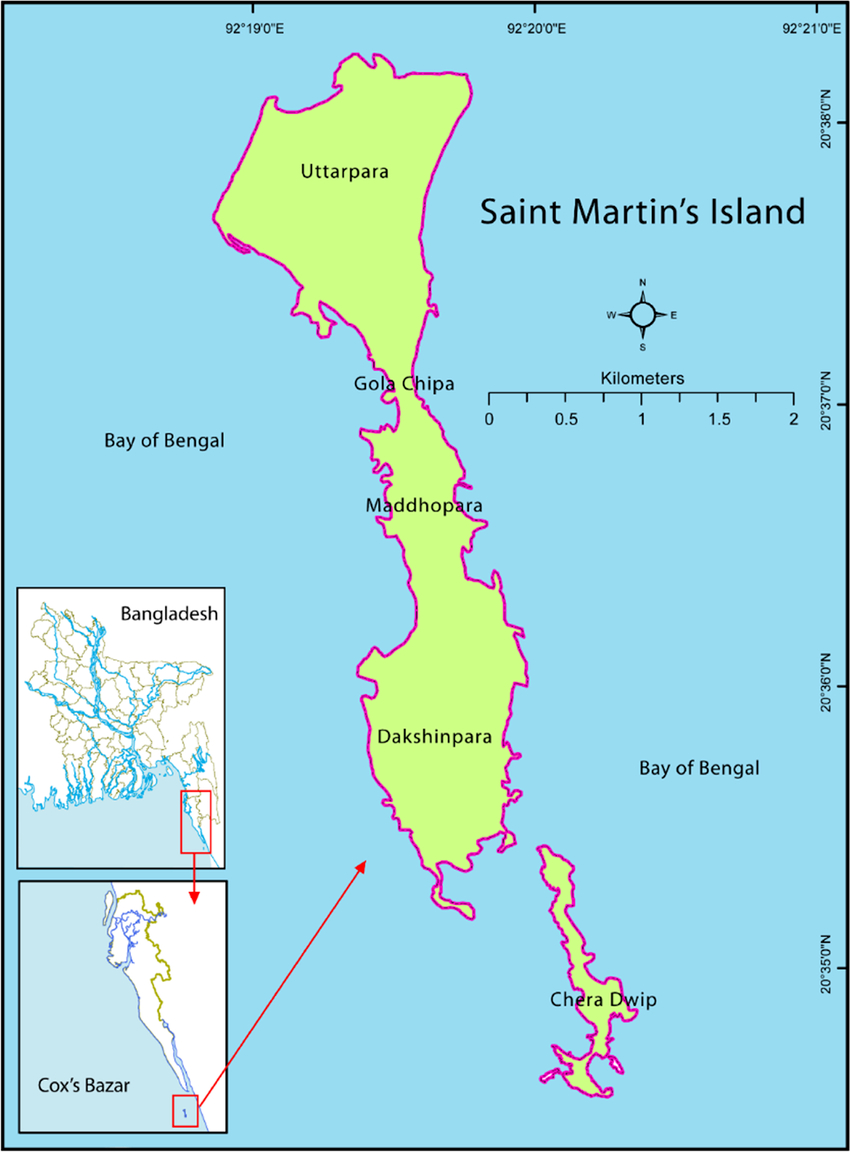
St. Martin’s Island is located in the northeastern region of the Bay of Bengal, near the maritime boundary betweenBangladesh and Myanmar.
It lies about 9 kilometerssouth of the Cox’s Bazar-Teknaf peninsula in Bangladesh.
The island is approximately 7.3 km long and is mostly flat, with an elevation of about 3.6 meters above mean sea level.
It is Bangladesh’s only coral island and is surrounded by coral reefs that extend 10-15 km to the west-northwest of the island.
Historical Background:
The island was originally part of the Teknaf peninsula but gradually submerged into the sea around 5,000 years ago.
It resurfaced approximately 450 years ago.
Arab merchants were among the first settlers in the 18th century. They named it “Jazira” and later “Narikel Jinjira” (Coconut Island).
In 1900, British India annexed the island, and it became known as St. Martin’s Island, named after a Deputy Commissioner of Chittagong.
Strategic importance:
Near the Strait of Malacca: Close to one of the world’s busiest maritime routes, making it strategically important for military oversight.It offers potential for monitoring maritime activities, including strategic interests of global powers.
Border with Myanmar: Proximity to Myanmar adds significance in regional security dynamics.
Other significance for Bangladesh:
It is part of Bangladesh’s EEZ, rich in marine resources like fish, oil, and gas. Also a key tourist destination.
It is important for biodiversity, with coral reefs and diverse marine life.
PYQ:
[2023] Consider the following pairs:
Area of conflict mentioned in news: Country where it is located
1.Donbas: Syria
2.Kachin: Ethiopia
3.Tigray: North Yemen
How many of the above pairs are correctly matched?
The Defence Research and Development Organisation (DRDO) has successfully conducted the maiden flight test of the long-range glide bomb (LRGB) ‘Gaurav’.
The test was carried out from a Su-30 MK-I fighter jet of IAF.
About LRGB GAURAV
LRGB Gaurav is a 1,000 kg class long-range glide bomb developed by the DRDO.
It is air-launched from a Su-30 MK-I fighter jet of the Indian Air Force.
The bomb is designed and developed indigenously by the Research Centre Imarat (RCI), Hyderabad.
Adani Defence and Bharat Forge participated as Development cum Production Partners in the Gaurav project.
Key Features:
It uses a hybrid navigation system that combines Inertial Navigation System (INS) with Global Positioning System (GPS) data for highly accurate targeting.
The glide bomb is capable of hitting targets at long distances, although the exact range is not publicly disclosed.
Gaurav enhances India’s precision strike capabilities, allowing for significant impact on various target types with reduced risk to aircraft.
PYQ:
[2014] Which reference to Agni-IV Missile, which of the following statements is/are correct?
1. It is a surface-to-surface missile.
2. It is fuelled by liquid propellant only.
3. It can deliver one-tonne nuclear warheads about 7500 km away.
Select the correct answer using the code given below.
Delhi Deputy Chief Minister Manish Sisodia was arrested in early 2023 by the CBI and ED in the Delhi liquor policy case. After nearly a year and a half in prison, the Supreme Court of India granted him bail, underscoring that bail should not be used as a form of punishment.
Previous judgments on the ‘Right to Speedy Trial’:
The Supreme Court referenced its earlier judgments, including Kashmira Singh (1977), P. Chidambaram (2020), and Satender Kumar Antil (2022), which establish that the right to a speedy trial is fundamental under Article 21 of the Constitution.
The Court’s decision in Arnab Manoranjan Goswami vs The State of Maharashtra and Ors. (2020) was cited, reinforcing that liberty is a core component of constitutionalism.
In recent scenario, the SC relied on its earlier order dated October 30, 2023, in Manish Sisodia vs Central Bureau of Investigation, which highlighted concerns about the large volume of evidence (56,000 pages of documents and 456 witnesses) potentially causing significant delays in trial proceedings.
What are the present limitations?
Prolonged Incarceration: The ruling pointed out that the legal system often leads to excessive delays, which can result in individuals being punished without trial.
Dependence on Prosecutorial Statements: A concern was raised about the reliance on the prosecution’s assurances regarding the timeline for trial completion.
‘Guarantee of Civil Liberties’:
Constitutional Foundation: The Supreme Court emphasized that individual liberties should not be contingent on the discretion of the prosecution.
In judgments like Maneka Gandhi v. Union of India (1978), the Court expanded the understanding of due process, emphasising that any deprivation of liberty must follow fair, just, and reasonable procedures.
Judicial Responsibility: The judgment aims to prevent the misuse of stringent laws like the Prevention of Money Laundering Act (PMLA) and to uphold the dignity and rights of individuals.
In Rana Ayyub v. Directorate of Enforcement (2023), the Supreme Court emphasized judicial oversight in PMLA enforcement while ensuring trials follow underlying offenses.
Public’s trust on Judiciary: Presently, the Apex Court pointed out the flawed tendency of some judges to deny bail unnecessarily, ignoring the principle of timely trials. This may lead to loss of public trust in the judiciary.
Call for Systemic Change: The ruling urges a reevaluation of the political and legal systems to prioritize justice and individual rights over personal vendettas.
State of Maharashtra v. Rani Kusum (2005) underscores the necessity for reforms to address delays in the judicial process.
Bail is the Rule, Not the Exception: The Supreme Court’s decision in granting bail to Manish Sisodia reinforces the principle that bail is the rule, not the exception.
Way forward:
Adherence to procedural deadlines: In this situation, courts should enforce stricter adherence to procedural deadlines and prioritize cases involving prolonged incarceration to safeguard the right to a speedy trial.
Independent oversight committees: Need to establish independent oversight committees to regularly review cases of prolonged incarceration without trial, ensuring accountability and reducing reliance on prosecutorial assurances alone.
Mains PYQ:
Q What was held in the Coelho case? In this context, can you say that judicial review is of key importance amongst the basic features of the Constitution? (UPSC IAS/2016)
Hindenburg Research has alleged SEBI Chairperson Madhabi Puri Buch and her husband held stakes in Adani-linked offshore funds, implying bias in SEBI’s Adani investigation.
Accusations Against SEBI Chairman Madhabi Puri Buch
Hindenburg Research has accused SEBI Chairman Madhabi Puri Buch of conflicts of interest related to offshore funds tied to the Adani Group, financial opacity regarding a consulting firm transferred to her husband, and potential favoritism towards Blackstone, where her husband is a senior advisor.
Status of the Ongoing Investigation by SEBI
Supreme Court Oversight: The Supreme Court has directed SEBI to investigate the allegations made by Hindenburg Research.
Show Cause Notice by SEBI: In June 2024, SEBI issued a show cause notice to Hindenburg Research, indicating that the regulator is actively pursuing the matter.
About SEBI’s Code on Conflict of Interest:
According to SEBI’s Code on Conflict of Interest, board members, including the Chairperson, are prohibited from holding any other office of profit or engaging in professional activities that involve receiving a salary or professional fees.It can constitute a number of different things that need to be disclosed by the concerned board member:
Certain transactions in shares: The Code says that a member must disclose their, and their family’s (spouse, dependent children below 18 years of age) holdings within 15 days of the assumption of Office, and annually update this disclosure.
Outside private activities: SEBI board members are not allowed to hold any other ‘office of profit’.
Acceptance of gifts: Board members are not allowed to accept “any gift (whose value exceeds Rs 1,000) by whatever name called, to the extent possible, from a regulated entity”. If they do, they have to hand it over to the General Services Department of the SEBI.
Miscellaneous: Members are bound to disclose “any post, other employment or fiduciary position” which they hold or have held in the past five years, in connection with any regulated entity.
Way forward:
Enhance stricter disclosure requirements: SEBI should implement stricter disclosure requirements for all board members, including the Chairperson, ensuring transparency about their financial interests, past affiliations, and potential conflicts.
Establishing an Independent Ethics Committee: An independent ethics committee should be created to oversee and review any potential conflicts of interest involving SEBI board members.
Mains PYQ:
Q In the light of Satyam Scandal (2009), discuss the changes brought in the corporate governance to ensure transparency and accountability. (2015)
The Ministry of New and Renewable Energy has issued operational guidelines for the Implementation of ‘Model Solar Village’ under PM-Surya Ghar Muft Bijli Yojana.
The centre recently allocated ₹800 crore for the same.
About PM Surya Ghar Muft Bijli Yojana
Description
Purpose
To provide 300 units of free electricity per month to beneficiaries through an investment of ₹75,000 crores.
Deadline
Extended the deadline from 2022 to 2026.
Announcement
Initially announced in an Interim Budget 2024-25 speech by the Finance Minister.
Target
Aimed to light up 1 crore households.
Implementation
Urban Local Bodies and Panchayats are incentivised to promote rooftop solar systems.
Financial Support
Average Monthly Electricity Consumption (units)
Suitable Rooftop Solar Plant Capacity
Subsidy Support
0-150
1-2 kW
₹ 30,000 to ₹ 60,000
150-300
2-3 kW
₹ 60,000 to ₹ 78,000
> 300
Above 3 kW
₹ 78,000
Features of the ‘Model Solar Village’ Initiative:
Details
Comprehensive Solarization
Solarize all households and public areas with home lighting, water systems, pumps, and streetlights.
Seeks to create one Model Solar Village per district.
Implementing Agency
State Renewable Energy Development Agency (SREDA) or another entity nominated by the State/UT Government will implement the scheme.
24×7 Solar-Powered Village
Develop villages powered entirely by solar energy, promoting self-reliance in meeting energy needs.
Central Financial Assistance (CFA)
₹1 crore grant per village based on a Detailed Project Report (DPR) by the Implementing Agency.
The total financial allocation for this initiative is ₹800 crore.
Eligibility Criteria
Revenue village with a population over 5,000 (or 2,000 in special category states).
Based on installed renewable energy capacity, overseen by the District Level Committee (DLC) 6 months after the declaration.
Fund Disbursement
40% on the award of works, 40% after completion, 20% after 6 months of operation.
PYQ:
[2018] With reference to solar power production in India, consider the following statements:
1. India is the third largest in the world in the manufacture of silicon wafers used in photovoltaic units.
2. The solar power tariffs are determined by the Solar Energy Corporation of India.
Which of the statements given above is/are correct?
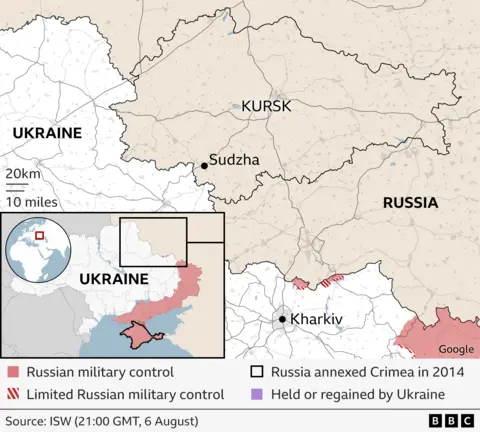
Ukrainian troops have advanced up to 35 kilometers into Russian territory in the Kursk region.
What is the Kursk Operation?
The Kursk operation marks a significant escalation in the ongoing conflict between Ukraine and Russia.
The operation has been characterized by intense fighting, with reports of casualties.
About Kursk Region:
It is located in the western part of Russia, bordering Ukraine to the southwest.
The region holds historical significance Battle of Kursk as the site of the, which took place from July to August 1943 and is recognized as the largest tank battle in history during World War II.
The Kursk region is rich in iron ore, which has led to substantial mining operations in the area.
The region experiences a continental climate, with cold winters and warm summers.
Significance of the Kursk Operation for Ukraine
Strategic Leverage: Strengthens Ukraine’s position in future negotiations by capturing Russian territory for potential land exchanges.
Buffer Zone Creation: Enhances security for contested Ukrainian areas by establishing a protective buffer on Russian soil.
Military Diversion: Forces Russia to redeploy troops, weakening their main front lines and easing pressure on Ukrainian forces.
PYQ:
[2023] Consider the following pairs:
Regions often mentioned in news
Reason for being in news
1. North Kivu and Ituri
War between Armenia and Azerbaijan
2. Nagorno-Karabakh
Insurgency in Mozambique
3. Kherson and Zaporizhzhia
Dispute between Israel and Lebanon
How many of the above pairs are correctly matched?
Q) Money laundering poses a serious security threat to a country’s economic sovereignty. What is its significance for India and what steps are required to be taken to control this menace? (2013)
Q) Discuss how emerging technologies and globalisation contribute to money laundering. Elaborate measures to tackle the problem of money laundering both at national and international levels. (2021)
Note4Students:
Mains: Issues related to Section 70 of the PMLA;
Mentor comments: Two recent Supreme Court observations in the bail petitions of Delhi CM Arvind Kejriwal and ex-Deputy CM Manish Sisodia highlight significant legal issues. Justice Sanjiv Khanna’s Bench questioned the role of the Aam Aadmi Party (AAP) in a PMLA case involving its leaders, asking if the party itself could be made an accused. This led the Enforcement Directorate to include AAP as an accused in Mr. Kejriwal’s case, marking the first time a political party is implicated under PMLA. This raises serious concerns given the pivotal role of parties in a parliamentary democracy.
Let’s learn!
—
Why in the News?
Two Supreme Court Benches questioned the role of political parties under the PMLA, leading to AAP being accused, which raises important constitutional issues.
About PMLA:
The Prevention of Money Laundering Act, 2002 (PMLA) is a significant piece of legislation in India aimed at combating money laundering and related financial crimes.
Objectives: 1. The PMLA is designed to prevent the process of money laundering, which involves concealing the origins of illegally obtained money. 2. The Act provides for the confiscation of properties derived from or involved in money laundering activities.It establishes mechanisms for the detection and investigation of money laundering offenses.
Issues related to Section 70 of the PMLA:
Application of Section 70 of PMLA to Political Parties: The legal question arises whether political parties can be categorized under the definition of “company” or “association of individuals” as per Section 70 of the PMLA. The law typically applies to bodies corporate or firms, which are transactional entities, unlike political parties.
Distinction in Definitions: Section 29A of the Representation of the People Act (RPA), 1951, defines a political party as an association of citizens that calls itself a political party. This specific designation creates a legal distinction between general associations of individuals and political parties, it means political parties may not be intended to fall under the scope of Section 70 of the PMLA.
Ejusdem Generis Interpretation: The legal principle of ejusdem generis suggests that “association of individuals” under Section 70 should be interpreted as entities similar to bodies corporate or firms. Since political parties are not engaged in business or transactional activities like these entities, their inclusion under Section 70 is legally questionable.
Issues related to Policy and criminality
Cabinet Decision-Making and Accountability: The cabinet, as the highest decision-making body in a parliamentary democracy, is collectively responsible for policy decisions. The judiciary typically does not examine the motives or correctness of cabinet policies, focusing instead on the process and legality. Charging individual ministers with criminality for collective cabinet decisions undermines the collective principle.
Ivor Jennings’ View on Cabinet Role: Constitutional authority Ivor Jennings describes the cabinet as the “directing body of national policy,” emphasizing that it is accountable to the legislature and ultimately to the people, who can disapprove of policies through democratic processes.
Policy vs. Criminality in Judicial Interpretation: The observation by the Bench in Mr. Sisodia’s case highlights the difficulty in drawing a line between policy decisions and criminal actions. Criminal charges against individual ministers for decisions made by the cabinet may disrupt the functioning of the cabinet and are legally unsustainable in a parliamentary democracy.
Way forward:
Clarification through Legislative Amendment: To address the ambiguity surrounding the applicability of Section 70 of the PMLA to political parties, the legislature could consider amending the PMLA to explicitly clarify whether political parties fall under the definition of “association of individuals.” This would provide legal certainty and prevent potential misuse or misinterpretation of the law.
Judicial Guidelines on Policy and Criminality: The judiciary could establish clear guidelines on the distinction between policy decisions made by the cabinet and criminal actions taken by individual ministers. These guidelines would help ensure that the cabinet’s collective responsibility is preserved while allowing for accountability in cases of individual misconduct that fall outside the scope of legitimate policy-making.


![[12th August 2024] The Hindu Op-ed: Parties, serious crimes and the need for judicial clarity](https://www.civilsdaily.com/wp-content/uploads/2024/08/12-Aug-1568x882.jpg)