💥Join UPSC 2027,2028 Mentorship (July Batch) + XFactor Notes & Microthemes PDF

Distribution: yearly

  • Freedom from dependence, a new era in health care

    Why in the News?

    India’s healthcare since globalization has improved greatly, and is globally recognized due to skilled professionals, effective policies, and strong institutions which draw patients from over 147 countries.

    Economic implications of being a preferred Medical Destination:

    • Foreign Exchange Savings: India saves billions in foreign exchange as fewer Indians need to travel abroad for advanced medical treatments.
    • Revenue Generation: The influx of international patients generates over $9 billion annually, contributing to economic growth.
    • Job Creation: The medical tourism sector creates employment opportunities in healthcare, hospitality, transportation, and pharmaceuticals.
    • Cost-Effective Treatments: India’s affordable yet high-quality medical services attract patients globally, further boosting the economy.

    What are the challenges? 

    • Shortage of Healthcare Professionals
        • Current Shortage: India is estimated to be short of around 600,000 doctors, leading to a doctor-patient ratio of approximately 0.7 doctors per 1,000 people, which is significantly lower than the World Health Organization’s recommended ratio of 1 doctor per 1,000 people.  
        • Future Demand: By 2030, the demand for healthcare professionals in India is expected to double, driven by an ageing population and the increasing burden of non-communicable diseases.
    • Inadequate Public Healthcare Spending
        • Low Expenditure: As of 2021-22, India’s public healthcare expenditure stood at 2.1% of GDP, which is significantly lower than that of many developed countries, For instance, countries like Japan and France spend about 10% of their GDP on healthcare, while the United States spends 16.9%.
        • Comparison with Neighbors: Even neighbouring countries like Bangladesh and Pakistan allocate over 3% of their GDP to public healthcare.
    • Unequal Access to Healthcare
        • Urban-Rural Disparity: There is a stark disparity in healthcare access between urban and rural areas. Rural regions often lack basic healthcare facilities, leading to limited access to quality services for a significant portion of the population.  
        • Healthcare Infrastructure: India’s healthcare infrastructure is inadequate to meet the growing demands of its population. For instance, India has one of the lowest per capita bed counts in the world, with only about 0.5 hospital beds per 1,000 people, compared to the OECD average of 4.7 beds per 1,000 people.
    • High Out-of-Pocket Expenditure
      • Financial Burden: Approximately 75% of healthcare expenditure in India is borne out-of-pocket by individuals and families.

    Need for a Strong Vision (Way forward)

    • “Heal in India” Initiative: The Prime Minister’s vision of “Heal in India” emphasizes positioning India as a global healthcare leader. This initiative is not merely a slogan but a strategic approach to enhance India’s reputation as a preferred medical destination.
    • Youth Engagement: Inspiring the youth to pursue careers in healthcare is crucial for sustaining growth in this sector. By encouraging innovation and entrepreneurship among young Indians, the country can ensure a robust healthcare system.
    • Investment in Public Healthcare: Increase public healthcare spending to improve infrastructure, especially in rural areas, and bridge the urban-rural disparity.
    • Focus on Medical Device Manufacturing: Promote domestic production of medical devices under the “Make in India” initiative to reduce dependency on imports.

    Mains PYQ:

    Q Appropriate local community-level healthcare intervention is a prerequisite to achieve ‘Health for All’ in India. Explain. (UPSC IAS/2018)
  • 3 more Ramsar Wetland sites now in India, taking total to 85

    Why in the News?

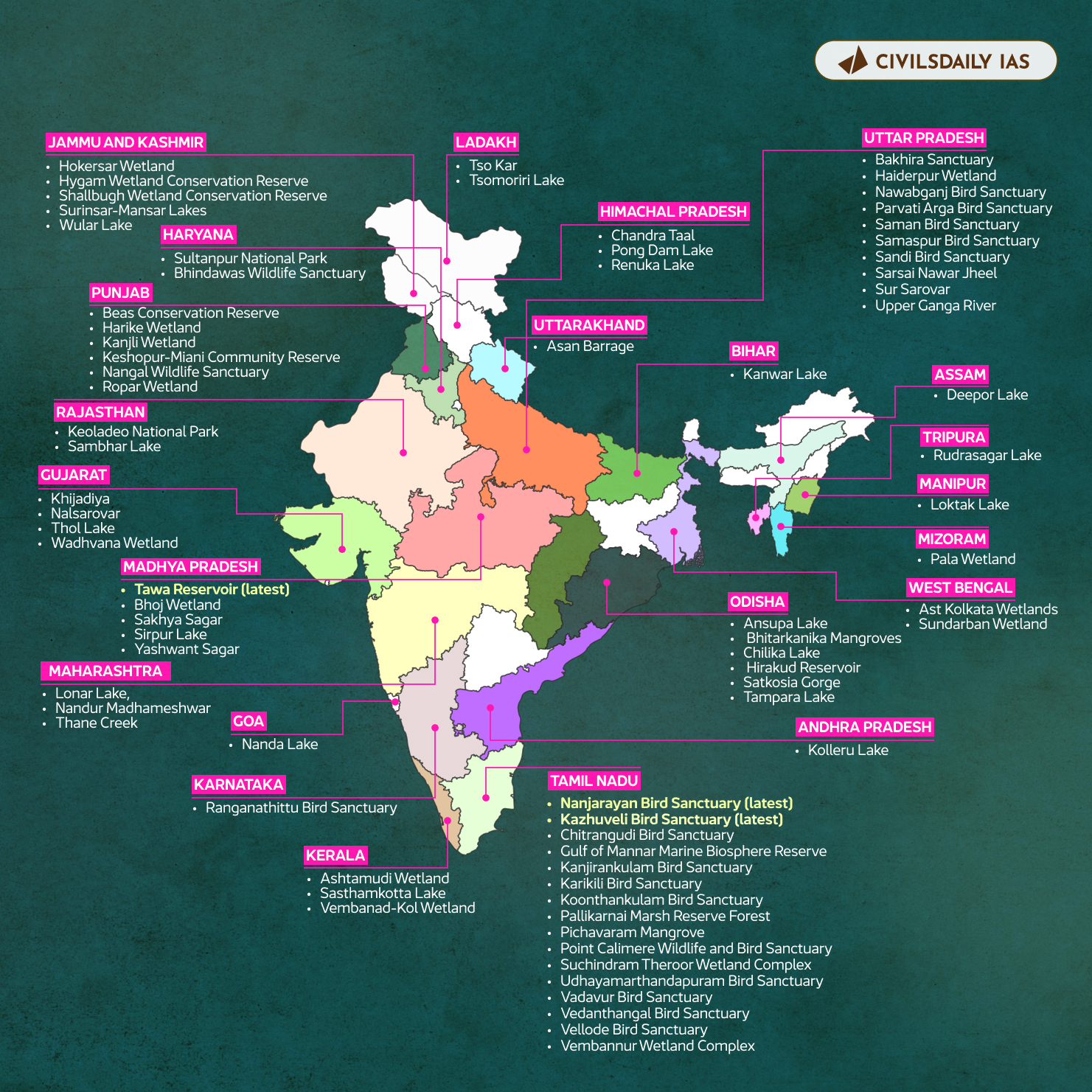
    • The Environment Ministry announced the designation of three more wetlands: Nanjarayan Bird Sanctuary (TN), Kazhuveli Bird Sanctuary (TN) and Tawa Reservoir (MP) as Ramsar Sites.
      • This makes the total Ramsar sites count in India to 85.

    About the newly designated Ramsar Sites:

    Location Geographical Features Key Species Ecosystem
    Nanjarayan Bird Sanctuary Tiruppur District, Tamil Nadu Located on the banks of Nanjarayan Tank;

    ~125 hectares

    Herons, egrets, pelicans Wetland habitats, surrounded by agricultural lands
    Kazhuveli Bird Sanctuary Villupuram District, Tamil Nadu Brackish water wetland near Bay of Bengal;

    ~5,000 hectares

    Flamingos, pelicans, storks, waterfowl Mix of freshwater and saltwater habitats, includes mangroves
    Tawa Reservoir Hoshangabad District, Madhya Pradesh Part of Narmada River Basin, foothills of Satpura Range;

    ~225 sq. km

    Mahseer fish, surrounded by Satpura forests Aquatic life, forested surroundings


    Important Facts:

    • India became a signatory to the Ramsar Convention in 1982.
      • India is one of the contracting parties to the Ramsar Convention, which was signed in Ramsar, Iran, in 1971.
    • With the inclusion of these 3 new sites, India now has 85 Ramsar sites, covering a total area of 13,58,068 hectares.
    • Tamil Nadu currently has the highest number of Ramsar sites in India, with 18 sites, followed by Uttar Pradesh with 10 sites.
    • India’s Ramsar wetlands constitute about 10% of the total wetland area in the country, spread across 18 states.
    • UK leads globally with 175 sites, followed by Mexico with 142 sites.
      • Bolivia, however, has the largest area under Ramsar protection, spanning 148,000 sq. km.
    • According to the National Wetland Inventory and Assessment by ISRO, India’s wetlands cover approximately 1,52,600 sq. km., which is 4.63% of total geographical area.
    • India has 19 types of wetlands, with Gujarat having the largest area, followed by Andhra Pradesh, Uttar Pradesh, and West Bengal.

    PYQ:

    [2019] Consider the following statements:

    1. Under Ramsar Convention, it is mandatory on the part of the Government of India to protect and conserve all the wetlands in the territory of India.
    2. The Wetlands (Conservation and Management) Rules, 2010 were framed by the Government of India based on the recommendations of the Ramsar Convention.
    3. The Wetlands (Conservation and Management) Rules, 2010 also encompass the drainage area or catchment regions of the wetlands as determined by the authority.

    Which of the statements given above is/are correct?

    (a) 1 and 2 only

    (b) 2 and 3 only

    (c) 3 only

    (d) 1, 3 and 3

  • What is the drug Captagon?

    Why in the News?

    Captagon, the “poor man’s cocaine,” has become increasingly popular among young adults in the Middle East and North Africa.

    What is the Drug Captagon?

    • Captagon is a synthetic drug that was originally developed in Germany in the 1960s and 1970s.
    • It was initially created as a pharmaceutical treatment for attention deficit disorders, narcolepsy, and sometimes depression.
    • The primary active ingredient in Captagon is fenethylline, a compound that, once ingested, is metabolized into two powerful stimulants: amphetamine and theophylline.
    • These substances stimulate the central nervous system, leading to increased alertness, reduced fatigue, and a sense of euphoria.

    How Addictive is Captagon?

    • Captagon is highly addictive due to its powerful effects on the brain and body.
    • As a psychostimulant, Captagon significantly impacts the central nervous system, leading to a range of effects that can make it very difficult for users to stop taking the drug once they start.
    • It is also reportedly used by fighters in conflict zones to enhance their endurance and suppress fatigue.
    • The primary effects of Captagon include:
    1. Euphoria: Users often experience an intense feeling of happiness or well-being.
    2. Increased Wakefulness: The drug reduces the need for sleep, keeping users awake and alert for extended periods.
    3. Enhanced Physical and Mental Performance: Users may feel stronger, more focused, and more capable of performing both physically and mentally demanding tasks.
    • However, the heavy use of Captagon comes with serious risks such as cognitive impairment, cardiovascular issues, and risk of addiction.

    Where is Captagon Made?

    • In recent years, Syria the “narco state” of Middle East has emerged as the largest producer of Captagon.
    • Its production increased after 2011 Arab Spring protests, which led to civil unrest and conflict in the region.

    PYQ:

    [2019] Consider the following statements:

    1. The United Nations Convention against Corruption (UNCAC) has a ‘Protocol against the Smuggling of Migrants by Land, Sea and Air’.
    2. The UNCAC is the ever-first legally binding global anti-corruption instrument.
    3. A highlight of the United Nations Convention against Transnational Organized Crime (UNTOC) is the inclusion of a specific chapter aimed at returning assets to their rightful owners from whom they had been taken illicitly.
    4. The United Nations Office on Drugs and Crime (UNODC) is mandated by its member States to assist in the implementation of both UNCAC and UNTOC.

    Which of the statements given above are correct?

    (a) 1 and 3 only
    (b) 2, 3 and 4 only
    (c) 2 and 4 only
    (d) 1, 2, 3 and 4

  • Extremophile bacteria have learnt to survive microwaves

    Why in the News?

    Researchers have isolated extremophile bacteria from harsh environments like volcanic vents, permafrost, acid mines, deep-sea hydrothermal vents, and lakes beneath polar ice caps.

    What are Extremophiles?

    • Extremophiles are microorganisms that thrive in extreme environmental conditions where other life forms typically cannot survive.
    • For example: Volcanic vents, Permafrost, Acid mines, Deep-sea hydrothermal vents, dark lakes buried beneath polar ice caps, on the exteriors of spacecraft, around nuclear waste storage sites.

    Adaptation and Evolution:

    • Extremophiles have developed unique biological and biochemical processes over millions of years to adapt to diverse habitats.
    • Unlike more complex life forms, which have one set of proteins, extremophiles have multiple sets of proteins, each adapted to specific environmental conditions.
    • These proteins are ‘activated’ based on the surrounding environment, enabling survival during extreme conditions like high temperatures, lack of water, or high acidity.
    • Significance: Some scientists believe that life on Earth may have begun as an extremophile in extreme environmental niches before spreading and adapting to more temperate ecosystems.

    About the ‘Earth Microbiome Project’

    • It is a global initiative aimed at mapping, organising, and understanding the diversity of microbial life across different environmental niches on Earth.
    • The project was founded in 2010.
    • Objective: 
      • To sequence 200,000 genetic samples from diverse environments.
      • To assemble 500,000 microbial genomes, creating a comprehensive map of microbial diversity on Earth.
    • Significance:
      • The project is part of broader efforts to understand the microbial world, which is still in its infancy.
      • It is related to other significant projects like the ‘Earth Biogenome Project,’ which aims to sequence the genomes of all eukaryotic organisms on the planet.
      • Understanding microbial diversity has numerous biological and industrial applications, such as developing new enzymes for molecular biology or finding new ways to adapt organisms to challenging environments.


    PYQ:

    [2017] With reference to agriculture in India, how can the technique of ‘genome sequencing’, often seen in the news, be used in the immediate future?

    1. Genome sequencing can be used to identify genetic markers for disease resistance and drought tolerance in various crop plants.

    2. This technique helps in reducing the time required to develop new varieties of crop plants.

    3. It can be used to decipher the host-pathogen relationships in crops.

    Select the correct answer using the code given below:

    (a) 1 only

    (b) 2 and 3 only

    (c) 1 and 3 only

    (d) 1, 2 and 3

  • WHO declares Mpox as Public Health Emergency of International Concern

    Why in the news?

    The World Health Organization (WHO) has declared mpox as a “public health emergency of international concern” (PHEIC).

    What is a PHEIC?

    • A PHEIC is a formal declaration by the WHO under the International Health Regulations (IHR), 2005.
    • It refers to an “extraordinary event” posing a public health risk through the international spread of disease, potentially requiring a coordinated global response.
    • Criteria for PHEIC:
      • Serious and unusual event: Poses a significant public health risk.
      • Cross-border implications: Affects more than one country.
      • International response needed: Requires immediate global coordination.
    • Purpose: Mobilizes resources, raises awareness, and coordinates efforts to manage and contain the threat.

    What is Mpox?

    • Mpox is a disease caused by the orthopoxvirus, related to the smallpox virus.
    • First detected in humans in 1970, it is endemic in central and West Africa.
    • Transmission: Spread from animals to humans (zoonotic) and between humans via close contact, respiratory droplets, or contaminated materials.
    • Symptoms: Fever, rash, swollen lymph nodes; can lead to severe complications or death.
    • Vaccination: WHO recommends vaccines, widely used in Nigeria and the Democratic Republic of the Congo (DRC) to control outbreaks.

    Recent Developments: 

    • In recent years, there has been an increase in mpox cases, including the emergence of new strains such as clade 1b, which has spread to countries outside of its typical endemic regions.
    • This led to the declaration of mpox as a Public Health Emergency of International Concern (PHEIC) due to its potential for widespread impact.


    PYQ:

    [2014] Consider the following diseases

    1. Diphtheria

    2. Chickenpox

    3. Smallpox

    Which of the above diseases has/have been eradicated in India?

    (a) 1 and 2 only

    (b) 3 only

    (c) 1, 2 and 3

    (d) None

  • [14th August 2024] The Hindu Op-ed: The shock-effects of South Asian tumult

    PYQ Relevance:

    Mains:

    Q1 Do you think that BIMSTEC is a parallel organisation like the SAARC? What are the similarities and dissimilarities between the two? How are Indian foreign policy objectives realized by forming this new organisation?  (UPSC IAS/2022) 

    Q2 Critically examine the compulsions which prompted India to play a decisive role in the emergence of Bangladesh (UPSC IAS/2013) 

    Note4Students: 

    Mains: Reason behind the declining India’s influence in South Asia;

    Mentor comments:  Since the start of this decade, India has faced a series of shocks in its neighborhood. In 2021, the coup in Myanmar and the Taliban takeover in Afghanistan set the stage. In 2022, the ouster of Prime Minister Imran Khan in Pakistan and the riots that forced Gotabaya Rajapaksa out in Sri Lanka added to the turmoil. More recently, electoral changes in the Maldives and Nepal have replaced India-friendly governments with less cooperative ones. With Sheikh Hasina’s dramatic exit in Bangladesh, India is now urgently reassessing its approach to safeguard against future upheavals in South Asia.

    Let’s learn!

    __

    Why in the News? 

    Hasina’s removal from power in Bangladesh is no doubt a dramatic setback for India, as both countries have transformed ties on every front in the past decade and a half. 

    Key lesson for India: 

    • Engage with All Political Stakeholders: India must broaden its diplomatic engagement to include all political parties in Bangladesh, particularly the opposition, such as the Bangladesh Nationalist Party (BNP).  
    • Monitor and Respond to Local Sentiments: India should enhance its intelligence and diplomatic capabilities to monitor local sentiments and political developments in Bangladesh more effectively. This includes understanding the socio-political dynamics and public opinion, which can provide critical insights into potential unrest or shifts in governance.  
    • Reassess Strategic Partnerships: India needs to reassess its strategic partnerships and avoid over-reliance on any single government or political party.  
    • Promote Democratic Values and Human Rights: India should advocate for democratic values and human rights in its foreign policy, emphasizing the importance of free and fair elections and the protection of civil liberties.  

    Loss of Reputation:

    • Reputation as a Dependable Partner: India’s reputation as a reliable ally in the region suffered a setback after the fall of Kabul when it refused visas to hundreds of Afghans fleeing the Taliban. Many of these individuals were senior defense and security officials who had risked their lives for Indian diplomats.
    • Pragmatism in Supporting Allies: Despite the potential complications, India wisely allowed Sheikh Hasina to stay in the country after her removal from power, recognizing that turning its back on an old ally would have been a betrayal. This approach is necessary to maintain long-term relationships in the region, where political leaders often return to power.
    • Future Diplomatic Challenges: The continued presence of Sheikh Hasina in India could complicate ties with any new government in Bangladesh, especially if they request her extradition or perceive the Awami League as regrouping in India.

    Communal Lens:

    • Faulty Assumption of Religious Ties: The good diplomatic ties in South Asia are somehow linked to shared religious majorities. For example, Hindu-majority Nepal has been a challenging relationship for India, while Buddhist-majority Bhutan and Muslim-majority Maldives have often been among its closest allies.
    • Impact of the Citizenship (Amendment) Act (CAA): The Indian government’s introduction of the CAA, which fast-tracks citizenship for non-Muslims from Muslim-majority countries (Afghanistan, Pakistan, Bangladesh), has backfired across the region. It has strained relationships not only with the countries directly mentioned but also with others in the neighbourhood.

    Erosion of Pan-South Asian Mechanisms: 

    1. Boycott of SAARC by India: India has boycotted the SAARC (South Asian Association for Regional Cooperation) summit for a decade now due to bilateral issues with Pakistan. This has led to the stagnation of the regional grouping and its inability to address common challenges.
    2. Abandonment of BIMSTEC: There are concerns that India may abandon the Bay of Bengal Initiative for Multi-Sectoral Technical and Economic Cooperation (BIMSTEC) if ties with Bangladesh worsen, similar to its stance on SAARC. This would further erode regional cooperation mechanisms.

    Implications for India

    1. Loss of Influence in the Region: The erosion of pan-South Asian mechanisms has diminished India’s influence in the region. Countries like Bangladesh are now more open to engaging with other powers, reducing India’s ability to shape regional dynamics.
    2. Vulnerability to External Interference: The absence of effective regional cooperation platforms has made South Asian countries more vulnerable to external interference from global powers like the United States and China. Their rivalries can now play out in the region without sensitivity to India’s interests.
    3. Deprived Economic Opportunities: The lack of regional integration has deprived India and its neighbours of potential economic benefits through increased trade, investment, and connectivity. Reviving mechanisms like SAARC could unlock significant economic opportunities for the region.

    Way Forward for India

    1. Reviving Pan-South Asian Mechanisms: India must take the lead in reviving pan-South Asian mechanisms like SAARC and finding ways to engage with its neighbours without external interference. This would require addressing bilateral issues and prioritizing regional cooperation.
    2. Balancing Relations with Global Powers: India needs to strike a balance in its relations with global powers like the United States and China. It should avoid being drawn into its rivalries and instead focus on pursuing its own interests in the region.

    Source: https://www.thehindu.com/opinion/lead/the-shock-effects-of-south-asian-tumult/article68521412.ece 

  • An overview of governance in Delhi

    Why in the News?

    The Supreme Court ruled that Delhi’s LG can independently nominate 10 aldermen to the MCD which escalates tensions between the Union, Delhi, and local governments.

    How did the Delhi government evolve?

    • At the commencement of the Constitution in 1950, Delhi was classified as a Part C State.
    • Following the state reorganisation in 1956, it became a Union Territory governed by an administrator.
    • The Municipal Corporation of Delhi (MCD) was established in 1958, and a limited local government was introduced in 1966.
    • Based on the Balakrishnan Committee’s recommendations in 1989, the 69th Constitutional Amendment in 1991 created a Legislative Assembly and council of ministers for the NCT of Delhi. 
    • However, the Union government retained control over public order, police, and land, excluding these subjects from the Delhi government’s jurisdiction.

    Why is there constant tension and friction between the Union government and the Delhi government?  

    • Legal Disputes: Legal battles have escalated tensions, particularly following Supreme Court judgments that have altered the balance of power between the elected Delhi government and the Lieutenant Governor (LG). For instance, recent rulings have clarified the LG’s powers, allowing for unilateral actions that bypass the council of ministers.
    • Control Over Key Areas: The Union government retains control over critical areas such as police, public order, and land, which limits the Delhi government’s autonomy.
    • Administrative Confusion: The presence of multiple layers of governance, including the MCD and other local bodies, complicates accountability and governance, leading to blame-shifting during crises, such as the recent incidents of electrocution and flooding.
    •  Budgetary Conflict: The Delhi State Government has accused the Central Government of underfunding the MCD, leading to poor civic services, while the Central Government has argued that the State Government is not providing adequate support.
    • Division and Unification of MCD: In 2012, the MCD was trifurcated into three separate entities by the Congress-led state government, a move seen as an attempt to decentralize power. However, in 2022, the BJP-led Central Government passed a law to reunify the MCD, citing administrative efficiency, but the move was perceived by the Delhi State Government as an effort to centralize control.

    What did the 1989 Balakrishnan committee recommend?  

    1. On Union Territory Status: The Balakrishnan Committee recommended that Delhi must remain a Union Territory rather than achieving full statehood.
    2. On Governance Structure: The committee proposed a governance model that included an Administrator exercising powers based on the advice of the Council of Ministers, ensuring a balance of power while maintaining central oversight.
    3. On Representation and Accountability: The committee emphasized the need for a more effective representative democratic system to safeguard the rights of Delhi’s growing population.

    How has the Municipal Corporation of Delhi been involved in the power tussle? 

    • Multiple Authorities: The MCD operates under the Union government’s control, adding complexity to the governance structure in Delhi. For example in public services and urban management.
    • Electoral Conflicts: The MCD’s elected representatives have often been caught in the crossfire of political disputes between the Union and Delhi governments, leading to inefficiencies and a lack of coherent governance. The recent tragedies in the city have highlighted the consequences of this blame-shifting.

    Way Forward:

    • Revisiting Governance Structure: A constitutional amendment could be considered to delineate the powers of the central government and the Delhi government more clearly. For instance, the area of New Delhi (50-100 square kilometres) could be under central control, while the rest could be governed by the Delhi Assembly.
    • Implementation of triple chain accountability: Implementing the spirit of the Supreme Court’s 2023 judgment, which emphasized a triple chain of accountability, could help restore balance and ensure that all layers of government are accountable to the people.
    • Promoting Consensus-Based Governance: Encouraging dialogue and consensus between the different layers of government could help mitigate conflicts and foster a more cooperative governance environment.

    Mains PYQ: 

    Q Whether the Supreme Court Judgement (July 2018) can settle the political tussle between the Lt. Governor and elected government of Delhi? Examine.(2018)

  • Does India have laws on the movement of ballast water?

    Why in the News?

    The TN Water Resources Department (WRD) has informed the National Green Tribunal that it has requested ₹160 crore from Kamarajar Port in Ennore, Tamil Nadu, to address the removal of invasive mussels along the coast near the port.

    • The WRD has accused Kamarajar Port of being primarily responsible for the spread of this invasive species due to its failure to regulate ballast water from ships.

    What is Ballast Water?

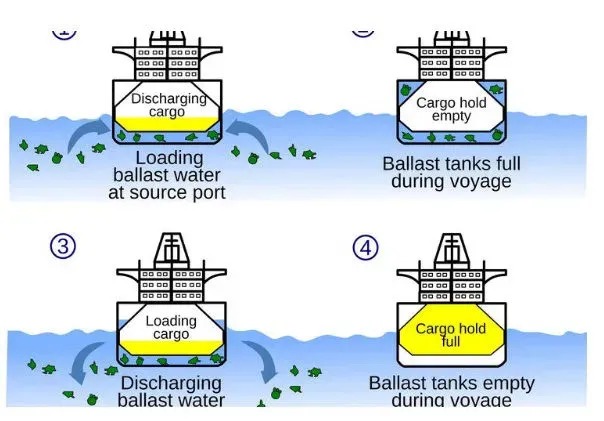
    • Ballast water is fresh or saltwater held in the ballast tanks of ships. It is used to provide stability and maneuverability during a voyage, especially when a ship is not carrying enough cargo or when additional stability is required due to rough seas.
    • Ballast water can carry a variety of biological materials, including bacteria, microbes, and small invertebrates. When discharged at a new location, this water can introduce non-native species into local ecosystems, potentially leading to ecological imbalances.

    How Serious is the Problem?

    • Invasive Species in India: Scientists have recorded nearly 30 invasive species entering Indian waters through ship ballast water, with the charru mussel (Mytella strigata) being one of the most harmful. This species has replaced native species in critical habitats like Pulicat Lake in Tamil Nadu.
    • Ecological Impact: The introduction of invasive species can disrupt local ecosystems, outcompete native organisms, and significantly affect biodiversity. The charru mussel has a high survival rate and prolific reproduction, exacerbating its impact on marine environments.
    • Economic Consequences: The proliferation of invasive species can hinder fishing activities and affect the livelihoods of local communities dependent on marine resources.

    What are Global Regulations?

    • Ballast Water Management (BWM) Convention: The International Maritime Organization (IMO) adopted the BWM Convention, which came into force in 2017. This convention aims to prevent the spread of harmful aquatic organisms and pathogens through ballast water.
    • Under the BWM Convention, ships must manage their ballast water to ensure that aquatic organisms and pathogens are removed or rendered harmless before discharge.
    • Compliance: Countries like Australia and New Zealand have stringent regulations to prevent ballast water from damaging their marine ecosystems, including rigorous checks of ballast water management systems.

    What is India’s Position?

    • As of July 2023, India has not signed the BWM Convention, meaning there are no obligations for ships calling at Indian ports to comply with its regulations. This lack of participation raises concerns about the unchecked discharge of ballast water.
    • While other maritime regulations apply in Indian ports but the discharge of ballast water is not subject to checks or regulations, leading to potential ecological risks.

    Way forward: 

    • Adopt and Implement the BWM Convention: India should consider ratifying the Ballast Water Management (BWM) Convention to align with international standards.
    • Strengthen Domestic Regulations and Awareness: Even before ratifying the BWM Convention, India can introduce national legislation to regulate ballast water discharge in its ports.

    Mains PYQ: 

    Q How does biodiversity vary in India? How is the Biological Diversity Act,2002 helpful in conservation of flora and fauna? (2018)

  • Hints of the corporatization of science research in India 

    Why in the News?

    The establishment of the Anusandhan National Research Foundation and its funding structure clearly signals the government’s intended direction.

    Research Policy in India

    • Shift Towards Corporatisation: The Indian government’s approach encourages research institutions to generate revenue through external sources, moving away from reliance on public funding.
      • This trend aligns with the 2015 Dehradun Declaration, which advocated for marketing patents to self-finance research initiatives.
    • Focus on Market-Driven Research: The ANRF aims to align research outcomes with market needs, promoting the idea that scientific advancements should have immediate applications.
      • This is evident in the emphasis on prototype development, which assesses the marketability of research products, which was highlighted in the 2024 Budget speech.
    • Integration of Industry and Academia: The ANRF is designed to forge collaborations between research institutions and the private sector by earmarking a substantial portion of its funding (approximately 72%) from private sources, bridging the gap between scientific research and commercial application.
    Note: The Anusandhan National Research Foundation (ANRF) is a significant initiative in India’s research landscape, established under the Anusandhan National Research Foundation Act, 2023.

    Funding Mechanism of ANRF

    • Budget Allocation: The ANRF will be allocated ₹50,000 crore over five years, with a significant portion expected to come from non-government sources, including industry and philanthropic contributions.
    • Governance Structure: The ANRF will be governed by a board that includes industry representatives and experts, ensuring that funding decisions align with market demands and technological advancements.

    What are the signals despite the stated objective of ANRF? (challenges)

    • Potential Undermining of Curiosity-Driven Research:  The private sector does not want to fund basic research because it has no immediate commercial applications which ultimately leads to a decline in foundational scientific exploration.
    • Public Funding Concerns: The government’s expectation for private sector funding raises questions about the sustainability of public investment in research.
      • The current ratio of public funding for science research in India (0.6% to 0.7% of GDP) is significantly lower than that of countries like South Korea (around 4.8%  of GDP).

    India’s Achievements Despite a Low GDP Investment in R&D: 

    • High Production of PhDs:  Annually, India generates approximately 40,813 PhDs, ranking third globally after the United States and China. 
    • Robust Research Output: India’s research output remains substantial, with over 300,000 publications in 2022, making it the third-largest producer of scientific publications globally.
    • Growth in Patent Grants: India has shown remarkable progress in intellectual property creation, securing 30,490 patents in 2022, placing it sixth globally.  
    • Improvement in Global Rankings: India has made significant strides in global innovation rankings and research quality. It improved its position on the Global Innovation Index (GII) from 81st place in 2015 to 40th in 2023.  
        • India climbed to the 9th rank in the Nature Index 2023, surpassing countries like Australia and Switzerland.
    • Investment in Autonomous R&D Institutions: A considerable portion of India’s R&D funding is directed towards autonomous research laboratories. The total investment in R&D reached approximately $17.2 billion in 2020-21, with a significant allocation to key scientific agencies such as the Defence Research and Development Organisation (DRDO) and the Indian Council of Agricultural Research (ICAR).

    Comparison with Other Countries

    As of 2023, India’s gross expenditure on R&D stands at approximately 0.64% of its GDP.

    • United States: The U.S. invests about 3.46% of its GDP in R&D
    • South Korea: South Korea leads with an impressive 4.8% of GDP allocated to R&D.
    • Germany: Germany’s R&D spending is around 3.1% of GDP.
    • China: China’s investment in R&D is approximately 2.4% of GDP.
    • Taiwan: Taiwan also invests around 3.77% of its GDP in R&D.

    Way Forward: 

    • Strengthening Public Funding for Basic Research: To ensure a balanced research ecosystem, the government should increase public investment in foundational scientific research.
    • Enhancing Industry-Academia Collaboration: The government should facilitate stronger partnerships between research institutions and the private sector while maintaining a focus on both applied and basic research.

    Mains PYQ: 

    Q What are the research and developmental achievements in applied biotechnology? How will these achievements help to uplift the poorer sections of the society? (2021)

  • [pib] FloodWatch India Version 2.0 App

    Why in the News?

    The Union Ministry of Jal Shakti has launched Version 2.0 of the ‘FloodWatch India’ mobile application.

    About FloodWatch India Version 2.0

    • FloodWatch India Version 2.0 is a mobile application developed by Central Water Commission (CWC) under the Union Ministry of Jal Shakti.
    • The app provides real-time information and forecasts related to flood situations across India.
    • It now covers 592 flood monitoring stations, up from 200 in the previous version, offering a more comprehensive overview of flood conditions.
    • The app includes information on the storage positions of 150 major reservoirs in India, aiding in flood management.
    • Key features include:
      • It provides real-time river flow data and flood forecasts up to 7 days in advance.
      • Users can view state-wise and basin-wise flood forecasts and advisories.
      • The app uses satellite data analysis, mathematical modelling, and real-time monitoring to ensure accurate and timely flood information.
      • The app is available in English and Hindi and offers both readable and audio broadcast formats.

    PYQ:

    [2016] The frequency of urban floods due to high intensity rainfall is increasing over the years. Discussing the reasons for urban floods, highlight the mechanisms for preparedness to reduce the risk during such events.