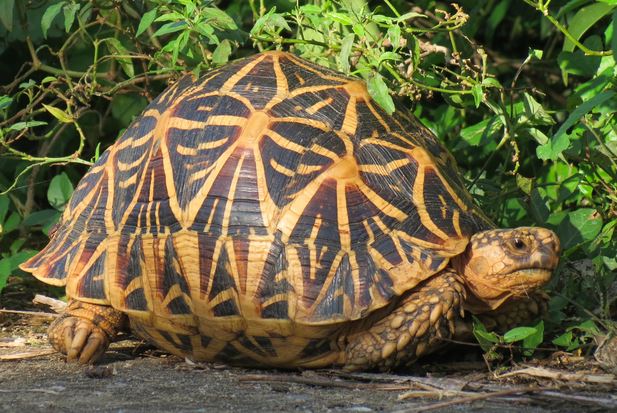
Malaysia has seized about 200 smuggled Indian Star Tortoises and Turtles in a major crackdown. The Indian star tortoise is the single most confiscated species of freshwater tortoise in the world, according to wildlife trade watchdog TRAFFIC.
AboutIndian Star Tortoises (Geochelone elegans)
Details
Habitat
Found in Central and Southern India, West Pakistan, and Sri Lanka
Typically resides in dry, open habitats such as scrub forests, grasslands, and rocky outcroppings
Threats
Habitat fragmentation due to urbanization and agricultural practices
Loss of genetic diversity due to hybridization
90% of trade occurs in the international pet market, according to the Wildlife Crime Control Bureau
Protection Status
IUCN Red List: Vulnerable
Wild Life Protection Act 1972: Schedule I
CITES: Appendix I
Back2Basics: TRAFFIC (Trade Records Analysis of Flora and Fauna in Commerce)
Details
Founded
1976
Headquarters
Cambridge, United Kingdom
Mission
Ensure that trade in wild plants and animals does not threaten the conservation of nature.
Founding Partners
World Wildlife Fund (WWF) and the International Union for Conservation of Nature (IUCN)
The Defence Ministry has launched the “GRSE Accelerated Innovation Nurturing Scheme (GAINS 2024)” of Garden Reach Shipbuilders & Engineers Limited (GRSE) in Kolkata.
About GAINS 2024
GAINS aims to address challenges in shipyards and promote technology development through startups nurtured in the country.
It aligns with the ‘Make in India’ and ‘Start-up India’ policies of the Government of India.
Objective: To seek solutions for shipyard-related problems and promote technological advancements.
Target Audience: MSMEs and Start-Ups encouraged to develop innovative solutions.
Significance of the Scheme
GAINS aims to strengthen maritime security and air defence through technological advancements.
It leverages MSMEs and Start-Ups to achieve self-reliance in ship design and construction.
Various defence production indigenisation initiatives in India:
Q) What are the salient features of the National Food Security Act, of 2013? How has the Food Security Bill helped in eliminating hunger and malnutrition in India? (UPSC IAS/2021) Q) Discuss the main objectives of Population Education and point out the measures to achieve them in India in detail. (UPSC IAS/2020)
Prelims: India is regarded as a country With a “Demographic Dividend” This is due to (UPSC IAS/2011) (a) Its high population in the age group below 15 years. (b) Its high population in the age group of 15-64 years. (c) Its high population in the age group above 65 years. (d) Its high total population.
Note4Students:
Prelims: World Population Day; Demographic Dividend;
Mentor comment: Over the decades, the world has seen significant demographic changes, with declining fertility rates and increasing life expectancy globally. India has also made notable progress, with fertility rates falling below replacement level and improvements in maternal and child health indicators. However, population dynamics continue to pose challenges that require attention and proactive measures. As the world approaches the 2030 target for the Sustainable Development Goals, understanding a country’s population trends is crucial to tailoring solutions and driving progress.
Let’s learn!
__
Why in the news?
The day July 11, was established by the United Nations as the ‘World Population Day’ in 1989, to raise awareness about global population issues and their impact on development, the environment, and individual well-being.
World Population – Then and Now: 1. The decades of the 1960s and 1970s were scary as the global population was growing at a yearly rate of 2%. 2. The Total Fertility Rate of the world has dropped from around five children per woman in 1950, to 2.3 children per woman in 2023.
About Malthus Theory of Population 1. Thomas Malthus’ Theory of Population, proposed in 1798, posited that population growth would outpace food production, leading to widespread famine and poverty. 2. He believed population grows exponentially while food production increases linearly. However, advancements in agriculture and technology have prevented the catastrophic outcomes he predicted.
India’s population dynamics – The main components:
Fertility:According to the National Family Health Survey (NFHS)-5, India’s total fertility rate (TFR) decreased from 3.4 to 2 between 1992 and 2021, dropping below the replacement level of 2.1.
Mortality: There has been a significant drop in the mortality rate as well. The average life expectancy of Indians has also increased over time.
Aging Population: India is experiencing a demographic shift, towards an aging population. According to the 2011 Census, individuals aged 60 years and above constituted 8.6% of the total population. The figure is projected to rise to 19.5% by 2050.
Migration:
Urbanization: Rapid Rural-to-Urban migration is straining urban infrastructure.
Gender Equality: Women’s labor force participation and political representation are crucial for sustainable development
But what do these changing dynamics signify?
India’s population dynamics are intertwined with its ‘development’ scenario. The reduction in fertility signifies a transition toward smaller family norms. It has many implications for the Social Development as follows:
•Demographic Dividend: A smaller dependent population can lead to a larger working-age population, potentially boosting economic growth. •Healthcare and Living Standards: Declining mortality rates and increasing life expectancy indicate improvements in healthcare and living standards. •Population Ageing: Requires long-term planning for geriatric care and social security benefits. •Gender Equality: Women’s labour force participation, which is straggling, their notable absence from Political representation, and their unending plight within society. Ensuring women’s rights and participation is essential for sustainable development.
India’s Journey towards the Sustainable Development Goals (SDGs)
Poverty Reduction (SDG 1)
The population living below the poverty linereduced from 48% to 10% between 1990 and 2019.
Government Initiatives:
Mahatma Gandhi National Rural Employment Guarantee Act (MGNREGA) was critical in addressing rural poverty.
Janani Suraksha Yojana (2005) increased institutional deliveries and reduced health expenditures for poor families.
Food Security and Nutrition (SDG 2)
India became self-sufficient in crop production after the Green Revolution hence, the proportion of the population suffering from hunger reduced from 18.3% in 2001 to 16.6% in 2021. However, India still contributes a third of the global burden of malnutrition.
Government Initiative:
POSHAN Abhiyaan (2018) aims to improve nutrition, but achieving ‘Zero Hunger’ by 2030 remains challenging.
Health Improvements (SDG3)
Maternal Mortality Rate (MMR) decreased from 384.4 in 2000 to 102.7 in 2020.
Under-five mortality rate and infant mortality rate significantly reduced post-2000s. Improvements in quality and coverage of healthcare, but still need to reach targets.
What needs looking into?
Population Dynamics: India needs to harness demographic dividend by creating job opportunities for the youth by addressing the rising burden of non-communicable diseases (NCDs) and strengthening social safety nets.
Nutrition: The government needs to increase budgetary allocation for health and nutrition sectors and strengthen nutrition programs to address malnutrition.
Gender Equality: Empowering socio-economically the section of vulnerable women and adopting a gender-equal approach in policy and development initiatives.
Collaborative Approach: Encouraging a multi-sectoral collaboration and ensuring a strong political will to drive progress efficiently.
In February 2023, the Ministry of Corporate Affairs (MCA) established a Committee on Digital Competition Law (CDCL) to assess the necessity for distinct legislation concerning competition within digital markets.
What is an ex-post framework?
An ex-post framework refers to a regulatory approach where authorities intervene and enforce regulations after potentially harmful activities or behaviors have already occurred.
In the context of competition law, it means that enforcement actions are taken against anti-competitive practices only after they have been observed or reported.
How is an ex-post framework different from an ex-ante framework?
Timing of Intervention:
Ex-post framework: Intervenes after anti-competitive conduct has occurred and its effects are observed. It relies on retrospective enforcement based on complaints or identified issues.
Ex-ante framework: Proactively sets rules and obligations before anti-competitive behavior happens, aiming to prevent market distortions and protect competition from potential harms.
Nature of Regulation:
Ex-post framework: Reactive in nature, focusing on remedial measures and enforcement actions against established instances of anti-competitive behavior.
Ex-ante framework: Proactive in nature, establishing upfront rules and obligations to guide behavior and prevent market abuses by dominant players before they occur.
Focus and Objectives:
Ex-post framework: Focuses on addressing past harms to competition, ensuring fair market practices, and correcting market distortions post-occurrence.
Ex-ante framework: Focuses on maintaining competitive markets, promoting innovation, and protecting consumer choice by setting clear rules and preventing anti-competitive behavior from developing in the first place.
Why does the draft Bill encourage an ex-ante competition regulation?
Proactive Prevention: Digital markets exhibit characteristics such as rapid growth, network effects, and economies of scale that can lead to quick and irreversible market dominance. An ex-ante framework allows regulatory authorities to preemptively set rules and obligations to prevent anti-competitive practices before they occur, thereby maintaining market competition and ensuring consumer choice.
Timely Intervention: The existing ex-post framework under the Competition Act, 2002 is considered inadequate for digital markets, where traditional enforcement mechanisms may be too slow to effectively address evolving market dynamics and prevent potential harms to competition. An ex-ante approach enables timely intervention and regulatory oversight to curb monopolistic tendencies and promote a level playing field for all market participants.
What framework does the European Union follow?
The European Union follows an ex-ante competition framework under the Digital Markets Act (DMA). It regulates large digital platforms identified as gatekeepers, imposing specific obligations to ensure fair competition.
Objectives: To promote competition, innovation, and consumer choice in digital markets by proactively addressing potential market distortions caused by dominant players.
What are systemically significant digital enterprises (SSDEs)?
SSDEs are digital enterprises identified as dominant in specific digital market segments under the draft Digital Competition Bill.Identified through quantitative tests based on financial strength and user reach in India, or qualitatively based on significant influence and market impact.
SSDEs are required to operate transparently, refrain from anti-competitive practices like self-preferencing and data misuse, and ensure fair access to their platforms for other businesses.
Conclusion: Ensure that the criteria used to designate SSDEs are well-defined and balanced. Conduct periodic reviews to adjust these criteria based on market dynamics and technological advancements to accurately capture entities with significant market power without overly burdening smaller players.
Mains PYQ:
Q Examine the impact of liberalization on companies owned by Indians. Are they competing with the MNCs satisfactorily? Discuss. (UPSC IAS/2013)
As of July 9, 2024, India has recorded a total of 162 Maoist fatalities this year, with Chhattisgarh alone reporting 141 deaths.
This marks one of the highest casualty figures for extremists in the predominantly tribal state since the establishment of the Communist Party of India (Maoist) in 2004.
About Left-wing extremism in India
Origins and Ideology: LWE in India began with the 1967 Naxalbari uprising in West Bengal, advocating armed revolution for a Maoist communist state overthrowing the Indian government.
Modus Operandi: Naxalites engage in guerrilla warfare, attacking security forces, extorting, intimidating, and propagandizing. They target government, infrastructure, and economic interests, and run parallel governance in controlled areas.
Red corridor Areas: LWE affects several states in central and eastern India, including Chhattisgarh, Jharkhand, Odisha, Bihar, West Bengal, Andhra Pradesh, Telangana, Maharashtra, Madhya Pradesh and Kerala, although to varying degrees.
Factors Contributing to LWE: Socio-economic disparities, land alienation and displacement of local communities, and issues related to Adivasi rights have contributed to the proliferation of LWE. Left-wing extremist groups have capitalized on these grievances to gain support among marginalized communities.
Government Response: The Government of India has taken various measures to counter LWE, including security operations, development initiatives, and rehabilitation programs. Violence related to LWE has decreased by 76% in 2022 compared to 2010, and the geographical spread of violence has also reduced.
In 2024, Maoists suffer severe setbacks in Chhattisgarh
Maoist Casualties in Chhattisgarh: In 2024, Chhattisgarh reported the highest number of Maoist deaths (141) since the formation of the Communist Party of India (Maoist) in 2004. This spike coincided with the return of the Bharatiya Janata Party (BJP) to power in December 2023.
Historical Context and Operations: The year 2009 saw the highest number of Maoist deaths (154) following the launch of ‘Operation Green Hunt’ by the Indian government, which included military offensives involving the Central Reserve Police Force (CRPF) and Chhattisgarh police.
Security Forces and Civilian Casualties: While Maoist casualties have increased recently, the number of security force personnel deaths has decreased. Civilian casualties have also reduced since their peak in 2006.
District-Wise Insights: Bijapur district witnessed the highest number of clashes in 2024, resulting in significant Maoist casualties. This district, along with Sukma, hosts several Border Security Force (BSF) camps, indicating intense security operations.
Surrenders and Operations: Despite some districts being declared ‘Maoist-free’ in recent years, significant operations continue, such as the joint BSF and District Reserve Guard operation in Kanker district resulting in top Maoist commander Shankar Rao’s death.
Development and Insurgency: There is a correlation between the intensity of the insurgency and lower development indicators like sanitation and literacy in districts like Dantewada, Bijapur, Sukma, Bastar, and Kanker. These areas are heavily forested, complicating security operations.
Way forward:
Integrated Development and Security Strategy: Implement a comprehensive strategy that integrates robust security measures with accelerated development initiatives in LWE-affected regions. This approach should prioritize improving socio-economic conditions, addressing land alienation, providing livelihood opportunities, and enhancing basic infrastructure like education and healthcare.
Enhanced Intelligence and Targeted Operations: Strengthen intelligence-gathering capabilities to preempt Maoist attacks and disrupt their operational networks effectively. This includes enhancing coordination among security forces, intelligence agencies, and local law enforcement to gather timely and actionable intelligence.
Mains PYQ:
Q Left Wing Extremism (LWE) is showing a downward trend, but still affects many parts of the country. Briefly explain the Government of India’s approach to counter the challenges posed by LWE. (2018)
India has chosen to endorse and formally adopt the High Seas Treaty, a global accord aimed at conserving and safeguarding biodiversity in the oceans.
This treaty is frequently linked to the 2015 Paris Agreement due to its extensive scope and potential influence.
What is the ‘High Seas Treaty’ agreement?
The agreement being referred to is the Biodiversity Beyond National Jurisdiction (BBNJ) Agreement, also known as the High Seas Treaty.
Aim: To address the conservation and sustainable use of marine biodiversity in areas beyond national jurisdiction, which constitute about 64% of the ocean surface.
Objective: To establish a framework for governing activities in these high seas areas to ensure environmental protection, regulate resource extraction, and promote equitable sharing of benefits from marine genetic resources.
It operates within the framework of the United Nations Convention on the Law of the Sea (UNCLOS) and aims to strengthen international cooperation and governance for the preservation of marine biodiversity.
Significance of the Treaty:
Conservation of Marine Biodiversity: It covers a vast portion of the global ocean- these areas are crucial for maintaining biodiversity and ecosystem functions that are vital for global marine health.
Governance and Regulation: The treaty establishes a framework for governing human activities in the high seas, such as fishing, mining, and bioprospecting. It seeks to regulate these activities to ensure they are sustainable and do not cause irreversible harm to marine ecosystems.
Global Environmental Protection: Similar to the Paris Agreement on climate change, the BBNJ Agreement represents a global effort to protect and manage resources that are essential for the well-being of present and future generations.
Addressing threats like overfishing and habitat destruction, it contributes to global efforts towards sustainable development and environmental conservation.
Equitable Sharing of Benefits: The treaty includes provisions such as pharmaceutical developments. This ensures that benefits derived from these resources are shared fairly among countries and communities, promoting global equity and access to valuable resources.
International Collaboration: It fosters international cooperation and collaboration in ocean governance.
By bringing together countries it strengthens the rule of law and promotes transparency and accountability in global ocean management.
Comparison with the 2015 Paris Agreement on climate change
Dimensions
High Seas Treaty- Biodiversity Beyond National Jurisdiction (BBNJ)
2015 Paris Agreement
Scope and Focus
Marine biodiversity conservation in the case of BBNJ
Focuses on reducing greenhouse gas emissions and adapting to climate impacts
Legal Framework
It integrates with the UN Convention on the Law of the Sea (UNCLOS)
Paris Agreement operates under the United Nations Framework Convention on Climate Change (UNFCCC).
Approach to Governance
Promotes governance structures that facilitate cooperation among nations to achieve common environmental goals.
same
Implications for Global Cooperation
Underscore the importance of multilateralism and collective action in addressing global environmental challenges.
same
Conclusion: Need to establish robust mechanisms for implementing and monitoring the BBNJ Agreement at national and international levels. This includes setting up effective reporting systems, conducting regular assessments of biodiversity conservation measures, and ensuring compliance with regulations on resource extraction and marine genetic resources.
Mains PYQ:
Q Describe the major outcomes of the 26th session of the Conference of the Parties (COP) to the United Nations Framework Convention on Climate Change (UNFCCC). What are the commitments made by India in this conference? (UPSC IAS/2021)
The 25th Prime Minister’s Science, Technology & Innovation Advisory Council (PM-STIAC) meeting was recently held at Vigyan Bhawan Annexe in New Delhi.
Highlights of the 25th PM-STIAC Meet
The meeting was aimed to discuss robust policy formulation for effective Carbon Capture, Utilization, and Storage (CCUS) in India.
Focus was on India’s carbon market, carbon credit scheme, and strategies to achieve a 45% reduction in emission intensity by 2030 and Net Zero by 2070.
About PM-STIAC
Details
Objective
Provide advice on STI policies and oversee implementation of the government’s STI vision
Establishment
2018
Chairperson
Principal Scientific Adviser (PSA) to the Government of India
Composition
Eminent scientists, technologists, and innovators from various fields
Key Roles and Functions
Policy Advice
Inter-Ministerial Coordination
Project Oversight
Innovation Ecosystem Promotion
Global Collaboration
Public Engagement
Policy and Program Development
Major Initiatives and Missions
NM-ICPS: Cyber-Physical Systems Innovation Hubs
Quantum Frontier Mission: Quantum Technologies
AI Mission: AI for Inclusive Growth
Electric Mobility Mission: Promote EVs
Waste to Wealth Mission: Sustainable Waste Management
Health and Well-being Mission: Improve Healthcare Delivery
AGNIi: Accelerating Growth of New India’s Innovations
Deep Ocean Exploration
What isCarbon Capture, Utilization, and Storage (CCUS)?
Carbon Capture, Utilization, and Storage (CCUS) is a technology aimed at reducing carbon dioxide (CO₂) emissions from industrial processes and power generation.
It involves three main steps:
Capture:
CO₂ is separated and captured from industrial emissions or directly from the air.
Capture technologies include pre-combustion, post-combustion, and oxy-fuel combustion.
Utilization:
Captured CO₂ is converted into useful products such as chemicals, fuels, and building materials.
Utilization helps in creating economic value from CO₂ and can support the development of a circular carbon economy.
Storage:
CO₂ is transported and stored in geological formations such as depleted oil and gas fields, deep saline aquifers, or basalt formations.
This prevents CO₂ from entering the atmosphere, thereby mitigating climate change.
Significance:
Climate Change Mitigation: Reduces greenhouse gas emissions, helping to meet climate targets.
Energy Transition: Supports the transition to low-carbon energy systems.
Economic Benefits: Generates new economic opportunities through the creation of new markets for CO₂-derived products.
Policy Initiatives for CCUS in India
National Hydrogen Energy Mission (2021):
Launched in 2021, the mission aims to promote the production and use of green hydrogen, with CCUS being a crucial component for producing blue hydrogen from natural gas.
Department of Science and Technology (DST) Initiatives:
DST has funded various research projects focusing on developing CCUS technologies since the early 2000s.
Projects include capturing CO₂ from industrial sources and converting it into valuable products like methanol and synthetic fuels.
National Carbon Capture, Utilization & Storage Policy Framework and Its Deployment Mechanism (2020):
Established in 2020, the framework aims to create a roadmap for deploying CCUS technologies across various sectors.
It focuses on enhancing research, development, and demonstration (RD&D) activities and creating enabling regulatory and policy environments.
Industry Collaborations:
Collaborations with industries such as Oil and Natural Gas Corporation (ONGC) and Bharat Petroleum Corporation Limited (BPCL) for pilot projects on CCUS.
Public-private partnerships to foster innovation and scale up CCUS technologies have been ongoing since the 2010s.
International Collaborations (CSLF, 2003):
India joined the Carbon Sequestration Leadership Forum (CSLF) in 2003, which promotes international collaboration on CCUS technology development.
Collaborations with countries like the United States and the United Kingdom for knowledge sharing and technical support.
Green Energy Corridors (2015):
Integration of CCUS with renewable energy initiatives to ensure a sustainable and low-carbon energy mix.
Established in 2015, this initiative supports developing infrastructure for transporting and storing captured CO₂.
PYQ:
[2020] Which one of the following statements best describes the term ‘Social Cost of Carbon’?
(a) It is a measure, in monetary value, of the long-term damage done by a tonne of CO2 emissions in a given year.
(b) Requirement of fossil fuels for a country to provide goods and services to its citizens, based on the burning of those fuels.
(c) Efforts put in by a climate refugee to adapt to live-in a new place.
(d) Contribution of an individual person to the carbon footprint on the planet Earth.
The National Commission for Minorities (NCM) has advised State Governments/UTs to conduct “Sarv Dharma Meetings”.
Advisory on “Sarv Dharma Meetings”
NCM advised State Governments/UTs to conduct “Sarv Dharma Meetings”:
At Sub-divisional level of States monthly.
At District level half-yearly.
It is aimed at curbing attacks and hate crimes against minority communities to prevent communal disharmony.
NCM emphasized that hate crimes stem from mental weakness and anger, highlighting citizens’ rights to practice and preach their religion freely.
Responsibilities and Recommendations
Citizens and society urged to disown and condemn hate crimes.
Advocated for punitive actions by authorities against anti-social elements.
Proposed mechanisms involving civic society to deter anti-social and anti-national forces and prevent societal violence.
AboutNational Commission for Minorities (NCM)
It is a statutory body formed on the basis of National Commission for Minorities Act, 1992 and replaced an earlier body called Minorities Commission.
The Commission consists of a total of 7 persons to be nominated by the Central Government from amongst persons of eminence, ability and integrity.
It consists of a Chairperson, a Vice- Chairperson and 5 Members.
Each Member holds office for a period of 3 years from the date of assumption of office.
Functions of NCM:
Evaluate minority development progress.
Monitor constitutional and legal safeguards.
Recommend effective safeguard implementation.
Address complaints regarding deprivation of rights.
Conduct studies on discrimination and recommend measures.
Research socio-economic and educational development.
Suggest measures to Central or State Governments.
Make periodical or special reports to the Central Government.
Address any matter referred by the Central Government.
Powers of NCM:
Summon and enforce attendance of any person from India.
Require discovery and production of documents.
Receive evidence on affidavit.
Requisition public records from courts or offices.
Issue commissions for examining witnesses and documents.
Who are Minorities?
The Central has notified minority communities at the national level in consultation with various stakeholders under Section 2 (c) of the National Commission for Minorities (NCM), Act, 1992.
The six communities notified as minority communities under Section 2(c) of the NCM Act are Christians, Sikhs, Muslims, Buddhists, Parsis, and Jains.
Jains were notified as minority community in January 2014.
Notification of any community-specific to a State as a minority community within a State comes under the purview of the respective State.
Total Minority Population in India as per 2011 Census:
19.3% of the total population (Muslims: 14.2%; Christians: 2.3%; Sikhs: 1.7%; Buddhists: 0.7%; Jains: 0.4%; Parsis: 0.006%)
Rights & Safeguards for Minorities:
Under Fundamental Rights (Part III of the Indian Constitution):
Article 29(1): Right to conserve distinct language, script, or culture.
Article 30(1): Right to establish and administer educational institutions.
Article 30(2): Freedom from discrimination in receiving state aid.
Under Official Language (Part XVII of the Indian Constitution):
Article 347: Rights for language spoken by any section of the population.
Article 350A: Instruction in mother tongue.
Article 350B: Special officer for linguistic minorities.
Sachar Committee Report (2006):
Constitution Date: 9 March 2005
Key Recommendations:
Create a National Data Bank (NDB) for socio-religious data.
Establish an Equal Opportunity Commission.
Provide incentives for a ‘diversity index.’
Ensure high-quality education for children aged 0-14.
Set up government schools in Muslim-concentrated areas.
Increase Muslim employment share in public-facing jobs.
Enact state laws for minority representation.
Support initiatives in Muslim-concentrated occupations.
Improve minority participation in commercial banks.
Focus on inclusive development while respecting diversity.
PYQ:
[2011] In India, if a religious sect/community is given the status of a national minority, what special advantages it is entitled to?
It can establish and administer exclusive educational institutions.
The President of India automatically nominates a representative of the community to Lok Sabha.
It can derive benefits from the Prime Minister’s 15-Point Programme.
Which of the statements given above is/are correct?
(a) 1 only
(b) 2 and 3 only
(c) 1 and 3 only
(d) 1, 2 and 3
India’s current account showed a surplus in Q4 of 2023-24. However, current account surpluses are not always beneficial, and deficits are not inherently detrimental.
Latest Data from the Reserve Bank of India (RBI)
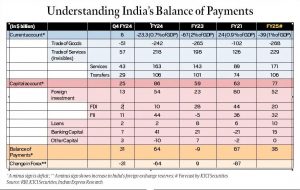
Current Account Surplus: India registered a current account surplus during the fourth quarter (Jan-Mar) of the 2023-24 financial year, marking the first surplus in 11 quarters.
Quarterly vs. Annual Data: Despite the Q4 surplus, the current account balance for the entire FY2023-24 remained in deficit, indicating underlying economic trends and demands.
What is Balance of Payments (BoP)?
The BoP is a ledger of a country’s transactions with the rest of the world, recording all monetary transactions between residents of a country and the rest of the world.
It shows the amount of money flowing into and out of the country, indicating the relative demand for the rupee compared to foreign currencies (usually in dollar terms).
Constituents of the BoP
The BoP has two main accounts: the Current Account and the Capital Account.
Current Account: It covers the trade in goods (exports and imports), trade in services (transportation, tourism, licensing, etc.), Income (wages, interest, dividends, etc.), and current transfers (remittances, foreign aid, etc.).
Trade of Goods (Merchandise Account): Records export and import of physical goods. A trade deficit occurs when imports exceed exports.
Invisibles of Trade: Includes services (banking, insurance, IT, tourism), transfers (remittances), and income (earnings from investments). These are transactions not visible like physical goods.
Net Balance: The sum of the merchandise trade and invisible trade determines the current account balance. Q4 showed a surplus in the current account due to a surplus in invisible despite a trade deficit.
Capital Account: It covers debt forgiveness, migrants’ transfers of financial assets, taxes on gifts and inheritances, and ownership transfers of fixed assets.
Investments: Captures transactions related to investments such as Foreign Direct Investment (FDI) and Foreign Institutional Investments (FII).
Net Balance: Q4 showed a net surplus of $25 billion in the capital account.
Impact on the Indian Economy:
Exchange Rate Stability: The current account surplus in Q4 helped stabilize the exchange rate of the rupee. By absorbing excess dollars, the Reserve Bank of India (RBI) prevented excessive appreciation of the rupee, which helps maintain the competitiveness of Indian exports.
Improved Sovereign Ratings: A current account surplus can positively impact India’s sovereign credit ratings, as it indicates stronger external financial health and reduces reliance on foreign borrowing.
Foreign Exchange Reserves: The surplus contributed to an increase in India’s foreign exchange reserves, enhancing the country’s ability to manage external shocks and providing a buffer against global economic uncertainties.
Investment Climate: A surplus in the capital account, driven by Foreign Direct Investment (FDI) and Foreign Institutional Investments (FII), indicates investor confidence in the Indian economy, potentially leading to more robust economic growth and development.
Economic Health Indicators: Despite the Q4 surplus, the annual current account deficit suggests robust domestic demand and investment needs. This aligns with a growing economy that requires imports of capital goods to enhance production capacity and future export potential.
Way forward:
Enhance Export Competitiveness: India should focus on boosting its export sector by diversifying export products and markets, improving product quality, and providing incentives for export-oriented industries.
Promote Sustainable Foreign Investment: Encouraging sustainable and long-term foreign investments, particularly in sectors like manufacturing, technology, and renewable energy, can strengthen the capital account.
Mains PYQ:
Q Craze for gold in Indian has led to surge in import of gold in recent years and put pressure on balance of payments and external value of rupee. In view of this, examine the merits of Gold Monetization scheme. (UPSC IAS/2015)
Argentina faces one of the world’s highest inflation rates and a decade-long economic stagnation.
The International Monetary Fund’s (IMF) earlier decision to release $4.7 billion from a $57 billion bailout package to Argentina, despite missed targets, raised eyebrows.
IMF’s Controversial Decision:
The IMF dispersed $4.7 billion, including overdue and advanced payments, to bolster President Milei’s nascent government.
This move contradicted IMF guidelines requiring adherence to economic conditions, signaling geopolitical influence and strategic support.
Argentina’s Economic Struggles
Persistent fiscal deficits and chronic inflation have plagued Argentina, with historical inflation averaging 190% from 1944 to 2023.
The government defaulted on sovereign debt nine times, exacerbating economic instability.
Since 2009, fiscal deficits persisted, reaching 4.4% of GDP in 2023, fueled by overspending and reliance on the inflation tax.
Milei’s administration targets fiscal reform to eliminate large deficits, contrasting with past failed attempts like the Austral Plan.
Alfonsín launched the Austral Plan, an austerity program that implemented a new currency (the austral), wage and price controls, and currency devaluations.
IMF and its Bailout
The IMF is an international organization (190 member countries) that provides loans, technical assistance, and policy advice to member countries.
Established in 1944 to promote international monetary cooperation, exchange rate stability, balanced economic growth, and poverty reduction.
Hq: Washington, D.C.
An IMF bailout, or an IMF program, is a loan package provided to financially troubled countries.
Bailout programs have specific terms and conditions that borrowing countries must meet to access the funds.
Types of IMF Bailout Packages:
Description
Duration
Conditionality
Stand-by Arrangements
Short-term lending programs for countries with temporary balance of payments problems.
1-2 years
Specific macroeconomic policies for stabilization
Extended Fund Facility
Medium-term lending programs to address balance of payments difficulties from structural weaknesses.
Longer-term
Extensive conditionality and significant reforms
Rapid Financing Instrument
Loan program providing quick financing for countries with urgent balance of payments needs.
Flexible
Fewer conditions and shorter application process
PYQ:
[2016] With reference to the International Monetary and Financial Committee (IMFC), consider the following statements:
1. IMFC discusses matters of concern affecting the global economy and advises the International Monetary Fund (IMF) on the direction of its work.
2. The World Bank participates as an observer in IMFC’s meetings.
Which of the statements given above is/are correct?