💥Join UPSC 2027,2028 Mentorship (July Batch) + XFactor Notes & Microthemes PDF

Distribution: yearly

  • Halal Certification Ban in Uttar Pradesh: A Comprehensive Overview

    Central Idea

    • On November 18, the Uttar Pradesh government imposed a state-wide ban on the “production, storing, distribution, and sale of halal certified edible items.”

    Understanding Halal and Halal Food

    • Definition of Halal: ‘Halal’ is an Arabic term meaning ‘permissible’ in English.
    • FAO Guidelines on Halal Food: The Food and Agriculture Organization defines halal food as compliant with Islamic Law, including specific slaughter methods.
    • Vegetarian Food and Halal: Generally, vegetarian food is deemed halal unless it contains prohibited substances like alcohol.
    • Labeling of Halal Products: Products claimed as halal must visibly display this on their labels.

    Halal-Certified Products

    • Purpose of Certification: Halal certification ensures food preparation adheres to Islamic law and is free from contamination.
    • Certification Bodies in India: Various private companies in India, like Halal India Pvt Ltd and Jamiat Ulama-i-Hind Halal Trust, offer halal certification. Some are government-recognized, while others are not.

    Controversy Surrounding Halal-Certified Products

    • Legality: The debate centers on the legality of certificate-issuing authorities and allegations of targeting specific religious communities.
    • Parallel Authority issue: The Indian government does not require halal certification; FSSAI certification is the standard for edible products.
    • International Trade and Halal Certification: As per the USDA 2022 report, halal certification is not essential for export or import trade permissions.
    • Religious violations: A case was filed against entities in Lucknow for purportedly exploiting religious sentiments to enhance sales through halal certification.

    Legal Aspects of Halal Certification

    • Complaints against Certification: Complaints have emerged against companies for allegedly issuing forged halal certificates for financial benefits.
    • Accusations of Illegal Certification: These companies are accused of lacking official recognition to issue halal certificates.

    Halal Certification System in India

    • Certifying Agencies: Various agencies provide halal certification to Indian companies, products, or food establishments.
    • Government Accreditation: The National Accreditation Board for Certification Bodies under the Quality Council of India accredits these Halal Certification Bodies.
    • Advantages of Certification: Certification from recognized bodies benefits companies in both domestic and international markets.
    • DGFT Guidelines: The Directorate General of Foreign Trade mandates that only facilities with valid certification from accredited bodies can export ‘halal certified’ meat and meat products.
    • Government’s i-CAS Scheme: The ‘India Conformity Assessment Scheme’ was developed to regulate the halal certification process.

    Implications of the Ban

    • Quality confusions: The ban aims to address confusion over food quality standards and align with the Food Safety and Standards Act.
    • Curbing forged certification: Companies issuing forged certificates are accused of fostering social unrest and betraying public trust.
    • Economic Impact: There are apprehensions about a potential conspiracy to undermine the sales of non-halal certified products.
    • Financial Misuse: There are allegations that profits from these activities could be funneled towards supporting terrorist organizations and anti-national activities.

    Conclusion

    • This ban reflects the complex interplay between food safety regulations, religious practices, and commercial dynamics.
    • It highlights the need for a balanced approach in addressing such multifaceted issues.
  • How UAPA has become more draconian over the years?

    Central Idea

    • Students in Jammu & Kashmir were booked under the Unlawful Activities (Prevention) Act (UAPA) after allegations of abuse and threats during the World Cup final, along with raising pro-Pakistan slogans.
    • Jammu & Kashmir police invoked a ‘softer provision’ of UAPA, citing the act of ‘terrorizing’ others with pro-India or anti-Pakistan sentiments.

    What is UAPA?

    • Purpose: UAPA empowers the government to investigate and prosecute acts of terrorism, and to designate entities as “unlawful” or “terrorist” organizations or individuals.
    • Enactment: Introduced in 1967, based on recommendations from the National Integration Council to counter national divisiveness. Initially focused on secessionist activities without explicit mention of terrorism.
    • Evolution of UAPA:
    1. Introduction of Terrorism (2004): Post-repeal of POTA, UAPA was amended to include terrorism. It defined terrorism, associated punishments, and introduced provisions for seizing ‘proceeds of terrorism’.
    2. Post-26/11 Amendments (2008): Expanded the definition of terrorism, introduced stringent bail conditions, and extended police and judicial custody durations. It also made bail more difficult to obtain and shifted the burden of proof to the accused in certain cases.
    3. Economic Security (2012): Included economic security under terrorism, categorizing activities like counterfeiting currency as terrorist acts. It also increased the duration for which an organization could be declared unlawful.
    4. Individual Designation (2019): Allowed the government to designate individuals as terrorists and expanded the NIA’s powers.

    The ‘Softer’ Provision: Section 13

    • Section 13 of UAPA: Deals with punishment for ‘unlawful activities’ rather than ‘terrorist activities’. It includes imprisonment up to seven years for participating in, advocating, abetting, or inciting unlawful activities.
    • Implications: Although termed ‘softer’, this section still carries significant penalties and makes bail challenging to obtain.

    Criticism and Concerns

    • Vague Definitions: The act’s broad and vague definitions, especially post-2008 amendments, allow for a wide interpretation of what constitutes terrorism or unlawful activities.
    • Human Rights Concerns: The act has been criticized for potentially violating human rights, including the presumption of innocence and the right to a fair trial.
    • Use against Dissenters: There have been instances where UAPA has been used against activists, journalists, and protestors, raising concerns about its use to suppress dissent.

    Conclusion: Balancing Security and Rights

    • Need for Scrutiny: The use of UAPA, especially its ‘softer’ provisions, requires careful scrutiny to ensure it doesn’t infringe on fundamental rights while addressing security concerns.
    • Debate on Amendments: Ongoing debates about UAPA focus on finding a balance between national security needs and the protection of individual rights and freedoms.
  • Cabinet clears terms of reference for 16th Finance Commission

    Central Idea

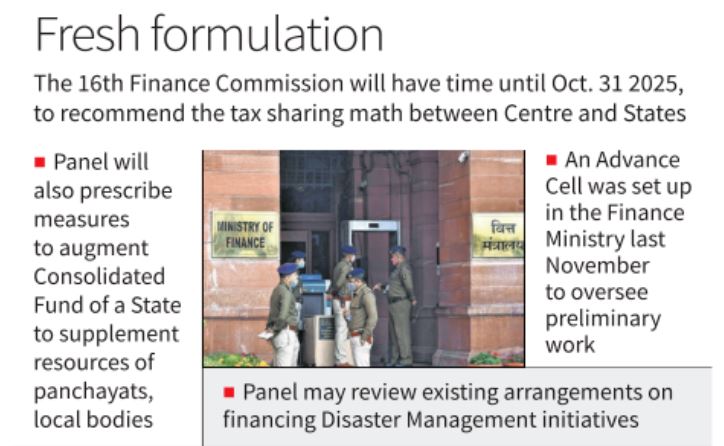
    • The Union Cabinet approved the terms of reference (ToR) for the Sixteenth Finance Commission.
    • The Commission will devise a formula for revenue sharing between the Centre and the States for the period starting April 1, 2026.

    About Finance Commission

    • Establishment: The Finance Commission (FC) of India was established by the President in 1951 under Article 280 of the Indian Constitution.
    • Purpose: Its primary role is to define and regulate the financial relations between the central government and the individual state governments.
    • Legislative Framework: The Finance Commission (Miscellaneous Provisions) Act, 1951, further outlines the qualifications, appointment, disqualification, term, eligibility, and powers of the Finance Commission.
    • Composition: Appointed every five years, the FC comprises a chairman and four other members.
    • Evolution: Since the First FC, changes in India’s macroeconomic landscape have significantly influenced the Commission’s recommendations.

    Constitutional Provisions

    • Article 268: Facilitates the levy of duties by the Centre, with collection and retention by the States.
    • Article 280: Outlines the FC’s composition, qualifications for members, and its terms of reference. It mandates the FC to recommend the distribution of net tax proceeds between the Union and States and the allocation among States. It also addresses the financial relations between the Union and States and the devolution of unplanned revenue resources.

    Key Functions of the Finance Commission

    • Tax Devolution: Recommends how net tax proceeds should be distributed between the Center and States.
    • Grants-in-Aid: Determines the principles governing these grants to States.
    • Augmenting State Funds: Advises on measures to enhance the States’ Consolidated Funds to support local bodies and panchayats, based on State Finance Commissions’ recommendations.
    • Other Financial Functions: Addresses any other financial matters referred by the President.

    Members of the Finance Commission

    • Structure and Standards: The Finance Commission (Miscellaneous Provisions) Act, 1951, provides a structured format and global standards for the FC.
    • Qualifications and Powers: Specifies rules for members’ qualifications, disqualification, appointment, term, eligibility, and powers.
    • Composition: The Chairman is chosen for their experience in public affairs. The other members are selected based on their judicial experience, knowledge of government finances, administrative and financial expertise, or special economic knowledge.

    Challenges for the 16th Finance Commission

    • Overlap with GST Council: The coexistence with the GST Council, a permanent constitutional body, presents a new challenge.
    • Conflict of Interest: Decisions by the GST Council on tax rates could impact the FC’s revenue-sharing calculations.
    • Feasibility of Recommendations: While the Centre often adopts the FC’s suggestions on tax devolution and fiscal targets, other recommendations may be overlooked.

    Major Outstanding Recommendations

    • Fiscal Council Creation: The 15th FC proposed a Fiscal Council for collective macro-fiscal management, but the government has shown reluctance.
    • Non-Lapsable Fund for Internal Security: Though the Centre agreed ‘in principle’ to establish this fund, its implementation details are pending.
  • Understanding Rat-Hole Mining

    rat-hole

    Central Idea

    • The rescue operation in Uttarakhand using rat-hole mining, a method banned for its hazardous nature and environmental impact, brings to light the complexities and challenges of mining practices in India.

    What is Rat-Hole Mining?

    • Description: A primitive and hazardous method of mining involving digging small tunnels, just large enough for a person to crawl through, to extract coal.
    • Types:
      • Side-Cutting: Following a visible coal seam on hill slopes.
      • Box-Cutting: Involves digging a pit and then creating horizontal tunnels.
    • Irony: Thecued workers from Assam, a region that lost lives to rat-hole mining in Meghalaya, were ironically saved using the same method.

    Why is Rat-Hole Mining Banned?

    • Location: Prevalent in Meghalaya, a Sixth Schedule State where central mining laws don’t apply.
    • Risks: Asphyxiation, mine collapse, flooding, and severe environmental impacts.
    • NGT Ban (2014): Due to safety hazards and environmental degradation, including river pollution.
    • Continued Illegal Mining: Despite the ban, illegal mining and transportation persist, with significant loss of lives (e.g., 17 miners drowned in 2018 in East Jaintia Hills).

    Factors Leading to the NGT Ban

    • Activism: Environmental and human rights groups highlighted the dangers for two decades.
    • Child Labor: Reports estimated around 70,000 children, mostly from Bangladesh and Nepal, were employed in these mines.
    • Official Acknowledgment: Under pressure, the State admitted to child labor in 2013, leading to the NGT ban in 2014.

    Feasibility of such mining

    • Economic Viability: Thin coal seams in Meghalaya make rat-hole mining more economically feasible than open-cast mining.
    • Coal Reserves: Meghalaya has significant coal reserves dating back to the Eocene age.
    • Government Action: Meghalaya announced the approval of mining leases for ‘scientific’ mining in 2023.
    • Concerns: Skepticism remains among anti-mining activists about the implementation of sustainable and legal mining practices.

    Conclusion

    • While the approval of ‘scientific’ mining offers a legal and potentially safer avenue, it remains to be seen how effectively it will replace the dangerous and unregulated rat-hole mining, especially in regions with unique geological and socio-political contexts like Meghalaya.


  • Who were Nolamba Pallavas?

    Central Idea

    • Ancient relics belonging to the Nolamba Pallavas dynasty were unearthed in Cholemarri village, situated 22 km from Penukonda in Sri Sathya Sai district.

    Significant Findings

    • Battlefield Site: Evidence suggests a fierce battle in the 9th century AD between the Nolamba Pallavas and the Bhana-Vaidambas.
    • Inscriptions and Artifacts:
      1. An inscription of Mahendra Nolambadhi Raja (875-897 AD), ruler of Henjeru (now Hemavati), was found in the fields.
      2. Hero stones with Telugu inscriptions (written in ancient Kannada script) from the Nolamba and Vijayanagara periods were discovered near Anjaneyaswamy temple.

    About the Nolamba Dynasty

    • Time Period: Ruled from the 8th to the 12th centuries C.E.
    • Geographical Extent: Nolambavadi region, covering parts of southeast Karnataka, Tamil Nadu, and Andhra Pradesh.
    • Political History: Initially feudatories to Pallavas, Chalukyas of Badami, Gangas, and Rashtrakutas, later to Chalukyas of Kalyani. Often referred to as Nolamba Pallava in inscriptions.
    • Capitals: Initially Chitradurga, later shifted to Hemavati.
    • Origin:
      • Founded by Mangala Nomabathi Raja (735–785 A.D.).
      • Emerged as governors under Pallavas and Chalukyas.
      • Experienced shifts in allegiance between Pallavas, Chalukyas, Banas, and Vaidumbas.
      • The term “Nolambas” came into existence post the Chalukyas’ resurgence under Vikramaditya I.
    • Decline: Overrun by Ganga king Marasimha, who claimed the title Nolambakulantaka.
    • Cultural Contributions: Known for constructing grand temple complexes like Kalleshwara Temple in Aralaguppe, Bhoganandishwara Temple in Nandi, and Ramalingeshwara Temple in Avani.
    • Religious Affiliation: Predominantly Shaivites, with temples dedicated to Lord Shiva.
  • Specie in news: Lantana Camara

    Lantana Camara

    Central Idea

    • In an exhibition in Bengaluru, sculptures of elephants made from Lantana camara gained popular attraction.

    About Lantana Camara

    • Lantana camara, commonly known as lantana, belongs to the verbena family (Verbenaceae) and originates from the American tropics.
    • Lantana was introduced to India in the early 19th century as an ornamental plant during the British colonial period. Its colorful flowers made it popular in gardens.
    • This shrub has the ability to spread across forest floors, climb like a creeper over trees, and easily intertwine with native vegetation.
    • Lantana is highly adaptable, thriving in diverse ecosystems.

    Impacts on Local ecosystem

    • Lantana’s invasive nature poses a serious threat to native flora and fauna. It competes with native plants for resources, often leading to a reduction in native biodiversity.
    • It forms dense thickets that alter the structure of habitats that impede the movement of animals and change the microhabitat conditions, such as light availability and soil composition.
    • It can invade agricultural land, reducing crop yields, and can also infest pastures, impacting grazing for livestock.
    • It is toxic to livestock and can cause health issues if ingested. This adds to the economic burden for farmers who need to ensure their animals do not graze on lantana-infested land.
    • The plant increases the risk of fire in the ecosystems it invades because it forms dense thickets that can easily catch and spread fire.
  • ‘Music Frog’ Species discovered in Arunachal Pradesh

    Music Frog

    Central Idea

    • Scientists have identified a new species of ‘music frog’, named Nidirana noadihing, in Arunachal Pradesh, India.

    Nidirana noadihing: The Music Frog

    • Location: It came from the place, Noa-Dihing River, from where the specimens were collected.
    • Size: The frogs grow up to 6 cm, with males measuring between 1.8 to 2.3 inches and females between 2.4 to 2.6 inches.
    • Appearance: They have a robust body, a rounded snout, smooth skin with bony protrusions on their backs, and a pale cream line bordered with dark brown running down their bodies.
    • Eye Features: The frogs have irregularly shaped spots on their eyelids, moderately large eyes with gold-rimmed pupils, and dark brown irises with a golden spackle.
    • Colouration: Their throat, forelimbs, thighs, and lower legs are light brown and pinkish, while their groin and the outside of their thighs are pale yellow with irregular dark olive patches.

    Habitat and Behavior

    • Habitat: Nidirana noadihing inhabits swamps, ponds, and paddy fields, often constructing nests for egg-laying.
    • Vocalization: The species is distinguished by its unique call, which led to its discovery near the Noa-Dihing river.
  • Second phase of Kashi Tamil Sangamam

    Central Idea

    • The Centre announced the schedule for second phase of the Kashi Tamil Sangamam from December 17 to 30.

    Kashi Tamil Sangamam

    • Kashi Tamil Sangamam celebrates the historical and cultural ties between North and South India.
    • It is managed by IIT Madras and BHU (Banaras Hindu University).
    • Its main goal is to bring together the knowledge and cultural traditions of North and South India, helping people understand our shared history and strengthen connections between these regions.
    • The Ministry of Education organizes this event with help from other ministries like Culture, Textiles, Railways, Tourism, Food Processing, Information & Broadcasting, and the Uttar Pradesh Government.
    • This effort aligns with the National Education Policy (NEP), 2020, which focuses on combining traditional Indian knowledge with modern knowledge systems.

    Cultural Significance

    • In the 15th century, King Parakrama Pandya from the Madurai area wanted to build a Lord Shiva temple, so he went to Kashi (Uttar Pradesh) to get a lingam.
    • On his way back, he rested under a tree, but the cow carrying the lingam wouldn’t move when he tried to continue his journey.
    • Parakrama Pandya took this as a divine sign and set up the lingam there, in what is now known as Sivakasi, Tamil Nadu.
    • The Pandyas built the Kasi Viswanathar Temple in present-day Tenkasi, southwestern Tamil Nadu, near the Kerala border, for those who couldn’t travel to Kashi.
  • What is Project Q*, the AI breakthrough from OpenAI?

    Central Idea

    • OpenAI, a leading AI technology company, has been embroiled in a high-profile controversy following the dismissal of Sam Altman, its CEO.
    • At the heart of the controversy is the development of a new AI model named Q* (Q-star), which has raised significant concerns among OpenAI staff and the broader tech community.

    What is Project Q*?

    • Advanced AI Algorithm: Q* represents a significant advancement in AI, capable of solving complex mathematical problems, even those outside its training data.
    • Step towards AGI: This model is seen as a stride towards Artificial General Intelligence (AGI), capable of performing any intellectual task that a human can.
    • Development Team: The breakthrough is attributed to Ilya Sutskever, with further development by Szymon Sidor and Jakub Pachoki.

    Why is Q* Feared?

    • Potential for Accelerated Scientific Progress: Researchers have expressed concerns about Q*’s ability to rapidly advance scientific discovery, questioning the adequacy of existing safety measures.
    • Internal Warnings: Reports suggest that Q*’s capabilities could pose a threat to humanity, a concern believed to be a major factor in Altman’s dismissal.

    Concerns Surrounding Project Q*

    • Advanced Reasoning and Abstract Understanding: Q* reportedly exhibits unprecedented logical reasoning and understanding of abstract concepts, raising concerns about unpredictable behaviors.
    • Combination of AI Methods: According to researcher Sophia Kalanovska, Q* might merge deep learning with human-programmed rules, enhancing its power and versatility.
    • AGI Implications: As a step towards AGI, Q* could surpass human capabilities in various domains, leading to control, safety, and ethical issues.
    • Capability for Novel Idea Generation: Unlike existing AI models, Q* could potentially generate new ideas and pre-emptively solve problems, leading to decisions beyond human control or understanding.
    • Risks of Misuse and Unintended Consequences: The advanced capabilities of Q* heighten the risk of misuse or unforeseen harmful outcomes.
  • Parthenon Sculptures Dispute: A Diplomatic Row between Greece and the UK

    Central Idea

    • UK PM Rishi Sunak cancelled his meeting with visiting Greek PM over the latter’s comments on ancient Parthenon Sculptures housed in the British Museum.

    Parthenon Sculptures

    • The Parthenon Sculptures are ancient Greek stone sculptures over 2,000 years old, originally part of the Parthenon temple in Athens.
    • These sculptures, including a 75-meter-long frieze, are significant artifacts of Athens’ Golden Age, depicting gods, heroes, and mythical beings.
    • In the early 19th century, Thomas Bruce, 7th Earl of Elgin and British ambassador to the Ottoman Empire, removed the sculptures from the Parthenon.
    • The marbles were subsequently purchased by British Museum in 1816.

    Debate over Legitimacy

    • Greece has accused Lord Elgin of stealing the sculptures, while he maintained he had permission from the Ottoman authorities.
    • The original document granting permission has been lost, leading to disputes over its authenticity and content.

    Greece’s Campaign for Return

    • Greece’s demand for the sculptures’ return dates back to its independence in the early 1830s.
    • The campaign gained momentum in the 1980s, spearheaded by Greek actress and then-culture minister Melina Mercouri.
    • The British Museum argues that the sculptures were legally acquired and rejects Greece’s demands for their return.
    • The museum contends that public benefit lies in having the sculptures in two locations, citing the impossibility of reassembling them completely and concerns over safe return.

    Current Developments

    • Prime Minister Sunak has described the marbles as a significant asset to the UK and opposes changing laws to facilitate their return.
    • Despite the cancelled meeting, Greek officials intend to continue negotiations with the British Museum.