💥Join UPSC 2027,2028 Mentorship (July Batch) + XFactor Notes & Microthemes PDF

Distribution: yearly

  • [pib] State Energy Efficiency Index, 2024

    Why in the News?

    The Bureau of Energy Efficiency (BEE) has released the latest edition of State Energy Efficiency Index 2024 (SEEI 2024).

    About State Energy Efficiency Index (SEEI), 2024:

    • Released by: Bureau of Energy Efficiency (BEE), Ministry of Power, in association with Alliance for an Energy Efficient Economy (AEEE).
    • Coverage: Assesses 36 States/UTs on energy efficiency performance for FY 2023–24.
    • Framework:
      • 6th edition, implementation-focused.
      • 66 indicators across sectors – Buildings, Industry, Municipal Services, Transport, Agriculture, DISCOMs, Cross-sector.
      • Includes new focus areas: EV adoption, star-rated buildings, Demand Side Management (DSM).
    • Classification:
      • Front Runners (>60%), Achievers (50–60%), Contenders (30–50%), Aspirants (<30%).
      • Top performers: Maharashtra (>15 MToE), Andhra Pradesh (5–15 MToE), Assam (1–5 MToE), Tripura (<1 MToE).
    • Key Highlights:
      • 24 states notified Energy Conservation Building Code (ECBC 2017).
      • 31 states adopted EV policies.
      • 13 states promoted solar pumps (Kerala – 74% adoption).
      • All 36 prepared State Energy Efficiency Action Plans (SEEAPs); 31 formed State Energy Transition Committees.
    • Significance: Supports India’s Net Zero 2070 goal by promoting state-level energy transition.

    Back2Basics: Bureau of Energy Efficiency (BEE):

    • Established: 1 March 2002, under the Energy Conservation Act, 2001.
    • Nodal Ministry: Ministry of Power.
    • Mission: To assist in developing policies & strategies for energy efficiency, with the aim of reducing energy intensity of the Indian economy.
    • Functions:
      • Regulatory: Implementation of Energy Conservation Act provisions.
      • Promotional:  Encourage adoption of efficient technologies & practices.
    • Key Achievements:
      • Contributed to 3.5% reduction in India’s overall energy consumption.
      • Implements programmes like Perform, Achieve, Trade (PAT), Standards & Labelling, Energy Efficiency Financing Platform, etc.
    [UPSC 2016] On which of the following can you find the Bureau of Energy Efficiency Star Label?

    1. Ceiling fans 2. Electric geysers 3. Tubular fluorescent lamps

    Select the correct answer using the code given below.

    Options: (a) 1 and 2 only (b) 3 only (c) 2 and 3 only (d) 1, 2 and 3*


  • Ice Age-era Dragon Fly rediscovered

    Why in the News?

    Odonatologists have reconfirmed the presence of the elusive dragonfly species Crocothemis erythraea in the southern Western Ghats.

    About Crocothemis erythraea Dragonfly:

    • Species Type: A rare dragonfly species, usually found in Europe, Asia, and the Himalayas.
    • Recent Finding: Reconfirmed in the Western Ghats, specifically in Kerala and Tamil Nadu high ranges.
    • Comparison: Closely resembles the common lowland species Crocothemis servilia, leading to earlier misidentifications.
    • Habitat Preference: Inhabits cooler, high-altitude areas above 550 metres.
    • Historical Origin: Likely spread to South India during the Ice Age and survived in montane habitats such as Sholas and grasslands.

    Significance of the Discovery:

    • Biodiversity Insight: Demonstrates how ancient climate changes influenced current biodiversity patterns.
    • Ecological Importance: Reinforces the Western Ghats’ status as a biodiversity hotspot of global value.
    • Conservation Message: Highlights the need to protect sensitive high-altitude habitats like Sholas and montane grasslands.
    • Scientific Contribution: Adds to India’s growing record of documenting and conserving rare species.
    [UPSC 2024] The organisms Cicada, Froghopper and Pond skater are:

    Options: (a) Birds (b) Fish (c) Insects* (d) Reptiles


  • Mount Etna Eruption

    Why in the News?

    Mount Etna has erupted again after its recent eruption in June.

    About Mount Etna:

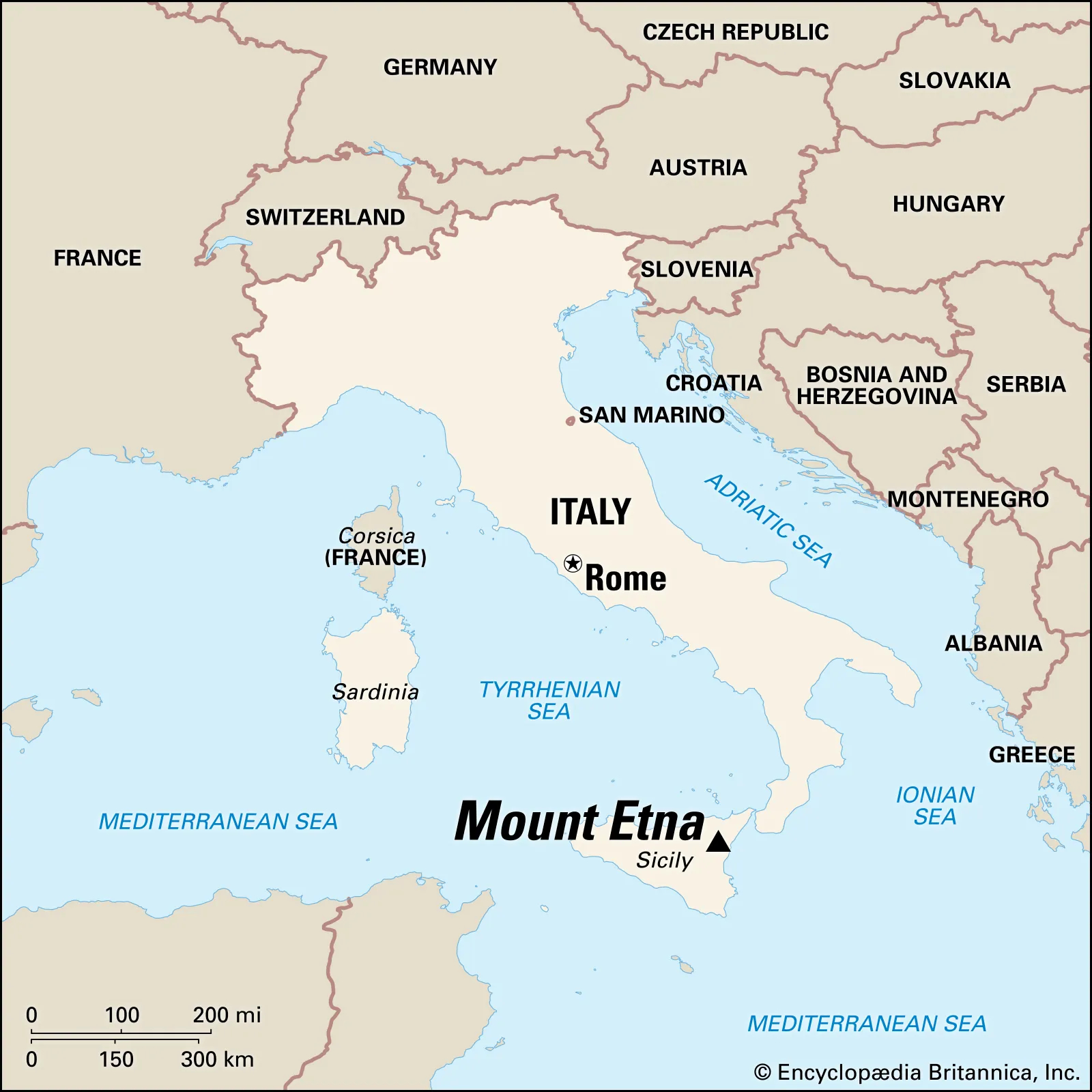
    • Location: Situated on the east coast of Sicily, Italy, near the city of Catania.
    • Type: Mount Etna is a stratovolcano (also called a composite volcano), which is formed from layers of hardened lava, volcanic ash, and rocks.
    • Height: It stands at approximately 3,300 meters, making it the tallest volcano in Europe south of the Alps.
    • Recognition: Declared a UNESCO World Heritage Site in 2013, with documented volcanic activity for at least 2,700 years.
    • Eruption Record: Etna is almost constantly active. Notable eruptions have occurred in 1400 B.C., 1669, 2001, 2018, 2021, 2024, and 2025.
    • Volcanic Activity Style: Known for Strombolian and effusive eruptions, with occasional Plinian eruptions (rare and more explosive).

    Reasons Behind the Eruption:

    • Nature of Eruption: The eruption is classified as either Strombolian or possibly Plinian, depending on interpretation:
      • Strombolian Eruption: Characterized by moderate explosive bursts, caused by gas bubbles in magma suddenly bursting at the surface.
      • Plinian Eruption: Some volcanologists suggest this classification due to the large ash column that may have reached the stratosphere.
    • Eruption Trigger: The eruption likely began due to pressure buildup from gas within the magma chamber, leading to collapse of the southeast crater and lava flows.
    [UPSC 2014] Consider the following geological phenomena:

    1. Development of a fault

    2. Movement along a fault

    3. Impact produced by a volcanic eruption

    4. Folding of rocks Which of the above cause earthquakes?

    Options: (a) 1, 2 and 3 (b) 2 and 4 (c) 1, 3 and 4 (d) 1, 2, 3 and 4*


  • Challenges of Monsoon Variability and Disaster Preparedness

    Introduction

    Heavy rains in August 2025 have wreaked havoc across North India, Himachal Pradesh cut off, Jammu and Kashmir reporting over 40 deaths, Punjab’s farmland submerged, and the Yamuna swelling in the capital. The floods highlight the increasing unpredictability of the southwest monsoon, where rainfall comes in concentrated bursts rather than spread across weeks. Beyond the immediate tragedy, this points to systemic governance challenges, unplanned infrastructure in fragile zones, inadequate early warning systems, and a reactive rather than preventive disaster management model.

    Increasing unpredictability of the monsoon

    1. Erraticism of rainfall: Concentrated bursts replace evenly spread rains, overwhelming slopes, rivers, and cities.
    2. Amplified erosion: Short, intense rain accelerates slope destabilisation in Himalayas.
    3. Recurring phenomenon: Evidence now suggests such rainfall patterns are no longer exceptional but likely regular.

    Fragility of Himalayan ecosystems and their weakening

    1. Deforestation and clearance: Forest cover removal and road-widening continue unchecked.
    2. Slope destabilisation: Lack of slope-safe engineering increases landslide risks.
    3. Shrinking catchments: Reduced buffering capacity heightens chances of slope failure and siltation downstream.

    Insufficiency in disaster preparedness

    1. Early warning gaps: Despite better forecasts, reliable ground-level alerts are absent.
    2. Relief over resilience: Agencies mobilise post-damage; pre-positioned supplies and community drills are missing.
    3. Reactive model: Each disaster treated as unforeseeable, ignoring repeated expert warnings.

    Policy choices aggravating vulnerabilities

    1. Strategic projects: Roads and urban expansion pursued in unstable landscapes.
    2. Poor compensatory afforestation: Quality of replanted forests does not match original ecological value.
    3. Climate-resilient infrastructure lag: Development focus prioritises speed over sustainability.

    Shifts required in disaster governance

    1. Shift to preventive strategies: Focus on reducing vulnerabilities before disasters occur.
    2. Systematic preparedness: Regular drills, community participation, and pre-emptive relief stocks.
    3. Balanced growth: Infrastructure that respects ecological fragility and integrates climate resilience.

    Conclusion

    The 2025 floods across North India are not isolated accidents but part of a pattern of climate-driven extreme weather. Treating each calamity as “unprecedented” delays learning and perpetuates cycles of loss. Building resilience means moving beyond post-disaster relief to preventive strategies: sustainable infrastructure, landslide mitigation, community drills, and early-warning systems. Unless governance shifts from reaction to anticipation, monsoon seasons will continue to leave trails of destruction.

    PYQ Relevance

    [UPSC 2019] Disaster preparedness is the first step in any disaster management process. Explain how hazard zonation mapping will help disaster mitigation in the case of landslides.

    Linkage: The 2025 North India floods highlight how slope destabilisation and unchecked construction in Himalayan States amplify landslide risks. Hazard zonation mapping could have guided slope-safe engineering, restricted high-risk land use, and improved early warning. Thus, it directly connects preparedness to mitigation, aligning with the UPSC 2019 question.

  • [pib] Mahatma Ayyankali (1863–1941)

    Why in the News?

    On his Jayanti (August 28), PM paid tribute to Mahatma Ayyankali.

    About Mahatma Ayyankali:

    • Birth: August 28, 1863, in Venganoor, Travancore (present-day Thiruvananthapuram, Kerala).
    • Community: Belonged to the Pulayar caste, among the most oppressed and excluded groups.
    • Background: Faced severe caste discrimination despite family owning land; denied access to temples, schools, roads, and public spaces.
    • Legacy: Remembered as a Dalit leader of modern Kerala and a pioneer of social justice, education, and labour rights.

    Key Reforms and Contributions:

    • Caste Defiance: Famous Villuvandi Yatra (1893) – ox-cart ride on caste-restricted roads, triggering riots but also mass mobilization for Dalit rights.
    • Education Movement: Demanded access for Dalit children to public schools; Travancore government issued 1907 order allowing entry, implemented by 1910.
    • Sadhu Jana Paripalana Sangham (SJPS): Founded in 1907 to promote Dalit education, legal aid, and social upliftment; expanded into hundreds of branches.
    • Legislative Role: In 1910, became the first Dalit member of the Sree Moolam Popular Assembly (Travancore Legislative Council).
    • Labour Reforms: Fought for higher wages and dignity for agricultural labourers.
    • Social Reforms: Campaigned for Dalit women’s right to cover their upper bodies in public, a practice denied earlier.
    • Temple Entry Movement: Early campaigns from 1895 onwards contributed to the 1936 Temple Entry Proclamation, ending exclusion of Dalits from temples in Travancore.
    • Recognition: Admired by Mahatma Gandhi, who called him the “Pulaya King”. Indira Gandhi later hailed him as “India’s greatest son”.
    [UPSC 2025] Who among the following was the founder of the ‘Self-Respect Movement’?

    Options: (a) ‘Periyar’ E. V. Ramaswamy Naicker * (b) Dr. B. R. Ambedkar (c) Bhaskarrao Jadhav (d) Dinkarrao Javalkar


  • [pib] Nuakhai Festival

    Why in the News?

    PM extended wishes to the Odia-speaking communities on the occasion of Nuakhai.

    About Nuakhai Festival:

    • Meaning: Derived from “Nua” (new) and “Khai” (food); literally “new food”, marking the first consumption of freshly harvested rice.
    • Region: Celebrated mainly in Western Odisha and also observed in parts of Chhattisgarh and Jharkhand by Odia-speaking communities.
    • Significance: Agrarian thanksgiving to deities, ancestors, and the earth; symbol of prosperity, good harvest, and family unity.
    • Date: Observed on Bhadraba Sukla Panchami (5th day after Ganesh Chaturthi).
    • Historical Roots: Traces to Vedic rituals of first grain offerings (Pralambana yajna); formalized in the 14th century by Raja Ramai Deo of Patna State, Sambalpur.
    • Social Role: Strengthens community bonds; people greet with “Nuakhai Juhar”, reconcile disputes, and seek elders’ blessings.

    Festivities and Cultural Elements:

    • Preparations: Begin 15 days in advance; involve nine ritual steps (Navaranga) such as fixing the date, cleaning homes, harvesting grain, offering puja, and sharing food.
    • Ritual Practice: Family head or priest performs puja, offering the first grain to the local deity, followed by distribution within the family.
    • Cultural Celebrations: Sambalpuri folk dances like Rasarkeli, Dalkhai, Maelajada, Sajani; folk songs praising harvest and community spirit.
    [UPSC 2018] Consider the following pairs: Tradition | State

    1. Chapchar Kut festival — Mizoram

    2. Khongjom Parba ballad — Manipur

    3. Thong-To dance — Sikkim

    Which of the pairs given above is/are correct?

    Options: (a) 1 only (b) 1 and 2* (c) 3 only (d) 2 and 3


  • United Nations Conference on Environment and Development (UNCED)

    Why in the News?

    This year marks three decades since the landmark Earth Summit in Rio de Janeiro in 1992, which established the United Nations Framework Convention on Climate Change (UNFCCC).

    About United Nations Conference on Environment and Development (UNCED):

    • Event: Also called the Earth Summit, held in Rio de Janeiro, Brazil (June 3–14, 1992).
    • Participation: 178 countries, 117 heads of state, thousands of NGOs and civil society groups.
    • Objective: Reconcile economic growth with environmental protection, mainstreaming sustainable development globally.
    • Key Outcomes:
      • Rio Declaration (27 principles, including precautionary principle & Common but Differentiated Responsibilities (CBDR)).
      • Agenda 21 (non-binding action plan for sustainable development).
      • UNFCCC (binding treaty on climate change; later Kyoto Protocol, Paris Agreement).
      • Convention on Biological Diversity (CBD) (binding treaty on biodiversity).
      • Statement of Forest Principles (non-binding guidelines for sustainable forests).
      • Commission on Sustainable Development (CSD) created to monitor implementation.
    • Significance: Landmark in international environmental diplomacy, embedding sustainability in global policy and leading to follow-ups (Rio+10, Rio+20).

    India and UNCED:

    • Stance & Advocacy:
      • Strongly pushed for Common but Differentiated Responsibilities (CBDR); developed nations must bear greater responsibility due to historical emissions and resource use.
      • Emphasized poverty eradication and the right to economic growth for developing countries.
      • Called for financial support and technology transfer from developed countries to the Global South.
    • Commitments:
      • Signed & ratified all key Rio agreements: Rio Declaration, Agenda 21, UNFCCC, CBD.
    • Domestic Follow-up:
      • Integrated Agenda 21 principles into national policies (sustainable resource use, biodiversity protection, EIAs).
      • Strengthened environmental legislation under the Environment Protection Act (1986).
    • Role: Positioned itself as a voice of developing countries, balancing environment with development imperatives.
    [UPSC 2010] The United Nations Framework Convention on Climate Change (UNFCCC) is an international treaty drawn at-

    Options:

    (a) United Conference on the Human Environment, Stockholm, 1972

    (b) UN Conference on Environment and Development, Rio De Janerio, 1992 *

    (c) World Summit on Sustainable Development, Johannesburg, 2002

    (d) UN Climate Change Conference, Copenhagen, 2009


  • UDISE+ Report, 2025

    Why in the News?

    The latest round of Unified District Information System for Education Plus (UDISE+) data was released by the Ministry of Education (MoE).

    About UDISE+

    • Launch: Introduced in 2018–19 as an upgraded version of UDISE (2012–13).
    • Purpose: Collects and monitors school-level data across India.
    • Coverage: Tracks enrolment, dropout rates, teachers, infrastructure, and gender indicators.
    • Design: Built to speed up data entry, reduce errors, improve verification, and enhance data quality.
    • Policy Role: Functions as a key tool for planning, monitoring, and implementing education reforms.
    • Scope: Covers schools at all levels – foundational, preparatory, middle, and secondary.

    Key Highlights of the UDISE+ 2025 Report:

    • Teachers: Number of teachers crossed 1 crore (1,01,22,420) in 2024–25, a 6.7% rise from 2022–23.
    • Pupil–Teacher Ratio (PTR): Improved to 10 (foundational), 13 (preparatory), 17 (middle), and 21 (secondary), well below NEP’s 1:30 recommendation.
    • Dropout Rates: Fell sharply to 2.3% (preparatory), 3.5% (middle), 8.2% (secondary) in 2024–25, compared to 8.7%, 8.1%, 13.8% respectively in 2022–23.
    • Retention Rates: Reached 98.9% (foundational), 92.4% (preparatory), 82.8% (middle), 47.2% (secondary).
    • Gross Enrolment Ratio (GER): Rose to 90.3% (middle) and 68.5% (secondary).
    • Transition Rates: Increased to 98.6% (foundational → preparatory), 92.2% (preparatory → middle), 86.6% (middle → secondary).
    • Zero-Enrolment & Single Teacher Schools: Single-teacher schools reduced to 1,04,125; zero-enrolment schools dropped to 7,993 (38% decline).
    • Infrastructure: 64.7% schools with computer access, 63.5% with internet, 93.6% with electricity, 99.3% with drinking water, 97.3% with girls’ toilets, 96.2% with boys’ toilets. 95.9% with handwashing, 83% with playgrounds, 89.5% with libraries, 54.9% with ramps/handrails, 29.4% with rainwater harvesting.
    • Gender Representation: Girls’ enrolment rose to 48.3%. Female teachers increased to 54.2% of the workforce.
    [UPSC 2018] Consider the following statements:

    1. As per the Right to Education (RTE) Act, to be eligible for appointment as a teacher in a State, a person would be required to possess the minimum qualification laid down by the concerned State Council of Teacher Education.

    2. As per the RTE Act, for teaching primary classes, a candidate is required to pass a Teacher Eligibility Test conducted in accordance with the National Council of Teacher Education guidelines.

    3. In India, more than 90% of teacher education institutions are directly under the State Governments

    Which of the statements given above is/are correct?

    Options: (a) 1 and 2 (b) 2 only * (c) 1 and 3 (d) 3 only


  • Kulasekarapattinam Launch Complex

    Why in the News?

    ISRO Chairman V. Narayanan announced that the upcoming rocket launching site at Kulasekarapattinam (Tamil Nadu) will handle 20–25 satellite launches annually.

    Kulasekarapattinam Launch Complex

    About Kulasekarapattinam Spaceport:

    • Location: Coastal hamlet near Tiruchendur, Thoothukudi district, Tamil Nadu; inaugurated by PM in February 2024.
    • Second Spaceport: India’s second spaceport after Satish Dhawan Space Centre (Sriharikota, Andhra Pradesh, 1971).
    • Capacity: Can handle 20–25 launches annually, including 24 launches using a Mobile Launch Structure.
    • Focus: Dedicated to Small Satellite Launch Vehicles (SSLVs), with capacity to launch rockets up to 500 kg.
    • Facilities: About 35 facilities including launch pad, rocket integration units, ground range, checkout systems, and Mobile Launch Structure with onboard checkout computers.

    Advantages offered by Kulasekarapattinam Spaceport:

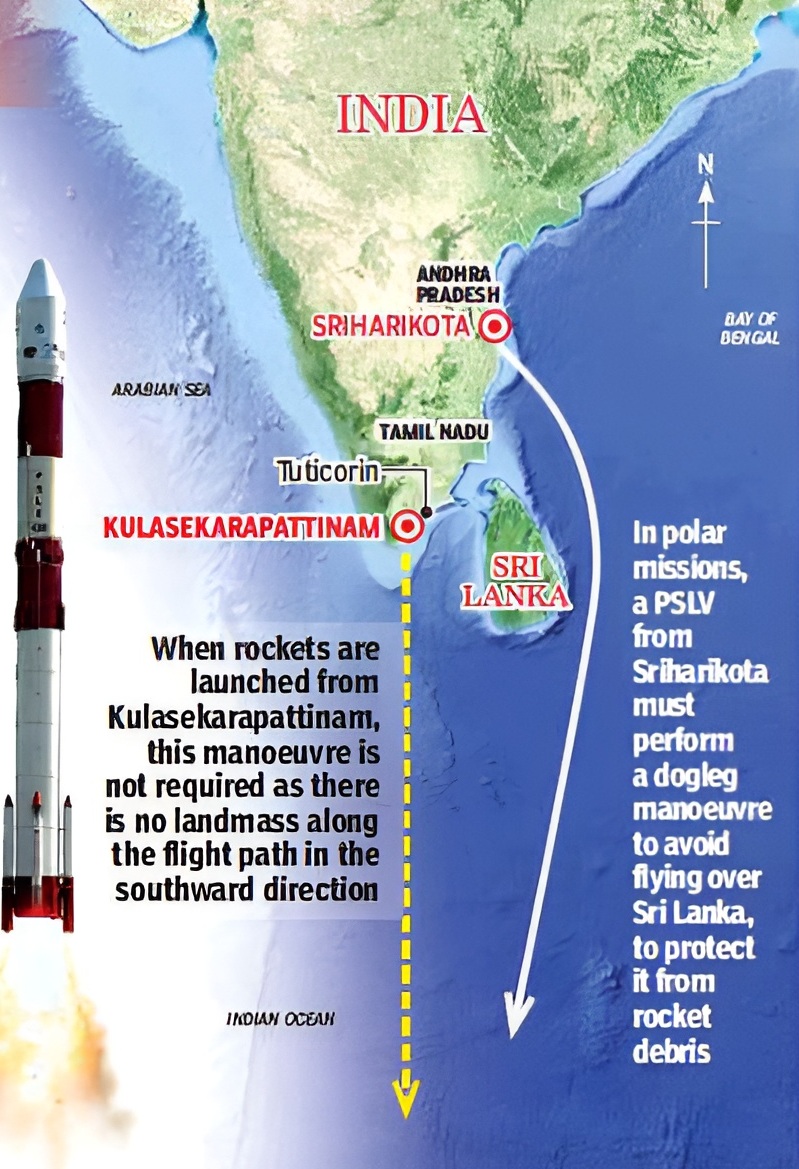
    • Direct Southward Launches: Location allows launches into the Indian Ocean without crossing landmasses; ensures more safety from debris fall.
    • No Dogleg Manoeuvre: Unlike Sriharikota, no detour is needed to avoid Sri Lanka, saving fuel.
    • Efficient Trajectory: Improves efficiency for satellites in Sun-Synchronous Polar Orbits (SSPOs).
    • Payload Advantage: SSLVs from Kulasekarapattinam can place ~300 kg into SSPO, higher than from Sriharikota.
    • Decongestion: Reduces pressure on Sriharikota, which will focus on larger PSLV, GSLV, and Gaganyaan launches.
    • Commercial Boost: Strengthens India’s role in the global small-satellite launch market, enhancing space economy.
    • Strategic Advantage: Near-equator position provides benefits for certain orbital paths.
    [UPSC 2008] ISRO successfully conducted a rocket test using cryogenic engines in the year 2007. Where is the test-stand used for the purpose, located?

    Options: (a) Balasore (b) Thiruvananthapuram (c) Mahendragiri* (d) Karwar


  • [28th August 2025] The Hindu Op-ed: Play Based Learning for India’s Future

    PYQ Linkage

    [UPSC 2016] Examine the main provisions of the National Child Policy and throw light on the status of its implementation.

    Linkage: The National Child Policy envisions ensuring survival, development, protection, and participation of every child. Initiatives like Poshan Bhi Padhai Bhi, Aadharshila, and Navchetna operationalise this by transforming Anganwadis into learning hubs and focusing on early stimulation. This reflects concrete implementation of policy goals through structured ECCE and parental involvement.

    Mentor’s Comment

    India’s vision of Viksit Bharat depends on nurturing its youngest citizens. By placing Early Childhood Care and Education (ECCE) at the core of policy, Anganwadi centres are being reimagined as the first classrooms, not just nutrition hubs. This editorial highlights the significance of play-based learning, the reforms underway, and their impact on social, economic, and human capital development.

    Introduction

    Nation-building begins where learning begins, in Anganwadis and playschools where children first explore and imagine. Since 85% of brain development occurs before six, India has prioritised structured, play-based learning. Initiatives like the National Education Policy (NEP) 2020, Poshan Bhi Padhai Bhi, Aadharshila curriculum, and Navchetna framework mark a decisive shift: education is no longer seen as starting at school, but from birth itself.

    Why in the News?

    Play-based learning has become a national policy priority under the present government. Anganwadi workers are being trained in ECCE, and centres are evolving into early learning hubs. This marks a historic policy turn, shifting focus from higher education to the earliest years of life, where investments yield the highest returns. Evidence shows ECCE can raise IQ levels by up to 19 points and deliver 13–18% returns (Heckman), making it one of the most impactful reforms in recent times.

    Reimagining Anganwadis as Learning Hubs

    1. Anganwadis as First Schools: Transition from nutrition centres to vibrant learning hubs.
    2. Poshan Bhi Padhai Bhi: A flagship initiative introducing structured ECCE and play-based learning.
    3. Training of Workers: First-ever systematic training of Anganwadi workers in ECCE methods.
    4. Budgetary Support: Enhanced allocations for teaching-learning materials.
    5. Community Trust: Parents now view Anganwadis as the foundation of their child’s education.

    Scientific Evidence Supporting ECCE

    1. Brain Development: NEP 2020 highlights 85% of brain growth occurs before six years.
    2. CMC Vellore Study: Children exposed to 18–24 months of ECCE gained up to 19 IQ points by age five, and 5–9 points by age nine.
    3. Global Research: Nobel Laureate James Heckman shows 13–18% returns on early childhood investments.

    Ensuring Holistic Development in Early Childhood

    1. Aadharshila Curriculum: National ECCE framework for children aged 3–6 years.
    2. 5+1 Weekly Plan: Balance of free play, structured learning, creativity, motor skills, social interaction, and values.
    3. Focus Beyond Cognitive Skills: Emotional, social, and physical development equally emphasised.
    4. Outdoor Play & Emotional Bonds: Ensuring resilience, socialisation, and value-building.

    Birth-to-Three: The Neglected but Crucial Stage

    1. Navchetna Framework: National framework for Early Childhood Stimulation.
    2. Parental Involvement: Empowering caregivers with play-based activities at home.
    3. Equity Focus: State as equaliser for low-income families lacking resources.

    Play-Based Learning as a Tool for Nation-Building

    1. Human Capital Formation: Better prepared children ensure stronger productivity.
    2. Social Inclusion: ECCE bridges gaps between privileged and underprivileged children.
    3. Nation’s Future: Early learning reduces dropout rates and improves long-term educational outcomes.

    Conclusion

    If India is to realise its vision of Viksit Bharat @2047, it must begin where life begins. By making play a policy, and not merely leisure, India is reshaping its future workforce and citizens. Anganwadis as learning hubs, structured ECCE, and parental engagement are steps that will yield dividends not just in GDP growth, but in nurturing empathetic, curious, and resilient human beings. Play is no longer child’s play, it is nation-building.

    Value Addition

    Anganwadis

    • Scale and Reach: Over 13.9 lakh Anganwadi Centres (AWCs) functioning under the Integrated Child Development Services (ICDS), covering nearly every village/urban ward.
    • Holistic Role: Provide nutrition, health check-ups, immunisation, pre-school non-formal education, and referral services — making them the convergence point for child and maternal welfare.
    • Policy Integration: Central to schemes like Poshan Abhiyaan, Poshan Bhi Padhai Bhi, and the Saksham Anganwadi & Poshan 2.0.
    • Early Childhood Development: With Aadharshila curriculum and Navchetna framework, AWCs are being repositioned as first schools ensuring ECCE and holistic growth.
    • Empowerment of Women: Run largely by women workers (anganwadi sevikas), providing local employment, social recognition, and female leadership at the grassroots.
    • Challenges: Issues of infrastructure gaps, irregular honorarium, workload burden, training deficits, and low community awareness remain barriers.
    • Global Alignment: Echoes UNICEF and UNESCO emphasis on early childhood care as foundational to human capital and demographic dividend.