💥Join UPSC 2027,2028 Mentorship (July Batch) + XFactor Notes & Microthemes PDF

Distribution: yearly

  • With Sci-Hub gone, will the ‘One Nation, One Subscription’ scheme step up?

    Introduction

    The blocking of Sci-Hub in India marks a turning point in the battle between corporate publishers and the principle of open knowledge. At the heart of the issue lies the paradox of publicly funded research locked behind exorbitant paywalls. The government’s One Nation One Subscription (ONOS) scheme, with an allocation of ₹6,000 crore, aims to democratize access to 13,000 journals for research institutions. Yet, concerns remain about its cost-effectiveness, inclusivity, and long-term sustainability.

    Why is this issue in the news?

    • The Delhi High Court’s verdict against Sci-Hub is a landmark moment because:
    • For the first time in India, the judiciary has formally sided with publishers in the long-drawn copyright battle.
    • It stands in sharp contrast with the reality that research is funded by public money but monetized by private publishers with 30%+ profit margins.
    • The problem is enormous: lakhs of rupees per journal subscription make access unaffordable for many institutions, forcing dependence on Sci-Hub earlier.
    • The government’s ONOS initiative is the first large-scale attempt to address structural inequities in knowledge access, but doubts persist about its ability to replace shadow libraries.

    The Distinctive Nature of Scientific Publishing

    1. No royalties for authors: Researchers and peer reviewers are unpaid, unlike musicians or filmmakers.
    2. Publicly funded research: Much of Indian science is taxpayer-funded, yet access is privatized.
    3. Exorbitant subscriptions: Institutions pay lakhs for a single journal. Publishers justify costs via “quality control” but enjoy 30%+ profit margins, raising concerns of rent-seeking.

    The Global Controversy Around Sci-Hub

    1. Copyright infringement: Courts in the U.S., Europe, and now India have ruled against Sci-Hub.
    2. Essential access tool: For countless researchers, Sci-Hub was the only means to access knowledge, especially outside elite universities.
    3. Contempt charges: Alexandra Elbakyan allegedly violated court orders by running Sci-Net, a mirror service.
    4. Declining relevance: Technical unreliability and growing open-access alternatives are reducing its utility.

    The Vision of One Nation, One Subscription

    1. Government-led subscription: Outlay of ₹6,000 crore (2023–2026) for bulk access to 13,000 journals.
    2. Phase I focus: All public institutions; Phase II may include private ones.
    3. Equal access: Seeks to eliminate inequities between elite and smaller research centres.
    4. Limitations: Independent researchers and those at private centres remain excluded until Phase II.

    ONOS in the Context of Global Open-Access Movements

    1. Global open-access movement: Over half of papers are already open access through preprints and repositories.
    2. U.S. policy (2026): All federally funded research must be open.
    3. EU Horizon Europe: Similar open-access mandate.
    4. India’s challenge: At a time when the world moves toward open access, ONOS risks becoming an expensive detour.

    Structural Flaws in Scholarly Publishing

    1. Dependence on foreign publishers: ONOS continues India’s reliance on Western journals.
    2. Copyright transfer: Indian researchers must still give away rights to their work.
    3. Pay-to-publish dilemma: Funds freed at institutions may shift to open-access journals, but may ignore institutional repositories.
    4. Need for rights retention: Policies like Harvard/MIT (mandatory deposit in repositories) could empower Indian researchers.

    Conclusion

    The Sci-Hub ban highlights the persistent inequities in access to scientific knowledge. While ONOS is a step forward, it risks being a band-aid solution unless paired with deeper reforms: indigenous publishing capacity, national repositories, and copyright retention policies. India must not merely manage the symptoms of an exploitative system but must cure the disease by reclaiming knowledge as a public good.

    Value Addition

    Knowledge as a Public Good

    • Publicly funded research must be accessible to all because it is financed by taxpayers.
    • Blocking access (through high subscription fees or court orders) creates an elitist knowledge economy.
    • UN and UNESCO treat knowledge access as a pillar of Sustainable Development Goals (SDG 4: Quality Education, SDG 9: Innovation).

    Economic Dimension

    • Global publishers enjoy 30%+ profit margins, while Indian institutions pay lakhs per journal subscription, draining public funds.
    • ONOS at ₹6,000 crore (2023–2026) represents bulk negotiation power by the state, saving scattered institutional expenditure.
    • Issue of dependency on foreign publishers persists, highlighting the need for indigenous publishing ecosystems.

    Global Comparisons

    • U.S. (2026 mandate): All federally funded research must be openly accessible.
    • EU’s Horizon Europe: Immediate open access to publications funded under the programme.
    • Plan S (Europe, 2018): Publicly funded research must be published in open-access journals.
    • India risks being out of sync if it over-invests in subscriptions while others move to free access models.

    Technology and Governance

    • ONOS = India’s experiment in e-governance for knowledge.
    • Needs to integrate institutional repositories, preprint servers, and rights retention policies (like Harvard/MIT) to empower researchers.
    • Can be linked with the Digital India mission, showing tech-driven democratization of services.

    Ethical Dimension

    • Applied Ethics of Technology: Corporate profits vs. collective social welfare.
    • Moral dilemma: Should intellectual property rights override public access to life-saving or path-breaking research?
    • Covid-19 demonstrated that open-access collaboration saved lives by accelerating vaccine and drug development.

    PYQ Relevance

    [UPSC 2024] ‘’What is the present world scenario of Intellectual Property Rights? Although India is second in the world to file patents, still only a few have been commercialized. Explain the reasons behind this less commercialization.”

    Linkage: The Sci-Hub ban and ONOS scheme reflect how IPR in scientific publishing creates barriers to access despite research being publicly funded. Globally, publishers extract high profits through restrictive copyright, mirroring the broader challenge of IPR becoming a tool of rent-seeking rather than innovation. India’s weak indigenous publishing ecosystem and overdependence on foreign journals parallel the problem of low commercialization of patents—both highlight the gap between innovation output and practical accessibility/utility.
  • [pib] Exercise ‘BRIGHT STAR 2025’

    Why in the News?

    India is set to participate with over 700 personnel from tri-services for 19th edition of Exercise Bright Star 2025 in Egypt.

    About Exercise Bright Star:

    • Origin: Began in 1980 as a US–Egypt bilateral drill after the Egypt–Israel peace treaty.
    • Nature: Now one of the largest and longest-running multinational tri-service military exercises in the Middle East.
    • Frequency: Held biennially in Egypt with the United States as the principal partner.
    • Objectives:
      • Enhance regional security and stability.
      • Improve jointness, interoperability, and operational coordination among partner nations.

    Key Highlights of the 2025 Edition:

    • Scale: Approximate 7,900 troops from 43 nations.
      • 13 countries directly deploying troops.
      • 30 countries participating as observers.
    • Strategic Significance:
      • Builds defence cooperation between India, Egypt, US, and partner nations.
      • Important amid West Asia, Red Sea, and Gulf security challenges.
    [UPSC 2024] Which of the following statements about ‘Exercise Mitra Shakti-2023’ are correct?

    1. This was a joint military exercise between India and Bangladesh.

    2. It commenced in Aundh (Pune).

    3. Joint response during counter-terrorism operations was a goal of this operation.

    4. Indian Air Force was a part of this exercise.

    Select the answer using the code given below:

    Options: (a) 1, 2 and 3 (b) 1 and 4 (c) 1 and 4 (d) 2, 3 and 4*


  • Gangotri Glacier System (GGS) shrinks 10% in 4 decades

    Why in the News?

    A recent IIT Indore study shows that climate change has caused a 10% shrinkage in the Gangotri Glacier System over four decades, altering snowmelt and hydrology.

    Gangotri Glacier System (GGS) shrinks 10% in 4 decades

    About Gangotri Glacier System (GGS):

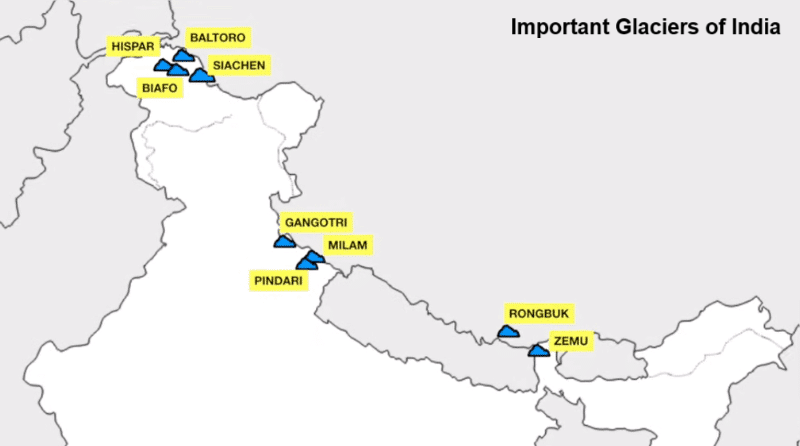
    • Location: Uttarkashi District, Uttarakhand, in the Central Garhwal Himalayas.
    • Origin: Near the Chaukhamba massif at ~7,000 metres above sea level.
    • Size: Main trunk 30–32 km long, 2–4 km wide, with a total glacierized area of ~252 sq. km.
    • Snout: Known as Gaumukh (“cow’s mouth”), source of the Bhagirathi River, which later merges with the Alaknanda at Devprayag to form the Ganga.
    • Tributaries: Includes Chaturangi, Raktavarn, Meru, Rudugaira, Kedar, and Vasuki glaciers.
    • Type: Valley-type glacier with granite, gneiss, and schist bedrock.
    • Features: Moraines, supraglacial lakes, crevasses, and avalanche fans.
    • Debris Cover: 20–24% of the glacier area is debris-covered, affecting melting rates.

    Key Findings of the IIT Indore Study (1980–2020):

    • Flow Contribution: Snowmelt 64%, glacier melt 21%, rainfall-runoff 11%, base flow 4%.
    • Decline in Snowmelt Share: From 73% in 1980–90 to 63% in 2010–20, reflecting climate change impact.
    • Temperature Rise: Mean annual temperature increased by 0.5°C in 2001–2020 compared to 1980–2000.
    • Shift in Peak Discharge: From August to July since the 1990s due to earlier melting and reduced winter precipitation.
    • Snowmelt Rebound: During 2010–2020, colder winters (–2°C) and higher winter precipitation (262 mm) increased snow accumulation.
    [UPSC 2019] Consider the following pairs:

    Glacier: River

    1. Bandarpunch -Yamuna

    2. Bara Shigri -Chenab

    3. Milam -Mandakini

    4. Siachen -Nubra

    5. Zemu -Manas

    Which of the pairs given above are correctly matched?

    Options: (a) 1, 2 and 4* (b) 1, 3 and 4 (c) 2 and 5 (d) 3 and 5


  • SpaceX’s Starship completes critical test flight

    Why in the News?

    SpaceX’s Starship has completed its first fully successful test flight after a series of failures.

    SpaceX’s Starship completes critical test flight

    About SpaceX Starship:

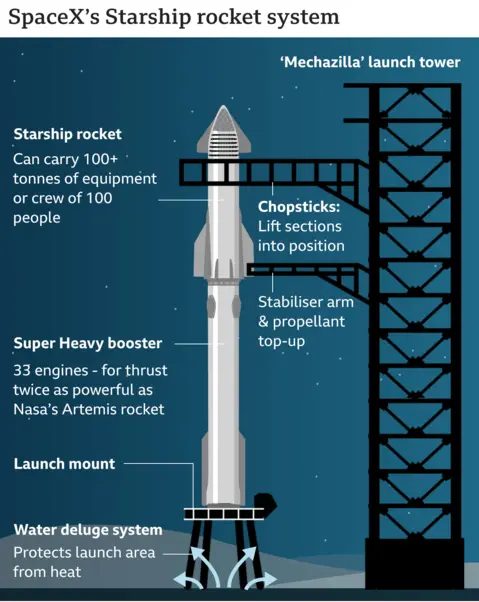
    • Design: A two-stage heavy-lift launch vehicle built to carry crew and cargo to Earth orbit, the Moon, Mars, and beyond.
    • Developer: SpaceX, founded by Elon Musk, with the vision of enabling interplanetary travel and colonisation.
    • Size: Nearly 120 metres tall with booster, making it the largest rocket ever built and flown. Taller than Saturn V (111 m) and India’s Qutub Minar (72.5 m).
    • Historic Test Flight: On 27 August 2025, achieved its first fully successful flight. Booster splashed down in the Gulf of Mexico, spacecraft reached the Indian Ocean.
    • Role in NASA Missions: Critical to Artemis Program for returning humans to the Moon and later missions to Mars.
    • Long-term Goal: Make Starship fully and rapidly reusable, cutting costs and redefining space travel.

    Key Features of Starship:

    • Two-Stage Rocket System:
      • Super Heavy booster powered by 33 Raptor engines generating 74 meganewtons of thrust, nearly double NASA’s SLS and twice Saturn V.
      • Engines burn liquid oxygen and methane, enabling deep-space use and Mars resource utilisation.
      • Booster fully reusable, capable of atmospheric re-entry and recovery.
      • Six Raptor engines and four landing fins, designed for full reusability on long-duration missions.
    • Payload Capacity: Can carry up to 150 tonnes to Low-Earth Orbit and over 100 tonnes to the Moon and Mars, more than all soft-landed lunar payloads combined.
    • Cost Reduction Potential: Estimated to deliver 100 tonnes of cargo to Mars for ~$50 million, compared to NASA Shuttle’s $1.5 billion per launch with far less payload.
    [UPSC 2025] Consider the following space missions:

    I. Axiom-4 II. SpaDeX III. Gaganyaan

    How many of the space missions given above encourage and support microgravity research?

    Options: (a) Only one (b) Only two (c) All the three* (d) None


  • Samudrayaan Mission

    Why in the News?

    Two Indian aquanauts dived over 5,000 m in the Atlantic aboard French vessel Nautile, as part of India’s Samudrayaan Mission.

    What is Deep Ocean Mission (DOM)?

    • Approved: 2021 by the Union Cabinet, with a budget of ₹4,077 crore for 5 years.
    • Aim: Explore, conserve, and sustainably use deep-ocean resources to support India’s Blue Economy.
    • Six Components:
      • Develop technologies for deep-sea mining, submersibles, and robotics.
      • Ocean climate change advisory service with observations + predictive models.
      • Deep-sea biodiversity exploration and conservation.
      • Surveys for polymetallic nodules and minerals.
      • Energy & freshwater extraction technologies from oceans.
      • Advanced Marine Station for ocean biology & engineering → to bridge research & industry.

    About Samudrayaan Mission:

    • Nature: India’s first crewed deep-sea exploration mission.
    • Objective: To send 3 humans up to 6,000 m depth into the central Indian Ocean by 2027.
    • Vehicle: Crewed submersible Matsya-6000 (fish-shaped, 2.1 m personal sphere).
      • Capacity: 3 aquanauts.
      • Endurance: 12 hours normal + 96 hours emergency life support.
      • Material: Titanium alloy sphere (80 mm thickness) to withstand ~600x atmospheric pressure.
    • Coordinating Agency: National Institute of Ocean Technology (NIOT), Ministry of Earth Sciences.
    • Strategic Significance: Will place India among a select group of countries (US, Russia, China, Japan, France) with human deep-sea exploration capability.

    Progress made so far:

    • Aquanaut Training: Discussed above.
    • Matsya-6000 Development:
      • Successfully wet tested in Feb 2025.
      • Titanium alloy sphere fabrication ongoing at ISRO using electron beam welding.
      • Initial steel test sphere used for 500 m trials.
    • Technology Development:
      • Indigenous acoustic telephone built for underwater communication (works in open ocean after initial failures).
      • Life-support systems designed to maintain 20% oxygen and scrub CO₂.
    • Next Steps:
      • Human test dive at 500 m depth planned before full 6,000 m mission.
      • Full Samudrayaan launch targeted by 2027.
    [UPSC 2021] Consider the following statements:

    1.The Global Ocean Commission grants licenses for seabed exploration and mining in international waters.

    2.India has received licenses for seabed mineral exploration in international waters.

    3. ‘Rare earth minerals’ are present on the seafloor in international waters.

    Which of the statements given above are correct?

    Options:(a) 1 and 2 only (b) 2 and 3 only* (c) 1 and 3 only (d) 1, 2, and 3


  • Rivers, Dams, and Headworks of Punjab

    Why in the news?

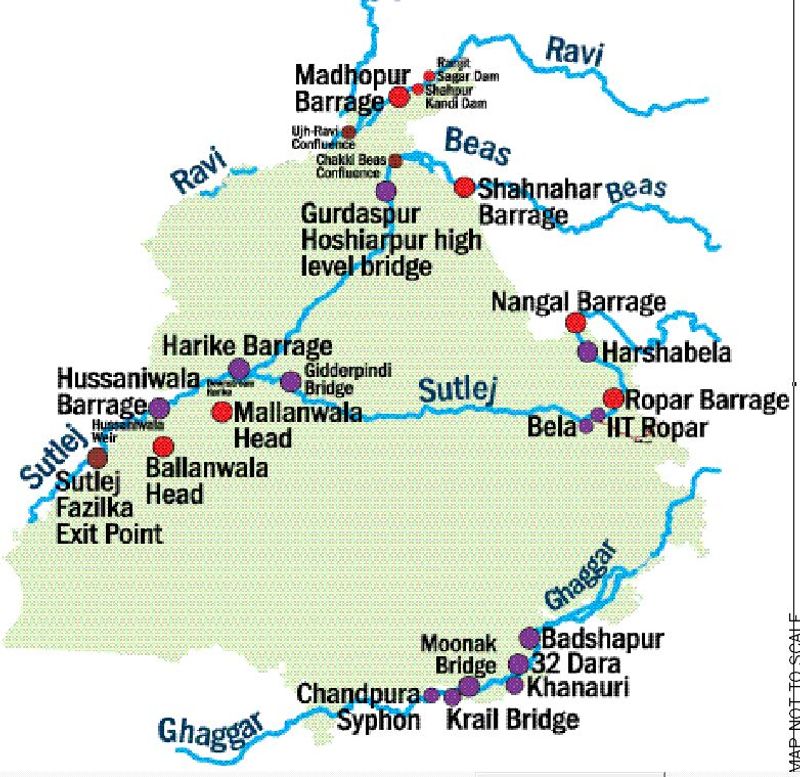
    Floods hit Punjab villages due to heavy rain in Himachal, high dam discharges (Bhakra, Pong, Ranjit Sagar), and regulated headworks flow.

    Rivers, Dams, and Headworks of Punjab

    About the Rivers, Dams, and Headworks of Punjab:

    River Origin & Entry into Punjab Major Dam (Location & Key Facts) Headworks & Functions
    Sutlej Origin: Rakshastal Lake (Tibet); enters India at Shipki La (HP); enters Punjab at Rupnagar; joins Beas at Harike, then Chenab in Pakistan. Bhakra Dam (near Nangal, HP–Punjab border).

    One of India’s highest gravity dams; reservoir = Gobind Sagar Lake; irrigation + hydropower.

    Ropar: Feeds Sirhind & BML canals (Punjab + Haryana).

    Harike: Diverts Sutlej–Beas water to Rajasthan & Punjab canals.

    Hussainiwala: Feeds Bikaner & Eastern Canals (Punjab + Rajasthan).

    Beas Origin: Beas Kund (Rohtang Pass, HP); enters Punjab near Mukerian (Hoshiarpur); flows via Hoshiarpur, Gurdaspur, Tarn Taran, Amritsar. Pong Dam (Maharana Pratap Sagar), HP (Kangra).

    Major irrigation + power dam; supplies Harike.

    Harike: Regulates Beas + Sutlej water; feeds Rajasthan & Punjab canals.
    Ravi Origin: Bara Banghal (Rohtang Pass, HP); enters Punjab near Pathankot; flows via Pathankot, Gurdaspur;

    Enters Pakistan and joins Chenab.

    Ranjit Sagar Dam (Thein Dam), Pathankot (Punjab–J&K border). Irrigation + hydropower. Madhopur: Feeds UBDC canal (Punjab).

    Madhopur–Beas Link: Transfers surplus Ravi to Beas before Pakistan.


    [UPSC 2021] With reference to the Indus river system, among the following four rivers, one of them joins the Indus directly:

    Options: (a) Chenab (b) Jhelum (c) Ravi (d) Sutlej*


  • PM SVANidhi Scheme extended until 2030

    Why in the News?

    The Union Cabinet has approved the restructuring and extension of the Prime Minister Street Vendor’s Atmanirbhar Nidhi (PM SVANidhi) scheme.

    About PM SVANidhi Scheme:

    • Launch: June 1, 2020, as Central Sector Scheme fully funded by the Ministry of Housing and Urban Affairs (MoHUA).
    • Purpose: To provide affordable credit to street vendors hit hard by the Covid-19 pandemic and help them restart/expand their businesses.
    • Target Group: Urban street vendors in statutory towns and peri-urban/rural areas.
    • Extension: Restructured and extended up to March 31, 2030.
    • Beneficiaries: 1.15 crore vendors, including 50 lakh new ones.

    Key Features:

    • Collateral-free Loans (incremental):
      • 1st tranche: ₹15,000 (earlier ₹10,000).
      • 2nd tranche: ₹25,000 (earlier ₹20,000).
      • 3rd tranche: ₹50,000.
    • Digital Empowerment:
      • Timely 2nd loan repayment → eligibility for UPI-linked RuPay Credit Card (for emergent business/personal needs).
      • Digital cashback incentives up to ₹1,600 on retail & wholesale transactions.
    • Capacity Building:
      • Training in entrepreneurship, financial literacy, digital skills, and marketing.
      • Food safety & hygiene training for street food vendors (with FSSAI partnership).
    • Implementation:
      • Jointly by MoHUA & Department of Financial Services (DFS).
      • DFS facilitates loans & credit cards through banks/financial institutions.
    • Wider Goals:
      • Promote financial inclusion & digital adoption.
      • Enable vendors’ business expansion & sustainable growth.
      • Contribute to inclusive urban economic development.
    [UPSC 2011] Microfinance is the provision of financial services to people of low-income groups. This includes both the consumers and the self-employed. The service/services rendered under microfinance is/are:

    1. Credit facilities 2. Savings facilities 3. Insurance facilities 4. Fund Transfer facilities

    Options: (a) 1 only (b) 1 and 4 only (c) 2 and 3 only (d) 1, 2, 3 and 4*


  • [27th August 2025] The gender angle to India’s economic vulnerabilities

    PYQ Relevance

    [UPSC 2021] Examine the role of ‘Gig Economy’ in the process of empowerment of women in India.

    Linkage: The article highlights that India’s economic vulnerabilities are aggravated by its failure to integrate women into the workforce. While traditional women-dominated export sectors face instability due to tariff shocks, the gig economy offers a new pathway for empowerment. Platforms like Urban Company demonstrate how women can earn sustainable incomes (₹18,000–25,000/month) with safety, insurance, and skill development. Thus, the gig economy is not just an employment option but a structural enabler of women’s empowerment, mobility, and autonomy. However, as the article stresses, formalisation of gig work, targeted policy support, and social protections are vital to make this empowerment sustainable.

    Mentor’s Comment

    India’s economic rise is undeniable, valued at $4.19 trillion, it is poised to be the world’s third-largest economy. Yet, the proposed 50% U.S. tariffs on Indian exports highlight an uncomfortable truth: India’s growth story is fragile because it has failed to empower half its population. This article unpacks how gender imbalance in labour markets is no longer a social concern but an economic vulnerability.

    Introduction

    India’s ascent as a global economic power is being tested by external shocks such as U.S. tariff hikes targeting $40 billion worth of Indian exports. Unlike China, which diversified and scaled its manufacturing, India’s labour-intensive sectors, textiles, gems, leather, footwear, remain exposed. These are precisely the industries that disproportionately employ women. The looming disruption reveals a deeper structural weakness: India’s persistently low female labour force participation rate (FLFPR). What was once viewed as a social development challenge is now a core economic liability threatening the sustainability of India’s demographic dividend.

    The U.S. tariff shock and its economic implications

    1. Targeted exports: U.S. tariffs at 50% could shave off nearly 1% from India’s GDP, directly hitting sectors employing 50 million workers, many of them women.
    2. Comparative disadvantage: India could face a 30–35% cost disadvantage against competitors like Vietnam.
    3. Dependency: The U.S. absorbs 18% of India’s exports, exposing India’s lack of diversification.
    4. Employment vulnerability: An export decline of up to 50% could destabilise women-dominated industries.

    Women’s participation as India’s strategic liability

    1. Persistently low FLFPR: Stuck at 37–41.7%, far below China’s 60% and the global average.
    2. Lost GDP potential: IMF estimates closing the gender gap could boost India’s GDP by 27%.
    3. Cultural and systemic barriers: Patriarchal norms, unpaid care work, safety issues, poor public transport, and sanitation gaps keep women away from education and jobs.
    4. Urban stagnation: Urban female labour participation shows little improvement despite rising education levels.

    The ticking clock of India’s demographic dividend

    1. Demographic window: India’s working-age population outnumbers dependents, but this will close by 2045.
    2. Historical lessons: China, Japan, and the U.S. capitalised on their demographic peak to fuel growth; Southern Europe failed due to low female participation, resulting in stagnation.
    3. Risk of lost opportunity: Without women’s integration, India risks a slowdown before fully realising its demographic advantage.

    Lessons from global experiences in women’s empowerment

    1. U.S. during WWII: Women’s labour mobilised with equal pay and childcare.
    2. China’s post-1978 reforms: FLFPR at 60%, backed by state-supported childcare and education.
    3. Japan’s reforms: FLFPR rose from 63% to 70%, boosting GDP per capita by 4%.
    4. Netherlands model: Flexible part-time work with full benefits, relevant for India’s context.
    5. Common thread: Institutional investments in legal protections, skills, and care infrastructure.

    Emerging solutions and policy innovations within India

    1. Karnataka’s Shakti Scheme: Free bus travel boosted female ridership by 40%, improving access to jobs, education, and autonomy.
    2. Targeted fiscal policies: Tax incentives for female entrepreneurs, digital inclusion drives, and gender-skilling programmes.
    3. Gig economy empowerment: Urban Company employs 15,000+ women, offering ₹18,000–25,000/month along with maternity benefits and insurance.
    4. Public schemes: Rajasthan’s Indira Gandhi Urban Employment Guarantee Scheme generated 4 crore person-days of work, with 65% jobs for women, enabling many to work for the first time.

    Conclusion

    The U.S. tariff threat is a wake-up call, India’s economic fragility lies not just in external shocks but in internal neglect of women’s potential. Empowering women is no longer a matter of social justice but a strategic necessity for sustaining growth, harnessing the demographic dividend, and achieving global competitiveness. The choice is stark: invest in women and rise as a resilient power, or ignore them and remain vulnerable to shocks and stagnation.

  • Mawsynram and Cherrapunji no longer Wettest Places in India

    Why in the News?

    Cherrapunji and Mawsynram have recorded about 50% below normal rainfall this year.

    About the Wettest Places in India:

    • Cherrapunji (Sohra, East Khasi Hills, Meghalaya) and Mawsynram (same district) are globally known as the wettest places on Earth.
    • Average annual rainfall: ~11,000–12,000 mm.
    • World record events:
      • Highest annual rainfall: Mawsynram holds the record for highest annual rainfall.
      • Heaviest rainfall: Cherrapunji recorded 2,493 mm in 48 hours (June 1995), one of the heaviest rainfalls ever documented.

    Comparative Rainfall Data (for 2025 Monsoon Season):

    • Cherrapunji (Sohra): ~3,500 mm (≈50% deficit from normal).
    • Surlabbi (Kodagu, Karnataka): ~7,300 mm (highest in India this year).
    • Tamhini (Maharashtra): 5,788 mm (June–July).
    • Trend: At least 32 stations across India received more rainfall than Cherrapunji in June–July 2025.
    • Historical Low for Sohra: 5,401 mm in 1962 → 2025 may break this record if deficit continues.

    Why Mawsynram /Cherrapunji receive such high rainfall?

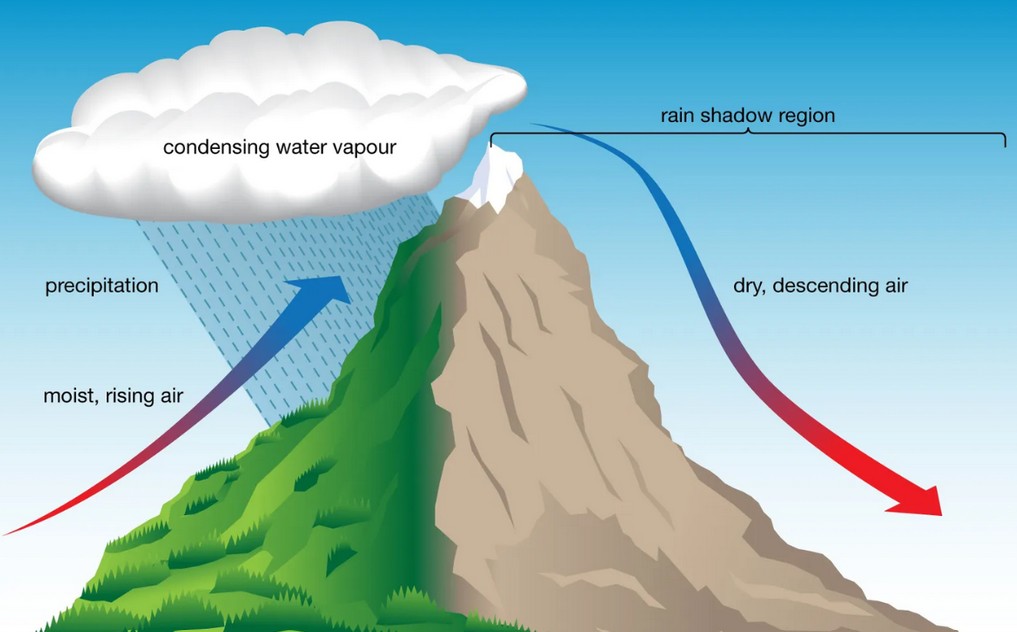
    • Geographical Location: Lies on the southern slopes of the Khasi Hills, directly facing the Bay of Bengal branch of the southwest monsoon.
    • Orographic Effect: Moist monsoon winds hit the steep hills, rise rapidly, and cause heavy orographic rainfall.
    • Monsoon Duration: Receives rainfall almost continuously from June to September, with frequent cloudbursts.
    • Topography: Steep hills + valleys act as a trap for moisture-laden winds, leading to intense rainfall concentration.
    • Climatic Setting: Part of the Humid Subtropical/Monsoonal climate zone of Northeast India, with high moisture inflow.
    [UPSC 2015] Consider the following States:

    1. Arunachal Pradesh 2. Himachal Pradesh 3. Mizoram

    In which of the above States do ‘Tropical Wet Evergreen Forests’ occur?

    Options: (a) 1 only (b) 2 and 3 only (c) 1 and 3 only* (d) 1, 2 and 3


  • [pib] India hosts 3GPP RAN Working Group Meetings on 6G Standardization

    Why in the News?

    The Telecommunications Standards Development Society (TSDI) of India has hosted the 3GPP Radio Access Networks (RAN1–RAN5) Working Group Meetings focusing on 6G standardization for the first time, in Bengaluru.

    About 3GPP (3rd Generation Partnership Project):

    • Overview: Global body established in 1998 for mobile telecom standards (2G → 6G).
    • Partners: Collaboration of ARIB (Japan), ATIS (USA), CCSA (China), ETSI (Europe), TSDSI (India), TTA (South Korea), and TTC (Japan).
    • Output: Publishes technical specifications, forming the global benchmark for telecom operators, equipment makers, and regulators.
    • Focus Areas:
      1. RAN (Radio Access Network) – towers & radios connecting users to the network.
      2. Core Network – switching, routing, internet connectivity.
      3. Services & System Aspects – apps, charging, security.

    What is RAN (Radio Access Network)?

    • Definition: The wireless part of a mobile network that links user devices (phones, IoT) to the core network using radio waves.
    • Components:
      • Base Stations (Node B in 3G, eNodeB in 4G, gNodeB in 5G).
      • Antennas & radios.
      • Controllers (e.g., RNC in 3G).
    • Functions:
      • Transmits & receives radio signals.
      • Allocates spectrum.
      • Manages coverage, speed, call/data quality, and handovers.
    • Importance: Defines network performance (speed, latency, capacity).
    • 3GPP RAN Working Groups (RAN1–RAN5): Develop physical layer, radio protocols, performance testing, ensuring smooth migration from 4G → 5G → 6G.

    Back2Basics:  Evolution of Mobile Standards

    • 3G (UMTS – Universal Mobile Telecommunications System): Introduced in early 2000s; based on WCDMA; enabled video calls, MMS, and mobile internet (up to 2 Mbps).
    • 4G (LTE – Long-Term Evolution): All-IP, OFDMA-based; provided high-speed broadband (hundreds of Mbps), VoLTE, and seamless video streaming.
    • 5G (NR – New Radio): Flexible OFDM-based; delivers ultra-high speeds (Gbps), ultra-low latency, supports IoT, automation, AR/VR, and network slicing.
    • 6G (Sixth Generation – under research): Expected by ~2030; aims for terabit-class speeds, AI-native networking, holographic communication, and satellite–terrestrial integration.


    [UPSC 2019] With reference to communication technologies, what is/are the difference / differences between LTE (Long-Term Evolution) and VoLTE (Voice over Long-Term Evolution)?

    1. LTE ‘is commonly marketed as 3G and VoLTE is commonly marketed as advanced 3G.

    2. LTE is data-only technology and VoLTE is voice-only technology.

    Select the correct answer using the code given below.

    Options: (a) 1 only (b) 2 only (c) Both 1 and 2 (d) Neither 1 nor 2*