💥Join UPSC 2027,2028 Mentorship (July Batch) + XFactor Notes & Microthemes PDF

Distribution: yearly

  • A case for quiet diplomacy to resolve standoff

    Apart from the recent one, there had been several stand-offs between India and China over the border issue. The use of quiet diplomacy to diffuse the situation underlies all these stand-offs. However, politicisation of stand-off could make the situation difficult to resolve. This article explains the use of quiet diplomacy and problems posed by the politicisation of the stand-offs.

    Process to diffuse tension began but not at all points

    •  Both sides have agreed on a broad plan to defuse four of the five points of discord.
    • The situation at the fifth, Pangong Lake remains uncertain as also in Galwan valley and north Sikkim.
    • At Pangong Tso, the Chinese have entrenched their positions with tents and remain on India’s side of the LAC.
    • There is a major point of difference which will not be easy to resolve.

    Let’s look into the strategy used by India in the past to resolve stand-offs

    • The pattern of resolution of past stand-offs underlines the key role played by quiet diplomacy in unlocking complicated stand-off situations.
    • Both the United Progressive Alliance (UPA) and National Democratic Alliance (NDA) governments have followed an approach that has coupled quiet diplomacy with a strong military posture, while at the same time allowing the adversary a way out.
    • This has been the broad strategy in dealing with challenges from China across the LAC.
    • And this strategy has generally worked.

    Let’s look into three specific incidents

    1) 2013-Depsang plains

    • In 2013, when Chinese troops pitched tents on India’s side of the LAC on the Depsang plains, similar to Pangong Tso.
    • The UPA government was under fire, both for being weak on China and for its reticence.
    • While the government was being publicly attacked for doing nothing, it had privately conveyed to China that if the stand-off didn’t end, an upcoming visit by Premier Li Keqiang would be off.
    • If that demand had been made public at the time, China would have only dug in its heels, even if the government may have won the headlines of the day.

    2) Chumar stand-off

    • The government adopted a similar strategy during the 2014 stand-off at Chumar, which coincided with President Xi Jinping’s visit to India.
    • Mr. Xi’s visit went ahead, while India quietly but forcefully stopped the Chinese road-building and deployed 2,500 soldiers, outnumbering the People’s Liberation Army (PLA).
    • The PLA withdrew.
    • Both sides disengaged and followed a moratorium into patrolling into contested areas, which was observed for many months thereafter.

    Ultimately, in both cases, the objective was achieved. China, faced with firm resistance, was prevented from changing the status quo.

    3) Doklam stand-off in 2017

    • In 2017, the government came under particularly intense fire because it stayed studiously silent through a 72-day stand-off at Doklam.
    • Indian troops crossed over into Bhutan to stop a Chinese road construction on territory India sees as Bhutanese but China claims.
    • By extending the road, India argued, China was unilaterally altering the India-Bhutan-China trijunction.
    • Beijing demanded an unconditional withdrawal.
    • When both finally disengaged, neither divulged the terms.
    • It would later emerge that the deal struck involved India withdrawing first.
    • China then stopped construction, and the status quo at the face-off site was restored.

    Stand-off politics in the country

    • Politics over border stand-offs is not new.
    •  The Opposition and the media are certainly right to hold the government to account.
    • Indeed, neither the Opposition nor the media would be doing its job if they weren’t.
    • The tensions on the LAC are neither the first nor likely to be the last.
    • With every incident, they are, however, getting increasingly politicised in an environment where there is a 24/7 demand on social media for information — and unprecedented capacity for disinformation.
    • Rather than wish away this reality — and adopt a stand that it is above questioning — the government needs to come to terms with it. 

    Dealing with the politicisation of stand-offs

    •  First, it needs to keep the Opposition informed, which it is clear it hasn’t.
    • Second, it needs to proactively engage with the media, even if that may be through low-key engagement as was the case on June 9, that does not escalate into a public war of words.
    • At the same time, expectations of having a public debate about the intricacies of every border stand-off — or for the Prime Minister to weigh in even while negotiations are ongoing — need to be tempered.
    • This will only risk inflaming tensions, and reduce the wiggle room for both sides to find an off-ramp.
    • The broader objective shouldn’t get lost in political debates.
    • That objective is to ensure India’s security interests remain protected — and that the status quo on India’s borders isn’t changed by force.

    Consider the question “Border issue between India and China has several times resulted in the stand-off between the two countries but the use of quiet diplomacy helped defuse the tension. But the politicisation of such issue could complicate the situation in the future. Comment.

    Conclusion

    • Past incidents have shown that quiet diplomacy, coupled with strong military resolve that deters any Chinese misadventures, has been more effective than public sabre-rattling, even if we may be inhabiting a media environment that misconstrues loudness as strength, and silence as weakness.
  • Migrants and COVID

    In this Article, we highlight some facts about migration in India, summarize key relief measures announced by the government and directives issued by the Supreme Court for the migrant population in relation to the lockdown.
    ———————————————————————————
    Reference source: https://www.prsindia.org/theprsblog/migration-india-and-impact-lockdown-migrants
  • Reservation not fundamental right: SC refuses to hear pleas by TN parties

    What did the Hon’ble Supreme Court rule?


    • Article 16 (4) and 16 (4-A) are in the nature of enabling provisions, vesting a discretion on the State Government to consider providing reservations, if the circumstances so warrant.
    • It is settled law that the State Government cannot be directed to provide reservations for appointments in public posts.
    • Similarly, the State is not bound to make reservations for Scheduled Castes and Scheduled Tribes in matters of promotions.
    • The judgment added that it is for the State Government to decide whether this was necessary.

    What do the precedents say?

    • There are several major Supreme Court judgments that have, in the past, ruled that Articles 15(4) and 16(4) does not provide a fundamental right per se.
    • A five-judge apex court bench, as early as 1962 in the R. Balaji v. the State of Mysore had ruled that Article 15(4) is an “enabling provision”, meaning that “it does not impose an obligation, but merely leaves it to the discretion of the appropriate government to take suitable action, if necessary”.
    • The court was hearing a challenge to an order passed by the erstwhile state of Mysore reserving 68 percent of seats in engineering and medical colleges for educationally and socially backward classes and SCs and STs.
    • Five years later, in 1967, another five-judge bench in A. Rajendran v. Union of India reiterated this position, holding that the government is under no constitutional duty to provide reservations for SCs and STs, either at the initial stage of recruitment or at the stage of promotion.
    • Article 16(4), it said, does not confer any right on the citizens and is an enabling provision giving discretionary power to the government to make reservations.
    • The position went on to be reiterated in several other decisions, including the nine-judge bench ruling in Indra Sawhney v. Union of India (1992) and the five-judge bench decision in M Nagaraj v. Union of India (2006).

    What does the judgment mean?

    • Reservations are not rights: The latest judgment is a reminder that affirmative action programs allowed in the Constitution flow from “enabling provisions” and are not rights as such.
    • Not a new legal position: This legal position is not new. Major judgments- these include those by Constitution Benches-note that Article 16(4), on the reservation in posts, is enabling in nature.
    • The state is not bound to provide reservation: In other words, the state is not bound to provide reservations. But if the state provides reservations, it must satisfy the following two criteria-
      • For the backward class: It must be in favor of sections that are backward.
      • Inadequately represented: And inadequately represented in the services based on quantifiable data.

    Consequences of this judgment

    • Possibility of the unequal system: Some may even read into this an inescapable state obligation to extend reservation to those who need it, lest its absence renders the entire system unequal.
    • Possibility of perceptible imbalance: For instance, if no quotas are implemented and no study on backwardness and extent of representation is done, it may result in a perceptible imbalance in social representation in public services.

    Why reservation needed?

    • To correct the historical injustice faced by backward castes in the country.
    • To provide a level playing field for backward section as they can not compete with those who have had the access of resources and means for centuries.
    • To ensure adequate representation of backward classes in the services under the State.
    • For advancement of backward classes.
    • To ensure equality as basis of meritocracy i.e all people must be brought to the same level before judging them on the basis of merit.

    Argument Against Reservation

    • Reservation in state services led to divisions and enmity among government employees, vitiating the atmosphere at workplace.
    • Eradication, not perpetuation of caste was the objective of the reservation policy but Caste Based Reservation only perpetuate the notion of caste in society.
    • Reservation was introduced to ensure that the historically underprivileged communities were given equal access to resources but irrespective of the economic progress they continue to remain socially disadvantaged.
    • Reservation destroys self-respect, so much so that competition is no longer on to determine the best but the most backward.
    • Reservations are the biggest enemy of meritocracy which is the foundation of many progressive countries.
    • It has became a tool to meet narrow political ends through invoking class loyalties and primordial identities.
    • The dominant and elite class within the backward castes has appropriated the benefits of reservation and the most marginalised within the backward castes have remained marginalised.
    • Reservation has become the mechanism of exclusion rather than inclusion as many upper caste poors are also facing discrimination and injustice which breeds frustration in the society.

    Way forward

    • Meanwhile, calls for reform and ret­hinking reservation policies get louder; one question is whether there’s a need to continue with reservation and if benefits have reached targets.
    • The challenge for India is that while many sections of the society remain disadvantaged, political action has resulted in the relative discrimination within reserved groups.
    • As the reservation pie grows larger, in effect, it becomes a method of exclusion rather than inclusion.
    • It is time that India has to make a critical assessment of its affirmative action programs.
    • Simplification, legislative sunsets, and periodic reviews should be important principles in the redesign.
  • Guidelines for Import of Exotic Species

    The Ministry of Environment Forest and Climate Change (MOEFCC) has issued an advisory saying people importing “exotic live species” will have to make a voluntary disclosure.

    Practice questions for mains:

    Q. What are Zoonotic Diseases? Discuss how the illicit trade in wildlife has resulted in the spread of zoonotic diseases of the scale of the ongoing COVID-19?

    What is the new Advisory?

    • According to the advisory, the phrase “exotic live species” includes “animals named under the Appendices I, II and III of the Convention of International Trade in Endangered Species of Wild Fauna and Flora”.
    • It does not include species from the Schedules of the Wildlife (Protection) Act 1972.
    • This will create a process where all imports will be screened.
    • As of now, the imports are being made through the Director-General of Foreign Trade and State Forest departments are not kept in the loop.
    • For new “exotic live species”, the importer should obtain a no-objection certificate from the Chief Wildlife Warden (CWLW) of the State.
    • For existing species, stocks shall be declared by the owner/ holder (stock, as on 1 January 2020) to the Chief Wildlife Warden (CWLW) of the concerned State or UT.

    Why need such advisory?

    • Many exotic species of birds, reptiles and amphibians are imported into India for commercial purposes.
    • Some of the most sought after exotic species in India are Ball python, Scarlet Macaw, sea turtles, sugar glider (Petaurus breviceps), marmoset and grey African parrots.
    • These imports were happening through the Director-General of Foreign Trade (DGFT), but they were beyond the purview of the forest departments and the chief wildlife wardens weren’t aware of them.
    • Wildlife experts have long been asking for stringent laws and guidelines to document and regulate numbers of exotic species being kept as pets by individuals and breeders in India.

    Significance

    • The move comes as the outbreak of coronavirus (COVID-19) has raised global concern about illegal wildlife trade and zoonotic diseases.
    • Often these species are illegally trafficked into the country to avoid lengthy documentation and scrutiny.

    Issues with guidelines

    • Matters such as the spread of invasive species as well as zoonotic diseases had not been taken care of in the advisory.
    • There is a growing domestic trade in exotic species of wildlife that is unfortunately not listed under the various appendices of CITES (such as sugar gliders, corn snakes).
    • Hence limiting the scope of the latest advisory to only those species covered under CITES drastically limits the scope of the advisory itself.
    • It does not have the force of law and could potentially incentivize illegal trade by offering a long amnesty period.

    Back2Basics: CITES

    • CITES stands for the Convention on International Trade in Endangered Species of Wild Fauna and Flora.
    • It is as an international agreement aimed at ensuring “that international trade in specimens of wild animals and plants does not threaten their survival”.
    • It was drafted after a resolution was adopted at a meeting of the members of the International Union for Conservation of Nature (IUCN) in 1963.
    • It entered into force on July 1, 1975, and now has 183 parties.
    • The Convention is legally binding on the Parties in the sense that they are committed to implementing it; however, it does not take the place of national laws.
    • India is a signatory to and has also ratified CITES convention in 1976.

    CITES Appendices

    • CITES works by subjecting international trade in specimens of selected species to certain controls.
    • All import, export, re-exports and introduction from the sea of species covered by the convention has to be authorized through a licensing system.

    It has three appendices:

    • Appendix I includes species threatened with extinction. Trade-in specimens of these species are permitted only in exceptional circumstances.
    • Appendix II provides a lower level of protection.
    • Appendix III contains species that are protected in at least one country, which has asked other CITES Parties for assistance in controlling trade.
  • National Institutional Ranking Framework (NIRF) ‘India Rankings 2020’

    The National Institute Ranking Framework (NIRF) ranking list has been released by the Ministry of Human Resource Development (MHRD).

    Practice question for mains:

    Q. What is NIRF? Discuss the parameters and methodology used in the ranking. Also, discuss its key features and limitations.

    About NIRF

    • The NIRF is a methodology adopted by the Ministry of HRD to rank institutions of higher education in India.
    • The Framework was approved and on 29 September 2015.
    • There are separate rankings for different types of institutions depending on their areas of operation like universities and colleges, engineering institutions, management institutions, pharmacy institutions and architecture institutions.
    • The ranking framework evaluates institutions on five broad generic groups of parameters, i.e. Teaching, Learning and Resources (TLR), Research and Professional Practice (RP), Graduation Outcomes (GO), Outreach and Inclusivity (OI) and Perception (PR).

    Why need such rankings?

    • Rankings help universities to improve their performance on various ranking parameters and identify gaps in research and areas of improvement.
    • The ranking is necessary for transparency and healthy competition.

    Highlights of the 2020 rankings

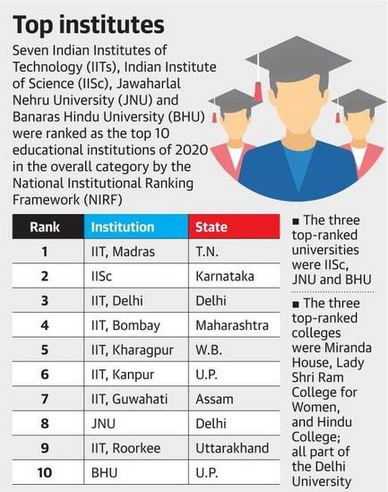
    • IIT Madras retains 1st Position in Overall Ranking as well as in Engineering,
    • Indian Institute of Science, Bengaluru tops the University list.
    • IIM Ahmedabad tops in Management Category and AIIMS occupies the top slot in Medical category for a third consecutive year.
    • Miranda College retains 1st position amongst colleges for a third consecutive year.
    • Maulana Azad Institute of Dental Sciences, Delhi secures 1st position in “Dental” category, dental institutions included for the first time in India Rankings 2020.
  • Nature Index, 2020

    India has ranked twelfth, globally in science research output as per the recently-released Nature Index table 2020. The top five positions have gone to the United States of America, China, Germany, United Kingdom and Japan.

    Note: This nature index has nothing to do with nature conservation. It has only mentioned the rankings of research institutes in natural and physical sciences.

    What is the Nature Index?

    • The Nature Index is a database of author affiliation information collated from research articles published in an independently selected group of 82 high-quality science journals.
    • It serves as an indicator of high-quality research in the Natural and Physical Sciences.
    • The database is compiled by Nature Research, a division of the international scientific publishing company Springer Nature that publishes academic journals.
    • The index provides a close to the real-time proxy of high-quality research output and collaboration at the institutional, national and regional level.

    India’s achievements

    • Globally the top-rated Indian institutions in this list are CSIR, a group of 39 institutions at the 160th position and IISc Bangalore at the 184th
    • Three of the autonomous institutions of the DST have found their place among the top 30 Indian Institutions.
    • Keeping out CSIR, which is a cluster of institutions, IACS Kolkata is among the top three institutions in quality Chemistry Research in India.
    • NCASR Banglore ranks 4th among academic institutions in life sciences, 10th in Chemistry and Physical Sciences, 10th among Indian academic institutions, and 469th in the global ranking.
  • Lonar Lake colour changes to pink

    The colour of water in Maharashtra’s Lonar Lake, formed after a meteorite hit the Earth some 50,000 years ago, has changed to glaring.

    Make a note of all saltwater lakes in India. Few of them are Pulicat, Pangong Tso, Chilika, and Sambhar Lakes etc.

    About Lonar Lake

    • Lonar Lake, also known as Lonar crater, is a notified National Geo-heritage Monument, saline (pH of 10.5), Soda Lake, located at Lonar in Buldhana district, Maharashtra.
    • It was created by an asteroid collision with earth impact during the Pleistocene Epoch.
    • It is one of the four known, hyper-velocity, impact craters in basaltic rock anywhere on Earth.
    • It sits inside the Deccan Plateau—a massive plain of volcanic basalt rock created by eruptions some 65 million years ago.
    • Its location in this basalt field suggested to some geologists that it was a volcanic crater.

    Why there’s a color change?

    • The salinity and algae can be responsible for this change.
    • There is no oxygen below one meter of the lake’s water surface.
    • There is an example of a lake in Iran, where water becomes reddish due to increase in salinity.
    • The level of water in the Lonar Lake is currently low as compared to the few past years and there is no rain to pour fresh water in it.
    • The low level of water may lead to increased salinity and change in the behaviour of algae because of atmospheric changes.
  • Crisis of today should not blind us to the crisis of tomorrow

    Covid-19 pandemic has overwhelmed the governments across the world. And the destruction caused by it would impact not only our present but the future as well. So, what this means to our climate future? First and foremost, it will leave the governments with less fund to invest for the greener outcomes. What would be the other impacts? And how can we avoid turning blind eye to the crises waiting for us in the near future? Read the article to know…

    Cyclones amid pandemic-what do it signal?

    • The very language used to describe the effects of climate change is now being deployed, correctly, to shape our understanding of a covid-ravaged near future: poverty, the failure of markets, uncertainty, and an overwhelmed government.
    • In less than a month, we have been given a glimpse of how the climate crisis can yank at the seams of a state already undone.
    • We saw Cyclone Amphan transform from a tropical storm to one of the largest cyclones South Asia has ever seen in a matter of hours, aided by warmer than usual waters in the Bay of Bengal.
    • We also saw Cyclone Nisarga barrel down on Maharashtra, the second pre-monsoon cyclone to hit the west coast in 127 years.
    • Governments would have been hard-pressed to deal with such extremes even in the best of times.

    So, how COVID-19 would impact response to climate change?

    •  There are two strands of opinion.
    • The optimistic one sees this as a moment to remake our states and societies in a measured response.
    • This includes directing economic packages to areas that increase our resilience to natural disasters and technologies that reduce our emissions.
    • This could be an opportunity to reinforce sustainable behaviour — fewer morning commutes and less air travel, for example.
    • The other strand is more dire, arguing that this will amount to a lost decade or two as our attention is focused on keeping the teetering ship of economy afloat.
    • In this reading, present concerns will trump preparations for an uncertain future.
    • Between these two strands there is consensus that we are at a critical juncture.
    • What we do now will determine the flow of events decades into the future.

    What our climate future holds?

    We will have to face the following 3 problems in the future owing to the Covid-19 pandemic today.

    1. Scarcity of funds

    • It has been two months since India’s lockdown, and we know enough to have a rational conversation about our climate future.
    • Perhaps the most important news relates to public and private debt.
    • The government has raised its borrowing limit, states will need to borrow more to tide over shortfalls and the private sector has seen returns from investments dry out.
    • All three are already heavily indebted, meaning the cost of capital for future borrowing will only grow.
    • That leaves limited fiscal room to finance the building blocks of resilience: everything from grain to health, employment schemes, irrigation, efficient water systems and river management infrastructure.
    • It could mean that efforts to reduce our energy emissions are left without patient pools of long-term capital.

    2. Underdeveloped knowledge infrastructure

    • The knowledge infrastructure needed to react to climate change might be left similarly underdeveloped.
    • Climate change distinguishes itself from other policy fields in the wide range of analytical tasks it demands, from predicting weather trends to understanding how specific seed varieties react to droughts.
    • Thinking about climate change requires a lot of people exploring varied questions simultaneously.
    • That involves funding an ecosystem of thinkers from diverse disciplines.
    • Only the state can provide for multi-year studies, institutional support and the like.
    • These are inherently long-term investments and only really start paying off over decades.
    • It means that hamstrung investment in coming years will leave a knowledge vacuum in the future.

    3. Impact on the psychology of the government

    • The Indian government, reacting to a million crises erupting across the economy, will be hard-pressed to plan for a hazy but sinister future.
    • Promises of a greener, less turbulent future will falter against the turbulence of today.
    • This instinct will be shared by governments across the world.
    • This might well numb the effects of the global climate negotiation architecture.

    Way forward

    • Crafting a response that carefully balances present and future will take a great deal of collective effort.
    • Foremost, it will require policy ideas that deliberately marry employment and industrial priorities with green outcomes.
    • Ideas such as pushing to manufacture solar equipment or electric vehicles in India should, at some point, coalesce into something that looks like a climate plan for the country.
    • This task will fall to universities, NGOs, think tanks and individuals working together in disciplined debate.

    Consider the question “Do you agree with the view that the corona crisis would adversely impact our efforts towards mitigating the impact of climate change? Giver reasons in support of your argument.”

    Conclusion

    We should be careful not to drag ourselves through one crisis only to emerge into another longer, less predictable, and unstoppable one. So, balancing the present problems and their solutions with an eye on a certain and stable future is the need of the hour.

  • Expanding the G7

    There has been a call for expansion of G7 by the U.S. President. Against this backdrop, this article examines the historical background in which the group emerged. But a lot has changed since. So, it would be appropriate for G7 to adjust to the new reality. But what would be the focus of a new mechanism? What are the areas in which India would be interested? All such questions are answered in this article.

    Call for expansion of G7 and China’s objection

    • Recently, the U.S. President proposed the expansion of G7 to G10 or G11,  with the inclusion of India, South Korea, Australia and possibly Russia.
    • Elaborating this logic, the White House Director of Strategic Communications said the U.S. President wanted to include other countries, including the Five Eyes countries.
    • Five Eye is an intelligence alliance comprising Australia, Canada, New Zealand, the United Kingdom and the United States.
    • The U.S. also stressed said the expanded group should talk about the future of China.
    • A Chinese Ministry of Foreign Affairs official immediately reacted, labelling it as “seeking a clique targeting China”.

    Should India care about China’s objection if invited to join?

    • China’s objection to an expanded G7 is no reason for India to stay away from it, if invited to join.
    • India has attended several G7 summits earlier too, as a special invitee for its outreach sessions.
    • India’s Prime Minister was guest invited to Biarritz, France to the G7 summit last year, along with other heads of government.

    The historical background of G7

    • The G7 emerged as a restricted club of the rich democracies in the early 1970s.
    • The quadrupling of oil prices just after the 1973 Arab-Israeli War, when  OPEC imposed an embargo against Canada, Japan, the Netherlands, and the United States, shocked their economies.
    • Although the French were spared the embargo, the chill winds of the OPEC action reverberated around the world.
    • So, French President invited the Finance Ministers of five of the most developed members of the Organisation for Economic Cooperation and Development, the United States, Germany, Japan, Italy, and the United Kingdom, for an informal discussion on global issues.
    • This transformed into a G7 Summit of the heads of government from the following year with the inclusion of Canada in 1976.
    • And the European Commission/Community (later Union) joined as a non-enumerated member, a year later.
    • On the initiative of U.S. President Bill Clinton and British Prime Minister Tony Blair, the G7 became the G8, with the Russian Federation joining the club in 1998.
    • This ended with Russia’s expulsion following the annexation of Crimea in 2014.

    Declining share G7 and rising of E7 in world GDP

    • When constituted, the G7 countries accounted for close to two-thirds of global GDP.
    • According to the 2017 report of the accountancy firm, PwC, “The World in 2050”, they now account for less than a third of global GDP on a purchasing power parity (PPP) basis.
    • And less than half on market exchange rates (MER) basis.
    • The seven largest emerging economies (E7, or “Emerging 7”), comprising Brazil, China, India, Indonesia, Mexico, Russia and Turkey, account for over a third of global GDP on purchasing power parity (PPP) terms.
    • And over a quarter on MER basis.

    Predictions for India

    • India’s economy is already the third largest in the world in PPP terms, even if way behind that of the U.S. and China.
    • By 2050, the PwC Report predicts, six of the seven of the world’s best performing economies will be China, India, the United States, Indonesia, Brazil, and Russia.
    • Two other E7 countries, Mexico and Turkey, also improve their position.
    • It projects that India’s GDP will increase to $17 trillion in 2030 and $42 trillion in 2050 in PPP terms, in second place after China, just ahead of the United States.
    • This is predicated on India overcoming the challenge of COVID-19, sustaining its reform process and ensuring adequate investments in infrastructure, institutions, governance, education and health.

    Limitations of G7

    • The success or otherwise of multilateral institutions are judged by the standard of whether or not they have successfully addressed the core global or regional challenges of the time.
    • The G7 failed to head off the economic downturn of 2007-08.
    • This failure led to the rise of the G20.
    • In the short span of its existence, the G20 has provided a degree of confidence, by promoting open markets, and stimulus, preventing a collapse of the global financial system.
    • The G7 also failed to address the contemporary issues, such as the COVID-19 pandemic, climate change, the challenge of the Daesh, and the crisis of state collapse in West Asia.
    • It had announced its members would phase out all fossil fuels and subsidies, but has not so far announced any plan of action to do so.
    • And their coal fired plants emit “twice more CO2 than those of the entire African continent”.

    Turmoil in West Asia and failure of Europe to act

    • Three of the G7 countries, France, Germany, and the U.K., were among the top 10 countries contributing volunteers to the ISIS.
    • West Asia is in a greater state of turmoil than at any point of time since the fall of the Ottoman Empire.
    • This turmoil has led to a migrants crisis.
    • Migrant crisis persuaded many countries in Europe to renege on their western liberal values, making the Mediterranean Sea a death trap for people fleeing against fear of persecution and threat to their lives.

    So, to deal with the unprecedented challenge, we need new institution

    • The global economy has stalled and COVID-19 will inevitably create widespread distress.
    • Nations need dexterity and resilience to cope with the current flux, as also a revival of multilateralism, for they have been seeking national solutions for problems that are unresolvable internally.
    • Existing international institutions have proven themselves unequal to these tasks.
    • A new mechanism might help in attenuating them.
    • It would be ideal to include in it the seven future leading economies, plus Germany, Japan, the U.K., France, Mexico, Turkey, South Korea, and Australia.
    •  The 2005 ad hoc experiment by Prime Minister Tony Blair in bringing together the G7 and the BRICS countries was a one-off.

    What should be the focus of this new institution?

    • A new international mechanism will have value only if it focuses on key global issues.
    • A related aspect is how to push for observing international law and preventing the retreat from liberal values on which public goods are predicated.
    • Global public health and the revival of growth and trade in a sustainable way -that also reduces the inequalities among and within nations- would pose a huge challenge.

    What should be India’s priority in new institution?

    • India would be vitally interested in three: 1) international trade, 2) climate change, 3) the COVID-19 crisis.
    • Second order priorities for India would be cross-cutting issues such as counter-terrorism and counter-proliferation.
    • An immediate concern is to ensure effective implementation of the 1975 Biological Weapons Convention .
    • And the prevention of any possible cheating by its state parties by the possible creation of new microorganisms or viruses by using recombinant technologies.
    • On regional issues, establishing a modus vivendi with Iran would be important to ensure that it does not acquire nuclear weapons and is able to contribute to peace and stability in Afghanistan, the Gulf and West Asia.
    • The end state in Afghanistan would also be of interest to India.
    • And also the reduction of tensions in the Korean Peninsula and the South China Sea.

    Consider the question “There has been a clamour for expanding G7 and India is being considered as one of the prospective candidates in the expanded group. In light of this examine the challenges and opportunities for India if it gets entry into the expanded group.”

    Conclusion

    The decaying influence in geopolitics and declining share in the world GDP calls for the formation of the new institution. IF and when that institution comes into being India should try to address its immediate concern with the help of new mechanism based on values.

  • GM seeds: the debate, and a sowing agitation

    In the current Kharif season, farmers would undertake mass sowing of GM seeds for maize, soybean, mustard brinjal and herbicide-tolerant (Ht) cotton, although these are not approved. Farmers had carried out a similar movement last year, too.

    Practice question for mains:

    Q. Indian agriculture is in a way, a victim of its own past success – especially the green revolution. Critically comment.

    Genetically Modified (GM) seeds

    • Conventional plant breeding involves crossing species of the same genus to provide the offspring with the desired traits of both parents.
    • Genetic engineering aims to transcend the genus barrier by introducing an alien gene in the seeds to get the desired effects.
    • The alien gene could be from a plant, an animal or even a soil bacterium.

    What is the legal position of GM crops in India?

    • In India, the Genetic Engineering Appraisal Committee (GEAC) is the apex body that allows for the commercial release of GM crops.
    • In 2002, the GEAC had allowed the commercial release of Bt cotton.
    • More than 95 per cent of the country’s cotton area has since then come under Bt cotton.
    • Use of the unapproved GM variant can attract a jail term of 5 years and a fine of Rs 1 lakh under the Environmental Protection Act,1989.

    GM crops in India

    • Bt cotton, the only GM crop that is allowed in India, has two alien genes from the soil bacterium Bacillus Thuringiensis (Bt) that allows the crop to develop a protein toxic to the common pest pink bollworm.
    • Ht Bt, on the other, cotton is derived with the insertion of an additional gene, from another soil bacterium, which allows the plant to resist the common herbicide glyphosate.
    • In Bt brinjal, a gene allows the plant to resist attacks of fruit and shoot borer.

    Why are farmers rooting for GM crops?

    • In the case of cotton, farmers cite the high cost of weeding, which goes down considerably if they grow Ht Bt cotton and use glyphosate against weeds.
    • Brinjal growers in Haryana have rooted for Bt brinjal as it reduces the cost of production by cutting down on the use of pesticides.
    • Industry estimates say that of the 4-4.5 crore packets (each weighing 400 gm) of cotton sold in the country, 50 lakh are of the unapproved Ht Bt cotton.
    • Haryana has reported farmers growing Bt brinjal in pockets which had caused a major agitation there.

    Why furore over GM crops?

    • Environmentalists argue that the long-lasting effect of GM crops is yet to be studied and thus they should not be released commercially.
    • The genetic modification brings about changes that can be harmful to humans in the long run.