💥Join UPSC 2027,2028 Mentorship (July Batch) + XFactor Notes & Microthemes PDF

Distribution: yearly

  • LAC row: China reaches accord with India

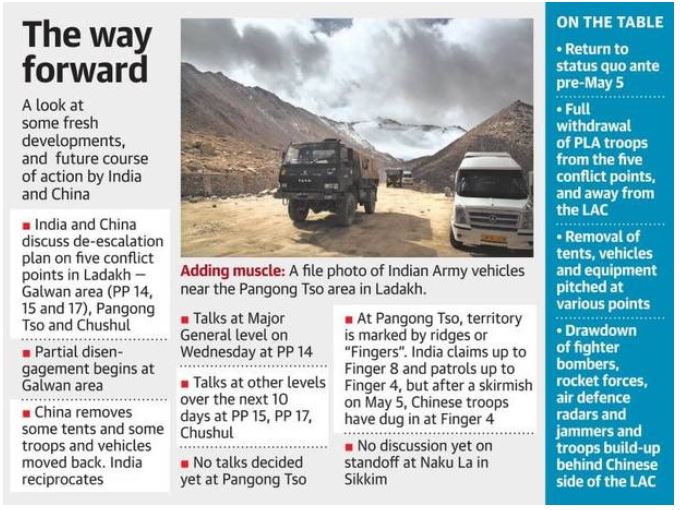
    China said that it had “reached an agreement” with India on the ongoing tensions along the Line of Actual Control (LAC), a day after India announced troops from both sides had begun a “partial disengagement” from some of the stand-off points.

    Practice question for mains:

    Q. “Early settlement of the boundary question serves the fundamental interests of both countries”. Discuss in light of the ongoing border skirmishes between India and China.

    Read the complete story here:

    [Burning Issue] India-China Skirmish in Ladakh

    Troops moving back

    • Partial deinduction has happened from some points in Galwan and Hot Springs areas.
    • Chinese side removed some of the tents and some troops and vehicles have been moved back, and the Indian side to has reciprocated.
    • At some points in the Galwan Valley, Chinese troops have moved back 2-3 km. However, there is no change in the ground situation at Pangong Tso.

    De-escalation begins

    • India and China held Major general-level talks to discuss further de-escalation at several standoff points in Eastern Ladakh including Patrolling Point (PP) 14, following a broad accord reached on Saturday in talks held at the Corps Commander-level.
    • As per the agreement, a series of ground-level talks would be held over the next 10 days, with four other points of conflict identified at PP15, PP17, Chushul and the north bank of Pangong Lake.
    • The Chinese Foreign Ministry said both sides had agreed to handle the situation “properly” and “in line with the agreement” to ease the situation.
    • However, it did not provide specific details on some of the stand-off points, such as Pangong Lake, where Chinese troops are still present on India’s side of the LAC.

    No final solution yet

    • At present, the two sides are taking actions in line with the agreement to ameliorate the border situation.
    • Government officials said a partial disengagement had happened at some points in the Galwan area and at Hot Springs, but there was no change at Pangong Lake.
    • Chinese state-run media has revealed that the ongoing dispute will not escalate into a conflict.
    • But it added due to the complexity of the situation, the military stand-off could continue for a little longer.

    Way forward

    • The military-level talks showed that both sides do not want to escalate tensions further.
    • It showed that China and India remain determined to peacefully resolve border issues.
    • However, the ongoing stand-off is not likely to end immediately, as concrete issues must still be resolved.
  • Challenger Deep: the deepest spot in the ocean

    On June 7, astronaut and oceanographer Kathy Sullivan, who was the first American woman to walk in space in 1984, became the first woman and the fifth person in history to descend to the deepest known spot in the world’s oceans, called the Challenger Deep in the Mariana Trench.

    The ocean relief can be divided into various parts such as Continental Shelf, Continental Slope, Continental Rise or Foot, Deep Ocean basins, Abyssal plains & Abyssal Hills, Oceanic Trenches, Seamounts and Guyots.

    Revise these ocean bottom relief  features from your basic references.

    Also revise India’s Deep Ocean Mission.

    What is Challenger Deep?

    • The Challenger Deep is the deepest known point in the Earth’s seabed hydrosphere (the oceans), with a depth of 10,902 to 10,929 m.
    • The deepest part is called the Challenger Deep, which is located below the surface of the western Pacific Ocean.
    • The first dive at Challenger Deep was made in 1960 by Lieutenant Don Walsh and Swiss scientist Jacques Piccard on a submersible called ‘Trieste’.
    • The British Ship HMS Challenger discovered Challenger Deep between 1872-1876.
    • In 2012, film director James Cameron reached the bottom of the Mariana trench after a descent that lasted 2 hours and 36 minutes.
    • Cameron reached a depth of about 10,908 metres on a dive in his submersible called the ‘Deepsea Challenger’ and became the first to complete a solo submarine dive to this spot.

    Why explore deep oceans?

    • Ocean exploration, however, is not randomly wandering in hopes of finding something new.
    • It is disciplined and organized and includes rigorous observations and documentation of biological, chemical, physical, geological, and archaeological aspects of the ocean.
    • Most of the existing knowledge of the oceans comes from shallower waters, while deeper waters remain relatively unexplored, even as humans are relying more on these areas for food, energy and other resources.
    • Further, finding out more about the deep ocean areas can potentially reveal new sources for medical drugs, food, energy resources and other products.
    • Significantly, information from the deep oceans can also help to predict earthquakes and tsunamis, and help us understand how we are affecting and getting affected by the Earth’s environment.

    What does it take to reach the deep ocean?

    • Vehicles called Human Occupied Vehicles (HOVs) may be used that carry scientists to the deep sea.
    • Alternatively, there are unmanned Remotely Operated Vehicles (ROVs) that are linked to ships using cables and can be steered by scientists remotely.
    • Even so, it is difficult for most private citizens to travel more than 100 feet below the surface of the ocean.
    • Further, technical divers can go as deep as 500 feet or more, but with an array of tanks filled with different gas blends.

    Why is it so difficult to explore deep oceans?

    • Most recreational divers can’t explore more than about 120 feet down due to the amount of air needed to keep lungs pressurized at depth.
    • Such depths could lead to nitrogen narcosis, the intoxication by nitrogen that starts to set in around that depth (most of our atmosphere is nitrogen, not oxygen).
    • Waters at such depths of several kilometres exert tremendous pressure which human bodies cannot sustain.
  • Species in news: Asiatic Lion

    Asiatic lions have now significantly risen in number at an estimated population of 674 in the Gir forest region of Gujarat. Unlike in previous years, this count was estimated not from a Census, but from a population “observation” exercise called Poonam Avlokan.

    Try this question from CSP 2017:

    Q. The term ‘M-STrIPES’ is sometimes seen in the news in the context of

    (a) Captive breeding of Wild Fauna

    (b) Maintenance of Tiger Reserves

    (c) Indigenous Satellite Navigation System

    (d) Security of National Highways

    Asiatic Lion

    • Indian Lion (Panthera Leo Persica) is listed as Endangered and exists as a single population in Gujarat.
    • It is one of five big cat species found in India and Gir National Park and Wildlife Sanctuary is the only habitat for Asiatic lions.
    • Historically, it inhabited much of Western Asia and the Middle East up to northern India.
    • On the IUCN Red List, it is listed under its former scientific name Panthera leo persica as Endangered because of its small population size and area of occupancy.
    • More than two dozen lions died last year in an outbreak of canine distemper virus (CDV) and Babesiosis.

    What is Poonam Avlokan?

    It includes two methods:

    • Block counting method — in which census enumerators remain stationed at water points in a given block and estimate abundance of lions in that block, based on the direct sighting of lions who need to drink water at least once in 24 hours during the summer.
    • Other teams keep moving in their respective territories and make their estimates based on inputs provided by lion trackers and on chance sightings.

    Back2Basics: Lion Census in India

    • The first Lion Census was conducted by the Nawab of Junagadh in 1936; since 1965, the Forest Department has been regularly conducting the Lion Census every five years.
    • The 6th, 8th and 11th Censuses were each delayed by a year, for various reasons.
    • This year it was postponed after the lockdown was announced.
  • Complexity of India-Nepal relations

    This article helps us understand Nepal’s perspective of the India-Nepal border dispute. Though the issue dates back to India’s independence, it came to dominate the political landscape in Nepal since 1990s. But there is no solution in sight. So, what makes the issue complex? Read to know…

    What the border dispute between two countries is about?

    • The inauguration of the “new road to Mansarovar” on May 8 by India’s defence minister has strained the relations between Nepal and India.
    • Nepal claims that a section of the road passes through the territory of Nepal and links with the Tibetan Autonomous Region of China through the Lipu Lekh pass in Nepal.
    • The 1816 Sugauli Treaty between Nepal and British India placed all the territories east of the Kali (Mahakali) river, including Limpiyadhura, Kalapani and Lipu Lekh at the northwestern front of Nepal, on its side.
    • The borders of Nepal, India and China intersect in this area.
    • Given the situation in 1961, Nepal and China fixed pillar number one at Tinker pass with the understanding that pillar number zero (the tri-junction of Nepal, India, and China) would be fixed later.
    • Lipu Lekh pass is 4 km northwest and Limpiyadhura 53 km west of Tinker pass.

    No progress on the solution of the issue

    • The dispute over the Kalapani area has spanned the last seven decades.
    • Both Nepal and India have recognised it as an outstanding border issue requiring an optimal resolution.
    • When in August 2014, Prime Minister Narendra Modi became the first Indian Prime Minister to visit Nepal in 17 years, Nepal’s Prime Minister Sushil Koirala raised this issue again.
    • The two prime ministers agreed to resolve the issue on a priority basis and directed their foreign secretaries “to work on the outstanding boundary issues including Kalapani and Susta”.
    •  There was virtually no progress on the ground.

    Nepal’s objection to India-China agreement

    •  In May 2015, Prime Minister Modi visited China, and the two countries agreed to “enhance border areas cooperation”.
    • The May 2015 agreement is a broad one compared to the 1954 India-China agreement “on trade and intercourse between Tibet Region of China and India”, which mentions Lipu Lekh pass as one of the six passes “through which traders and pilgrims of both countries may travel”.
    • Nepal protested against the inclusion of its territory, Lipu Lekh, in the joint statement without its consent and demanded that the two countries make necessary corrections to reflect the ground realities.
    • The protest was ignored.

    Growing nationalism and distrust let to the deterioration of relations

    • The tone of Nepal-India relations appears to be dominated by frustrations of the past and traditional attitudes more than the opportunities of the future.
    • The widening gap in understanding each other’s concerns has helped feed Nepali nationalism and create a dense cloud of distrust and suspicion between the two countries.
    • The gap widened after India chose to impose an economic blockade in response to Nepal’s sovereign decision to promulgate a democratic constitution.
    • The current ruling Communist Party of Nepal made people’s anger over the blockade its campaign plank during the 2017 general election.

    What makes the border issues complex and difficult to solve?

    • Complexity of the issue stems from the fact that the political leadership handles only a small part of this very important bilateral relationship.
    • India as a big neighbour is rarely seen grasping the psychological dimensions of the relationship.
    • Officials handling these multifaceted relations may momentarily influence the atmospherics but they rarely touch the core of these relations, let alone reorient or transform them in the rapidly changing context.
    • This is manifest in the deferring of substantive conversations on the outstanding boundary issue for decades.
    • The foreign secretary level mechanism has not met even once to discuss the border issue since its formation.
    • There are over three dozen bilateral mechanisms between Nepal and India to engage at various levels.
    • The meetings of these mechanisms are rarely regular.

    Consider the question “The India-Nepal border dispute looks minor, but allowing it to fester is likely to sow the seeds of immense competition and intense rivalry in the sensitive Himalayan frontier with far-reaching geopolitical implications. Comment.”

    Conclusion

    Geography, history, and economy make Nepal and India natural partners, sharing vital interest in each other’s freedom, integrity, dignity, security and progress. People-to-people relations are unique strengths of bilateral relations. India, for it’s part and in the spirit of its ‘neighbourhood first’ policy, must start a solution-oriented dialogue and find the solution to the dispute.

  • Permafrost and the hazards of its Thawing

    The principal reason that led to the recent 20,000-tonne oil leak at an Arctic region power plant in Russia that is now being recognised is the sinking of ground surface due to permafrost thaw.

    Try this question from Mains 2017:
    Q. What is Cryosphere? How does the Cryosphere affect global climate?

    What is Permafrost?

    • Permafrost is ground that remains completely frozen at 0 degrees Celsius or below for at least two years.
    • It is defined solely based on temperature and duration.
    • The permanently frozen ground, consisting of soil, sand, and rock held together by ice, is believed to have formed during glacial periods dating several millennia.

    Where are they found?

    • These grounds are known to be below 22 per cent of the land surface on Earth, mostly in polar zones and regions with high mountains.
    • They are spread across 55 per cent of the landmass in Russia and Canada, 85 per cent in the US state of Alaska, and possibly the entirety of Antarctica.
    • In northern Siberia, it forms a layer that is 1,500 m thick; 740 m in northern Alaska.
    • At lower latitudes, permafrost is found at high altitude locations such as the Alps and the Tibetian plateau.

    How climate change is eating away at these grounds?

    • The Earth’s polar and high altitude regions — its principal permafrost reservoirs — are the most threatened by climate change.
    • Arctic regions are warming twice as fast compared to the rest of the planet, its current rate of temperature change being the highest in 2,000 years.
    • In 2016, Arctic permafrost temperatures were 3.5 degrees Celsius higher than at the beginning of the 20th century.
    • A study has shown that every 1 degree Celsius rise in temperature can degrade up to 39 lakh square kilometre due to thawing.
    • This degradation is expected to further aggravate as the climate gets warmer, putting at risk 40 per cent of the world’s permafrost towards the end of the century– causing disastrous effects.

    The threat to infrastructure

    • Thawing permafrost is also ominous for man-made structures overhead.
    • The Russian oil leak occurred recorded temperatures in Siberia at more than 10 degrees Celsius above average, and called them “highly anomalous” for the region where the power plant is located.
    • As temperatures rise, the binding ice in permafrost melts, making the ground unstable and leading to massive potholes, landslides, and floods.
    • The sinking effect causes damage to key infrastructure such as roads, railway lines, buildings, power lines and pipelines.
    • These changes also threaten the survival of indigenous people, as well as Arctic animals.

    A ticking time bomb

    • Beneath its surface, permafrost contains large quantities of organic leftover from thousands of years prior — dead remains of plants, animals, and microorganisms that got frozen before they could rot.
    • It also holds a massive trove of pathogens.
    • When permafrost thaws, microbes start decomposing this carbon matter, releasing greenhouse gases like methane and carbon dioxide.
    • Researchers have estimated that for every 1 degree Celsius rise in temperature, these grounds could release GHGs to the tune of 4-6 years’ of emissions from coal, oil, and natural gas.
    • Along with greenhouse houses, these grounds could also release ancient bacteria and viruses into the atmosphere as they unfreeze.

    Back2Basics
    https://www.civilsdaily.com/news/thawing-of-permafrost/

    Also read:

    Ambarnaya River Oil spill in Russia

  • Taking care of finances of local governments

    This article makes some suggestions to improve local finance and argues that the extant fiscal illusion is a great deterrent to mobilisation.

    Advantageous position in handling disasters

    • In terms of information, monitoring and immediate action, local governments are at an advantage, and eminently, to meet any disaster such as COVID-19.
    • While increasing the borrowing limits of the state form 3.5% of GDP to 5%, there was a recognition that local governments should be fiscally empowered immediately.
    • This is a valid signal for the future of local governance.

    4 challenges posed by Covid and addressing them collectively

    • COVID-19 has raised home four major challenges:1) economic, 2) health, 3) welfare/livelihood 4) resource mobilisation.
    • These challenges have to be addressed by all tiers of government in the federal polity, jointly and severally.

    Local government empowerment: 5 critical areas

    • 1) Own revenue is the critical lever of local government empowerment.
    • But the several lacunae that continue to bedevil local governance have to be simultaneously addressed.
    • 2) The new normal demands a paradigm shift in the delivery of health care at the cutting edge level.
    • 3) The parallel bodies that have come up after the 73rd/74th Constitutional Amendments have considerably distorted the functions-fund flow matrix at the lower level of governance.
    • 4) There is yet no clarity in the assignment of functions, functionaries and financial responsibilities to local governments.
    • Functional mapping and responsibilities continue to be ambiguous in many States.
    • Instructively, Kerala attempted even responsibility mapping besides activity mapping.
    • 5) The critical role of local governments will have to be recognised by all.

    Let’s look into resource mobilisation issue: 3 Heads

    • A few suggestions for resource mobilisation are given under three heads: 1) local finance, 2) Members of Parliament Local Area Development Scheme-MPLADs, 3) the Fifteenth Finance Commission (FFC).

    1. Local finance

    • Property tax collection with appropriate exemptions should be a compulsory levy and preferably must cover land.
    • The Economic Survey 2017-18 points out that urban local governments, or ULGs, generate about 44% of their revenue from own sources as against only 5% by rural local governments, or RLGs.
    • Per capita own revenue collected by ULGs is about 3% of urban per capita income while the corresponding figure is only 0.1% for RLGs.
    • There is a yawning gap between tax potential and actual collection, resulting in colossal underperformance.
    • When they are not taxed, people remain indifferent.
    • LGs, States and people seem to labour under a fiscal illusion.
    • In States such as Uttar Pradesh, Bihar and Jharkhand, local tax collection at the panchayat level is next to nil.
    • Property tax forms the major source of local revenue throughout the world.
    • All States should take steps to enhance and rationalise property tax regime.
    • A recent study by Professor O.P. Mathur shows that the share of property tax in GDP has been declining since 2002-03.
    •  The share of property tax in India in 2017-18 is only 0.14% of GDP as against 2.1% in the Organisation for Economic Co-operation and Development (OECD) countries.
    • If property tax covers land, that will hugely enhance the yield from this source even without any increase in rates.

    Other 2 options for raising finances

    • 1) Land monetisation and betterment levy may be tried in the context of COVID-19 in India. To be sure, land values have to be unbundled for socially relevant purposes.
    • 2) Municipalities and even suburban panchayats can issue a corona containment bond for a period of say 10 years.
    • We are appealing to the patriotic sentiments of non-resident Indians and rich citizens.
    • Needless to say, credit rating is not to be the weighing consideration.
    • That the Resurgent India Bond of 1998 could mobilise over $4 billion in a few days encourages us to try this option.

    2) MPLADS

    • The suspension of MPLADS by the Union government for two years is a welcome measure. The annual budget was around ₹4,000 crore.
    • The Union government has appropriated the entire allocation along with the huge non-lapseable arrears.
    • MPLADs, which was avowedly earmarked for local area development, must be assigned to local governments, preferably to panchayats on the basis of well-defined criteria.

    3) Fifteenth finance commission-FFC

    • A special COVID-19 containment grant to the LGs by the FFC to be distributed on the basis of SFC-laid criteria is the need of the hour.
    • The commission may do well to consider this.
    • The local government grant of ₹90,000 crore for 2020-2021 by the FFC is only 3% higher than that recommended by the Fourteenth Finance Commission.
    • Building health infrastructure and disease control strategies at the local level find no mention in the five tranches of the packages announced by the Union Finance Minister.

    Suggestions related to grants

    • The ratio of basic (i.e. with no conditions) to tied (with condition)grant is fixed at 50:50 by the commission.
    • In the context of the crisis under way, all grants must be untied  for freely evolving proper COVID-19 containment strategies locally.
    • The 13th Finance Commission’s recommendation to tie local grants to the union divisible pool of taxes to ensure a buoyant and predictable source of revenue to LGs (accepted by the then Union government) must be restored by the commission.

    Consider the question “The stable source of revenue for the local government bodies whether from their own sources or in the form of grants should lie at the heart of efforts to empower them. Comment.”

     Conclusion

    COVID-19 has woken us up to the reality that local governments must be equipped and empowered. Relevant action is the critical need.

    B2BASICS:

    73rd and 74th Amendment Acts, 1993

    • It’s been 25 years since decentralized democratic governance was introduced in India by the 73rd and 74th Constitution Amendments, which came into force on April 24 and June 1, 1993, respectively.
    • The 73rd Amendment to the Constitution (Part IX) has given constitutional status to the Panchayats, and has provided it with a substantial framework. It envisions the Panchayats as the institutions of local self-governance and also the universal platforms for planning and implementing programmes for economic
      development and social justice.
    • The creation of lakhs of “self-governing” village panchayats and gram sabhas, with over three million elected representatives mandated to manage local development, was a unique democratic experiment.
    • Article 243A gives constitutional recognition to the Gram Sabha as a body consisting of persons registered in the electoral rolls relating to a village comprised within the area of the Panchayat at the village level.
    • The 74th Amendment Act provided for the constitution (Part IXA) of three types of municipalities in urban areas depending upon the size and area.
    • The Constitution provides for a complete institutional mechanism including reservation for women and formation of State Finance Commissions (SFCs) for local democracy.
  • Who is afraid of monetisation of deficit?

    Rating agencies influence the decisions of investors. So, when any economy is downgraded by them, it’s certainly a cause for concern. But to restart the economic engines, governments need to spend more by borrowing. This article suggests the way to achieve both: avoiding downgrade and increasing spending. How? Read to know…

    To worry or not to worry: Issue of downgrading by rating agencies

    • Some economists urged the government amid covid pandemic to go out and spend without worrying about the increase in public debt.
    • They said the rating agencies would understand that these are unusual times.
    • If they did not and chose to downgrade India, we should not worry too much about it.
    • Well, the decision of the rating agency, Moody’s, to downgrade India from Baa2 to Baa3 should come as a rude awakening.
    • The present rating is just one notch above the ‘junk’ category.
    • Moody’s has also retained its negative outlook on India, which suggests that a further downgrade is more likely than an upgrade.
    •  The downgrade, Moody’s says, has not factored in the economic impact of the pandemic.
    • Any further deterioration in the fundamentals from now on will push India into ‘junk’ status.

    Here is why we should be worried about a downgrade

    •  Whatever the failings of the agencies, in the imperfect world of global finance that we live in, their ratings do carry weight.
    • Institutional investors are largely bound by covenants that require them to exit an economy that falls below investment grade.
    • If India is downgraded to junk status, foreign institutional investors, or FIIs, will flee in droves.
    • The stock and bond markets will take a severe beating.
    • The rupee will depreciate hugely and the central bank will have its hands full trying to stave off a foreign exchange crisis.
    • That is the last thing we need at the moment.

    So, what is the way out? Try for an upgrade!

    • We have to put our best foot forward now to prevent a downgrade and bring about an upgrade instead.
    • To do so, we need to note the key concerns that Moody’s has cited in effecting the present downgrade to our rating: slowing growth, rising debt and financial sector weakness.
    • These concerns are legitimate.

    Bleak prospects

    • Many economists as also the Reserve Bank of India (RBI) expect India’s economy to shrink in FY 2020-21.
    • The combined fiscal deficit of the Centre and the States is expected to be in the region of 12% of GDP.
    • Moody’s expects India’s public debt to GDP ratio to rise from 72% of GDP to 84% of GDP in 2020-21.
    • The banking sector had non-performing assets of over 9% of advances before the onset of the pandemic.
    • Weak growth and rising bankruptcies will increase stress in the banking sector.

    Fiscal deficit and growth: two concerns of rating agencies

    • The government’s focus thus far has been on reassuring the financial markets that the fisc will not spin out of control.
    • It has kept the ‘discretionary fiscal stimulus’ down to 1% of GDP.
    • That 1%  figure is most modest in relation to that of many other economies, especially developed economies.
    • ‘Discretionary fiscal stimulus’ refers to an increase in the fiscal deficit caused by government policy as distinct from an increase caused by slowing growth, the latter being called an ‘automatic stabiliser’.
    • Keeping the fiscal deficit on a leash addresses the concerns of rating agencies about a rise in the public debt to GDP ratio.
    • But it does little to address their concerns about growth.
    • The debt to GDP ratio will worsen and financial stress will accentuate if growth fails to recover quickly enough.
    • The government’s stimulus package relies heavily on the banking system to shore up growth.
    • But there is only so much banks can do.
    • More government spending is required, especially for infrastructure.

    So, government need to increase fiscal stimulus without increasing public debt

    • We need to increase the discretionary fiscal stimulus without increasing public debt.
    • The answer is monetisation of the deficit, that is, the central bank providing funds to the government.
    • These fears are based on misconceptions about monetisation of the deficit and its effects.

    What monetisation of debt mean?

    • A common misconception is that it involves ‘printing notes’.
    • But that is not how central banks fund the government.
    • The central bank typically funds the government by buying Treasury bills.
    • As proponents of what is called Modern Monetary Theory point out, even that is not required.
    • The central bank could simply credit the Treasury’s account with itself through an electronic accounting entry.
    • What is base money? When the government spends the extra funds that have come into its account, there is an increase in ‘Base money’, that is, currency plus banks’ reserves.
    • So, yes, monetisation results in an expansion of money supply.
    • But that is not the same as printing currency notes.

    But expansion of money supply leads to inflation, what about that?

    • It could be that the expansion is inflationary.
    • This objection has little substance in a situation where aggregate demand has fallen sharply and there is an increase in unemployment.
    • In such a situation, monetisation of the deficit is more likely to raise actual output closer to potential output without any great increase in inflation.

    No difference in borrowing from banks or RBI directly:MMT

    • Exponents of the Modern Monetary Theory (MMT) make a more striking point.
    • They say there is nothing particularly virtuous about the government incurring expenditure and issuing bonds to banks instead of issuing these to the central bank.
    • The expansion in base money and hence in money supply is the same in either route.
    • The preference for private debt is voluntary.
    • MMT exponents say it has more to do with an ideological preference for limiting government expenditure.
    • Central banks worldwide have resorted to massive purchases of government bonds in the secondary market in recent years, with the RBI joining the party of late.
    • These are carried out under Open Market Operations (OMO).
    • The impact on money supply is the same whether the central bank acquires government bonds in the secondary market or directly from the Treasury.

    So why the shrill clamour against monetisation of public debt?

    • OMO is said to be a lesser evil than direct monetisation because the former is a ‘temporary’ expansion in the central bank’s balance sheet whereas the latter is ‘permanent’.
    • But we know that even so-called ‘temporary’ expansions can last for long periods with identical effects on inflation.
    • What matters, therefore, is not whether the central bank’s balance sheet expansion is temporary or permanent but how it impacts inflation.
    • As long as inflation is kept under control, it is hard to argue against monetisation of the deficit in a situation such as the one we are now confronted with.

    Way forward

    • We now have a way out of the constraints imposed by sovereign ratings.
    • The government must confine itself to the additional borrowing of ₹4.2 trillion which it has announced.
    • Further discretionary fiscal stimulus must happen through monetisation of the deficit.
    • That way, the debt to GDP ratio can be kept under control while also addressing concerns about growth.

    Consider the question “Examine the issues involved in the direct monetisation of the debt by the government to fund the spending in  the wake of covid pandemic.”

    Conclusion

    The rating agencies should be worrying not about monetisation per se but about its impact on inflation. As long as inflation is kept under control, they should not have concerns — and we need not lose sleep over a possible downgrade.


    Back2Basics: Automatic stabiliser

    • Automatic stabilisers refer to how fiscal instruments will influence the rate of growth and help counter swings in the economic cycle.
    • Automatic stabilisers will influence the size of government borrowing.

    Discretionary fiscal policy

    • Keynesian Perspective: Keynes noted that in a recession, confidence falls and the private sector cut back on spending and investment.
    • Therefore, we see a rise in private savings and a fall in aggregate demand. This can worsen the recession.
    • This is why Keynes advocated government borrowing – to make use of these surplus savings.
    • Keynes argued that automatic stabilisers may not be enough, and the government should specifically find public sector projects to inject money into the circular flow.
    • This is known as discretionary fiscal policy.
  • Shapes of Economic Recovery

    Predicting recovery graphs, economists have added cool shapes for our information.

    The types of graphs mentioned here are the possible indicators of macro-economic recovery. They are the potential hotspots for a prelim question. UPSC can puzzle you with the type of graphs and associated macroeconomic situation.

    Try to mirror! How would our economy grow?!

    Types of graphs

    The shape of economic recovery is determined by both the speed and direction of GDP prints. This depends on multiple factors including fiscal and monetary measures, consumer incomes and sentiment.

    • The best scenario is a V-shaped recovery in which the economy quickly recoups lost ground and gets back to the normal growth trend-line.
    • A pipe graph is a V graph with a longer tail — the recovery isn’t one that happens quickly over one quarter but over two-three quarters.
    • The pipe is different from the Swoosh because in the latter the economy bears the pain for longer.
    • A Zshaped recovery is when a post-lockdown spending surge is so fierce that growth is lifted above the trendline and then after a party settles down to trend. The Z-shaped recovery is the most-optimistic scenario in which the economy quickly rises like a phoenix after a crash.
    • A U-shaped recovery — resembling a bathtub — is a scenario in which the economy, after falling, struggles and muddles around a low growth rate for some time, before rising gradually to usual levels.
    • A W-shaped recovery is a dangerous creature — growth falls and rises, but falls again before recovering yet again, thus forming a W-like chart. The double-dip depicted by a W-shaped recovery is what some economists are predicting if the second wave of COVID comes along and the initial rebound flatters to deceive.
    • The L-shaped recovery is the worst-case scenario, in which growth after falling, stagnates at low levels and does not recover for a long, long time.
    • Then, there is the J-shaped recovery, a somewhat unrealistic scenario, in which growth rises sharply from the lows much higher than the trend-line and stays there.
    • There is also the Swoosh shaped recovery, similar to the Nike logo — in between the V-shape and the U-shape. Here, after falling, growth starts recovering quickly but then, slowed down by obstacles, moves gradually back to the trend-line.
    • Finally, say hello to the Inverted square root shaped In this, there could a rebound from the bottom, the growth slows and settles a step-down.

    Why is it important for India?

    • The Indian economy was slowing down even before COVID hit, and the trouble has now been amplified manifold because of the lockdowns.
    • Experts predict a fall of up to 5 per cent in the GDP in FY-21.
    • This is clearly a crisis situation, and our getting out of the hole will depend a great deal on the shape of the economic recovery that will hopefully follow.
    • A Z- or at least V-shaped recovery would be the most preferable. If not, we should at least have a U-shaped recovery or a Swoosh to get back on our feet in a couple of years.
    • A W-shape will bring in much pain before the eventual gain, while an L-shape or the Inverted-square root will make a wreck of the growth train.
  • International Convention for the Prevention of Pollution from Ships (MARPOL)

    The Ministry of Shipping has informed about the steps taken for prevention and control of pollution arising from ships in the sea and in the inland waterways under the MARPOL Convention.

    Aspirants must note the following things:

    1. If the convention is a subsidiary to the United Nations/IMO,

    2. Whether it is Legally binding?

    3. If India is a signatory or not …..

    MARPOL Convention

    • MARPOL is the main international convention aimed at the prevention of pollution from ships caused by operational or accidental causes.
    • The Protocol of 1978 was adopted in response to a number of tanker accidents in 1976–1977.
    • It is one of the most important international marine environmental conventions.
    • It was developed by the IMO with an objective to minimize pollution of the oceans and seas, including dumping, oil and air pollution.
    • The Convention includes regulations aimed at preventing and minimizing pollution from ships – both accidental pollution and that from routine operations – and currently includes six technical Annexes.
    • India is a signatory to MARPOL.
    • It has six annexes (I to VI) and it deals with prevention of (1) Pollution from ships by Oil, (2) Noxious liquid substances, (3) Dangerous goods in packaged form, (4) Sewage, (5) Garbage and (6) Air pollution from ships respectively.
  • Green colour band for BS-VI 4W vehicles

    The Ministry of Road Transport and Highways (MoRTH) has issued an order mandating a coloured strip to identify four-wheeled BSVI vehicle.

    Note important PM levels allowed under BS VI norms. Note how it is different from the earlier BS IV norm.

    Details of the colour band

    • MoRTH has mandated a strip of green colour of 1 cm width on top of the existing sticker carrying details of registration for BS-VI.
    • Vehicles of any fuel type will carry the green strip irrespective of their original stickers i.e. for petrol or CNG which have a light blue colour sticker and a diesel vehicle which is of orange colour.
    • These stickers will now have a green strip of 1 cm on top for BS-VI, as mandated.

    Back2Basics:  Bharat Stage Norms

    Standard Reference Date of Implementation
    Bharat Stage II Euro 2 1 April 2005
    Bharat Stage III Euro 3 1 April 2010
    Bharat Stage IV Euro 4 1 April 2017
    Bharat Stage VI Euro 6 April 2020 with a mandate (proposed)

    Minutes of BS-VI

    • Carmakers would have to put three pieces of equipment — a DPF (diesel particulate filter), an SCR (selective catalytic reduction) system, and an LNT (Lean NOx trap) — to meet stringent BS-VI norms, all at the same time.
    • This is vital to curb both PM (particulate matter) and NOx (nitrogen oxides) emissions as mandated under the BS-VI norms.

    How is BS-VI Different from BS-IV?

    • The major difference between the existing BS-IV and forthcoming BS-VI norms is the presence of sulphur in the fuel.
    • While the BS-IV fuels contain 50 parts per million (ppm) sulphur, the BS-VI grade fuel only has 10 ppm sulphur content.
    • Also, the harmful NOx (nitrogen oxides) from diesel cars can be brought down by nearly 70%.
    • In the petrol cars, they can be reduced by 25%.
    • However, when we talk about air pollution, particulate matter like PM 2.5 and PM 10 are the most harmful components and the BS-VI will bring the cancer-causing particulate matter in diesel cars by a phenomenal 80%.