💥Join UPSC 2027,2028 Mentorship (August Batch) + XFactor Notes & Microthemes PDF

GS Paper: GS1

  • [pib] Food and Agriculture Organization (FAO)

    On the occasion of 75th Anniversary of Food and Agriculture Organization (FAO) on 16th October 2020, PM has released a commemorative coin of Rs 75.

    Try this MCQ:

    Q.The FAO accords the status of ‘Globally Important Agricultural Heritage Systems (GIAHS)’ to traditional agricultural systems. What is the overall goal of this initiative?

    1. To provide modern technology, training in modern farming methods and financial support to local communities of identified GIAHS so as to greatly enhance their agricultural productivity.
    2. To identify and safeguard eco-friendly traditional farm practices and their associated landscapes, agricultural biodiversity and knowledge systems of the local communities.
    3. To provide Geographical Indication status to all the varieties of agricultural produce in such identified GIAHS Select the correct answer using the code given below:

    (a) 1 and 3 only

    (b) 2 only

    (c) 2 and 3 only

    (d) 1, 2 and 3

    About FAO

    • It is a specialized agency of the United Nations that leads international efforts to defeat hunger and improve nutrition and food security.
    • It was founded in October 1945 and is headquartered in Rome.
    • It maintains regional and field offices around the world, operating in over 130 countries.
    • It also conducts research, provides technical assistance to projects, operates educational and training programs, and collects data on agricultural output, production, and development.
    • Composed of 197 member states, the FAO is governed by a biennial conference representing each member country and the European Union, which elects a 49-member executive council.
    • The Director-General serves as the chief administrative officer.

    India and FAO

    • India has had a historic association with FAO.
    • Indian Civil Service Officer Dr Binay Ranjan Sen was the Director-General of FAO during 1956-1967.
    • The World Food Programme, which has won the Nobel Peace Prize 2020, was established during his time.
    • India’s proposals for the International Year of Pulses in 2016 and the International Year of Millets 2023 have also been endorsed by FAO.
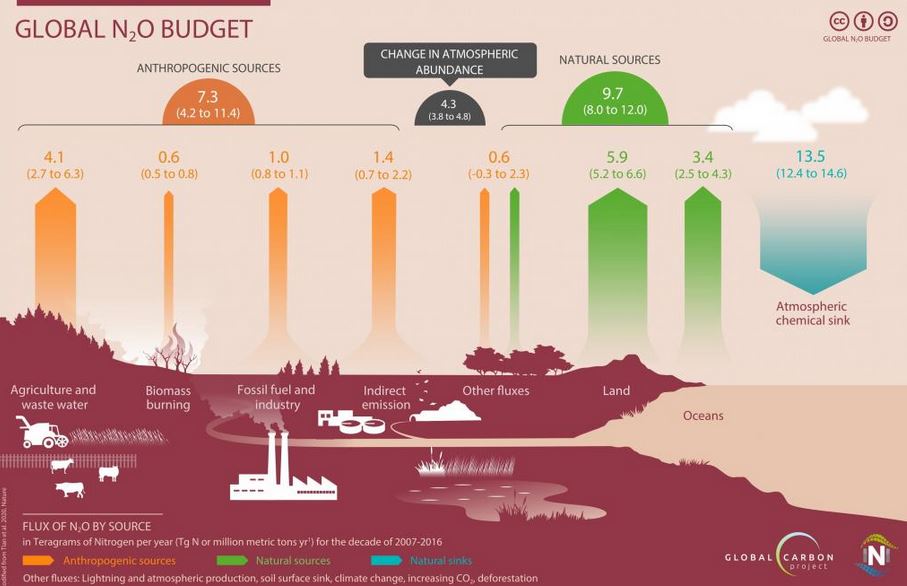
  • Global Nitrous Oxide Pollution

    Human emissions of nitrous oxide (N2O) — a greenhouse gas 300 times more potent than carbon dioxide (CO2) — increased by 30 per cent between 1980 and 2016.

    Observe the above image carefully and try to find out the major contributor of nitrous oxide emission in the Global N2O Budget.

    What is Nitrous oxide?

    • Nitrous oxide is a dangerous gas for the sustainable existence of humans on Earth.
    • It has the third-highest concentration — after CO2 and methane — in our atmosphere among greenhouse gases responsible for global warming.
    • N2O can live in the atmosphere for up to 125 years.
    • Most N2O emissions have come from emerging countries like India, China and Brazil.

    About the research

    • Nitrous oxide global concentration levels have increased from 270 parts per billion (ppb) in 1750 to 331 ppb in 2018 — a jump of 20 per cent.
    • The growth has been the quickest in the past five decades because of human emissions.
    • The research was conducted through an international collaboration between the International Nitrogen Initiative (INI) and the Global Carbon Project of Future Earth, a partner of the World Climate Research Programme.

    Why N2O matters?

    • N2O is also the only remaining threat to the ozone layer, for it accumulates in the atmosphere over a long period of time, just like CO2.
    • The increase in its emissions means that the climatic burden on the atmosphere is increasing from non-carbon sources as well, while the major focus of global climate change negotiations is currently centred on carbon.
    • A major proportion of the N2O emissions in the last four decades came from the agricultural sector, mainly because of the use of nitrogen-based fertilizers.
    • The growing demand for food and feed for animals will further increase global nitrous oxide emissions.
  • What is World Food Programme?

    The Nobel Peace Prize was awarded to the World Food Programme (WFP) for feeding millions of people from Yemen to North Korea, with the coronavirus pandemic seen pushing millions more into hunger.

    Tap here to read more about Nobel Prizes here at:

    Nobel and other Prizes

    World Food Programme

    • The WFP is the food-assistance branch of the United Nations and the world’s largest humanitarian organization focused on hunger and food security.
    • Founded in 1961, it is headquartered in Rome and has offices in 80 countries.
    • In addition to emergency food aid, WFP focuses on relief and rehabilitation, development aid, and special operations, such as making food systems more resilient against climate change and political instability.
    • It is an executive member of the United Nations Development Group, which collectively aims to fulfil the 17 Sustainable Development Goals (SDG), and has prioritized achieving SDG 2 for “zero hunger” by 2030.
  • What is Global Warming Hiatus (GWH)?

    A new study on variability in the Mascarene High (MH) in the Southern Indian Ocean during global warming hiatus (GWH) has revealed that the region experienced significantly increased sea surface temperature (SST) during this period (1998-2016).

    Try this PYQ:

    Q.With reference to Ocean Mean Temperature (OMT), which of the following statements is/are correct? (CSP 2020)

    1. OMT is measured upto a depth of 26 degree Celsius isotherm which is 129 meters in the south-western Indian Ocean during January-March.
    2. OMT collected during January-March can be used in assessing whether the amount of rainfall in monsoon will be less or more than a certain long-term mean.

    Select the correct answer using the code given below:
    (a) 1 only
    (b) 2 only
    (c) Both 1 and 2
    (d) Neither 1 nor 2

    What is Global Warming Hiatus (GWH)?

    • A global warming hiatus is referred to a global warming pause, or a global warming slowdown, which is a period of relatively little change in globally averaged surface temperatures.
    • The hiatus, however, can result in an increase in the SST.

    What is Mascarene High (MH)?

    • The Mascarene High (MH) is a semi-permanent subtropical high-pressure zone in the South Indian Ocean.
    • It is also called the Indian Ocean subtropical high, which is a high-pressure area located between 20° to 35° South latitude and 40° to 90° East longitude.
    • It is a region from where the cross-equatorial winds blow to India.
    • It has been named after the Mascarene Islands, in the Indian Ocean east of Madagascar consisting of the islands belonging to Mauritius as well as the French Réunion Islands.
    • Apart from its large influence on African and Australian weather patterns, it also helps in driving the inter-hemispheric circulation between the Indian Ocean in the south and subcontinental landmass in the north.

    Role of MH

    • The warming in SST due to global warming has resulted in a decrease in the pressure gradient between the MH and the Indian landmass.
    • This in turn suppressed the intensity of low-level cross-equatorial winds over the western Indian Ocean affecting the onset of the monsoon over the Indian subcontinent and rainfall over East Asia.
  • ‘Pagri Sambhal Jatta’ Movement

    Sardar Ajit Singh Sandhu,  the brain behind the ‘Pagri Sambhal Jatta’ movement is now being remembered in the ongoing agrarian resentments in Punjab.

    Try this PYQ:

    Q.What was the immediate cause for the launch of the Swadeshi movement?

    (a) The partition of Bengal done by Lord Curzon.

    (b) A sentence of 18 months rigorous imprisonment imposed on Lokmanya Tilak.

    (c) The arrest and deportation of Lala Lajpat Rai and Ajit Singh; and passing of the Punjab Colonization Bill.

    (d) Death sentence pronounced on the Chapekar brothers.

    ‘Pagri Sambhal Jatta’ Movement

    • In 1879, the British constructed the Upper Bari Doab canal to draw water from the Chenab river and take it to Lyallpur (now in Pakistan and renamed Faisalabad) to set up settlements in uninhabited areas.
    • Promising to allot free land with several amenities, the government persuaded peasants and ex-servicemen from Jalandhar, Amritsar and Hoshiarpur to settle there.
    • In 1907, in Lyallpur, Ajit Singh Sandhu also Bhagat Singh’s uncle headed the movement that articulated this discontent.
    • The catchy slogan, Pagdi Sambhal Jatta, the name of the movement, was inspired by the song by Banke Lal, the editor of the Jang Sayal newspaper.
    • The agitated protestors ransacked government buildings, post offices, banks, overturning telephone poles and pulling down telephone wires.

    Who was Ajit Singh?

    • He was a revolutionary and a nationalist during the time of British rule in India.
    • With compatriots, he organised agitation by Punjabi peasants against anti-farmer laws known as the Punjab Colonization Act (Amendment) 1906 and administrative orders increasing water rate charges.
    • He was an early protester in the Punjab region of India who challenged British rule and openly criticized the Indian colonial government.
    • In May 1907, with Lala Lajpat Rai, he was exiled to Mandalay in Burma.
    • Due to great public pressure and apprehension of unrest in the Indian Army, the bills of exile were withdrawn and both men were released in November 1907.
  • Personality in news: Shyamji Krishna Varma

    PM has paid rich tributes to revolutionary freedom fighter Shyamji Krishna Varma on his birth anniversary.

    Try this PYQ:

    Q. The Ghadr (Ghadar) was a –

    (a) Revolutionary association of Indians with headquarters at San Francisco.

    (b) Nationalist organization operating from Singapore

    (c) Militant organization with headquarters at Berlin

    (d) Communist movement for India’s freedom with head-quarters at Tashkent

    About Shyamji Krishna Varma

    • SK Varma (1857–1930) was an Indian revolutionary fighter, a patriot, lawyer and journalist who founded the Indian Home Rule Society, India House and The Indian Sociologist in London.
    • He was a noted scholar in Sanskrit and other Indian languages.
    • He pursued a brief legal career in India and served as the Divan of a number of Indian princely states in India.
    • He had, however, differences with Crown authority, was dismissed following a supposed conspiracy of local British officials at Junagadh and chose to return to England.
    • An admirer of Dayanand Saraswati’s approach of cultural nationalism, and of Herbert Spencer, Krishna Varma believed in Spencer’s dictum: “Resistance to aggression is not simply justified, but imperative”.
  • Places in news: Kamchatka Peninsula

    An ‘ecological disaster’ of sorts is unfolding on a black volcanic beach of the Kamchatka Peninsula in the Russian Far East, according to a report.

    Note the features of the map and surrounding seas.

    About Kamchatka Peninsula

    • The Kamchatka Peninsula is a 1,250-kilometre-long peninsula in the Russian Far East.
    • The Pacific Ocean and the Sea of Okhotsk make up the peninsula’s eastern and western coastlines, respectively.
    • Immediately offshore along the Pacific coast of the peninsula runs the 10,500-metre-deep Kuril–Kamchatka Trench.
    • The Kamchatka Peninsula, the Commander Islands, and Karaginsky Island constitute the Kamchatka Krai of the Russian Federation.
    • The vast majority of the 322,079 inhabitants are ethnic Russians, although about 13,000 are Koryaks (2014).
    • The Kamchatka peninsula contains the volcanoes of Kamchatka, a UNESCO World Heritage Site.

    Why in news?

    • Then, sea animals begin to die in large numbers, their bodies littering the beach.
    • These included octopuses, seals, sea urchins, stars, crabs and fish.
    • Examination of the seawater by the administration has shown that levels of phenols and oil compounds have spiked.
  • Sawantwadi Toy (PIB)

    Context- Online Release of Picture Postcard on Sawantwadi Toy by India Post.

    What are Sawantwadi toys ?

    • Sawantwadi toys refers to hand made works of art made of wood in Sawantwadi a town in Sindhudurg district of Maharashtra. Most of these toys are made in the village of Kolgaon in Sawantwadi taluka.
    • These toys are made from the wood of the Indian Coral tree (Erythrina variegata).
    • Craftsmen who make these toys belong to the Chittari community who came to Sawantwadi from Karwar and Goa.


  • Who was Kanaklata Barua ?

    A Fast Patrol Vessel (FPV) named ICGS Kanaklata Barua was commissioned in the Indian Coast Guard on Wednesday, in Kolkata. It is named after a teenage freedom fighter who was shot dead in Assam during the Quit India Movement.

    Who was Kanaklata Barua ?

    • One of the youngest martyrs of the Quit India Movement, Kanaklata Barua has iconic status in Assam. Barua.
    • Then 17, led the Mukti Bahini, a procession of freedom fighters to unfurl the Tricolour at Gohpur police station on September 20, 1942. When police did not let them move forward, an altercation led to firing, killing Barua at the head of the procession.
    • She had joined the Mrityu Bahini [a kind of a suicide squad] just two days before the incident. The squad strictly admitted members aged 18 and above but Kanaklata was an exception. She wanted to lead the procession and after much persuasion she was allowed to.
    •  Even as Barua fell to bullets, she did not let go of the flag. She did not want it to touch the ground. Another woman volunteer behind her — Mukunda Kakoty — came and held the flag, and she, too, was shot.

      How important is her legacy ?

    •  1940’s was a time where you saw a lot of women coming to the fore, leading processions, patriotic fervour was at its peak — and Kanaklata was a product of this time.
    • There are schools named after her, there are two statues, there is a ship. While we see her as an icon now, people in her village hated her then — she was a rebel, who questioned patriarchy.
  • Eden Gardens: India’s oldest cricketing ground

    This newscard is an excerpt from the original article published in TH.

    UPSC may ask a question like this:

    Q. In which Governor-General/Viceroy’s term was the famous cricketing ground ‘Eden Gardens’ was built?

    Eden Gardens

    • The first cricket club outside Britain was the Calcutta Cricket Club founded in 1792, and the first match was played 12 years later between the Etonians, senior civil servants and other company officials.
    • In 1825 the club got a plot of land on the ground between Government House and Fort William to be used as a cricket ground.
    • In 1841, the club was permitted to enclose the ground with a fence. But the Army at Fort William described the club as an “encroacher”.
    • Cricket Club of Calcutta authorities then looked for an alternative ground and at ₹1,000, found a new one, fenced it and made it playable.
    • In 1864, the land was laid out for a ground for Calcutta Cricket Club in the extended part of Eden Gardens.

    Deriving its name

    • Eden Gardens made its first appearance during the time of Governor-General Lord Auckland (1836-42).
    • According to the achieves, a local landlord gifted this land to Lord Auckland and his sisters Emily Eden and Fanny Eden helped him save his third daughter from a deadly disease.