💥Mains Ready By December. Smash Mains & Smash PYQ Admissions Open

GS Paper: GS1-01.Indian Culture- Salient aspects of Art Forms, Literature and Architecture from ancient to modern times.

  • Fading alphabet to fresh paint: Dogri scripts a comeback on Jammu signboards

    Why in the News

    New public signboards in Jammu carry area names in Namey Dogra Akhar, the script of the Dogri language, alongside the usual Devanagari for Hindi and Roman for English. Dogri has long been written in Devanagari, with its own script falling into disuse. Civic authorities are putting the boards up at prominent locations and institutions as an attempt to revive that script. Dogri itself carries the full set of formal protections available to an Indian language, at the Union level and in the Union Territory. The tension is that the decision that secured the language, adopting Devanagari to popularise its literature, is the same decision that displaced its script.

    What is Namey Dogra Akhar?

    1. A modified Takri: Namey Dogra Akhar is a modified version of Takri, the original script in which Dogri was written. The name translates as new Dogri script.
    2. It was created to solve a transcription problem: Takri had no vowel signs, so official orders and documents could not be reliably transcribed in it.
    3. The vowels were borrowed from Devanagari: Writers were directed to take vowel signs from Devanagari, which produced the new script. It then entered administrative work alongside Persian, which was already in use.

    Where does Dogri stand as a language?

    1. Family and group: Dogri is an Indo-Aryan language, part of the Indo-European family that also includes Hindi, Bengali and Punjabi. It belongs to the Western Pahari group, a cluster of related languages found mainly in the western Himalayas.
    2. Speakers and spread: It was the primary language of nearly 2.6 million people at the 2011 Census. It is spoken mainly by the Dogras of Jammu and Kashmir’s Jammu division, with smaller groups in Punjab, Himachal Pradesh and Pakistan-occupied Kashmir.
    3. Formal recognition: Dogri was recognised as one of the 22 scheduled languages under the Eighth Schedule in 2003. It was declared one of the official languages of the Union Territory of Jammu and Kashmir in 2020.

    How did the script lose its place in administration?

    1. The first Dogra ruler left it undeveloped: Maharaja Gulab Singh, the first Dogra ruler of Jammu and Kashmir, directed his energies at expanding the empire up to Tibet. He found little time to promote or develop Takri.
    2. His successor built the new script into government: Maharaja Ranbir Singh, who ascended the throne in 1856, was a scholar of Sanskrit and Persian and a reformer who had the civil and criminal laws compiled into the Ranbir Penal Code. The modified script emerged in administrative work during his rule.
    3. Urdu replaced Persian and squeezed the script out: Maharaja Pratap Singh, who succeeded in 1885, replaced Persian with Urdu as the official language to simplify administrative work, since Urdu was already widely used among the local population.
    4. Local use outlasted official use: The Dogri script continued to be used by many local people for several years after it lost its administrative standing.
    5. Three script demands were balanced against each other: Maharaja Hari Singh, who became ruler in 1926, faced British pressure for English in official work and a demand for Hindi in the Dogra heartland. He promoted Devanagari and Roman alongside the Perso-Arabic script used for Urdu.

    Why did reviving the language not revive the script?

    1. A literary body switched scripts to widen readership: The Dogri Sanstha, a literary organisation, adopted the Devanagari script in 1944 to popularise Dogri literature.
    2. The switch bought recognition at the script’s expense: It helped Dogri gain Sahitya Akademi recognition in 1969. It also contributed to the eventual decline of Namey Dogra Akhar.
    3. Academic institutionalisation ran entirely in Devanagari: The University of Jammu set up a Dogri Research Cell in 1971, later upgraded into a full department. The language became a formal subject in affiliated degree colleges in 1987, taught in Devanagari.
    4. The agitations were about the language, not the script: A Dogri Action Committee led by a Dogri poet held demonstrations in 1990 to get the language introduced in schools. An umbrella group, the Dogri Sangharsh Morcha, launched an agitation two years later for inclusion among the scheduled languages, and Dogri entered primary schooling as a third language in 2002.

    What is the current revival attempt?

    1. It began outside government: Civil society members started displaying boards written in Namey Dogra Akhar at religious places and cremation grounds a few years ago. A former principal of the Government Medical College, Jammu led that effort.
    2. It then moved to the municipal body: The same effort approached the Jammu Municipal Corporation to install public signboards, which is how the boards reached prominent locations and institutions.
    3. Teaching is the announced next step: Classes in the Dogri script are to be started, on the stated position that a language cannot survive without its own script.

    Challenges to reviving the Dogri script

    1. Signage does not by itself create readers: A script on a board stays decorative until a population can decode it, and Dogri continues to be taught in Devanagari. Eg. Manipur returned Meitei Mayek to everyday use only after making the script compulsory in schools from 2006.
      The Fix: Introduce the script as a taught component of the existing Dogri syllabus in schools and colleges rather than as an optional cultural add on.
    2. Digital support is thin: A script without fonts, keyboard layouts and rendering support cannot be used in the places where writing now happens. Eg. The Dogra script received its own Unicode block in 2018, and usable fonts and input methods remain scarce.
      The Fix: Commission open licensed fonts and an input method, and require them in Union Territory government publishing so the script has a working digital base.
    3. The written corpus is not accessible: Older material in Takri and its modified successor survives largely in temple and private collections rather than in catalogued, digitised archives. Eg. The National Mission for Manuscripts, set up in 2003, catalogues such holdings, and regional collections in scripts with few readers move slowest through it.
      The Fix: Fund a script specific digitisation and transliteration project, so learners have material to read once they can read it.
    4. Official status has not required the script: Recognition for the language and official language status in the Union Territory brought protection to Dogri without obliging anything to be written in its own script. Eg. Government business in the Union Territory runs in Devanagari, Roman and Perso-Arabic.
      The Fix: Mandate the script on official signage, letterheads and certificates, so demand for literacy follows an actual use.

    Conclusion

    The boards make the script visible before they make it legible, and that gap is where comparable revivals have stalled. Recognition for Dogri arrived through a script that was not its own, which is why formal status has never carried the script along with the language. The marker to watch is whether the promised classes and a place in the school syllabus follow the signboards, since a script survives by being written rather than by being displayed.

    Back2Basics: Eighth Schedule of the Constitution

    1. What it lists: The Eighth Schedule names the languages the Union is obliged to develop and enrich. It currently carries 22 languages, against 14 at the Constitution’s commencement.
    2. Where it is used in the Constitution: Article 344(1) provides for an Official Language Commission whose members are drawn from these languages. Article 351 directs the Union to draw on them in developing Hindi.
    3. How a language is added: Inclusion requires a constitutional amendment. Dogri, Bodo, Maithili and Santhali were the most recent additions, made by the 92nd Constitutional Amendment Act.

    [2018, GS1, 10 marks] Safeguarding the Indian art heritage is the need of the moment. Discuss.
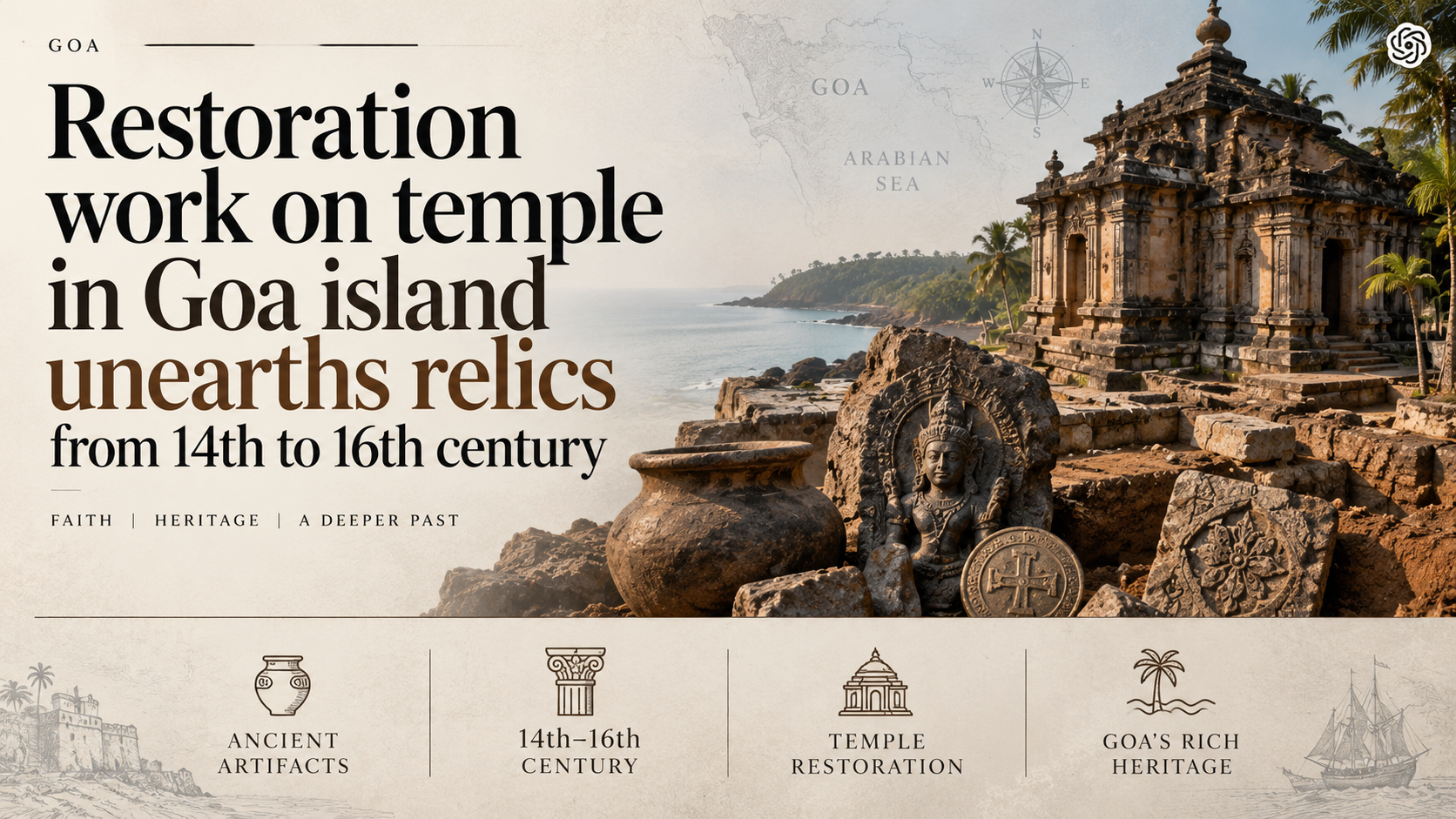
  • Restoration work on temple in Goa island unearths relics from 14th to 16th century

    Restoration work on temple in Goa island unearths relics from 14th to 16th century

    Why in the News

    Restoration work at the old site of the Saptakoteshwar temple on Divar island in Goa has uncovered relics dated between the fourteenth and the sixteenth centuries.

    What was recovered, and where?

    1. A guardian motif: A Kirtimukh motif is among the finds, and its presence marks a formal temple entrance rather than an open air shrine.
    2. A structural element: A carved capital of a temple pillar was also recovered, which is the load bearing head of a column and part of a built temple rather than a portable object.
    3. The find spot: Both were recovered along the old pathway running between Koti Tirth and Madhavachi Talli.
    4. The dating: The relics and remains have been dated to between the fourteenth and the sixteenth centuries.

    Why do the finds change the reading of the site?

    1. Distribution carries the argument: The elements sit along a pathway, so it is their placement rather than the value of any single object that supports the inference.
    2. A complex rather than a shrine: Architectural members of this kind, found together, indicate a temple complex rather than one isolated structure.
    3. A sacred corridor: The alignment links the site’s water body with its associated structures into a processional route.
    4. The extent is revised: The understood extent of the island’s pre Portuguese temple landscape is now larger than the surviving remains indicated.

    Why does Saptakoteshwar matter in Goa’s religious history?

    1. A principal Shaiva site: Saptakoteshwar is counted among Goa’s principal Shaiva sites and its deity is a form of Shiva.
    2. Kadamba patronage: The Kadamba rulers of Goa held Saptakoteshwar as their tutelary deity, and the name appears on their coinage.
    3. Displacement in the Portuguese period: The Divar temple was destroyed in the sixteenth century, and the deity was moved off the island to Narve in Bicholim, which lay outside Portuguese control at the time.
    4. A later rebuilding: The temple at Narve was rebuilt in 1668 by Chhatrapati Shivaji Maharaj, and worship has continued at that site since.

    Challenges to protecting incidental archaeological finds

    1. Restoration is not excavation: Material surfacing during repair work is lifted without the layer by layer record that dates it and relates it to what lies around it. Eg. The Divar elements were recovered along a pathway during restoration rather than from a documented trench.
      The Fix: Require a licensed archaeologist to supervise any ground disturbance at a historic temple site, with layer wise recording completed before material is moved.
    2. Most sites carry no legal protection: Statutory protection attaches only to monuments notified under the Ancient Monuments and Archaeological Sites and Remains Act, 1958 or a State equivalent, and everything else depends on local custody. Eg. The Archaeological Survey of India protects roughly 3,700 monuments, a small fraction of the country’s stock of historic sites.
      The Fix: Notify a newly evidenced site under the State protection list as soon as dated material is recovered, rather than waiting for an excavation to conclude.
    3. A living temple changes faster than it is recorded: A site in continuous worship is repaired and rebuilt by its own community, which removes earlier fabric in the process. Eg. Cement plaster and modern tiling at working shrines routinely cover older stone members.
      The Fix: Complete measured drawings and photographic documentation of a living temple before any restoration grant is released.
    4. Conservation capacity is thin: Trained conservators, epigraphists and conservation architects are few relative to the number of sites needing attention. Eg. State archaeology departments in the smaller States operate with a handful of technical posts.
      The Fix: Fund State conservation units jointly with university archaeology departments so field documentation has standing capacity behind it.

    Conclusion

    The value of these finds lies less in the objects than in the boundary they redraw around a site long assumed to end at its surviving shrine. Whether that reading holds depends on a systematic survey along the corridor rather than on further chance recovery during repair work. The step to watch is whether the pathway and its surroundings are brought under a protected category before restoration continues over them.

    Back2Basics: Kirtimukh

    1. What it is: Kirtimukh is a fierce swallowing face carved as an architectural motif, the name meaning face of glory.
    2. Where it is placed: It is set above temple doorways, over deity niches and at the apex of arches, as a guardian of the threshold.
    3. Its origin story: Puranic accounts describe a devouring being created by Shiva that consumes its own body at his command and is then placed at the entrance to be honoured first.
    4. Its reach: The motif runs across Hindu and Buddhist architecture in India and into Southeast Asia, so its presence signals a formal temple structure.

    [2018, GS1, 10 marks] Safeguarding the Indian art heritage is the need of the moment. Discuss.”

  • Excavation at Vaishya Tekri, Ujjain, sheds light on Ashoka’s Mauryan-era rule

    Excavation at Vaishya Tekri, Ujjain, sheds light on Ashoka’s Mauryan-era rule

    Why in the News

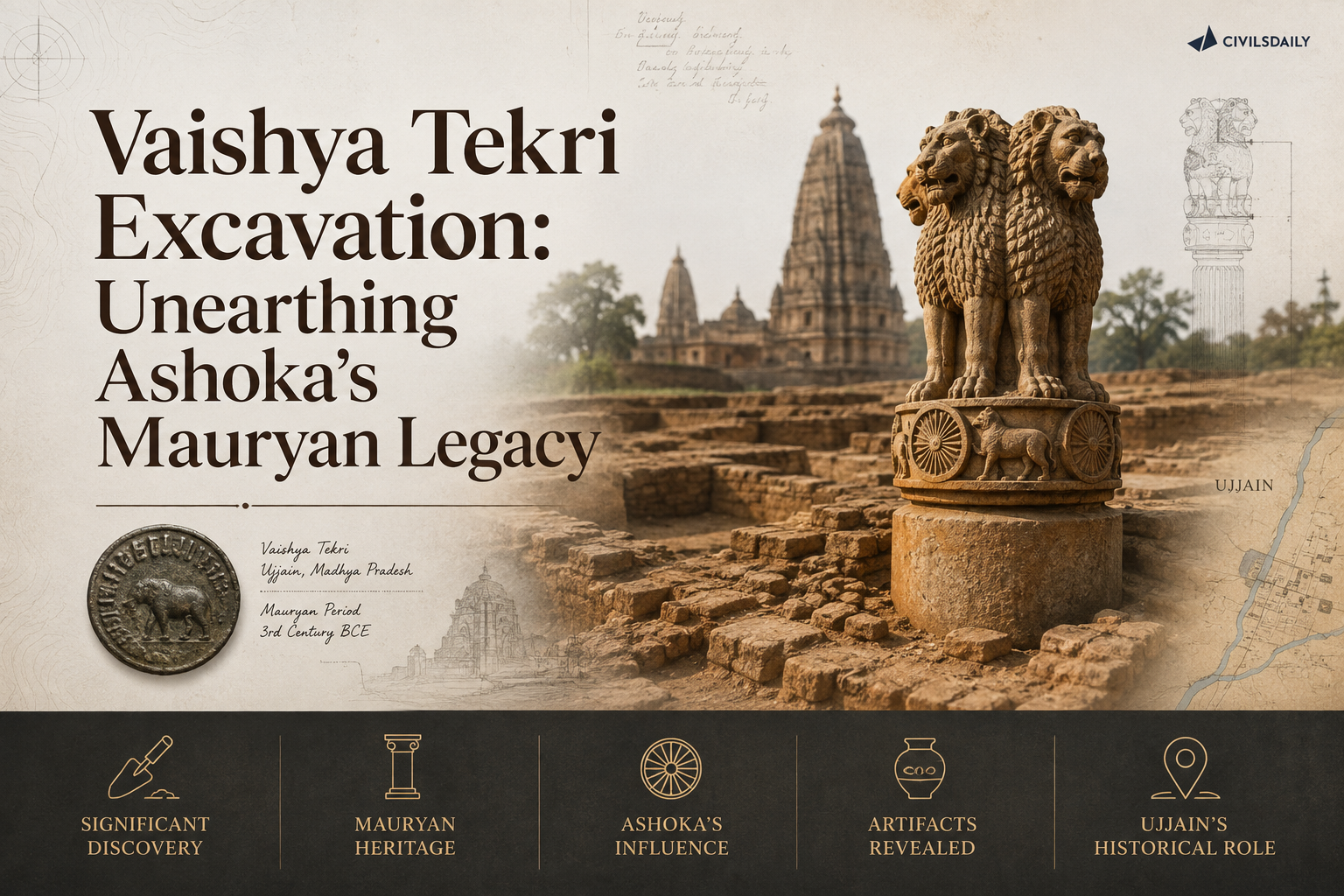
    An ongoing excavation at the Vaishya Tekri mound in Ujjain has uncovered a Buddhist stupa dated to the Mauryan period, adding physical evidence to the tradition that Ashoka served as Mauryan viceroy over Ujjain and the surrounding Avanti province before he became emperor. Ujjain’s connection to Ashoka has so far rested mainly on textual and traditional accounts, including his association with the city of Vidisha and with Devi, traditionally described as his consort during his time there. A dated stupa at Vaishya Tekri gives that tradition an archaeological anchor it did not previously have at this specific site.

    What has the excavation at Vaishya Tekri found?

    1. A Buddhist stupa dated to the Mauryan period: Excavators have uncovered the remains of a stupa, a dome-shaped Buddhist commemorative structure typically built to enshrine relics, at the Vaishya Tekri mound, with the structure’s dating placed within the Mauryan period.
    2. Located at a mound with a known but under-explored history: Vaishya Tekri has long been recognised as an archaeologically significant mound in Ujjain, but the current excavation is what has produced the specific Mauryan-period stupa evidence.
    3. Physical evidence for a previously text-based tradition: The tradition that Ashoka governed Avanti province from Ujjain as a Mauryan prince before becoming emperor has rested on textual and inscriptional sources; a dated Mauryan-period Buddhist structure at Ujjain itself gives that tradition a corresponding physical find.

    How does this connect to Ashoka’s association with Ujjain, Vidisha, and Devi?

    1. Ujjain as Ashoka’s provincial capital under his father: Textual tradition holds that Ashoka was appointed viceroy of Avanti province, governing from Ujjain, during the reign of his father, Bindusara, before Ashoka’s own accession as emperor.
    2. Vidisha’s connection through Devi: Tradition associates Ashoka with Devi, described as his consort during his time in the region, whom he is said to have met at or near Vidisha, a city close to Ujjain within the same Avanti province.
    3. Stupa construction consistent with early Buddhist patronage in the region: A Mauryan-period Buddhist stupa at Ujjain is consistent with the broader pattern of early Buddhist architectural patronage across the Avanti region during and after Ashoka’s association with it, including the well-documented stupas at nearby Sanchi.

    Back2Basics: Vaishya Tekri, Ujjain

    1. An archaeological mound in Ujjain, Madhya Pradesh, long identified as a site of historical significance within the ancient city associated with the Avanti Mahajanapada, one of the sixteen great kingdoms of ancient India.
    2. Ujjain’s ancient layers have previously yielded evidence of settlement dating from well before the Mauryan period, making it one of the longer continuously significant urban sites in central India.
    3. Its Mauryan-period association rests on textual tradition identifying it as the seat of Ashoka’s viceroyalty over Avanti province prior to his accession as emperor.
    4. Sits within the same historical region as Vidisha and Sanchi, both major centres of early Buddhist architectural activity.

    “[2022] Consider the following pairs :
    Site of Ashoka’s major rock edicts Location in the State of
    1. Dhauli — Odisha
    2. Erragudi — Andhra Pradesh
    3. Jaugada — Madhya Pradesh
    4. Kalsi — Karnataka
    How many pairs given above are correctly matched ?
    (a) Only one pair
    (b) Only two pairs
    (c) Only: three pairs
    (d) All four pairs

  • Sealed for 70 years, what BHU found inside 22 boxes from a Varanasi dig

    Sealed for 70 years, what BHU found inside 22 boxes from a Varanasi dig

    Why in the News

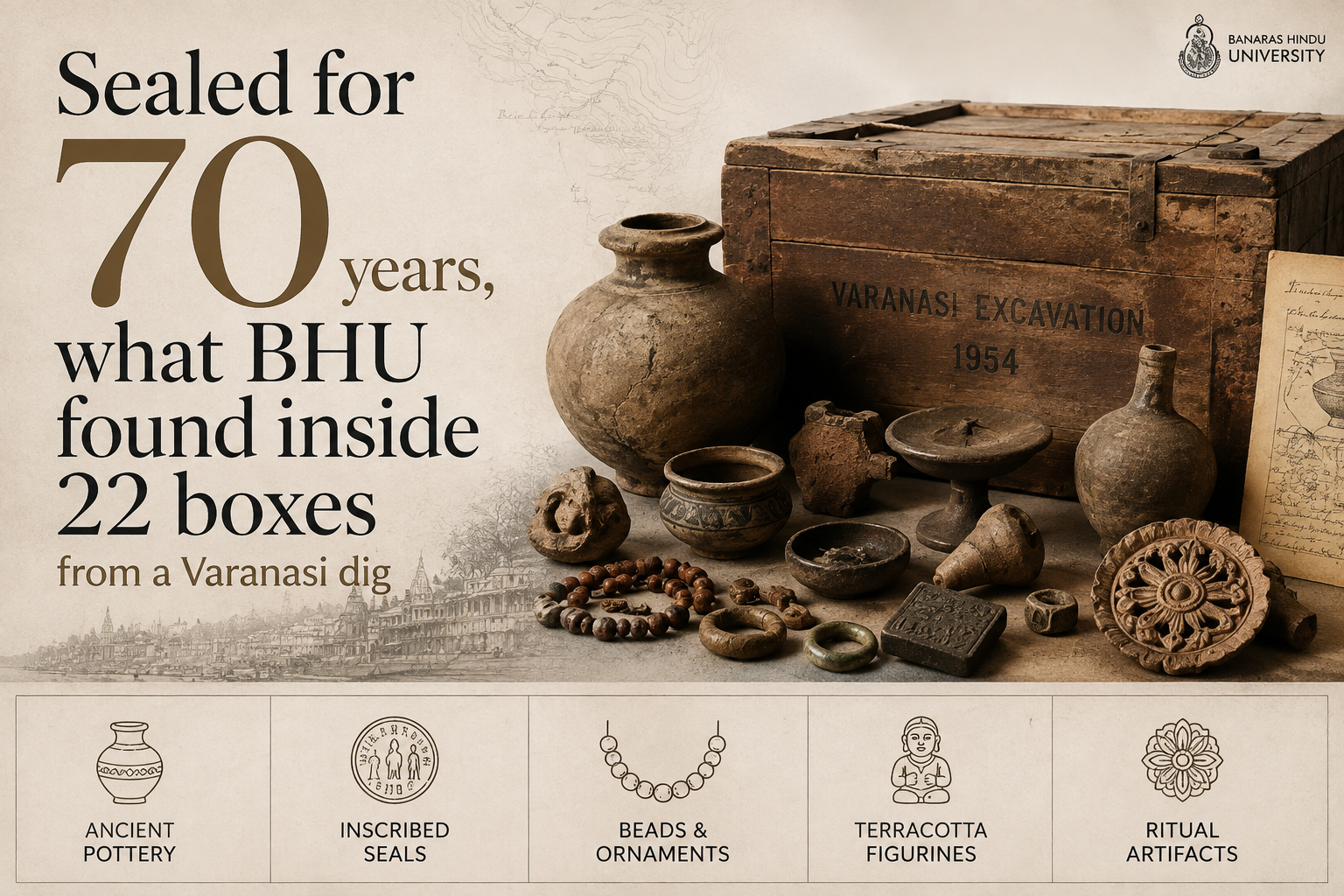
    Banaras Hindu University (BHU) opened 22 boxes on 20 August 2026 that had lain unopened for nearly 70 years, and found more than 10,000 artefacts, including painted black pottery believed to be nearly 3,000 years old.

    What is the Rajghat archaeological site?

    1. Location: Rajghat lies on the north-eastern edge of Varanasi, near the confluence of the Ganga and the Varuna rivers.
    2. Significance: It is one of the most important archaeological sites in the middle Ganga Valley.
    3. Historical identity: The area was part of ancient Varanasi, which served as the capital of the Kashi kingdom, also known as the Kashi Mahajanapad.
    4. Chronology: Archaeologists have divided the history of the site into six cultural periods, beginning around 800 BC and continuing up to the medieval period.

    What did the 22 boxes contain?

    1. The artefact count: The boxes held more than 10,000 artefacts in total.
    2. The dating anchor: Among them is painted black pottery believed to be nearly 3,000 years old.
    3. The object categories: The boxes contain sculptures, ancient coins, tools, stamp seals and objects made of copper, ivory and bone.
    4. A separate photographic archive: They also held around 3,000 glass slides and more than 5,000 photographic negatives documenting archaeological sites across India, including Rajghat, Manjhi, Ratnagiri, Ajanta and Ellora.
    5. Rare images within the archive: The photographs include rare images of idols of Vishnu, Shiva and Buddha, which are being examined and will be restored as part of the department’s conservation work.
    6. The condition of the containers: The trunks were found in an advanced state of deterioration, which makes the recovery and preservation of the material inside particularly significant.

    Why do the seals and inscriptions matter?

    1. Inscribed seals are present: Several of the seals recovered bear inscriptions, including some written in the Brahmi script.
    2. Who will read them: Researchers specialising in epigraphy at BHU will study them, and experts from other universities may be consulted where specialised expertise is required.
    3. What they can establish: The inscriptions can help researchers understand the scripts, systems of governance, and trade and economic systems of the periods in which they were used.
    4. Seals settled the site’s identity earlier: During the earlier excavations, seals and sealings bearing the name ‘Varanasi’ were found, and these findings helped establish the site’s connection with ancient Varanasi.

    Why did the material stay unstudied for 70 years?

    1. The site was found by accident: The first archaeological remains at Rajghat were discovered in 1939 during the expansion of the Kashi railway station, and were sent to the ASI for examination.
    2. The excavation ran for twelve years: Excavations were carried out jointly by the ASI and BHU between 1957 and 1969, under the supervision of BHU Professor A K Narain and the archaeologist T N Roy.
    3. What the excavations found: They unearthed remains of ancient settlements, including structures believed to be houses, terracotta objects, seals and other artefacts, which allowed researchers to trace the development of human settlement at Rajghat over several centuries.
    4. Documentation stopped short of study: Professor Narain documented the excavations in four volumes, and a large part of the material recovered was not studied in detail.
    5. The techniques did not exist then: The Vice-Chancellor noted that the objects were excavated at a time when advanced scientific techniques for archaeological research were not available in India.

    What happens to the material now?

    1. Three research teams have been formed: The department has constituted three specialised research teams to conserve and document the material.
    2. The stated purpose: The department has undertaken advanced research on its archaeological collections to allow scholars to reassess historical chronologies and produce new insights into ancient Indian civilisation.
    3. A parallel recovery is already under way: A month earlier, experts opened a box containing a human skeleton recovered from the same site, which had also remained sealed for around 70 years.
    4. Ancient DNA work has begun: A team specialising in ancient DNA collected samples from that skeleton for genetic and bio-archaeological analysis.
    5. What that analysis is expected to yield: The analysis is expected to provide clues about the people who lived in Varanasi around 1,000 years ago.

    “[2024] Consider the following information:

    Archaeological Site :: State :: Description

    1. Chandraketugarh : Odisha : Trading Port town

    2. Inamgaon : Maharashtra : Chalcolithic site

    3. Mangadu : Kerala : Megalithic site

    4. Salihundam : Andhra Pradesh : Rock-cut cave shrines

    In which of the above rows is the given information correctly matched?

    (a) 1 and 2 only

    (b) 2 and 3 only

    (c) 3 and 4

    (d) 1 and 4

  • Ujjain’s Giant Stupa: Was Vaishya Tekri Bigger Than Sanchi?

    Why in the News

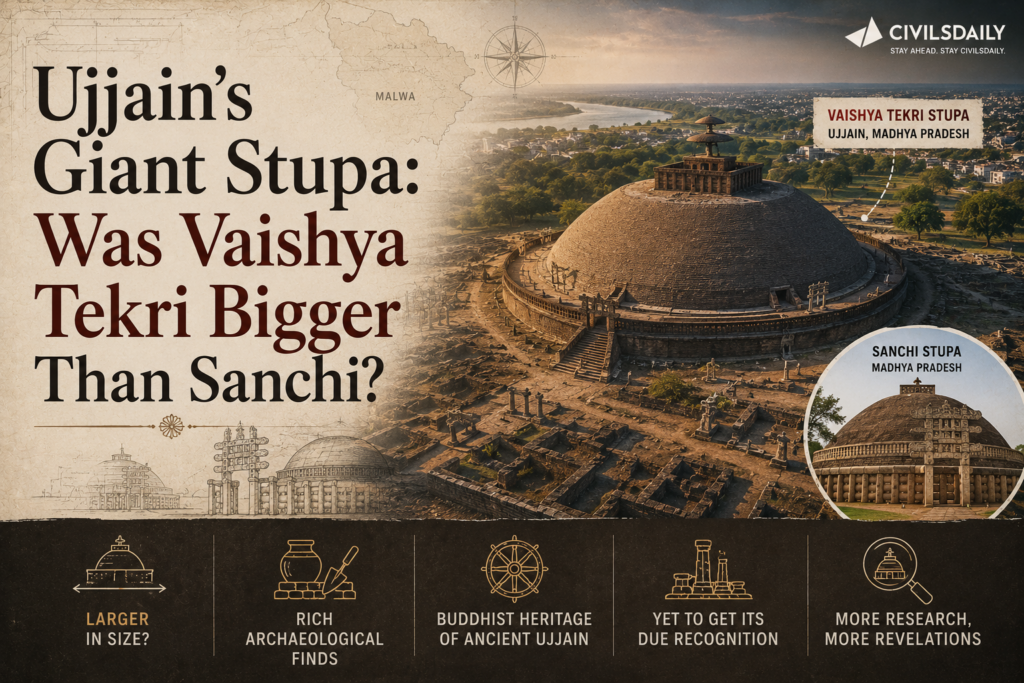
    Madhya Pradesh plans to excavate and restore Vaishya Tekri in Ujjain, a major mound believed to contain a Mauryan-era stupa. ASI suggests it may have been larger than the Sanchi Stupa, but its association with Ashoka remains unproven.

    What is Vaishya Tekri?

    • Located in Ujjain, an important Mauryan-era centre.
    • Excavated first in 1938-39 by the erstwhile Gwalior State.
    • Identified as a major stupa, not a natural mound.
    • 1938 report estimated its base at about 350 ft diameter and height at 100+ ft.
    • Dating to the 3rd century BCE was suggested from brick dimensions and coins.

    Key Archaeological Evidence

    • Core made of rammed blackish murum.
    • Exterior faced with brick masonry and mud mortar.
    • Finds included:
      • Punch-marked coin
      • Cast Avanti coin
    • A moat surrounded the stupa, with a western passage for worshippers.
    • An unusual bowl-shaped masonry base helped resist lateral thrust.

    Ashoka Connection

    • Tradition associates Ujjain with Ashoka’s viceroyalty.
    • However, the 1938 excavation did not establish an Ashokan connection.
    • The report only stated that the stupa could possibly be one of the stupas attributed to Ashoka.
    • Brick size and coins establish a period, not the identity of the patron.

    Prelims Quick Facts

    • Vaishya Tekri: Ujjain, Madhya Pradesh
    • Period: Mauryan, 3rd century BCE
    • Monument: Buddhist stupa
    • First excavation: 1938-39
    • Estimated diameter: ~350 ft
    • Sanchi Stupa height: ~54 ft
    • Key coin: Punch-marked coin
    • Agency: Archaeological Survey of India

    “[2026] Which of the following statements on the Amaravati Stupa and its relief sculpture is/are correct?
    1. It was located in the lower Krishna valley.
    2. In India, it was next only to the Sanchi Stupa in size.
    3. The Amaravati school of sculpture made a lasting impact on the later South Indian sculpture, and its products were carried to Sri Lanka and South-east Asia.
    (a) 1 only
    (b) 1 and 3 only
    (c) 2 and 3 only
    (d) 1, 2 and 3

  • Pandavani Legend Teejan Bai Passes Away

    Why in News?

    Padma Vibhushan awardee Teejan Bai (1956–2026), the foremost exponent of Pandavani, passed away at AIIMS Raipur. She played a pivotal role in taking Chhattisgarh’s traditional folk art to the global stage.

    Key Highlights

    • Born in Ganiyari village (Durg district), Chhattisgarh.
    • Learned Pandavani from her maternal grandfather Brajlal Pardha and gave her first public performance at 13 years of age.
    • Broke gender barriers by performing in the Kapalika style, traditionally reserved for men.
    • Performed in over 17 countries, popularising Indian folk traditions worldwide.
    • Received the Padma Shri, Padma Bhushan, and Padma Vibhushan.

    About Pandavani

    • A traditional folk storytelling and musical art form of Chhattisgarh.
    • Narrates episodes from the Mahabharata through singing, narration, acting, and dialogue.
    • The performer uses a tanpura (tambura) as both a musical instrument and a symbolic prop.

    Two Styles of Pandavani

    • Vedamati Style: Performed while sitting, with greater emphasis on narration.
    • Kapalika Style: Performed while standing, combining dramatic acting, gestures, expressions, and dialogue.

    [2014] A community of people called Manganiyars is well-known for their:

    (a) Martial arts in North-East India

    (b) Musical tradition in North-West India

    (c) Classical vocal music in South India

    (d) Pietra dura tradition in Central India.

  • Australia Repatriates Three Antiquities to India

    Why in News?

    Australia announced the repatriation of three Chola-era antiquities stolen from temples in Tamil Nadu during Prime Minister Narendra Modi’s visit.

    Key Highlights

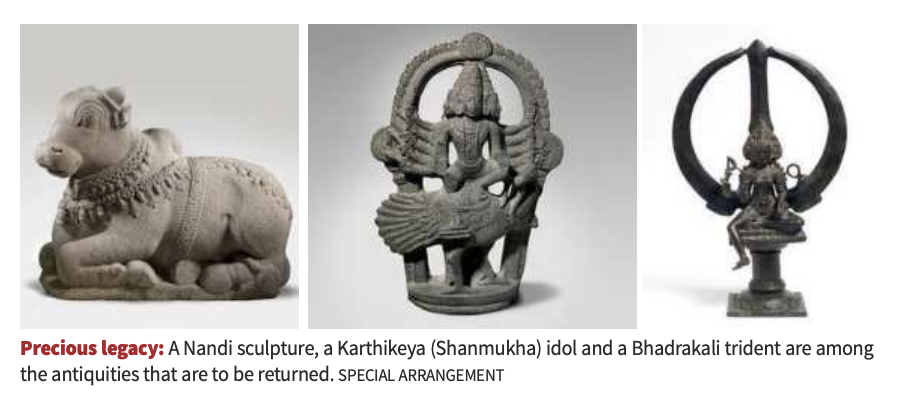
    • Australia will return:
      • Bronze Trident (Trishul) of Goddess Bhadrakali
      • Granite Nandi idol
      • Basalt sculpture of six-headed Karthikeya (Shanmukha)
    • The artefacts date to the 11th-12th century (Chola period).
    • They were housed in the National Gallery of Australia.

    Legal Basis

    • Repatriation is being carried out under the India-Australia Mutual Legal Assistance Treaty (MLAT).
    • Investigation by the Tamil Nadu Idol Wing CID established that the artefacts were illegally removed from temples and trafficked overseas.

    Original Temples

    • Bhadrakali Trident: Sri Kasi Viswanatha Swamy Temple, Kollumangudi, Tiruvarur.
    • Karthikeya Idol: Naganathaswamy Temple, Manambadi, Thanjavur.
    • Nandi Idol: Identified as originating from a temple in Tamil Nadu.

    [2025] Who among the following led a successful military campaign against the kingdom of Srivijaya, the powerful maritime State, which ruled the Malay Peninsula, Sumatra, Java and the neighbouring islands?

    [A] Amoghavarsha (Rashtrakuta)

    [B] Prataparudra (Kakatiya)

    [C] Rajendra 1 (Chola)

    [D] Vishnuvardhana (Hoysala)

  • Rakhigarhi Skeletons Undergo DNA Analysis & Facial Reconstruction

    Why in News?

    The Archaeological Survey of India (ASI) has sent nearly 5,000-year-old skeletons excavated from Rakhigarhi, Haryana, for DNA analysis and facial reconstruction to gain insights into the people of the Harappan Civilization.

    Key Highlights

    • Five skeletons recovered:
      • 3 females and 2 males (preliminary assessment).
      • Estimated age: 30-40 years.
    • Scientific Institutions Involved:
      • Anthropological Survey of India (AnSI), Kolkata: Anthropological study and facial reconstruction.
      • Birbal Sahni Institute of Palaeosciences (BSIP), Lucknow: Ancient DNA analysis.
    • Objectives of the Study:
      • Determine ancestry and genetic profile.
      • Identify cause of death and possible diseases.
      • Reconstruct facial features and physical appearance.
      • Estimate height, lifestyle, and social status.
      • Reconstruct the palaeo-environment of the Harappan period.
    • Three additional disturbed burials with fragmentary remains were also discovered at Mound No. 7, the site’s ancient cemetery.

    About Rakhigarhi

    • Located in Hisar district, Haryana.
    • Largest known site of the Indus Valley (Harappan) Civilization.
    • Flourished during 2600-1900 BCE (Mature Harappan Phase).
    • Known for Planned urban settlement, Drainage system, Granaries, Cemetery remains, and Craft production

    Ancient DNA (aDNA)

    • DNA extracted from ancient bones, teeth, or other biological remains.
    • Used to study Human migration, Evolution, Population genetics, Ancient diseases

    [2021] Which one of the following ancient towns is well-known for its elaborate system of water harvesting and management by building a series of dams and channelizing water into connected reservoirs?

    [A] Dholavira

    [B] Kalibangan

    [C] Rakhigarhi

    [D] Ropar

  • Mohenjo-daro’s “Dancing Girl”: History, Identity and the Debate on Modesty

    Why in News?

    The National Council of Educational Research and Training (NCERT) restored the original image of the iconic Mohenjo-daro bronze figurine in a Class 9 textbook after an earlier version had shaded its bare torso, reviving debates over cultural representation and historical interpretation.

    About the Figurine

    • A bronze statuette discovered at Mohenjo-daro (1926), dating to the Indus Valley Civilization (c. 2500 BCE).
    • About 10.5 cm tall, created using the lost-wax casting technique.
    • Depicts a young female figure adorned with numerous bangles and ornaments.

    Why is its Identity Contested?

    • Archaeologist John Marshall identified it as a “nautch girl” (dancing girl) based on posture and appearance.
    • However, scholars argue there is no archaeological evidence that she was a professional dancer.
    • Historian Upinder Singh notes that the figure “may not have been dancing at all.”
    • Archaeologist Gregory L. Possehl also questioned the dancer interpretation.

    Partition and Ownership Debate

    • After Partition, around 12,000 Harappan artefacts in Delhi became subjects of dispute between India and Pakistan.
    • Both countries agreed to a 50:50 division of artefacts from Mohenjo-daro and Chanhu-daro.
    • Pakistan chose the “Priest King” figurine over the Dancing Girl, reportedly due to concerns over the latter’s nudity.
    • The Dancing Girl remains in India and is viewed by many scholars as part of the shared heritage of South Asia.

    Significance

    • Demonstrates the advanced metallurgical skills of the Indus Valley Civilization.
    • Highlights how colonial interpretations and contemporary moral values shape our understanding of the past.
    • Reflects debates on heritage ownership, gender, modesty, and cultural identity.

    Value Addition

    • Lost-Wax Casting Technique: A metal casting process in which a wax model is covered with clay; molten metal replaces the melted wax to create the final sculpture.
    • The Dancing Girl is one of the most iconic artistic representations of the Indus Valley Civilization.

    [2025] The famous female figurine known as ‘Dancing Girl’, found at Mohenjo-daro, is made of

    [A] carnelian

    [B] clay

    [C] bronze

    [D] gold

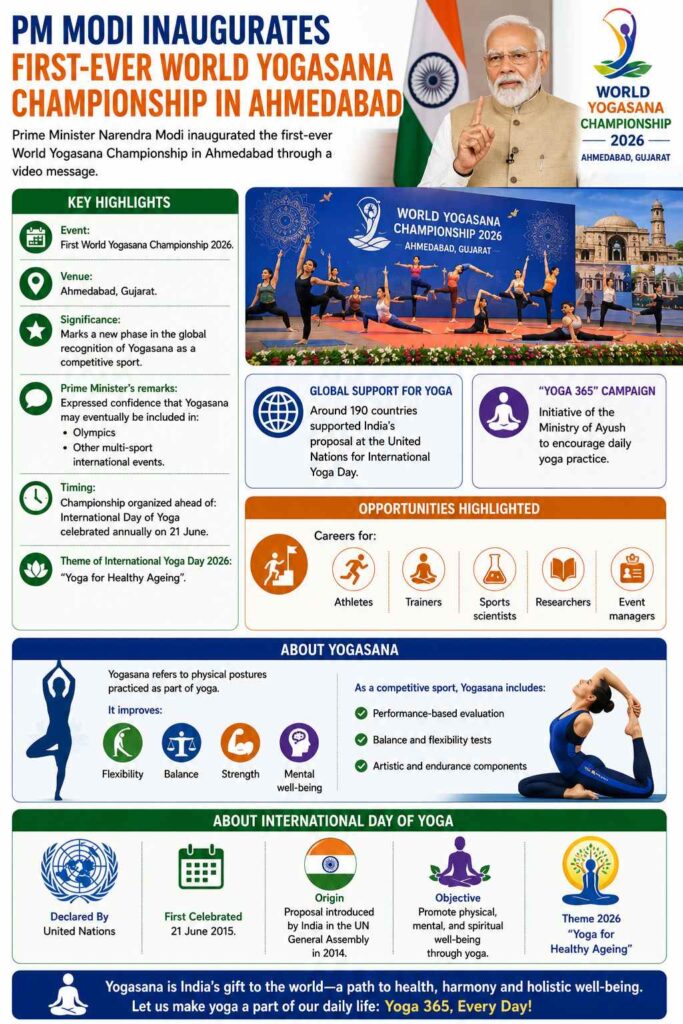
  • First World Yogasana Championship 2026

    Why in the news?

    Prime Minister Narendra Modi inaugurated the first-ever World Yogasana Championship in Ahmedabad through a video message.

    Key Highlights

    • Event: First World Yogasana Championship 2026.
    • Venue: Ahmedabad, Gujarat.
    • Significance: Marks a new phase in the global recognition of Yogasana as a competitive sport.
    • Prime Minister’s remarks:
      • Expressed confidence that Yogasana may eventually be included in:
        • Olympics
        • Other multi-sport international events.
    • Timing:
      • Championship organized ahead of:
        • International Day of Yoga celebrated annually on 21 June.
    • Theme of International Yoga Day 2026: “Yoga for Healthy Ageing”.
    • Global support for Yoga:
      • Around 190 countries supported India’s proposal at the United Nations for International Yoga Day.
    • “Yoga 365” campaign:
      • Initiative of the Ministry of Ayush to encourage daily yoga practice.
    • Opportunities highlighted:
      • Careers for:
        • Athletes
        • Trainers
        • Sports scientists
        • Researchers
        • Event managers

    About International Day of Yoga

    • Declared by the United Nations
    • First celebrated on 21 June 2015.
    • Origin: Proposal introduced by India in the UN General Assembly in 2014.
    • Objective: Promote physical, mental, and spiritual well-being through yoga.

    [2025] Consider the following statements in respect of the first Kho Kho World Cup:
    I. The event was held in Delhi, India.
    II. Indian men beat Nepal with a score of 78-40 in the final to become the World Champion in men category.
    III. Indian women beat Nepal with a score of 54-36 in the final to become the World Champion in women category.
    Which of the statements given above is/are correct?

    [A] I only

    [B] II and III only

    [C] I and III only

    [D] I, II and III