💥Join UPSC 2027,2028 Mentorship (August Batch) + XFactor Notes & Microthemes PDF

GS Paper: India & Its Neighborhood – Relations

  • India’s growing neighbourhood dilemmas

    McMOHAN LINE | UPSC Current Affairs | IAS GYAN

    Central idea

    The central idea revolves around the challenges in India’s neighborhood, marked by politically anti-India regimes, China’s growing influence, and a changing geopolitical landscape. The dilemmas stem from a shift in power dynamics, policy stances, and mistaken assumptions, necessitating a realistic approach, proactive diplomacy, and addressing workforce shortages for effective foreign policy implementation.

    Key Highlights:

    • Neighbourhood Challenges: The Achilles heel of Indian foreign policy lies in its neighbourhood, posing three types of dilemmas: politically anti-India regimes, structural challenges from Beijing’s growing influence, and the overarching geopolitical architecture.
    • China’s Rising Influence: China’s Belt and Road Initiative (BRI) and strategic outreach in South Asia present challenges, making India geopolitically vulnerable within an unfriendly neighbourhood.
    • Causes of Dilemmas: Regional geopolitical architecture, China’s ascendance, normative approach vs. China’s non-normative stance, and the shift from resident to non-resident power dynamics contribute to India’s dilemmas.
    • Policy Stance Dilemma: India’s status quo bias in dealing with regional politics and a focus on power centers contribute to path-dependencies and sometimes alienate other centers of power or opposition leaders.
    • Mistaken Assumptions: Assumptions that South Asia minus Pakistan would align with Indian geopolitical reasoning and that cultural connections would ensure better relations have proven inaccurate.

    Key Challenges:

    • Changing Balance of Power: India must adapt to the changed balance of power in Southern Asia, acknowledging China’s emergence as a serious contender for regional primacy.
    • Involvement of External Actors: Proactively involving friendly external actors in the region is crucial to prevent it from becoming Sino-centric.
    • Flexible Diplomacy: Indian diplomacy needs to be flexible, engaging multiple actors in each neighboring country and focusing on lessening anti-India attitudes rather than solely dealing with those in power.
    • Diplomatic Workforce Shortage: The shortage of diplomats is a critical challenge, hindering India’s ability to implement foreign policy effectively and respond to global opportunities or crises.

    Key Quotes:

    • “India’s neighbours and periphery are China’s too, even if we do not like it.”
    • “Dealing with whoever is in power is a good policy, but engaging only those in power is a bad policy.”

    Critical Analysis:

    • India faces complex geopolitical challenges in its neighborhood, requiring a pragmatic approach to the changed power dynamics. The need for a mental switch, proactive diplomacy, and addressing workforce shortages emerges as critical. The evolving scenario necessitates a shift from traditional assumptions and a more nuanced engagement strategy.

    Way Forward:

    • Realistic Framing: India should acknowledge the fundamental changes in the regional balance of power and operate within the framework of a new geopolitical reality.
    • External Actor Engagement: Actively involve friendly external actors to counterbalance China’s influence in the region.
    • Flexible Diplomacy: Adopt a flexible diplomatic approach that engages with multiple actors in neighboring countries, focusing on reducing anti-India sentiments.
    • Diplomatic Workforce Enhancement: Address the shortage of diplomats by significantly enhancing India’s diplomatic workforce to effectively implement foreign policy objectives.
  • Places in news: Julian Felipe Reef

    Julian Felipe Reef

    Central Idea

    • The Philippines confirmed that more than 135 Chinese vessels made incursion on Julian Felipe Reef (also known as Whitsun Reef), a place off its coast.

    About Julian Felipe Reef

    • Julian Felipe Reef is part of the Spratly Islands, located in the West Philippine Sea, a portion of the South China Sea.
    • It lies within the Philippines’ exclusive economic zone.
    • It is a large boomerang-shaped shallow coral reef.

    Recent Dispute

    • The reef gained international attention in early 2021 when a large number of Chinese vessels, described by the Philippines as maritime militia, were spotted at the reef.
    • It is subject to a territorial dispute involving several countries, primarily the Philippines, China, and Vietnam.
    • The Philippines claims the Reef as part of its territory, specifically within its 200-nautical-mile exclusive economic zone, under the UNCLOS.
    • This dispute is part of the larger and complex South China Sea territorial disputes involving various countries in the region.
    • The Philippines has sought international arbitration under UNCLOS to assert its claims.
  • Bangladesh’s Elections: Concerns for India

    Bangladesh

    Central Idea

    • In recent months, Western nations, including the US, UK, and EU have been urging Bangladesh to hold free, fair, and participatory elections.
    • These calls have been accompanied by pressure on the Sheikh Hasina government to step down and allow a neutral caretaker administration to oversee the upcoming parliamentary elections in January.
    • While the US has eased its stance under Indian intervention, the EU continues to exert pressure.

    This article explores the intricate dynamics of Bangladesh’s political landscape, the potential consequences of fair elections, and the global interests at stake.

    Fair Elections vs. Radical Islamists

    • Opposition Demands: The Bangladesh Nationalist Party (BNP) demands elections under a caretaker government, which the government has rejected.
    • Potential Outcome: With the BNP unlikely to participate, the elections may result in a one-sided contest favoring the Awami League, returning Sheikh Hasina to power for the fourth time.
    • Anti-Incumbency: After 15 years in power, the Awami League faces significant anti-incumbency, exacerbated by record-high inflation and economic challenges.
    • Economic Crisis: Falling forex reserves, currency depreciation, and mounting external debt have created a looming debt crisis.
    • Chinese Loans: Much of the infrastructure development relies on high-interest loans from China.

    Authoritarianism and Islamist Influence

    • Authoritarian Practices: The Awami League’s authoritarian measures, including arrests and harassment of opposition leaders, have fueled resentment among the masses.
    • Corruption and Nepotism: Perceived corruption and nepotism within the Awami League have widened the gap between the government and the impoverished population.
    • Islamist Influence: The Awami League’s encouragement of Islamist groups like Hefazat-e-Islam Bangladesh has created a toxic environment within the ruling party.
    • Radicalization: Islamist organizations, through religious schools and mosques, have radicalized a significant portion of the population, especially the youth.
    • Islamist Opposition: The Islamist parties, including Jamaat-e-Islami, Hefazat, and Islami Oikyo Jote, now fill the opposition space.
    • Political Analyst’s Perspective: Political analysts argue that the Awami League’s crackdown on the BNP has inadvertently strengthened Islamist parties, which seek to implement strict Sharia laws and turn Bangladesh into an Islamic state.

    Potential Outcomes of Equitable Elections

    • Rise of Jihad: Fair and equitable elections may pave the way for radical Islamist parties to come to power.
    • Jamaat-e-Islami: Despite being banned from contesting elections, Jamaat nominees may run as Independents or on tickets from other parties, potentially leading to their victory.
    • Radicalists Victory: Political observers suggest that non-partisan elections would likely result in Islamist parties sweeping the polls and gaining power.
    • Impact on India: The rise of Islamists in Bangladesh could negatively affect India, potentially aligning Bangladesh with Pakistan and China, and posing a threat to India’s interests.
    • Global Concerns: An Islamist-controlled Bangladesh could become a breeding ground for jihadis and a potential failed state, posing a danger to global security.

    World’s Interest in the Election Process

    • Global Implications: Given the far-reaching consequences of Islamist rule in Bangladesh, the world has a vested interest in allowing the election process to proceed with limited interference.
    • Focus on Future Actions: While the elections may be flawed or unfair, the priority should be to ensure that after returning to power, the Awami League commits to keeping China at bay, curbing Islamist forces, allowing a responsible and secular opposition to thrive, and cleansing the party of Islamist elements.
    • Securing Bangladesh’s Future: Striking a balance between a flawed elections and securing Bangladesh’s democratic and secular future is essential for the world’s stability and security.

    Conclusion

    • The upcoming elections in Bangladesh present a complex dilemma for both the nation and the world.
    • While free and fair elections could bring radical Islamists to power, their absence could lead to continued authoritarianism.
    • Striking the right balance and securing Bangladesh’s future as a democratic and secular nation is paramount to global stability and peace.
  • China to extend China-Myanmar Economic Corridor to Sri Lanka

    cmec

    Central Idea

    • In a significant move towards expanding the Belt and Road Initiative (BRI) in South Asia, China has expressed its commitment to prioritize the extension of the China-Myanmar Economic Corridor (CMEC) to Sri Lanka.

    What is CMEC?

    Details
    Geographical Scope Connects China’s Yunnan Province with Mandalay, Kyaukphyu SEZ on the Bay of Bengal, and Yangon in Myanmar.
    Strategic Importance Provides China an alternative to the Strait of Malacca for trade and energy transport. Offers a shorter, more secure route to the Middle East and Africa.
    Infrastructure Involves building roads, railways, ports, and industrial zones. Key projects include the development of the Kyaukphyu deep-sea port.
    Economic Impact on Myanmar Promises infrastructure development, foreign investment, and job creation in Myanmar. Raises concerns about debt sustainability, environmental impact, and displacement of local communities.
    Political and Security Challenges The corridor passes through politically sensitive and conflict-prone areas in Myanmar, posing challenges to its implementation and stability.

    Expanding the Economic Corridor

    • China’s Strategic Priority: State Councillor Shen Yiqin emphasized that China is making the extension of the CMEC to Sri Lanka a strategic priority.
    • Free Trade Agreement Acceleration: Both nations affirmed their commitment to expediting the implementation of the China-Sri Lanka Free Trade Agreement, reinforcing their economic partnership.

    Significance of CMEC in BRI

    • CMEC’s Emergence: CMEC is the latest addition to the six land corridors within the Belt and Road Initiative, gaining prominence over the stalled Bangladesh-China India Myanmar (BCIM) corridor.
    • South Asian Perspective: India and Bhutan remain outside the BRI framework, while countries like Sri Lanka are enthusiastic participants, poised for a more substantial economic contribution in the second phase of the initiative.
  • What is the BDS movement, led by Palestinian groups against Israel?

    bds

    Central Idea

    • An article in a German newspaper accused Indian poet Ranjit Hoskote of “anti-Semitism” and supporting the BDS (Boycott, Divestment, Sanctions) movement.

    What is BDS Movement?

    • BDS (Boycott, Divestment, Sanctions) movement was launched in 2005 by over 170 Palestinian groups.
    • It aims to garner international support for Palestinian people’s rights.
    • BDS describes itself as an “inclusive, anti-racist human rights movement” opposing all forms of discrimination, including anti-Semitism and Islamophobia.
    • It draws inspiration from the South African anti-apartheid movement.

    BDS Goals

    • BDS calls for nonviolent pressure on Israel until it complies with international law, with three key demands:
      1. Ending Israel’s occupation and colonization of Arab lands and dismantling the Wall.
      2. Recognizing the rights of Arab-Palestinian citizens of Israel to full equality.
      3. Respecting, protecting, and promoting the rights of Palestinian refugees to return to their homes, as per UN Resolution 194.

    Strategies of BDS

    • BDS involves boycotts of Israeli government, associated institutions, and companies involved in human rights violations.
    • Divestment campaigns urge institutions to withdraw investments from Israel.
    • Sanctions campaigns seek to pressure governments to fulfill legal obligations to end Israeli apartheid.
    • BDS focuses on a smaller number of carefully selected companies and products for maximum impact.

    Israeli Government’s Response

    • Israel’s Prime Minister Benjamin Netanyahu has linked BDS to anti-Semitism.
    • BDS argues that criticism of Israel’s violations of international law should not be equated with anti-Semitism.
    • Israeli Minister Gilad Erdan led efforts against the economic boycott of Israel but downplayed the threat.

    Economic Impact of BDS

    • BDS has led to some brands and celebrities refusing to work in Israel.
    • Impact on an entire state’s economy is challenging to measure due to various factors.
    • BDS aims to become a powerful tool in ending western support for Israeli apartheid and settler colonialism.
  • India-Bhutan Relations

    bhutan

    Central Idea

    • The recent three-day visit of Bhutan King Jigme Khesar Namgyel Wangchuk to Assam marked a significant milestone in India-Bhutan relations.
    • Notably, it was the first-ever visit by a Bhutanese monarch to the state, signifying the close ties between the two neighbours and a fresh chapter of cooperation.

    Bhutan and India: Historical Context

    • Border Proximity: Despite sharing a 265.8 km border, this visit was the first of its kind, underscoring the uniqueness of the occasion.
    • Challenging Times: The peaceful relationship between India and Bhutan faced complexities in the 1990s when insurgent groups from Assam established camps and operated in Bhutan’s southeast forests.

    1990s: Indian Insurgent Presence in Bhutan

    • Backdrop: Pressure on insurgent groups in Assam, due to Indian military crackdowns and changes in Bangladesh’s political landscape, compelled them to seek refuge elsewhere.
    • Bhutanese Sanctuary: Insurgent groups, including ULFA, NDFB, and KLO, set up camps in Bhutan’s Samdrup Jongkhar district, near the Assam border.

    Bhutan’s Initial Approach

    • Reluctant Engagement: Bhutan initially ignored the presence of Indian insurgents on its territory and attempted dialogue with them.
    • Diplomatic Pressure: The situation strained diplomatic relations with India, its significant neighbor, funder, and trade partner.
    • Limited Military Capability: Bhutan’s small and inexperienced military hindered decisive action against the insurgents.
    • Unfruitful Talks: Despite multiple rounds of dialogue with ULFA and NDFB, no tangible outcomes were achieved, with the KLO refusing to engage in talks.

    Triggers for the Military Crackdown

    • Direct Threat to Sovereignty: The presence of insurgents became a direct threat to Bhutan’s sovereignty and national security.
    • Impact on Relations: Insurgent activities had negative implications for Bhutan-India relations, affecting development, economic activities, and bilateral trust.
    • Humanitarian Consequences: Attacks on Bhutanese nationals, threats, extortion, and violence-affected innocent lives and disrupted travel and trade routes.
    • Arms Supply to Ethnic Nepalese: Concerns emerged that insurgents might supply arms to ethnic Nepalese Lhotshampas, who were subjected to repression by the royal government, potentially sparking an ethnic insurgency in southern Bhutan.

    Operation All Clear: The Result

    • Coordinated Offensive: On December 15, 2003, the Royal Bhutan Army, supported by the Indian Army, launched ‘Operation All Clear,’ simultaneously targeting ULFA, NDFB, and KLO camps.
    • Indian Support: India provided logistical and medical assistance and sealed the Indo-Bhutan border to prevent insurgent escape into India.
    • Significant Outcome: The operation resulted in the killing or capture of at least 650 insurgents, including top leaders from the three groups.

    Conclusion

    • Bhutan’s historic royal visit to Assam signifies a strengthening of bonds and a reaffirmation of friendship after a complex period.
    • The military operation ‘Operation All Clear’ demonstrated Bhutan’s commitment to safeguarding its sovereignty and security, ultimately contributing to regional stability.
    • Today, India and Bhutan stand united, fostering peace, cooperation, and prosperity in the region.
  • Israel-Hamas War: Is Russia benefiting from the conflict?

    russia

    Central Idea

    • Russia’s official stance on the Israel-Hamas conflict places blame on the US for the actions of the militant Islamist organization Hamas.
    • However, experts suggest that Russia’s interests deviate from its stated position, as it appears to benefit from the ongoing conflict and the global attention it garners.

    Russia’s Interests and Official Position

    • Friendship and Disappointment: Russia had hoped for support from Israeli PM in the Ukraine conflict. When Israel did not side with Russia, Putin was reportedly disappointed.
    • Diverting Global Focus: This diversion of global attention away from Ukraine and towards the Middle East benefits Russia, as it weakens its adversary, the US.
    • Blame Deflection: While publicly advocating for peace and blaming the US, Russia may secretly favor the continuation of the Israel-Hamas conflict.

    Potential Benefits for Russia

    • Public focus shift: The Israel-Hamas conflict provides material for Russian propaganda to manipulate public sentiment.
    • US hegemony loss: It can be used to suggest that while Russia is accused of starting the war in Ukraine, Israel’s actions are even more egregious and beyond US control, potentially leading to a larger conflict.
    • Affinity in the Islamic World: Despite diminished influence in the Middle East, Russia may use the conflict to demonstrate solidarity with the Arab world. This strategic posturing seeks to convey that Russia supports Palestinians, even though its influence in the region is limited.

    Potential Challenges for Russia

    • Internal Turmoil: Recent anti-Semitic incidents in some Russian regions pose challenges to the Kremlin. These incidents, like the one in Dagestan, indicate difficulties in maintaining regional security. Escalating anti-Semitic rhetoric could destabilize Russia’s regions, necessitating caution from Moscow.
    • Economic Impact: Contrary to expectations, Russia may not experience economic benefits from the Middle East conflict. Rising oil prices, which usually benefit Russia, are not materializing due to oil-producing nations avoiding war support for Palestinians.

    Can Russia mediate?

    • Controversial Hamas Delegation Visit: A recent visit by a Hamas delegation to Moscow raised concerns and criticism from Israel. The primary goal of the meeting was to secure the release of Russian hostages, potentially limiting Russia’s role as a neutral mediator.
    • Challenges in Hostage Negotiations: Negotiating the release of hostages requires engaging with multiple actors, making successful negotiations uncertain.
    • Irritation among Israelis: Russia’s behaviour, such as hosting a Hamas delegation and altering its stance, has irritated many Russian-speaking Israelis.

    Conclusion

    • Russia’s role in the Israel-Hamas conflict appears to be marked by contradictions between its official position and underlying geopolitical interests.
  • Akhaura-Agartala Rail Link

    Akhaura-Agartala Rail Link

    Central Idea

    • The Akhaura-Agartala rail connection has been launched. After nearly seven and a half decades, Bangladesh and northeastern India are set to re-establish rail connectivity through Tripura.

    Akhaura-Agartala Rail Link

    • This rail link stretches over 12.24 km, with a 6.78 km dual gauge rail line in Bangladesh and 5.46 km in Tripura.
    • Akhaura junction, located in Bangladesh’s Brahmanbaria district, has historical ties with India’s northeastern region, dating back to the colonial era.
    • The connection was originally constructed in the late 19th century to cater to Assam’s tea industry’s demand for access to the Chittagong port.
    • The project gained momentum in 2010 when then-PM Manmohan Singh signed an agreement to rebuild the rail link during PM Sheikh Hasina’s visit to Delhi.

    Akhaura-Agartala Rail Link

    Significance of the project

    • Multilevel connectivity: Akhaura is currently well-connected by rail, river, and road to several industrial areas in Bangladesh, including Dhaka, Chittagong, and Sylhet.
    • NE connectivity: The rail link to Agartala is expected to enhance connections between India’s northeast and Chittagong, facilitating the transportation of goods.
    • Shortened Routes: The Akhaura link has the potential to significantly reduce travel time and distance for trains travelling to Tripura, southern Assam, Mizoram, Kolkata, and the rest of India, compared to the longer route via Guwahati and Jalpaiguri stations.
    • Unique Event: This event is unique as it marks the first direct rail connection between Akhaura and Agartala, with the first trains anticipated to run between Nishchintapur and Gangasagar stations.

    Commercial benefits

    • Trade Expansion: The rail link is expected to boost India-Bangladesh trade in various sectors, including agriculture products, tea, sugar, construction items, iron and steel, and consumer goods, while also fostering people-to-people relationships.
    • Expanded Connectivity: The Akhaura-Agartala rail route is seen as a significant initiative to enhance India’s connectivity with Southeast Asian regions, holding potential for regional economic growth.
  • Places in news: Dagestan

    Dagestan

    Central Idea

    • A recent incident involving anti-Israel protesters storming an airport in Makhachkala, Dagestan, has drawn international attention.
    • This incident highlights the unique position of Dagestan, which, while sounding like a country, is actually a province within Russia.

    About Dagestan

    • Dagestan, officially known as the Republic of Dagestan, is a province within the Russian Federation, dispelling any confusion arising from its name.
    • Situated in the southernmost part of Russia, it holds strategic importance for the country.

    Geographical Location

    • Land of Mountains: Dagestan’s name translates to “land of the mountains,” emphasizing its mountainous terrain.
    • North Caucasus: Located in the eastern part of the North Caucasus, it shares borders with Georgia and Chechnya to the west and Azerbaijan to the south. To the east lies the Caspian Sea.
    • Inaccessible Terrain: Some areas within Dagestan’s mountains are so remote that reaching them requires helicopters.

    Ethnic Diversity

    • Over 40 Ethnicities: The province is home to at least 40 different ethnic groups.
    • 30+ Languages: More than 30 languages are spoken in this region.
    • Prominent Ethnic Groups: The largest ethnic group in Dagestan is the Avars, comprising approximately one-fifth of the population. Other significant groups include Dargins, Kumyks, and Lezgins.
    • Ethnic Russian Presence: Despite the ethnic diversity, around 10% of Dagestan’s population is ethnically Russian.

    Capital: Makhachkala

    • Strategic Coastal City: Makhachkala, the capital of Dagestan, is situated along the Caspian Sea coast.
    • Historical Significance: Once a major trading port, Makhachkala was conquered by the Russian Imperial Army in the 19th century.
    • Oil and Gas Hub: Today, Dagestan serves as a crucial conduit for oil and gas pipelines connecting the Caspian Sea to Russia’s heartland, possessing its own reserves of these resources.
    • Challenges: The region has grappled with organized crime and instability, with Russian security forces combating armed insurgencies and militant groups in Dagestan and neighboring areas.
  • Bhutan-China Border Talks and Indian Concerns

    Bhutan-China Border Talks

    Central Idea

    • In Beijing, the 25th round of Bhutan-China Border Talks culminated with the signing of a significant Cooperation Agreement.
    • This historic agreement reflects the progress made in their quest for border resolution, carrying forward the 3-Step Roadmap initiated in 2021.
    • Amid the backdrop of a seven-year gap in talks, these recent developments bear immense significance.

    Bhutan-China Border Talks

    • Complex Border: Bhutan and the Tibetan Autonomous Region share an extensive contiguous border, spanning approximately 470 km. Prior to 2016, the two nations engaged in 24 rounds of talks to address border disputes.
    • Positive Momentum: Talks had been stalled due to the Doklam Standoff in 2017 and the subsequent COVID-19 pandemic. However, this interlude witnessed discussions at other levels, especially after China raised concerns about a border dispute to Bhutan’s east.
    • A Seven-Year Hiatus Ends: After a prolonged pause in boundary talks lasting seven years, the resumption of discussions signals substantial headway.

    3-Step Roadmap

    • Initiating Border Delimitation: The 3-Step roadmap, established through an MoU in 2021 and facilitated by the Joint Technical Team (JTT), aims to delineate the Bhutanese and Chinese territories conclusively. Despite the absence of diplomatic ties, Bhutan and China seek to formalize their border.
    • Steps in the Roadmap:
      1. Agreement on the border “on the table.”
      2. On-ground inspections of the border.
      3. Formal demarcation of the boundary.

    India’s Vigilance and Concerns

    • Strained Sino-Indian Relations: In the context of deteriorating relations between India and China since the 2020 Line of Actual Control standoff, any warming of ties between China and one of India’s closest neighbours raises concerns in New Delhi.
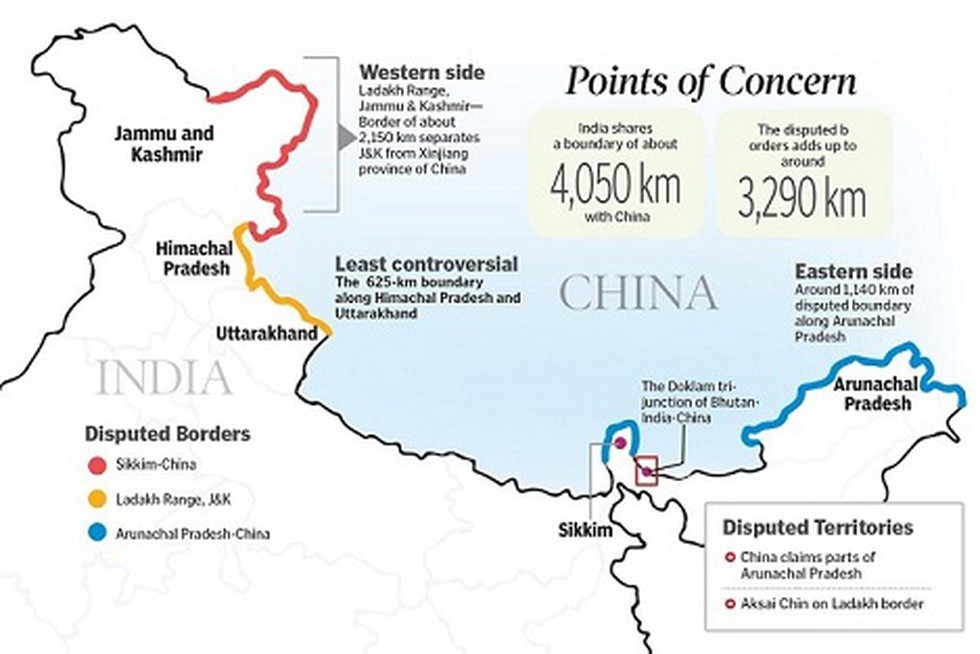
    • Doklam: A Critical Focus: India closely observes discussions related to Doklam, where China has proposed a “swap” of areas under Bhutanese control with territories in Jakarlung and Pasamlung, claimed by China. The Doklam trijunction is strategically significant as it is in close proximity to India’s Siliguri corridor, a vital land link connecting northeastern states to the rest of India.
    • China’s Strategic Moves: Since the Doklam standoff in 2017, China has bolstered its presence in the Doklam plateau, constructing underground facilities, new roads, and villages in disputed areas within Bhutan, undermining India’s strategic interests.
    • Diplomatic Tensions: India remains cautious about China’s insistence on establishing full diplomatic relations with Bhutan and opening an embassy in Thimphu. Given India’s challenges with Chinese projects and funding in neighbouring countries like Bangladesh, Nepal, Sri Lanka, and the Maldives, China’s presence in Bhutan raises apprehensions.

    Conclusion

    • The Bhutan-China boundary talks represent a significant stride towards resolving longstanding disputes.
    • However, Bhutan’s leadership has emphasized that decisions will be made with due consideration for India’s concerns, maintaining a delicate balance in this Himalayan diplomatic endeavour.