💥Join UPSC 2027,2028 Mentorship (August Batch) + XFactor Notes & Microthemes PDF

GS Paper: India & Its Neighborhood – Relations

  • Pakistan and IMF talks: What lies ahead?

    The latest IMF press release maintains it would consider an extension of the current Extended Fund Facility (EFF) to end June 2023 and augment the fund amount to $7 billion for Pakistan.

    Pakistan seeks IMF bailout

    • Surprisingly, it took five months to reach the staff-level agreement.
    • The total disbursement under the current EFF to Pakistan has now been $4.2 billion.
    • The talks were originally aimed at releasing a tranche of $900 million.

    What is Extended Fund Facility (EFF)?

    • The EFF was established by the IMF to provide assistance to countries experiencing serious payment imbalances because of structural impediments or slow growth and an inherently weak balance-of-payments position.
    • An EFF provides support for comprehensive programs including the policies needed to correct structural imbalances over an extended period.

    What was the Pakistani EFF?

    • The 39-month EFF between the two was signed in July 2019 to provide funds amounting to Self-Drawing Rights (SDR) — $4,268 million.
    • The EFF was signed by Pakistan to address the medium-term balance of payment problem, and work on structural impediments and increase per capita income.

    Why did the talks take longer to conclude?

    • The IMF placed demands (all of which seem impossible for Pakistan) includes :
    1. Fiscal consolidation to reduce debt and build resilience
    2. Market-determined exchange rate to restore competitiveness
    3. Eliminate ‘quasi-fiscal’ losses in the energy sector and
    4. Strengthened institutions with transparency
    • Ousted Pakistani PM eased fuel prices. This was considered a major deviation under the EFF benchmarks.
    • Then govt gave tax amnesties to the industrial sector, impacted the tax regime and a structural benchmark for fiscal consolidation.
    • The IMF insisted on its demands before approving any release of the tranche.

    How important is the IMF support to Pakistan?

    • Pakistan’s economic situation is dire.
    • According to the Economic Survey of Pakistan 2022, the fiscal deficit in FY 22 was $18.6 billion, and the net public debt at $252 billion, which is 66.3% of the GDP.
    • The power sector’s circular debt is $14 billion.

    Why have the Pakistan-IMF relations remained complicated?

    • Structural reforms require long-term commitment, which have been sacrificed due to Pakistan’s short-sighted political goals.
    • Hence the urge to go to the IMF for fiscal stability has been repeated over time.

    Risks posed by a failed Pakistan

    • There is also a narrative that Pakistan has the fifth largest population with nuclear weapons that cannot be allowed to fail.
    • A section within Pakistan also places the geo-strategic location of the country would provide an edge for cooperation, rather than coercion.
    • Hence, this section believes, the IMF would continue to support.
    • Given the IMF’s increased assertion, Pakistan’s political calculations and the elections ahead, the relationship between the two is likely to remain complicated.

    What lies ahead for Pakistan and the IMF?

    • Despite the latest agreement, the road ahead for the IMF and Pakistan is not an easy one.
    • Political calculations and the elections ahead will play a role in Pakistan’s economic decision-making.
    • However, one thing is eminent Pakistan will certainly collapse someday badly like Sri Lanka.

    Try this PYQ from CSP 2022

    “Rapid Financing Instrument” and “Rapid Credit Facility” are related to the provisions of lending by which one of the following?

    (a) Asian Development Bank

    (b) International Monetary fund

    (c) United National Environment Programme Finance initiative

    (d) Word bank


    [wpdiscuz-feedback id=”md50hycvo5″ question=”Please leave a feedback on this” opened=”1″]Post your answer here.[/wpdiscuz-feedback]


    Back2Basics: Special Drawing Rights (SDRs)

    • SDRs, created by the IMF in 1969, are an international reserve asset and are meant to supplement countries’ reserves.
    • Adding SDRs to the country’s international reserves makes it more financially resilient.
    • Providing liquidity support to developing and low-income countries allows them to tide over the balance of payments (BOP) situations like the one India has been experiencing due to the pandemic and the one it faced earlier in 1991.
    • SDRs being one of the components of foreign exchange reserves (FER) of a country, an increase in its holdings is reflected in the BOP.


    UPSC 2023 countdown has begun! Get your personal guidance plan now! (Click here)

  • Places in news: Paracel Islands

    A US destroyer sailed near the disputed Paracel Islands in the South China Sea, drawing an angry reaction from Beijing, which said its military had “driven away” the ship.

    About Paracel Islands

    • The Paracel Islands, also known as the Xisha Islands and the Hoang Sa Archipelago are a disputed archipelago in the South China Sea.
    • The archipelago includes about 130 small coral islands and reefs, most grouped into the northeast Amphitrite Group or the western Crescent Group.

    What is the South China Sea Dispute?

    • It is a dispute over territory and sovereignty over ocean areas, and the Paracels and the Spratlys – two island chains claimed in whole or in part by a number of countries.
    • China, Vietnam, the Philippines, Taiwan, Malaysia, and Brunei all have competing claims.
    • Alongside the fully-fledged islands, there are dozens of rocky outcrops, atolls, sandbanks, and reefs, such as the Scarborough Shoal.
    • China claims by far the largest portion of territory – an area defined by the “nine-dash line” which stretches hundreds of miles south and east from its most southerly province of Hainan.
    • Beijing says its right to the area goes hundreds of centuries to when the Paracel and Spratly island chains were regarded as integral parts of the Chinese nation.
    • It showed the two island groups falling entirely within its territory. Those claims are mirrored by Taiwan.

    Spat over Chinese claims

    • China has backed its expansive claims with island-building and naval patrols.
    • The US says it does not take sides in territorial disputes but has sent military ships and planes near disputed islands, calling them “freedom of navigation” operations to ensure access to key shipping and air routes.
    • Both sides have accused each other of “militarizing” the South China Sea.
    • There are fears that the area is becoming a flashpoint, with potentially serious global consequences.


    UPSC 2023 countdown has begun! Get your personal guidance plan now! (Click here)

  • Status of China’s Belt and Road Initiative in South Asia

    China has felt a need to re-visit the various projects under the BRI in different South Asian countries.

    Why in news?

    • At the recently concluded summit of G-7 leaders in Germany, US and his allies unveiled their $600 billion plan called the Partnership for Global Infrastructure and Intelligence.
    • This is being seen as a counter to China’s Belt and Road Initiative (BRI), valued at a trillion U.S. dollars by some experts.

    What is China’s Belt and Road Initiative?

    • In 2013, Chinese President Xi Jinping, during his visits to Kazakhstan and Indonesia, expressed his vision to build a Silk Road Economic Belt and a 21st Century Maritime Silk Road.
    • He then aimed to break the “bottleneck” in Asian connectivity. This vision led to the birth of the BRI.
    • The initiative envisioned a Chinese-led investment of over $1 trillion in partner countries by 2025.
    • More than 60 countries have now joined BRI agreements with China, with infrastructure projects under the initiative being planned or under construction in Asia, Africa, Europe, and Latin America.

    How does BRI work?

    • To finance BRI projects, China offers huge loans at commercial interest rates that countries have to pay within a fixed number of years.
    • The west has accused China of debt-trapping by extending “predatory loans” that force countries to cede key assets to China.
    • However, research indicates that low and middle-income countries are often the ones to approach China after not being able to secure loans from elsewhere.
    • In recent years, the BRI seems to have experienced a slowing down as annual Chinese lending to countries slimmed from its peak of $125 billion in 2015 to around $50 to 55 billion in 2021.

    What have been the BRI’s investments in Pakistan?

    • On his 2015 visit to Pakistan, Xi unveiled the BRI’s flagship project and its biggest one in a single country — the China Pakistan Economic Corridor (CPEC).
    • The CPEC envisioned multiple projects involving energy, transport and communication systems.
    • At the centre of the CPEC was the $700 million development of the city of Gwadar into a smart port city that would become the “Singapore of Pakistan”.
    • Other major projects are the orange line metro, coal power plants to tackle energy shortages and the Main Line 1 rail project from Peshawar to Karachi.

    Pace of progress in Pakistan

    • Multiple reports have shown that shipping activities at the Gwadar Port is almost negligible so far, with only some trade to Afghanistan.
    • Gwadar residents have also protested against the large security force deployed to protect Chinese nationals involved in projects.
    • Chinese nations has also became the target of multiple deadly attacks by Baloch freedom fighters.
    • Coal plants were set up and managed by Chinese firms to improve the power situation in Pakistan.
    • Chinese power firms closing down their operations as the latter did not pay dues worth 300 billion in Pakistani rupees (approximately $1.5 billion).

    What about Sri Lanka?

    • In Sri Lanka, multiple infrastructure projects that were being financed by China came under the fold of the BRI after it was launched in 2013.
    • In 2021, Colombo ejected India and Japan out of a deal to develop the East Container Terminal at the Colombo port and got China to take up the project.
    • Some BRI projects in Sri Lanka have been described as white elephants — such as the Hambantota port.
    • The port had always been secondary to the busy Colombo port until the latter ran out of capacity.
    • Other key projects under BRI include the development of the Colombo International Container Terminal, the Central Expressway and the Hambantota International Airport among others.

    Projects in Afghanistan

    • Afghanistan has not comprehensively been brought into the BRI, despite a MoU being signed with China in 2016.
    • China had promised investments worth $100 million in Afghanistan which is small in comparison to what it shelled out in other South Asian countries.
    • The projects have not materialised so far and uncertainties have deepened after the Taliban takeover last year.

    Projects in Maldives

    • Situated in the middle of the Indian Ocean, Maldives comprises two hundred islands, and both India and China have strategic interests there.
    • One of the most prominent BRI projects undertaken in the Maldives is the two km long China-Maldives Friendship Bridge — a $200 million four lane bridge.
    • Most of China’s investment in the Maldives happened under former President Abdullah Yameen, seen as pro-China.

    Projects in Bangladesh

    • Bangladesh, which joined the BRI in 2016, has been promised the second-highest investment (about $40 billion) in South Asia after Pakistan.
    • It has been able to benefit from the BRI while maintaining diplomatic and strategic ties with both India and China.
    • It has managed to not upset India by getting India to build infrastructure projects similar to BRI in the country.
    • BRI projects include Friendship Bridges, special economic zones, the $689.35 million-Karnaphuli River tunnel project, upgradation of the Chittagong port, and a rail line between the port and China’s Yunnan province.
    • However, multiple projects have been delayed owing to the slow release of funds by China.


    UPSC 2023 countdown has begun! Get your personal guidance plan now! (Click here)

  • Russia withdraws from Snake Island

    Russian forces abandoned the strategic Black Sea outpost of Snake Island, in a major victory for Ukraine that could loosen the grip of Russia’s blockade on Ukrainian ports.

    I will give you a trick to remember countries bordering Black Sea. It is ‘GURRBUT’.

    Now please take effort to write those names of countries here.

    Snake Island

    • Zmiinyi Island, also known as Snake or Serpent Island, is a small piece of rock less than 700 metres from end to end, that has been described as being “X-shaped”.
    • It is located 35 km from the coast in the Black Sea, to the east of the mouth of the Danube and roughly southwest of the port city of Odessa.
    • The island, which has been known since ancient times and is marked on the map by the tiny village of Bile that is located on it, belongs to Ukraine.

    Why does Russia seek to control the Black Sea?

    • Domination of the Black Sea region is a geostrategic imperative for Moscow.
    • The famed water body is bound by Ukraine to the north and northwest, Russia and Georgia to the east, Turkey to the south, and Bulgaria and Romania to the west.
    • It links to the Sea of Marmara through the Bosporus and then to the Aegean through the Dardanelles.
    • It has traditionally been Russia’s warm water gateway to Europe.
    • For Russia, the Black Sea is both a stepping stone to the Mediterranean as well as a strategic buffer between NATO and itself.
    • Cutting Ukrainian access to the Black Sea will reduce it to a landlocked country and deal a crippling blow to its trade logistics.


    UPSC 2023 countdown has begun! Get your personal guidance plan now! (Click here)

  • China’s interventions in the Horn of Africa

    China recently held the first China-Horn of Africa Peace, Governance and Development Conference.

    Why in news?

    • China has been investing across the African continent throughout the last decade.
    • The conference held in Ethiopia witnessed the participation of foreign ministries from the following countries of the Horn: Kenya, Djibouti, Ethiopia, Sudan, Somalia, South Sudan, and Uganda.

    Major objectives

    • No doubt that china predates small nations with debt-trapping the countries.
    • It focuses on increasing the infrastructural investments in African countries and converting them to security assets.
    • It asserted three objectives in Africa:
    1. Controlling the pandemic
    2. Implementing a Forum on China-Africa Cooperation (FOCAC) outcomes, and
    3. Upholding common interests while fighting hegemonic politics

    What is FOCAC?

    • The FOCAC promotes China’s role in the infrastructural and societal development of the Horn.
    • In the 2021 forum, the entire region of the Horn participated and four resolutions were adopted:
    1. Dakar Action Plan
    2. China-Africa Cooperation Vision 2035
    3. Sino-African Declaration on Climate Change
    4. Declaration of the Eighth Ministerial Conference of FOCAC

    How has China garnered goodwill in HOA?

    • HOA have benefited from China’s vaccine diplomacy.
    • Beijing has also initiated the “2035 vision for China-Africa cooperation”; it aims to transform the health sector, alleviate poverty, promote trade and investments, and expand digital innovation.
    • The vision also focuses on green development, capacity building, improving people-to-people exchanges and facilitating peace and security in the continent.

    What are China’s primary interests/investments in the Horn of Africa?

    China’s interests are related to four major areas: infrastructural projects, financial assistance, natural resources and maritime interests.

    (1) Infrastructure

    • Looking at Chinese investments in infrastructure, one of its landmark projects was fully funding the $200 million African Union headquarters in Addis Ababa.
    • It has also made significant investments in railways; it is building the Addis-Djibouti railway line connecting the land-locked country with Eritrean ports in the Red Sea.
    • China has also invested in the Mombasa-Nairobi rail link in Kenya, and has already delivered on railway projects in Sudan.
    • It also has a viable military hardware market in Ethiopia and has built over 80 infrastructural projects in Somalia, including hospitals, roads, schools and stadiums.

    (2) Debts and ‘assistances’

    • With respect to financial assistance, Ethiopia, is one of the top five African recipients of Chinese investments, and also has a debt of almost $14 billion.
    • China accounts for 67% of Kenya’s bilateral debt.
    • In 2022, China promised to provide $15.7 million assistance to Eritrea.

    (3) Mineral explorations

    • The third major Chinese interest in Africa is the presence of natural resources — oil and coal. Beijing has invested $400 million in Mombasa’s oil terminal.
    • China is also interested in minerals such as gold, iron-ore, precious stones, chemicals, oil and natural gas in Ethiopia.
    • South Sudan, a source for petroleum products, has had continued Beijing investment in the industry since the latter’s initial entry in 1995.

    (4) Maritime interest

    • China’s first and only military base outside its mainland is in Djibouti.
    • During his visit in early 2022, Wang hinted at China’s willingness to develop Eritrea’s coast which would connect to China’s investments in land-locked Ethiopia.
    • The US has speculated that China wishes to build another military base in Kenya and Tanzania, thereby increasing its military presence in the region.

    Has the Horn of Africa been welcoming of China’s presence?

    • Africa has been keen on interacting with China.
    • Despite the wariness surrounding China’s projects in Africa, the governments have mostly been welcoming.
    • When conflict broke out in Tigray in November 2020, Addis Ababa appreciated Beijing for respecting Ethiopia’s sovereignty.
    • In December 2021, Kenya defended Chinese projects in the country; President Uhuru Kenyatta maintained that China-Africa partnership was mutually beneficial.
    • Similarly, in May 2022, the East African Community (EAC) welcomed Chinese investors to work in East Africa for the prosperity of the people.

    Beijing’s principle of non-intervention

    • Peace and stability is a mutual requirements for China and Africa.
    • For Africa, Chinese investments could lead to stable environments which could help the countries achieve their peace and development objectives.
    • For China, conflict in the region comes at a heavy cost.
    • In Ethiopia. when the conflict broke out, over 600 Chinese nationals, working on different projects, were evacuated, putting several investments at risk.
    • From a trading perspective, the region plays a significant role in achieving the objectives of the China-Africa Cooperation Vision 2035.

    Why is HOA important?

    • In the last decade, the region lying between Suez Canal and the Seychelles has emerged as a new geopolitical hotspot.
    • It has factors like impressive economic growth of regional countries, emergence of new security threats, and the ensuing major power rivalry driving the strategic trajectory of the region.
    • The straits of Bab el-Mandeb, which lies at the heart of this region, connects the energy-rich Middle East to Europe and, along with the Suez Canal, is considered a jugular vein for global trade.

    Indian footprints in the region

    • India has been paying greater attention to the region but still lags behind China.
    • India has bolstered defence cooperation with Oman and France (which holds territories in the Southwestern Indian Ocean).
    • It has signed logistics support agreements with these countries to ensure greater naval access in the region.
    • Reportedly, India was in talks with Japan to grant access to Indian naval vessels at the Japanese base in Djibouti.
    • India has also sought to open a military base in the Seychelles and plans to further enhance its naval presence in the Western Indian Ocean.

    These efforts are directed to increase Indian leverage and limit Chinese influence in the region.

    Lessons for India

    • China’s move towards peace in Africa indicates a shift in its principle of non-intervention.
    • It is China’s message that its presence in the continent has a larger objective and is not likely to be limited to the Horn of Africa.
    • This includes an aim to project itself as a global leader and boost its international status.
    • Further, the recent developments imply that China is focussing on a multifaceted growth in the continent for the long run.


    UPSC 2023 countdown has begun! Get your personal guidance plan now! (Click here)

  • PM visits United Arab Emirates (UAE)

    PM Modi expressed gratitude to President of the United Arab Emirates Sheikh Mohamed bin Zayed (MBZ) al Nahyan for taking great care of 3.5 million Indian community in the UAE during the pandemic.

    India- UAE Relations: A backgrounder

    • The relation has greatly flourished especially after the accession of H. H. Sheikh Zayed Bin Sultan Al Nahyan, as the ruler of Abu Dhabi in 1966.
    • The greater push has been achieved in bilateral relations when the visit of Indian PM’s to the UAE in August 2015.
    • It marked the beginning of a new strategic partnership between the two countries.
    • Further, the Crown Prince was invited in January 2017 as the chief guest at India’s Republic Day celebrations.
    • In 2017 the two sides signed the agreement on Comprehensive Strategic Partnership (CSP).

    Significance of ties

    • Indian Diaspora in UAE: Around 3 million Indians are living harmoniously in the UAE.
    • UAE – A willing partner: As India seeks to enhance economic engagement and deepen security cooperation with the Gulf, it finds a willing partner in the UAE.
    • India being a natural partner: UAE’s ‘Look East’ find partners for its economic growth and with security concerns emanating from turmoil in West Asia and growing threat from terrorism.
    • Investments: UAE has a special place due to its business-friendly atmosphere, willingness to invest in the Indian economy.
    • India’s West Asia policy: The UAE occupies a key place in India’s West Asia policy. The high-level visit from both sides has given a new impetus to this partnership.

    Why UAE is tilting toward India?

    • Turmoil in West Asia: Geopolitical conditions as Iran is threatening continuously to close the Strait of Hormuz in case there is a conflict with Saudi Arabia or US.
    • Disappointment from Pakistan: UAE saw Pakistan as a partner and incorporated a deep economic and security relationship with it. But in the present day, Pakistan does not seem to be of much help to UAE.
    • India as a market: India is an important destination for oil and energy purchase. UAE also recognizes exhaustible nature of its fossil fuel reserves.
    • Returns on investment: UAE’s massive sovereign wealth funds can act as a great resource in the development of infrastructure in India.
    • Addressing Terrorism: There has been a rising convergence between India and UAE on the terror issue and both the countries talked of the need to combat terror groups without any discrimination.
    • Lack of regional consensus: Countries like Syria, Iraq, Libya and Yemen are suffering from violent conflicts. The Gulf Cooperation Council (GCC) has not produced expected results.

    Economic Significance of the UAE

    • UAE, due to its strategic location, has emerged as an important economic centre in the world.
    • In recent years, the UAE, through its ‘Vision 2021’, has sought to diversify its economy and reduce its dependency on oil.
    • Although the UAE has diversified its economy, the hydrocarbon sector remains very important followed by services and manufacturing.
    • Within services, financial services, wholesale and retail trade, and real estate and business services are the main contributors.

    India-UAE trade and investment ties

    • India is UAE’s third largest trade partner after China and the United States.
    • The UAE accounts for 8 percent of India’s oil imports and was fifth largest supplier of crude oil to India.
    • The aim is to boost bilateral merchandise trade to above U.S.$100 billion and services trade to U.S.$15 billion in five years.
    • As we are witnessing a big turnaround in manufacturing, the UAE would be an attractive export market for Indian electronics, automobiles, and other engineering products.
    • The UAE’s investment in India is estimated to be around U.S.$11.67 billion, which makes it the ninth biggest investor in India.

    Advanced technology and the knowledge economy

    (1) Technology

    • In 2018, India and UAE signed a MoU to generate an estimated $20 billion in the span of a decade.
    • The Emirates have stepped up efforts to invest in the development of the knowledge economy by expanding the “golden visa”.
    • Space is a new arena in which India and the UAE have collaborated through the work of the UAE Space Agency (UAESA) and the Indian Space Research Organization (ISRO).
    • Space cooperation between India and the UAE gained quick momentum during PM Modi’s visit to the Emirates in 2015.
    • The two countries are likely to work together on Emirates’ ‘Red planet Mission’.

    (2) Security and Defence Cooperation

    • Another significant pillar of India-UAE ties is reflected in their growing cooperation in security and defense sector.
    • With the spread of radicalism in Gulf and South Asia, India looks to enhance security cooperation with UAE to counter terrorist threats and combat radicalization.
    • Desert Eagle II’, a ten day air combat exercise, was held between the air forces of India and UAE.

    Way Forward

    (1) Needs to ensure the execution of the investment projects with the required expertise

    • Potential areas to enhance bilateral trade include defence trade, food and agricultural products as well as automobiles.
    • Indian companies with expertise in renewable energy sector can invest in UAE.
    • In defence sector, there is a need to further enhance cooperation through joint training programmes.

    (2) Manifold Benefits of India-UAE Trade Agreements

    • With India’s newfound strength in exports, a trade agreement with an important country such as the UAE would help sustain the growth momentum.
    • As we are witnessing a big turnaround in manufacturing, the UAE would be an attractive export market for Indian electronics, automobiles, and other engineering products.

    (3) Improving the relations with the GCC

    • As part of the GCC, the UAE has strong economic ties with Saudi Arabia, Kuwait, Bahrain, and Oman and shares a common market and customs union with these nations.
    • This FTA with the UAE will pave the way for India to enter the UAE’s strategic location, and have relatively easy access to the Africa market and its various trade partners.
    • This can help India to become a part of that supply chain especially in handlooms, handicrafts, textiles and pharma.

    (4) Solving the issue of UAE’s Non-Tariff Barriers (NTBs)

    • The UAE tariff structure is bound with the GCC (applied average tariff rate is 5%), therefore, the scope of addressing Non-Tariff Barriers (NTBs) becomes very important.
    • The reflection of NTBs can be seen through Non-Tariff Measures (NTMs) mostly covered by Sanitary and Phytosanitary (SPS) and Technical Barriers to Trade (TBT).


    UPSC 2023 countdown has begun! Get your personal guidance plan now! (Click here)
  • Pakistan’s Economic Crisis and the IMF Challenge

    Pakistan’s foreign exchange reserves have been depleting during the last one year and is heading towards a default risk as Sri Lanka did.

    Pakistani economy is said to have been crippling since the discontinuance of US ‘military’ aid which it had used

    What is the news?

    • The Pakistani rupee has been on free fall; from 150 in April 2021 to 213 against the dollar on 21 June, an all-time low.
    • This would mean high oil and electricity prices, to outrage the people who are already to the streets due to ousted PM Imran Khan.
    • The government-International Monetary Fund (IMF) talks have remained complicated.

    Options available for Pakistan

    • Pakistan is under deep Balance of Payment (BoP) crisis (as was India in 1991).
    • Pakistan has exhausted all credit options as SL did.
    • Even the China Pakistan Economic Corridor (CPEC) is at standstill.
    • Even the Saudi’s and so called ‘caliphate’ of Turkey has not come to Pakistan’s rescue.

    Only option left: IMF bail out

    • The immediate future of Pakistan’s economy would depend on IMF resuming its support.
    • Despite an intense discussion between the two, there has not been a consensus until now.

    What is IMF bail-out?

    • Bailout is a general term for extending financial support to a company or a country facing a potential bankruptcy threat.
    • When a country asks the IMF for a loan, the country is facing a major economic crisis.
    • In particular, it does not have enough foreign currency (‘dollars’) to pay for imports and the repayments on its loans. In short, the country cannot pay its international bills. So, it need a bailout.
    • The IMF will give the country an aid, which is ‘cash’ in the sense that it does not have to be spent on a particular project. This money can be used to pay its bills.
    • But, the IMF will impose certain conditions. The basic condition is to spend less – both domestically and internationally.
    • This belt-tightening is not easy – people lose jobs, prices rise, etc. And, one has to repay the loan.
    • These conditions are necessary to ensure that the money is being spent where it is supposed to.

    Pakistan and IMF: A track record

    • Pakistan’s relationship with the IMF has remained complicated. It sees conditions laid as a breach of sovereignty.
    • Though Islamabad has been negotiating with the IMF repeatedly, there has been an economic nationalism, mostly jingoistic, against approaching the IMF in recent years.
    • Imran Khan, the former PM made statements and fuelled the sentiments against the IMF.
    • After becoming the PM in 2018, he preferred approaching friendly countries (China and Saudi Arabia) and avoiding the IMF.
    • The new government is now back to the IMF; it expects the IMF to release the payments, expand the support programme, and give a longer rope to repay.

    Conditions laid out by IMF for recent bail-out

    • The IMF is willing to support Pakistan but has some conditions regarding macroeconomic reforms.
    • It wants Pakistan to be transparent about its debt situation, including what Islamabad owes to China, as a part of the CPEC.
    • Terror-financing in Pakistan is the most favored type of investment!
    • The IMF may agree to support after a few more promises by the government.
    • But the relief may be less than what Pakistan would hope for.

    A vicious cycle

    • Since its inception, Pakistan has spent more years inside an IMF programme than outside of it.
    • Every leader took the money, imposed massive hardships on the population through austerity and demand suppression and then reneges on its commitment through a patchy implementation.
    • Radical fanaticism and anti-India sentiments are successful tools of public appeasement.

    Will Pakistan pursue macroeconomic reforms?

    • In Pakistan, budgets have remained populist.
    • The economic governance declined due to corruption, lack of financial institutions’ independence, and the export decline.
    • The subsidies in the energy sector — fuel, oil and electricity — remain high to appease the public.
    • With the present coalition government facing elections, they are less likely to take any further bold decisions.

    Will “friendly countries” support Pakistan without preconditions?

    • Saudi Arabia and China have been supporting Pakistan. MBS has already pulled his hands.
    • Riyadh’s support is not unconditional.
    • It can ask Pakistan “to return the money at any time if the two countries have divergent views regarding their relationship or ties with a third country, or some other issue.”
    • China has been another significant source for Pakistan. Islamabad has been regularly seeking loans from China within and outside the CPEC projects.
    • However, since the attack on Chinese citizens by Baloch Fighters, China appears to have been disgusted with Pakistan.
    • CPEC is also at a standstill.

    FATF clearance is no panacea

    • During the latest Financial Action Task Force (FATF) meeting, there was an understanding that Pakistan has met its requirement.
    • The FATF has agreed to explore the possibilities of removing Pakistan from the grey list.
    • However, even when Pakistan was on the grey list, the IMF had been holding talks with Islamabad.
    • The big two — China and Saudi Arabia — were not constrained by Pakistan’s listing in the FATF.
    • So, the relaxation is less likely to open gates for big investments.

    Will Pakistan go the Sri Lankan way?

    • The situation was similar in Sri Lanka — the falling value of rupee, declining foreign exchange reserves, differences with the IMF, and rising fuel prices.
    • All of them led to public protests in Sri Lanka against the government.
    • The economic and energy crises in Pakistan have not snowballed into a political storm as it had happened in Sri Lanka.
    • The dope of “threats to Religion” works effectively there.

    Conclusion

    • The experiment of Pakistan (as a separate nation) has failed on various fronts.
    • To conclude, Pakistan’s economic and energy situation is serious and demands bold decisions.
    • The situation will worsen in the short term before it gets better, but this has been Pakistan’s history in the last 75 years.
    • With a relief from the IMF, after a protracted negotiation, a few band-aids, and the US intervention, Islamabad may muddle through this time as well, until the next crisis.


    UPSC 2023 countdown has begun! Get your personal guidance plan now! (Click here)

  • Places in news: Strait of Hormuz

    A US Navy warship fired a warning flare to wave off an Iranian speedboat coming straight at it during a tense encounter in the strategic Strait of Hormuz.

    Why in news?

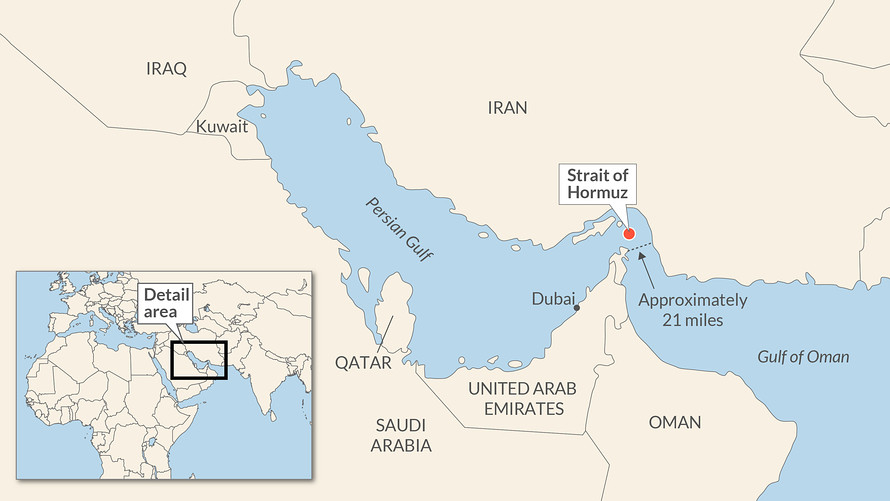
    • The Strait of Hormuz, a narrow waterway in the Middle East marks the most sensitive transportation choke point for global oil supplies.

    Strait of Hormuz

    • The Strait of Hormuz is a narrow channel, approximately 30 miles wide at the narrowest point, between the Omani Musandam Peninsula and Iran.
    • It connects the Persian Gulf to the Gulf of Oman.
    • The Strait is deep and relatively free of maritime hazards.
    • Its depth is greatest near the Musandam Peninsula and tapers as you move north toward the Iranian shore.

    Why is it important?

    • Oil tankers carrying crude from ports on the Persian Gulf must pass through the strait.
    • Around 21 million barrels of oil a day flowed through it in 2018, equivalent to roughly a third of global seaborne oil trade and about 21% of global petroleum liquids consumption.


    UPSC 2023 countdown has begun! Get your personal guidance plan now! (Click here)

  • What West Seti Power Project can mean for India-Nepal ties?

    India will be taking over an ambitious hydropower project in Nepal — West Seti — nearly four years after China withdrew from it, ending a six-year engagement between 2012 and 2018.

    What is West Seti Hydel Project?

    • The West Seti Dam is a proposed 750-megawatt (MW) hydroelectric dam on the Seti River in the Far-Western Development Region of Nepal.
    • Particularly, it is a storage scheme designed to generate and export large quantities of electrical energy to India.
    • The project is envisaged to provide Nepal 31.9% electricity free.
    • Besides, locals affected by the project are being given a share of Nepali Rs 10 million plus 30 units of electricity per month free.

    Why in news now?

    • The project was earlier accorded to a Chinese company.
    • But Nepal feared that India won’t buy power from China-executed projects.

    Significance: India -Nepal Power Relations

    • Nepal is rich in power sources with around 6,000 rivers and an estimated potential for 83,000 MW.
    • India has formally approached Nepal on many occasions, seeking preferential rights over Nepali waters should it match offers coming from elsewhere.
    • India is viewed as a feasible power market for Nepal.
    • India has undertaken to harness or expressed intent to harness major rivers in the north.

    Issues in project execution

    • There has been some uncertainty in Nepal over India’s inability to deliver projects on time.
    • An ambitious Mahakali treaty was signed back in 1996, to produce 6,480 MW, but India has still not been able to come out with the Detailed project Report.
    • The Upper Karnali project, for which the multinational GMR signed the contract, has made no headway for years.
    • Major reasons for stalling of these projects was a lack of consensus over power purchase agreement with India.
    • Also, seismic sensitivity of the Himalayan Region is the prime consideration.

    What has helped build faith recently?

    • India under PM Modi has been successful in executing the 900-MW Arun Three Project in eastern Nepal’s Sankhuwa Sabha.
    • After a standoff between Nepal and India led to the economic blockade of 2015, equations changed after Deuba took over last July, replacing Oli.

    Benefits for Nepal

    • Nepal has a massive power shortfall as it generates only around 900 MW against an installed capacity of nearly 2,000 MW.
    • Although it is currently selling 364 MW power to India, it has over the years importing from India.

    Hurdles from Nepal’s internal crisis

    • Nepal’s Constitution has a provision under which any treaty or agreement with another country on natural resources will require Parliament’s ratification by at least a two-thirds majority.
    • That will also mean homework will be required before any hydro project is signed and given for execution.

    Way forward

    • Until India agrees to value Nepal’s water and the existing focus on power is not reviewed, mutual distrust may continue.
    • India must start executing its projects timely.
    • And its success is expected to restore India’s image in Nepal and give it weightage in future considerations for hydropower projects, when competition is bound to be tough.
    • West Seti, therefore, has the potential to be a defining model for Nepal India’s power relations in future.


    UPSC 2023 countdown has begun! Get your personal guidance plan now! (Click here)

  • Indus Waters Treaty (IWT): An enduring agreement bridging India-Pakistan ties

    Context

    The 118th meeting of the Permanent Indus Commission (PIC) comprising the Indus Commissioners of India and Pakistan held on May 30-31, 2022 in New Delhi.

    Indus Waters Treaty, 1960: A background

    • After years of arduous negotiations, the Indus Waters Treaty was signed in Karachi on September 19, 1960, by then Indian Prime Minister Jawaharlal Nehru and then Pakistani President Ayub Khan, negotiated by the World Bank.
    • According to this agreement, control over the water flowing in three “eastern” rivers of India — the Beas, the Ravi and the Sutlej was given to India
    • The control over the water flowing in three “western” rivers of India — the Indus, the Chenab and the Jhelum was given to Pakistan
    • The treaty allowed India to use western rivers water for limited irrigation use and unrestricted use for power generation, domestic, industrial and non-consumptive uses such as navigation, floating of property, fish culture, etc. while laying down precise regulations for India to build projects
    • India has also been given the right to generate hydroelectricity through the run of the river (RoR) projects on the Western Rivers which, subject to specific criteria for design and operation is unrestricted.
    • The Permanent Indus Commission, which has a commissioner from each country, oversees the cooperative mechanism and ensures that the two countries meet annually (alternately in India and Pakistan).
    • This year, the commission met twice, in March in Islamabad, Pakistan, and then in New Delhi, in May.
    • It is a rare feat that despite the many lows in India-Pakistan relations, talks under the treaty have been held on a regular basis.

    Some disagreements

    • Throughout its existence, there have been many occasions during which differences between the two countries were discernible.
    • Both countries held different positions when Pakistan raised objections regarding the technical design features of the Kishanganga and Ratle hydroelectric power plants.
    • Differences were also discernible when Pakistan approached the World Bank to facilitate the setting up of a court of arbitration to address the concerns related to these two projects referred to in Article IX Clause 5 of the treaty, and when India requested the appointment of a Neutral Expert referent to Clause 2.1 of Article IX .
    • Eventually, on March 31, 2022, the World Bank, decided to resume two separate processes by appointing a neutral expert and a chairman for the court of arbitration.
    • The appointment of a neutral expert will find precedence to address the differences since under Article IX Clause 6 of the treaty provisions, Arbitration ‘shall not apply to any difference while it is being dealt with by a Neutral Expert’.
    • Pakistan, invoking Article VII Clause 2 on future cooperation, raised objections on the construction and technical designs of the Pakal Dul and Lower Kalnai hydropower plants.
    • Similarly, India has raised concerns on issues such as Pakistan’s blockade of the Fazilka drain.

    Lessons from the treaty

    • Engagement between conflicting nations: The treaty is an illustration of a long-standing engagement between the conflicting nations that has stood the vagaries of time.
    • Water management cooperation: The treaty is considered one of the oldest and the most effective examples of water management cooperation in the region and the world.
    • Avoiding conflict: With the exception of differences on a few pending issues, both countries have avoided any actions resulting in the aggravation of the conflict or acted in a manner causing conflict to resurface.

    Potential for cooperation

    • Joint research: Recognising common interests and mutual benefits, India and Pakistan can undertake joint research on the rivers to study the impact of climate change for ‘future cooperation’ (underlined in Article VII).
    • Potential for cooperation and development: The Indus Waters Treaty also offers great potential for cooperation and development in the subcontinent which can go a long way in ensuring peace and stability.

    Conclusion

    Given that both India and Pakistan have been committed to manage the rivers in a responsible manner, the Treaty can be a reference point to resolve other water-related issues in the region through regular dialogue and interaction.

    UPSC 2023 countdown has begun! Get your personal guidance plan now! (Click here)