💥Join UPSC 2027,2028 Mentorship (August Batch) + XFactor Notes & Microthemes PDF

GS Paper: India & Its Neighborhood – Relations

  • Trincomalee Oil Farms Deal

    After a year of negotiations, Sri Lanka will ink the deal with India to jointly develop the Trincomalee oil tank farms — a coveted project that has remained controversial for decades.

    About Trincomalee oil field

    • The facility, built by the British around World War II as a refueling station, has 99 storage tanks that look like giant wells.
    • They have a capacity of 12,000 kilolitres each.
    • Eighty-four of those are in the 800-acre Upper Tank Farm (UTF). For a good part of a century now, these tanks have remained unused, shrouded in a forest.
    • The Lower Tank Farm (LTF) has 16 tanks, spread across 50 acres.

    Historical background

    • Trincomalee harbor is the second deepest natural harbor in the world.
    • The British who were in control of the island decided to make this as their primary logistics station in the east after World War I.
    • It is also a lesser-known but important logistic station during World War II.
    • British started the oil storage project in 1924 and completed in late 1930s.
    • After that it was abandoned by the British in 1948 when Sri Lanka gained independence.
    • In 2002, the development of this tank farm was revived by an Indian company Indian Oil Corporation (IOC).

    History of India’s interest in Trincomalee

    • The development of the Trincomalee Oil Tank farm has been a recurring talking point in Indo-Lanka relations since 1987.
    • It was first mentioned in the Indo- Lanka Accord signed by PM Rajiv Gandhi and President Jayewardene.
    • Despite that, nothing really took off until 2003, when Indian Oil Corporation set up Lanka IOC, its Sri Lankan subsidiary.
    • The agreement remained dormant for years, until the Sirisena- Wickremesinghe administration tried revisiting it through the 2017 MoU.

    Significance of Trincomalee

    • Demography: Trincomalee is home to 3.7 lakh Muslim, Tamil and Sinhala people and Trincomalee, in Sri Lanka’s post-war years.
    • Tourism: It has emerged as a favorite destination for surfers from around the world, gradually transforming with plush resorts and restaurants dotting its coast.
    • Important sea route: Trincomalee remains in spotlight as a potential transit point for international trade routes, particularly drawing India which has known strategic interests there.
    • Balancing China: From India’s geostrategic viewpoint, Trincomalee is an important counterbalance to the southern Hambantota Port backed substantially by China.

    Hurdles to the Project

    • Public resistance: India-backed projects in Sri Lanka tend to draw way more public resistance from nationalists among the majority Sinhalese constituency than projects with Chinese or American involvement.
    • Anti-India sentiments: Observers in Sri Lanka attribute this to the “baggage” that Indian diplomacy carries, years after its intervention during different stages of Sri Lanka’s civil war.


    UPSC 2022 countdown has begun! Get your personal guidance plan now! (Click here)

  • India- Sri Lanka Fisherman Issue

    The Sri Lankan Navy has seized eight Indian fishing vessels and arrested 55 fishermen on the charge of poaching.

    What is the issue?

    • As in the past, fishermen from Rameswaram and nearby coasts continue to sail towards Talaimannar and Katchatheevu coasts, a region famous for rich maritime resources in Sri Lanka.
    • Indian boats have been fishing in the troubled waters for centuries and had a free run of the Bay of Bengal, the Palk Bay and the Gulf of Mannar until 1974 and 1976.
    • Treaties were later signed between the two countries to demarcate the maritime boundary — the ‘International Maritime Boundary Line'(IMBL).

    Issues for Sri Lanka

    • Proliferation of Trawlers: The overuse of mechanized trawlers in Palk Bay is damaging the marine ecosystem in SL waters.
    • Breach of sovereignty: There were many favorable reasons too for Indian fishermen as their access to Sri Lankan waters was easier at the time of Sri Lankan civil war.
    • Porous borders: Maritime boundaries were never tightly guarded as a result, Indian trawlers continue to routinely enter Lankan waters for fishing.
    • End of Civil War: Everything changed in 2009 with the end of civil war. Arrests and attacks increased on Indian fishermen as they continued entering Lankan waters because of depletion of marine resources on the Indian side.

    Fishermen’s concern:

    (1) Depletion of fisheries

    • There is a depletion of fisheries on the Indian side, so Indian fishermen cross into Sri Lankan waters thus denying the livelihood of their counterparts.
    • They deliberately cross the territorial waters even at the risk of getting arrested or shot dead by the Sri Lankan Navy.
    • Sri Lankan fishermen across Palk Bay are concerned over similar depletion on their side (where there is a ban for trawlers) because of poaching by Indian fishermen.

     (2) Rights over Katchatheevu Island

    • Tamil fishermen have been entering Sri Lankan waters nearby Katchatheevu island, where they had been fishing for centuries.
    • In 1974, the island was ceded to Sri Lanka after an agreement was signed by Indira Gandhi between the two countries without consulting the Tamil Nadu government.
    • The agreement allows Indian fishermen “access to Katchatheevu for rest, for drying of nests and for the annual St Anthony’s festival” but it did not ensure the traditional fishing rights.

    (3) Hefty fines

    • After some respite in the last couple of years, Sri Lanka introduced tougher laws banning bottom-trawling and put heavy fines for trespassing foreign vessels.
    • SL has increased the fine on Indian vessels found fishing in Sri Lankan waters to a minimum of LKR 6 million (about ₹25 lakh) and a maximum of LKR 175 million (about ₹17.5 Crore).
    • Quiet often, the fishermen are shot dead by SL marines.

    Fishermen issue in TN politics

    • It has been often a sensitive political issue in Tamil Nadu in the past one decade.
    • In a defiant speech in 1991, late CM Jayalalitha had called on the people of Tamil Nadu to retrieve the Katchatheevu Island.

    Way forward

    • Leasing: Two courses of action exist: (1) get back the island of Katchatheevu on “lease in perpetuity” or (2) permit licensed Indian fishermen to fish within a designated area of Sri Lankan waters and vice versa.
    • Licensing: The second course of action would persuade Colombo to permit licensed Indian fishermen to fish in Sri Lankan waters for five nautical miles from the IMBL.
    • Reconsidering old agreements: The 2003 proposal for licensed fishing can be revisited.
    • Looping in fishermen themselves: Arranging frequent meetings between fishing communities of both countries could be systematized so as to develop a friendlier atmosphere mid-seas during fishing.

    Conclusion

    • The underlying issues of the fisheries dispute need to be addressed so that bilateral relations do not reach a crisis point.
    • Immediate actions should be taken to begin the phase-out of trawling and identify other fishing practices.


    UPSC 2022 countdown has begun! Get your personal guidance plan now! (Click here)

  • What’s behind the Russia-Ukraine Conflict?

    Thousands of Russian troops have been deployed to stations along Ukraine’s border, sparking fears among Western leaders and Ukraine itself that Moscow is planning an invasion

    Roots of the Russia-Ukraine Conflict

    Ans. USSR disintegration

    • Ukraine was a part of the Russian empire for centuries before becoming a Soviet republic.
    • It won independence as the USSR broke up in 1991.
    • Since then, it has moved to shed its Russian imperial legacy and is in increasingly close ties with the West.
    • After the Crimean annexation, both nations have signed ceasefire agreements at Minsk in 2014 and 2015.

    The beginning

    Ans. Separatist insurgency in Ukraine’s East (by Russian speaking population)

    • In 2014, then Russian-leaning Ukrainian President Viktor Yanukovych rejected an association agreement with the European Union in favor of closer ties with Moscow.
    • This sparked mass protests that led to his ouster in 2014.
    • Russia responded by annexing Ukraine’s Crimean Peninsula and throwing its weight behind a separatist insurgency that broke out in Ukraine’s east.

    Beginning of armed conflict

    • More than 14,000 people have died in the fighting that devastated Ukraine’s eastern industrial heartland known as Donbas.
    • Ukraine and the West accused Russia of sending its troops and weapons to back the rebels.
    • Moscow denied that, charging that Russians who joined the separatists were volunteers.
    • Earlier this year, a spike in cease-fire violations in the east and a Russian troop concentration near Ukraine fueled war fears.

    Why is Russia resented over Ukraine?

    • Cultural ties defying the conflict: The Russian president has repeatedly described Russians and Ukrainians as “one people” and claims that Ukraine has unfairly received historic Russian lands during Soviet times.
    • Influence of the ‘West’: The Kremlin has accused Ukraine of failing to honor the 2015 peace deal and criticized the West for failing to encourage Ukrainian compliance.
    • Asylum to rebels: The agreement was a diplomatic coup for Moscow, requiring Ukraine to grant broad autonomy to the rebel regions and offer a sweeping amnesty to the rebels.
    • Affinity with the US and NATO: Ukraine’s aspirations to join NATO represent a red line for Moscow.

    American concern over Russian build-up

    • Buffer state with Russia: Ukraine is a crucial buffer between Russia and the West.
    • Heavy troop deployment: Russia hasn’t provided any details about its troop numbers and locations, saying that their deployment on its own territory shouldn’t concern anyone.
    • Invasion: Russia is planning to deploy an estimated 175,000 troops and almost half of them are already stationed along various points near Ukraine’s border in preparation for a possible invasion.
    • Protection of its ally: Ukraine has been a close ally of the US. Hence, NATO has placed its military infrastructure closer to Russia.

    Recent developments

    • As it moves a large number of troops towards the border, Russia seeks assurances from the US that Ukraine will not be inducted into NATO.
    • However, US President Joe Biden has made it clear that he is not prepared to give any such assurance.
    • This has left the countries in a stand-off, with tens of thousands of Russian troops ready to invade Ukraine at short notice, and the West not budging on Russia’s demands.
    • Experts believe that Russia is keeping the tensions high at the Ukraine border in order to get sanctions relief and other concessions from the West.


    UPSC 2022 countdown has begun! Get your personal guidance plan now! (Click here)

  • Places in news: Solomon Islands

    Australia has announced sending police, troops and diplomats to the Solomon Islands to help after anti-Government demonstrators.

    Solomon Islands

    • Solomon Islands is a sovereign country consisting of six major islands and over 900 smaller islands in Oceania, to the east of Papua New Guinea and northwest of Vanuatu.
    • Its capital, Honiara, is located on the largest island, Guadalcanal.
    • The country takes its name from the Solomon Islands archipelago, which is a collection of Melanesian islands that also includes the North Solomon Islands (a part of Papua New Guinea).
    • It excludes outlying islands, such as the Santa Cruz Islands and Rennell and Bellona.


    UPSC 2022 countdown has begun! Get your personal guidance plan now! (Click here)

  • India-Maldives Relations in recent times

    The Government of Maldives has said that it “strongly rejects attempts to spread false information” criticizing its ties with India, its “closest ally and trusted neighbor”.

    The India-Out Campaign

    • Maldivian protesters recently demanded the Solih administration to ‘stop selling national assets to foreigners’, implying India.
    • ‘India Out’ campaign in Maldives had started sometime last year as on-ground protests in the Maldives and later widely spread across social media platforms under the same hashtag.
    • It is not related to people-to-people conflict (Indian diaspora) but is discontent on close relationship between Maldivian government & India.

    Causes for the anti-India sentiments

    • Political instability: The anti-India sentiment is nearly a decade old and can be traced back to when Abdulla Yameen Abdul Gayoom became president in 2013. He used anti-India sentiments for his political mobilization and started tilting China.
    • Controversy over helicopter gift: Two Dhruv Advanced Light Helicopters (ALF) that were given by India to the Maldives for ocean search-and-rescue operations. Opposition tried to portray this as military presence in the country.
    • Confidential agreements: Most agreements being signed between the Ibrahim Solih government and India are backdoor and has not been publicly discussed in the Maldives Parliament.
    • Alleged interference in domestic politics: India being a big neighbour, there are unsubstantiated perceptions & allegations on Indian Diplomats stationed in Maldives interfering in Domestic affairs.

    India-Maldives Relations: A backgrounder

    • India and Maldives are neighbors sharing a maritime border.
    • Both nations established diplomatic relations after the independence of Maldives from British rule in 1966.
    • India was one of the first nations to recognize Maldives’ independence.
    • Since then, India and Maldives have developed close strategic, military, economic and cultural relations.
    • Maldivians generally regard Indians and India as a friend and trusted neighbor in the field economic, social and political.

    Restoration of ties

    • Ibrahim Mohamed Solih who became President in 2018 has restored Maldives close ties with India.

    Major irritants in ties

    • Political Instability: India’s major concern has been the impact of political instability in the neighborhood on its security and development.
    • Increasing radicalization: In the past decade or so, the number of Maldivians drawn towards terrorist groups like the Islamic State (IS) and Pakistan-based jihadist groups has been increasing.
    • Inclination towards terror: Radicalism in the island nation has increased the possibility of Pakistan based terror groups using remote Maldivian islands as a launch pad for terror attacks against India and Indian interests.
    • Chinese affinity: China’s strategic footprint in India’s neighborhood has increased. The Maldives has emerged as an important ‘pearl’ in China’s “String of Pearls” construct in South Asia.

    Recent gestures by India

    [1] 2014 Malé drinking-water crisis

    • In the wake of a drinking water crisis in Malé in December 2014, following collapse of the island’s only water treatment plant, Maldives urged India for immediate help.
    • India came to rescue by sending its heavy lift transporters like C-17 Globemaster III, Il-76 carrying bottled water.

    [2] 2020 Covid-19 crisis

    • During the COVID-19 crisis of 2020, India extended help to Maldives in the form of financial, material and logistical support.
    • Also, the IAF airlifted 6.2 tonnes of essential medicines and hospital consumables to Maldives, as part of ‘Operation Sanjeevani’.

    [3] Greater Male Connectivity Project

    • India has recently announced the signing of a $500-million infrastructure project for the construction of the Greater Malé Connectivity Project (GMCP).
    • This infrastructure project, the largest-ever by India in the Maldives, involves the construction of a 6.74-km-long bridge and causeway link.

    Why is Maldives significant for India?

    • Increasing maritime cooperation: As maritime economic activity in the Indian Ocean has risen dramatically in recent decades, the geopolitical competition too in the Indian Ocean has intensified.
    • Toll Gate in Indian Ocean: It is situated at the hub of commercial sea-lanes running through the Indian Ocean. More than 97% of India’s international trade by volume and 75% by value passes through the region.
    • Naval cooperation: Maldives is an important partner in India’s role as the net security provider in the Indian Ocean Region.
    • Important SAARC member: Besides, Maldives is a member of the South Asian Association for Regional Cooperation (SAARC) and the South Asia Subregional Economic Cooperation (SASEC).
    • People To People Contact: There is a significant population of Maldivian students in India. They are aided by a liberal visa-free regime extended by India. There is also medical tourism.
    • Major destination for Tourists: Tourism is the mainstay of the Maldivian economy. The country is now a major tourist destination for some Indians and a job destination for others.

    Conclusion

    • There is a significant Indian diaspora in the Maldives. Innumerable Indians work across the hospitality, education, and health-care sectors of the Maldives economy.
    • India must use its Diaspora more extensively for strengthening its relations.


    UPSC 2022 countdown has begun! Get your personal guidance plan now! (Click here)

  • Reopening of the Kartarpur Corridor Project

    The government is considering reopening the Kartarpur Sahib Gurudwara corridor to Pakistan this week for Gurpurab or Prakash Parv.

    Kartarpur Corridor

    • The Kartarpur corridor connects the Darbar Sahib Gurdwara in Narowal district of Pakistan with the Dera Baba Nanak shrine in Gurdaspur district in India’s Punjab province.
    • The name Kartarpur means “Place of God”.
    • The first guru of Sikhism, Guru Nanak, founded Kartarpur in 1504 AD on the right bank of the Ravi River.

    Inception of the project

    • The Kartarpur Corridor was first proposed in early 1999 by then PMs Atal Bihari Vajpayee and Nawaz Sharif as part of the Delhi–Lahore Bus diplomacy.
    • The project is now compared to the fall of the Berlin Wall in 1989, as it could help in easing tensions between the two countries.

    Conditions for the pilgrimage (from Indian side)

    • Only Indians resident or overseas citizens can travel by corridor, Pakistanis cannot.
    • Children or aged persons of all ages can register to apply.
    • After 15 days of travel by corridor another registration can be done for second visit.
    • Registration can only be done online at a mentioned website of Indian Government

    About Guru Nanak

    • Guru Nanak Dev (1469-1539) also referred to as Baba Nanak was the founder of Sikhism and is the first of the ten Sikh Gurus.
    • He advocated the ‘Nirguna’ form of Bhakti. He rejected sacrifices, ritual baths, image worship, austerities and the scriptures of both Hindus and Muslims.
    • He appointed one of his disciples, Angad, to succeed him as the preceptor (guru), and this practice was followed for nearly 200 years.
    • The fifth preceptor, Guru Arjan, compiled his hymns along with those of his four successors and also other religious poets, like Baba Farid, Ravidas, and Kabir, in the Adi Granth Sahib.


    UPSC 2022 countdown has begun! Get your personal guidance plan now! (Click here)

  • Delhi Regional Security Dialogue on Afghanistan

    India is hosting the National Security Advisors (NSAs) level ‘Delhi Regional Security Dialogue on Afghanistan’ this week.

    About the dialogue

    • It will be headed by NSA Ajit Doval.
    • It aims to organise a conference of regional stakeholders and important powers on the country’s current situation and the future outlook.
    • Invitations are sent to Afghanistan’s neighbours such as Pakistan, Iran, Tajikistan, and Uzbekistan, and other key players including Russia, and China.

    Pakistan’s response

    • Not surprisingly, Pakistan has denounced India’s invitation. China too followed Pakistan’s footsteps.
    • Had Pakistan consented to come, it would have been the first high-level visit to India from Pakistan since 2016.
    • Pakistani position reflects its mindset on Afghanistan, where it has played a conspiring role.
    • It reflects its mindset of viewing Afghanistan as its protectorate.

    Response from the other countries

    • India’s invitation has seen an overwhelming response.
    • Central Asian countries as well as Russia and Iran have confirmed participation.

    Significance of the dialogue

    • This will be the first time that all Central Asian countries, and not just Afghanistan’s immediate neighbours, would be participating in this format.
    • The enthusiastic response is a manifestation of the importance attached to India’s role in regional efforts to promote peace and security in Afghanistan.
    • If peace is established in Afghanistan, it could become a major trading hub as a corridor of connectivity in the heart of Asia.

    When you are not at the table, you are on the menu… this conference is India’s attempt to set the table, be on the table, and decide the agenda.

    India’s motive for the conference

    • This is India’s attempt to secure for itself a seat at the table to decide the future course of action on Afghanistan.
    • It underlines the need to actively engage with the world to protect India’s security interests.
    • Until the fall of Kabul, India had not engaged with the Taliban through publicly-announced official channels.

    India’s expectations form Taliban Govt

    • Taliban should not allow safe havens for terror on its soil.
    • The administration should be inclusive, and the rights of minorities, women, and children must be protected.


    UPSC 2022 countdown has begun! Get your personal guidance plan now! (Click here)
  • Suggestions on alternative foreign policy

    Context

    A document has emerged from the Centre for Policy Research (CPR) in the nature of an alternative to the present foreign and defence policies named ‘India’s Path to Power: Strategy in a world adrift’. It is authored by eight well-known strategists and thinkers.

    Background of the document

    • In 2012, many of the same authors had produced another document, ‘Non-alignment 2.0’, in the light of the global changes at that time, as a contribution to policymaking, without criticising the policies of the government.
    • The present document, however, is in the nature of an alternative to the foreign and defence policies of the government, as some of its tenets are not considered conducive to finding a path to power for India in the post-pandemic world.

    Change in foreign policy

    • The first term of the Modi government was remarkable for its innovative, bold and assertive foreign policy, which received general approbation.
    • After his unconventional peace initiatives with Pakistan failed, he took a firm stand and gained popularity at home.
    • His wish to have close relations with the other neighbours did not materialise, but his helpful attitude to them even in difficult situations averted any crisis.
    • He brought a new symphony into India-U.S. relations and engaged China continuously to find a new equation with it. India’s relations with Israel and the Arab countries became productive.
    • In its second term, the government dealt with some of the sensitive matters, which were essentially of a domestic nature such as Article 370, citizenship issues and farming regulation.
    • The external dimensions of these matters led to a challenge to the government’s foreign policy.

    Suggestions in the Centre for Policy Research report

    • Impact of domestic issues on foreign policy: The finding of the report is that domestic issues have impacted foreign policy and, therefore, India should set its house in order to stem the tide of international reaction.
    • This assertion at the beginning of the report is the heart of the report and it is repeated in different forms.
    • Importance of globalisation: The report rightly points out that “it would be incorrect and counterproductive for India to turn its back on globalisation…”
    • Revival of SAARC: The report also suggests that SAARC should be revived and that India should rejoin the Regional Comprehensive Economic Partnership and continue its long-standing quest for membership in the Asia-Pacific Economic Cooperation.
    • Strategic autonomy: The report also stresses the importance of strategic autonomy in today’s world where change is the only certainty.
    • Relations with the US and China: As for the India-U.S.- China triangle, the report makes the unusual suggestion that India should have better relations individually with both the U.S. and China than they have with each other.
    • The report concludes that since China will influence India’s external environment politically, economically and infrastructurally, there is no feasible alternative to a combination of engagement and competition with China.
    • Pakistan policy: The report asserts, “as long as our objectives of policy towards Pakistan are modest, resumption of dialogue and a gradual revival of trade, transport and other links are worth pursuing.”

    Conclusion

    The significance of the report is that it reveals the end of the era of consensus foreign policy and presents a shadow foreign policy for the first time in India. It remains to be seen whether any of the opposition parties will adopt it and fight the next election on the platform provided by the report.

    UPSC 2022 countdown has begun! Get your personal guidance plan now! (Click here)

  • What is International Maritime Boundary Line (IMBL)?

    The Tamil Nadu police have issued an alert on the possibility of an attack on fishermen crossing the International Maritime Boundary Line (IMBL) for fishing in Sri Lankan waters.

    About International Maritime Boundary Line (IMBL)

    • A maritime boundary is a conceptual division of the Earth’s water surface areas using physiographic or geopolitical criteria.
    • As such, it usually bounds areas of exclusive national rights over mineral and biological resources, encompassing maritime features, limits and zones.
    • Generally, a maritime boundary is delineated at a particular distance from a jurisdiction’s coastline.
    • Although in some countries the term maritime boundary represents borders of a maritime nation that are recognized by the United Nations Convention on the Law of the Sea.
    • The terminology does not encompass lake or river boundaries, which are considered within the context of land boundaries.

    The delineation of maritime boundaries has strategic, economic, and environmental implications.

    Classification

    Maritime spaces can be divided into the following groups based on their legal status:

    1. Under the sovereignty and authority (exercising power) of a coastal State: internal waters, territorial sea, and archipelagic waters,
    2. With mixed legal regime, which fall under both the jurisdiction of the coastal State and under the international law: contiguous zone, the continental shelf and the exclusive economic zone, and
    3. That can be used by all States (including land-locked ones) on an equal basis: high seas.

    Note: While many maritime spaces can be classified as belonging to the same group, this does not imply that they all have the same legal regime. International straits and canals have their own legal status as well.

    Zones

    The zones of maritime boundaries are expressed in concentric limits surrounding coastal and feature baselines.

    1. Inland waters—the zone inside the baseline.
    2. Territorial sea—the zone extending 12 nm. from the baseline
    3. Contiguous zone—the area extending 24 nm. from the baseline
    4. Exclusive Economic Zone—the area extending 200 nm from the baseline except when the space between two countries is less than 400 nm

    Back2Basics: India-Sri Lanka Fisherman Issue

    • There have been several alleged incidents of Sri Lankan Navy personnel firing on Indian fishermen fishing in the Palk Strait, where India and Sri Lanka are only separated by 12 nautical miles.
    • The issue started because of Indian fishermen having used mechanized trawlers, which deprived the Sri Lankan fishermen (including Tamils) of their catch and damaged their fishing boats.
    • The Sri Lankan government wants India to ban use of mechanized trawlers in the Palk Strait region, and negotiations on this subject are undergoing.
    • So far, no concrete agreement has been reached since India favours regulating these trawlers instead of banning them altogether.
    • It has been often a sensitive political issue in Tamil Nadu in the past decade.

    About Katchatheevu Island

    • Katchatheevu, an uninhibited off-shore island in the Palk Strait, is administered by Sri Lanka.
    • Though the island was jointly managed by India and Sri Lanka allowing the fishermen of both countries to dry their nets there, it was ceded to Sri Lanka in 1974.
    • Since then, Katchatheevu has remained an issue with some political parties in Tamil Nadu demanding that the island be returned to benefit the fishermen of India.


    UPSC 2022 countdown has begun! Get your personal guidance plan now! (Click here)

  • Bhutan-China Border Agreement

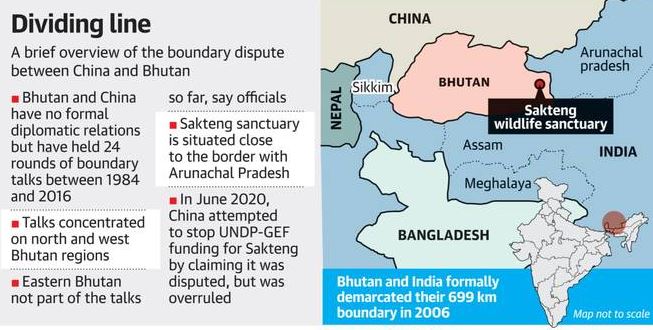
    In a step towards resolving their boundary disputes, Bhutan and China signed an agreement on a three-Step roadmap to help speed up talks to “break the deadlock” in negotiations.

    Bhutan-China Border Issues

    Bhutan shares an over 400-km-long border with China.

    • Doklam: China wants to exchange the valleys to the north of Bhutan with the pasture land to the west (including Doklam), totalling 269 square kilometres.
    • Jakarlung and Pasamlung valleys: located near Tibet to Bhutan’s North, which measure 495 sq. kms.
    • Sakteng Wildlife Sanctuary Project: China claims this area (near to Arunachal Pradesh) in eastern Bhutan as its own.

    What is the recent agreement?

    • The roadmap “for Expediting the Bhutan-China Boundary Negotiations”, is expected to progress on the boundary talks process that has been delayed for five years.
    • It was stalled due to the Doklam standoff in 2017, and then by the Covid Pandemic.
    • Although China and Bhutan do not have official diplomatic relations they have engaged in 24 rounds of ministerial-level talks to resolve their border dispute.

    Implications for India

    The boundary issue between China and Bhutan is special because it not only relates to Bhutan but also has become a negative factor for China-India ties.

    • China control much of the Doklam: Since the 2017 stand-off with India, Beijing has already strengthened its de facto control over much of the Doklam plateau, located strategically along the India-China-Bhutan trijunction.
    • Bhutan supports it: This agreement has been equally endorsed and appreciated by Bhutan and China.
    • Deadlock at LAC talks: Its timing is particularly significant New, given India-China border talks on their 17-month-old standoff at the Line of Actual Control appear to have hit an deadlock.
    • India’s strategic risks: This has big implications for India, since the Doklam swap would have given China access to the strategically sensitive “chicken neck” of the Siliguri corridor.

    India’s interest

    (a) Doklam

    • The Doklam plateau remains hugely critical for India due to the Siliguri Corridor that lies to the south of Doklam.
    • The corridor, also known as the ‘Chicken’s Neck’, is a 22-km wide major arterial road connecting mainland India with its northeastern states and thus it is a highly sensitive area for China.

    (b) Sakteng: the hotspot

    • The Sakteng sanctuary adjoins West Kameng district and Tawang disticts in India’s Arunachal Pradesh state.
    • Its strategic value lies in its proximity to Arunachal Pradesh, where China claims around 90,000 sq km of Indian territory.
    • Tawang, the major bone of contention between India and China in the eastern sector of their border dispute, lies to the northeast of the Sakteng.

    Conclusion

    • Bhutan has to balance its ties with India as well as China.
    • We need to explore channels that India can activate with Bhutan when it comes to the highly sensitive matter of settling the boundary dispute between them and China.


    UPSC 2022 countdown has begun! Get your personal guidance plan now! (Click here)