💥Mains Ready By December. Smash Mains & Smash PYQ Admissions Open

GS Paper: GS2

  • ‘Creamy Layer’ condition in OBC Quota

    Why in the News?

    The government is considering measures to ensure uniform application of the ‘creamy layer’ condition in OBC reservations across central and state government jobs, public sector enterprises, universities, and autonomous bodies.

    About the Concept of Creamy Layer:

    • Origin: Emerged from Indra Sawhney vs Union of India (1992); excluded affluent Other Backward Class (OBC) groups from reservations.
    • 1993 DoPT Rules: Defined creamy layer – children of Group A/Class I officers, early-promoted officials, Group B parents, senior armed forces, high constitutional functionaries, professionals, traders, and large landowners.
    • Income Criteria:
      • Ceiling: ₹1 lakh in 1993, revised to ₹8 lakh in 2017.
      • Exclusions: Salary and agricultural income not counted.

    2004 Clarification & Implementation Issues:

    • Clarification: DoPT directed separate assessment of salary and other income (except agriculture).
    • Rule: If either exceeded limit (₹2.5 lakh then) for 3 consecutive years → creamy layer.
    • Problem: Poor enforcement (2004–14) due to political sensitivities; stricter checks after 2014.
    • Impact: Between CSE 2015–23, over 100 OBC caste certificates rejected under new interpretations.

    Equivalence Efforts:

    • Consultations: Involved Social Justice, Education, Law, Labour Ministries, DoPT, NITI Aayog, NCBC.
    • Goal: Standardise creamy layer rules across universities, Public Sector Undertakings (PSUs), and autonomous bodies.
    • Proposal: Retrospective relief suggested by Home Minister Amit Shah and NCBC.

    Key Proposals Under Consideration:

    • University Teachers: Salaries start at Group A-equivalent → children to be creamy layer.
    • Autonomous Bodies: Posts aligned with central pay scales.
    • Non-Teaching Staff: Categorisation based on equivalence with government jobs.
    • PSU Executives: Already included since 2017; those ≤₹8 lakh excluded.
    • Aided Institutions: Staff categorised based on parity with govt. employees.

    Likely Beneficiaries:

    • Lower Govt. Staff: Children of employees earning just above ₹8 lakh gain most.
    • Correction of Anomalies: Ensures parity between teachers and aided staff.
    • State PSU Issues: Fixes cases like fuel pump attendants in PSUs being declared creamy layer.
    • Private Sector: No change; creamy layer based only on income/wealth criteria.
    [UPSC 2023] Consider the following organizations/bodies in India:

    1. The National Commission for Backward Classes

    2. The National Human Rights Commission

    3. The National Law Commission

    4. The National Consumer Disputes Redressal Commission

    How many of the above are constitutional bodies?

    Options: (a) Only one *(b) Only two (c) Only three (d) All four


  • Office of the Chief Election Commissioner (CEC)

    Why in the News?

    The Opposition (INDI Alliance bloc) is considering moving a motion of removal of the Chief Election Commissioner (CEC) in Parliament.

    About Election Commission of India (ECI):

    • Establishment: Permanent constitutional body set up on 25 January 1950 (National Voters Day).
    • Constitutional Basis: Articles 324–329, Part XV of the Constitution.
    • Mandate: Conducts elections to Lok Sabha, Rajya Sabha, State Legislative Assemblies, and the offices of President and Vice President.
    • Structure: Since 1993, functions as a three-member body with Chief Election Commissioner (CEC) and two Election Commissioners.
    • Status of CEC: Same salary, status, and perks as a judge of the Supreme Court of India.

    Appointment to ECI:

    • Law: Chief Election Commissioner and Other Election Commissioners (Appointment, Conditions of Service and Term of Office) Act, 2023 (replaced 1991 Act).
    • Appointing Authority: President of India.
    • Selection Committee: Prime Minister (Chairperson), Leader of Opposition in Lok Sabha, and a Union Cabinet Minister nominated by the Prime Minister.
    • Eligibility: Must have served as a Secretary-level officer in Government of India with proven integrity and election management experience.
    • Tenure: 6 years or until 65 years of age, whichever is earlier.

    Removal:

    • CEC: Removed like a Supreme Court judge (Article 324(5)) on grounds of proved misbehaviour or incapacity. Requires a motion passed by two-thirds majority in both Houses of Parliament and Presidential order.
    • Other Election Commissioners: Removed only on recommendation of the Chief Election Commissioner.
    [UPSC 2012] Consider the following statements with reference to India:

    1. The Chief Election Commissioner and other Election Commissioners enjoy equal powers but receive unequal salaries

    2. The Chief Election Commissioner is entitled to the same salary as in provided to a judge of the Supreme Court

    3. The Chief Election Commissioner shall not be removed from his office except in like manner and on like grounds as a judge of the Supreme Court

    4. The term of office of the Election Commissioner is five years from the date he assumes his office or till the day he attains the age of 62 years, whichever is earlier

    Which of these statements are correct?

    Options: (a) 1 and 2 (b) 2 and 3* (c) 1 and 4 (d) 2 and 4


  • [pib] “Anna-Chakra” Supply Chain Optimisation Tool for PDS 

    Why in the News?

    The Union Minister of State for the Ministry of Consumer Affairs, Food and Public Distribution has provided crucial information regarding the Anna-Chakra Tool to the Parliament.

    About Anna-Chakra:

    • Purpose: Digital tool to optimise supply chain of the Public Distribution System (PDS).
    • Developed by: World Food Programme (WFP) and Foundation for Innovation and Technology Transfer (IIT-Delhi).
    • Implementation: Adopted in 30 States/UTs, except Manipur.
    • Coverage: Supports 4.37 lakh Fair Price Shops and 6,700 warehouses.
    • Savings: Reduces logistics/fuel costs, saving about ₹250 crore annually.
    • Environmental Impact: Route optimisation reduces travel distance by 15–50%, cutting CO₂ emissions.

    Back2Basics: Public Distribution System (PDS) in India:

    • Objective: Provides subsidised food grains to poor households, ensuring food security.
    • History: Originated in inter-war years; expanded after 1960s food shortages.
    • Reforms: Revamped PDS (1992) extended coverage to rural and poverty-prone areas.
    • Structure:
      • Centre (FCI) – procurement, storage, transportation, bulk allocation.
      • States – distribute food grains to families via Fair Price Shops.
    • Coverage: Serves ~800 million people through 5 lakh+ Fair Price Shops.
    • Items Distributed: Wheat, rice, sugar, kerosene; some states add pulses and oils.
    • Significance: Shields poor households from food price shocks and economic distress.


    [UPSC 2008] Consider the following statements:

    1. Regarding the procurement of food grains, Government of India follows a procurement target rather than an open-ended procurement policy.

    2. Government of India announces minimum support prices only for cereals.

    3. For distribution under Targeted Public Distribution System (TPDS), wheat and rice are issued by the Government of India at uniform Central issue prices to the States/Union Territories.

    Which of the statements given above is/are correct?”

    Options: (a) 1 and 2 (b) 2 only (c) 1 and 3* (d) 3 only


  • The Constitution (130th Amendment) Bill, 2025

    Why in the News?

    The Union Home Minister is set to introduce three bills in the Lok Sabha to provide legal framework for removal of the Prime Minister, Union Ministers, Chief Ministers and Ministers in States and UTs who are “arrested and detained in custody on account of serious criminal charges.”

    Which are the three Bills?

    1. 130th Constitutional Amendment Bill, 2025 (discussed below)
    2. Jammu and Kashmir Reorganisation (Amendment) Bill, 2025 – Provides clarity on removal of CM and Ministers in J&K.
    3. Government of Union Territories (Amendment) Bill, 2025 – Defines similar provisions for Puducherry and other UTs.

    About the 130th Constitutional Amendment Bill, 2025:

    • Scope: Applies to Prime Minister, Chief Ministers, and Ministers at Union, State, and Union Territory levels.
    • Grounds for Removal: Arrest and detention for 30 consecutive days for an offense punishable by five years or more.
    • Reappointment: Possible after release from custody.
    • Objective: Prevent prolonged tenure of arrested leaders in office (e.g., recent case involving Delhi CM Arvind Kejriwal).

    Amendments proposed to the following Articles:

    Current Provision Limitation Changes Proposed
    Article 75 (Union – PM & Union Ministers) PM appointed by President; Ministers appointed on PM’s advice. They hold office during the pleasure of the President. Removal is political (loss of confidence, resignation, dismissal). No explicit mechanism to remove PM/Ministers if detained/arrested for long periods. New provision: If PM or any Union Minister is detained in custody for 30 consecutive days for a serious offense (≥5 years punishment), they must resign by 31st day or automatically cease to hold office. They may be reappointed after release.
    Article 164 (States – CM & State Ministers) CM appointed by Governor; Ministers appointed on CM’s advice. They hold office during the pleasure of the Governor. Council of Ministers collectively responsible to State Assembly. No clear rule for automatic removal if CM/Ministers remain in custody. Similar to Union level: If CM or Minister is detained in custody for 30 consecutive days under serious charges (≥5 years punishment), they automatically lose office. Reappointment allowed after release.
    Article 239AA (Union Territory of Delhi – CM & Ministers) Special status for Delhi (NCT). CM and Council of Ministers aid & advise LG. They hold office as per political responsibility to the Assembly. No explicit provision for automatic removal on detention. A new Section 5A to be inserted: CM/Ministers of NCT of Delhi cease office if detained for 30 days under serious charges (≥5 years). Reappointment possible after release.

    Rationale and Significance:

    • At present, the Constitution has no provision for automatic removal of ministers in custody.
    • Bill ensures that office bearers uphold public trust and do not undermine governance during detention.
    • The statement of objects emphasized that elected representatives must rise above political interests and maintain conduct beyond suspicion.
    • Promotes integrity of democracy by aligning ministerial positions with constitutional morality and accountability.
    [UPSC 2020] Consider the following statements:

    1. According to the Constitution of India, a person who is eligible to vote can be made a minister in a State for six months even if he/she is not a member of the Legislature of that State.

    2. According to the Representation of People Act, 1951, a person convicted of a criminal offence and sentenced to imprisonment for five years is permanently disqualified from contesting an election even after his release from prison.

    Options: (a) 1 only (b) 2 only (c) Both 1 and 2 (d) Neither 1 nor 2*


  • When can Courts order a Recount of Votes?

    Why in the News?

    The Supreme Court for the very first time has recounted EVM votes on its premises and overturned a Haryana sarpanch election result.

    Legal Framework for Challenging Election Results:

    • Parliamentary, Assembly, State Council elections: Validity can be challenged by filing an election petition in the High Court of the state where the election was held.
    • Local government elections: Petitions must be filed at district-level civil courts.
    • Eligibility to file: Only a candidate or elector related to the election can file.
    • Timeframe: Petition must be filed within 45 days of result declaration.
    • Petition requirements:
      • Must contain concise statement of material facts.
      • Allegations of “corrupt practices” must include names of individuals, dates, and locations.
    • Judicial Approach:
      • SC considers corrupt practices as quasi-criminal, requiring high standard of proof.
      • Vague or ambiguous petitions are dismissed.
    • Legal Basis:
      • Representation of the People Act, 1951.
      • State Panchayat Raj Acts.

    Grounds for Invalidating an Election:

    Courts can void an election on:

    • Bribery or undue influence, e.g., hiding criminal antecedents or promoting enmity.
    • Candidate disqualified/unqualified on the election date.
    • Improper rejection of nomination paper.
    • Improper acceptance of nomination or improper reception/rejection of votes, if shown to materially affect results.
    • Non-compliance with Constitution or election laws/rules, if it materially impacted the outcome.

    When can Courts order Recount of Votes?

    • A recount is a possible judicial remedy but not granted lightly.
    • Seen as affecting vote secrecy, which is vital to free and fair elections.
    • Courts order recounts only if:
      • Petitioner presents specific material facts.
      • Evidence shows a prima facie case of probable counting error.
      • Recount is deemed necessary for justice.
    • Normally conducted at election location.
    • Exception: Panipat case, where SC recounted votes in its own premises.

    Can Courts declare a new Winner?

    • Rare, but courts can declare a new winner if:
      • Evidence shows petitioner (or another candidate) actually had majority of valid votes.
      • Or petitioner proves they would have won but for votes gained through corrupt practices.
    • Requires concrete, quantifiable evidence of tainted votes.
    • Example: In Feb 2024 Chandigarh mayoral election, SC declared a new winner after:
      • Presiding officer wrongly invalidated 8 paper ballots.
      • All votes had been cast for the losing candidate.
      • SC restored them as valid, making the losing candidate the winner.
    [UPSC 2004] Consider the following tasks:

    1. Superintendence, direction and conduct of free and fair elections.

    2. Preparation of electoral rolls for all elections to the Parliament, State Legislatures and the Office of the President and the Vice-President.

    3. Giving recognition to political parties and allotting election symbols to political parties and individuals contesting the election.

    4. Proclamation of final verdict in the case of election disputes.

    Which of the above are the functions of the Election Commission of India?

    Options: (a) 1, 2 and 3* (b) 2, 3 and 4 (c) 1 and 3 (d) 1, 2 and 4


  • [18th August 2025] The Hindu Op-ed: A case for judicial introspection

    PYQ Relevance

    [UPSC 2017] To enhance the quality of democracy in India the Election Commission of India has proposed electoral reforms in 2016. What are the suggested reforms and how far are they significant to make democracy successful?

    Linkage: The 2016 ECI reforms sought to strengthen electoral transparency and fairness, while the current debate on the 2023 Act vs. Baranwal judgment highlights how the independence of ECI itself is under threat. Together, they show that both institutional autonomy and procedural reforms are essential for improving the quality of democracy.

    Mentor’s Comment:

    The credibility of elections is the lifeline of any democracy. Recent controversies around the appointment of Election Commissioners and the weakening of institutional safeguards have put India’s electoral integrity under the spotlight. This article unpacks the constitutional debates, judicial interventions, legislative countermeasures, and comparative global experiences to help aspirants understand the stakes involved in preserving the Election Commission of India (ECI) as an independent constitutional body.

    Introduction

    The Election Commission of India (ECI) ensures that elections are free, fair, and impartial. In 2023, the Supreme Court’s Anoop Baranwal case gave more independence to the ECI by including the Chief Justice of India (CJI) in the appointment process. But Parliament quickly passed a law removing the CJI and putting a Cabinet Minister in his place. The Court did not stop this change, and elections in 2024 were conducted under this new system. This has raised doubts about whether the ECI can act independently from the government.

    Current debate over who controls ECI appointments

    1. Nullification of Baranwal judgment: The Chief Election Commissioner and Other Election Commissioners (Appointment, Conditions of Service and Term of Office) Act, 2023. replaced the CJI with a Cabinet Minister (nominated by the PM) in the selection panel, reversing judicial attempts to ensure independence.
    2. Supreme Court’s refusal to stay the law: In Dr. Jaya Thakur v. Union of India (2024), the SC upheld the Act’s validity for the time being, allowing the government’s version to prevail in the 2024 Lok Sabha elections.
    3. Failure of judicial vigilance: A potentially independent ECI could have overseen elections more impartially, but judicial reluctance meant the executive retained control.
    4. Global parallels: Scholars like Landau and Dixon (2020) warn how courts sometimes legitimize authoritarian regimes by siding with executive dominance in electoral matters.

    Anoop Baranwal v. Union of India (2023): The Supreme Court’s big step for ECI independence

    1. Article 324 interpretation: The Court held that appointments to the ECI must be insulated from the executive’s exclusive control.
    2. Role of CJI: Inclusion of the Chief Justice in the selection committee was seen as a safeguard against partisanship.
    3. Warning against pliability: The judgment noted that a “pliable ECI” could become a tool for perpetuating power, undermining free and fair elections.

    The Chief Election Commissioner and Other Election Commissioners (Appointment, Conditions of Service and Term of Office) Act, 2023: Parliament’s counter to the Court

    1. Executive dominance: By excluding the CJI and including a Cabinet Minister, the law tilted the balance back towards government control.
    2. Presumption of validity: The SC’s refusal to strike down or stay the Act demonstrated a conservative approach, prioritizing legislative supremacy over constitutional safeguards.
    3. Practical implications: The 2024 Lok Sabha and Assembly elections were conducted under an ECI shaped by this executive-heavy framework.

    Global lessons on electoral manipulation

    1. Authoritarian strategies: According to Landau & Dixon, regimes in Venezuela, Ecuador, Bolivia used courts and electoral commissions to legitimize manipulated outcomes.
    2. Pre-election manipulation: Autocrats often consolidate institutions (courts, ECs) well before elections, creating a tilted playing field.
    3. Positive global model: South Africa’s Chapter Nine institutions, including its Electoral Commission, provide a framework for independent, fourth-branch institutions to safeguard democracy.

    Fourth pillar of democracy: Autonomous Institutions

    1. Beyond traditional separation: Modern democracies recognize institutions beyond Legislature, Executive, and Judiciary such as independent ECs, CAGs, Information Commissions.
    2. Imaginative interpretation: In the Baranwal case, the Court attempted to evolve the ECI into such a fourth branch institution, enhancing checks on executive power.
    3. Legislative reversal: The 2023 Act effectively nullified this innovation, raising questions about India’s commitment to electoral impartiality.

    The road ahead for electoral reforms: Restoring faith in Democracy

    1. Reinstating CJI in the selection panel: This would revive the spirit of the Baranwal verdict.
    2. Fresh appointments through a reformed process: Ensuring a genuinely independent ECI could require re-selection of commissioners.
    3. Truth Commission role: A reformed ECI could investigate alleged instances of electoral fraud, restoring voter confidence.

    Conclusion

    The ECI is not just another administrative body, it is the custodian of the democratic process. The dilution of judicial safeguards in its appointment mechanism risks eroding the integrity of elections, thereby weakening the very foundation of democracy. Restoring the spirit of Baranwal by reinstating the CJI’s role in appointments and insulating the ECI from executive control remains the most urgent democratic reform.

    Mapping Microthemes (GS relevance)

    • GS-II (Polity & Governance): Electoral reforms, Independence of constitutional bodies, Separation of powers.
    • GS-I: Role of institutions in shaping democratic practices.
    • GS-III: Impact of political manipulation on governance outcomes.
    • GS-IV (Ethics): Constitutional morality, impartiality, institutional integrity.
  • How inclusive is EC’s special revision exercise?

    The Election Commission of India’s (ECI) Special Intensive Revision (SIR) of electoral rolls has become a focal point of debate, extending beyond a routine update. The ECI’s insistence on specific identity and citizenship proofs, most notably the birth certificate, has sparked a critical discussion. The core issue is the potential for widespread voter exclusion, which stands in stark contrast to the foundational democratic principle of ensuring the broadest possible inclusion of all eligible citizens. A recent Lokniti-CSDS survey, conducted across five states and one Union Territory, provides compelling data that challenges the feasibility and inclusivity of the SIR exercise as it is currently designed.

    The Paradox of Electoral Reforms: Inclusion vs. Exclusion

    The Unintended Consequences of the Special Intensive Revision

    1. Documentation Burden: Over half of all respondents lack a birth certificate. A similar proportion lacks a domicile or caste certificate, while at least two-thirds don’t have their parents’ birth certificates.
    2. Widespread Lack of Awareness: Only 36% of respondents were aware of the SIR exercise or its document requirements, indicating a massive information gap.
    3. Socio-Economic Disparities: The lack of necessary documents disproportionately affects vulnerable groups. Roughly 5% of respondents had none of the 11 documents required by the EC. This group of “No Document Citizens” had a higher percentage of women, and were predominantly from the lower economic half, with over one-fourth being SC and over 40% OBC.

    Which groups are most vulnerable to exclusion?

    1. No-document citizens: 5% of respondents had none of the 11 documents.
    2. Marginalized impact: Majority of these were women, ¾ from lower economic strata, ¼ SC, and 40% OBC.
    3. Parental records: Absence of parental birth certificates was as high as 87% in Madhya Pradesh and 72% mothers in Uttar Pradesh.

    Impact of the SIR on Indian democracy

    • Core democratic risk: Exclusion of eligible voters undermines the principle of universal adult suffrage.
    • State capacity challenge: Weak record-keeping and low administrative accessibility deepen inequalities.
    • Policy dilemma: While cleansing electoral rolls is important, the current framework risks mass deletion of legitimate voters.

    Administrative challenges contributing to this problem

    1. Inconsistent Birth Certificate Possession: The possession of birth certificates varies sharply across states, revealing significant administrative and historical disparities. In Madhya Pradesh only 11% of respondents had a birth certificate and in West Bengal, with a 49% possession rate. Even in states with higher rates like West Bengal and Delhi, at least half the population still lacks this document.
    2. Difficulty in Obtaining Documents: The process is perceived as “very difficult” by a substantial portion of the population in major states, including 46% in Delhi, 41% in Kerala, 40% in Madhya Pradesh, and 41% in West Bengal.
    3. Parental Documents as a Major Hurdle: The requirement for parental documents for those born after 1987 (and for both parents for those born after 2003) is a near-impossible condition for many.
    4. State Capacity Gaps: The survey highlights the varying capacity of different states to provide and maintain official records, which is a major factor in the documentation gaps.
    5. Exclusion of Aadhaar: The EC’s decision to exclude Aadhaar creates an unnecessary barrier for voters, especially in states where other documents are rare.

    The findings of the Lokniti-CSDS survey underscore that while cleansing electoral rolls is a valid goal, the current SIR framework is not inclusive. The reliance on documents that many citizens lack, coupled with significant state-wise and socio-economic disparities in document possession, creates a high risk of voter exclusion. The data show that the exercise, as it stands, is more likely to disenfranchise legitimate voters than to simply remove errors, highlighting the need for a more pragmatic and flexible approach that accounts for the ground realities of India’s diverse population.


    Value Addition

    The SIR’s Challenge to Inclusive Democracy

    The Election Commission’s Special Intensive Revision (SIR) aims to update voter lists but risks excluding many citizens. This is a problem because it goes against the core democratic principle of including all eligible voters.

    1. Cleansing vs. Exclusion: While cleaning up the voter list is a good goal, the SIR’s strict rules about documents could lead to the removal of many people who have a legal right to vote. The survey showed that 5% of people lack any of the required documents, with this problem hitting women and people from lower economic backgrounds the hardest.
    2. State Variation: The SIR’s uniform rules are problematic because the ability to get official documents varies greatly across India. For example, possession of a birth certificate is very low in Madhya Pradesh (11%) compared to West Bengal (49%).
    3. Democratic Principle: Democracy depends on everyone having the right to vote. By creating new barriers, the SIR exercise weakens the foundation of free and fair elections.

    Mapping Micro Themes:

    1. GS1: Social exclusion, regional disparities in documentation.
    2. GS2: Electoral reforms, governance capacity, rights of citizens.
    3. GS3: Use of technology (Aadhaar vs exclusions), administrative bottlenecks
    4. GS4: Ethical governance, fairness, justice in democracy.

    PYQ Relevance:

    [UPSC 2017] To enhance the quality of democracy in India the Election Commission of India has proposed electoral reforms in 2016. What are the suggested reforms and how far are they significant to make democracy successful?

    Linkage: The 2016 ECI reforms aimed at enhancing transparency and accountability (e.g., NOTA, state funding, criminal disqualification), while the SIR focuses on electoral roll accuracy. Both highlight the tension between integrity and inclusivity in democracy. The linkage shows that reforms must balance systemic credibility with citizens’ access, else democracy risks exclusion.


  • Supreme Court interventions in Civil–Criminal overlap Cases

    Why in the News?

    In August 2025, the Supreme Court intervened twice to prevent the misuse of criminal proceedings in essentially civil disputes.

    About Civil and Criminal Cases:

    • Civil cases involve disputes between individuals or organisations and are mostly governed by Code of Civil Procedure, 1908 (CPC). The aim is to resolve rights and duties, usually through compensation (damages) or injunctions. Examples: property disputes, contract breaches, divorce, custody, money recovery.
    • Criminal cases involve offences against the state or society. The objective is punishment and deterrence. Initiated by the state prosecutor. Examples: theft, cheating, assault, murder.
    • Burden of proof:
      • Civil cases: Decided on a preponderance of probabilities (more likely than not).
      • Criminal cases: Guilt must be proven beyond reasonable doubt.
    • Dual Cases: Some acts can give rise to both civil and criminal liability. For dual proceedings, there must be proof of criminal intent before entering the commercial or personal relationship.
    • Timelines: Data from the National Judicial Data Grid (2025) shows civil cases are slower (avg. 4.91 years) compared to many criminal cases (70% disposed within a year).

    Recent Supreme Court Actions:

    • Rajasthan plywood dispute case (Aug 13, 2025): SC held there was no criminal breach of trust in a simple sale transaction. Denial of pre-arrest bail by the High Court was overturned.
    • Allahabad HC case (Aug 4, 2025): SC criticised a judge for allowing criminal proceedings in a business transaction dispute, calling it a “mockery of justice”. The judge was temporarily barred from handling criminal cases, later reinstated after CJI intervention.
      • The SC clarified that civil disputes cannot be turned into criminal prosecutions unless fraud or criminal intent is clearly shown.
    [UPSC 2016] With reference to the ‘Gram Nyayalaya Act’, which of the following statements is/are correct?

    1. As per the Act, Gram Nyayalayas can hear only civil cases and not criminal cases.

    2. The Act allows local social activists as mediators/reconciliators.

    Options: (a) 1 only (b) 2 only* (c) Both 1 and 2 (d) Neither 1 nor 2


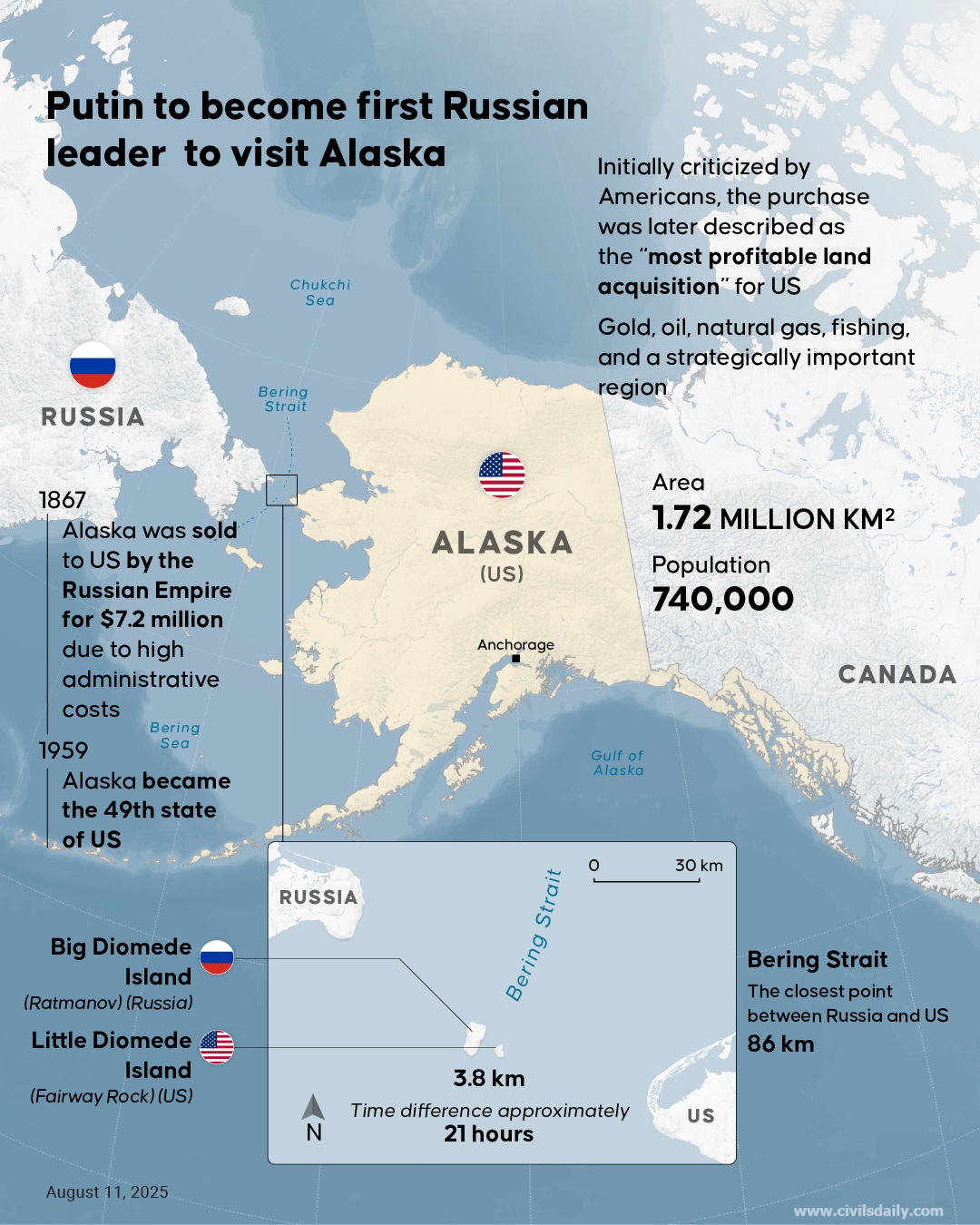
  • Russia’s Sale of Alaska to US

    Why in the News?

    United States President Donald Trump and his Russian counterpart Vladimir Putin are set to meet in Anchorage, Alaska to discuss how to end the war in Ukraine.

    Russia's Sale of Alaska to US

    About Alaska:

    • Acquisition: Largest U.S. state; Purchased from Russia in 1867 for $7.2 million.
    • Mountains: Includes Alaska Range with Mount Denali (20,310 ft), the highest peak in North America.
    • Geography: Brooks Range separates central Alaska from the Arctic far north.
    • Tundra: Northern regions feature vast tundra, permafrost, and Arctic coastal plains.
    • Glaciers: Hosts 100,000+ glaciers, including Bering Glacier, the largest in North America.
    • Forests: About 5% glacier ice, with extensive boreal and temperate rainforests in the south.
    • Volcanoes: More than 70 active volcanoes in Aleutians and Alaska Peninsula.
    • Seismic Activity: Located on the circum-Pacific seismic belt, prone to powerful quakes (e.g., 1964 Alaska earthquake).
    • Water Resources: Contains 3 million+ lakes and 3,000+ rivers, among the most water-rich regions globally.
    • Peninsulas: Includes Alaska Peninsula, Kenai Peninsula, and Seward Peninsula (linked to ancient Bering land bridge).

    Why did Russia sell Alaska to the US?

    • After the Crimean War (1853–56), Russia was financially strained and needed funds.
    • Alaska was seen as a remote, unprofitable liability with declining fur trade.
    • Russia feared Britain might seize Alaska easily from nearby Canada in a future war.
    • Selling it to the United States ensured goodwill and balanced British power.
    • The $7.2 million sale (1867) turned a weakly defended outpost into cash for reforms.

    Geopolitical Significance of Alaska:

    • Natural Resources: Rich in oil, gas (e.g., Prudhoe Bay discovery, 1968), fisheries, and minerals vital for U.S. energy security.
    • Shipping Routes: Offers access to Arctic Sea routes, increasingly navigable due to climate change.
    • Strategic Gateway: Provides access to the Arctic and Pacific, enhancing U.S. naval and air capabilities.
    • Defense Value: Proximity to Russia made it critical in the Cold War and remains vital in Arctic competition.
    • Military Presence: Hosts major U.S. bases and radar systems for missile defense and surveillance.
    • Arctic Council Role: Strengthens U.S. claims in polar governance and Arctic Council negotiations.
    • Scientific Hub: Serves as a center for climate, seismic, and polar ecosystem research.
    [UPSC 2025] Consider the following statements:

    I. Anadyr in Siberia and Nome in Alaska are a few kilometers from each other, but when people are waking up and getting set for breakfast in these cities, it would be different days.

    II. When it is Monday in Anadyr, it is Tuesday in Nome.

    Which of the statements given above is/are correct?

    (a) I only * (b) II only (c) Both I and II (d) Neither I nor II


  • [14th August 2025] The Hindu Op-ed: The Ceding of Academic Freedom in Universities

    PYQ Relevance

    [UPSC 2014] Should the premier institutes like IITs/IIMs be allowed to retain premier status, allowed more academic independence in designing courses and also decide mode/criteria of selection of students? Discuss in light of the growing challenges.

    Linkage: This PYQ directly links to the article’s core theme of academic autonomy by addressing whether premier institutions should have greater freedom in curriculum design, student selection, and governance. The article highlights how over-regulation, political interference, and funding control erode such freedoms across Indian universities. Answering this PYQ can draw on the article’s arguments for institutional autonomy, diversity, and the dangers of one-size-fits-all regulation.

    Mentor’s Comment

    Academic freedom is central to nurturing innovation, fostering critical thought, and sustaining democratic accountability in higher education. It ensures that universities remain spaces for questioning, debate, and independent research, free from undue political or bureaucratic interference. In the Indian context, constitutional guarantees under Articles 19(1)(a) and 21, along with policy frameworks like the NEP 2020, lay a foundation for such autonomy, yet over-regulation and ideological pressures often undermine it. This article illustrates these challenges vividly, linking them to global patterns and emphasising the need for reforms that safeguard autonomy while ensuring institutional accountability.

    Introduction

    Academic freedom is the lifeblood of higher education, enabling questioning, debate, and independent thought. Any restriction on this freedom undermines knowledge creation, weakens the teaching–learning process, and, in the long run, hampers the nation’s intellectual, social, and economic progress.

    Core Arguments in Favour of Academic Freedom in Universities

    1. Universities as Centres of Critical Inquiry:
      1. Universities must be spaces where students and faculty can challenge existing ideas, debate openly, and explore new perspectives.
      2. Questioning is not rebellion, it is the foundation of knowledge development.
      3. Freedom for Students & Faculty: Students need the right to ask questions without fear. Faculty must have autonomy to challenge conventional wisdom in their fields.
    2. Institutional Autonomy:
      1. Universities must independently decide curriculum and pedagogy.
      2. External political or bureaucratic interference in academic content dilutes intellectual rigour.
      3. Universities contribute ideas for science, technology, economic policy, and social reform.
      4. Act as “conscience-keepers” through public intellectual engagement.
      5. Autonomy fosters accountability but accountability should be through transparent institutional mechanisms, not political intervention
      6. Rankings, despite flaws, can help ensure performance-based accountability
    3. Impact on Innovation & Society:
      1. Restricting academic discourse narrows creativity in research and stifles innovation.
      2. Over time, the economy, society, and polity bear the cost through diminished problem-solving capacity.
    4. Open Intellectual Spaces:
      1. Universities should freely invite diverse voices and speakers.
      2. Restricting platforms for dialogue harms learning outcomes and social progress.

    Erosion of Academic Autonomy: Challenges and Way Forward

    1. Freedom in Research:
      1. Universities and faculty must set research priorities and agendas free from political or ideological bias.
      2. Funding should be based on peer review, not prejudice or preference.
      3. Fundamental research needs time, resources, and tolerance for dissenting views.
      4. Lack of such an environment partly explains why Indian universities have not produced Nobel laureates in recent decades.
    2. The Indian Reality:
      1. Curricula are regulated and straitjacketed; reading lists are often politically vetted.
      2. Promising non-mainstream research, especially in humanities and social sciences, is discouraged.
      3. Government-controlled funding bodies can indirectly dictate research themes.
      4. Even private universities self-censor to avoid antagonising political authorities.
    3. Regulation and Autonomy:
      1. UGC Act, 1956 grants regulation powers but often centralises control.
      2. NEP 2020 proposes Higher Education Commission of India to streamline governance but risks uniformity over diversity.
      3. Autonomy must be administrative, financial, and academic with accountability ensured via transparent governance systems, not political directives.

    Case in Point – Academic Freedom Under Strain in India

    1. JNU Reading List Controversy (2019): Certain texts removed from syllabi for “ideological bias.”
    2. IIT-Madras Student Group Derecognition (2015): Suspension after alleged criticism of government policies.
    3. Ashoka University Resignations (2021 & 2023): Faculty exits over lack of institutional support for academic freedom.
    4. UGC Advisory (2022): Urged avoidance of events critical of government policies.

    Global Context

    1. Restrictions in democracies (Argentina, Hungary, Türkiye) and authoritarian states (China, Russia, Vietnam).
    2. The US faced funding cuts under the Trump administration, risking erosion of its innovation edge.
    3. China limits social sciences freedom but maintains merit-based appointments in top institutions.

    Conclusion

    Academic freedom is not a privilege, it is a necessity for national growth. Curtailing it is an attack on the very roots of innovation, democratic engagement, and societal advancement.

    Value Addition

    India’s Academic Freedom Snapshot

    1. Academic Freedom Index 2023: Low score; declining trend since 2013
    2. QS World University Rankings – Few Indian universities in global top 200; autonomy cited as a factor
    3. NAAC Accreditation: Less than 35% of HEIs accredited
    4. UGC Autonomy Regulations: 82 universities granted autonomy (2018–2023)
    5. Global Comparison: US, UK, Germany ranked significantly higher in academic freedom

    Regulation of Indian Universities

    1. University Grants Commission (UGC) Act, 1956: regulates standards, allocates funds, recognises institutions.
    2. AICTE: governs technical education institutions
    3. NAAC: accredits higher education institutions
    4. National Education Policy (NEP) 2020 proposes:
      1. Higher Education Commission of India (single regulator)
      2. Academic, administrative, and financial autonomy
      3. Flexibility in curriculum and interdisciplinarity
    • Challenges:
      1. Political interference in appointments and syllabus
      2. Over-centralisation vs. institutional diversity
      3. Risk of self-censorship in private institutions

    Mapping Micro Themes

    GS Paper Topic/Theme Micro Theme Example
    GS Paper II Education & Rights Academic freedom as a democratic necessity Art. 19(1)(a) & 21 protecting campus speech
    GS Paper II Higher Education Regulation UGC, NEP 2020, institutional autonomy IIT autonomy reforms
    GS Paper III Innovation & R&D Freedom boosting research productivity Correlation between autonomy and patents

    Practice Mains Question

    Essay: “The quest for uniformity is the worst enemy of creativity.”

    1. Evaluate the relationship between academic freedom and democratic accountability in India.