India emphasized that only proposals acceptable to both Russia and Ukraine can lead to peace as it decided to disassociate from the final document issued on June 16 at the conclusion of the Peace Summit in Switzerland.
What is a Joint Communique on a Peace Framework?
The Joint Communique on a Peace Framework is a formal document issued at the conclusion of the Peace Summit in Switzerland, held on June 16, 2024. This communique outlines the collective stance and proposed guidelines for achieving peace in the ongoing Russia-Ukraine conflict.
Key Highlights of the Ukraine Peace Summit in Switzerland
Attendance and Endorsement: More than 80 countries attended the summit and endorsed the “Joint Communique on a Peace Framework.” The communique emphasized the protection of Ukraine’s territorial integrity, based on Ukraine’s peace formula and the UN charter.
Non-Endorsing Countries: India, Saudi Arabia, South Africa, Thailand, Indonesia, Mexico, and the United Arab Emirates did not sign the communique. Brazil maintained an observer status, and China declined the invitation altogether.
India’s Participation and Stance: India attended the summit but chose not to endorse the final document. India’s stance is rooted in the belief that any peace proposal must be acceptable to both Russia and Ukraine for it to be sustainable. The Ministry of External Affairs (MEA) emphasized India’s commitment to understanding different perspectives to find a lasting resolution through dialogue and diplomacy.
Why did India Refuse?
Neutrality and Balanced Approach: India maintains a policy of neutrality and balanced diplomacy, avoiding taking sides in the Russia-Ukraine conflict to preserve its diplomatic relations with both nations.
Mutually Acceptable Solutions: India believes that any peace proposal must be acceptable to both Russia and Ukraine to be sustainable, emphasizing dialogue and practical engagement between the conflicting parties.
Strategic and Diplomatic Considerations: By not endorsing the communique, India retains its potential role as a trusted mediator, protecting its strategic ties with Russia and considering broader geopolitical concerns such as food and energy security.
Conclusion: India’s decision reflects its stance on neutrality, advocating for peace proposals acceptable to both Russia and Ukraine while preserving diplomatic relations and strategic interests amid global geopolitical dynamics.
Mains PYQ:
Q What is the significance of Indo-US defence deals over Indo-Russian defence deals? Discuss with reference to stability in the Indo-Pacific region.(UPSC IAS/2020)
While global gender parity has improved to 68.5% in 2024 from 68.4% in 2023, progress remains slow. The World Economic Forum’s report indicates it will take 134 years to achieve full parity at this rate.
The Global Gender Gap Report 2024
It is released by the World Economic Forum (WEF), and highlights significant disparities in gender parity across various sectors.
Present Scenario:
Global Gender Gap Report 2024:
The global gender gap stands at 68.5% closed, indicating slow progress towards gender parity.
Iceland leads with over 90% closure, while India has slipped to 129th position out of 146 countries, with 64.1% closure.
India’s slight regression is attributed to declines in education and political empowerment indices.
Challenges in India:
Despite improvements in economic participation, India needs to bridge gaps in education and political representation.
The labour force participation rate for women is 45.9%, indicating significant untapped potential.
Gender disparity in literacy rates persists, with women lagging 17.2 percentage points behind men, impacting India’s global ranking.
Significance of Low Gender Gap in the Education Sector:
Bridging the gender gap in education is crucial for enhancing women’s economic opportunities.
Measures such as preventing dropout rates among girls, imparting job skills, and ensuring workplace safety are essential.
Improving literacy rates and educational attainment levels for women can lead to higher economic productivity and empowerment.
Significance of Low Gender Gap in Political Representation:
India shows low representation of women in political bodies despite some progress. Women constitute only 13.6% of the Lok Sabha members, reflecting inadequate political empowerment.
Implementation of the Women’s Reservation Bill, aimed at reserving one-third of seats in legislative bodies, remains crucial for enhancing women’s political participation and influence.
Way forward:
Enhancing Education Access and Quality: Implement targeted policies to reduce the gender gap in education, focusing on increasing girls’ enrollment and retention rates.
Promoting Women’s Political Empowerment: Implement initiatives to encourage women’s active participation in politics, such as leadership training programs, awareness campaigns, and support networks.
Mains PYQ:
Q Can the vicious cycle of gender inequality, poverty and malnutrition be broken through microfinancing of women SHGs? Explain with examples. (UPSC IAS/2021)
Shortly after a fatal fire claimed the lives of 49 migrant workers, predominantly Indians, in the Mangaf area of Al Ahmadi municipality, Kuwait
About the Gulf Cooperation Council (GCC)
It is a regional intergovernmental organization that aims to promote economic, political, and cultural cooperation among its member states.
The GCC was established in 1981 and currently consists of six Arab countries: Bahrain, Kuwait, Oman, Qatar, Saudi Arabia, and the United Arab Emirates. The council’s main headquarters is located in Riyadh, Saudi Arabia.
What is the Kafala system?
The Kafala system is a sponsorship system used in several Gulf Cooperation Council (GCC) countries, including Saudi Arabia, Qatar, Kuwait, Bahrain, Oman, and the United Arab Emirates. It governs the legal status of migrant workers, particularly those from other countries in Asia and Africa, who come to work in these countries. It binds migrant workers to a specific employer, known as the “kafeel,” who is responsible for the worker’s visa and legal status.
Note: sponsorship by local sponsor or employer in West Asian countries
Migrants’ Rights in GCC countries:
Vulnerabilities of Migrant Workers: Migrant workers in GCC countries face systemic vulnerabilities due to the Kafala system, tying their legal status to employers who control their accommodation, wages, and freedom of movement. Lack of independent legal status and dependency on employers make them susceptible to exploitation, poor living conditions, and arbitrary deportations.
Living Conditions and Safety: Many migrants live in crowded and substandard accommodations, which exacerbate risks during emergencies such as fires, as seen in the Mangaf tragedy. Safety standards in workplaces and living spaces often fall short, posing significant risks to migrants’ health and well-being.
Legal Protections and Access to Justice: Legal protections for migrant workers vary, with some categories like domestic workers often excluded from labor laws and protections. Limited access to justice and the ability to organize or unionize further restrict their ability to advocate for improved rights and conditions.
India’s Relationship with GCC Countries:
Economic Dependence and Migrant Workforce: India has a significant economic relationship with GCC countries, with millions of Indian migrants working across sectors such as construction, healthcare, and services. Remittances from GCC countries contribute significantly to India’s economy, highlighting the mutual economic interdependence.
Diplomatic and Policy Engagements: India engages diplomatically with GCC countries to safeguard the interests and welfare of its migrant workers, advocating for better working conditions, legal protections, and safety measures. Bilateral agreements and negotiations focus on labour rights, remittance flows, and crisis management during emergencies affecting Indian migrants.
What India can do? (Way forward)
Diplomatic Engagement and Advocacy: Strengthen diplomatic ties with GCC countries to advocate for better working conditions, legal protections, and safety measures for Indian migrants.
Consular Services and Support: Enhance consular services and support networks in GCC countries to provide timely assistance, legal aid, and emergency relief to Indian migrant workers.
Skill Development and Empowerment: Collaborate with GCC governments and employers to ensure skill development programs for Indian migrants, enhancing their employability and negotiating power.
Mains PYQ:
Q Indian Diaspora has an important role to play in South-East Asian countries’ economy and society. Appraise the role of the Indian Diaspora in South-East Asia in this context. (UPSC IAS/2017)
The Bruhat Bengaluru Mahangara Palike (BBMP)has proposed a Solid Waste Management (SWM) Cess of ₹100 per month for each household.
What is Cess?
A cess is a form of tax or levy imposed by governments to fund specific services or purposes, such as waste management or infrastructure development.
How has the SWM cess fared so far?
Purpose of SWM Cess: SWM Cess is intended to cover a portion of the costs incurred by Urban Local Bodies (ULBs)in providing SWM services, which are resource-intensive and crucial for maintaining cleanliness and health standards in urban areas.
Legal Provisions: According to the Solid Waste Management Rules, 2016, ULBs are mandated to collect user fees/cess for SWM services. The proposed increase reflects the rising costs and challenges faced by ULBs in managing solid waste effectively.
Why has it hit the headlines suddenly?
Significant Increase in User Fee: The proposed SWM Cess represents a substantial increase from the previous user fees typically charged by ULBs (Urban Local Bodies) across India, which are generally in the range of ₹30-50 per month. Such a significant rise in fees has garnered attention and sparked debate among residents and stakeholders in Bengaluru.
Impact on Residents: The SWM Cess directly affects every household in Bengaluru, potentially adding financial burden on residents. This has led to widespread discussions and concerns among citizens about the affordability and justification of the proposed increase.
Present Status in Bengaluru:
Bengaluru faces significant challenges in solid waste management (SWM) due to its large population and high daily waste generation of approximately 5,000 tonnes. Managing such volumes requires extensive resources and infrastructure.
The Bruhat Bengaluru Mahangara Palike (BBMP) primarily focuses its SWM efforts on the collection and transportation of waste. These activities are labor-intensive and consume a major portion of BBMP’s budget allocated for SWM services.
SWM services constitute a substantial portion of BBMP’s budget, with limited revenue generated from these services. This financial strain necessitates the proposal of initiatives like the SWM Cess to bridge the funding gap and ensure sustainable service delivery.
What is about to change?
Proposed Changes: Going forward, Bengaluru plans to implement several changes in its SWM strategy.
These include revising user fees and potentially increasing charges on bulk waste generators to better cover operational costs and enhance service efficiency.
Strategies for Improvement: BBMP aims to enhance waste management practices through initiatives such as waste segregation at source, promoting decentralized composting centres, and launching public awareness campaigns. These efforts are aimed at optimizing resource utilization and improving overall SWM effectiveness in the city.
Mains PYQ:
Q What are the impediments in disposing of the huge quantities of discarded solid wastes which are continuously being generated? How do we remove safely the toxic wastes that have been accumulating in our habitable environment? (UPSC IAS/2018)
Madras HC upheld the ‘Right to Report’ serious incidents of sexual harassment a time, rejecting the 3-month deadline under the Sexual Harassment of Women at Workplace (Prevention, Prohibition, and Redressal) Act (POSH), 2013.
Long-term emotional and psychological damage on victims underscored the need for a broader application of the law.
Right to Report under POSH Act, 2013
Case Background: The decision came while addressing a police officer’s petition to quash an enquiry report for alleged sexual assault against a female colleague.
Madras HC Reasoning: Serious allegations leading to “grave mental trauma” and “stress” constitute a “continuing offence” under POSH, allowing victims to report and investigate at any time.
Notable Observations: the Madras HC distinguished between isolated incidents and serious allegations like assault or molestation.
Isolated Incidents: Must adhere to strict deadlines under POSH.
Serious Allegations: Treated as continuous misconduct until addressed, allowing flexibility in reporting timelines due to fear of victimisation.
What is the POSH Act?
The Sexual Harassment of Women at Workplace (Prevention, Prohibition and Redressal) Act was passed in 2013.
It defined sexual harassment, laid down the procedures for a complaint and inquiry, and the action to be taken.
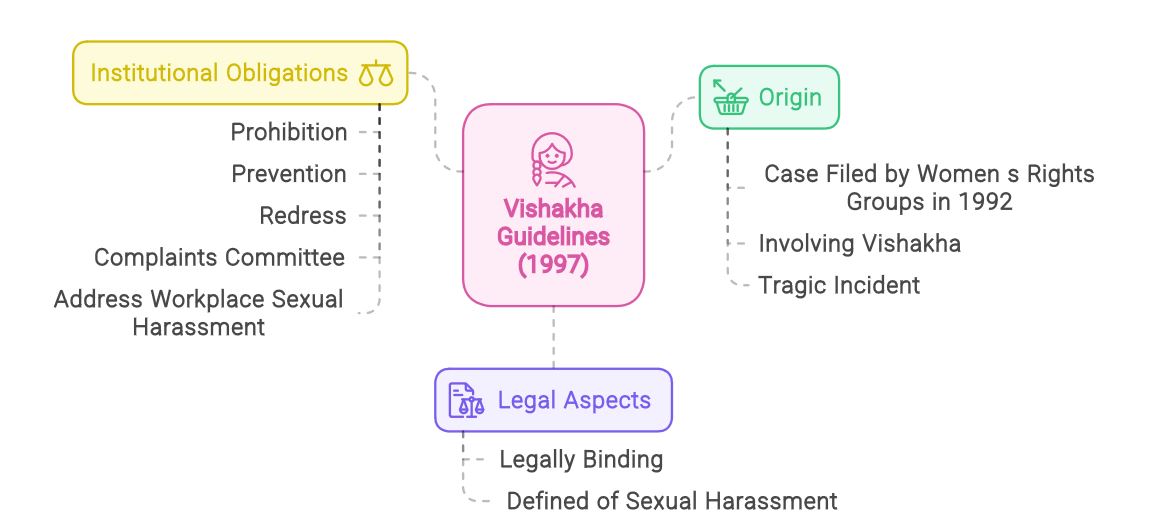
It broadened the Vishakha Guidelines, which were already in place.
The POSH Act broadened these guidelines:
It mandated that every employer must constitute an Internal Complaints Committee (ICC) at each office or branch with 10 or more employees.
It lays down procedures and defines various aspects of sexual harassment, including the aggrieved victim, who could be a woman “of any age whether employed or not”, who “alleges to have been subjected to any act of sexual harassment”.
This meant that the rights of all women working or visiting any workplace, in any capacity, were protected under the Act.
Definition of Sexual Harassment
Under the 2013 law, sexual harassment includes “any one or more” of the following “unwelcome acts or behaviour” committed directly or by implication:
Physical contact and advances
A demand or request for sexual favours
Sexually coloured remarks
Showing pornography
Any other unwelcome physical, verbal or non-verbal conduct of a sexual nature.
The Ministry of Women & Child Development has published a Handbook on Sexual Harassment of Women at the Workplace with more detailed instances of behaviour that constitutes sexual harassment at the workplace. These include, broadly:
Sexually suggestive remarks or innuendos; serious or repeated offensive remarks; inappropriate questions or remarks about a person’s sex life
Display of sexist or offensive pictures, posters, MMS, SMS, WhatsApp, or emails
Intimidation, threats, blackmail around sexual favours; also, threats, intimidation or retaliation against an employee who speaks up about these
Unwelcome social invitations with sexual overtones, commonly seen as flirting
Unwelcome sexual advances.
Unwelcome behaviour
The Handbook says “unwelcome behaviour” is experienced when the victim feels bad or powerless; it causes anger/sadness or negative self-esteem.
It adds unwelcome behaviour is one which is “illegal, demeaning, invading, one-sided and power based”.
Circumstances amounting to SHW
The Act mentions five circumstances that amount to sexual harassment implied or explicit:
The promise of preferential treatment in her employment
The threat of detrimental treatment
Threat about her present or future employment status
Interference with her work or creating an offensive or hostile work environment
Humiliating treatment likely to affect her health or safety
Procedure for complaint
Description
Filing a complaint
The aggrieved victim has the option to file a complaint with the ICC, but it is not compulsory for the ICC to act.
Assistance in filing a complaint
Any member of the ICC must provide reasonable assistance to the victim in filing a written complaint.
Filing a complaint on behalf of the victim
If the victim is unable to file a complaint due to incapacity, death, or other reasons, her legal heir may file it on her behalf.
The time limit for filing a complaint
The complaint must be made within 3 months from the date of the incident
Extension of time limit
ICC has the authority
Monetary settlement and conciliation
Yes. It is possible.
Forwarding complaint or initiating an inquiry
Must be completed within 90 days.
Confidentiality of information
The act ensures the confidentiality of the woman’s identity, respondent’s identity, inquiry details, recommendations, and actions taken
Requirements imposed on employers
Description
Internal Complaints Committee (ICC)
Employers with more than 10 employees must establish an ICC to address sexual harassment complaints.
Composition of ICC
The ICC must include women employees, another employee, and a third-party member familiar with sexual harassment issues.
Local Committee (LC) for smaller organizations
Organizations with fewer than 10 employees must create an LC to receive complaints from the informal sector.
Complaint filing process
Women can file written complaints to either the ICC or LC within three to six months of the incident.
Resolution methods
The Act provides two resolution methods: conciliation between the parties involved or conducting an inquiry by the committee.
Annual audit report
Employers must file an annual audit report on sexual harassment complaints and take responsibility for conducting workshops, awareness programs, and orientation for ICC members.
Non-compliance penalties
Non-compliance with the Act can result in penalties, including fines.
PYQ:
[2019] What are the continued challenges for Women in India against time and space?
[2014] We are witnessing increasing instances of sexual violence against women in the country. Despite existing legal provisions against it, the number of such incidences is on the rise. Suggest some innovative measures to tackle this menace.
[2010] Two of the schemes launched by the Government of India for Women’s development are Swadhar and Swayam Siddha. As regards the difference between them, consider the following statements:
Swayam Siddha is meant for those in difficult circumstances such as women survivors of natural disasters or terrorism, women prisoners released from jails, mentally challenged women etc.,whereas Swadhar is meant for holistic empowerment of women through Self Help Groups.
Swayam Siddha is implemented through Local Self Government bodies or reputed Voluntary Organizations whereas Swadhar is implemented through the ICDS units set up in the states.
Which of the statements given above is/are correct?
(a) 1 only
(b) 2 only
(c) Both 1 and 2
(d) Neither 1 nor 2
Q The concept of cooperative federalism has been increasingly emphasised in recent years. Highlight the drawbacks in the existing structure and the extent to which cooperative federalism would answer the shortcomings. (UPSC IAS/2015) Q How far do you think cooperation, competition and confrontation have shaped the nature of federation in India? Cite some recent examples to validate your answer. (UPSC IAS/2020)
Mentors’ comment: Federalism is crucial as it balances power between national and regional governments, fostering a diverse and inclusive governance structure. It allows regions to address local needs effectively while maintaining national unity. By promoting cooperation and accommodating diversity, federalism enhances democratic participation, prevents centralization of power, and ensures more equitable resource distribution, supporting overall stability and development.
Let’s learn_ _
Why in the news?
On June 4, 2024, the BJP fell short of a Lok Sabha majority, relying on regional partners. This coalition governance could curb the BJP’s dominance and revitalize India’s federal structure, damaged over the past decade.
Undermine the Federalism in last decade before the 2024 election
Centralisation of Power: Under the current administration, there has been a significant shift towards centralising power at the expense of state autonomy, moving away from the principle of cooperative federalism.
Use of Investigative Agencies: Regulatory and investigative agencies like the Enforcement Directorate, Central Bureau of Investigation, and Income-Tax agencies have been used to clamp down on political opponents from regional parties, thereby undermining state authority and autonomy.
Imposition of Hindi: Efforts to impose Hindi on non-Hindi speaking southern states have been part of a broader strategy to homogenize the nation, disregarding the linguistic and cultural diversity of states.
Unilateral Decision-Making: Key decisions, such as imposing a nationwide lockdown during the COVID-19 pandemic, were made unilaterally by the central government without consulting the states, exemplifying a top-down approach.
Fiscal Manipulation: The financial autonomy of states has been undermined by the central government through mechanisms like levying cesses on various items, which are not shared with states, disrupting the balance of fiscal federalism.
The concerns of the Southern States
Financial Disparity: Southern states recognize the necessity of correcting regional imbalances but are concerned about disproportionate financial allocations favoring less-performing northern states. For example, Uttar Pradesh received ₹25,069 crore in tax devolution, more than the combined total for all five southern states.
Potential Political Disenfranchisement: There is anxiety over the potential political dominance of northern states like Uttar Pradesh and Bihar, particularly concerning the upcoming delimitation exercise. These states, with their larger populations, could outweigh the southern states’ influence in the Lok Sabha.
Measures to resolve the concerns of southern States
Need for Equitable Redistribution: Southern leaders emphasise the importance of equitable redistribution and representation, advocating for a balanced approach that does not financially persecute the high-performing southern states.
Coordination Among Southern Leaders: Southern chief ministers are likely to collaborate to address the threat of political disenfranchisement, recognising that their collective interests are at stake in maintaining a fair federal structure.
Why Need to Revive the Inter-State Council?
Potential for Effective Deliberation: Although the Council has the potential to be a formidable forum for decision-making and dispute resolution, it has become ineffective under the control of the Ministry of Home Affairs.
Independent Arena for Coordination: Reviving the Council would provide an independent space for consultation, decision-making, and dispute resolution, ensuring better coordination between states and various governmental departments on issues affecting states.
Accommodating Diversity: In a diverse country like India, fostering a sense of common belonging while respecting the developmental differences among states is crucial. The Council can help in creating policies that are inclusive and considerate of these differences.
Preventing Fragmentation: Ensuring that all states feel that their common nationhood is beneficial helps in maintaining national unity. Without proper forums for dialogue, regional, religious, and linguistic tensions could escalate.
Addressing Inequitable Power Dynamics: The statement “We have more people, so we will have more money and power” threatens to disrupt the delicate balance of federalism. The Council can help address these power imbalances and promote equitable development across all states.
Conclusion: To strengthen India’s federalism, revitalizing the Inter-State Council is crucial, ensuring it operates independently for effective consultation and decision-making. Equitable fiscal practices, respect for state autonomy, and promotion of cultural diversity will foster cooperative governance and prevent centralization, thereby balancing regional needs with national unity.
The Central Information Commission (CIC) upheld Rashtrapati Bhavan’s response to an RTI query regarding the number of times former President Kovind returned decisions by the Prime Minister/Union Council of Ministers for reconsideration.
The President’s Secretariat stated that no information was available on record regarding such returns.
Back2Basics: Right to Information (RTI)
The RTI Act of 2005 grants Indian citizens the right to access government-held information, with exceptions.
Its goal is to enhance transparency and accountability in public authorities.
This Act replaced the earlier Freedom of Information Act of 2002.
RTI aligns with Freedom of Speech and Expression (Article 19) in India’s Constitution.
About Central Information Commission (CIC)
Details
Establishment
Set up under the Section 12 of the Right to Information Act, 2005.
Function
Oversees implementation of RTI Act in Central Government and Union Territories.
Resolves complaints and decides appeals related to the Act.
Headquarters
New Delhi
Composition
Chief Information Commissioner (CIC)
Up to 10 Information Commissioners (IC), (appointed by President on recommendation of PM-led Committee consisting Leader of Opposition and Cabinet Ministers.)
Qualifications
CIC and IC must be persons of eminence in public life with wide knowledge and experience in: Law, Science and Technology, Social Service, Management, Journalism, Mass Media, Administration, and Governance.
NON-ELIGIBLITY: Members of Parliament or Legislature of any State or Union Territory, hold any office of profit, be connected with any political party, or carry on any business or profession.
Tenure
CIC and IC hold office for such term as prescribed by Central Government or until they attain age of 65 years, whichever is earlier.
NO Reappointment.
IC can be appointed as Chief Information Commissioner, but total tenure including term as IC should not exceed 5 years.
Removal
President can remove CIC or IC on grounds like insolvency, conviction for moral turpitude, engaging in another office of profit, etc.
Removal for misbehaviour requires Supreme Court enquiry and recommendation.
Salary & Conditions
Salary, allowances, and service conditions determined by Central Government, cannot be varied to their disadvantage during service (After RTI Amendment Act,2019)
How RTI amendment, 2019 has changed CIC?
Before the 2019 amendment to the RTI Act, ICs at the CIC held a 5-year fixed term and were considered equal in status to the Chief Election Commissioner and Supreme Court judges.
The 2019 amendments granted the Centre the power to alter these terms at its discretion.
Functions
Receives and inquires into complaints related to RTI Act violations, including non-appointment of Public Information Officer, refusal or delay in information, unreasonable fees, incomplete or false information.
Submits annual report on Act’s implementation to Central Government, presented to Parliament.
Powers
Can suo-moto order inquiries, summon persons, enforce oaths, access and inspect documents, receive evidence on affidavit, requisition public records, summon witnesses, and enforce compliance of decisions.
Can direct public authorities on information access, officer appointments, record management, training, and impose penalties or compensation for non-compliance.
PYQ:
[2018] The Right to Information Act is not all about citizens’ empowerment alone, it essentially redefines the concept of accountability. Discuss. (150 words)
[2019] There is a view that the Officials Secrets Act is an obstacle to the implementation of RTI Act. Do you agree with the view? Discuss.
[2020] “Recent amendments to the Right to Information Act will have a profound impact on the autonomy and independence of the Information Commission”. Discuss.
The President of India has rejected a Mercy Petition to pardon a Pakistani terrorist.
The accused was one among the Lashkar-e-Tayyeba terrorists who attacked the Red Fort in 2000, killing two soldiers and a civilian guard.
What is the process of Mercy Petition?
Step 1: The convict facing a death sentence can file a mercy petition within 7 days of the Supreme Court dismissing their appeal.
Step 2: The convict or their relative submits a written petition to the President or governor, citing grounds such as sole breadwinner, physical/mental health, perceived harshness of the law, or judicial errors.
Step 3: The petition is forwarded to the Ministry of Home Affairs for assessment and recommendations, including consultation with the relevant State government.
Step 4: Based on Home Ministry recommendations and the Council of Ministers’ advice, the President can accept or reject the mercy pleawithout a specified time limit.
Step 5: While governors cannot pardon death sentences, they can commute, remit, or reprieve sentences under their state’s executive powers for offences against state laws.
Judiciary on Mercy Petitions:
Bachan Singh v. State of Punjab (1980): The Supreme Court, upheld the death penalty but set the stringent criteria. It emphasized that the death penalty should be awarded only in the “rarest of rare” cases when all mitigating circumstances are considered.
In Maru Ram v. Union of India (1981), the Supreme Court ruled that the power to grant pardons under Article 72 of the Constitution must be exercised based on the advice of the Council of Ministers.
In Kehar Singh vs Union of India (1989) case, the court asserted that presidential pardon is an act of grace, not a right that can be claimed. The exercise of this power is purely administrative and not subject to judicial review.
In the Dhananjoy Chatterjee vs State of West Bengal (1994) case, the Supreme Court clarified that the pardoning powers under Articles 72 and 161 of the Constitution can only be exercised by the Central and State Governments, respectively, and not autonomously by the President or Governor.
In Epuru Sudhakar & Anr. v. Government of Andhra Pradesh (2006), the Supreme Court ruled that the clemency powers of the President and Governor under Article 72 and Article 161 are subject to judicial review.
In Shatrugan Chauhan v. State of U.P. (2014), the appex court has also commuted the death sentence in cases of inordinate delay in deciding mercy petitions. The court commuted the sentence of one Gurmeet Singh after he spent 27 years in custody (and 21 years on death row).
In Mohd. Afzal Guru vs State of Delhi (2014)case, the court-mandated a minimum 14-day gap between the rejection of a mercy petition and the execution of a death penalty, ensuring adequate time for legal recourse.
Report of the 262nd Law Commission (2015): Recommended abolishing the death penalty for all crimes except terrorism-related offenses and waging war.
In April 2023, the Supreme Court upheld the Mumbai High Court’s decision to commute the death sentence of a woman and her sister due to significant delays in deciding their mercy petitions.
About Presidents’ Pardoning Powers under Article 72
According to Article 72, the President of India has the power to grant pardons, reprieves, respites, or remissions of punishment or to suspend, remit, or commute the sentence of any person convicted of any offense: In cases where the punishment or sentence is by a Court Martial;
According to Article 161, the Governor of a State has the power to grant pardons, reprieves, respites, or remissions of punishment or to suspend, remit, or commute the sentence of any person convicted of any offence against any law relating to matters under the executive power of the State.
In the recent Supreme Court Ruling of 2021, the apex court held that the Governor of a state can pardon prisoners, including those on death row, even before they have served a minimum of 14 years of their prison sentence.
Did you know?
Pardon means completely absolving the person of the crime and letting him go free. The pardoned criminal will be like a normal citizen.
Commutation means changing the type of punishment given to the guilty into a less harsh one, for example, a death penalty commuted to a life sentence.
Reprieve means a delay allowed in the execution of a sentence, usually a death sentence, for a guilty person to allow him some time to apply for a Presidential Pardon or some other legal remedy to prove his innocence or successful rehabilitation.
Respite means reducing the quantum or degree of the punishment to a criminal in view of some special circumstances, like pregnancy, mental condition etc.
Remission means changing the time period of the punishment without changing its nature, for example reducing twenty years of rigorous imprisonment to ten years.
Cases as specified by Art. 72
In all cases where the punishment or sentence:
is by a court-martial.
is for an offence against any law relating to a matter to which the executive power of the Union extends.
is a sentence of death.
Nature of the Pardoning Power
The pardoning power of the president is not absolute.
At a procedural level, the apex court in Epuru Sudhakar & Anr. v. Government of Andhra Pradesh (2006) has held that the President’s power must be exercised based on the aid and advice of the Council of Ministers and can be challenged on multiple grounds including that relevant material was not considered, the power was exercised based on political considerations, or there was no application of mind.
This has not been discussed by the Constitution but is the practical truth. Further, the constitution does not provide for any mechanismto question the legality of decisions of presidents or governors exercising mercy jurisdiction.
PYQ:
[2014] Instances of President’s delay in commuting death sentences have come under public debate as denial of justice. Should there be a time specified for the President to accept/reject such petitions? Analyse.
To achieve a $5 trillion economy by 2025-26, India must eliminate obstacles hindering Foreign Investments and facilitate smoother processes for companies and investors.
About the Indian Foreign Exchange Management (Non-debt Instruments) Rules
FEMA outlines the formalities and procedures for the dealings of all foreign exchange transactions in India. These foreign exchange transactions have been classified into two categories — Capital Account Transactionsand Current Account Transactions.
The Indian Foreign Exchange Management (Non-debt Instruments) Rules, 2019, commonly referred to as FEMA NDI, regulates foreign investments in Indian companies. These rules are critical for overseeing the flow of foreign capital into the country, ensuring that investments align with national interests and do not pose security risks.
The amendment to the Indian Foreign Exchange Management (Non-debt Instruments) Rules, 2019 (“FEMA NDI”)was again made through press note number 3 in the year 2020.
In exercise of the powers conferred by section 47 of the Foreign Exchange Management Act, 1999 (42 of 1999) and consequent to the Foreign Exchange Management (Non-Debt Instrument) Rules, 2019, the Reserve Bank of India makes the following regulations relating to mode of payment and reporting requirements for investment in India by a person resident outside India.
‘Act’means the Foreign Exchange Management Act, 1999 (42 of 1999);
On April 16, 2024, the Ministry of Finance, through the Department of Economic Affairs, notified the Foreign Exchange Management (Non-debt Instruments) (Third Amendment) Rules, 2024 (the “Amendment“), prescribing new entry routes for foreign investment in activities under the space sector.
Introduction of Press Note 3 (PN3) Requirement:
What does it mean?: This amendment requires prior government approval for any investments from entities or individuals in countries that share a land border with India. This rule applies if the investment comes directly from these countries or if the beneficial owner (the real person who ultimately owns or controls the investment) is a citizen or resident of these countries.
The purpose: Implemented during the COVID-19 pandemic, the rule aims to prevent opportunistic takeovers of struggling Indian companies by neighboring countries
Challenges with the Recent Amendment
Undefined ‘Beneficial Owner’: The term ‘beneficial owner’ isn’t clearly defined in the PN3 Requirement, leading to confusion. Different laws define the term differently, making it hard for companies to know which standards to follow.
Regulatory Uncertainty: Since the latter half of 2023, the Reserve Bank of India (RBI) has adopted a stricter interpretation of these rules. This shift has caused anxiety among investors and companies, as practices previously deemed acceptable are now being scrutinized.
Regulatory Burden: Companies now face significant delays and a high rate of rejection when seeking approval for investments. According to some officials, proposals worth ₹50,000 crore have been stalled or rejected in the past three years, with 201 applications being turned down.
Severe Fines: Non-compliance with the PN3 Requirement can result in fines up to three times the amount of the investment. For many startups, this could mean financial ruin, as the fines could exceed their revenue or assets.
Legal Battles: Violations could lead to lengthy and costly legal disputes, further burdening the already slow judicial system in India.
What can be the better solution? (Way forward)
Ownership Thresholds: Define beneficial ownership with clear thresholds, such as 10% to 25% ownership stakes. This would help companies understand whether they need to seek approval.
Control-Conferring Rights: Specify which rights indicate control, such as the ability to influence board decisions or veto significant operational changes. Exclude rights that merely protect investor interests, such as veto powers over mergers.
Investor Representations: Allow Indian companies to require foreign investors to provide assurances about their compliance with the PN3 Requirement, backed by indemnities.It would provide a safety net for Indian companies.
Time-Bound Reviews: Introduce a system where companies can seek timely advice from regulatory authorities on whether specific clauses in their investment agreements confer control. This would be similar to mechanisms in competition law, offering clarity and reducing the risk of penalties for inadvertent non-compliance.
Mains PYQ:
Q Foreign Direct Investment (FDI) in the defence sector is now set to be liberalized: What influence this is expected to have on Indian defence and economy in the short and long run? (UPSC IAS/2014)
The central government has granted a one-year extension to the Digital Health Incentive Scheme (DHIS), aimed at digitizing patients’ health records and integrating them with the Ayushman Bharat Digital Health Account (ABHA ID).
About the Digital Health Incentive Scheme:
The National Health Authority (NHA) launched the Digital Health Incentive Scheme on January 1, 2023, to implement the Ayushman Bharat Digital Mission (ABDM) to create a digital health ecosystem in the country.
ABDM intends to support different healthcare facilities like clinics, diagnostic centers, hospitals, laboratories and pharmacies in adopting the ABDM ecosystem to make available the benefits of digital health for all the citizens of India.
It encourages the adoption of digital health solutions like Health Management Information Systems (HMIS) and Laboratory Management Information Systems (LMIS) by offering financial incentives for each additional record digitized beyond a specified threshold.
Benefits of the Digital Health Incentive Scheme:
Earn incentives for Digitization: Reimburse the expenses incurred for digitization to all the participating healthcare facilities and digital Solution Companies.
Efficiency in Healthcare Delivery: Seamless access to patient’s longitudinal health records; Removes hassles in the healthcare process (registration, appointment, consultation, IPD admission, discharge, etc).
Building a Robust Digital Health Ecosystem: Building a robust digital health ecosystem across different levels of healthcare facilities.
Improved Quality of Care: Evidence-based, accessible, and good quality care. Patient’s ease of access to digitized health records and improved healthcare delivery.
Why has the scheme been extended?
The extension aims to sustain momentum in the adoption of digital health technologies. By providing additional time, the scheme supports more healthcare providers, both public and private, in overcoming financial barriers associated with digitization and promoting a digital-first approach to healthcare delivery.
Extending the scheme allows for incorporating feedback from stakeholders and refining its implementation based on operational insights. This iterative process ensures that the scheme remains effective in enhancing healthcare efficiency, patient care, and accessibility to medical records across the country.
How many Hospitals and Digital Health Companies have availed of the incentive?
Registered Facilities: A total of 4,005 healthcare facilities have registered for the Digital Health Incentive Scheme (DHIS). This includes 1,085 private healthcare facilities.
Digital Solution Companies (DSCs): There are 41 digital solution companies (DSCs) registered under the scheme, out of which 36 are private companies.
Availed the Scheme: Among the registered facilities and companies, 584 healthcare facilities have availed the scheme so far. This includes 83 private healthcare facilities. Additionally, 12 DSCs, including 10 private companies, have also availed the incentive.
How can it be beneficial for the patients?
Quick Registration: Patients can benefit from quicker OPD registrations through digital systems, reducing waiting times at hospitals and clinics.
Digital Transactions: Digital health records enable easier access to medical history and facilitate seamless sharing of information between healthcare providers, ensuring continuity of care.
Reduced Redundancy: Digital records help in avoiding duplicate tests and procedures due to lost or misplaced paper records, which is particularly beneficial for patients who move between healthcare facilities or states.
Better Coordination: Healthcare providers can access comprehensive patient records quickly, leading to more coordinated and effective treatment plans.
Prevention of Additional Costs: By reducing the need for repeat tests and administrative overheads associated with paper-based records, patients are less likely to incur unnecessary expenses.
Clear Communication: Patients can securely view, access, and share their health records with healthcare providers, promoting transparency and informed decision-making about their care.
Secure Storage: Digital health records stored under the Ayushman Bharat Digital Health Account (ABHA ID) ensure data security and privacy, adhering to regulatory standards.
Do you know what is ‘ABHA ID’?
ABHA ID, or Ayushman Bharat Digital Health Account ID, is a unique digital identifier issued to individuals in India.
It serves as a centralized platform for individuals to store and manage their medical records digitally, including doctor consultations, prescriptions, and diagnostic test results.
ABHA ID facilitates easy access to health information across different healthcare providers, promotes continuity of care, and supports informed decision-making during medical treatments.
Conclusion: The extension of the Digital Health Incentive Scheme aims to boost adoption of digital health solutions, benefiting patients with improved access and care coordination. Challenges include ensuring equitable access and addressing digital literacy barriers.
Mains PYQ:
Q Appropriate local community level healthcare intervention is a prerequisite to achieve ‘Health for All’ in India. Explain. (UPSC IAS/2018)
![[15th June 2024] The Hindu Op-ed: Reimagining Indian federalism](https://www.civilsdaily.com/wp-content/uploads/2024/06/15-June-1568x882.jpg)