💥Join UPSC 2027,2028 Mentorship (July Batch) + XFactor Notes & Microthemes PDF

GS Paper: GS2

  • CBSE On Screen Marking crisis exposes gaps in evaluation transparency

    Why in the News

    The Central Board of Secondary Education’s On Screen Marking system left roughly 18 lakh Class XII students unable to access their evaluated answer scripts, with only about 4 lakh managing to view them. The Supreme Court has flagged this as a source of frustration of young minds, exposing a gap between the Board’s digital evaluation push and its duty to let students verify their own results.

    What is On Screen Marking (OSM)?

    1. Definition: On Screen Marking is a digital evaluation method where scanned answer scripts are marked by examiners on a screen instead of on paper.
    2. Objective: The Central Board of Secondary Education (CBSE) adopted it to standardise evaluation and speed up result processing.
    3. Access problem: Students are meant to view their own scanned, marked scripts after results, but the current system does not guarantee this access at scale.
    4. CIC role: The Central Information Commission (CIC) had already advised CBSE to frame a standard operating procedure (SOP) for script access before this crisis became public.

    Why has script access broken down for most students?

    1. Capacity gap: The Board built a system that could evaluate scripts digitally but did not build matching capacity to let all students retrieve their own scripts afterward.
    2. Verification denied: Without script access, students cannot check whether their marks were recorded and totalled correctly.
    3. Court intervention: The Supreme Court’s intervention signals that the current process fails a basic due process test for an examination body.
    4. Trust deficit: The gap between the promise of a transparent digital system and the reality of restricted access has deepened student distrust in board evaluation.

    What are the challenges to CBSE’s On Screen Marking system?

    1. Server capacity: Providing 18 lakh students simultaneous access to scanned scripts requires infrastructure the Board has not demonstrated it has built.
    2. Re-evaluation load: A universal access policy will likely increase re-evaluation requests, straining CBSE’s examination machinery further.
    3. Accountability gap: No fixed timeline currently binds CBSE to release scripts or resolve discrepancies once a student flags one.
    4. Precedent for other boards: State boards using similar digital evaluation systems face the same access question, but have no shared standard to follow.
    5. Data security: Wider script access at scale raises the risk of manipulation or leakage of evaluation data if access controls are weak.

    What are the Core Safeguards Used Globally?

    1. Item-Level Marking: Slicing whole papers into isolated questions, sending each question to a different subject specialist to minimize bias or fatigue.
    2. Seed Scripts: Silently injecting pre-marked test scripts into an evaluator’s queue; failing to match the benchmark locks the user out for recalibration.
    3. Centralized Tracking: Real-time dashboards tracking marker progress, turnaround times, and statistical consistency across distributed pools.

    Conclusion

    The central issue is not the shift to digital evaluation itself but the absence of a guaranteed, time bound right for students to view their own scripts. A proposed seven day transparency framework standard operating procedure would fix the access gap, but only if CBSE is bound to a deadline rather than treating disclosure as discretionary.

    PYQ Relevance

    [UPSC 2020] National Education Policy 2020 is in conformity with the Sustainable Development Goal-4 (2030). It intends to restructure and reorient education system in India. Critically examine the statement.

    Linkage: The PYQ evaluates reforms aimed at improving quality, equity and governance in education. The OSM controversy underscores that digital reforms in education must be accompanied by transparency, accountability and robust grievance redressal to achieve quality education.

  • Style and substance of the Saudi Arabia nuclear deal

    Why in the News

    1. The United States and Saudi Arabia have concluded a civil nuclear cooperation agreement while the wider region remains unsettled by the US Iran conflict.
    2. Saudi Arabia has not adopted the IAEA Additional Protocol, raising the question of how much oversight this new nuclear relationship actually carries.

    What is the IAEA Additional Protocol?

    1. Definition: The Additional Protocol is a legal instrument that gives the International Atomic Energy Agency (IAEA) expanded rights to inspect and verify a country’s nuclear activities beyond its baseline safeguards agreement.
    2. Effect: A state that signs it must declare a wider range of nuclear related activities and permit broader IAEA access to sites.
    3. India’s position: India’s own Additional Protocol with the IAEA entered into force in 2014, covering only its civilian nuclear facilities.
    4. Saudi status: Saudi Arabia has not adopted the Additional Protocol, leaving its nuclear activities under a narrower verification regime than India’s.

    Why does the absence of the Additional Protocol matter here?

    1. Verification gap: Without the Additional Protocol, the IAEA has narrower legal access to confirm that Saudi nuclear material is not diverted toward weapons use.
    2. Weaponisation risk: Critics read the deal, agreed without this safeguard, as tolerating a higher proliferation risk in a volatile region.
    3. Precedent concern: Allowing a partner state nuclear cooperation without the stricter protocol could weaken the norm that such protocols are a baseline expectation.
    4. Political linkage: The Trump administration has separately linked nuclear cooperation to shifting conditions on Saudi Arabia joining the Abraham Accords.

    Conclusion

    1. The deal proceeds without the stronger IAEA verification standard that a comparable agreement, such as India’s own, already carries.
    2. Whether the absence of the Additional Protocol becomes a lasting proliferation risk depends on whether Saudi Arabia is later pressed to adopt it.

    “[2018] In the Indian context, what is the implication of ratifying the ‘Additional Protocol’ with the ‘International Atomic Energy Agency (IAEA)’? (a) The civilian nuclear reactors come under IAEA safeguards.

    (b) The military nuclear installations come under the inspection of IAEA.

    (c) The country will have the privilege to buy uranium from the Nuclear Suppliers Group (NSG).

    (d) The country automatically becomes a member of the NSG. Answer: (a)”

  • Editorial: US forced labour tariff framing as trade deal pressure

    PYQ Relevance
    [UPSC 2018]
    What are the key areas of reform if the WTO has to survive in the present context of ‘Trade War’, especially keeping in mind the interest of India?
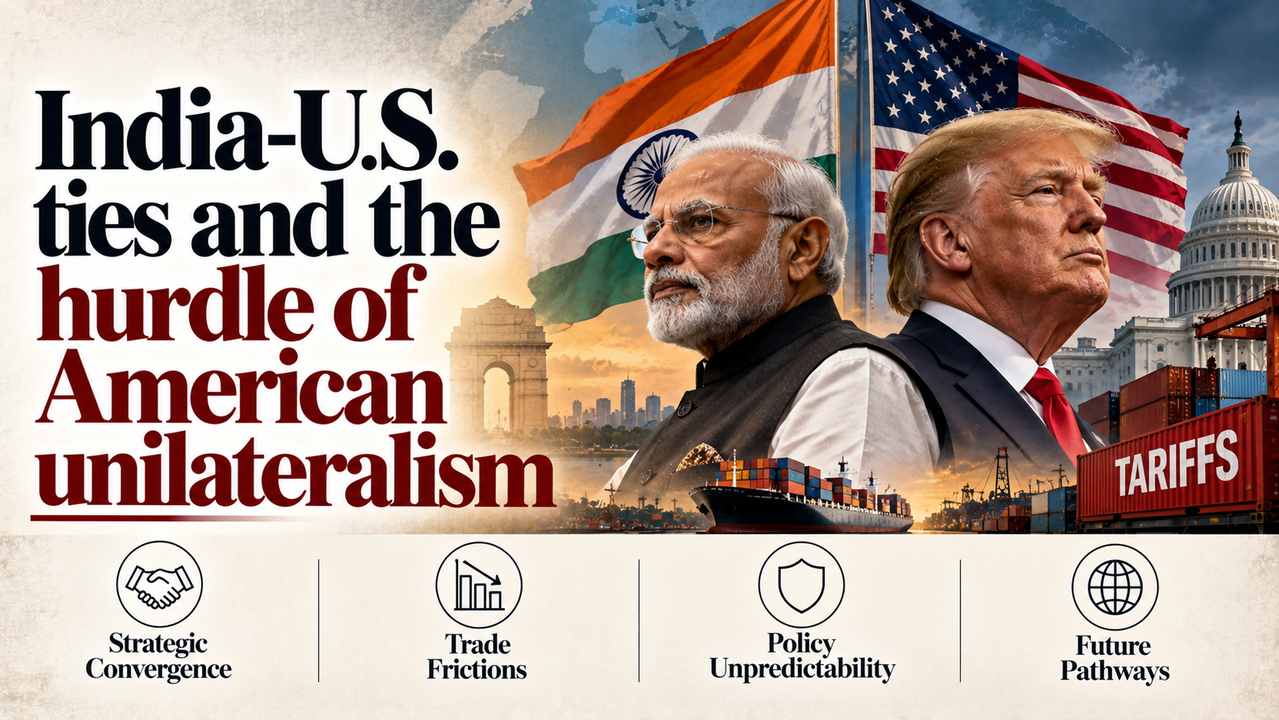
    Linkage: The PYQ examines trade wars, tariffs and their implications for India’s trade interests. The US forced-labour tariffs reflect the growing use of unilateral trade measures, highlighting the challenges posed to India amid weakening multilateral trade rules.

    Mentor’s Comment

    The United States has introduced a new tariff justified on forced labour grounds, applied unevenly across trading partners, days after halting a broader trade negotiation with India. This illustrates how trade policy is increasingly being used as a geopolitical instrument rather than solely to enforce labour standards. For India, the challenge is to protect its export interests while resisting pressure to accept unfavourable trade concessions and continuing to uphold a rules-based multilateral trading system.

    What are the Trump administration’s new tariffs imposed for forced labour concern?

    1. The Trump administration has imposed new tariffs under Section 301 of the Trade Act of 1974, which is designed to address unfair foreign practices affecting US commerce.
    2. Effective from July 24, the US imposed 10 per cent or 12.5 per cent tariffs on all the 60 economies, which were subject to the investigation.
    3. India and 16 other countries are subject to the lower 10 per cent tariff, while 12.5 per cent tariffs have been imposed on the remaining 43 economies.

    Why is the tariff read as pressure rather than a labour standards measure?

    1. Uneven application: Countries that already hold a trade deal with the United States receive more favourable tariff treatment, regardless of their actual labour practices.
    2. Timing: The tariff surfaced shortly after trade talks with India stalled, suggesting it functions as leverage to revive negotiations.
    3. No independent audit trail: The tariff does not rest on a published, verifiable forced labour finding specific to Indian sectors.
    4. Selective targeting: Sectors and countries without existing US trade agreements bear a disproportionate share of the tariff’s impact.

    What is at stake for India in responding to this pressure?

    1. Negotiating posture: Accepting a hasty deal under this pressure risks locking India into terms it would not otherwise accept.
    2. Sectoral exposure: Indian export sectors named under the tariff face immediate cost pressure regardless of the tariff’s actual justification.
    3. Precedent: Conceding to a tariff based on an unverified standard invites similar leverage tactics in future negotiations.

    Conclusion

    India should not treat this tariff as a genuine labour compliance issue requiring domestic reform, but as a negotiating tactic requiring a negotiating response. Response through the WTO’s dispute mechanisms remains untested here.

    1. Examination reform: Nilekani task force and Radhakrishnan committee implementation under Supreme Court watch

      The Supreme Court will consult the Nandan Nilekani-led task force at its next hearing on 3 August 2026 regarding the proposed transition of NEET-UG from a pen-and-paper examination to Computer-Based Testing (CBT). The Court is also examining the government’s progress in implementing the K. Radhakrishnan Committee’s recommendations on examination reforms.

      Key Highlights

      • Implementation review: The Centre has submitted an affidavit on the implementation status of the 101 recommendations of the K. Radhakrishnan Committee.
      • Committee recommendations:
        • 60 short-term and 35 medium/long-term reforms.
        • Restructuring of the National Testing Agency (NTA).
        • Introduction of Computer-assisted Secure Pen-and-Paper Testing (CPPT).
        • Adoption of DIGI-EXAM for secure candidate authentication.
      • Infrastructure plan: Establishment of 1,000 Secure Testing Centres across the country.
      • Related development: Concerns over examination integrity have also emerged in the Jharkhand Combined Civil Services Examination, highlighting the need for broader examination reforms.

      About the National Testing Agency (NTA)

      • Established in 2017 as an autonomous organisation under the Ministry of Education.
      • Conducts major national entrance examinations such as NEET-UG, JEE Main, CUET and UGC-NET.
      • Objective is to ensure fair, transparent, efficient and technology-driven examinations.

      What is Computer-Based Testing (CBT)?

      • Candidates answer questions on a computer terminal instead of paper.
      • Responses are digitally recorded and securely transmitted.
      • Reduces risks associated with paper leaks, manual handling and evaluation delays.

      What is Computer-assisted Secure Pen-and-Paper Testing (CPPT)?

      • Question papers are generated digitally and printed securely at authorised centres shortly before the examination.
      • Minimises transportation and storage of printed question papers.
      • Reduces the possibility of paper leaks while retaining a pen-and-paper examination format.
    2. The Public Examinations (Prevention of Unfair Means) Amendment Bill, 2026 passed by both houses

      Why in News

      The Public Examinations (Prevention of Unfair Means) Amendment Bill, 2026 has been passed by both Houses of Parliament, having first been cleared by the Lok Sabha on July 29, 2026, followed by approval from the Rajya Sabha on July 30, 2026.

      Key Highlights

      • Stricter punishment: Maximum imprisonment for offences involving unfair means increased to 10 years, from the earlier 3 to 5 years.
      • Higher penalty: Maximum fine for individual offences enhanced to ₹50 lakh.
      • Organised examination fraud: Punishable with a minimum imprisonment of 7 years and a fine up to ₹10 crore.
      • Procedural reforms: Provides for fast-track courts and mandates completion of investigations within two months.
      • Companion legislation: The Prevention of Insults to National Honour (Amendment) Bill, 2026 was also introduced during the same session.

      Background

      • The amendment strengthens the Public Examinations (Prevention of Unfair Means) Act, 2024.
      • The Act aims to prevent paper leaks, impersonation, organised cheating and other examination-related malpractices in public examinations conducted by designated authorities.

      Objectives

      • Ensure fairness, transparency and credibility in recruitment and entrance examinations.
      • Deter organised examination fraud through stringent penalties.
      • Protect the interests of genuine candidates.
      • Improve the speed of investigation and prosecution.

      Significance

      • Enhances the integrity of public recruitment and competitive examinations.
      • Acts as a deterrent against paper leak mafias and organised crime networks.
      • Strengthens public confidence in examination systems.
      • Supports merit-based selection and good governance.

      [2026] Mr. X, a senior officer, was overseeing a critical vaccination programme during a pandemic. He found that a private service provider responsible for vaccine distribution was compromising on quality to make profits. Despite immense pressure to manage the issue due to vested interests, he raised his voice based on the principles of public administration which he learnt during various training programmes attended across his career. He reported the issue to the appropriate vigilance authority and halted the contract to ensure citizen welfare.
      Which one among the following principles of public administration was most strongly demonstrated by Mr. X’s actions?

      [A] Esprit de corps

      [B] Equity

      [C] Accountability

      [D] Delegation

    3. US critical minerals self-sufficiency push collides with 2027 deadline

      Why in News

      The United States is facing challenges in achieving self-sufficiency in defence critical minerals before its January 2027 target. The effort is complicated by China’s dominance, which accounts for over 80% of global critical minerals refining capacity.

      Project Vault (United States)

      • Project Vault is a US initiative to build a Strategic Critical Minerals Reserve and reduce dependence on Chinese supply chains.
      • It aims to stockpile critical minerals, expand domestic mining and refining, and secure supplies for defence, semiconductors, clean energy and advanced manufacturing.
      • The initiative is supported by up to US$12 billion through government financing and private investment.
      • It complements broader US efforts to establish resilient supply chains with trusted partner countries and strengthen strategic mineral security.

      Why China Dominates

      • Controls a large share of mining, refining and processing capacity.
      • Built an integrated mine-to-manufacturing supply chain over several decades.
      • Benefits from state support, advanced processing technology and economies of scale.
      • Has previously used export restrictions as a strategic tool in geopolitical disputes.

      [2026] Which of the following statements about Rare Earth Elements (REEs) and Critical Minerals is/are correct?

      1. Modern technological innovations including Artificial Intelligence, robotics and space exploration extensively utilise Rare Earth Elements (REEs).

      2. China has the highest share in mining of REEs followed by India.

      3. The Government of India launched the National Critical Mineral Mission (NCMM) in 2025 to establish a robust framework for self-reliance in the critical mineral sector.

      4. Rare Earth Elements are a set of 13 metallic elements.

      (a) 1 and 3 only (b) 3 only (c) 1, 3 and 4 (d) 1, 2 and 4

    4. Anti-defection law: Supreme Court seeks Centre’s reply on Tenth Schedule merger interpretation

      Why in News

      The Supreme Court has issued notice on a plea filed by Kapil Sibal challenging the prevailing interpretation of the merger exception under the Tenth Schedule (Anti-Defection Law). The plea, linked to the 2022 Goa defection case, argues that the current interpretation undermines the purpose of the Anti-Defection Law by allowing legislators to avoid disqualification without a genuine party merger.

      What is the Merger Exception?

      • Paragraph 4 of the Tenth Schedule provides an exception to disqualification in cases of a merger.
      • A merger is protected when not less than two-thirds of the legislators of a political party agree to merge with another party.
      • The present dispute is whether a legislative party alone can claim a merger, or whether the original political party must also merge.

      About the Tenth Schedule (Anti-Defection Law)

      • Added by the 52nd Constitutional Amendment Act, 1985.
      • Strengthened by the 91st Constitutional Amendment Act, 2003, which removed the earlier exemption for one-third splits.
      • Seeks to curb political defections, ensure government stability, and uphold party discipline.
      • The Presiding Officer (Speaker/Chairman) decides questions relating to disqualification.

      Constitutional Provisions

      • Articles 102(2) and 191(2): Provide for disqualification of MPs and MLAs under the Tenth Schedule.
      • Tenth Schedule: Contains provisions relating to disqualification on grounds of defection.

      Landmark Judgments

      • Kihoto Hollohan v. Zachillhu (1992): Upheld the constitutional validity of the Tenth Schedule and held that the Speaker’s decision is subject to judicial review.
      • Keisham Meghachandra Singh v. Speaker, Manipur (2020): Directed Speakers to decide disqualification petitions within a reasonable period, ordinarily three months.

      Issues with the Current Law

      • Delay in deciding disqualification petitions.
      • Allegations of partisan conduct by the Speaker.
      • Ambiguity regarding the merger exception.
      • Weakens representative democracy when mass defections alter electoral mandates.

      [2013, GS2, 10M] The role of individual MPs (Members of Parliament) has diminished over the years and as a result healthy constructive debates on policy issues are not usually witnessed. How far can this be attributed to the anti-defection law, which was legislated but with a different intention?”

      [2022] With reference to anti-defection law in India, consider the following statements:

      1. The law specifies that a nominated legislator cannot join any political party within six months of being appointed to the House.

      2. The law does not provide any time-frame within which the presiding officer has to decide a defection case.

      Which of the statements given above is/are correct?

      (a) 1 only

      (b) 2 only

      (c) Both 1 and 2

      (d) Neither 1 nor 2

    5. Do not surrender to China, do not depend on the U.S.

      PYQ Linkage
      [UPSC 2024]:
      “The West is fostering India as an alternative to reduce dependence on China’s supply chain and as a strategic ally to counter China’s political and economic dominance.” Explain this statement with examples.
      Linkage: The PYQ discusses the West-India-China triangle, supply-chain diversification, and countering Chinese dominance. The article’s prescribed path of supply-chain resilience and diversification away from China directly extends this PYQ’s theme, while adding the caution against over-reliance on the U.S. as well.

      Mentor’s Comment

      The Trump administration’s unpredictable policies, punitive tariffs, withdrawal of preferential trade status, renewed outreach to Islamabad, and tightened H-1B visa rules, have triggered a domestic business-lobby push to reset India’s China policy. The debate pits the risk of continued dependence on an unreliable United States against the risk of premature capitulation to a revisionist, hostile China. At stake is whether India abandons hard-won post-Galwan strategic leverage in a moment of geopolitical anxiety.

      Why has an unpredictable Washington triggered a domestic push to reset India’s China policy?

      1. Trump-era volatility: The current U.S. administration hit India with punitive tariffs on steel and aluminium, stripped its preferential trade status, and renewed ties with Islamabad, alongside tightened H-1B visa rules.
      2. Lobby’s core claim: An influential business lobby argues India’s confrontational China posture has been synchronised with Washington’s “containment” agenda rather than India’s own national interests.
      3. Economic dependency argument: The lobby contends deep reliance on Chinese technology, supply chains, industrial inputs and capital means a dogmatic anti-China stance stymies India’s own growth while barely denting Beijing’s economy.
      4. Flip-flop risk framing: Washington’s historical pattern of escalating tensions one day and striking bilateral deals the next could leave an overextended India exposed to Chinese retaliation.
      5. Partial concession: The warning against subordinating Indian interests to an unpredictable Washington is valid on its own terms. This validity does not by itself justify a China reset.

      Why is a hasty, unreciprocated economic embrace of China a dangerous prescription?

      1. Convenience mistaken for security: The reset proposal confuses tactical business convenience with long-term national security.
      2. Cost of premature capitulation: It ignores a decade of unprovoked Chinese hostility, deepens asymmetric dependency, and strips India of leverage as the global order enters its most volatile phase since the Cold War.
      3. Motive critique: The primary domestic driver of the reset argument is a business lobby focused on short-term balance sheets, seeking cheap Chinese capital, machinery and active pharmaceutical ingredients (APIs).
      4. Structural blind spot: This view treats international trade as an apolitical transaction, divorced from the realities of comprehensive national power.
      5. Selective memory: Advocating a return to the pre-2020 status quo requires forgetting twelve years of relentless PLA and CCP aggression, recasting a coherent containment strategy as isolated border skirmishes.

      What is China’s actual record of territorial aggression and economic coercion against India?

      1. Border aggression timeline: Depsang (2013), Chumar (2014), Doklam (2017) and the fatal Galwan Valley clashes (2020) mark systematic attempts to alter the Line of Actual Control (LAC) through salami-slicing tactics.
      2. Territorial claims: China continues to assert claims over the entire state of Arunachal Pradesh and renames geographical features in areas it does not control.
      3. Demographic weaponisation: Stapled visas are issued to residents of Jammu and Kashmir and Arunachal Pradesh to contest India’s internal geography.
      4. Economic coercion: China has withheld critical machinery and industrial inputs and weaponised its monopoly over rare earths and tunnel-boring machines during bilateral disputes.
      5. Pakistan nexus: China provided Islamabad real-time tactical satellite data and intelligence during Operation Sindoor (May 2025), shifting from military supplier to an active, hostile participant in Pakistan’s security architecture against India.

      Why is the assumption that economic concessions will produce Chinese reciprocity a myth?

      1. Structural goal mismatch: China’s foreign policy in Asia is built on establishing a unipolar continent; Beijing does not view New Delhi as a peer.
      2. Diplomatic obstruction: China has used its UNSC veto to shield Pakistan-based terrorist organisations and has blocked India’s bids for UNSC permanent membership and Nuclear Suppliers Group (NSG) membership.
      3. Trade deficit risk: Unconditional market access would expand an already asymmetric trade deficit, with China’s annual trade surplus over India already exceeding $100 billion.
      4. Kill-switch risk: Deepening reliance hands Beijing an economic lever that could paralyse Indian industry and strip New Delhi of independent strategic decision-making in a future crisis.
      5. Behavioural logic: China respects power and exploits vulnerability. Signalling that India cannot sustain a prolonged stand-off would confirm that Beijing’s multi-domain pressure strategy is working.
      6. Leverage once lost: Post-Galwan restrictions on Chinese apps, investment and telecom infrastructure are crucial diplomatic leverage, not emotional reactions. Dismantling them for minor economic relief would be an act of unilateral disarmament.

      Is India’s China-reset debate really a false choice between two unreliable powers?

      1. Valid criticism, wrong conclusion: Washington’s unpredictable shifts make it unwise to rely entirely on the U.S. as a security guarantor.
      2. Structural reality: The United States will always prioritise its own domestic and global calculations, leaving New Delhi to stand alone on the heights of Ladakh.
      3. False binary: Washington’s unreliability does not require India to run into the arms of an actively hostile neighbour.
      4. Middle space: An immense strategic space exists between subordinating India’s national interests to the U.S. and conceding an unconditional economic and political surrender to China.

      What strategic path should India actually tread instead of tilting toward either power?

      1. Strategic patience: Internal fortification, not reactive alignment with either power, is the correct approach for New Delhi.
      2. Supply-chain resilience: India must accelerate diversification of trade partnerships across Europe, East Asia and the Global South.
      3. Domestic capacity-building: Domestic manufacturing capability must be built aggressively, even at the cost of short-term inflation.
      4. Structural framing: China represents a generational, structural challenge to India’s rise, not a cyclical irritant resolvable through a reset.
      5. Risk of panic-driven policy: A hasty rethink driven by panic over Washington, or by a short-term-profit-driven business lobby, would leave India permanently exposed, economically vulnerable and strategically diminished.

      Conclusion

      India’s debate over resetting China policy conflates a legitimate criticism of U.S. unpredictability with an illegitimate case for capitulating to Beijing. A decade of Chinese salami-slicing, economic coercion, and intelligence support to Pakistan during Operation Sindoor makes reciprocity from Beijing implausible, while abandoning post-Galwan restrictions on Chinese capital and technology would amount to unilateral disarmament. Neither subordinating strategic autonomy to Washington nor surrendering economic leverage to Beijing serves India’s interests. What remains unresolved is how India absorbs the short-term costs of supply-chain diversification and domestic manufacturing build-up without domestic political pressure forcing a premature tilt toward either power.

    6. Why India must modernise the way the government publishes laws and regulations 

      Why in the News?

      India’s legal publishing system still runs on PDF-based gazettes, a format created in the early 1990s, forcing citizens, lawyers and even courts to search scattered notifications to determine which provisions of law are actually in force. In one documented case, sections of a 2005 amendment to the Code of Criminal Procedure remained unnotified and legally void for more than two decades without public knowledge. This exposes a gap between the constitutional promise that laws be knowable in advance and the administrative reality of an opaque, print-oriented publishing format.

      Why must a law be knowable before it can be enforced?

      1. Historical precedent: Mahatma Gandhi’s first act against the 1906 Transvaal “Black Act” was to translate and publish the ordinance in full in Indian Opinion, so that Indians could read exactly what was being done to them.
      2. Underlying principle: A community cannot defend its rights against a law it cannot read.
      3. Constitutional expectation: Bills before Parliament or a State Assembly are meant to be made known to the people in advance of enactment.
      4. Practical breach: Bills are often not placed in the public domain before they are introduced.
      5. Judicial dimension: The judiciary is expected to know the state of the law it adjudicates, which presupposes that the state of the law is discoverable.

      Where does India’s legal publishing system actually fail?

      1. Fragmentation: Laws governing citizens include Acts and their amendments, rules, regulations, BIS standards, road standards, circulars and municipal bylaws.
      2. No single source: There is no single place to find out what the law actually is; it lies scattered across multiple websites.
      3. Discovery problem: Citizens struggle to find the law currently in force.
      4. Historical-state problem: Even after locating a copy, determining what the law was on a given date is a separate and difficult exercise.
      5. Primary publishing channel: Government uses gazettes as its primary means of publishing laws and bringing them into force.

      Can a provision bind citizens if its own government cannot confirm it is in force?

      1. Case origin: A legal publisher was incorporating changes made by the Code of Criminal Procedure (Amendment) Act, 2005 into the principal Act.
      2. Search failure: The amendment left it to the government to decide when its various sections would come into force, and no gazette notifying Sections 16, 25, 28(a), 28(b), 38, 42(a), 42(b), 42(f)(iii) and (iv), and 44(a) could be found.
      3. RTI confirmation: An RTI application to the Ministry of Home Affairs confirmed that these sections have never been notified.
      4. Legal consequence: More than two decades later, these sections are still not valid law.
      5. Systemic implication: If a central ministry itself cannot demonstrate whether a provision is in force, publication by gazette has failed at its most basic function.

      What technical flaw locks Indian law into this opacity?

      1. Format origin: Gazettes are published as PDFs, a format created in the early 1990s to ensure a digital document looks identical on every device by embedding fonts and images.
      2. Print-fidelity trade-off: This makes PDFs easy to share and print but very hard to extract the structure and meaning of a legal document from.
      3. Lost hierarchy: A law is inherently hierarchical, with chapters, parts, sections and subsections, but a PDF exposes none of that hierarchy.
      4. Language barrier: Many gazettes published in regional languages use proprietary fonts that display correctly on a PDF viewer but cannot be searched in that regional language or read on most websites.
      5. Amendment tracking: A format that cannot expose structure also cannot show precisely what changed across successive amendments to an Act.

      What do global legal-publishing models demonstrate is possible?

      1. Akoma Ntoso, Africa: Many African countries have adopted the Akoma Ntoso standard, a markup language designed specifically for legal documents; Akoma Ntoso is an open markup format that encodes a law’s structure, semantics and language rather than only its printed appearance.
      2. Indigo platform, Africa: These countries use Indigo, an open-source legal publishing platform that lets users add or edit laws and see precisely what changed across an Act’s successive amendments, with subordinate rules tagged to their principal Act.
      3. USLM, United States: The United States publishes every law and amendment in USLM (United States Legislative Markup), a variant of Akoma Ntoso, generating PDF and HTML versions automatically from it using a stylesheet.
      4. Federal Register, United States: All past issues of the Federal Register have been converted into this format and made available for bulk download, allowing commercial legal vendors, nonprofits and think tanks to build citizen-facing tools on top of it.
      5. CLML, United Kingdom: The United Kingdom publishes its legislation at legislation.gov.uk, run by The National Archives, using Crown Legislation Markup Language (CLML), another modified version of Akoma Ntoso.
      6. Convergence toward one standard: The National Archives has stated it aims to move towards Akoma Ntoso itself, since Akoma Ntoso is emerging as the international standard, is less complex, and is supported by a wider pool of experts and suppliers.

      What is at stake for Indian democracy if this publishing model is not upgraded?

      1. Structural lag: While the rest of the world has moved away from PDF publishing, India remains dependent on a standard built more than three decades back.
      2. Persistent barrier: Until the government upgrades its legal publishing software stack, access to the law will remain unnecessarily difficult for citizens, lawyers, judges and other stakeholders in a democracy.
      3. Precedent from the internet: The internet itself was built on open standards, which every stakeholder came together to adopt.
      4. Ambedkar’s distinction: Dr B.R. Ambedkar reminded that a democracy needs more than a government “for the people”; it needs a government “by the people.”
      5. Contractor-capture risk: Laws are the raw material of democracy, and leaving their publication to a handful of contractors will only deepen the obscurity around them.
      6. Reform payoff: If the government instead consults citizens and standardises legal publishing, it could transform how the state communicates with the people and make them active participants in democracy.

      Conclusion

      The central failure identified is not the absence of law but the absence of a reliable way to know the law: India’s PDF-and-gazette-based publishing system leaves entire provisions practically undiscoverable even as they legally bind citizens. Other democracies have already shown that open, structured legal markup standards (Akoma Ntoso, USLM, CLML) can make a law’s text, hierarchy and amendment history transparent and machine-readable. Until India upgrades this publishing infrastructure, the rule of law will remain formally intact but practically inaccessible, with its administration effectively outsourced to a narrow set of contractors rather than opened to citizens.

      PYQ Linkage

      [UPSC 2018] E-Governance is not only about utilization of the power of new technology, but also much about critical importance of the ‘use value’ of information. Explain.

      Linkage: The PYQ argues that e-governance’s value lies in making information usable, not merely digitised. The article’s central claim mirrors this exactly, PDF gazettes are digitised but not structurally usable, while open markup standards make the “use value” of legal information real.

    7. Nilekani to lead task force on exams: Modi

      Why in News?

      Prime Minister Modi constituted a six member high powered task force headed by Nandan Nilekani to recommend steps to secure India’s examination system, as the Public Examinations (Prevention of Unfair Means) Amendment Bill, 2026 is set to be introduced in Parliament.

      Key Highlights

      • The task force is headed by Nandan Nilekani and includes S. Somanath, Tapan Deka, V. Kamakoti, Anita Karwal, and Amrit Lal Meena.
      • It has been tasked with recommending measures to make the public examination system leak proof, transparent, secure, and technology driven.
      • The Public Examinations (Prevention of Unfair Means) Amendment Bill, 2026 is scheduled to be introduced during the Monsoon Session of Parliament.
      • The proposed reforms seek to strengthen exam security, digital monitoring, accountability, and integrity in recruitment and entrance examinations.
      • Pralhad Joshi has assumed additional charge as Union Education Minister following the resignation of Dharmendra Pradhan.

      Public Examinations (Prevention of Unfair Means) Act, 2024

      • Enacted to prevent unfair practices such as paper leaks, impersonation, and organised cheating in public examinations.
      • Covers examinations conducted by bodies such as: UPSC, SSC, RRBs, NTA, IBPS, and Other notified central recruitment agencies
      • Prescribes:
        • Imprisonment of 3 to 5 years and a fine up to ₹10 lakh for individuals involved in unfair means.
        • Imprisonment of 5 to 10 years and a fine of at least ₹1 crore for organised paper leak syndicates.
      • Offences are cognizable, non-bailable, and non-compoundable.

      [2024, GS2, 15 marks] What are the aims and objects of the recently passed and enforced, The Public Examination (Prevention of Unfair Means) Act, 2024? Whether University/State Education Board examinations, too, are covered under the Act?”

      [2018] Consider the following statements:

      1. As per the right to education (RTE) Act, to be eligible for appointment as a teacher in a state, a person would be required to possess the minimum qualification laid down by the concerned State council of Teacher education.
      2. As per the RTE Act, for teaching primary classes, a candidate is required to pass a Teacher Eligibility Test conducted in accordance with the National Council of Teacher Education guidelines
      3. In India, more than 90 % of teacher education institutions are directly under the State Governments.

      Which of the statements given above is/are correct?

      [A] 1 and 2

      [B] 2 only

      [C] 1 and 3

      [D] 3 only