Why in the news?
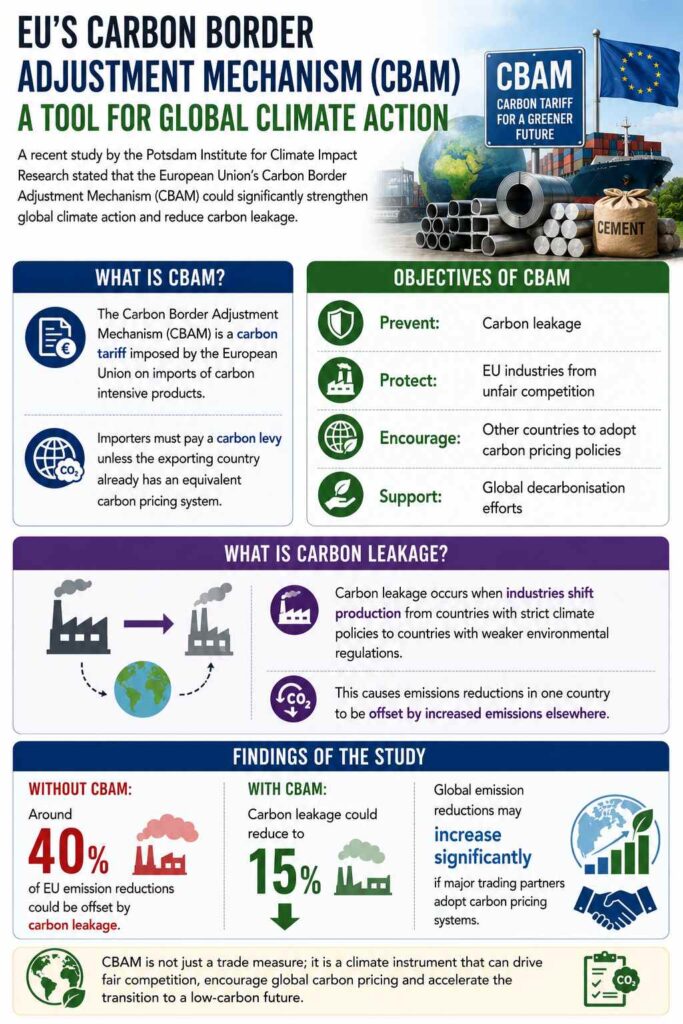
A recent study by the Potsdam Institute for Climate Impact Research stated that the European Union’s Carbon Border Adjustment Mechanism (CBAM) could significantly strengthen global climate action and reduce carbon leakage.
What is CBAM?
The Carbon Border Adjustment Mechanism (CBAM) is:
- A carbon tariff imposed by the European Union on imports of carbon intensive products.
- Importers must pay a carbon levy unless the exporting country already has an equivalent carbon pricing system.
Objectives of CBAM
- Prevent: Carbon leakage
- Protect: EU industries from unfair competition
- Encourage: Other countries to adopt carbon pricing policies
- Support: Global decarbonisation efforts
What is Carbon Leakage?
Carbon leakage occurs when:
- Industries shift production from countries with strict climate policies to countries with weaker environmental regulations.
- This causes emissions reductions in one country to be offset by increased emissions elsewhere.
Findings of the Study
- Without CBAM, Around 40% of EU emission reductions could be offset by carbon leakage.
- With CBAM, Carbon leakage could be reduced to 15%.
- Global emission reductions may increase significantly if major trading partners adopt carbon pricing systems.
What is Carbon Pricing?
Carbon pricing means:
- Putting a monetary cost on carbon emissions to reduce greenhouse gas emissions.
- Major forms: Carbon tax and Emissions Trading System (ETS)
Criticism of CBAM
Critics argue:
- Developing countries may face higher export costs.
- It may act as a trade barrier.
- EU does not provide sufficient:
- Climate finance
- Technology support
for industrial decarbonisation in poorer countries.
[2023] Consider the following statements:
Statement-I:Carbon markets are likely to be one of the most widespread tools in the fight against climate change.
Statement-II:Carbon markets transfer resources from the private sector to the State
Which one of the following is correct in respect of the above statements?
[A] Both Statement I and Statement II are correct and Statement II is the correct explanation for Statement I
[B] Both Statement I and Statement II are correct and Statement II is not the correct explanation for Statement I
[C] Statement I is correct but Statements II is incorrect
[D] Statement I is incorrect but Statement II is correct.
