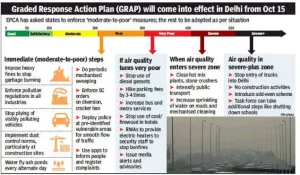
The Commission for Air Quality Management directed New Delhi authorities to enforce stage II of the Graded Response Action Plan (GRAP) with immediate effect.
Graded Response Action Plan (GRAP)
- In 2014, when a study by the WHO found that Delhi was the most polluted city in the world, panic spread in the Centre and the state government.
- Approved by the Supreme Court in 2016, the plan was formulated after several meetings that the Environment Pollution (Prevention and Control) Authority (EPCA) held with state government and experts.
- The result was a plan that institutionalized measures to be taken when air quality deteriorates.
- GRAP also works as an emergency measure.
- It includes strict measures such as a ban on the entry of heavy vehicles, the odd-even road rationing restrictions, and a halt of construction work – each of which is likely to be impractical at a time when the pandemic has exacted heavy economic costs and public transport has been seen as an infection risk.
How does it work?
- As such, the plan does not include action by various state governments to be taken throughout the year to tackle industrial, vehicular and combustion emissions.
- When the air quality shifts from poor to very poor, the measures listed under both sections have to be followed since the plan is incremental in nature.
- If air quality reaches the severe+ stage, GRAP talks about shutting down schools and implementing the odd-even road-space rationing scheme.
Measures taken under GRAP
1) Severe+ or Emergency
(PM 2.5 over 300 µg/cubic metre or PM10 over 500 µg/cu. m. for 48+ hours)
- Stop entry of trucks into Delhi (except essential commodities)
- Stop construction work
- Introduce odd/even scheme for private vehicles and minimise exemptions
- Task Force to decide any additional steps including shutting of schools
2) Severe
(PM 2.5 over 250 µg/cu. m. or PM10 over 430 µg/cu. m.)
- Close brick kilns, hot mix plants, stone crushers
- Maximise power generation from natural gas to reduce generation from coal
- Encourage public transport, with differential rates
- More frequent mechanized cleaning of road and sprinkling of water
3) Very Poor
(PM2.5 over 121-250 µg/cu. m. or PM10 over 351-430 µg/cu. m.)
- Stop use of diesel generator sets
- Enhance parking fee by 3-4 times
- Increase bus and Metro services
- Apartment owners to discourage burning fires in winter by providing electric heaters during winter
- Advisories to people with respiratory and cardiac conditions to restrict outdoor movement
4) Moderate to poor
(PM2.5 over 61-120 µg/cu. m. or PM10 over 101-350 µg/cu. m.)
- Heavy fines for garbage burning
- Close/enforce pollution control regulations in brick kilns and industries
- Mechanized sweeping on roads with heavy traffic and water sprinkling
- Strictly enforce a ban on firecrackers
UPSC 2023 countdown has begun! Get your personal guidance plan now! (Click here)