Why in the News
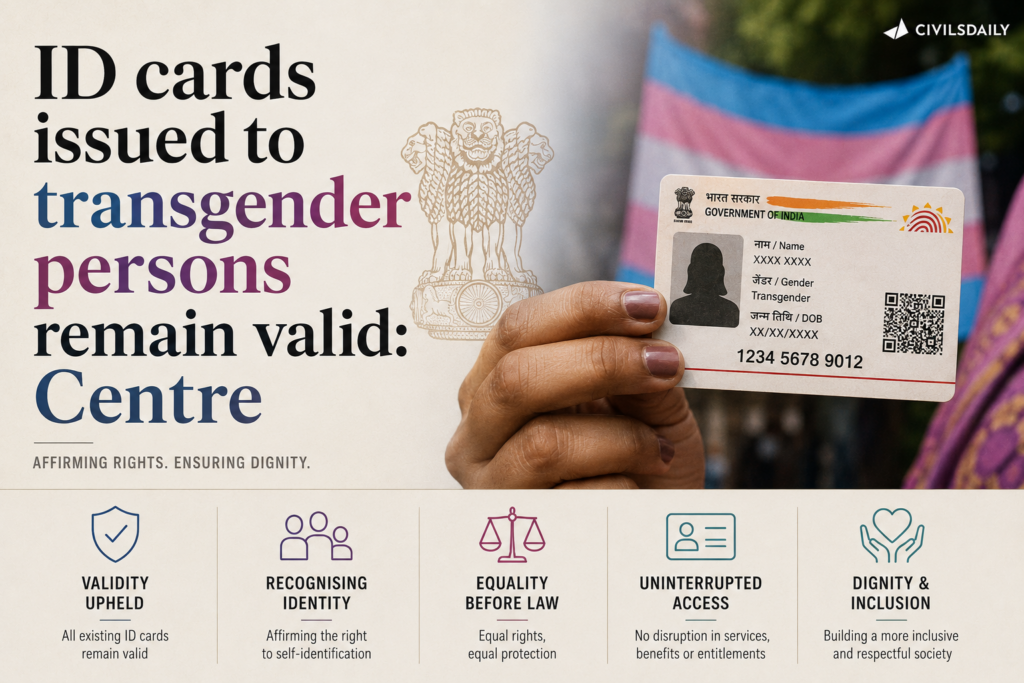
The Union government assured a three judge Bench of the Supreme Court that transgender identity cards issued before the Transgender Persons (Protection of Rights) Amendment Act, 2026 came into force continue to remain valid. The assurance was given in a challenge arguing that the amendment, in force since 30 March, dismantles the right to self identification recognised in the National Legal Services Authority v Union of India (2014) line of cases. The dispute turns on whether gender identity is declared by the person or certified by the State.
What is the Transgender Persons (Protection of Rights) Amendment Act, 2026?
- About: It amends the Transgender Persons (Protection of Rights) Act, 2019, the statute that governs recognition of transgender identity and the certificate of identity issued to a transgender person.
- Commencement: It came into force on 30 March 2026.
- Core objection to it: Petitioners argue that it dismantles the right to self identification and gives the State unfettered authority to determine gender identity.
- Status of earlier cards: The Solicitor General assured the Court that identity cards issued before the amendment remain valid, and their validity is unaffected by the new law.
- Judicial position so far: The Court had already indicated in the previous hearing that the 2026 law should not operate retrospectively to invalidate cards issued under the earlier legislation.
- Forum: The challenge is before a three judge Bench headed by the Chief Justice of India.
What is self identification of gender?
- About: Self identification is the principle that a person’s gender is determined by that person’s own declaration of identity, without any requirement of medical examination or third party certification.
- Legal origin in India: The Supreme Court recognised it in National Legal Services Authority v Union of India (2014), holding that the right to determine one’s gender is integral to dignity under Article 21.
What is a transgender identity card?
- About: A certificate of identity issued to a transgender person that provides official recognition of the person’s self identified gender.
- Practical use: It is used to support changes to name and gender across official records, and the government’s transgender portal expressly enables such changes.
What is the current status of gender identity recognition in India?
- Statutory basis: Recognition runs through the certificate of identity issued under the Transgender Persons (Protection of Rights) Act, 2019 and the rules made under it.
- Application route: An application is made to the District Magistrate, who issues a certificate of identity as a transgender person and a revised certificate after gender affirming surgery.
- Third gender status: Transgender persons are recognised as a third gender for the purposes of state welfare and identity documents.
- Prohibition of discrimination: The 2019 Act bars discrimination in education, employment, healthcare, access to public goods and the right to residence.
- Reservation position: No reservation in education or public employment has been extended to transgender persons as a class, despite the direction in the 2014 judgment to treat them as socially and educationally backward.
- Position after the amendment: The 2026 Amendment Act is in force from 30 March 2026, and its validity is under challenge before a three judge Bench.
- Position of existing card holders: Cards issued before the amendment continue to remain valid on the government’s own assurance to the Court.
Constitutional Provisions Related to gender identity
- Article 14: Guarantees equality before the law and equal protection of the laws to every person, not only to men and women.
- Article 15: Prohibits discrimination on grounds of religion, race, caste, sex or place of birth, with sex read to include gender identity.
- Article 16: Guarantees equality of opportunity in matters of public employment and permits reservation for backward classes.
- Article 19(1)(a): Protects freedom of expression, which includes expression of gender identity through dress, speech and behaviour.
- Article 21: Guarantees life and personal liberty, read to include dignity, personal autonomy and the right to determine one’s gender.
- Article 15(4) and Article 16(4): Permit special provisions and reservation for socially and educationally backward classes, the route directed in the 2014 judgment.
- Article 32: Provides the remedy through which the present challenge to the amendment has been brought.
- Article 23: Prohibits trafficking and forced labour, relevant to the exploitation the community faces in the absence of livelihood options.
What did the National Legal Services Authority judgment establish?
- Recognition of a third gender: The Supreme Court held in April 2014 that transgender persons must be recognised as a third gender for the purposes of law.
- Right to self identification: It held that the gender to which a person belongs is to be determined by that person’s own identification and not by biological or medical criteria.
- Constitutional grounding: It located the right in Articles 14, 15, 16, 19(1)(a) and 21, treating gender identity as an aspect of dignity and personal autonomy.
- Backward class direction: It directed the Centre and the States to treat transgender persons as socially and educationally backward for the purposes of reservation.
- Positive obligations: It directed provision of separate public toilets, medical facilities, welfare schemes and measures to address social stigma.
- The wider line of cases: Puttaswamy v Union of India (2017) recognised privacy and decisional autonomy, Navtej Singh Johar v Union of India (2018) decriminalised consensual same sex relations, and Arunkumar v Inspector General of Registration (2019) upheld the marriage rights of a transgender person.
What do the petitioners argue against the 2026 amendment?
- Loss of self determination: The amendment allows the State unfettered authority to determine gender identity, displacing the person’s own declaration.
- Conflict with binding precedent: Self identification was recognised as a constitutional right in 2014, and a statute cannot narrow a right located in Article 21.
- Value of existing documents: The importance of transgender identity cards already issued cannot be trifled away, since name and gender across official records depend on them.
- Retrospective effect: Any reading that invalidates earlier cards would strip recognition already granted under a previous legislation.
- Who is before the Court: The petitioners include community members and activists, so the challenge is brought by the group the law regulates.
Can the State certify gender identity without displacing the right to determine it?
- Two claims in tension: The State has an interest in a verifiable identity document, and the individual has a constitutional right to declare gender without external validation.
- Where certification becomes control: A certificate that records a declaration is administrative, and a certificate that decides the declaration is determinative of the right itself.
- Documentary dependence: Name and gender in every other official record follow from the certificate, so control over the certificate is control over legal personality.
- Precedent against statute: The right was recognised through Article 21 in 2014, and the amendment operates on the same subject through ordinary legislation.
- The retrospectivity carve out: Protecting existing cards resolves the immediate hardship of current holders and leaves the question of future applicants untouched.
- The unresolved core: The assurance settles who keeps a card already issued, not who will be entitled to one under the amended procedure.
Major debates surrounding gender self identification
- Declaration against certification: Whether recognition should follow a self declaration or require screening by a district authority.
- Medicalisation of identity: Whether any surgical or medical requirement for a revised certificate is consistent with autonomy under Article 21.
- Appeal and remedy: Whether refusal of a certificate by a District Magistrate should carry a statutory appeal, which the 2019 Act was criticised for omitting.
- Reservation for transgender persons: Whether the 2014 direction to treat the community as socially and educationally backward requires a horizontal reservation across categories.
- Penalty asymmetry: Whether the lower punishment for sexual violence against transgender persons under the 2019 Act compared with the general criminal law is constitutionally sustainable.
- Family and residence: Whether the requirement to reside with the natal family or in a rehabilitation centre respects the autonomy of adults who leave hostile homes.
- Data and enumeration: Whether recognition can be operationalised at all without accurate population data, since the last enumeration of the community was in Census 2011.
Challenges to the transgender rights framework
- Certification bottleneck: Recognition depends on a single district officer with no statutory appeal against refusal. e.g. applicants under the Transgender Persons (Protection of Rights) Rules, 2020 have reported long delays in issue of the certificate of identity.
- Absence of reservation: The 2014 direction on backward class status has not been operationalised at the national level. e.g. Karnataka became the first State to provide a one per cent reservation in public employment in 2021, and most States have not followed.
- Weak penalty structure: Offences against transgender persons carry lower punishment than equivalent offences in the general criminal law. e.g. the 2019 Act prescribes six months to two years for sexual abuse of a transgender person.
- Healthcare exclusion: Gender affirming care and mental health support are unevenly available and rarely insured. e.g. Ayushman Bharat TG Plus was created precisely because transgender persons were excluded from mainstream health coverage.
- Livelihood and employment: Discrimination pushes the community towards begging and sex work despite a statutory bar on discrimination. e.g. the SMILE scheme’s livelihood component was designed to move persons out of begging.
- Documentation mismatch: Records in education certificates, bank accounts and property documents do not update automatically after a change in gender. e.g. the government’s transgender portal exists specifically to enable name and gender changes across records.
- Data invisibility: Policy runs on a 2011 count with no subsequent enumeration. e.g. Census 2011 recorded 4.88 lakh transgender persons, a figure widely regarded as an undercount.
Conclusion
The assurance protects existing card holders and leaves the constitutional question untouched, since the dispute is about whether gender identity is declared or certified. The Transgender Persons (Protection of Rights) Amendment Act, 2026 remains in force from 30 March 2026, and its validity is pending before a three judge Bench of the Supreme Court on a challenge grounded in the 2014 line of cases. The Court has recorded that the law should not operate retrospectively and the government has accepted that position on the record. The source names no next date for the hearing, so the stage reached is the government’s undertaking and the pending challenge.
[2024] Under which of the following Articles of the Constitution of India, has the Supreme Court of India placed the Right to Privacy?
(a) Article 15
(b) Article 16
(c) Article 19
(d) Article 21
