Why in the News
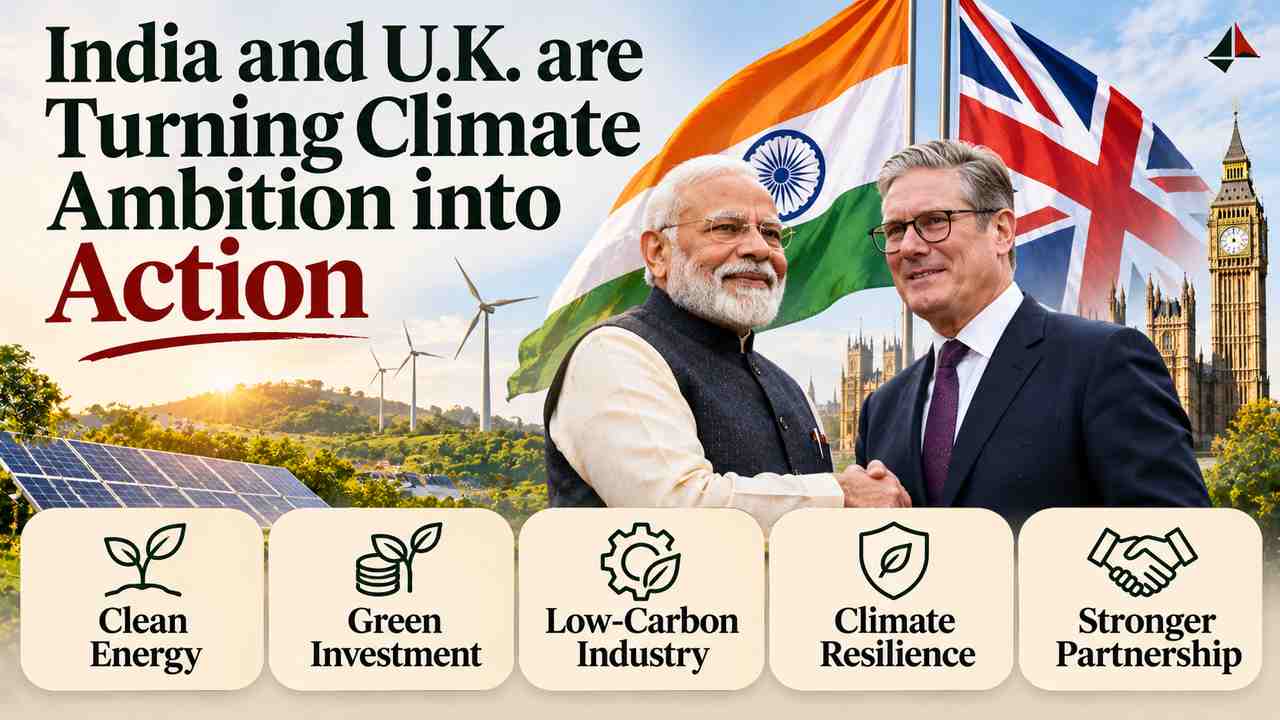
India and the United Kingdom (U.K.) present their climate partnership as a move from targets to delivery. The largest ever Earthshot Prize edition is held in Mumbai next week, as the 31st Conference of the Parties (COP31) to the United Nations (UN) climate convention meets in Türkiye. The test is whether capital and policy certainty follow the ideas.
What is the Earthshot Prize, and why is it in India?
- What it is: Founded by the Prince of Wales and launched in 2020, the Earthshot Prize rewards environmental solutions that can work at scale, like a global innovation contest.
- Prize money: Five winners will each receive £1 million to accelerate their work.
- India’s record: India has produced more finalists and winners than any other country: nine finalists, including four winners.
- The takeaway: The Mumbai edition puts India’s role in clean growth and climate innovation on display.
Why is faster climate action urgent, and what shows it can work?
- Montreal Protocol: Under the Montreal Protocol, a global treaty, governments, companies, scientists and non governmental organisations together phased out almost all ozone depleting substances. The ozone layer is on track to recover within decades.
- Worsening crisis: El Niño, a periodic Pacific warming that disrupts weather worldwide, and conflict driven energy shocks have worsened the climate crisis this year.
Where do India and the U.K. stand on clean energy?
- India’s capacity milestone: Non fossil sources now account for more than half of India’s installed power capacity, five years ahead of its 2030 target.
- India’s global role: India aims for 500 gigawatts of non fossil capacity by 2030. It shapes the global response through the International Solar Alliance (ISA) and the Coalition for Disaster Resilient Infrastructure (CDRI).
- U.K. record: The U.K. has cut its greenhouse gas emissions by more than half since 1990 and kept its economy growing.
How do the two countries cooperate on energy and finance?
- Regulators and offshore wind: India’s Central Electricity Regulatory Commission (CERC) and the U.K.’s Office of Gas and Electricity Markets (Ofgem) cooperate on electricity market reform. A joint taskforce supports offshore wind in India.
- Shared learning: The U.K. was partner country at the Bharat Renewable Energy Summit and Expo 2026, and it is learning from India’s energy stack on how to share data.
- Climate Finance Initiative: The two governments launched the India-U.K. Climate Finance Initiative last year to scale climate investment.
- Capital portfolio: A £330 million U.K. portfolio, run with the Government of India, has drawn in more than £3.5 billion for green businesses and start ups.
- British International Investment (BII): The U.K.’s development finance institution has backed more than 600 businesses and committed $1.1 billion to climate investments in India, its largest market.
Why is climate also treated as a security issue?
- Climate as security: At the UN General Assembly in September, the U.K. Foreign Secretary jointly convened foreign ministers on climate and nature as national security challenges.
- Disaster risk reduction: India and the U.K. jointly chaired the UN Disaster Risk Reduction Senior Officials’ Meeting in New Delhi in October.
- Sovereign disaster risk pool: India’s National Disaster Management Authority (NDMA) and the U.K.’s Centre for Disaster Protection are assessing a sovereign disaster risk pool, a shared insurance fund that pays governments quickly after a disaster.
Challenges
- Scale of finance: Portfolios of hundreds of millions of pounds are small against the investment India’s non fossil target needs.
- Capacity versus generation: Installed capacity overstates the transition, since coal still produces most of India’s electricity.
- Policy certainty: Innovators scale only with predictable policy, so shifting rules deter long term investors.
Way Forward
- Blended finance: Use public portfolios to draw larger private capital into grids, storage and electric transport.
- Risk pool decision: Complete the feasibility study on the risk pool and settle its design and funding.
- Route to scale: Link Earthshot finalists to investors and public procurement so their solutions reach scale.
Conclusion
India and the U.K. have built a working climate partnership across regulation, finance and disaster risk. Whether its finance and policy certainty grow to match their targets is the test COP31 will sharpen.
About India-U.K. Relations
- Trade agreement: The Comprehensive Economic and Trade Agreement (CETA) came into force in July 2026, with zero duty access for 99% of Indian exports to the U.K.
- U.K.-India Vision 2035: Adopted with the signing of the CETA in July 2025, this ten year agenda covers trade, technology, defence and education, with climate and clean energy central to it.
Matching Previous Year Question
“[2022, GS3, 15 marks] Do you think India will meet 50 percent of its energy needs from renewable energy by 2030 ? Justify your answer. How will the shift of subsidies from fossil fuels to renewables help achieve the above objective? Explain.”
