Why in the news?
The Government of India highlighted major achievements in environmental protection, biodiversity conservation, climate action, and sustainable development over the last 12 years.
Forest and Green Cover
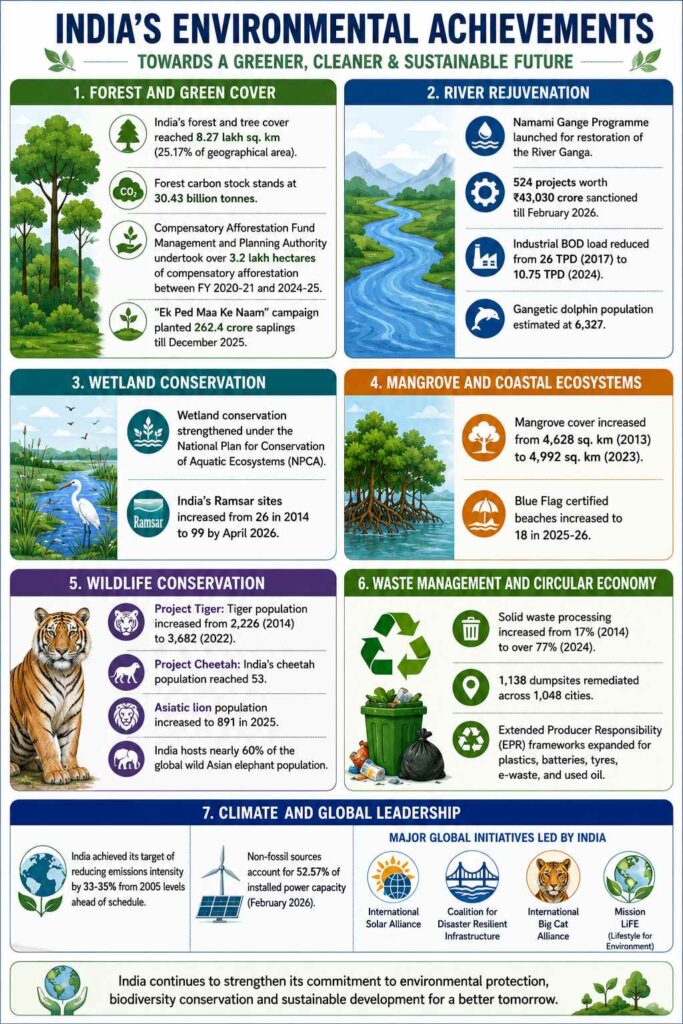
- India’s forest and tree cover reached 8.27 lakh sq. km (25.17% of geographical area).
- Forest carbon stock stands at 30.43 billion tonnes.
- Compensatory Afforestation Fund Management and Planning Authority undertook over 3.2 lakh hectares of compensatory afforestation between FY 2020-21 and 2024-25.
- “Ek Ped Maa Ke Naam” campaign planted 262.4 crore saplings till December 2025.
River Rejuvenation
- Namami Gange Programme launched for restoration of the River Ganga.
- 524 projects worth ₹43,030 crore sanctioned till February 2026.
- Industrial BOD load reduced from 26 TPD (2017) to 10.75 TPD (2024).
- Gangetic dolphin population estimated at 6,327.
Wetland Conservation
- Wetland conservation strengthened under the National Plan for Conservation of Aquatic Ecosystems (NPCA).
- India’s Ramsar sites increased from 26 in 2014 to 99 by April 2026.
Mangrove and Coastal Ecosystems
- Mangrove cover increased from 4,628 sq. km (2013) to 4,992 sq. km (2023).
- Blue Flag certified beaches increased to 18 in 2025-26.
Wildlife Conservation
- Project Tiger: Tiger population increased from 2,226 (2014) to 3,682 (2022).
- Project Cheetah: India’s cheetah population reached 53.
- Asiatic lion population increased to 891 in 2025.
- India hosts nearly 60% of the global wild Asian elephant population.
Waste Management and Circular Economy
- Solid waste processing increased from 17% (2014) to over 77% (2024).
- 1,138 dumpsites remediated across 1,048 cities.
- Extended Producer Responsibility (EPR) frameworks expanded for plastics, batteries, tyres, e-waste, and used oil.
Climate and Global Leadership
- India achieved its target of reducing emissions intensity by 33-35% from 2005 levels ahead of schedule.
- Non-fossil sources account for 52.57% of installed power capacity (February 2026).
- Major global initiatives led by India:
- International Solar Alliance
- Coalition for Disaster Resilient Infrastructure
- International Big Cat Alliance
- Mission LiFE
[2025] Consider the following statements:
Statement I: Circular economy reduces the emissions of greenhouse gases.
Statement II: Circular economy reduces the use of raw materials as inputs.
Statement III : Circular economy reduces wastage in the production process.
Which one of the following is correct in respect of the above statements?
[A] Both Statement II and Statement III are correct and both of them explain Statement I
[B] Both Statement II and Statement III are correct but only one of them explains Statement I
[C] Only one of the Statements II and III is correct and that explains Statement I
[D] Neither Statement II nor Statement III is correct
