Why in the News
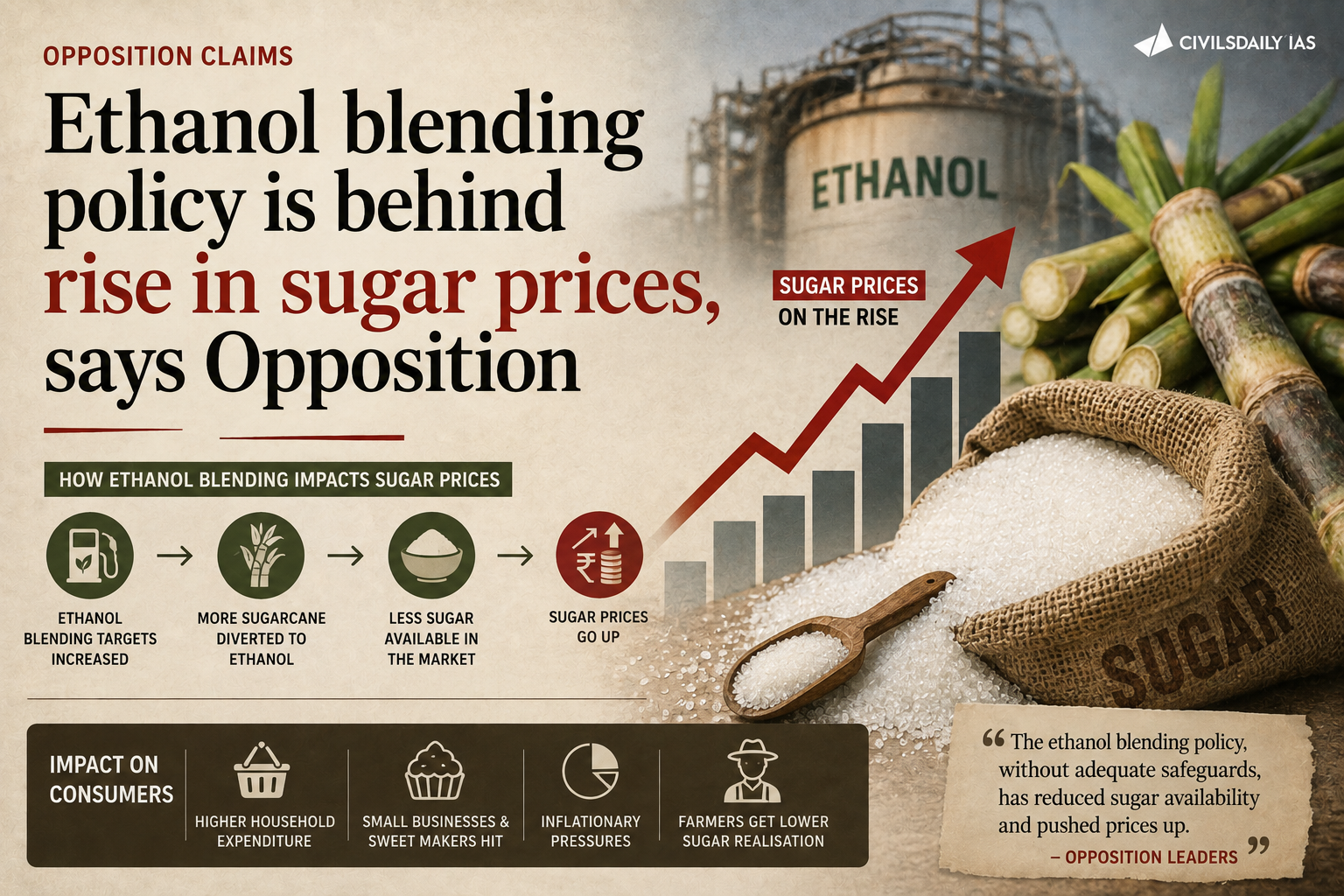
Retail sugar prices reached Rs 62.5 to Rs 64 per kg in Maharashtra and Rs 63 to Rs 64 per kg in Karnataka on 20 August. The corresponding ranges on 1 August were Rs 46.2 to Rs 46.9 and Rs 46.25 to Rs 47 per kg, with Uttar Pradesh at Rs 44.95 to Rs 46.7. Closing stocks for the 2025-26 sugar season are set to fall to a nine-year low on a production shortfall. The ethanol blending programme has been named as the cause of the spike. What is contested is whether diverting cane to fuel drove the price rise, or whether a crop failure larger than the diversion did.
What is the Ethanol Blended Petrol Programme?
- A fuel substitution programme run through sugar mills: The Ethanol Blended Petrol (EBP) Programme requires oil marketing companies to blend ethanol into petrol, and it sources that ethanol partly from sugarcane. It runs under the National Policy on Biofuels, 2018.
- Cane can be diverted at three points: Mills may make ethanol from direct sugarcane juice or syrup, from B-heavy molasses, or from C-heavy molasses, each of which sacrifices a different quantity of sugar.
- The 20 per cent target was met early: The blending target of 20 per cent ethanol in petrol was achieved ahead of its 2025-26 deadline.
- It exists to fix mill finances as much as fuel imports: Diversion gives mills a buyer who pays on delivery, which shortens the cane payment cycle to farmers and cuts crude oil imports at the same time.
What is sugar recovery?
- Recovery is the yield of the crush: Recovery rate is the sugar produced expressed as a percentage of the cane crushed, and it decides how much sugar a given tonnage of cane actually yields.
- It is set in the field, not the mill: Recovery depends on sucrose accumulated in the cane stalk, which needs sunlight and aeration in the ripening months, so a waterlogged crop lowers recovery even where tonnage holds up.
What are B-heavy and C-heavy molasses?
- Molasses grades mark how much sugar is left behind: Molasses is the residue after sugar crystals are extracted, and B-heavy molasses is drawn off at an earlier stage than C-heavy molasses, so it retains more fermentable sugar.
- The grade decides the sugar sacrificed: One tonne of ethanol from C-heavy molasses costs almost no sugar, B-heavy costs more, and direct juice or syrup costs the most, which is why diversion policy is set grade by grade.
India’s sugar balance sheet: what do the numbers show?
| Sugar Year (Oct-Sep) | Opening Stocks | Domestic Output | Domestic Consumption | Exports | Closing Stocks |
|---|---|---|---|---|---|
| 2016-17 | 72.5 | 202.62 | 244.48 | 0.46 | 39.41 |
| 2017-18 | 39.41 | 323.28 | 253.9 | 6.32 | 104.71 |
| 2018-19 | 104.71 | 331.62 | 255 | 38 | 143.33 |
| 2019-20 | 143.33 | 273.85 | 253 | 59.4 | 104.78 |
| 2020-21 | 104.78 | 311.2 | 260 | 72 | 83.98 |
| 2021-22 | 83.98 | 359.25 | 262 | 110 | 71.23 |
| 2022-23 | 71.23 | 331 | 281 | 64 | 57.23 |
| 2023-24 | 57.23 | 319 | 295 | 1 | 80.23 |
| 2024-25 | 80.23 | 261.8 | 284 | 8 | 50.03 |
| 2025-26* | 50.03 | 279 | 280 | 8 | 41.03 |
All figures in lakh tonnes. *Industry estimates. Source: National Federation of Cooperative Sugar Factories Ltd.
- The season starts with just over 50 lakh tonnes: Opening stocks for 2025-26 stood at 50.03 lakh tonnes, so total sugar available after adding production works out to about 329 lakh tonnes.
- Consumption and exports leave 41 lakh tonnes: Deducting domestic consumption of 280 lakh tonnes and exports of 8 lakh tonnes closes the season at around 41 lakh tonnes.
- That is the lowest in nine years: The last time closing stocks were lower was 39.41 lakh tonnes in 2016-17.
- A disputed opening figure makes it worse: Some in the industry hold that opening stocks were only 48 lakh tonnes rather than 50.03 lakh tonnes, which would take closing stocks to 39 lakh tonnes, the lowest since 2008-09.
- The peak was three seasons of surplus: Closing stocks ran to 143.33 lakh tonnes in 2018-19 and were still 104.78 lakh tonnes in 2019-20, so the current tightness follows a period of overhang, not chronic scarcity.
Why did production fall so far below projection?
- The apex body projected a large crop: The Indian Sugar and Bio-energy Manufacturers Association (ISMA), the association of private sugar mills, estimated gross production for the 2025-26 season at 343.5 lakh tonnes in early November 2025. After 34 lakh tonnes of ethanol diversion, it pegged net output at 309.5 lakh tonnes.
- The actual crop came in far smaller: Latest industry estimates put gross production at 309 lakh tonnes and ethanol diversion at 30 lakh tonnes, leaving net output at 279 lakh tonnes. Net output is therefore 30.5 lakh tonnes below the 309.5 lakh tonnes originally projected on a net basis.
- Excess rain hit the crop at the wrong time: The cane crop in Maharashtra, Karnataka and Gujarat suffered excess rainfall in September and October last year, with a delayed withdrawal of the southwest monsoon.
- Waterlogging cut both tonnage and recovery: Waterlogged fields combined with a lack of sunshine deprived the standing crop of aeration and daylight. That affected cane growth and sucrose accumulation in the stalks, lowering yields and mill recovery.
- The two tropical States missed badly: ISMA had projected Maharashtra at 130 lakh tonnes and Karnataka at 63.5 lakh tonnes, and their mills produced only 99.2 lakh tonnes and 47.2 lakh tonnes.
- Uttar Pradesh lost output to disease and pest: Factories in the State produced 89.7 lakh tonnes against an earlier estimate of 103.2 lakh tonnes. Red rot fungal disease and the top shoot borer insect pest were the chief causes, and the dominant Co-0238 cane variety has grown increasingly susceptible to both.
What turned a shortfall into a price spike?
- Prices were flat for most of the season: Average ex-factory prices in Maharashtra fell from Rs 38.31 to Rs 36.98 per kg between September 2025 and April 2026, then recovered to Rs 38.23 by June. They rose from July, averaging Rs 41.85 per kg that month.
- Declared mill stocks were doubted: Some liquidity-strapped mills had already sold sugar beyond their government-fixed monthly release quotas and had little left. The stocks they declared existed on paper.
- A second bad monsoon was priced in early: High rainfall deficiency in June, particularly in Maharashtra and Karnataka, convinced the trade that yields and production would take a hit in the 2026-27 season as well.
- Buyers and sellers both moved first: Larger merchants, stockists and bulk industrial consumers began taking positions before July. From August some mills started holding back sales in anticipation of higher prices ahead of the festival season.
Where does India’s ethanol actually come from?
- Sugarcane supplies under a third: Of 810.67 crore litres of ethanol supplied to oil marketing companies for blending between November 2025 and July 2026, only 259.24 crore litres or 32 per cent came from sugarcane-based feedstock.
- Direct juice and syrup is the largest cane route: Direct juice or syrup contributed 147.6 crore litres, B-heavy molasses 98.19 crore litres and C-heavy molasses 13.45 crore litres.
- Grain supplies the balance: Distilleries using grain-based feedstock supplied 551.43 crore litres or 68 per cent of the total.
- Maize leads the grain feedstock: Maize accounted for 288 crore litres, Food Corporation of India rice 207.1 crore litres and broken or damaged foodgrains 56.33 crore litres.
Is ethanol diversion the cause of the spike or a scapegoat for a crop failure?
- The diversion looks large in isolation: Thirty lakh tonnes of sugar went into ethanol in the current season, which is more than two-thirds of the season’s projected closing stock.
- The crop failure was larger than the diversion: Gross production before any diversion came in 34.5 lakh tonnes below the initial gross estimate of 343.5 lakh tonnes, so the sugar lost to the weather exceeded the sugar lost to fuel.
- Two-thirds of blended ethanol never touched cane: The blending target is being met mainly out of maize and rice, so cutting cane diversion to zero would remove only a third of the programme’s feedstock demand and not a third of the price.
- Reversing diversion moves the problem, it does not remove it: Ethanol sales are the payment stream that lets mills clear cane dues on time, so a ban on juice and B-heavy diversion converts a consumer price problem into a farmer arrears problem.
What has the government done to check sugar prices?
- Exports banned on 13 May: All sugar exports were banned until 30 September 2026. It was a precautionary move rather than a response to a confirmed shortage.
- Duty-free imports opened this week: Import of up to 10 lakh tonnes of raw sugar at zero duty was allowed until 31 October, against the standard tariff of 100 per cent on the sweetener.
- Refiners at Kandla will process the raws: The raw sugar can be processed by companies operating refineries at Gujarat’s Kandla port, such as Shree Renuka Sugars and Shri Dutta India Private Ltd. The refined output can supply the market until Indian mills begin cane crushing from end-October to early November.
- Stock limits imposed on 28 July: A stocking limit of 400 tonnes was imposed on all sugar dealers, and no dealer may hold any sugar beyond 30 days of receiving it.
- Bulk buyers put under disclosure on 13 August: Mills were directed by letter to furnish details of bulk consumers such as soft drink and confectionery makers and sweetmeat sellers who bought 500 tonnes or more annually, directly or through agents, during the 2025-26 financial year.
- A diversion curb is expected next: The government is expected to direct mills not to manufacture ethanol from direct sugarcane juice and B-heavy molasses in the 2026-27 season, on the stated priority of augmenting domestic sugar supply.
Challenges to the Ethanol Blended Petrol Programme
- Grain has crowded out cane as feedstock: Grain-based distilleries now supply more than twice the volume the cane routes do, which shifts the food security question from sugar to cereals. Eg. Food Corporation of India rice was released to distilleries in the current supply year. Fix. Cap grain feedstock at a notified share of annual blending and reserve open market cereal releases for the public distribution system.
- Procurement prices have not tracked cane costs: Ethanol procurement prices have stayed largely stagnant as the Fair and Remunerative Price for cane has risen, squeezing distillery margins. Eg. Cane FRP rose from Rs 285 per quintal in 2020-21 to Rs 355 per quintal in 2025-26. Fix. Index the ethanol procurement price for each feedstock route to the notified cane price through a published formula.
- Distillation capacity sits underused: Mills built distilleries on the expectation of assured diversion, and capacity idles whenever policy switches back to sugar. Eg. Many mills face underutilised distillation capacity in the current season. Fix. Publish a three-year rolling diversion band so investment decisions are made against a stated range rather than an annual notification.
- Higher blends carry a vehicle cost: Ethanol has a lower energy density than petrol, so fuel efficiency falls by roughly 2 to 6 per cent at higher blend levels and older engines face material compatibility issues. Eg. Vehicles manufactured before E20 compliance norms were not certified for the current blend. Fix. Mandate a labelled dual fuel dispensing option at retail outlets so owners of non-compliant vehicles retain a lower blend choice.
- Cane ethanol carries a heavy water footprint: Sugarcane is grown largely in water-stressed tropical districts, so cane-based ethanol transfers an irrigation burden to the fuel sector. Eg. Maharashtra and Karnataka face groundwater depletion in the same belts that supply mill cane. Fix. Restrict juice and B-heavy diversion licences to mills that have converted a notified share of their command area to drip irrigation.
Conclusion
The sugar price spike is the result of a crop that came in 34.5 lakh tonnes below projection in gross terms, stocks doubted by the trade and positions taken ahead of the festival season, not of ethanol diversion that supplied under a third of blended fuel. The government has answered on the supply side, with an export ban, duty-free raw imports, dealer stock limits and bulk-buyer disclosure. A curb on cane-based ethanol in 2026-27 would trade a consumer price problem for a cane arrears problem. The season will close on the tightest stock position in nine years, and next season’s crop is already being discounted for a deficient June.
“[2025] Consider the following statements:
Statement I: Of the two major ethanol producers in the world, i.e., Brazil and the United States of America, the former produces more ethanol than the latter.
Statement II: Unlike in the United States of America, where corn is the principal feedstock for ethanol production, sugarcane is the principal feedstock for ethanol production in Brazil.
Which one of the following is correct in respect of the above statements?
(a) Both Statement I and Statement II are correct and Statement II explains Statement I
(b) Both Statement I and Statement II are correct but Statement II does not explain Statement I
(c) Statement I is correct but Statement II is not correct
(d) Statement I is not correct but Statement II is correct
