💥UPSC 2026, 2027, 2028 UAP Mentorship (March Batch) + Access XFactor Notes & Microthemes PDF

Search results for: “”

  • African cheetahs still stuck in transit

    India’s ambitious project to translocate African cheetahs has missed an unofficial deadline of August 15.

    Asiatic Cheetah

    • Cheetah, the world’s fastest land animal was declared extinct in India in 1952.
    • The Asiatic cheetah is classified as a “critically endangered” species by the IUCN Red List, and is believed to survive only in Iran.
    • It was expected to be re-introduced into the country after the Supreme Court lifted curbs for its re-introduction.

    Distribution of cheetahs in India

    • Historically, Asiatic cheetahs had a very wide distribution in India.
    • There are authentic reports of their occurrence from as far north as Punjab to Tirunelveli district in southern Tamil Nadu, from Gujarat and Rajasthan in the west to Bengal in the east.
    • Most of the records are from a belt extending from Gujarat passing through Maharashtra, Madhya Pradesh, Uttar Pradesh, Chhattisgarh, Jharkhand and Odisha.
    • There is also a cluster of reports from southern Maharashtra extending to parts of Karnataka, Telangana, Kerala and Tamil Nadu.
    • The distribution range of the cheetah was wide and spread all over the subcontinent. They occurred in substantial numbers.
    • The cheetah’s habitat was also diverse, favouring the more open habitats: scrub forests, dry grasslands, savannahs and other arid and semi-arid open habitats.

    What caused the extinction of cheetahs in India?

    • The major reasons for the extinction of the Asiatic cheetah in India:
    1. Reduced fecundity and high infant mortality in the wild
    2. Inability to breed in captivity
    3. Sport hunting and
    4. Bounty killings
    • It is reported that the Mughal Emperor Akbar had kept 1,000 cheetahs in his menagerie and collected as many as 9,000 cats during his half-century reign from 1556 to 1605.
    • The cheetah numbers were fast depleting by the end of the 18th century even though their prey base and habitat survived till much later.
    • It is recorded that the last cheetahs were shot in India in 1947, but there are credible reports of sightings of the cat till about 1967.

    Conservation objectives for their re-introduction

    • Based on the available evidence it is difficult to conclude that the decision to introduce the African cheetah in India is based on science.
    • Science is being used as a legitimising tool for what seems to be a politically influenced conservation goal.
    • This also in turn sidelines conservation priorities, an order of the Supreme Court, socio-economic constraints and academic rigour.
    • The issue calls for an open and informed debate.

    Issues in re-introduction

    • Experts find it difficult whether the African cheetahs would find the sanctuary a favorable climate as far as the abundance of prey is concerned.
    • The habitat of cheetahs is needed to support a genetically viable population.


    UPSC 2023 countdown has begun! Get your personal guidance plan now! (Click here)

  • Super Vasuki: India’s longest train

    The Railways conducted a test run of its longest freight train, Super Vasuki, with 295 loaded wagons carrying over 27,000 tonnes of coal.

    Super Vasuki

    • The 3.5-km-long freight train covered the distance of about 267 km between Korba in Chhattisgarh and Rajnandgaon in Nagpur.
    • It was run by the South East Central Railway (SECR).
    • The Railways plans to use this arrangement (longer freight trains) more frequently, especially to transport coal in peak demand season to prevent fuel shortages in power stations.

    Feats achieved

    • This is the longest and heaviest freight train ever run by the Indian Railways.
    • The train takes about four minutes to cross a station.
    • The amount of coal carried by Super Vasuki is enough to fire 3,000 MW of power plant for one full day.
    • This is three times the capacity of existing railway rakes (90 cars with 100 tonnes in each) that carry about 9,000 tonnes of coal in one journey.


    UPSC 2023 countdown has begun! Get your personal guidance plan now! (Click here)

  • fiscal federalism in India

    Context

    The centralisation of fiscal powers in India has been blamed for the poor fiscal health of the states.

    Centralisation of fiscal powers: A background

    • Jawaharlal Nehru believed that socio-economic inequities could be addressed through the planning process.
    • A degree of centralisation in fiscal power was required to address the concerns of socio-economic and regional disparities.
    • As a result asymmetric federalism is inherent to the Indian Constitution.
    • India was never truly federal — it was a ‘holding together federalism’ in contrast to the ‘coming together federalism,’ in which smaller independent entities come together to form a federation (as in the United States of America).
    • In fact, the Government of India Act 1935 was more federal in nature than the Constitution adopted on January 26, 1950 as the first offered more power to its provincial governments.
    • Historically, India’s fiscal transfer worked through two pillars, i.e., the Planning Commission and the Finance Commission. 
    • But the waning of planning since the 1990s, and its abolition in 2014, led to the Finance Commission becoming a major means of fiscal transfer as the commission itself broadened its scope of sharing all taxes since 2000 from its original design of just two taxes — income tax and Union excise duties.
    •  Today, the Finance Commission became a politicised institution with arbitrariness and inherent bias towards the Union government.
    • Tamil Nadu government constituted a committee under Justice P.V. Rajamannar in 1969, the first of its kind by a State government, to look at Centre-State fiscal relations and recommend more transfers and taxation powers for regional governments.

    Declining fiscal capacity of the states

    • While States lost their capacity to generate revenue by surrendering their rights in the wake of the Goods and Services Tax (GST) regime, their expenditure pattern too was distorted by the Union’s intrusion, particularly through its centrally sponsored schemes.
    • The ability of States to finance current expenditures from their own revenues has declined from 69% in 1955-56 to less than 38% in 2019-20.
    • While the expenditure of the States has been shooting up, their revenues did not.
    • Stagnant revenue: Since States cannot raise tax revenue because of curtailed indirect tax rights — subsumed in GST, except for petroleum products, electricity and alcohol — the revenue has been stagnant at 6% of GDP in the past decade.

    Implications of fiscal centralisation in India

    • Use of non-divisive cess: Even the increased share of devolution, mooted by the Fourteenth Finance Commission, from 32% to 42%, was subverted by raising non-divisive cess and surcharges that go directly into the Union kitty.
    •  This non-divisive pool in the Centre’s gross tax revenues shot up to 15.7% in 2020 from 9.43% in 2012, shrinking the divisible pool of resources for transfers to States.
    • Cut in the corporate tax: The recent drastic cut in corporate tax, with its adverse impact on the divisible pool, and ending GST compensation to States have had huge consequences.
    • States paying high interest rates: States are forced to pay differential interest — about 10% against 7% — by the Union for market borrowings.
    • Centrally sponsored schemes curbing autonomy:  There are 131 centrally sponsored schemes, with a few dozen of them accounting for 90% of the allocation, and States required to share a part of the cost.
    • They spend about 25% to 40% as matching grants at the expense of their priorities.
    • These schemes, driven by the one-size-fits-all approach, are given precedence over State schemes, undermining the electorally mandated democratic politics of States.
    • In fact, it is the schemes conceived by States that have proved to be beneficial to the people and that have contributed to social development.
    • Driven by democratic impulses, States have been successful in innovating schemes that were adopted at the national level.
    • The diversion of a State’s own funds to centrally sponsored schemes, thereby depleting resources for its own schemes, violates constitutional provision.
    • Deepening inequality: The World Inequality Report estimates ‘that the ratio of private wealth to national income increased from 290% in 1980 to 555% in 2020, one of the fastest such increases in the world.
    • The poorest half of the population has less than 6% of the wealth while the top 10% nearly grab two-third of it’.
    • India’s tax-GDP ratio has been one of the lowest in the world — 17% of which is well below the average ratios of emerging market economies and OECD countries’ about 21% and 34%, respectively.
    • Its income tax base has been very narrow.
    • Indirect tax still accounts for about 56% of total taxes.
    • Instead of strengthening direct taxation, the Union government slashed corporate tax from 35% to 25% in 2019 and went on to monetise its public sector assets to finance infrastructure.

    Conclusion

    In sum, India’s fiscal federalism driven by political centralisation has deepened socio-economic inequality, belying the dreams of the founding fathers who saw a cure for such inequities in planning. It has not altered inter-state disparities either.

    UPSC 2022 countdown has begun! Get your personal guidance plan now! (Click here)

  • 17th August 2022| Daily Answer Writing Enhancement(AWE)

    Topics for Today’s questions:

    GS-1        Salient features of Indian Society, Diversity of India.

    GS-2        Mechanisms, laws, institutions and bodies constituted for the protection and betterment of these vulnerable sections.

    GS-3        Cyber Security

    GS-4      Attitude: content, structure, function; its influence and relation with thought and behaviour; moral and political attitudes; social influence and persuasion.

    Question 1)


    Q.1 Critically assess the government’s move on raising the age of marriage of women in India from 18 to 21 years. (10 Marks)


    Question 2)

    Q.2 In view of the recent Parliamentary Standing Committee report, discuss the issues faced by the National Commission for Scheduled Tribes (NCST) and suggest measures that can be adopted to strengthen it. (10 Marks)

    Question 3)

    Q.3 Highlighting the vulnerability of India’s critical infrastructure to cyber attacks, discuss the various steps taken by the government to boost cyber security. (10 Marks)

    Question 4)  

    Q.4 Distinguish between attitude and behaviour. How attitude of an individual influence its behaviour? (10 Marks)


    HOW TO ATTEMPT ANSWERS IN DAILY ANSWER WRITING ENHANCEMENT(AWE)?

    1. Daily 4 questions from General studies 1, 2, 3, and 4 will be provided to you.

    2. A Mentor’s Comment will be available for all answers. This can be used as a guidance tool but we encourage you to write original answers.

    3. You can write your answer on an A4 sheet and scan/click pictures of the same.

    4.  Upload the scanned answer in the comment section of the same question.

    5. Along with the scanned answer, please share your Razor payment ID, so that paid members are given priority.

    6. If you upload the answer on the same day like the answer of 11th  February is uploaded on 11th February then your answer will be checked within 72 hours. Also, reviews will be in the order of submission- First come first serve basis

    7. If you are writing answers late, for example, 11th February is uploaded on 13th February , then these answers will be evaluated as per the mentor’s schedule.

    8. We encourage you to write answers on the same day. However, if you are uploading an answer late then tag the mentor like @Staff so that the mentor is notified about your answer.

    *In case your answer is not reviewed, reply to your answer saying *NOT CHECKED*. 

    1. For the philosophy of AWE and payment: 

  • This Independence Day, Get ready to secure a seat among the top 15000 to write IAS Mains 2023 | Avail a Flat 20% discount on mentoring by Santosh Sir.

    This Independence Day, Get ready to secure a seat among the top 15000 to write IAS Mains 2023 | Avail a Flat 20% discount on mentoring by Santosh Sir.

    To commemorate 75th Independence day, CivilsDaily will be giving a 20% scholarship for Smash Prelims 2023 enrollments between 15th-21st August 2023

    CLICK:- Download Smash Prelims 2023 Timetable


    Only 10000 out of around 11 Lakhs aspirants who appear, qualify in the UPSC Prelims. Just the 1%. This leaves no scope for mistakes, yet many of you keep committing the same mistakes again and again. 

    Considering the competition, complexity, and vastness of the syllabus, and a long drawn-out preparation cycle clearing IAS prelims becomes a formidable challenge for almost 99% of the aspirants. The key lies in staying in the green zone.


    Table of content:

    1. Staying in the Green Zone
    2. About Santosh sir
    3. Smash Prelims 2023 and 20% Independence week scholarship
    4. 6 pillared approach of Smash Prelims
    5. Success Stories of Smash Prelims 2022

    Stay in the Green Zone of Optimum performance with Santosh sir’s Mentorship

    In UPSC Prelims preparation it is not just the number of mocks you had attempted, syllabus covered, or UPSC experience you have had that matters but it is rather a combination of many factors. (Click here to discuss with a senior mentor)

    UPSC preparation is a long journey and ups and downs, are a part of it. While intensity or motivation can give you a high for a few days but it is consistency that will sail you through. You got to stay in the green zone of optimum preparation for the longest period of time.

    Under Santosh sir’s mentorship, students can feel consistency and improvement in UPSC Prelims preparation.

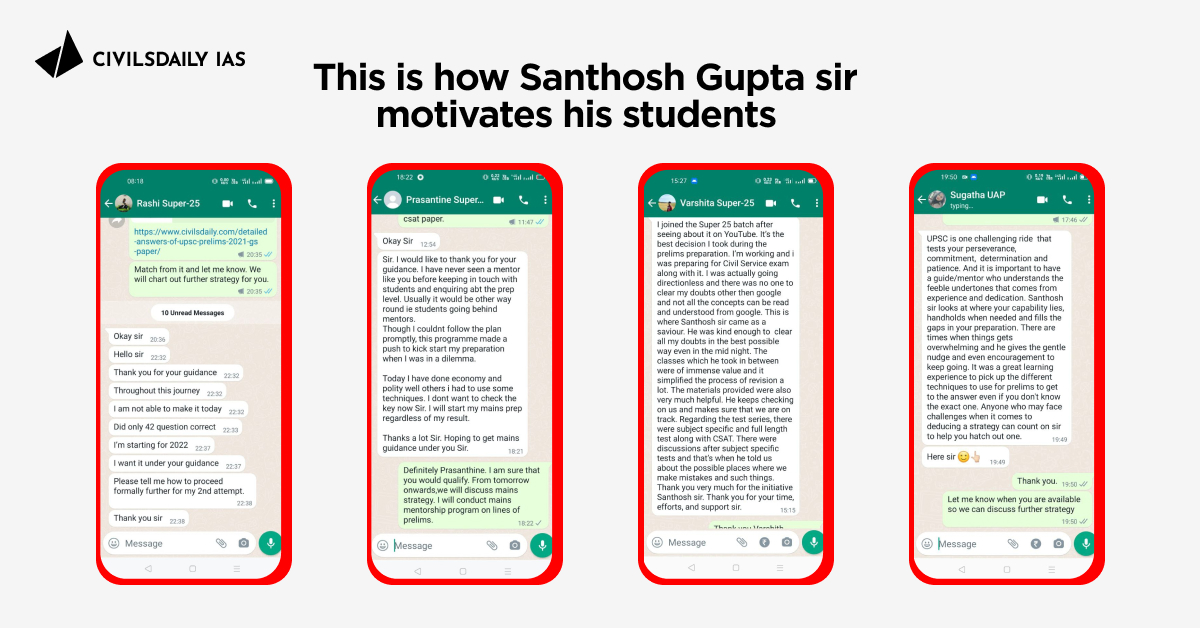
    Santosh sir is always there to ensure his students are following the right sources, makes them understand the concepts, plans strategies for his students, reviews and analyses their progress even on 1-1 calls. Along with academics, he is there with his students through the bouts of demotivation and lows.

    A quick bit about Santosh Gupta:

    Santosh Gupta sir has scored above 140 twice in UPSC prelims and always 120 plus in all 6 attempts. He wrote all 6 mains and appeared for Interviews 3 times. He has qualified UPSC EPFO and BPSC 56-59th also. He has been teaching and mentoring UPSC aspirants for the last 5 years with tremendous interest in the environment and ecology and Polity.

    Consistent effort as per a well-devised strategy and expert mentorship of Santosh sir will sail you through this challenge.

    Tavishi failed thrice in the Prelims before but after joining Santosh sir’s mentorship cleared Prelim 2022 in her 4th attempt. Schedule a call with Tavishi’s mentor

    SMASH PRELIMS 2023: PERSONALIZED MENTORSHIP, TEST SERIES, LECTURES, NOTES

    CLICK:- Download Smash Prelims 2023 Timetable

    Fill up the form below to avail 20% scholarship for Smash Prelims 2023 program.

    Our Smash Prelims Program started as a pilot project last year with an aim to introduce step-wise improvement in our chosen 40 aspirants. Over a period of 2 months, Santhosh sir inculcated confidence in aspirants who were either newbies or gave too many attempts. This year, we achieved a remarkable 80% success ratio. This year, we have set our eyes on 100%. Yes, we are as ambitious and aspirational just like any other UPSC aspirant.

    Moreover, aspirants must be prepared for the googlies thrown at them by UPSC in the Prelims (new things being tried out by UPSC- like options, topics, etc).

    Only barrier between your success and your failure is YOU. If required, change yourself and keep working on your strengths and weaknesses.


    About 6 pillared approach of Smash Prelims 2023

    Pillar-1: 44 Prelims test

    Prelims Tests: 44 (14 Basic + 8 Advanced + 6 CA tests + 10 Full tests + 6 CSAT tests)

    Pillar-2: Special Value Additions Notes and Classes by Santosh Gupta

    50 Special classes on topics including Polity, History, Economics, Geography, Sessions to cover Environment innovatively, Science & Technology and more.

    Pillar-3: Mentorship calls

    One-to-one mentorship by core faculty and toppers

    • One to one Mentor calls after tests
    • Habitat/WhatsApp support from mentors
    • Frequent sessions with toppers for support and guidance.
    You are 8 times more likely to clear Prelims 2023 with Santosh sir’s mentorship

    Pillar-4: Weekly zoom session by Santosh Gupta 

    Doubt clearance and continuous improvement

    Pillar-5: Learn Question-solving 

    • Strategic Live 1000 Questions solving with Santosh Gupta sir for Prelims-2023
    • Learn Art of Question-solving: Using Logical approach + Elimination techniques
    • Live Question solving of Previous year’s questions

    Pillar-6: Current Affairs

    Specifically made Current affairs notes + Live classes by core faculty for the entire two years for prelims.

    You are 8 times more likely to clear Prelims 2023 with Santosh sir’s mentorship under Smash Prelims program

    What CivilsDaily’s Smash Prelims students have to say?

    Success Stories of Smash Prelims 2022

    From failing twice-thrice to clearing Prelims 2022

    80% of the Smash Prelims students cleared UPSC Prelims 2022. In 2023 we will take this up to 95%

    Click and Enroll here

    CLICK:- Download Smash Prelims 2023 Timetable

  • Labour welfare necessity

    Context

    • One of the biggest economic fallout of the pandemic has been the deteriorating labour market conditions.
    • In the years ahead when the health crisis subsides and the economy witnesses a rebound, the healing of the labour market may take some more time. This is because the impact of recovery on this market is always felt with a lag.
    • Given the ebb and flow of the pandemic, the growth recovery is likely to be fragmented and will weigh on the number and types of jobs available.

    Definition

    • Labour welfare relates to taking care of the well-being of workers by employers, trade unions, governmental and non-governmental institutions and agencies.
    • Welfare includes anything that is done for the comfort and improvement of employees and is provided over and above the wages.

    What are labour rights?

    • Labour rights or workers’ rights are both legal rights and human rights relating to labour relations between workers and employers. These rights are codified in national and international labour and employment law. In general, these rights influence working conditions in relations of employment.

    Why labour law is needed

    • Labour law aims to correct the imbalance of power between the worker and the employer; to prevent the employer from dismissing the worker without good cause; to set up and preserve the processes by which workers are recognized as ‘equal’ partners in negotiations about their working conditions etc.

    Constitutional mandate

    • Article 41 – The state shall within the limits of its economic capacity and development make effective provision for securing the right to work, to education and to public assistance in cases of unemployment, old age, sickness and disablement and in other cases of underserved want.
    • Article 42 – The state shall make provision for securing just and humane conditions of work and for maternity relief.

    Necessity for welfare

    • There were only 25 million during the initial period of industrial growth, while the strength of the workers is increasing year after year and hence, need for a mechanism to look into the welfare of the labour.
    • Workers put in long hours of work in unhealthy surrounding and the drudgery of the factory work continues to have adverse effect. To counter these welfare measures were felt necessary.
    • As a result of hardwork, they fall prey to alchoholism, gambling and other immoral activities results in absenteeism and other problems in the organisation. Hence the need was felt.

    Scope for labour welfare in India

    • Contribute to the productivity of labour and efficiency of the enterprise.
    • Raise the standard of living of workers by indirectly reducing the burden on their purse.
    • Be in tune and harmony with similar services obtaining in a neighbouring community where an enterprise is situated.
    • Be based on an intelligent prediction of the future needs of industrial work and be so designed as to offer a cushion to absorb the shock of industrialization and urbanization
    • Be administratively viable and essentially development in outlook.

    Government steps in this direction

    • Social Security Measures: The social security measures would help man to face the contingencies as such it is difficult for him either to work or to get work and support himself and his family. Thus social security measure provides a self balancing social insurance or assistance from public funds.
    • Social Insurance: is described as the giving in return for contribution, benefits up to subsistence level, as of right and without a means test, so that an individual may build freely upon it.
    • Social Assistance: is provided as an supplement to social insurance for those needy persons who cannot get social insurance payments and is offered after a means test.
    • Public Service: is a programme constituting the third main type of social security. They are financed directly by the government from its general revenues in form of cash payments or services to every member of the community falling within a defined category.

    Case study of Finland

    • Universal basic income pilot project: For two years Finland’s government gave 2,000 unemployed citizens €560 a month with no strings attached. It was the first nationwide basic income experiment. The concept is slowly becoming difficult for people to ignore.

    Challenges in labour welfare in India

    • Technical glitches: Under the Constitution of India, Labour is a subject in the concurrent list where both the Central and State Governments are competent to enact legislation. As a result, a large number of labour laws have been enacted catering to different aspects of labour e.g. occupational health, safety, employment etc.
    • Loopholes: Because of the predominantly heavy-handed labour regulations (also called as Inspector Raj) with exploitable gaps, the MNCs and domestic organizations have resorted to alternate ways i.e. employing contract labour at less than half the payroll of a permanent employee.
    • Gaps in labour laws: One of the main reasons for labour reforms is the concept of contract labour. Trade Unions suggest that this concept itself should be removed. There is stringent hiring and firing process defined in Industry Disputes Act. It makes it mandatory for the organization to seek Government permission before removing an employee.

    Conclusion

    • Labour Welfare helps labourers improve their working conditions, providing social security and raising their standard of living.
    • Raise the employee’s morale use the workforce more effectively besides removing dissatisfaction help to develop loyalty in workers towards the organization.

    Mains question

    Q.What is labour welfare according to you? Why it is needed? Explain the challenges in front of Indian labour reforms.


    UPSC 2023 countdown has begun! Get your personal guidance plan now! (Click here)

  • Justice Lalit appointed 49th CJI

    Justice Uday Umesh Lalit was appointed the 49th Chief Justice of India (CJI) after President Droupadi Murmu signed his warrant of appointment.

    How is CJI selected?

    • Justice U.U. Lalit is the senior-most judge in the Supreme Court now.
    • The ‘Memorandum of Procedure of Appointment of Supreme Court Judges’ says “appointment to the office of the CJI should be of the seniormost Judge of the SC considered fit to hold the office”.
    • The process begins with the Union Law Minister seeking the recommendation of the outgoing CJI about the next appointment.

    What is the time frame?

    • The Minister has to seek the CJI’s recommendation at the “appropriate time”.
    • The Memorandum does NOT elaborate or specify a timeline.

    Making final appointment

    The Memorandum says:

    1. Receipt of the recommendation of the CJI
    2. The Union Minister of Law, Justice and Company Affairs will put up the recommendation to the PM
    3. PM will advise the President in the matter of appointment
    4. President of India appoints the CJI

    Chief Justice of India: A brief background

    • The CJI is the chief judge of the Supreme Court of India as well as the highest-ranking officer of the Indian federal judiciary.

    Appointment

    • The Constitution of India grants power to the President to nominate, and with the advice and consent of the Parliament, appoint a chief justice, who serves until they reach the age of 65 or until removed by impeachment.
    • Earlier, it was a convention to appoint seniormost judges.
    • However, this has been broken twice. In 1973, Justice A. N. Ray was appointed superseding 3 senior judges.
    • Also, in 1977 Justice Mirza Hameedullah Beg was appointed as the chief justice superseding Justice Hans Raj Khanna.

    Qualifications

    The Indian Constitution says in Article 124 (3) that in order to be appointed as a judge in the Supreme Court of India, the person has to fit in the following criteria:

    • He/She is a citizen of India and
    • has been for at least five years a Judge of a High Court or of two or more such Courts in succession; or
    • has been for at least ten years an advocate of a High Court or of two or more such Courts in succession; or
    • is, in the opinion of the President, a distinguished jurist

    Functions

    • As head of the Supreme Court, the CJI is responsible for the allocation of cases and appointment of constitutional benches which deal with important matters of law.
    • In accordance with Article 145 of the Constitution and the Supreme Court Rules of Procedure of 1966, the chief justice allocates all work to the other judges.

    On the administrative side, the CJI carries out the following functions:

    • maintenance of the roster; appointment of court officials and general and miscellaneous matters relating to the supervision and functioning of the Supreme Court

    Removal

    • Article 124(4) of the Constitution lays down the procedure for removal of a judge of the Supreme Court which is applicable to chief justices as well.
    • Once appointed, the chief justice remains in the office until the age of 65 years. He can be removed only through a process of removal by Parliament as follows:
    • He/She can be removed by an order of the President passed after an address by each House of Parliament supported by a majority of the total membership of that House and by a majority of not less than two-thirds of the members of that House present.
    • The voting has been presented to the President in the same session for such removal on the ground of proven misbehavior or incapacity.


    UPSC 2023 countdown has begun! Get your personal guidance plan now! (Click here)

  • Open Network for Digital Commerce (ONDC)

    US firm Microsoft has become the first big tech company to join the Open Network for Digital Commerce (ONDC).

    What does Microsoft joining ONDC mean?

    • Microsoft getting on board the ONDC wagon means the project gets its first international marquee name ahead of its Bengaluru launch.
    • A number of participants are currently live on the ONDC network, offering a number of services in the e-commerce supply chain such as buying, selling and offering logistics services.

    Who else is on board

    • Among those that are live are Paytm, which has joined the platform as a buyer, and Reliance-backed Dunzo, which is offering logistics services for hyperlocal deliveries.
    • Companies like Kotak, PhonePe, Zoho and Snapdeal are in the “advanced stage of development”, according to the ONDC website.
    • Axis Bank, HDFC Bank and Airtel have already initiated integration with the network.
    • According to some media reports, e-commerce giants Flipkart and Amazon are also considering joining the network.

    What is ONDC?

    • ONDC seeks to promote open networks, which are developed using the open-source methodology.
    • The project is aimed at curbing “digital monopolies”.
    • This is a step in the direction of making e-commerce processes open-source, thus creating a platform that can be utilized by all online retailers.
    • They will encourage the usage of standardized open specifications and open network protocols, which are not dependent on any particular platform or customized one.

    What does one mean by ‘Open-sourcing’?

    • An open-source project means that anybody is free to use, study, modify and distribute the project for any purpose.
    • These permissions are enforced through an open-source licence easing adoption and facilitating collaboration.

    What processes are expecting to be open-sourced with this project?

    • Several operational aspects including onboarding of sellers, vendor discovery, price discovery and product cataloguing could be made open source on the lines of Unified Payments Interface (UPI).
    • If mandated, this could be problematic for larger e-commerce companies, which have proprietary processes and technology deployed for these segments of operations.

    What is the significance of making something open-source?

    • Making a software or a process open-source means that the code or the steps of that process is made available freely for others to use, redistribute and modify.
    • If the ONDC gets implemented and mandated, it would mean that all e-commerce companies will have to operate using the same processes.
    • This could give a huge booster shot to smaller online retailers and new entrants.

    What does the DPIIT intend from the project?

    • ONDC is expected to digitize the entire value chain, standardize operations, promote inclusion of suppliers, derive efficiencies in logistics and enhance value for stakeholders and consumers.

    Countering ‘Digital Monopoly’

    • Digital monopolies refer to a scenario wherein e-commerce giants or Big Tech companies tend to dominate and flout competition law pertaining to monopoly.
    • The Giants have built their own proprietary platforms for operations.
    • In March, India moved to shake up digital monopolies in the country’s $ 1+ trillion retail market by making public a draft of a code of conduct — Draft Ecommerce Policy, reported Bloomberg.
    • The government sought to help local start-ups and reduce the dominance of giants such as Amazon and Walmart-Flipkart.
    • The rules sought to define the cross-border flow of user data after taking into account complaints by small retailers.

    Processes in the ONDC

    • Sellers will be onboarded through open networks. Other open-source processes will include those such as vendor and price discovery; and product cataloging.
    • The format will be similar to the one which is used in the Unified Payments Interface (UPI).
    • Mega e-commerce companies have proprietary processes and technology for these operations.
    • Marketplaces such as Amazon, Flipkart, Zomato, BigBasket and Grofers will need to register on the ONDC platform to be created by DPIIT and QCI.
    • The task of implementing DPIIT’s ONDC project has been assigned to the Quality Council of India (QCI).

    Why such a move by the govt?

    • This COVID pandemic has made every business to go digital.
    • India is a country with 700 million internet users of whom large crunch of population are active buyers on e-coms.
    • There are 9 platforms in the world which are billion user platform and all are private. This is the monopoly which the govt aims to hit.
    • No country would ever want a few (foreign) companies to control their domestic e-commerce ecosystem.
    • Countries like US are struggling to control their monopoly over the e-commerce giants leaving no space for Indian legislations to control these overseas companies.
    • In India Amazon, Walmart, Uber are controlling larger crunch of share in the market leaving very less scope for domestic companies to cope up with.

    Scope for ONDCs success

    • Over last 50 years India is dealing with Big Tech companies with responsibility and pragmatic manner. Now it is also coming with new policies to control them.
    • The drafting panel has extraordinary persons like Mr. Nandan Nilekani and others who were in Aadhar, NPCI, MyGov, Retail industry and these make it inclusive and innovative.
    • India has successfully executed various public digital platforms like JAM Trinity, Aadhar linked projects. India for sure can handle its digital ecosystem better in e-coms too.
    • Open-sourcing will benefit society at large as did the UPI.

    Issues that can be raised

    • Draft E-Commerce policy can raise resistance from companies like Amazon, Flipkart, Walmart etc.
    • They may raise hues over operability and ease of doing business.
    • MSMEs have already raised the growing compliance burden for e-commerce.
    • They have argued that the govt is technologically and digitally motivating everybody to get online and on the other hand it is culling their very ability to reach out to the consumer to get more people on board.

    Possible issues with ONDC

    • Every platform has its own challenges so would the ONDC may have.
    • While UPI was ruled out (BHIM being the first) people were reluctant in using it due to transaction failures.
    • With subsequent improvements and openness people and businesses are using it in every walks of life. So it would work with ONDC.

    Conclusion

    • Once adopted, ONDC will make sure consumer and seller interest will be protected as the UPI did.
    • Best is yet to come and we are in 4th industrial revolution where the Govt should strengthen itself accordingly and make businesses inclusive and restrict the monopolies.


    UPSC 2023 countdown has begun! Get your personal guidance plan now! (Click here)

  • Medical education in India

    Context

    • The increasing population (1.32 billion ) and the occurrence of diseases, demands Indian medical education and the training approach to be modified and ensure enhancing practical clinical skills, than just sticking with predominantly theoretical or classroom training.
    • The demand for medicine to be taught in language beside English has been made repeatedly over the years, and was reiterated by union home minister recently.

    Definition

    • Medical education consists of training aimed at ensuring physicians acquire the competencies, skills and aptitudes that that allow them to practice professionally and ethically at the highest level.

    Goal of medical education

    • The goal of basic medical education is to ensure that medical students have acquired the knowledge, skills, and professional behaviors that prepare them for a spectrum of career choices, including, but not limited to, patient care, public health, clinical or basic research, leadership and management, or medical education.

    Why medical education in India needs urgent reforms

    • Current Status: Despite being home to one of the oldest medicinal systems in the world, India is still struggling to bring its medical education at par with the leaders around the world. The 541 medical colleges in the country haven’t been able to reach the standard of education that could meet the healthcare needs of the country.
    • Deficiency: The doctor-patient ratio of 1:1655 in India as against WHO norm of 1:1000 clearly shows the deficit of MBBS. While the government is working towards a solution and targeting to reach the required ratio, there is a need to relook at the overall medical education.
    • Post pandemic scenario: The lag in formal medical education has come up evidently post-pandemic when the nation saw the medical fraternity struggling to fill the doctor deficit.
    • Structural issues: It also brought forth the outdated learning methods that most of the medical institutes were using. Due to lockdown and fear of Covid-19 spread, a lot of institutes cancelled lectures and practical sessions.

    Current challenges faced by medical education in India

    • Limited government seats: The number of seats available for medical education in India is far less than the number of aspirants who leave school with the dream of becoming doctors.
    • What data speaks: Of the 1.6 million students who appeared in the National Eligibility cum Entrance Test (NEET) in 2021, only 88,120 made it into the 562 medical colleges in the country. Others had to enrol in non-medical courses in India or seek admission to foreign medical colleges. While the number of medical colleges has now increased to 596 (with 89,875 seats), the entry barrier is still high.
    • Lack of skills: Though the institutes are managing to hire professors and lecturers, there is a lack of technical skills. Finding faculties in clinical and non-clinical disciplines is difficult and there are very few faculty development programs for upskilling the existing lot.
    • Lack of infrastructure: The gap in digital learning infrastructure is currently the biggest challenge the sector is facing. There is an urgent need to adopt technology and have resources available to facilitate e-learning.
    • Lack of research and innovation: The medical research and innovation needs an added push as there haven’t been many ground-breaking research here. The education system needs to focus more on increasing the quality of research. Additionally since industry academia partnership is not available, hence innovation also takes a back-seat.

    A recent analysis estimates that India has only 4.8 fully qualified and actively serving doctors per 10,000 population.

    Government steps in tackling these challenges and issues

    • NMC bill: The National Medical Commission Bill, 2019 was passed recently by the parliament. The bill sets up the National Medical Commission (NMC) which will act as an umbrella regulatory body in the medical education system. The NMC will subsume the MCI and will regulate medical education and practice in India. Apart from this, it also provides for reforms in the medical education system.
    • MCI suggestion: The Medical Council of India (MCI) launched the globally recognized Competency-based medical education (CBME) for MBBS students in 2019. The CBME curriculum seeks to step away from a content-based syllabus and more towards one that is more practical and aligned with the country’s increasing health demands.
    • Schemes: 22 new All India Institutes of Medical Sciences (AIIMS) were developed under this initiative, and MBBS classes have already commenced at 18 of the new AIIMS.

    About NMC

    The Aim of the National Medical Commission are to (i) improve access to quality and affordable medical education, (ii) ensure availability of adequate and high quality medical professionals in all parts of the country; (iii) promote equitable and universal healthcare that encourages community health perspective and makes services of medical professionals accessible to all the citizens; (iv) encourages medical professionals to adopt latest medical research in their work and to contribute to research; (v) objectively assess medical institutions  periodically in a transparent manner; (vi) maintain a medical register for India; (vi) enforce high ethical standards in all aspects of medical services; (vii) have an effective grievance redressal mechanism.

    Steps to be taken 

    • To cater to any unprecedented demand in the future and to bring up the quality of education, the Indian medical education system undoubtedly needs major reforms.
    • While the focus needs to be put on improving the curriculum to bring competency-based education, there are several ways that can help bring reform in the current medical education system. Some of these are;
    1. Leveraging technology to offer digital learning solutions
    2. Capitalizing on e-learning and facilitating infrastructure to support it
    3. Revising curriculum to have more practical training, competency-based skill development
    4. Inculcating problem-solving approach by situational/case-based examination
    5. A broad-based faculty development program to sharpen the competency of teachers
    6. Eliminating caste-based reservation and paving way for merit-based admission
    7. Industry academia collaboration to facilitate innovation

    Way forward

    • There should be a substantial step-up in public investment in medical education.
    • By establishing new medical colleges, the government can increase student intake as well as enhance equitable access to medical education.
    • Besides, it must allocate adequate financial resources to strengthen the overall capacity of existing medical colleges to enrich student learning and improve output.

    Try this question for mains

    Q. Considering the large diaspora of medical students across the globe do you consider there are problems in Indian medical education system? If there are any ,discuss them along with current health status and steps needed to counter them .

    UPSC 2023 countdown has begun! Get your personal guidance plan now! (Click here)

More posts