The Ministry of Youth Affairs & Sports launched the “RESET Programme” to empower retired sportspersons with career skills on National Sports Day.
What is RESET Programme?
Details
Launch Date
August 29, 2024 (National Sports Day)
Nodal Ministry
Ministry of Youth Affairs & Sports
Objective
To empower retired sportspersons with skills and knowledge for career development and employability
Eligibility
– Retired athletes aged 20-50 years
– Winners/participants in international events, national/state medallists
– Recognized by National Sports Federations/IOA/Ministry of Youth Affairs and Sports
Programme Levels
Two levels based on educational qualifications:
– Class 12th and above
– Class 11th and below
Implementation
Lead institute: Lakshmibai National Institute of Physical Education (LNIPE)
Learning Mode
Hybrid mode: Self-paced online learning and on-ground training
Additional Support
Placement assistance, guidance for entrepreneurial ventures
PYQ:
[2017] Consider the following in respect of ‘National Career Service’:
1. National Career Service is an initiative of the Department of Personnel and Training, Government of India.
2. National Career Service has been launched in a Mission Mode to improve the employment opportunities to uneducated youth of the country.
Gujarat and parts of Rajasthan are facing severe flooding caused by a land-based deep depression.
The unusual formation of this deep depression over land was intensified by moisture influx from soils or the Bay of Bengal and the Arabian Sea.
What is Land-Based Deep Depression?
A land-based deep depression is a type of cyclonic system characterized by a significant drop in atmospheric pressure leading to sustained wind and significant weather impact.
They form and intensify over land, which is relatively rare due to the limited availability of moisture.
Characteristics:
It forms over land or water.
Wind Speed ranges from 51 to 62 km/h, just below the threshold for a tropical cyclone (62-88 km/h).
Relies on moisture from soilandsurrounding environments rather than oceanic sources.
It often has an unpredictable path and can cause significant rainfall and localized flooding.
Implications of Land-Based Deep Depressions
These systems can bring prolonged and intense rainfall, leading to widespread flooding, especially in regions unaccustomed to high levels of precipitation.
Heavy rainfall can lead to significant soil erosion, affecting agricultural productivity and altering landscapes.
Prolonged flooding can cause waterlogging in agricultural fields, leading to soil salinization and reduced fertility.
PYQ:
[2012] Consider the following statements:
1. The duration of the monsoon decreases from southern India to northern India.
2. The amount of annual rainfall in the northern plains of India decreases from east to west.
Which of the statements given above is/are correct?
The Atlantic bluefin tuna, already heavily overfished, now faces a new threat from warming seas, causing it to migrate further north.
Atlantic Bluefin Tuna (Thunnus thynnus)
Details
Scientific Classification
Family: Scombridae; Species: Thunnus thynnus.
Common Names
Northern bluefin tuna, Giant bluefin tuna (for individuals over 150 kg), formerly known as “tunny”.
Habitat and Range
Western and Eastern Atlantic Ocean, Mediterranean Sea; extinct in the Black Sea.
Size
Can weigh up to 680 kg; one of the largest Perciformes.
Commercial Importance
Highly valued in the Japanese market for sushi and sashimi; foundation of a major global fishery.
Conservation Status
Overfished; dramatic stock declines (72% in Eastern Atlantic, 82% in Western Atlantic);
Moved to “Least Concern” by IUCN in 2021 due to some population recovery;
Proposed for CITES Appendix I.
PYQ:
[2015] With reference to the International Union for Conservation of Nature and Natural Resources (IUCN) and the Convention on International Trade in Endangered Species of Wild Fauna and Flora (CITES), which of the following statements is/are correct?
1. IUCN is an organ of the United Nations and CITES is an international agreement between governments
2. IUCN runs thousands of field projects around the world to better manage natural environments.
3. CITES is legally binding on the States that have joined it, but this Convention does not take the place of national laws.
Select the correct answer using the codes given below:
“My UPSC preparation and the academic rigour I applied in the process help me today to deal with the complex challenges of the ministry.”
Gautam Mohakul, Deputy Controller of Accounts, Ministry of Finance
Read what Gautam Sir has to say about UPSC Journey and Post Selection Life As An Officer
As aspirants preparing for the UPSC exam, we are tested on many levels—maintaining consistency, managing time, and having a never-give-up attitude, while ensuring deadlines are met at any cost. Perhaps that’s why this exam is considered more of an attitude-based exam than one based solely on aptitude. So, why does the UPSC CSE exam focus so much on temperament and other virtues like patience and perseverance?
The answer to this question lies in the challenges that civil servants face in their everyday lives. Civil services are not just another 9-to-5 job; the behavioural traits that aspirants develop during their preparation help them navigate the challenges they encounter in service. The rigor that aspirants apply during their exam preparation proves invaluable when taking on important positions in districts or handling complex tasks in ministries.
Join us this Sunday, 1st September 2024, at 5:30 PM, for a session with Gautam Mohakul Sir, who is at the helm of affairs at the Ministry of Finance. He will share his in-service experiences and how he applied the skills he learned during his exam preparation to handle various challenges. This session will provide insights into the right mindset required to clear the exam and what life and work are like after becoming a civil servant. See you all this Sunday at 5:30 PM!
Join this session on 1st Sept 2024 at 5:30 p.m. This session is a must-attend for you If you are attempting UPSC for the first time in 2025 or have attempted earlier and now preparing for next year, then it is going to be a valuable session for you too.
(Don’t wait—the next webinar won’t be until October’24)
These masterclasses are packed with value. They are conducted in private with a closed community. We rarely open these webinars for everyone for free. This time we are keeping it for 300 seats only.
Q The proposed withdrawal of the International Security Assistance Force (ISAF) from Afghanistan in 2014 is fraught with major security implications for the region’s countries. Examine in light of the fact that India is faced with a plethora of challenges and needs to safeguard its own strategic interests. (UPSC IAS/2013)
Q ‘India is an age-old friend of Sri Lanka.’ Discuss India’s role in the recent political crisis in Sri Lanka in the light of the preceding statement. (UPSC IAS/2022)
Mentor comment: The political landscape in countries like India, Pakistan, and Bangladesh, where governments have faced criticism for undermining democratic institutions and processes. Elections in Bangladesh (January 7, 2024) resulted in PM Sheikh Hasina securing a fourth consecutive term. However, the elections were widely condemned by boycotting, demanding a caretaker government to oversee the electoral process. Similarly in Pakistan, the elections (February 8, 2024), were marred by allegations of irregularities and military influence. International observers and analysts have raised alarms about the military’s increasing control over political processes, which has led to Pakistan being classified as an authoritarian regime by the Economist Intelligence Unit.
This backlash may be attributed to various factors, including economic challenges, social unrest, and the manipulation of electoral systems, which have led to a deterioration of public trust in democratic norms and practices. Today’s editorial emphasizes the importance of recognizing these trends as they pose risks to the stability and future of democracy in South Asia, urging a reevaluation of the political dynamics at play in the region.
Let’s learn!
__
Why in the News?
South Asian region is experiencing a subtle yet significant backlash against democratic governance, characterized by increasing authoritarian tendencies and a decline in civil liberties.
On Emerging Democratic Backlash in India and Pakistan:
Middle-Class Attitudes: Historically, the middle classes in both countries have shown ambivalence towards democracy, sometimes favoring military rule, though a younger generation in Pakistan is becoming critical of military involvement in politics.
Presently, in India, there has been a democratic pushback against the BJP’s authoritarianism. People also fought against the dictatorship during the Emergency in 1975.
In Pakistan, the PTI emerged as a major political force, resonating with public sentiment against military influence, despite state machinery working against it.
Digital Backlash: Both countries are witnessing a silent democratic backlash, with citizens utilizing digital platforms and electoral participation to reclaim democratic spaces.
What are the main causes of the democratic backlash in South Asia?
Authoritarian Tendencies: The noticeable shift towards authoritarianism is often characterized by the erosion of civil liberties, media suppression, and the undermining of democratic institutions.
For example, in India, the Modi government has been accused of implementing divisive policies and attacking minority rights, leading to a downgrade in its democratic status.
Electoral Integrity Issues: In Bangladesh, the 2024 elections were described as a “sham” and Pakistan’s elections faced accusations of military interference and manipulation, particularly against the Pakistan Tehreek-e-Insaf (PTI) party.
Polarization and Social Unrest: Politically, there are rising tensions between various social and ethnic groups. This leads to social unrest and can create an environment where authoritarian measures are justified as necessary for maintaining order.
Political Culture: In India, the middle class has at times expressed a preference for authoritarian rule when faced with perceived chaos, reflecting a complex relationship with democracy.
Similarly in Pakistan, the military’s historical role in politics has fostered a culture where military intervention is sometimes seen as a stabilizing force.
Economic Challenges: Issues such as poverty and unemployment exacerbate political discontent and can lead citizens to support more authoritarian governance as a means of achieving stability and order.
Pakistan towards authoritarianism since its inception:
•1971 Events: Major protests led to significant political changes, including the first general election in 1970 and the eventual disintegration of East Pakistan in 1971, countering military intentions. •2008 Events: Since 2008, Pakistan has experienced a relative transition to democracy with four general elections, but this has been met with military pushback. •Present Dynamics: Recent elections (2018 and 2024) reveal a troubling trend of political elites forming alliances with the military, undermining democratic processes and targeting political opponents.
India’s Democratic Trajectory: •1975 Events: India was seen as a model democracy with a history of free elections and separation of powers, barring the Emergency period in 1975. •Since 2014: Indian Politics marked a shift towards an authoritarian model of governance characterized by executive overreach and a campaign for an “Opposition-free democracy”. •Judicial Activism and Overreach: Judicial activism has played a role in protecting rights and promoting social justice in India, filling legislative vacuums and enhancing administrative efficiency. However, judicial overreach can undermine parliamentary democracy by interfering with the functioning of the legislative and executive branches, damaging the balance between organs of government.
Implication for South Asia
Silent democratic backlash: Factors like authoritarian tendencies, electoral integrity issues, military influence, economic challenges, and social unrest have contributed to the erosion of democratic norms and public trust in the region.
The international community has expressed concerns about the deteriorating state of democracy in South Asia, particularly in Pakistan where the military’s influence has led to its classification as an authoritarian regime.
Conclusion: As citizens in both countries increasingly advocate for democratic governance, it is crucial to observe how these movements evolve, particularly in Pakistan, where the political landscape is more volatile.
The Himachal Pradesh Assembly passed a Bill on tuesday to increase the minimum marriage age for women from 18 to 21 years.
Why did the Himachal Pradesh Assembly pass the Bill?
For Empowerment: The bill aims to provide them with more opportunities for education, career development, and overall personal growth.
For Health and Well-being: The Bill addresses the adverse health impacts associated with early marriage and motherhood, emphasizing the importance of allowing women to mature physically before starting a family.
For Social Justice: The bill aims for equal opportunities and ensures that women are not deprived of opportunities due to early marriage.
What is theProhibition of Child Marriage Act (PCM) Act?
The PCM Act, 2006 is a significant piece of legislation in India aimed at preventing child marriages and protecting the rights of children.
Under the Act, a “child” is defined as a male who has not completed 21 years of age and a female who has not completed 18 years of age.
What are the new proposed Amendments to the PCM Act?
Uniform Marriage Age: The Bill amends Section 2(a) of the PCM Act, redefining a “child” as any male or female who has not completed 21 years of age, eliminating the previous gender-based distinction.
Overriding Clause: The Bill amends Section 2(b) to include a clause that gives the new marriage age an overriding effect over any other law, custom, or usage, making it universally applicable in Himachal Pradesh.
Extension of Annulment Period: The Bill increases the period for filing a petition to annul a child marriage from two years after attaining majority to five years, allowing both men and women to annul their marriage until they turn 23.
How will the Bill’s amendments to the PCM Act come into force?
Concurrent List Consideration: Marriage is a subject under the Concurrent List, allowing both the central and state governments to legislate on it. However, the Bill introduces amendments to a central law, making it potentially “repugnant” to the PCM Act.
Note:
In the legal context, “repugnant” refers to a situation where a law enacted by a state legislature conflicts with or is contradictory to an existing central law on the same subject.
Article 254(1): If there is a conflict between a central law and a state law on a subject listed in the Concurrent List, the central law will prevail, and the repugnant portion of the state law will be considered void.
Governor’s Assent: As the Bill amends a central law, it must be reserved for the President’s consideration under Article 254(2) of the Constitution after being passed by the state Assembly and receiving the Governor’s assent.
President’s Approval: The Bill will become law only if the President of India gives her assent. This process ensures that the state’s amendments are consistent with the Constitution and central laws.
Way Forward:
Align with National Law: Coordinate with the central government to harmonize the amended marriage age with national legislation, ensuring legal consistency.
Community Awareness: Implement targeted awareness campaigns to educate the public on the benefits of delaying marriage, emphasizing women’s education and health.
Mains PYQ:
Q Empowering women is the key to control the population growth.” Discuss. (UPSC IAS/2019)
In the present context, in India, there are groundbreaking new treatments available, but we need to rethink and update the program to eliminate TB.
Current status of TB in India:
Incidence Rate: As of 2022, the incidence rate of TB in India was reported at 199 cases per 100,000 population, a decline from 237 per lakh population in 2015. This reflects a 16% decrease in new TB cases since 2015.
Prevalence: The estimated prevalence of tuberculosis infection (TBI) among individuals over 15 years of age was around 31% according to a national survey conducted from 2019 to 2021.
Global Contribution: India accounted for approximately 26% of the global incidence of TB cases in 2020. In that year, India also represented 38% of global TB deaths among HIV-negative individuals.
Mortality Rate: The mortality rate due to TB decreased from 28 per lakh population in 2015 to 23 per lakh population in 2022, indicating progress in managing the disease.
Total Cases: Estimates suggest that the total number of TB cases in India has increased from 2.2 million to 2.6 million in recent years, reflecting ongoing challenges in detection and treatment.
What were the problems with previous Extended Treatment Regimen?
Lengthy and Complex: Traditional TB treatment regimens are long and require patients to take 13 to 14 tablets daily for 9 to 11 months, or 4 to 5 tablets daily for 18 to 24 months.
Severe Side Effects: These regimens are physically and psychologically draining, causing side effects like loss of hearing and psychosis.
Economic Impact: Prolonged treatment leads to loss of employment and drives many families into poverty due to the need for frequent clinic visits.
WHO-Recommended Effective Regimen:
BPaL/M Regimen: WHO has recommended a shorter, safer, and more effective regimen called BPaL/M for drug-resistant TB patients.
Advantages: This regimen requires only 3 to 4 tablets daily for six months, with fewer side effects and higher success rates (89% compared to 68% for traditional treatments).
Close to 80 countries have procured the BPaL/M regimen, and 20 high-burden countries are already rolling it out.
Present TB Elimination Policy in India:
The deficiency in the NTP was identified in 1963 and the Revised National TB Control Programme was developed.
Presently, India’s National TB Elimination Programme 2023 is leading the effort to meet the goal of eliminating TB by 2025, five years ahead of the SDGs.
Ending the TB epidemic by 2030 is among the health targets of the UN’s Sustainable Development Goals.
How India can make the best use of new treatments?
Proactive Screening and Diagnosis: Focus on modernizing health datasets,GIS mapping, and conducting targeted multi-disease screening drives, especially in vulnerable populations (e.g., those with comorbidities, slum dwellers, and prisoners).
Advanced Diagnostic Tools: Expand the use of portable X-ray machines with AI-driven tools and rapid molecular tests for faster and more accurate detection and drug resistance profiling.
Early Detection and Treatment: Leveraging new technologies and proactive measures will help improve TB detection rates, reduce delays, and enhance treatment outcomes, ultimately aiding in the elimination of TB in India.
Conclusion: India need to invest in advanced diagnostic tools like AI-driven portable X-ray machines and rapid molecular tests to ensure early and accurate detection of TB, particularly in high-risk and underserved populations, to support timely treatment and reduce TB incidence.
Mains PYQ:
Q Can overuse and free availability of antibiotics without Doctor’s prescription, be contributors to the emergence of drug-resistant diseases in India? What are the available mechanisms for monitoring and control? Critically discuss the various issues involved. (UPSC IAS/2014)
On Monday, August 26, Canadian PM Justin Trudeau announced that Canada would be “reducing the number of temporary foreign workers in low-wage jobs.”
Who are these “Temporary Workers” in Canada?
Temporary workers in Canada encompass various categories of individuals, including:
Temporary Work Visa Holders: These individuals come to Canada for a fixed duration, typically two years, to work in low-wage jobs that pay between CAD 13-19 per hour (approximately Rs 800-1,200 per hour).
International Students: After completing their studies, many international students remain in Canada on work visas for one to three years while applying for Permanent Residency (PR).
Spouse Open Work Permit Holders: Many international students bring their spouses to Canada, who can work in low-wage jobs under this permit.
Labour Market Impact Assessment (LMIA) Workers: These workers are hired under LMIA contracts, which allow employers to recruit foreign workers when they cannot find Canadians to fill job openings.
Humanitarian Arrivals and Youth Program Participants: This category includes individuals arriving through special humanitarian pathways, such as the Canada-Ukraine Authorization for Emergency Travel (CUAET), asylum seekers, and participants in reciprocal youth programs that allow Canadians to work abroad.
How will Canada’s Policy of “Reducing” Such Workers Impact Indians?
Reduced Opportunities: The restrictions on temporary workers will limit job opportunities for many Indians, particularly students and their spouses, who make up a significant portion of the temporary workforce.
Impact on International Students: Indians constitute around 40% of Canada’s international student population, with a majority coming from Punjab. The new policy may restrict their ability to transition from temporary work to permanent residency.
Shift in Immigration Dynamics: The introduction of restrictions emphasizes a policy shift that could deter potential migrants from considering Canada as a destination.
Indians in Canada:
The Indian community in Canada has grown significantly in recent years. Between 2000 and 2020, the registered Indian population increased from 670,000 to over 1 million.
As of 2021, there were approximately 1.8 million people of Indian origin in Canada, representing over 5% of the total population.
Indian students are the largest international student group in Canada, accounting for 20% of all international students in 2021. There were over 319,000 Indian students enrolled in Canadian institutions, contributing approximately US$ 4.9 billion to the Canadian economy in 2021
Many highly skilled Indian professionals contribute to various sectors, including technology, healthcare, and engineering. In 2022, over 15,000 Indian tech workers moved to Canada, enhancing the labor market with their expertise.
Way forward:
Strengthen Domestic Opportunities: India should focus on creating more job opportunities and enhancing skill development programs within the country to reduce dependency on foreign employment, ensuring that young professionals and students have viable career options at home.
Bilateral Engagement and Negotiation: Engage in diplomatic discussions with Canada to advocate for the interests of Indian workers and students, seeking to ensure continued access to work and study opportunities under fair and equitable conditions.
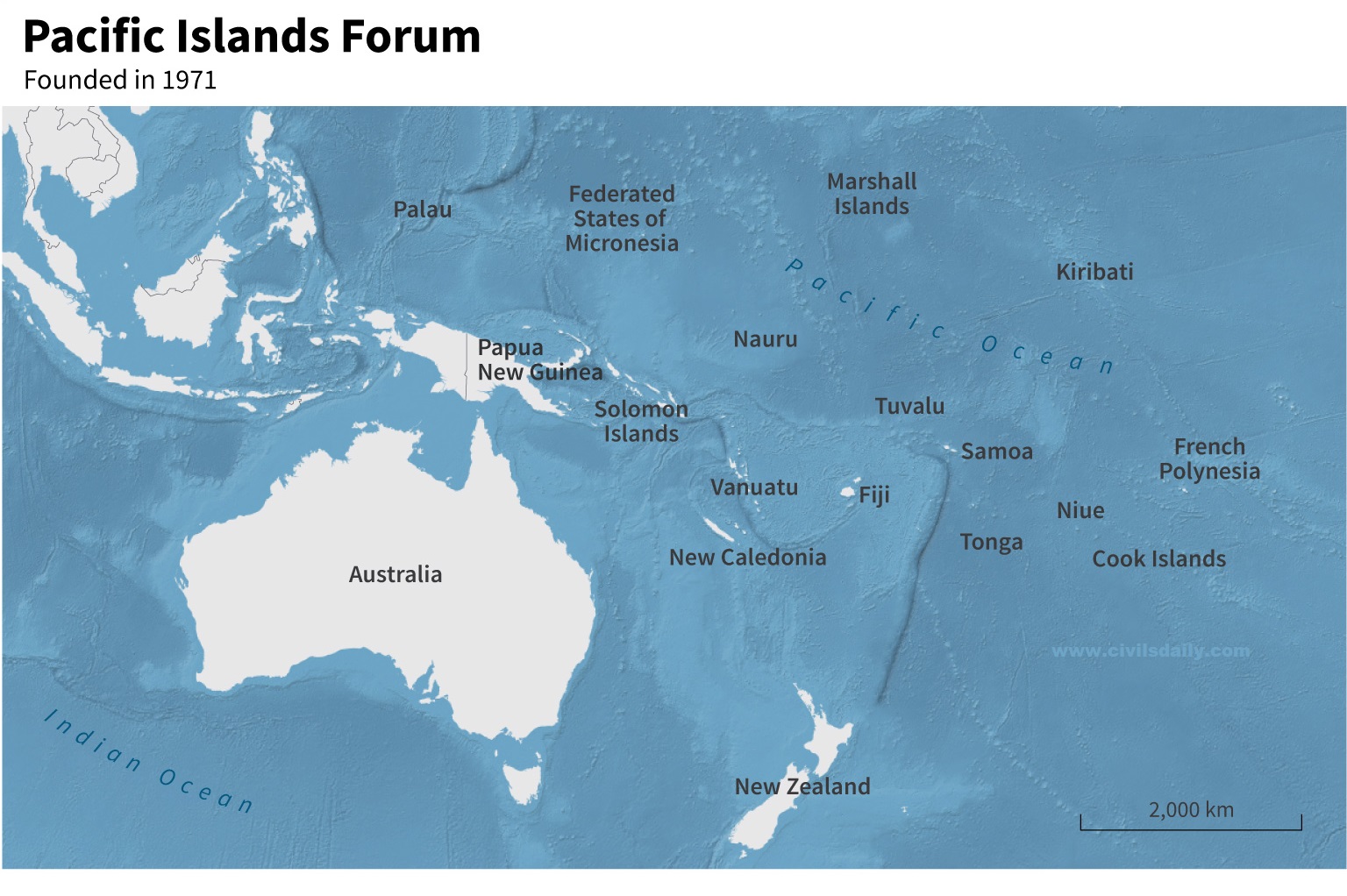
The annual meeting of the Pacific Islands Forum (PIF) has begun in Nuku’alofa, the capital of Tonga.
About Pacific Islands Forum (PIF):
Details
Establishment
1971
Members
18 members:Australia, Cook Islands, Federated States of Micronesia, Fiji, French Polynesia, Kiribati, Nauru, New Caledonia, New Zealand, Niue, Palau, Papua New Guinea, Republic of Marshall Islands, Samoa, Solomon Islands, Tonga, Tuvalu, and Vanuatu.
Vision
Promote peace, harmony, security, social inclusion, and prosperity in the Pacific region.
Framework
Operates under the Framework for Pacific Regionalism which outlines strategic visions and objectives.
Dialogue Partners
18, including major nations like the USA, China, India, and members of the EU.
Key Focus Areas
Environmental sustainability, economic growth, cultural development, and regional security.
Leadership
Directed by a Secretary-General, with annual meetings among leaders of member countries.
Significance of PIF
The PIF advocates for global climate action and funds resilience efforts through the Pacific Resilience Facility (PRF) to support vulnerable Pacific nations.
It enhances cooperation among its 18 small island states, fostering joint decision-making on key regional issues.
The forum strengthens the Pacific’s ability to navigate geopolitical tensions between major powers like the US and China.
PIF promotes sustainable economic development through regional trade and investment initiatives.
It focuses on protecting the Pacific’s ecosystems by addressing challenges like ocean pollution and overfishing.
PYQ:
[2016] With reference to the ‘Trans-Pacific Partnership’, consider the following statements:
1. It is an agreement among all the Pacific Rim countries except China and Russia.
2. It is a strategic alliance for the purpose of maritime security only.
Which of the statements given above is/are correct?
Results of the latest round of Rajya Sabha elections are out.
Elections to the Rajya Sabha:
Details
Election Method
Members are elected indirectly by the elected members of the State Legislative Assemblies and the electoral college for UTs (Delhi and Pondicherry).
Using the proportional representation system via the Single Transferable Vote (STV) method and Open Ballot.
Composition
• Total Members: Up to 250 members, with 238 elected and 12 nominated by the President for their contributions to art, literature, science, and social services.
• Current Strength: 245 members (233 elected, 12 nominated).
Voting Requirements for Candidates
Candidates must be proposed by at least 10 members of the State Assembly or 10% of the party’s strength in the Assembly.
Voting Process
• Single Transferable Vote: Voters rank candidates based on preference. Votes are transferable if a preferred candidate is eliminated or achieves the quota.
• Open Ballot System: Employed to facilitate transparency in the voting process.
Election Procedure
• Quota System: To win, a candidate must obtain a quota of votes calculated as [Total Votes / (Number of Vacancies + 1)] + 1.
Powers and Functions
• Legislative Powers: Can introduce and pass bills except Money Bills.
• Special Powers: Can pass resolutions to create all-India services, make laws on state list subjects under certain conditions, and approve proclamations of emergency.
Sessions
3 regular sessions each year: the Budget session, Monsoon session, and Winter session.
Special sessions can be convened as required.
Tenure
A permanent body that is not subject to dissolution;
One-third of its members retire every two years.
Chairmanship
Vice President of India serves as the ex-officio Chairman of the Rajya Sabha.
House also elects a Deputy Chairman from among its members.
Eligibility for Membership
Candidates must be Indian citizens, at least 30 years old, and comply with other conditions set by the Constitution.
Disqualification Criteria
Members can be disqualified for defection, certain criminal convictions, or if declared bankrupt, among other reasons.
Special Features
• Nominated Members: Up to 12 members can be nominated by the President. • No dissolution: Unlike the Lok Sabha, the Rajya Sabha cannot be dissolved but operates as a continuous body.
Key Sessions and Administrative Details
• First Sitting: Conducted on May 13, 1952.
• Secretary General: Acts as the chief executive officer and the administrative head of the Rajya Sabha Secretariat.
PYQ:
[2013] Consider the following statements:
The Chairman and the Deputy Chairman of the Rajya Sabha are not the members of that House.
While the nominated members of the two Houses of the Parliament have no voting right in the presidential election, they have the right to vote in the election of the Vice President.
Which of the statements given above is/are correct?

![[UPSC Free Openhouse] Mr. Gautam Mohakul, Ministry of Finance On Why is UPSC Preparation Crucial for In-Service Work? || Join on 1st Sept 2024 at 5:30 PM](https://www.civilsdaily.com/wp-content/uploads/2024/08/Gautam-1568x882.jpg)

![[29th August 2024] The Hindu Op-ed: A Silent democratic backlash in South Asia](https://www.civilsdaily.com/wp-content/uploads/2024/08/29-Aug-1568x882.jpg)