💥UPSC 2026, 2027, 2028 UAP Mentorship (March Batch) + Access XFactor Notes & Microthemes PDF

Search results for: “”

  • Beating all challenges as a working professional, achieved the IAS goal. | Prakhar Chandrakar, AIR 102, UPSC 2021 | A student of CD’s Mentorship Program | Talk to his mentor


    Prakhar was also not satisfied with the railway job. He had to fulfill his dream by becoming an IAS. After a failure in the first attempt, he increased his hard work under the personalized mentorship of Civilsdaily, accepted all challenges as a working professional, and went ahead. The result of which was seen this time and he secured the 102nd rank.
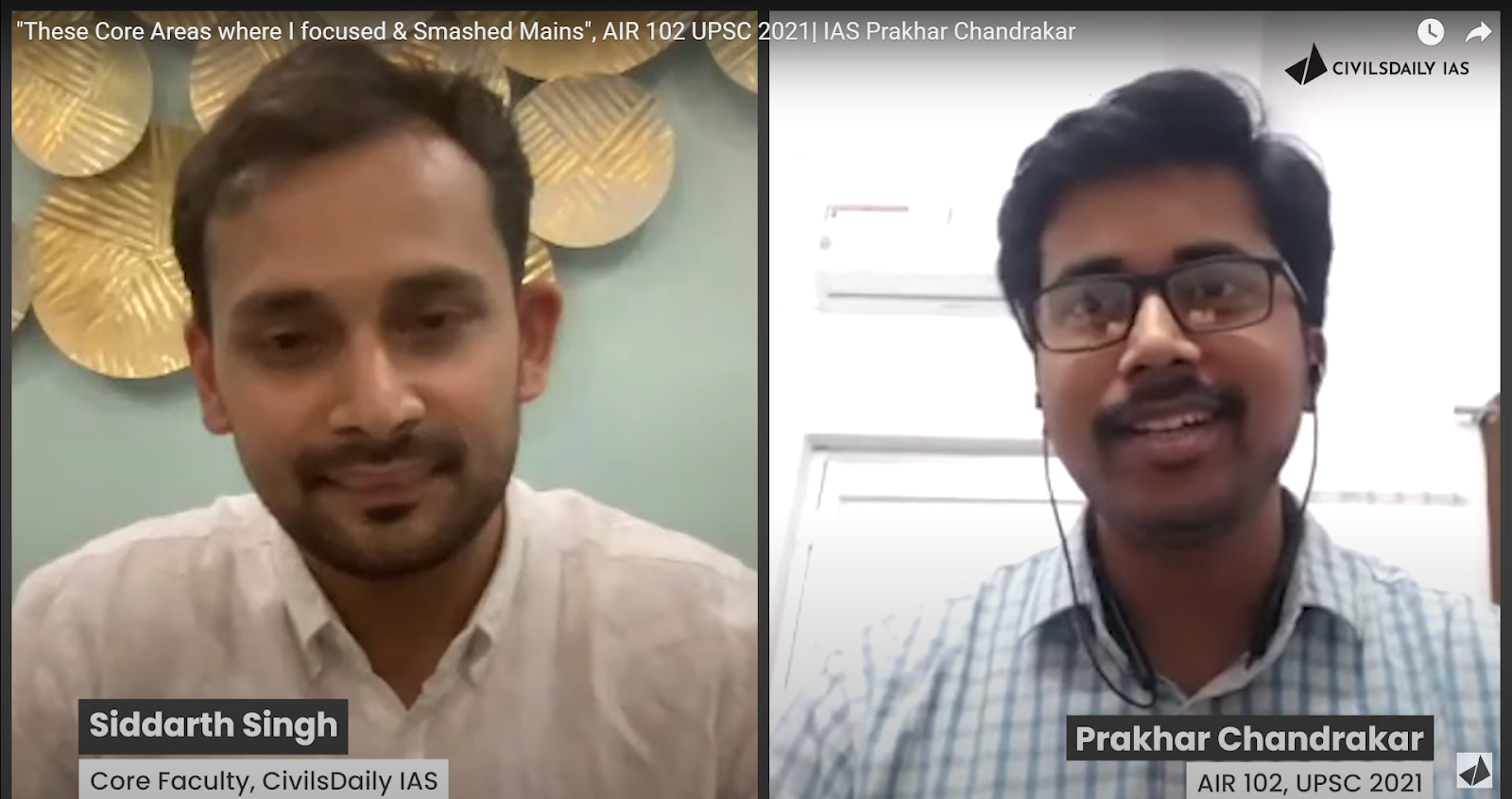

    Prakhar Chandrakar, AIR 102, UPSC 2021. Civilsdaily Mentorship Student

    Prakhar Chandrakar was a mentorship student under Sajal sir, Sukanya ma’am, and other mentors under the Smash Mains FLT program. He was relentless about improving himself in order to serve the country he loves dearly. He improved GS marks 120+ drastically in this 2021 Mains.


    He, in a candid conversation with CD mentor Sidhdhart Singh, Prakhar shared his thought.

    Prakhar Chandrakar, AIR 102, UPSC 2021. Civilsdaily Mentorship Student

    Prakhar Chandrakar, a resident of Panchavati Colony, secured 102nd rank. He has done B.Tech in Electrical Engineering from NIT College Raipur. After completing B.Tech, Prakhar was posted as an engineer in NTPC for 2 years. During this time, he was selected for the post of Assistant Engineer in Railways at Sambalpur, Odisha. He chose Electrical Engineering in Mains. His mother Champa Chandrakar is a major reader.


    He attributed his success to Civilsdaily’s Mentorship

    • For prelims he joined our CD’s Smash Prelims.
    • For mains he regularly gave some effort to make answer structure better under the guidance of mentors.
    • He followed Civilsdaily from the very inception of his UPSC journey, especially for daily current affairs.
    • In his 1st attempt, he joined CD’s interview program and scored very well in the interview. Still, he couldn’t become an IAS because of his fewer marks in GS papers.
    • In his 2nd attempt, he joined Sajal Sir’s Smash Mains Program + Interview program. Now he improved his GS marks by 150+ And in Essay, he improved by 20+.  this time he secured All India Rank 102.
    • He joined Civilsdaily’s FLT online mock test series for mains.
    • He was meticulous about study materials. he consolidated his study materials and revised them as many times as he could.
    • He always gets hand-holding mentorship support to improve his performance.
    • He learned to make his own notes.
    • From the very starting, he wished he would carry his preparation under CD’s senior teachers and mentors.

    Before getting into CD’s Mentorship Program under Sajal Sir, though he had reached an interview, he couldn’t come on the final merit list. He said that he couldn’t figure out the necessary things which were highly required to work on. For ultimate success what matters is an ecosystem for co-learning and active learning together learning, doubt clearing, notes, references, mentors, and a focussed community. You’re going to learn and discuss like never before. 

    CLICK: BOOK YOUR SLOT WITH AIR 102, PRAKHAR’S MENTORS, AND GET HIS NOTES | FREE REGISTRATION


    About Prakhar Chandrakar- His UPSC journey and hobbies

    NamePrakhar Chandrakar
    Age26
    ResidentPanchavati Colony, Chhattisgarh
    ExamUPSC 2021
    All India Rank102
    Attempts2nd 
    OptionalElectrical Engineering

    He was an active student of CivilsDaily’s Mentorship program and took guidance in all stages of preparation. He thanked CD’s senior mentors and faculties for his top rank on UPSC 2021 merit list.


    He improved his marks drastically in this 2021 Mains. In a candid conversation with Civilsdaily, Prakhar shared his journey, motivations, up and downs, lessons learned, and his secret of what kept him going.

    It is yet another validation of CivilsDaily’s vision and approach to personalized mentorship.

    CLICK- SAMACHAR MANTHAN FREE COPY AND MENTORSHIP CALL

  • Rise in Unvaccinated Children in India

    The number of children in India who were unvaccinated or missed their first dose of diphtheria-tetanus-pertussis (DTP) combined vaccine doubled due to the pandemic, rising from 1.4 million in 2019 to 2.7 million in 2021, according to official data published by the WHO and UNICEF.

    Why in news?

    • This data signifies that the world recorded the largest sustained decline in childhood vaccinations in approximately 30 years.
    • There was an increase in zero dose.
    • This is the first time ever there has been a decline in evaluated coverage in immunisation for India as a whole.

    Vaccination measures in India

    • Intensified Mission Indradhanush (IMI) 4.0: India started IMI 4.0 from February 2022, which is expected to further reduce the number of unvaccinated children.
    • India’s Universal Immunisation Programme (UIP): It provide free vaccines to all children across the country to protect them against Tuberculosis, Diphtheria, Pertussis, Tetanus, Polio, Hepatitis B, Pneumonia and Meningitis due to Haemophilus Influenzae type b (Hib), Measles, Rubella, Japanese Encephalitis (JE) and Rotavirus diarrhoea. (Rubella, JE and Rotavirus vaccine in select states and districts).

    About Intensified Mission Indhradhanush (IMI) 4.0

    • IMI 4.0 aims to fill gaps in the routine immunisation coverage of infants and pregnant women hit by the Covid-19 pandemic and also aims to make lasting gains towards Universal Immunization.
    • It will have three rounds and will be conducted in 416 districts across 33 states.
    • Unlike the past, each round under IMI 4.0 will be conducted for seven days, including Routine Immunization (RI) days, Sundays, and public holidays.

    Mission Indradhanush (MI)

    • Mission Indradhanush (MI) was launched in 2014 with the goal to ensure full immunization with all available vaccines under Universal Immunization Programme (UIP) for children up to two years of age and pregnant women.
    • It targets achieving 90% full immunization coverage in all districts.
    • Under MI, all vaccines under the Universal Immunization Program (UIP) are provided as per National Immunization Schedule.
    • UIP provides free vaccines against 12 life-threatening diseases, mentioned above.

    Back2Basics: Universal Immunisation Programme

    • The Expanded Programme on Immunization was launched in 1978.
    • It was renamed as UIP in 1985 when its reach was expanded beyond urban areas.
    • UIP is one of the largest public health programmes targeting close to 2.67 crore newborns and 2.9 crore pregnant women annually.
    • Under UIP, Immunization is provided free of cost against 12 vaccine-preventable diseases.
    • The two major milestones of UIP have been the elimination of polio in 2014 and maternal and neonatal tetanus elimination in 2015.
    • To speed up the coverage, Mission Indradhanush was planned and implemented to rapidly increase the full coverage to 90%.


    UPSC 2023 countdown has begun! Get your personal guidance plan now! (Click here)

  • Political tussle over Podu Cultivation and Forest Lands in Telangana

    Activists have taken up the issue of Podu cultivation of adivasis and tribals in forest areas in Telangana.

    What one means by Podu?

    • Podu is a traditional system of cultivation used by tribes in India, whereby different areas of jungle forest are cleared by burning each year to provide land for crops.
    • It is a form of shifting agriculture using slash-and-burn methods. The word comes from the Telugu language.
    • Traditionally used on the hill-slopes of Andhra Pradesh, it is similar to the jhum method found in north-east India and the bewar system of Madhya Pradesh.

    What is the ‘Podu’ Land Issue?

    • The Telangana government had decided in 2021 to move landless, non-tribal farmers engaged in shifting cultivation inside forests to peripheral areas in an effort to combat deforestation.
    • It ensured that all steps would be taken to ensure that forest land was not encroached upon.
    • It is observed that podu progressively degrades large areas of the forest.

    Shifting cultivation in India

    • In this type of agriculture, first of all a piece of forest land is cleared by felling trees and burning of trunks and branches.
    • After the land is cleared, crops are grown for two to three years and then the land is abandoned as the fertility of the soil decreases.
    • The farmers then move to new areas and the process is repeated.
    • Dry paddy, maize, millets and vegetables are the crops commonly grown in this type of farming.

    This practice is known by different names in different regions of India:

    1. Jhum in Assam,

    2. Ponam in Kerala,

    3. Podu in Andhra Pradesh and Odisha and

    4. Bewar masha penda and Bera in various parts of Madhya Pradesh.


    What TS has to offer as alternative to Podu?

    • To stop this deforestation, the government wants to move out cultivators from deep inside forests to the periphery by allotting them land for cultivation.
    • Tribal farmers who have been traditionally cultivating for decades would not be affected by this drive against illegal encroachers.
    • The land ownership titles have been given to tribals and more than 3 lakh acres have been allocated to tribal farmers state-wide.

    And what about non-tribal farmers?

    • These farmers can apply to the state government to allocate them land outside the forests.
    • Those who are moved out of the forests would be given land ownership certificates, power and water supplies and Rythu Bandhu benefits.

    Back2Basics: Rythu Bandhu

    • Rythu Bandhu is a scheme under which the state government extends financial support to land-owning farmers at the beginning of the crop season through direct benefit transfer.
    • The scheme aims to take care of the initial investment needs and do not fall into a debt trap.
    • This in turn instills confidence in farmers, enhances productivity and income, and breaks the cycle of rural indebtedness.

    DBT under the Scheme

    • Each farmer gets Rs 5,000 per acre per crop season without any ceiling on the number of acres held.
    • So, a farmer who owns two acres of land would receive Rs 20,000 a year, whereas a farmer who owns 10 acres would receive Rs 1 lakh a year from the government.
    • The grant helps them cover the expenses on input requirements such as seeds, fertilizers, pesticides, and labor.


    UPSC 2023 countdown has begun! Get your personal guidance plan now! (Click here)

  • UPSC Previous Years Question Papers

    What are PYQs?

    Previous years’ question papers are those sets of questions that went before in time and order. Like all other exams, there are copies of UPSC-CSE PYQs exist. You can download PDFs of PYQs from us. And analyze what types of questions are asked in Civil Service Examination.

    Why are PYQs so important?

    From toppers to Mentors, none can deny the importance of the previous year’s question papers. They are important from different angles. Let’s see:

    • Every exam is unique in itself. So, the exam patterns also differ from one another. To know the Ques. pattern, the role of PYQs is undeniable.
    • They help us know the difficulty level of the questions. And in how much depth we should maintain while preparing the subjects.
    • Previous Years’ questions let us know those pet topics of the exams. 
    • To know the dynamic trends, PYQs are incomparable.
    • PYQs work as the pieces of equipment for a fence. You can have a grip on the entire syllabus following them.

    How to do them!

    If you wish to start UPSC Preparation without coaching, make previous years’ question papers your mentor.

    Read and analyze the previous years’ question papers in the following ways so that it means a lot to you.

    Previous Years’ Question Papers (UPSC Prelims)

    • Previous 10 Years Question papers of GS-1
    • Previous 5 Years Question Papers of GS-2 (CSAT – A qualifying paper)

    Now, start investing 30 days to 45 days to analyze them fully and comprehensively. 

    • Take a note of the weightage of the topic and subject-wise questions.
    • Try to comprehend how UPSC connected current affairs with static.
    • In CSAT, start solving papers one by one from the second day.
    • Try to find out offbeat questions. And the way how UPSC designed such questions.
    • Every question has its unique demand. Identify them.
    • Take a note of whether the trend of a question from a particular chapter has been going towards an easier level or a more difficult level. 
    • Always do the pet chapters in 360 degrees.

    UPSC Online Workshop:

    You are doing previous years’ question papers. And that’s appreciated. But, have you ever thought that all the aspirants are also doing the same? Then how our ‘Hall of Fame’ toppers distinguished themselves on the final merit list!

    To gain more accuracy, speed, and performance and To save time, money & energy, they used to attend Online workshops on IAS prep strategy with senior IAS mentors.

  • How to prepare Ethics for UPSC-CSE | Ethics Books for UPSC

    “Ethics is a inner perception of the difference between What you have a right to do and what is right to do”-CD


    Table of Content:


    What is Ethics?

    Definition & Nature: Ethics is the philosophical study of morality that is the set of beliefs concerning right or wrong, good or bad, justice or injustice, etc. These beliefs can be our individual judgments or governance centric and upheld values or principles. These guide our actions, define our values and give us reasons for being the persons we are. Famous philosophers say:

    • Ethics is a set of moral principles on “How ought to live!”- Socrates.
    • “Ethics is the study of what is good or right in conduct.”- Mackenzie.
    • “Ethics is a normative science of the conduct of human beings living in societies which judge this conduct to be right or wrong, good and bad”- W. Lillie

    Moral reasonings are the very essence of Ethics, which are possible because we can act against our nature, based on our conscience. And these moral reasonings stop us from simply describing what is likely to happen, and allow us to make judgments about what should happen. Of all the ways you might act, which is the best? Of all possibilities, which one should bring into reality? These are the questions, ethics seek to answer.

    Ethics in UPSC-CSE Preparation

    UPSC-CSE exam consists of two successive phases.

    • Prelims
    • Mains (Written & Interview)

    In the mains, there are 4 General Studies Papers apart from Qualifying Papers, Essay, and Optional Subject papers.

    And GS-4 consists of Ethics, Integrity, and Aptitude. (250 marks)

    A civil servant is empowered with a certain official authority and legal power. So, how the civil servant makes use of such powers is important for our society as well as our government. So, besides other subjects, his ‘Ethical Competence’ is also tested.

    How to prepare for Ethics

    An ethics paper is designed to evaluate ethical competence and not mere knowledge about Ethics. It is a matter of application. 

    In 10 effective ways you can prepare ‘Ethics’ for Civil Service Examination:

    • Know the syllabus, know the UPSC demands
    • Read limited books. Mark important lines. And make notes.
    • Develop a healthy habit of writing answers, consisting of keywords.
    • Read PYQs. Under a mentor.
    • Learn drawing diagrams.
    • Relate your logic with personal experience.
    • Mention what social reformers’ points
    • Try to write a robust but short summarized introduction and conclusion
    • To understand the ideas behind the subject, always start with very basic books like NCERTs.
    • Ethics is a very scoring subject. You can easily score 110+. So, as not to lose the opportunity, prepare under the guidance of a senior mentor. 

    Toppers and Mentors suggested Ethics Books

    You can start yourself at your home with 2 basic books

    • NCERT-Class-11 Psychology
    • NCERT-Class-12 Psychology

    Some Advanced books are there. You can also boost your preparation with them:

    • Ethics, Integrity, and Aptitude by Subba Rao and PN Rao Chaudhury
    • Lexicon for Ethics, Integrity, and Aptitude for IAS general studies paper IV by Niraj Kumar
    • Ethics, Integrity, and Aptitude – M. Karthikeyan
    • Ethics in Governance- Innovation, Issues, and Instrumentalities – Ramesh K Arora.
    • Yojana

    Apart from the above, try to read the summary of ARC reports:

    • ARC 4th Report
    • Citizen-Centric Administration – ARC report

    Biographies and Other Books

    • Mahatma Gandhi: Experiment with Truth
    • Varghese Kurien Auto biography
    • Swami Vivekananda – Karmayoga and his biography
    • BBC Websites

    Attend a free online workshop with our Senior Ethics Mentor, Sukanya Rana Ma’am

    Sukanya ma’am has firsthand experience of 4 mains and 2 interviews of UPSC. She has also appeared in the State PCS interview. Before she worked as an officer in a public sector bank and now as a Mentor at Civilsdaily, she aims to guide future aspirants in finding success. Sukanya Ma’am has scored consistently 100+ marks in ethics and in 2019 her marks were 140 in GS 4. In 2020, under her mentorship, many smash mains students were able to secure 110+ marks.


  • [Burning Issues] Crumbling States Finances: A Risk Analysis

    Context

    • The RBI recently released a very important document about the economy of the States of India.
    • Some of our Indian states have been managing their finances so bad that these states could be heading towards the same state as Sri Lanka’s economy!
    • And we all know what’s happening in Sri Lanka right now!
    • The worst part is that if this continues for a long time, the entire country of India will lose money and could face another economic crisis!

    Questions raised:

    • Why is this RBI document comparing Indian states to the economic crisis in Sri Lanka?
    • How are these states doing the same mistakes as the Sri Lankan government?
    • And most importantly as citizens of India what are pointers that you need to keep eye on before you cast your vote for the so-called leaders of India?

    Crumbling state finances:

    How can we arrive at this conclusion?

    (1) Debt-GSDP Ratio

    • Punjab, Rajasthan, Kerala, West Bengal, Bihar, Andhra Pradesh, Jharkhand, Madhya Pradesh, Uttar Pradesh and Haryana turn out to be the states with the highest debt burden.
    • Highest debt-GSDP ratio in FY22 are Punjab (53.3%), Rajasthan (39.8%), West Bengal (38.8%), Kerala (38.3%) and Andhra Pradesh (37.6%).
    • All these states receive revenue deficit grants from the Centre.
    • What exacerbated the debt-GSDP ratio was that while numerator (liabilities) rose sharply, the denominator (nominal GDP) fell sharply.

    (2) Fiscal Deficit

    • The Fiscal Responsibility and Budget Management (FRBM) Act, 2005 prescribes the ceiling for debt to GSDP ratio at 25 per cent.
    • Eight out of the 15 states studied here, exceed the prescribed limit in FY22.
    • Odisha was a clear outlier with a 15.79 per cent Debt-GSDP ratio.
    • States like Tamil Nadu and Karnataka were marginally higher than the mandated limit. 

    (3) Fiscal deficit to GSDP

    • Large borrowing by some States is due to the sharp expansion in their fiscal deficits, much beyond the mandated level.
    • Bihar recorded highest fiscal deficit to GSDP ratio at 11.30 per cent as per FY22 revised estimates followed by Rajasthan (5.2 per cent), Punjab (4.60 per cent) and Uttar Pradesh (4.27 per cent).

    (4) Interest cover

    • High borrowings or fiscal deficit-GDP ratio is not something to be worried about as long as the States have adequate revenue surplus to fund them.
    • This can be gauged by looking at the interest cover as measured by the revenue receipts of the State divided by its interest payment.
    • For instance, Bihar had the highest fiscal deficit as a percentage of GSDP, however, the state has adequate revenue receipts to cover its interest burden, with interest cover of 11.3.
    • Odisha topped the list with highest interest coverage ratio since it has been diligently lowering its borrowing as well as the resultant interest burden.
    • Punjab, Haryana, West Bengal, Tamil Nadu and Kerala appear weak going by this metric with interest cover under 6 times. 

    (5) Increase in Market Borrowings

    • Most States increased their market borrowing during the pandemic as their fiscal deficits expanded.
    • Tamil Nadu topped the list of states with highest gross market borrowings in both FY21 and FY22.
    • But not all states were on a borrowing spree.
    • Odisha stayed away from market borrowing through state development loans (SDLs) in FY22.

    (6) Revenue buoyancy

    • Revenue buoyancy of States has already been affected since the Goods and Services Tax (GST) came in and states’ ability to raise taxes has come down.
    • Interest payments, salaries and pensions fall under the committed expenditure of State governments.
    • This committed expenditure of Kerala and Tamil Nadu accounts for 71 per cent and 67 per cent of their budgeted revenue receipts respectively in FY23. 
    • A larger proportion of the budget allocated for committed expenditure items limits the state’s flexibility to decide on other expenditure priorities such as developmental schemes and capital outlay.

    (7) Dependency on Centre

    • Own tax revenue of Haryana, Kerala and Andhra Pradesh constitutes about half of their total revenue collections.
    • The major source of revenue of other States is Central transfers.
    • Within own tax revenue, States’ goods and services tax (SGST), States’ excise duties and sales tax are the major sources of revenue

    (8) Poor capital outlay

    • High revenue expenditure results in poor spending quality, as reflected in their high revenue spending to capital outlay ratios.
    • Capital outlay is the money spent on acquiring assets while revenue expenditure indicates daily operations expenses like salaries and pensions.

    What factors led to the financial vulnerabilities of Indian states?

    (1) Pandemic

    • The prolonged COVID crisis has worsened fiscal positions of governments around the world as reflected in mounting debt levels.
    • The sustainability of public debt at national and sub-national levels has again assumed centre-stage as the dominant fiscal risk.
    • In particular, the pandemic has taken a heavy toll on finances of states in India.

    (2) Freebie Politics

    (3) DISCOM sector distress and payment crisis

    • The power sector accounts for much of the financial burden of state governments in India, both in terms of subsidies and contingent liabilities.
    • Illustratively, many state governments provide subsidies, artificially depressing the cost of electricity for the farm sector and a section of the household sector.
    • Despite various financial restructuring measures17, the performance of the DISCOMs has remained weak, with their losses surpassing the pre-UDAY level of 0.4 per cent of GDP.

    (4) Pension expenditure

    • The government’s fiscal burden in providing a safety net to the elderly could rise to as much as 4.1% of the GDP by 2030 from 2.2% at present, a report by global analytical company Crisil has said.
    • Currently, the central government spends 3-3.4% of GDP on education and just over 1% of GDP on medical and public health, water supply and sanitation.
    • This is an ever-increasing challenge, as the old live longer, and demographic transitions reduce the number of young to pay for the old.
    • Many states are opting out of New Pension Scheme (NPS) to the old pension scheme which is a huge burden on the exchequer.

    A rational analysis

    (1) Certain necessary expenditures cannot be avoided

    • States often try and provide some kind of relief to voters.
    • We can certainly be in favour of expanding, for example, the MGNREGA type of spending and subsidy in the form of food ration schemes.
    • These go a long way in increasing the productive capacity of the population. So, they’re not just freebies.
    • They build a healthier and a stronger workforce, which is a necessary part of any growth strategy.
    • That is similar to a State spending on education or health.

    (2) Certain election promises create dysfunctions

    • There are obviously cases where State governments have gone astray and have gone into providing all sorts of freebies or gifts.
    • But when it comes to simply giving away loan waivers, we cannot go in favour of these because they have undesired consequences such as destroying the whole credit culture.
    • It blurs the very basic question as to why is it that a large majority of the farming community is getting into a debt trap repeatedly.

    (3) Non-essentiality of welfare expenditure

    • We know about free electricity that is being given in various States to rural communities.
    • This has sometimes led to disastrous consequences in terms of the declining water table, wastage of electricity and various other things.
    • There are nuances to the issue, and one will have to get into those nuances to take a final call on whether a certain welfare spending is necessary or not.

    (4) Necessary expenditures/ merit freebies

    • Some people have been questioning subsidies going into education, such as for laptops and other things.
    • Some of them have now become necessities for increasing productivity, knowledge, skills, and various other things.
    • So, we need a more nuanced understanding of the issue.

    Way forward

    • Fiscal discipline: The state governments must restrict their revenue expenses by cutting down expenditure on non-merit goods in the near term.
    • Stabilize debt levels: In the medium term, these states need to put efforts toward stabilising debt levels.
    • Power sector reforms: Further, large-scale reforms in the power distribution sector would enable the DISCOMs to reduce losses and make them financially sustainable and operationally efficient.
    • Focus on capital creation: In the long term, increasing the share of capital outlays in the total expenditure will help create long-term assets, generate revenue and boost operational efficiency.
    • Risk testing: State governments need to conduct fiscal risk analyses and stress test their debt profiles regularly to be able to put in place provisioning to manage fiscal risks efficiently.
  • EKLAVYA: Free Scholarship Test to get up to 60% discount on Foundation 2023 || Test on 17th July at 10 AM || Registration Open

    EKLAVYA: Free Scholarship Test to get up to 60% discount on Foundation 2023 || Test on 17th July at 10 AM || Registration Open

    Attend & score above the cut-off marks and get 60% on all the Civilsdaily courses under Smash Foundation Course.

    https://youtu.be/aANKfbU0cy4

    Dear Students!

    Civilsdaily is glad to announce that we are back with our pioneering initiative that has given our institute several top positions since its inception: the much-acclaimed Mentorship Programs!

    But wait, we have another exciting news! We will conduct an entrance-cum-scholarship exam, Mission Eklavya 2023 on July 17, 2022.

    It can be the best kick-start opportunity to save your Time, Money and Energy up to 60%.


    Table of Content


    1. What is Mission Eklavya 2023 program?

    Guys, Mission Ekalavya is a National Scholarship Test Program for UPSC 2023. This is the perfect opporunity for a beginner who has no idea about UPSC, but want to check if he has the aptitude for the same. If you take the upcoming free UPSC national scholarship test and come out with flying colours, you will get about 60% scholarship on the Civilsdaily Flagship Foundation Course.

    Ultimate Assessment Program and Foundation Program includes – 

    • Mentorship (1:1, throughout the preparation till Interview stage)
    • Masterclasses (complete GS syllabus covered, Only provided in Foundation course)
    • Samachar Manthan (Current affairs Programme)
    • Decimate Prelims (Prelims Crash course)
    • Mains Answer Writing Initiative (On a weekly basis)
    • Smash Mains (upon Qualifying prelims 2023)
    • Essay Guidance Program (To score above 120+ in Essay Mains Paper)
    • Interview Guidance Program (more than 1 mock interview will be conducted with a panel)
    • Civilsdaily IAS Community for Peer to Peer Interaction
    Get all the Civilsdaily courses under Smash Foundation Course for 60% off after you attend our scholarship test and score above the cut-off marks!

    2. Details of the Civilsdaily Free National Scholarship Test

    Date – 17th July, 2022.

    CLICK: Register Here for ‘EKLAVYA’

    • Mode: Online
    • Registration Fee – Free
    • Language: English
    • Time: 2 Hrs
    • Syllabus: GS Paper 1 (Preliminary exam)
    • No. of Questions: 100
    • Date: 17th July
    • Time: 10 AM
    • Result: 27/07/2022

    3. Mentorship: Our Every student is a batch.

    An average aspirant, pays for Prelims Course, Mains Program, Interview Guidance, Test Series & Study Materials all separately. The fees then comes up to 2-3 Lakhs for one attempt alone.

    Identifying this issue, Civilsdaily has designed the Flagship mentorship cum Foundation Course for 2023 aspirants. This course covers the entire 3-stage journey of a UPSC aspirant. From Prelims to Interview –

    • 1:1 Mentorship: Dedicated mentor to each student
    • Weekly, Monthly, Quarterly Study Plans
    • Weekly Test Series
    • Classes & Study Materials will be provided.

    Another benefit of the program is that it’s an umbrella course wherein an aspirant can access other paid courses of Civilsdaily for FREE.

    The main objective of the program is to identify and nurture serious aspirants to become future UPSC toppers. And that’s why we have designed a scholarship test.

    Our foundation course will be intensive yet personalised. You will be getting individual coaching on how to conquer the basics, develop analytical skills, inculcate conceptual clarity and acquire the necessary knowledge to face the unpredictable and dynamic UPSC.

    Apart from conducting subject-wise classes that covers all the Prelims-Mains syllabus from scratch, aspirants will follow a customised timetable and will complete their revision on a daily basis to attempt our weekly prelims and mains tests. Once the test is over, they will get a strategy call from a mentor, who will clear their doubts and tell them how to improve their performance from next test onwards.

    Simply put, like Ekalavya you will be getting a unique coaching experience that eludes other UPSC aspirants. Even aspects like Essay, Ethics and CSAT which is ignored in other normal coaching programs, will be covered over here with tests, mentorship, classes and notes.


    4. Toppers’ Talk


    5. Why should you take the CD’s Scholarship Test? 

    1. Test your preparation on UPSC-CSE grade questions, at national level.

    2. Chance to compete against the best. See where you stand.

    3. Identify your subjectwise strengths, weak points, and problem areas before you start preparation.

    4. Mentors will provide personalised counselling based on your performance in the scholarship test. 

    5. A detailed discussion will help you navigate through the challenges during the preparation.

    6. Achieve up to 60% scholarship in our exclusive umbrella foundation course.

    As the program is rigorous and involves individual attention, we can take only limited enrollments. Hence, we are conducting a Scholarship Exam to identify serious UPSC aspirants on 13th and 20th of March. Depending on your relative score, you can get up to a 60% scholarship.

    We are looking for

    1. Serious and hardworking aspirants.

    2. Ready to dedicate a minimum of 5-8 hours daily.

    3. Can complete assigned targets and tests without fail.

    4. Only 1 thought in mind and that is – to clear UPSC Civil Services 2023.

    5. Willing to take constructive feedback from mentors after each test.

  • [Yojana Archive] Decoding Modern Tech Terms

    UPSC 2023 countdown has begun! Get your personal guidance plan now! (Click here)

    In this article, we shall discuss some very popular and important modern tech terms.

    This is just an introductory article. All these technologies will be discussed in detail in subsequent articles.

    Blockchain Technology

    • A system whereby information about transactions is stored on a countless comuters spread across the glob.
    • It is considered an alternative to the conventional banking system.
    • Along with banks, this also applies to mobile payment system.

    NFTs

    • The success of Blockchain as an independent means of storing and authenticating information has created many more inoovations, one of these is Non Fungible Token or NFT.
    • Here the information is stored in the blockchain system itself, especially in a system called ethereum.
    • Under NFT system a kind of digital certificate is issued that such an original thing unique in the world.

    IOT

    • Internet of Things or, more accurately the internet of devices, is all about connecting devices over the internet and letting them ‘talk’ to us, applications and each other.
    • This allows huge amounts of data to be collected and transferred, which can then be used for multiple practical purposes.
    • However, Internet of Things doesn’t necessarily have to be connected to the internet, it can also be a network of things.
    • A common example are wristwatches with sensors that can track the wearers’ heartbeat and pass on the information to our smartphones via bluetooth.
    • The smartphone can store that data on cloud after which it can be accessed at any point of time to view a report card of how your heart has been behaving for over a period of a week or a month.

    Metaverse

    • A simplistic way to look at the metaverse is as a parallel, virtual, world where users can have different identities, possessions and characters.
    • In the complex explanation, Metaverse is supposed to be the post-Internet world, a decentralised computing platform of sorts if you will, which is continuous, and live.
    • It is an entirely digital economy, and the way most Silicon valley intellectuals see this, metaverse exists both in the digital and physical realm.
    • Virtual reality would be an element of this metaverse, but the idea goes beyond just donning a VR headset and starting to play a game.
    • According to Ball, the metaverse does not reset or pause or end, but “continues indefinitely.”
    • Metaverse is not something that just one company can build. Nor is Facebook the only one working on this. Epic Games, the creator of Fortnite, has big plans for the metaverse using its unreal engine.
    • In fact, Fortnite already has many elements which would conform to the idea such as live events, its own currency, etc.

    Quantum Computing

    • The Quantum computing is much talked about because of its infinite power.
    • A Quantum computer can perform calculations millions of times faster than a normal computer, and that is why it can prove to be a boon for humanity.
    • Traditional computers work based on a fundamental unit of binary digits(0-1 Bit).
    • On the other hand the quantum computers adopts qubit(quantum bit).
    • The qubit value can be 0, 1 or both.

    Artificial Intelligence

    • AI refers to ability of human beings to learn analyse think, understand, solve problems, make decision, etc, similar to human being.
    • Machines equipped with AI will become powerful and intelligent and compete with human beings capabilities.
      For example features like machine translation, voice-to-text conversion and voice assistance these days are reached to us because of AI.

    Cloud Computing

    • Cloud computing implies using the resources available on the internet on your computers or devices.
    • Cloud computing has made vast computational power and storage space available to us, and technology like AI is required for its calculations.

     UPSC 2023 countdown has begun! Get your personal guidance plan now! (Click here)

  • Register for recorded video| Webinar -Tackle UPSC Mains GS paper 2 and LIVE answer writing with Anuradha Suneja, AIR 266| One of the highest scorers in 2021 Mains GS papers | Get Telegram group, FREE Prelims package, and mentorship call

    Register for recorded video| Webinar -Tackle UPSC Mains GS paper 2 and LIVE answer writing with Anuradha Suneja, AIR 266| One of the highest scorers in 2021 Mains GS papers | Get Telegram group, FREE Prelims package, and mentorship call

    Register for the recorded session.

    18th July, 7 pm |Learn how to tackle UPSC Main GS paper 2 with Anuradha Suneja, CD mentorship students, and AIR 266, UPSC 2021. Submit your query, and get Telegram group + access to FREE resources.


    CivilsDaily is back with another super important #UPSCskill webinar. This time you will meet one of our mentorship students (under Sajal sir) and now a UPSC ranker – Anuradha Suneja. AIR 266, UPSC 2021.

    Anuradha Suneja, was one of the highest scorers in UPSC 2021 Mains GS papers (among top 50) and scored in the top three in UPSC Mains GS paper 2.

    Webinar: Master UPSC mains GS Paper 2 and LIVE answer writing

    Webinar on 18th July, 7 pm – Monday

    Anuradha Suneja will be taking a LIVE webinar on coming Monday. Through a LIVE answer writing session, she will be teaching and helping you master UPSC mains GS paper 2, its syllabus, case studies and approach towards UPSC mains in general.

    Feedback for the last #UPSCskill Webinar

    18th July, 7 pm |Learn how to tackle UPSC Main GS paper 2 with a UPSC ranker, Anuradha Suneja, AIR 266, UPSC 2021. Submit your query, and get Telegram group + access to FREE resources.

    About Anuradha Suneja

    Anuradha Suneja secured an AIR 266 in UPSC 2021. She was a student of our Mentorship programs and was taking mentorship under Sajal sir. Anuradha hails from Haryana and is a Delhi University graduate. She also has a masters in Political Science. She was a topper through and through. Anuradha loves diary writing and playing badminton.

    anuradha suneja upsc air 266 sajal sir

    In her Mains 2021 attempt, she not only improved in her GS papers but the quality of her answers increased to such an extent that even after skipping (mistakenly) questions worth 50 marks she was able to score awesomely in Mains.

    She profusely thanks Sajal sir, our mentorship, and student-centric approach for her success. It is a humbling and heartening moment for CivilsDaily and we wish her all the very best for her future.

    What The Hindu mentioned about Civilsdaily Mentorship

    The Hindu has acknowledged the success rate of CD’s Smash mains Mentorship

    Quora Digests:

    18th July, 7 pm |Learn how to tackle UPSC Main GS paper 2 with a UPSC ranker, Anuradha Suneja, AIR 266, UPSC 2021. Submit your query, and get Telegram group + access to FREE resources.

  • Draft disability policy

    Context

    The Department of Empowerment of Person with Disabilities (DoEPwD) recently released the draft of the national policy for persons with disabilities.

    Why new policy?

    • Signing of UN convention: The necessity for a new policy which replaces the 2006 policy was felt because of multiple factors such as India’s signing of the United Nations Convention on Rights of Persons with Disabilities.
    • Increased number of disabilities: Enactment of Rights of Persons with Disabilities Act 2016, which increased the number of disabilities from seven conditions to 21 necessitated the change.
    • Incheon Strategy: Being a party to the Incheon Strategy for Asian and Pacific Decade of Persons with Disabilities, 2013-2022 (“Incheon commitment”).
    • Changed discourse from medical model to human right: These commitments have changed the discourse around disability by shifting the focus from the individual to society, i.e., from a medical model of disability to a social or human rights model of disability.
    • The principle of the draft policy is to showcase the Government’s commitment to the inclusion and empowerment of persons with disabilities by providing a mechanism that ensures their full participation in society.

    Absence of commitment to political uplift

    • Article 29 of the Convention on Rights of Persons with Disabilities mandates that state parties should “ensure that persons with disabilities can effectively and fully participate in political and public life on an equal basis with others, directly or through freely chosen representatives….”
    • The Incheon goals also promote participation in political processes and in decision making.
    • The Rights of Persons with Disabilities Act 2016 embodies these principles within its fold.
    • India does not have any policy commitment that is aimed at enhancing the political participation of disabled people.
    • The exclusion of disabled people from the political space happens at all levels of the political process in the country, and in different ways.
    • Section 11 of the Rights of Persons with Disabilities Act prescribes that “The Election Commission of India and the State Election Commissions shall ensure that all polling stations are accessible to persons with disabilities and all materials related to the electoral process are easily understandable by and accessible to them”.
    • Although this mandate has been in existence for a few years, the disabled people still report accessibility issues before and on election day. 
    • There is often a lack of accessible polling booths in many locations.
    • Lack of aggregate data: The lack of live aggregate data on the exact number of the disabled people in every constituency only furthers their marginalisation.

    Lack of representation

    • Representation plays an imperative role in furthering the interests of the marginalised community.
    • Disabled people are not represented enough at all three levels of governance.
    • However, few States have begun the initiative at local levels to increase participation.
    • For instance, Chhattisgarh started the initiative of nominating at least one disabled person in each panchayat.
    • If a disabled person is not elected then they are nominated as a panchayat member as per changes in the law concerned.
    • This is a step that has increased the participation of the disabled in the political space at local level.
    • The goal of the policy document — of inclusiveness and empowerment — cannot be achieved without political inclusion.

    Suggestions: Follow four pronged approach

    • The policy can follow a four-pronged approach:
    • 1] Capacity building: Building the capacity of disabled people’s organisations and ‘empowering their members through training in the electoral system, government structure, and basic organisational and advocacy skills’;
    • 2] Legal and regulatory framework: The creation, amendment or removal of legal and regulatory frameworks by lawmakers and election bodies to encourage the political participation of the disabled;
    • 3] Participation of civil society: Inclusion of civil societies to ‘conduct domestic election observation or voter education campaigns’;
    • 4] Framework for outreach by political parties: A framework for political parties to ‘conduct a meaningful outreach to persons with disabilities when creating election campaign strategies and developing policy positions’.

    Conclusion

    The document lays emphasis on the point that central and State governments must work together with other stakeholders to “make the right real”. This right can be made real only when it includes political rights/political participation within it.

    UPSC 2023 countdown has begun! Get your personal guidance plan now! (Click here)

More posts
