💥UPSC 2026, 2027, 2028 UAP Mentorship (March Batch) + Access XFactor Notes & Microthemes PDF

Search results for: “”

  • (Webinar) UPSC Mains is about execution! Meet Mridul- 22yo, First attempt, AIR 247 | Learn writing quality answers, making mains worthy notes, and more | UPSC Mains Bootcamp + Open Test (25th Jun) | Get his notes + Exclusive Telegram group

    (Webinar) UPSC Mains is about execution! Meet Mridul- 22yo, First attempt, AIR 247 | Learn writing quality answers, making mains worthy notes, and more | UPSC Mains Bootcamp + Open Test (25th Jun) | Get his notes + Exclusive Telegram group

    UPSC Mains 2022 is just ~80 days away. Get your Mains prep started with UPSC Ranker, Mridul. Register for CivilsDaily’s Bootcamp: 25th June 2022. This will be followed by an Open Mains Test on the same day. Details below

    Haven’t started with mains prep? Feel nervous about Mains answer writing? Not able to write all 20 questions? Can’t make yourself sit and start answer writing?

    Facing the same issues as mentioned above? This webinar cum UPSC Bootcamp is for you.

    Mridul Shivhare, AIR 247 is a special ranker. He cleared UPSC in his first attempt at the young age of 22. His quality of answers is amazing. He has tricks to literally compel the examiner to give marks. By the way, a crazy fact- Mridul left around 170 marks worth of questions in his Mains and still was able to secure AIR 247 (yup, quality of answer matters).

    In this special session, we will also be joined by Sukanya Rana, UPSC Mains head, CivilsDaily IAS. Sukanya has been able to guide successfully around 50 rankers in 2021 including AIR 28,32, 49, and more.

    UPSC Mains 2022 strategy for next 2 months.
Parameters on which UPSC evaluates your answers
Improve your mains answer's structure
How to write quality answers with limited knowledge/content?
Access to Mains Telegram group 
My Mains resources
    After Bootcamp, we will be having an Open Mains Test on 25th June only, at 6 pm. Top five scorers will get a Scholarship for Mains Mentorship Test Series and Program.

    Register for the Bootcamp and we will email you the link for the Telegram group, Open test question paper, and other Mains resources.


    This image has an empty alt attribute; its file name is WhatsApp-Image-2022-05-16-at-3.48.43-PM-1024x745-6.jpeg

    About CivilsDaily’s Mains Programs

    Mains Essential Program FLT EDITION 2022

    Program Inclusion Details:

    • 12 Full-length tests: After the prelims, it is time to go full gear. Practice 3 rounds of FLT based on 4 GS paper.
    • Quality Enrichment Program Notes: QEP is an intensive and holistic program for IAS Mains 2022 GS papers. We aim to cover up to 250 most relevant issues with a 360-degree view, covering all dimensions of each and every topic. Not only you’ll learn and analyze these issues but will also understand how to utilize them via Daily Answer Writing and Mains Test Series.
    • Personalized discussion in 1-to-1 mentorship: You doubt why you are scoring less or how you can improve your score for the next paper. No worries! Just schedule a call with our mentor to clear all your doubts and queries.
    • Civilsdaily’s handholding
    • Civilsdaily magazine: Your current affairs will be covered with access to our 1-year subscription.

    Click Here to Check Details

    Have a query about the program? Reach Us

    Smash Ethics Program

    Smash Ethics 2022 (Batch 2) with 1-to-1 Mentorship | Score 110+ in Ethics GS-4

    Program Inclusion:

    • Comprehensive Video Lectures covering Paper 4
    • Full syllabus Notes.
    • 8 FLT tests
    • 1-1 Mentorship support after every test
    • Membership of Ethics group (exclusive) on Civilsdaily’s Habitat
    • Doubt resolution session on Habitat

    Click Here to Enroll the Course

    Have a query about the program? Reach Us

    MEP Super 100 2023

    Program inclusion:

    • 12 Sectional tests: The whole syllabus will be divided into portions like history, economics, and geography. The test will be spread for a period of 8 months. This will ensure that your basic static preparation happens on a continuous basis alongside your mains answer writing program. Killing two birds with one stone!
    • 12 Full-length tests: After the prelims, it is time to go full gear.
    • Personalized discussion: You doubt why you are scoring less or how you can improve your score for the next paper. No worries! Just schedule a call with our mentor to clear all your doubts and queries.
    • Civilsdaily’s handholding: You will be provided membership to Mains 2023 club on Habitat. There you can put up your doubts and queries. Also can be used to interact with peers on strategies to improve your mains writing. You can also contact mentors like Sajal sir, Sukanya ma’am, Sudhanshu sir and Poornima Ma’am. They all have interview-level experience, so utilize their experience to your benefit.
    • Civilsdaily magazine: Your current affairs will be covered with access to our 1-year subscription. (June 2022 to May 2023)

    Click Here to Enroll the Course

    Have a query about the program? Reach Us

    Essay Program

    Program inclusion:

    • 8 FLTs
    • Detailed orientation for beginners
    • Process building Sessions
    • Content/Approach Building Sessions
    • Model essays
    • One-to-one mentorship
    • Membership in exclusive Essay group on Habitat
    • Notes and references on Habitat
    • Topic-wise arranged PYQs

    Check Out Now

    Have a query about the program? Reach Us

    This image has an empty alt attribute; its file name is CivilsDailys-Hall-of-Fame-UPSC-2028-4-713x1024-8.jpg
  • Let AIR 12, Yasharth Shekhar resolve all your UPSC IAS exam related doubts | 1-1 Live Ask me anything UPSC 2021 Topper’s Session | Registration Free

    Let AIR 12, Yasharth Shekhar resolve all your UPSC IAS exam related doubts | 1-1 Live Ask me anything UPSC 2021 Topper’s Session | Registration Free

    Hi Guys, Interacting with a Topper is always refreshing & confidence boosting.

    So, Yasharth Shekhar, AIR 12 ranker will be LIVE on Saturday for a 1-1 session. He will be taking your questions and will personally resolve each one of your doubts. So, put up your question for Yasharth Shekhar below and set up a reminder for 5 pm coming Saturday.

    What is Yasharth Shekhar going to discuss!

    • Understanding the expectations
    • Planning and Strategizing
    • Learning
    • Analyzing
    • Execution
    • How to pluck loopholes
    • How to write ‘Rule of answers’ what the question demands
    • And many other untold secrets that only a topper can explain

    So, whether you’re a Working Junta or a full-time college fresher, preparing for IAS 2023/24 & made up your mind, a topper’s session can help you strategize and decipher the IAS exam and design a timetable that fits right in your hectic schedule. Besides he can help you pick the right books and craft a practical & personal strategy.

    1-1 Live Session Details:

    Date: 25th June (Saturday)

    Time: 5 pm

    About Yasharth Shekhar

    A graduate in Economics from St. Stephen’s, Yasharth Shekhar secured AIR 12 in his third attempt. His optional was Geography. He wants to use his knowledge in developing better infrastructure for the country.

  • BRICS

    Context

    China is hosting the 14th BRICS summit in virtual mode. The focus of the summit will be centred on the conflict and the association’s future.

    About BRICS

    • BRICS is an acronym for the grouping of the world’s leading emerging economies, namely Brazil, Russia, India, China and South Africa.
    • The BRICS Leaders’ Summit is convened annually.
    • It does not exist in form of an organization, but it is an annual summit between the supreme leaders of five nations.
    • The grouping was formalized during the first meeting of BRIC Foreign Ministers on the margins of the UNGA in New York in September 2006.
    • The first BRIC Summit took place in 2009 in the Russian Federation and focused on issues such as reform of the global financial architecture.
    • South Africa was invited to join BRIC in December 2010, after which the group adopted the acronym BRICS.
    • South Africa subsequently attended the Third BRICS Summit in Sanya, China, in March 2011.
    • The Chairmanship of the forum is rotated annually among the members, in accordance with the acronym B-R-I-C-S.

    Significance of BRICS

    • Economically, militarily, technologically, socially and culturally, BRICS nations represent a powerful bloc.
    • 40 per cent of the world’s population: They have an estimated combined population of 3.23 billion people, which is over 40 per cent of the world’s population.
    • 25 per cent of global GDP: They account for over more than a quarter of the world’s land area over three continents, and for more than 25 per cent of the global GDP.
    • Two fastest growing large economies: The grouping comprises two of the fastest-growing nations, India and China.
    •  It has proved its mettle to an extent by establishing the BRICS New Development Bank (NDB) and the Contingency Reserve Arrangement (CRA).

    How the Ukraine crisis creates challenges for the BRICS

    • The leaders of BRICS countries — Brazil, Russia, India, China and South Africa — will navigate the crucial dilemma of evolving a common stance on the Russian-Ukraine conflict.
    • The primary agenda of BRICS was rebalancing an international system dominated by the West.
    • However, the Ukraine crisis could act as a distraction from that primary agenda.
    • The geopolitical considerations of its members can come in the way of attaining the grouping’s original goal.
    • Target of economic warfare: Some of the BRICS members could be potential targets of the kind of economic warfare deployed by the West against Russia.
    •  The West has so far not expected the BRICS countries to stringently adhere to its sanctions against Russia.
    • But it will be naïve to expect that they will persist with this attitude.

    Way forward

    1] Create institutional arrangement

    • Challenging the economic might of the West in the near future might be close to impossible.
    • Despite the group comprising China, India and Russia, intra-BRICS trade accounts for less than 20 per cent of global trade.
    • BRICS is far from having its own payment mechanisms, international messaging systems or cards.
    • The Ukraine crisis should drive home the need to create institutional arrangements that can cushion against similar financial turbulence in the future.

    2] Recalibrate structure and expand

    • BRICS requires a recalibration of its structure and agenda.
    • Creating financial mechanisms and technological institutions could turn BRICS into a G20 for developing nations.
    • It’s time to revisit the idea of expanding the grouping by inviting new members.
    • This could also impart new vigour to the BRICS’s developmental goals.

    3] Economic cooperation between India and China

    • Economic cooperation between India and China is vital for the success of any future BRICS endeavour.
    • The border conflict has created a mistrust of China in India.
    • In the current situation, New Delhi is unlikely to take an anti-West stance.
    • India, unlike China, is neither a UN Security Council member nor does it have major sticking points with the West.
    • At the same time, India is not a part of the Western camp.
    • That does open up the possibility of New Delhi taking a more proactive position in BRICS.
    • The two powers need to come together for the sake of global governance reform.

    Conclusion

    The Ukraine crisis could be an occasion for the leaders of BRICS nations to commit themselves to the original goal of the bloc. It’s an opportunity they shouldn’t let go of.

    UPSC 2023 countdown has begun! Get your personal guidance plan now! (Click here)

  • 23rd June 2022| Daily Answer Writing Enhancement(AWE)

    Topics for Today’s questions:

    GS-1          Social Empowerment, Regionalism and Secularism

    GS-2         Executive and Judiciary

    GS-3        Issues related to direct and indirect farm subsidies

    GS-4      Contribution of moral thinkers and philosophers from India and the world.

    Question 1)


    Q.1 There exists a wide gap between the constitutionally professed secularism and its practice in India. Do you agree? Substantiate with relevant arguments. (15 Marks)


    Question 2)

    Q.2 Seniormost judge of the Supreme Court is appointed as the Chief Justice of India. What are the issues with such a process? Suggest the way forward. (15 Marks)

    Question 3)

    Q.3 What are the types of the subsidies that Agreement on Fisheries Subsidies (AFS) seek to prohibit? Why does the AFS matter to India? (10 Marks)

    Question 4)  

    Q.4 Shri Lal Bahadur Shastri’s life exemplifies value-driven public service of the highest order. What are the values one can learn from his life to be a good citizen and a good administrator? (10 Marks)


    HOW TO ATTEMPT ANSWERS IN DAILY ANSWER WRITING ENHANCEMENT(AWE)?

    1. Daily 4 questions from General studies 1, 2, 3, and 4 will be provided to you.

    2. A Mentor’s Comment will be available for all answers. This can be used as a guidance tool but we encourage you to write original answers.

    3. You can write your answer on an A4 sheet and scan/click pictures of the same.

    4.  Upload the scanned answer in the comment section of the same question.

    5. Along with the scanned answer, please share your Razor payment ID, so that paid members are given priority.

    6. If you upload the answer on the same day like the answer of 11th  February is uploaded on 11th February then your answer will be checked within 72 hours. Also, reviews will be in the order of submission- First come first serve basis

    7. If you are writing answers late, for example, 11th February is uploaded on 13th February , then these answers will be evaluated as per the mentor’s schedule.

    8. We encourage you to write answers on the same day. However, if you are uploading an answer late then tag the mentor like @Staff so that the mentor is notified about your answer.

    *In case your answer is not reviewed, reply to your answer saying *NOT CHECKED*. 

    1. For the philosophy of AWE and payment: 

  • Agreement on Fisheries Subsidies (AFS)

    Context

    The recently concluded twelfth ministerial conference of the World Trade Organisation (WTO) adopted the trade agreement called the Agreement on Fisheries Subsidies (AFS).

    About the AFS

    • WTO negotiations on fisheries subsidies were launched in 2001 at the Doha Ministerial Conference, with a mandate to “clarify and improve” existing WTO disciplines on fisheries subsidies.
    • At the 2017 Buenos Aires Ministerial Conference (MC11), ministers decided on a work programme to conclude the negotiations by aiming to adopt, at the next Ministerial Conference, an agreement on fisheries subsidies which delivers on Sustainable Development Goal 14.6.
    • The recently concluded twelfth ministerial conference of the World Trade Organisation (WTO) adopted a sustainability-driven trade agreement called the Agreement on Fisheries Subsidies (AFS).

    Provisions adopted in the AFS

    • Prohibits three subsidies: Fundamentally, AFS prohibits three kinds of subsidies:
    • First, illegal, unreported, or unregulated (IUU) fishing.
    • Second, fishing of already over-exploited stocks.
    • Third, fishing on unregulated high seas.
    • Two-year transition period for developing countries: As part of special and differential treatment (S&DT), developing countries like India have been given a two-year transition period for phasing out the first two kinds of subsidies within their Exclusive Economic Zone (EEZ).
    • However, the final negotiated outcome, most crucially, lacks the much-needed discipline on subsidies for fishing in other members’ waters and those that contribute to overcapacity and over-fishing (OCOF).
    • Limited AFS: WTO member countries agreed to a limited AFS sans regulations disciplining OCOF subsidies, which have been pushed to the future and are expected to be completed within four years.
    • If negotiations fail, the AFS will stand terminated, as provided in Article 12.
    • Meanwhile, all countries can continue providing most OCOF subsidies, that is, except for fishing on unregulated high seas.

    What are the implications for India?

    • Longer transition period required: India has been demanding that developing countries be given a longer transition period of 25 years to put an end to OCOF subsidies within their EEZ.
    • Economic growth through ocean resources: Given its long coastline of nearly 7,500 kilometres, the blue economy — sustainable use of ocean resources for economic growth — occupies a cardinal place in India’s development trajectory.
    •  India has set a target of exporting marine products worth $14 billion by 2025.
    • Policy space for marine infrastructure: India needs the policy space to invest in developing the marine infrastructure to harness the full potential of the blue economy.
    • Livelihood concerns: Moreover, India needs to protect the livelihood concerns of close to four million marine farmers, the majority of whom are engaged in small-scale, artisanal fishing, which does not pose a great threat to sustainability.
    • However, India’s demand for a longer transition period was not acceptable to many countries who insisted on this period being seven years

    The disparity between Developed countries and Developing countries

    • India rightly contends that WTO disciplines should not be developed in a manner that throttles its emerging sector while richer nations continue to negotiate exemptions for indefinite subsidisation and exclusion of horizontal, non-specific fuel subsidies in the text.
    • Rich countries have historically provided massive subsidies to build capacity for large-scale fishing and fishing in distant waters, thereby contributing the most to depletion.
    • India provided subsidies worth a mere $277 million in 2018, in sharp contrast to the top five subsidisers: China, EU, US, South Korea, and Japan, whose subsidies range from $7,261-$2,860 million respectively.

    Way forward

    • Comprehensive agreement: For the sake of sustainability, countries need to overcome their differences soon and forge a comprehensive agreement with the inclusion of meaningful S&DT, else they risk the indefinite continuation of harmful subsidies by all players.
    • One balancing act could be to consider different ways to effectuate such flexibilities while accommodating the demands in a more targeted manner.
    • Strengthening infrastructure: India could strengthen infrastructure and mechanisms to be able to utilise any future exemptions.

    Conclusion

    For India, the AFS is less-than-perfect, with a potential of no real outcome at the end of four years if the negotiations fail. But negotiations over the global commons are not easy.

    UPSC 2023 countdown has begun! Get your personal guidance plan now! (Click here)

  • Last few seats for Smash Mains 2023 | Let us get you in the top 100 this time | 1:1 personalized mentorship from GS topper 2017 and Sajal sir | (Invite only)

    Last few seats for Smash Mains 2023 | Let us get you in the top 100 this time | 1:1 personalized mentorship from GS topper 2017 and Sajal sir | (Invite only)

    Trusted by Rankers, Acknowledged by The Hindu | (Advanced program for Veterans and High Potential candidates) Register now!

    With UPSC Prelims 2023 knocking at the door, it is time you get into Mains mode quickly.

    We launched Smash Mains Program for UPSC 2023 earlier this month and now 5 seats are remaining.

    If you have appeared for UPSC interview(s) previously and are super close to clearing this exam but Mains is your Achilles heel. Then this is for you.

    Smash Mains Program is a highly personalized and intensive handholding program for the crème-de-la-crème (veterans) amongst UPSC aspirants (the intake is 50 students & Last 5 seats are remaining).

    Unique Features of the program:

    • Invite/Register-only
    • Those who are scoring less marks in GS in mains consistently, need to send your mark sheet and test copy here.
    • Based on that Sajal sir will select the students.
    • One-to-one detailed and in-depth interaction with Sajal sir.
    https://youtu.be/_9wRoQUPiAs
    The Hindu has acknowledged CD’s 80% success rate in Answer writing & Smash Mains.
    Why UPSC toppers are convinced that Smash Mains helped them succeed?
    Check our reviews on Quora

    https://www.quora.com/What-is-your-review-of-the-Civilsdaily-Mains-test-series-How-are-the-personalised-guidance-and-the-evaluation-of-copies/

    CLICK HERE FOR THE SCHEDULE OF THE SMASH MAINS PROGRAM

    We deliver what we promise.

    CLICK HERE FOR THE SCHEDULE OF THE SMASH MAINS PROGRAM


    With over 80% of enrolled students in 2021 becoming UPSC Top rankers, Smash Mains 2022 is back. Also, what we have noticed is about 85% of questions in UPSC Mains paper are from Smash Test Series.

    As an aspirant if you have taken many test series, but are unable to score above 100 marks and want to improve your scores before Mains 2022, then this program is for you!

    How has Smash Mains helped 2021-2022 Aspirants in Preparing for UPSC?

    What do aspirants need in their UPSC preparation journey? They need a senior who will give them moral support and the required logistics to prepare for the tough exam in a simplified manner.

    You can clear the exam only with confidence and consistency. And to achieve both, you require a personalized mentor. Many aspirants feel that just attending classes or tests is not beneficial for them. So we tweaked our program to include mentorship both in our tests series and classes. Aspirants feel they can reach out to us anytime with their concerns and we are available to sort them out.

    Message from Sajal Sir

    Dear Students,

    For some of you, prelims have never been a challenge for you. You have been missing the main cut-off with a small margin (repeatedly). This means that there are some fundamental issues with your approach. You might be aware or not of this. But just realization is not enough, you have to work on its execution as well. And bringing that to fruition will be possible through a guided process under a meticulously designed plan.

    Note: The Entry is Restricted to those who have appeared in UPSC interviews in the past 2 years or have missed the mains cut off by a whisker.

    The focus is on identifying and highlighting the issues with your preparation (information/analysis / utilization). According to your strength and weaknesses, a tailor-made strategy is developed. Under Sajal sir’s strict monitoringincremental improvements are aimed every day, after every session.

    My marks in UPSC 2017 GS Mains paper were:

    • GS Paper 1 – 132
    • GS Paper 2 – 125
    • GS Paper 3 – 130

    Key Takeaways About Smash Mains 2023

    Almost 35+ Ranker in the Top 100 of UPSC 2021 is a Civilsdaily Student.

    Your mentor, Sajal Sir is himself the 2017 topper of GS Mains. He has appeared for interviews many times.

    Over 400 students have emerged as toppers under Sajal Sir’s mentorship in the last 7 years.

    Sajal Sir will daily motivate you on our chat-based platform, Habitat, and have weekly 1-on-1 discussions with you after every test.

    You don’t have to waste any more time finding the strategy (value-added notes, test series, or timetable ) for the next 3 months. You will get guidance for it.

    You will gain access to Civildaily’s Samachar Manthan – For holistic and comprehensive coverage of Current Affairs.

    You will have exclusive membership to Smash Mains club in Habitat.

    One of our other Civilsdaily Students cleared the exams in 2020 to become an IPS Officer. He wrote the 2021 exam again as he aims for an IAS posting. This is what he said about our program

    Progression of Smash Mains 2023

    After completing the Mains Test series, you will have a one-to-one detailed and in-depth interaction with Sajal sir. Final refinements are done to every answer. Value addition material, as well as pointers, will be provided here. We will work with you to ensure you have enough material for value addition. Our focus will be on providing tips that add the missing X factor to your answers.

    Why is Smash 2023 the best way to prepare for mains?

    Individual attention and approachability are the USPs of this program. Listen to what our Smash Mains 2020 student and topper Pooja Gupta (AIR 42) says about the program.

    Not putting Penguins among the Fowls – You already know how to write an average answer (you’re missing it by a few marks actually). You want to know how to increase your score from 90 to 110-115. The approach followed by other institutes in their Test series is the same for a veteran and a complete newbie and here lies the problem. Without personalized one-to-one interaction with someone like Sajal sir (who has scored these awesome marks), it will be difficult for you to rectify these minute yet very important shortcomings.

    Evaluation is a strength of this program and we put it on a high priority. Sajal sir himself is involved in the process, unlike other institutes where evaluation is outsourced to those who themselves might not have appeared for mains (It’s bizarre). It shouldn’t be based on ‘model answers’ as there are 3-4 ways of approaching an answer. Only a seasoned player will be able to go beyond these model answers and be able to appreciate your approach (If it’s innovative) even if it differs from the model answers provided.

    Test copies get checked in a time-bound manner. The questions, answers and material provided are of the highest quality.

    Always on time and insightful discussions end with a reality check and motivation to perform better in the next test.

    Emphasis on execution and utilization of knowledge – Mains is not only about knowledge but the way you express the relevant knowledge in the most optimum manner.

    Sajal sir’s interventions are highly specific and not generalized. Sitting right in front of you he walks you through each and every question. Always there, he will not let you lose your focus.

    AIR 148 UPSC 2020 topper and our Civilsdaily student, Ponmani explains why answer writing with mentorship is necessary for Mains.

    CLICK HERE FOR THE SCHEDULE OF THE SMASH MAINS PROGRAM

    The Batch of Smash Mains Program will start soon.

  • Anti-defection Law

    The unfolding political crisis in Maharashtra has thrown the spotlight on the anti-defection law, and the roles of the Deputy Speaker and the Governor.

    What is the news?

    • Some legislators have aligned themselves with the party’s rebel leader and are camping in Guwahati.
    • The party has warned its MLAs that their absence from the meeting would lead to the presumption they wanted to leave the political party.
    • And this would therefore lead to action against them under the anti-defection law.

    What is the Anti-Defection Law?

    • The anti-defection law provides for the disqualification of MLAs who, after being elected on the ticket of a political party, “voluntarily give up their party membership”.
    • The Supreme Court has interpreted the term broadly and ruled an MLA’s conduct can indicate whether they have left their party.
    • The law is also applicable to independent MLAs.
    • But the anti-defection law does not apply if the number of MLAs who leave a political party constitute two-thirds of the party’s strength in the legislature.
    • These MLAs can merge with another party or become a separate group in the legislature.

    How does the two-thirds rule work in the current situation in Maharashtra?

    • Reports indicate that 30 MLAs are with rebel leader.
    • Taking this number at face value means it does not reach the two-thirds (37) mark of the 55 MLAs the party has in the Maharashtra Assembly.
    • Therefore, the protection under the anti-defection law would not be available to the rebel group.

    What adds more to this high-stage political drama?

    • It is the Assembly Speaker who decides whether an MLA has left a party or a group that constitutes two-thirds of a party.
    • The position of the Speaker of the Maharashtra Assembly is, however, currently vacant.
    • Article 180(1) of the Constitution states that the Deputy Speaker performs the Speaker’s duties when the office is vacant.
    • Since then, the Deputy Speaker has been acting as the Speaker.

    How would a decision be taken whether the anti-defection law applies in this case?

    Under the current circumstances, two ways would lead to adjudication under the law.

    (1) Approaching the acting Speaker to file defection petition

    • First, any MLA of the Assembly can petition that certain MLAs have defected from their political party.
    • Such a petition has to be accompanied by documentary evidence.
    • The Deputy Speaker would then forward the petition to the MLAs against whom their colleagues are making the charge of defection.
    • The MLAs would have seven days or such time that the Deputy Speaker decides is sufficient to enable them to put across their side of the story.

    (2) Proving of two-third majority

    • Rebel leader and MLAs supporting too can write to the Deputy Speaker with evidence claiming that they represent two-thirds of the strength and claim protection under the anti-defection law.
    • In either case, Speakers will decide the matter after hearing all parties, which could take time.

    How much time does it usually take? Why delay occurs?

    • In recent years, one of the fastest decisions in a defection proceeding was delivered by Rajya Sabha Chairman Venkaiah Naidu.
    • However in state legislatures, defection petitions have taken much longer.
    • For example, in 2020, the Supreme Court used its extraordinary power to remove a Manipur minister from his position.
    • But whether the Speaker decides quickly or takes time, the Speaker is usually challenged in court, which further delays the decision.
    • Both Venkaiah Naidu and the Supreme Court have recommended that Speakers decide on defection cases in three months.

    What is the Governor’s role?

    (1) Declaration of Presidents Rule (NA)

    • The Governor has a crucial role when there is political instability in a state.
    • Before 1994, Governors were quick to dismiss a state government, charging that it did not have a majority in the state legislature and recommending the imposition of the President’s rule in the state.
    • But the Supreme Court ended this practice with its judgment in the S R Bommai case in 1994.

     (2) Holding Assembly

    • In this landmark case, the court ruled that the place for deciding whether a government has lost its majority was in the legislature.
    • Hence, Maharashtra Governor can ask Chief Minister to convene the Assembly and prove his majority on the floor of the House.

     (3) Governors Discretion

    • The CM can recommend to the Governor to dissolve the legislature before the end of its five-year term and call for elections under Article 174(2)(b).
    • Here, the Governor’s discretion comes into play.
    • The Governor may choose not to dissolve the legislature.
    • This is when if he or she believes that the recommendation is coming from a council of ministers who do not enjoy the confidence of the state legislature.

    Note: In 2020, the Supreme Court, in Shivraj Singh Chouhan & Ors versus Speaker, MP Legislative Assembly & Ors, upheld the powers of the Speaker to call for a floor test if there is a prima facie view that the government has lost its majority.

    (4) Floor test

    • Under Article 175(2), the Governor can summon the House and call for a floor test to prove whether the government has the numbers.
    • In a detailed judgment, the Court also explained the scope of the power of the Governor and the law revolving around floor tests.
    • When the House is in session, it is the Speaker who can call for a floor test.
    • But when the Assembly is not in session, the Governor’s residuary powers under Article 163 allow him to call for a floor test.

    Conclusion

    • The spectacle of rival political parties whisking away their MLAs to safe destinations does little credit to the state of our democratic politics.
    • It is an unfortunate reflection on the confidence which political parties hold in their own constituents and a reflection of what happens in the real world of politics.
    • Political bargaining, or horse-trading, as we noticed, is now an oft repeated usage in legal precedents.


    UPSC 2023 countdown has begun! Get your personal guidance plan now! (Click here)
  • PM to attend G-7 summit in Germany

    PM Modi will fly to the Germany as a special invitee to the meeting of G-7 countries.

    Group of 7

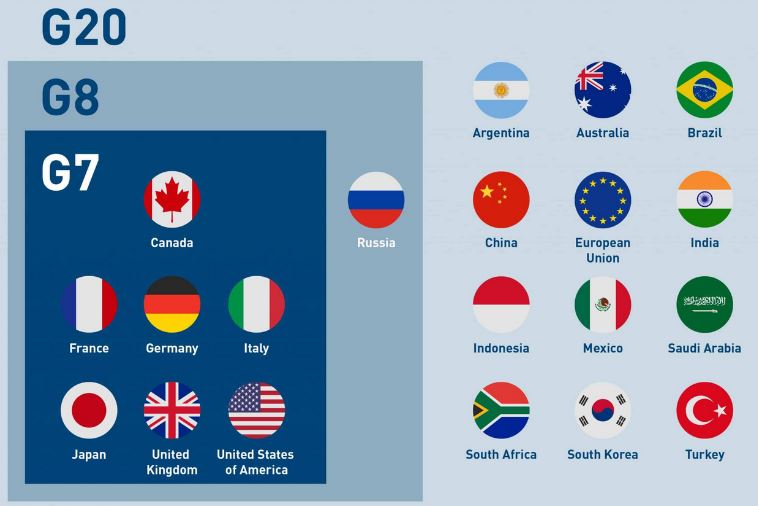
    • The G-7 or ‘Group of Seven’ includes Canada, France, Germany, Italy, Japan, the United Kingdom, and the United States.
    • It is an intergovernmental organisation that was formed in 1975 by the top economies of the time as an informal forum to discuss pressing world issues.
    • Initially, it was formed as an effort by the US and its allies to discuss economic issues.
    • The G-7 forum now discusses several challenges such as oil prices and many pressing issues such as financial crises, terrorism, arms control, and drug trafficking.
    • It does not have a formal constitution or a fixed headquarters. The decisions taken by leaders during annual summits are non-binding.
    • Canada joined the group in 1976, and the European Union began attending in 1977.

    Evolution of the G-7

    • When it started in 1975—with six members, Canada joining a year later—it represented about 70% of the world economy.
    • And it was a cosy club for tackling issues such as the response to oil shocks.
    • Now it accounts for about 40% of global GDP.
    • Since the global financial crisis of 2007-09 it has sometimes been overshadowed by the broader G20.
    • The G-7 became the G-8 in 1997 when Russia was invited to join.

    Why was Russia expelled?

    • The G-7 was known as the ‘G-8’ for several years after the original seven were joined by Russia in 1997.
    • The Group returned to being called G-7 after Russia was expelled as a member in 2014 following the latter’s annexation of the Crimea region of Ukraine.
    • Since his election in 2016, President Trump has suggested on several occasions that Russia be added again, given what he described as Moscow’s global strategic importance.

    Why in news now?

    • New Delhi is preparing for more pressure from the G-7 countries.
    • These countries (Canada, France, Germany, Italy, Japan, the UK, the US and the EU) have unitedly imposed sanctions on Russia since it invaded Ukraine.
    • They want India to cooperate in restricting its purchase of Russian oil, not circumvent the sanctions by using a rupee-rouble mechanism.
    • It also wants India to lift the ban on the export of wheat.

    Relevance of G7 for India

    • India will get more voice, more influence and more power by entering the G7.
    • After UN Security Council (UNSC), this is the most influential grouping.
    • If the group is expanded it will collectively address certain humongous issues in the global order.
    • Diplomatically, a seat at the high table could help New Delhi further its security and foreign policy interests, especially at the nuclear club and UNSC reforms.
    • It will further protect its interests in the Indian Ocean.

    Challenges for India’s entry

    • The decision to expand the grouping cannot be taken by the US alone.
    • There needs to be a consensus.
    • However, a special invitation to India is no mean achievement.


    UPSC 2023 countdown has begun! Get your personal guidance plan now! (Click here)

  • Tribes in news: Santhal Tribe

    The Santhal community is in the spotlight after a political alliance nominated one of its leaders for the Presidential election, Droupadi Murmu, for the election to the highest Constitutional post of India.

    Santhal Tribe

    • Santhal, also spelt as Santal, literally means a calm, peaceful man. Santha means calm, and ala means man in the Santhali (also spelt as Santali) language.
    • Santhals are the third largest Scheduled Tribe community in India after Gonds and Bhils.
    • The Santhali population is mostly distributed in Jharkhand, Odisha and West Bengal.

    Historical background

    • The Santhals were a nomadic stock before they chose to settle in the Chotanagpur plateau.
    • By the end of the 18th century, they had concentrated in the Santhal Parganas of Jharkhand (earlier Bihar).
    • From there, they migrated to Odisha and West Bengal.

    Demographic details

    • Tribal communities, outside the Northeast, generally have lower levels of literacy.
    • But the Santhals have higher – a result of a pro-school education awareness since at least the 1960s – literacy rate compared to other tribes in Odisha, Jharkhand and West Bengal.
    • Many of the community have entered the creamy layer of Indian society.
    • For example, Jharkhand CM Hemant Soren is a Santhal.
    • The incumbent Comptroller and Auditor General of India (CAGI) Girsh Chandra Murmu, who was the first Lt Governor of the UT of Jammu and Kashmir, is also a Santhal.

    Cultural features of Santhals

    (1) Religion

    • Despite their social upliftment, the Santhals are usually connected to their roots.
    • They are nature worshippers and could be seen paying obeisance at Jaher (sacred groves) in their villages.
    • River Damodar holds a special place in the religious life cycle of a Santhal.
    • When a Santhal dies, his or her ashes and bones are immersed in the Damodar for a peaceful afterlife.
    • Their traditional dress includes dhoti and gamuchha for men and a short-check saree, usually blue and green, for women, who generally put on tattoos.

     (2) Society

    • Various forms of marriage are accepted in the Santhal society – including elopement, widow remarriage, levirate, forced (rare) and the one in which a man is made to marry the woman he has impregnated.
    • Divorce is not a taboo in the Santhal society. Either of the couple could divorce the other.

    (3) Artforms

    • Santhals are fond of their folk song and dance that they perform at all community events and celebrations.
    • They play musical instruments like kamak, dhol, sarangi and flutes.
    • Most Santhals are agriculturists, depending on their farmlands or forests.
    • Their homes, called Olah, have a particular three-colour pattern on the outer walls.
    • The bottom portion is painted with black soil, the middle with white and the upper with red.

    (4) Language

    • Their tribal language is called Santhali, which is written in a script called Ol chiki, developed by Santhal scholar Pandit Raghunath Murmu.
    • Santhali language belongs to the Munda group.
    • Santhali written in OI-Chiki script is recognised as one of the scheduled languages in the Eighth Schedule to the Constitution.

    Back2Basics: Santhal Rebellion

    • The Santhal rebellion also known as Santhal Hool was a revolt by the Santhal in present-day Jharkhand, India, against the British East India Company and the Zamindari System.
    • It began on June 30, 1855, and the East India Company declared martial law on November 10, 1855, which lasted until January 3, 1856, when martial law was lifted.
    • The insurrection was put down by the Presidency soldiers.
    • The four Murmu Brothers – Sidhu, Kanhu, Chand, and Bhairav – spearheaded the revolt.


    UPSC 2023 countdown has begun! Get your personal guidance plan now! (Click here)

More posts