A blueprint that defines the extended jurisdiction of the Border Security Force (BSF) and its new logistical requirements in frontier States has been prepared and is soon expected to be submitted to the Union Home Ministry.
What is the news?
While in Punjab, West Bengal and Assam, the BSF jurisdiction, from the border towards the hinterland, was enhanced from the earlier 15 km to 50 km.
In Gujarat the same limit has been reduced from 80 km to 50 km, while in Rajasthan the limit has been kept unchanged at 50 km.
Do you know?
BSF currently stands as the world’s largest border guarding force. It has been termed as the First Line of Defence of Indian Territories.
About Border Security Force (BSF)
The BSF is India’s border guarding organization on its border with Pakistan and Bangladesh.
It comes under the Ministry of Home Affairs.
It was raised in the wake of the 1965 Waron 1 December 1965 for ensuring the security of the borders of India and for matters connected therewith.
The BSF has its own cadre of officers but its head, designated as a Director-General (DG), since its raising has been an officer from the Indian Police Service (IPS).
What are the new modifications?
The MHA has exercised the powers under the Border Security Force Act of 1968.
It has thus outlined the area of BSF’s jurisdiction.
Powers exercised by BSF in its jurisdiction
BSFs jurisdiction has been extended only in respect of the powers it enjoys under:
Criminal Procedure Code (CrPC)
Passport (Entry into India) Act, 1920 and
Passport Act, 1967
Arrest and search
BSF currently has powers to arrest and search under these laws.
It also has powers to arrest, search and seize under the NDPS Act, Arms Act, Customs Act and certain other laws.
Sanctions behind such powers
Scarcely populated borders: At that time, border areas were sparsely populated and there were hardly any police stations for miles.
Trans-border crimes: To prevent trans-border crimes, it was felt necessary that BSF is given powers to arrest.
Manpower crunch: While police stations have now come up near the border, they continue to be short-staffed.
Various issues at Borders
Encroachment
Illegal incursion
Drug and cattle smuggling
Impact on State Police jurisdiction
Such moves are aimed to complement the efforts of the local police.
Thus, it is an enabling provision.
It’s not that the local police can’t act within the jurisdiction of the BSF.
The state police have better knowledge of the ground.
Hence BSF and local Police can act in cooperation.
Criticism of the move
At a basic level, the states can argue that law and order is a state subject and enhancing BSF’s jurisdiction infringes upon powers of the state government.
In 2012, then Gujarat CM and the present PM had opposed a central government moves to expand BSF’s jurisdiction.
A public interest litigation (PIL) seeking to invalidate Talaq-e-Hasan, the prescribed Islamic way of divorce, has been filed in the Supreme Court.
What is the PIL about?
The petition seeks to make the prescribed Islamic way of divorce Talaq-e-Hasan unconstitutional as it is violative of Articles 14, 15, 21 and 25 of the Constitution.
The petitioner has been unilaterally divorced through the Talaq-e-Hasan mode by her husband.
She also prayed that Section 2 of the Muslim Personal Law (Shariat) Application Act, 1937 that permits Muslims to practise unilateral divorce be declared void.
Basis of the PIL
The hearing comes almost five years after the five judge Bench headed by then CJI J.S. Khehar invalidated instant triple talaq in their verdict in the Shayara Bano vs the Union of India Case.
The invalidation of instant triple talaq where the court held, “What is bad in theology is bad in law as well”, led to the enactment of the Muslim Women (Protection of Rights on Marriage) Act 2019.
What is Triple Talaq?
In instant triple talaq a man pronounces multiple divorce in one go.
It has no scope for reconciliation between the feuding couple, and often ends a marriage instantly.
It is, as the judges held, not mentioned anywhere in the Quran which prescribes a code of divorce largely through Surah Baqarah, verses 226 to 237 and the opening six verses of Surah Talaq.
Incidentally, triple talaq in this manner has been banned in many Muslim countries, including Egypt, Pakistan, Jordan, Kuwait, Iraq, Malaysia etc.
How is Talaq-e-Hasan different from instant triple talaq?
Unlike instant triple talaq, Talaq-e-Hasan is pronounced with a gap of at least one month or one menstrual cycle.
Only a single revocable divorce takes place through the first pronouncement of Talaq-e-Hasan.
The husband and wife are supposed to live together after this pronouncement and have the option of rapprochement.
If the couple is not able to mend fences in the intervening period and the husband does not annul divorce through word or by establishing intimacy, the talaq stays valid.
At the end of this month, the husband has to pronounce divorce for the second time.
Likewise for the third time. After the second pronouncement too, the divorce is revocable, and the couple may resume their conjugal relationship anytime they so desire.
If, however, the third pronouncement is made after at least one menstrual cycle, then irrevocable divorce takes place.
Why such hue over menstrual cycle?
Significantly, no divorce can be administered when the woman is undergoing her menstrual cycle.
Even in the case of pregnancy, no divorce takes place.
And if such a pronouncement is made, it remains in abeyance till the end of pregnancy.
Are there other options of divorce apart from the Talaq-e-Hasan?
The third option of divorce besides Talaq-e-Hasan and the now repudiated instant triple talaq, is Talaq-e-Ahsan.
Under this form, a single pronouncement is made.
Following the pronouncement, a woman has to go through iddat or a waiting period of three months.
During this period the divorce can be cancelled.
However, failure to annul divorce during this period results in it being finalised after which a woman is independent, and free to marry another man or stay single, as she may choose.
Both Talaq-e-Hasan and Talaq-e-Ahsanenjoy legal validity in almost all Muslim countries.
Interestingly, women too have a right to end an unsuccessful marriage through Khula.
Legal status of Khula in India
In April 2021, the Kerala High Court held this form of divorce valid.
The court overruled a 49-year-old verdict in K.C. Moyin vs Nafeesa and Others (1972) that barred Muslim women from dissolving their marriage through non-judicial modes.
There is some debate among religious scholars on the ways of Khula.
Some hold that the man’s consent is necessary in Khula while most say that he enjoys no such privilege.
Yesterday, June 21 was the day of the summer solstice in the northern hemisphere.
What is Summer Solstice?
Solstice means “sun stands still” in Latin.
The longest day of 2021 for those living north of the Equator is June 21.
This day is characterized by a greater amount of energy received from the sun.
In technical terms, this day is referred to as the summer solstice, the longest day of the summer season.
It occurs when the sun is directly over the Tropic of Cancer, or more specifically right over 23.5-degree north latitude.
The Southern Hemisphere receives most sunlight on December 21, 22 or 23 when the northern hemisphere has its longest nights– or the winter solstice.
Why do we have summer solstice?
Since Earth rotates on its axis, the Northern Hemisphere gets more direct sunlight between March and September over the course of a day.
This also means people living in the Northern Hemisphere experience summer during this time.
The rest of the year, the Southern Hemisphere gets more sunlight.
During the solstice, the Earth’s axis — around which the planet spins, completing one turn each day — is tilted in a way that the North Pole is tipped towards the sun and the South Pole is away from it.
Answer this PYQ in the comment box:
Q.On 21st June, the Sun (CSP 2019):
(a) Does not set below the horizon at the Arctic Circle
(b) Does not set below the horizon at Antarctic Circle
(c) Shines vertically overhead at noon on the Equator
(d) Shines vertically overhead at the Tropic of Capricorn
Post your answers here.
Some interesting facts
During the June solstice compared to any other time of the year, the North Pole is tipped more directly toward the sun, and the south pole is tipped more directly away from the sun.
As a result, all locations north of the equator see days longer than 12 hours and all locations south see days shorter than 12 hours.
The sun’s path across the sky is curved—NOT a straight line on the summer solstice.
Based on Earth’s current orbit, the summer solstice date rotates between June 20, 21 and 22 and is not fixed since it depends on the physics of our solar system and not on human calendar.
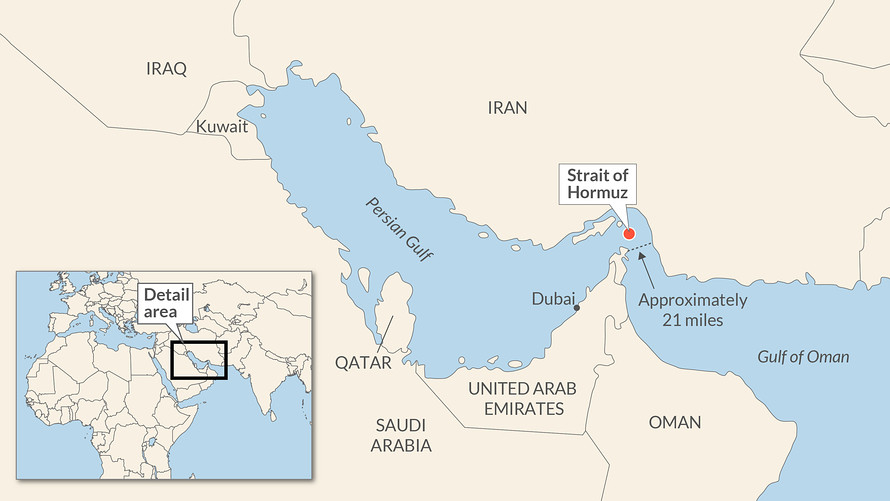
A US Navy warship fired a warning flare to wave off an Iranian speedboat coming straight at it during a tense encounter in the strategic Strait of Hormuz.
Why in news?
The Strait of Hormuz, a narrow waterway in the Middle East marks the most sensitive transportation choke point for global oil supplies.
Strait of Hormuz
The Strait of Hormuz is a narrow channel, approximately 30 miles wide at the narrowest point, between the Omani Musandam Peninsula and Iran.
It connects the Persian Gulf to the Gulf of Oman.
The Strait is deep and relatively free of maritime hazards.
Its depth is greatest near the Musandam Peninsula and tapers as you move north toward the Iranian shore.
Why is it important?
Oil tankers carrying crude from ports on the Persian Gulf must pass through the strait.
Around 21 million barrels of oil a day flowed through it in 2018, equivalent to roughly a third of global seaborne oil trade and about 21% of global petroleum liquids consumption.
Communication is a critical element of monetary policy. Yet there seems to be a gap between what the MPC says and what the RBI does.
About MPC
The Reserve Bank of India Act, 1934 (RBI Act) has been amended by the Finance Act, 2016, to provide for a statutory and institutionalised framework for a Monetary Policy Committee, for maintaining price stability, while keeping in mind the objective of growth.
Highest monetary policy-making body: By law, the Monetary Policy Committee is the highest monetary policy-making body in the land, tasked with deciding monetary policy changes at regular intervals.
Composition: The MPC will have six members – the RBI Governor (Chairperson), the RBI Deputy Governor in charge of monetary policy, one official nominated by the RBI Board and the remaining three members would represent the Government of India.
The MPC will be chaired by the Governor.
Under the inflation targeting regime, the most important role in communication belongs to the MPC.
Communication with public
Monetary policy changes are communicated through formal statements, with the discussions underlying these decisions also being published, so that the public can understand why the MPC decided the way that they did.
Communication gap: Over the past few years, a communication gap seems to have opened up between what the MPC has been saying and what the RBI has been doing, thereby potentially eroding the credibility of the IT framework.
Influencing inflation expectations: Communication is an important part of the ability of the central bank to influence inflation expectations.
Following are the ways which indicate the communication gap between the RBI and the MPC, with several implications for the credibility of the MPC.
1] Separate statements
During the first few years of the inflation-targeting regime from 2016 to 2018, the process of communication worked quite well.
On the days of policy announcements, the governor and his deputies would participate in a press conference.
From 2019 onwards, however, things began to change.
Governor’s separate statement: The RBI began to release a separate governor’s statement on the day of the monetary policy meeting, presenting an inflation outlook and even explaining the decision taken by the MPC.
MPC statement: It has overlapped with the MPC statement; at times, it has seemed somewhat different.
For example, following the June 8 Monetary Policy Review the MPC highlighted inflation concerns, and voted in favour of raising the policy repo rate.
On the same day, a governor’s statement mentioned that the central bank will also remain focussed on the orderly completion of the government’s borrowing programme.
Confusion: The issuance of two such different statements can lead to confusion, especially as lowering inflation and lowering government bond yields are contradictory policy objectives.
Why is communication so crucial? To influence inflation expectations!
If the public believes the central bank is committed to keeping inflation under control, then it will act accordingly.
Firms will moderate their price increases, fearing that large price rises will make them uncompetitive.
Meanwhile, workers will accept moderate wage increases, while investors will accept low interest rates on their bond purchases.
With everyone acting in this way, it will be easier for the central bank to ensure that inflation indeed remains low.
Anchored inflation expectations: If inflation expectations are well anchored, then it becomes relatively easy for the central bank to ensure that inflation returns to the target level before too long.
2] Change in the Monetary Policy Corridor width during pandemic
Deciding the repo rate: The most important task of the MPC, enshrined in the RBI Act (Amended), 2016 that introduced IT, is to decide the repo rate, since this has long been the lynchpin of India’s monetary policy framework.
Ever since the early 2000s, policy had aimed to keep overnight money market rates in a corridor, with the lower bound established by the reverse repo rate and the upper bound by the repo rate.
Since the width of this corridor was fixed, once the repo rate was decided, the reverse repo rate was automatically determined, and market overnight rates adjusted accordingly.
During the Covid-19 pandemic, the RBI constantly adjusted the reverse repo rate even as the MPC kept the repo rate unchanged.
As a result, the fixed width of the corridor was lost, and the MPC lost any role in determining interest rates.
3] Introduction of policy instruments outside the remit of MPC
During pandemic, the RBI introduced a number of new policy instruments, again outside the remit of the MPC.
GSAP: It brought in the GSAP programme through which it pre-commited to buying a certain amount of dated government bonds in order to control their yields.
Variable reverse repo auctions: It then introduced variable reverse repo auctions, and more recently, replaced the reverse repo rate with the long-dormant standing deposit facility rate.
The rationale for this was not explained in the MPC statement.
All unconventional monetary policy announcements were kept outside the MPC statement.
This raised the questions about the role of the committee in deciding monetary policy actions at a crucial time like the pandemic.
4] Intervention in the foreign exchange market
The RBI has been intervening in the foreign exchange market to manage the rupee.
Forex interventions by definition influence the domestic monetary base and inflation.
Yet the MPC in its monetary policy statements does not discuss either the exchange rate dynamics or the forex interventions.
Just as it does not discuss the RBI’s interventions in the bond market to lower the yields.
Way forward
In its latest two statements, the MPC indicated that policy would now be focusing on bringing India’s inflation rate under control.
Clear policy framework: If the RBI is going to be successful in this endeavour, the first step must be to close the communication gap, by reintroducing a simple and clear policy framework and restoring the central role of the MPC.
Conclusion
The net result of all these actions is a potential loss of both clarity and credibility. The communication gap will need to be closed in order for the RBI to become successful in bringing inflation back to its 4 per cent target level.
The Corridor in the monetary policy of the RBI refers to the area between the reverse repo rate and the MSF rate.
Reverse repo rate will be the lowest of the policy rates whereas Marginal Standing Facility is something like an upper ceiling with a higher rate than the repo rate.
The MSF rate and reverse repo rate determine the corridor for the daily movement in the weighted average call money rate.
As per the monetary policy of the RBI, ideally, the call rate should travel within the corridor showing a comfortable liquidity situation in the financial system and economy.
What is GSAP?
The G-Sec Acquisition Programme (G-SAP) is basically an unconditional and a structured Open Market Operation (OMO), of a much larger scale and size.
G-SAP is an OMO with a ‘distinct character’.
The word ‘unconditional’ here connotes that RBI has committed upfront that it will buy G-Secs irrespective of the market sentiment.
The commonality between Sri Lanka and the southern parts of India remains a less-emphasised yet significant aspect of India-Sri Lanka relations.
Crisis in Sri Lanka and relief provided by India
The present economic crisis in Sri Lanka has pushed it closer to India for immediate relief.
India, as part of its ‘Neighbourhood First’ policy, has extended support to the people of Sri Lanka in the form of aid (close to $3.5 billion) to help secure Sri Lanka’s food, health and energy security by supplying it essential items such as food, medicines, fuel and kerosene.
The latest in the series was the signing of an agreement on June 10 between the Government of Sri Lanka and the Export-Import Bank of India for a $55-million short term Line of Credit to facilitate the procurement of urea for paddy crop in the ongoing ‘Yala’ season.
On its part, Tamil Nadu decided to provide aid of ₹123 crore, comprising 40,000 tonnes of rice, 137 types of life-saving drugs and 500 tonnes of milk powder.
Sri Lanka-India sub-regional context
During his second term as Prime Minister, Mr. Wickremesinghe while delivering a lecture in Chennai, in August 2003, called for the development of the south India-Sri Lanka sub-region as a single market.
Such a market would provide more opportunities for the economic growth of both countries.
In 2016 he highlighted the fact that the five Indian southern States, with a total population of 250 million, had a combined gross state domestic product of nearly $450 billion; with the addition of Sri Lanka’s $80 billion GDP, the sub-region would have a $500 billion economy, having an aggregate population of around 270 million.
Challenges
Possibility of greater economic collaboration: Whether this bonhomie can lead to greater economic collaboration between Sri Lanka and south India, not necessarily Tamil Nadu alone, given the historical baggage, is anybody’s guess.
Baggage of history: Some sections of the Sinhalese still hold the view that India had been a threat to Sri Lanka and it can still be a threat to them.
The manner in which the Rajapaksa regime unilaterally scrapped in February 2021 a tripartite agreement signed in 2019 with India and Japan for the development of Colombo’s East Container Terminal was a reflection of the historical baggage.
This perception can be traced to history when Sri Lanka was invaded by rulers of south India who humbled the Sinhala kings.
In the aftermath of the 1983 anti-Tamil pogrom, the support provided by the Indian government to Tamil rebels only strengthened this perception.
Modest investment in Sri Lanka’s development: Despite India’s open willingness to take part in the development of Sri Lanka after the civil war, the scale of its involvement has been modest.
Incomplete projects due to lack of political will: After the cancellation of the tripartite agreement, India was later provided with projects such as the West Container Terminal, the Trincomalee oil tank farm and a couple of renewable projects, there were several proposals that envisaged India’s participation but did not see the light of day.
Another project, a collaboration between NTPC Limited and the Ceylon Electricity Board, was cancelled.
Other projects too such as the development of the Kankesanthurai harbour and the expansion of the Palaly airport in Jaffna, both envisaging Indian participation, would have become a reality had there been show of political will from the other side.
The project of building a sea bridge and tunnel, connecting Rameshwaram to Talaimannar, remains on paper.
Way forward
Infrastructure development: Even now, there is enormous scope for collaboration between the two countries in the area of infrastructure development.
Cross-border energy trade: The economic crisis has revived talk of linking Sri Lanka’s electricity grid with that of India.
If this project takes off, the first point of interconnectivity on the Indian side will most likely be in Tamil Nadu.
India has cross-border energy trade with Bangladesh, Nepal, Bhutan and Myanmar.
Facilitating people-to-people interaction: The apprehension in the minds of sections of the Sinhalese majority about India being a threat can be dispelled only by facilitating greater people-to-people interaction, including pilgrimages by monks and other sections of Sri Lankan society to places of Buddhist importance not only in north India but also in the south (Andhra Pradesh).
Conclusion
Much more will have to be done but the opportunity created by the current circumstances should be utilised to bring Indian and Sri Lankan societies closer — a prerequisite to achieving an economic union between Sri Lanka and the southern States of India.
Chinese President Xi Jinping will host a virtual summit of the leaders of the BRICS countries. PM Modi is expected to join.
Why in news?
China is keen for the grouping to explore expansion and include new developing country members.
Under the “BRICS Plus” format, the forthcoming summit is also expected to be attended by leaders of invited emerging countries.
What is BRICS?
BRICS is an acronym for the grouping of the world’s leading emerging economies, namely Brazil, Russia, India, China and South Africa.
The BRICS Leaders’ Summit has convened annually. It does not exist in form of an organization, but it is an annual summit between the supreme leaders of five nations.
Its inception
On November 30, 2001, Jim O’Neill, a British economist who was then chairman of Goldman Sachs Asset Management, coined the term ‘BRIC’ to describe the four emerging economies of Brazil, Russia, India, and China.
He made a case for BRIC on the basis of econometric analyses projecting that the four economies would individually and collectively occupy far greater economic space and become among the world’s largest economies in the next 50 years or so.
How it has formed?
The grouping was formalized during the first meeting of BRIC Foreign Ministers on the margins of the UNGA in New York in September 2006.
The first BRIC Summit took place in 2009 in the Russian Federation and focused on issues such as reform of the global financial architecture.
Who are the members?
South Africa was invited to join BRIC in December 2010, after which the group adopted the acronym BRICS. South Africa subsequently attended the Third BRICS Summit in Sanya, China, in March 2011.
The Chairmanship of the forum is rotated annually among the members, in accordance with the acronym B-R-I-C-S.
The importance of BRICS is self-evident: It represents 42% of the world’s population, 30% of the land area, 24% of global GDP and 16% of international trade.
The five BRICS countries are also members of G-20.
The BRICS outreach to Africa began at the last summit hosted by South Africa, in 2013. It has picked up momentum now but African leaders want more.
They need big loans from the New Development Bank (NDB) for their infrastructure projects.
China introduced the “BRICS Plus” format at the Xiamen summit last year by inviting a few countries from different regions.
South Africa emulated it, arranging the attendance of top-level representation of five nations of its choice: Argentina, Jamaica, Turkey, Indonesia and Egypt.
The precise role of “BRICS Plus” countries will take time to evolve but an immediate benefit is the immense opportunities it provides for networking among leaders.
In this article, we will examine India’s ties with Myanmar which has been in turmoil since February, 2021.
The military had seized control of the country in a coup and detained Aung San Suu Kyi and other leaders of her Parliament.
Myanmar: A backgrounder
Myanmar, also known as Burma, is in South East Asia and neighbours Thailand, Laos, Bangladesh, China and India.
The biggest city is Yangon (Rangoon) but the capital is Nay Pyi Taw.
The main religion is Buddhism. There are many ethnic groups in the country, including Rohingya Muslims.
The country gained independence from Britain in 1948. It was ruled by the armed forces from 1962 until 2011, when a new government began ushering in a return to civilian rule.
Myanmar under Suu Kyi
Aung San Suu Kyi became world-famous in the 1990s for campaigning to restore democracy.
She spent nearly 15 years in detention between 1989 and 2010 after organising rallies calling for democratic reform and free elections.
She was awarded the Nobel Peace Prize while under house arrest in 1991.
In 2015, she led the NLD to victory in Myanmar’s first openly contested election in 25 years.
Myanmar in recent timeline:
(1) Crackdown on Rohingyas
Suu Kyi’s international reputation has suffered greatly as a result of Myanmar’s treatment of the Rohingya minority.
Myanmar considers them illegal immigrants and denies them citizenship. Over decades, many have fled the country to escape persecution.
Thousands of Rohingya were killed and more than 700,000 fled to Bangladesh following an army crackdown in 2017.
(2) Military Coup
The military is now backing in charge and has declared a year-long state of emergency.
It seized control following a general election which Suu Kyi’s National League for Democracy (NLD) party won by a landslide.
The armed forces had backed the opposition, who were demanding a rerun of the vote, claiming widespread fraud.
The election commission said there was no evidence to support these claims.
Suu Kyi is thought to be under house arrest. Several charges have been filed against her, including breaching import and export laws and possession of unlawful communication devices.
How does the world see Myanmar today?
Many western liberal democracies have condemned the military takeover.
UN Secretary-General António Guterres said it was a “serious blow to democratic reforms”.
US President Joe Biden has threatened to reinstate sanctions.
However, the issue has now faded from the geopolitical discourse.
Chinese pleasure over Myanmar Coup
China neither condemned nor expressed any concern. It just said that reconciliation is needed between the civilian set-up and Myanmar military or Tatmadaw.
China blocked a UN Security Council statement condemning the coup.
The country, which has previously opposed international intervention in Myanmar, urged all sides to “resolve differences”.
Its Xinhua news agency described the changes as a “cabinet reshuffle”.
Neighbours including Cambodia, Thailand and the Philippines, have said it is an “internal matter”.
An analysis: India-Myanmar Relations
India-Myanmar relations are rooted in shared historical, ethnic, cultural and religious ties.
As the land of Lord Buddha, India is a country of pilgrimage for the people of Myanmar.
The geographical proximity of the two countries has helped develop and sustain cordial relations and facilitated people-to- people contact.
Both share a long land border of over 1600 km (approx.) and a maritime boundary in the Bay of Bengal.
A large population of Indian origin (according to some estimates about 2.5 million) lives in Myanmar. India and Myanmar signed a Treaty of Friendship in 1951.
India’s interests
India needs a good working relationship with the Myanmar government for its diplomatic and strategic initiatives.
This is especially due to China’s nefarious designs in Myanmar, which wants to develop it as a geopolitical base against India.
Despite Myanmar being ruled by military junta over the years, India has developed close ties and shares a good relationship with Tatmadaw.
(a) Strategic relations
The geographically strategic location of Myanmar makes it a bridge between South Asia and Southeast Asia.
Last year, despite facing shortage of its own, India handed over INS Sindhuvir, a submarine, to the Myanmar Navy.
Tatmadaw responded well to Indian overtures and even allowed India to conduct counter-interagency operations against Indian insurgents groups in Myanmar border areas.
Both nations seek to cooperate to counteract drug trafficking and insurgent groups operating in the border areas.
(b) Economic Relations
India and Myanmar are leading members of BIMSTEC, SAARC and the Mekong-Ganga Cooperation, along with Vietnam, Laos, Cambodia and Thailand, helping India develop its influence and ties amongst Southeast Asian nations.
Also, the Myanmar government recently hinted at delaying and cancelling BRI projects and developing some big ticket projects with India.
(c) Humanitarian Assistance
India responded promptly and effectively in rendering assistance after natural disaster in Myanmar such as the earthquake in Shan state (2010) Cyclone Mora (2017), and Komen (2015).
India offered to help in capacity building in disaster risk mitigation as well as strengthening Myanmar’s National Disaster Response Mechanism.
What defines China-Myanmar relations?
China has its own designs and wants to use Myanmar as another base in its ‘string of pearl’ strategy against India. Through the string of pearls approach, China intends to encircle India by developing military bases in India’s neighbouring countries and Myanmar has long been on China’s radar.
(a) Debt trap diplomacy
Burdening Myanmar under Chinese debt trap is the first step of the plan.
Under China-Myanmar Economic Corridor (CMEC) part of the Belt and Road Initiative (BRI), China is funding and developing many big projects in Myanmar that can be used as military bases in future.
These infrastructure projects have put Myanmar in massive Chinese debt trap, and accounts for over 40 per cent of the current $10 billion national debt.
(b) Political interference
The second Chinese step was to control the political machinery.
Like in Nepal, where China maneuvered to install a pro-Beijing and anti-India group government, Myanmar is expected to witness the same thing with military coup.
Geostrategic experts say China instigated Nepal to start the border dispute with India.
(c) Trade dependence
With this second step done, the third step comes into play: making a country your economically held scapegoat.
When it comes to bilateral trade with India, it stood at just $1.5 billion dollars in 2019-20, nowhere near that of China. With China, the bilateral trade is worth $12 billion dollars.
But if we go by an official Chinese report quoting the Ministry of Commerce of China, export and import between China and Myanmar was worth $168 billion dollars in 2019.
That is huge for a small country like Myanmar.
Through the prism of Coup
(a) Impact on India
While the coup invited international condemnation, not much has changed for India as it has built ties with the Tatmadaw over the years.
The handing over late last year of INS Sindhuvir, a kilo-class submarine of the Indian Navy, to the Myanmar Navy, was the most recent sign of the deepening ties between New Delhi and the Tatmadaw.
India and China have been competing for influence in Myanmar.
If India hadn’t agreed to help Myanmar meet its naval requirements, it would have meant a greater Chinese presence in the Bay of Bengal.
Senior General Min Aung Hlaing (behind this coup) has made multiple visits to India over the last few years, most recently in 2019, when he met our PM.
(b) Impact on China
India was the largest supplier of weapons and other military equipment to Myanmar in 2019, the last year for which records are available in the SIPRI Military Expenditure Database.
Tatmadaw exported military hardware worth $100 million from India that year while it spent only $47 million on Chinese military equipment the same year.
This is significant because China has been the largest supplier of weapons to the Southeast Asian country over the decades.
The General has also been critical of China, accusing Beijing of providing support to certain insurgent groups in the country, including the Arakan Army in Rakhine state, which the Tatmadaw has been fighting.
Many rebel groups in Myanmar have been using Chinese-made weapons against the military. This, experts say, rules out a tight embrace of China in the near term.
Repercussions of the Coup
Diplomatic isolation: And with over 50 years of military rule and an isolated status in the world, it seems that most of the relations are held by China alone.
Sanctions and embargoes: If the US goes ahead with its threat of sanctions because of the coup, Myanmar will have to turn to Beijing as a shield.
New puppet of China: In a nutshell, Myanmar’s economy is largely dependent on China, and with a pro-Beijing government in place, Myanmar may well fall finally into Chinese debt trap by allowing China funded BRI projects.
Hostility in India’s neighbourhood: If that happens, Myanmar will be reducing to a mere economic scapegoat of its largest trading partner China, and a hostile neighbour for India’s geopolitical interests.
Deterrence in Indo-Pacific: This in turn will emerge as a deterrent in the global vision of Indo-Pacific.
It may be often tempting to describe India’s Myanmar policy as suffering from a dilemma between values and interest.
Wait….. India never acts blindfolded
India’s interest in Myanmar has always been guided strategically by the centrality of democracy to ensure deeper ties.
India has also learned to accept that “the liberal democratic paradigm will not automatically come about” in Myanmar, nor in any other part of India’s politically volatile neighbourhood.
So while Indian policymakers have always been clear about their democratic endgame in Myanmar, they also recognise that pragmatic adjustments are sometimes necessary to engage with the military, which remains the ultimate guarantor of internal stability and order.
Since Nehruvian times….
60 years ago, the Burmese armed forces, the Tatmadaw, first took over power to end a decade of democratic reforms in the 1950s.
The coup of March 1962 was a severe setback for India’s investment in a federal, democratic Burma under the leadership of Nehru’s great friend U Nu.
However, with the democratic regime in deep crisis, it made sense to engage General Ne Win to protect Indian interests, including cross-border insurgencies, China’s influence and the safety of the larger Indian diaspora.
Despite his personal distress at the imprisonment of his friend and the end of democracy, Nehru gave the green light for India to become one of the first countries to recognise the military regime, even before China.
For the time being, India will push for democracy in public domain but in private it will pivot to engage with Myanmar’s new military regime.
The road to democracy in Myanmar lies through its military
Sixty years later, the situation is strikingly similar.
This marks a return to India’s dual policy of the 2000s, when it built a relationship of high-level trust with the Myanmar military while also nudging and supporting the Generals to embrace democratic reforms.
This approach was first crafted in the late 1990s by Shyam Saran, then India’s ambassador in Yangon, and executed in 2000 with a rare display of successful defence diplomacy led by Army chief VP Malik.
This was no easy task. Western analysts criticised India for blindly engaging Myanmar.
At the UN India came under attack for not supporting sanctions and condemnatory resolutions, especially during the failed 2007 democratic uprising.
Despite such pressure, India stood firm and also paid a price for it. PM Manmohan Singh, for example, declined two invitations and only visited Myanmar in 2012, after the democratic opening.
Way forward
The carefully calibrated policy of the 2000s will serve India well today, where circumstances are even more favourable.
Thanks to the rise of China, the US and the EU are now more wary of isolating Myanmar.
And the Tatmadaw is now also less enamored of China and keen to deepen relations with India.
But New Delhi will still have to work hard to pursue its democratic realist policy in Myanmar.
For India to play a role
(a) Domestically
The first challenge will be to preserve trust with the Generals even while keeping up the pressure to restore a democratic order.
Delhi will have to keep the relationship going at the highest level to ensure that the Generals respect India’s core concerns.
This includes the Naga peace process, keeping an eye on China’s activities, and cross-border connectivity initiatives.
(b) Internationally
The second challenge will be for India to coordinate its position internationally and buy itself manoeuvering space to engage Myanmar.
The US and the EU are still likely to be less understanding of India’s position than the Association of South-East Asian Nations and Japan.
Especially at the UN Security Council, India could play an important role to bridge differences and develop a common platform to nudge Myanmar back on to the democratic track.
You need to register to submit a question for AIR 67, Anand Malhotra and get access to Telegram group.
What’s the right time to start writing answers? How to start as a beginner? How to make notes? Should I start writing Essays regularly as a beginner? Can I prepare for UPSC Mains 2022 in 80 days?
If such questions are bugging you day and night, this Webinar is for you!(Details below)
Hey aspirants, Prelims 2022 result out, most of you must be studying for UPSC Mains 2022. But what about those appearing for UPSC 2023-24?
Whatever be the result you must start writing answers.
Not only us, but our toppers also feel that you should keep your preparation integrated. Prelims and Mains (answer writing and essays) must go hand in hand.
Feeling Motivated?
CivilsDaily’s topper Anand Malhotra, AIR 67, UPSC 2021 wants to discuss a few things with you regarding UPSC Mains preparation. For that, he will be taking a LIVE session (Webinar).
An engineer and an IIM grad, Anand Malhotra secured AIR 67 in his second attempt. Before this, Anand had a stint with a startup and a tech MNC as well. His optional was Sociology.
Anand loves watching talk shows like TED and would love to motivate and guide you. Watch the video to know more about him.
The government has assured the creation of one million jobs over the next one-and-a-half years. This may be optimistic, but if it does materialise, the employment landscape will change dramatically.
Background
What is the unemployment rate? Expressed in percentage, the unemployment rate is defined as the share of people who are without any job.
Joblessness in the country essentially relates to educated young adults seeking jobs in the formal economy.
The government recently announced it would recruit 10 lakh people in “mission mode” over the next one-and-a-half years.
The announcement came at a time when the unemployment rate for youth (aged 15-29 years) in urban areas has been hovering at over 20 per cent for the last several quarters.
What is the employment situation in India today?
If jobs are being created on a progressive basis, there will be an increase in income generation, which in turn, should spur consumption.
Therefore, if consumption picks up – this can be indicated by the growth in the consumer goods segments — then one can be confident of jobs being created.
What is the situation in India? Consumer durable goods have been registering negative or slightly positive growth for the last five years or so — this is a reflection of the purchasing power of the people that ultimately can be linked to job creation.
There have been talks of start-up economy in the country and their achievements.
Interestingly, it is a well-known fact that, globally, 80-85 per cent of start-ups fold up in the first couple of years mainly due to non-viable models that fail the scaling-up challenge.
Therefore, while start-ups sound exciting, job creation at scale cannot be part of these experiments, unless there is an assured flow of funds.
Challenge in recruiting 10 lakh people
It will be a really big task given that presently the central government offices house around 3.45 million personnel as per the budget for 2022-23.
Short time frame: The first challenge is in recruiting such a large number in this short period of time considering that there are fairly lengthy processes involved in hiring people to government departments.
Finding meaningful role: Hiring such a number is good for the country, but finding meaningful roles for them in various departments needs to be seriously examined.
Quite clearly, plans need to be in place to provide work to this set of new employees.
Increase in cost for the government: The third issue that would have to be kept in mind is the increase in cost for the government.
As per the budget for 2022-23, the average outgo per employee was around Rs 12.20 lakh.
Assuming the new set earns half of the existing average, the additional cost would be at least Rs 60,000 crore.
The salary outlay for the year was Rs 4.22 lakh crore.
These provisions would have to be made in subsequent budgets.
Conclusion
The overall unemployment picture looks complex today. While the government’s intent to add over a million jobs in the next 18 months is laudable, the task is audacious and challenging from both an administrative and financial point of view.