💥UPSC 2026, 2027, 2028 UAP Mentorship (March Batch) + Access XFactor Notes & Microthemes PDF

Search results for: “”

  • What is the Xiaomi Scam?

    Last week, the Enforcement Directorate had seized Rs 5551.27 crore ($725 million) from the local bank accounts of the Chinese smartphones company, Xiaomi.

    Unfolding the Xiaomi Scam

    • Xiaomi faces charges of having made illegal remittances to foreign entities by passing them off as royalty payments.
    • It is a charge that Xiaomi has been continuously facing in India.
    • The ‘royalty and licence fee’ paid by Xiaomi India were not being added to the transaction value of the goods imported by the company and its contract manufacturers.
    • By not adding “royalty and licence fee” into the transaction value, Xiaomi was evading Customs duty.

    What is the recent probe?

    • The Enforcement Directorate has seized the bank account assets from Xiaomi Technology India, under the provisions of Foreign Exchange Management Act (FEMA.
    • The company had remitted over Rs 5500 crore to foreign-based entities, including one Xiaomi group entity, in the guise of royalty payments.
    • Such huge amounts in the name of royalties were remitted on the instructions of their Chinese parent group entities.

    Xiaomi’s response

    • Xiaomi, for its part, said that it is committed to working closely with government authorities to clarify any misunderstandings.
    • It argued that the royalty payments and statements to the bank are all legit and truthful and were made for the in-licensed technologies and IPs used in our Indian version products.
    • It is a legitimate commercial arrangement for Xiaomi India to make such royalty payments.
    • But it is a typical corporate response, something on the lines that Xiaomi did on the previous occasion too.

    How has China responded?

    • China firmly support its companies in protecting their lawful rights and interests.
    • It urged India to provide a fair, just and non-discriminatory business environment for Chinese companies making investment and operating in the country.
    • It is visible that China has made a dovish statement as they usually do.
    • Xiaomi now has alleged its top executives faced threats of “physical violence” and coercion during questioning by ED.

    Indian govt on strong wicket

    • Indian governmental authorities have made it clear that the Chinese companies were not being targeted.
    • And financial misdemeanours had indeed been committed by these companies.
    • The government has also explained the various cases in details and what it has seized so far.
    • But the Chinese companies seem to be playing the victim card.

    Back2Basics: Directorate of Enforcement (ED)

    • ED is a law enforcement agency and economic intelligence agency responsible for enforcing economic laws and fighting economic crime (esp Money Laundering) in India.
    • It is part of the Department of Revenue of the Ministry of Finance.
    • It is composed of officers from the Indian Revenue Service, Indian Police Service and the Indian Administrative Service as well as promoted officers from its own cadre.
    • The total strength of the department is less than 2000 officers out of which around 70% of officials came from deputation from other organizations while ED has its own cadre, too.
    • The prime objective of the Enforcement Directorate is the enforcement of two key Acts namely:
    1. Foreign Exchange Management Act 1999 (FEMA) and
    2. Prevention of Money Laundering Act 2002 (PMLA)


    UPSC 2023 countdown has begun! Get your personal guidance plan now! (Click here)

  • In news: Tropical Cyclone Asani

    Severe cyclonic storm ‘Asani’, packing winds above 105 kmph and setting off heavy rain, is likely to make landfall on the eastern coast of India.

    What are tropical Cyclones?

    • A tropical cyclone is an intense circular storm that originates over warm tropical oceans and is characterized by low atmospheric pressure, high winds, and heavy rain.
    • Cyclones are formed over slightly warm ocean waters. The temperature of the top layer of the sea, up to a depth of about 60 meters, need to be at least 28°C to support the formation of a cyclone.
    • This explains why the April-May and October-December periods are conducive for cyclones.
    • Then, the low level of air above the waters needs to have an ‘anticlockwise’ rotation (in the northern hemisphere; clockwise in the southern hemisphere).
    • During these periods, there is an ITCZ in the Bay of Bengal whose southern boundary experiences winds from west to east, while the northern boundary has winds flowing east to west.
    • Once formed, cyclones in this area usually move northwest. As it travels over the sea, the cyclone gathers more moist air from the warm sea which adds to its heft.

    Requirements for a Cyclone to form

    There are six main requirements for tropical cyclogenesis:

    • Sufficiently warm sea surface temperatures
    • Atmospheric instability
    • High humidity in the lower to middle levels of the troposphere
    • Enough Coriolis force to develop a low-pressure centre
    • A pre-existing low-level focus or disturbance
    • Low vertical wind shear

    How are the cyclones named?

    • In 2000, a group of nations called WMO/ESCAP (World Meteorological Organisation/United Nations Economic and Social Commission for Asia and the Pacific) decided to name cyclones.
    • It comprised Bangladesh, India, the Maldives, Myanmar, Oman, Pakistan, Sri Lanka and Thailand, decided to start naming cyclones in the region.
    • After each country sent in suggestions, the WMO/ESCAP Panel on Tropical Cyclones (PTC) finalised the list.
    • The WMO/ESCAP expanded to include five more countries in 2018 — Iran, Qatar, Saudi Arabia, United Arab Emirates and Yemen.

    Why is it important to name cyclones?

    • Adopting names for cyclones makes it easier for people to remember, as opposed to numbers and technical terms.
    • It’s easier and less confusing to say “Cyclone Titli” than remember the storm’s number or its longitude and latitude.
    • Apart from the general public, it also helps the scientific community, the media, disaster managers etc.
    • With a name, it is also easy to identify individual cyclones, create awareness of its development, rapidly disseminate warnings to increase community preparedness etc.


    UPSC 2023 countdown has begun! Get your personal guidance plan now! (Click here)

  • What is Monkeypox?

    The UK health authorities have confirmed a case of Monkeypox, which is a virus passed from infected animals such as rodents to humans, in someone with a recent travel history to Nigeria where they are believed to have caught it.

    What is Monkeypox?

    • The monkeypox virus is an orthopoxvirus, which is a genus of viruses that also includes the variola virus, which causes smallpox, and vaccinia virus, which was used in the smallpox vaccine.
    • It causes symptoms similar to smallpox, although they are less severe.
    • While vaccination eradicated smallpox worldwide in 1980, monkeypox continues to occur in a swathe of countries in Central and West Africa, and has on occasion showed up elsewhere.
    • According to the WHO, two distinct clade are identified: the West African clade and the Congo Basin clade, also known as the Central African clade.

    Its origin

    • Monkeypox is a zoonosis, that is, a disease that is transmitted from infected animals to humans.
    • Monkeypox virus infection has been detected in squirrels, Gambian poached rats, dormice, and some species of monkeys.
    • According to the WHO, cases occur close to tropical rainforests inhabited by animals that carry the virus.

    Symptoms and treatment

    • Monkeypox begins with a fever, headache, muscle aches, back ache, and exhaustion.
    • It also causes the lymph nodes to swell (lymphadenopathy), which smallpox does not.
    • The WHO underlines that it is important to not confuse monkeypox with chickenpox, measles, bacterial skin infections, scabies, syphilis and medication-associated allergies.
    • The incubation period (time from infection to symptoms) for monkeypox is usually 7-14 days but can range from 5-21 days.
    • There is no safe, proven treatment for monkeypox yet.


    UPSC 2023 countdown has begun! Get your personal guidance plan now! (Click here)

  • Imp: UPSC Prelims 2022 || Important British Commissions and Committees

    10th May, 2022

    Educational Commissions

    (1) Charles Wood Despatch – 1854
    • Objective: Wood’s despatch proposed several recommendations in order to improve the system of education.
    • According to the recommendations, it was declared that the aim of the Government’s policy was the promotion of western education. In his despatch, he emphasized on the education of art, science, philosophy and literature of Europe.
    • In short, the propagation of European knowledge was the motto of the Wood’s Despatch.
    • According to the despatch, for higher education, the chief medium of instruction would be English.
    • However, the significance of the vernacular language was no less emphasized as Wood believed that through the mediums of vernacular language, European knowledge could reach to the masses.
    • Wood’s Despatch also proposed the setting up of several vernacular primary schools in the villages at the lowest stage.
    • Moreover, there should be Anglo-Vernacular high schools and an affiliated college in the district level.
    • Wood’s Despatch recommended a system of grants-in-aid to encourage and foster the private enterprise in the field of education.
    • The grants-in-aid were conditional on the institution employing qualified teachers and maintaining proper standards of teaching.

    (2) Hunter Commission – 1882

    • Appointed by: Viceroy Lord Ripon
    • Objective: Hunter Education Commission was a landmark commission with objectives to look into the complaints of the non-implementation of the Wood’s Despatch of 1854; the contemporary status of elementary education in the British territories; and suggests means by which this can be extended and improved.
    • Headed by: Sir William Wilson Hunter
    • He submitted its report in 1882.

    Commission suggestions:

    1. There should be two types of education arrangements at the high school level, in which emphasis should be given on giving a vocational and business education and other such literary education should be given, which will help in admission to the university.
    2. Arrangement for emphasis on the importance of education at the primary level and education in local language and useful subjects.
    3. Private efforts should be welcomed in the field of education, but primary education should be given without him.
    4. Control of education at the primary level should be handed over to the district and city boards.

    (3) Hunter Commission of 1882 on Primary Education:

    • Primary education should be regarded as the education of the masses. Education should be able to train the people for self-dependence.
    • The medium of instruction in primary education should be the mother tongue. Normal Schools should be established for the training of teachers.
    • The curriculum should include useful subjects like agriculture, elements of natural and physical science and the native method of arithmetic and measurement, etc.
    • The spread of primary education for the tribal and backward people should be the responsibility of the Government.
    • Fees should be an example to students on the basis of their financial difficulties.

    (4) Raleigh Commission – 1902

    • Appointed under: Raleigh Commission was appointed under the presidency of Sir Thomas Raleigh on 27 January 1902.
    • Objective: To inquire into the condition and prospects of universities in India and to recommend proposals for improving their constitution and working.
    • Evidently, the Commission was precluded from reporting on primary or secondary education.
    • As a result of the report of the recommendations of the Commission the Indian Universities Act was passed in 1904.
    • The main objective of the Act: to improve the condition of education in India and upgrade the system to a better level

    Important changes introduced for the upliftment of University Education:

    1. Universities were empowered to appoint their own staff including the teaching staff.
    2. The number of Fellows of a University was limited within 50 to 100.
    3. The number of elected Fellows was fixed at 20 for the Bombay, Madras and Calcutta Universities and 15 for others.
    4. The Governor-General was now empowered to decide a University’s territorial limits and also affiliation between the universities and colleges.
    5. After the implementation of the provisions of the University Act, though the number of colleges declined, yet the number of students increased considerably.

    Government Resolution on Education Policy (1913)

    • In 1906, the progressive state of Baroda introduced compulsory primary education throughout its territories. In its 1913
    • Resolution on Education Policy, the government refused to take up the responsibility of compulsory education, but accepted the policy of removal of illiteracy and urged provincial governments to take early steps to provide free elementary education to the poorer and more backward sections.
    Timeline: Vernacular education development in India

    (5) Sadler Commission – 1917

    • In 1917, the Calcutta University Commission (Sadler Commission) was appointed by the Government of India under the Chairmanship of Mr. Michel Sadler, the Vice-Chancellor of the University of Leeds.

    Recommendations:

    1. All the teaching resources in the city of Calcutta should be organized so that the Calcutta University may become entirely a teaching university.
    2. A separate teaching and residential university should be established at Dacca.
    3. There was a need for a coordinating agency. Hence an inter-University Board should be set up.
    4. Honors courses should be instituted and they should be distinctly different from the Pass courses.
    5. Full time and salaried Vice-Chancellor should be appointed to be the administrative head of the university.
    6. The Senate and the syndicate should be replaced by the Court and the Executive Council respectively.
    7. Universities should be freed from excessive official control.
    8. Government interference in the academic matters of universities should stop.

    (6) Hartog Commission – 1929

    • Sir Philip Joseph Hartog committee was appointed by the British Indian government to survey on the growth of education in India.
    • The Hartog committee (1929), had devoted more attention to mass education than the secondary and University education.
    • The Hartog committee highlighted the problem of wastage and stagnation in education at the primary level.
    • It recommended the policy of consolidation instead of multiplication of schools. The duration of the primary course was to be fixed to four years.
    • It recommended for the improvements in quality, pay, and service conditions of teachers and relating the syllabus and teaching methods to the local environment of villages and locality
    • The Hartog committee on education recommended for the promotion of technical and commercial education by universities to control the problem of unemployment.
    • The recommendation of the Hartog committee of 1929 was an attempt for consolidation and stabilization of education. The Hartog committee of 1929 was seen as a torchbearer of the government’s effort to improve the quality of education.
    • However, these recommendations of Hartog committee of 1929 remained only on paper and could not be implemented due to the great economic depression of 1930-31.

    (7) Sargent Plan – 1944

    • The Sargent plan of education came after Sir John Sargent was given the task to prepare a comprehensive scheme of education for India in 1944.

    Recommendations:

    1. Pre-primary education for children between 3 to 6 years of age. Universal, compulsory and free primary or basic education for all children between the ages 6—11 (junior basic) and 11—14 (senior basic).
    2. High school education for six years for selected children between the years 11—17.
    3. Degree course for three years beginning after the higher secondary examination for selected students
    4. Technical, commercial, agricultural and art education for full time and part-time students, girls schools are to teach domestic science.
    5. The liquidation of adult illiteracy and the development of a public library system in about 20 years.
    6. Full provision for the proper training of teachers.
    7. Educational provision is made for the physically and mentally handicapped children.
    8. The organization of compulsory physical education.
    9. Provision to be made for social and recreational activities.
    10. The creation of employment bureaus.
    11. The creation of the Department of Education in the centre and in the states.
    12. The use of mother tongue is to be used as the medium of instruction in all high schools.

    Famine Commissions during British Rule in India

    (1) Campbell Commission
    • In 1865-66, a famine engulfed Orissa, Bengal, Bihar, and Madras and took a toll of nearly 20 lakhs of lives with Orissa alone loosing 10 lakh lives, since the famine was most severe in Orissa; it is called the Orissa famine.
    • The Government officers though forewarned took no steps to meet the calamity.
    • The Government adhered to the principles of free trade and the law of demand and supply, the Government did provide employment to the table booked men leaving the work of charitable relief to the voluntary agency.
    • But the famine proved a turning point in the history of Indian famines for it was followed by the appointment of a committee under the chairmanship of Sir George Campbell.

    (2) Stratchy Commission

    • It was set up in 1878 under the Chairmanship of Sir Richard Strachey.
    • The commission recommended state interference in food trade in the event of famine. India witnessed another major famine in 1896-97.

    (3) Lyall Commission

    • It was constituted in 1897 under the Chairmanship of Sir James Lyall. This commission recommended the development of irrigation facilities.

    (4) MacDonnell Commission

    • It was set up in 1900 under the Chairmanship of Sir Anthony (Later Lord) McDonnel to re-evaluate and recommend changes in report of the previous commission, based on the findings of the recent famine.
    • This Commission recommended that the official machinery dealing with a famine must work around the year so that the scarcity of food grains could be controlled well in time.

    Law Commission

    • Law Commissions in India have a pre-independence origin. The first Law Commission was formed in 1834 as a result of the Charter Act, 1833 under the chairmanship of TB Macaulay.
    • The first commission’s recommendations resulted in the codification of the penal code and the Criminal Procedure Code.
    • Three other law commissions were constituted before independence by the British government.
    • All four pre-independent law commissions have contributed to the statute books immensely.
    • After independence, the first Law Commission was constituted in 1955 in a continuance of the tradition of bringing law reforms in the country through the medium of law commissions.
    • Second Pre-Independence Law Commission,1853 – Sir John Romilly.
    • Third Pre-Independence Law Commission, 1862- Sir John Romilly.
    • Fourth Pre-Independence Law Commission, 1879 – Dr Whitley Stokes.

    Currency Commission

    (1) Mansfield Commission by Dufferin in 1886
    • The Indian Currency Committee or Fowler Committee was a government committee appointed by the British-run Government of India on 29 April 1898 to examine the current situation in India.
    • Until 1892, silver was the metal on which Indian currency and coinage had largely been based. In 1892, the Government of India announced its intent to “close Indian mints to silver” and, in 1893, it brought this policy into force.

    Other Commissions on Currency:

    1. Fowler Commission by Elgin II in 1898
    2. Babington Smith Commission by Chelmsford in 1919
    3. Hilton Young Commission by Linlithgow in 1926

    Other Important Commissions

    1. Scott-Moncrieff Commission (Irrigation) by Curzon in 1901
    2. Fraser Commission (Police Reforms) by Curzon in 1902
    3. Hunter Commission (Punjab Disturbances) by Chelmsford 1919
    4. Butler Commission (Indian States relation with British Crown) by Irwin in 1927
    5. Whiteley Commission (Labour) by Irwin in 1929
    6. Sapru Commission (Unemployment) by Linlithgow in 1935
    7. Chalfield Commission (Army) by Linlighgow 1939
    8. Floud Commission (Tenancy in Bengal) by Linlighgow in 1940

  • India’s judiciary and the slackening cog of trust

    Context

    Departures from substantive and procedural justice need deep scrutiny as the fallout could severely imperil governance.

    Judicial corruption in India in lower judiciary

    • According to Transparency International (TI 2011), 45% of people who had come in contact with the judiciary between July 2009 and July 2010 had paid a bribe to the judiciary.
    • The most common reason for paying the bribes was to “speed things up”.
    • The Asian Human Rights Commission (AHRC) (April 2013) estimates that for every ₹2 in official court fees, at least ₹ 1,000 is spent in bribes in bringing a petition to the court.
    • Freedom House’s ‘Freedom in the World 2016 report for India’ states that “the lower levels of the judiciary in particular have been rife with corruption” (Freedom House 2016).
    • Allegations of corruption against High Court judges abound.
    • Worse, there are glaring examples of anti-Muslim bias, often followed by extra-judicial killings by the police.
    • Anti-Muslim bias alone may not result in erosion of trust but if combined with unprovoked and brutal violence against them (e.g., lynching of innocent cattle traders) is bound to.

    Forms of judicial corruption

    • Pressure and bribery: Judicial corruption takes two forms: political interference in the judicial process by the legislative or executive branch, and bribery.
    • Despite the accumulation of evidence on corrupt practices, the pressure to rule in favour of political interests remains intense.
    • Court officials coax bribes for free services, and lawyers charge additional “fees” to expedite or delay cases.

    Case pendency

    • According to the National Judicial Data Grid, as of April 12, 2017, there are 24,186,566 pending cases in India’s district courts, of which 2,317,448 (9.58%) have been pending for over 10 years, and 3,975,717 (16.44%) have been pending for between five and 10 years.
    • Vacancies: As of December 31, 2015, there were 4,432 vacancies in the posts of [subordinate court] judicial officers, representing about 22% of the sanctioned strength.
    • In the case of the High Courts, 458 of the 1,079 posts, representing 42% of the sanctioned strength, were vacant as of June 2016.
    • Thus, severe backlogging and understaffing persisted, as also archaic and complex procedures of delivery of justice.

    Understanding the substantive and procedural justice

    • Substantive justice is associated with whether the statutes, case law and unwritten legal principles are morally justified e.g., freedom to pursue any religion,
    • Procedural justice is associated with fair and impartial decision procedures.
    • Outdated laws: Many outdated/dysfunctional laws or statutes have not been repealed because of the tardiness of legal reform both at the Union and State government levels.
    • Worse, there have been blatant violations of constitutional provisions.
    • The Citizenship (Amendment) Act (December 2019) provides citizenship to — except Muslims — Hindus, Buddhists, Sikhs, Jains, Parsis and Christians who came to India from Pakistan, Bangladesh and Afghanistan on or before December 31, 2014.
    • But this goes against secularism and is thus a violation of substantive justice.
    • Alongside procedural delays, endemic corruption and mounting shares of under-trial inmates with durations of three to five years point to stark failures of procedural justice and to some extent of substantive justice.

    Conclusion

    Exercise of extra-constitutional authority by the central and State governments, weakening of accountability mechanisms, widespread corruption in the lower judiciary and the police, with likely collusion between them, the perverted beliefs of the latter towards Muslims, other minorities and lower caste Hindus, a proclivity to deliver instant justice, extra-judicial killings, filing FIRs against innocent victims of mob lynching have left deep scars on the national psyche.

    UPSC 2023 countdown has begun! Get your personal guidance plan now! (Click here)

  • 1 hours TO GO | How to tackle Prelims pressure during examination? | Free Live Webinar on the Power of Subconscious Mind | Ask Me Anything Special Session | Book Your Slot Now

    1 hours TO GO | How to tackle Prelims pressure during examination? | Free Live Webinar on the Power of Subconscious Mind | Ask Me Anything Special Session | Book Your Slot Now

    Feel Free to Join the fantastic Ask Me Anything open book session & consult How you can grow your Self-Mastery for better performance. 

     “Do you think you are utilizing only half of your mental and physical capabilities? It’s the game of your subconscious mind.”Civilsdaily.

    One might think that it is only the conscious part of the brain which makes one distinguished from the others. It is true in some sense. But, in the case of UPSC preparation, your subconscious mind overrides your conscious mind to some extent.

    Choose toppers’ 5 magical Mantras or principles which will overwrite your fears and self-doubts. You can start reasoning how your MCQ and Answer writing skills are improving, how you are completing the syllabus, how you are getting more clarity on the examination process, and how you are travelling closer to success day by day. 

    To assemble self-trust and confidence to yield the positive results sooner, join this free live webinar conducted by Civilsdaily’s Senior IAS toppers’ mentor to get certain value-added insights on how to convert ‘Despair’ into ‘Hope’  spontaneously. 

    Webinar Details:

    Grab the opportunity to get great tips on ‘How to remove all the causes of despair in the journey of UPSC-CSE 2023’, and ‘What is our subconscious mind’, & ‘How to use Self Mastery through Conscious Auto-Suggestion’. This entire webinar is free. All aspirants are wholeheartedly welcome to attend.

    Date: 9th May 2022 (Monday)

    Time: 7 PM to 8 PM

    Success Mantras in This Free Live Webinar by Siddharth Sir!

    1. How to stay focused on the study with full of concentration. Best, authentic, Do’s & Don’t, to remember all essential pieces of information for UPSC. What are the mind’s auto-suggestions? Why it is a must for UPSC!
    1. How to avoid procrastination? It’s nobody’s enemy but one’s own. So, how to stay motivated that will pluck up your spirit, also be discussed.
    1. Most of our thoughts, emotions, and behaviours are determined by the Subconscious and Unconscious minds. So, to stay firm to your UPSC goal, it’s mandatory to learn how to control your subconscious mind.
    1. How to beat burnout while studying long hours! When we study with love, we never forget. It’s yourself to whom you have to give a tough competition. So, how to establish a relationship between books & you are the foremost thing you should never ignore.
    1. What are those 5 magical principles to decode yourself? Our toppers used to utilize & implement these 5 magical principles that proved miracles.
    1. It’s not only knowledge that you must be packed with but how toppers increased the efficiency of an IAS officer must possess. How to create a basic conceptual framework that boosts your brainpower will be one of the main points of our webinar.
    1. Stress is the only villain that can destroy the power of the brain. If you think depression, it will get you depressed. And if you enjoy it, your brain will get more powerful subconsciously. 
    1. The untold secret of the power of attraction is that the UPSC-CSE journey can be getting nearer day by day. The most brilliant ways to use the power of attraction to invigorate the subconscious mind will be disclosed in this webinar.

    About Siddharth Singh Sir:

    Siddharth sir is a mentor with CivilsDaily for nearly 5+ years and is now working with other senior mentors of the Civilsdaily UPSC Guidance Program. With a brief stint in the service and Edtech industry, he has mentored more than 2000 Aspirants and is one of the recognized interviewers under UPSC Domain. He also identifies himself as a certified Nutritionist and a fitness fanatic by inclination. He is also known for his love for writing and reciting News/poetry in a deeper and soulful voice.

  • Extreme Poverty down in India

    Context

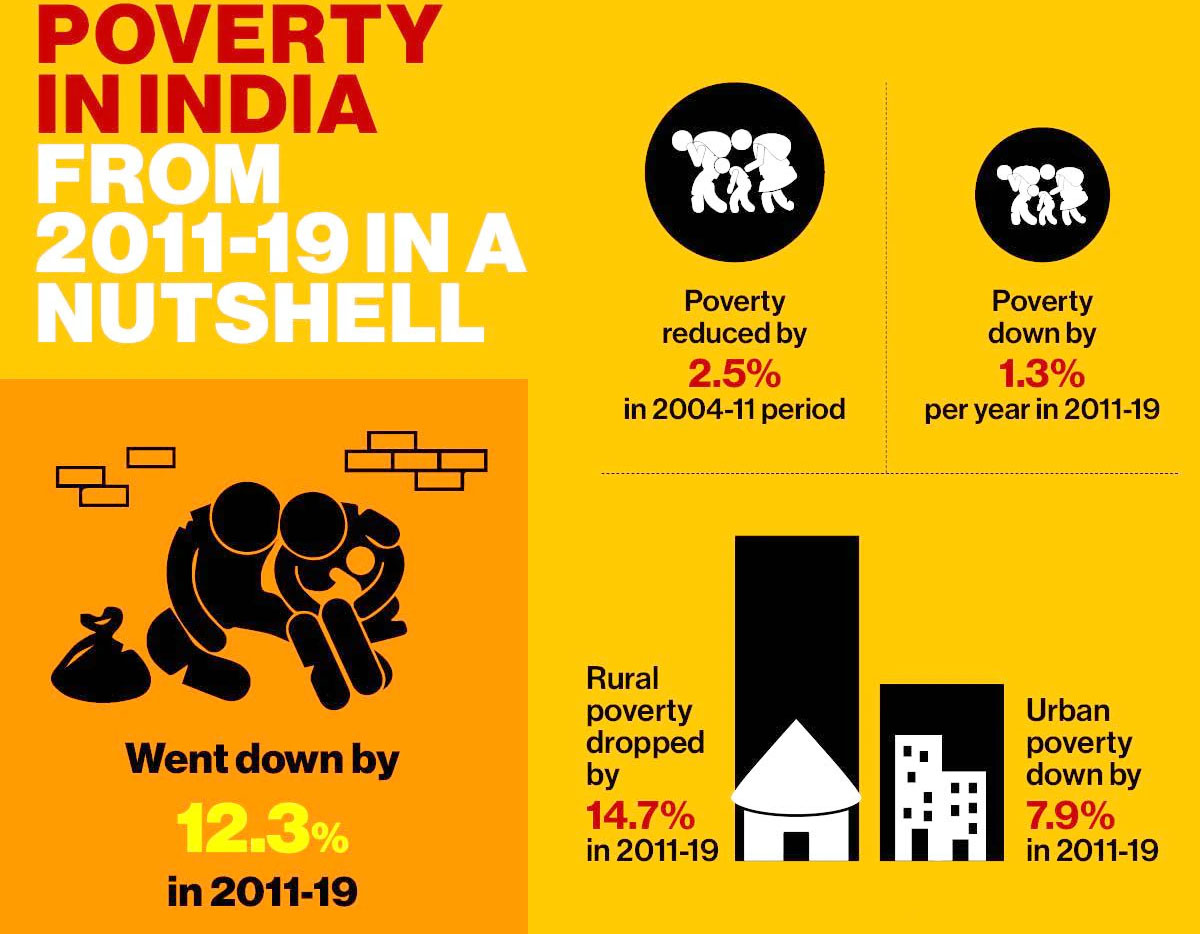
    A recent World Bank Report has shown that extreme poverty in India more than halved between 2011 and 2019 – from 22.5 per cent to 10.2 per cent.  The reduction was higher in rural areas, from 26.3 per cent to 11.6 per cent.

    What explains the reduction in poverty?

    • Poverty has reduced significantly because of the government’s thrust on improving the ease of living of ordinary Indians through schemes.
    • These schemes include the Ujjwala Yojana, PM Awas Yojana, Swachh Bharat Mission, Jan Dhan and Mission Indradhanush in addition to the Deendayal Antyodaya Yojana-National Rural Livelihood Mission and improved coverage under the National Food Security Act.
    • It is important to understand how poverty in rural areas was reduced at a faster pace.
    • Much of the success can be credited to all government departments, especially their janbhagidari-based thrust on pro-poor public welfare.

    Contributing factors

    1] Identification of beneficiaries through SECC 2011

    • The identification of deprived households on the basis of the Socioeconomic and Caste Census (SECC) 2011 across welfare programmes helped in creating a constituency for the well-being of the poor, irrespective of caste, creed or religion.
    • Deprivation criterion: Since deprivation was the key criterion in identifying beneficiaries, SC and ST communities got higher coverage and the erstwhile backward regions in Bihar, Madhya Pradesh, Rajasthan, Uttar Pradesh, Jharkhand, Odisha, Chhattisgarh, Assam, Rajasthan and rural Maharashtra got a larger share of the benefits.
    • Gram Sabha Validation: Social groups that often used to be left out of government programmes were included and gram sabha validation was taken to ensure that the project reached these groups.

    2] Widened coverage of women

    • The coverage of women under the Deendayal Antyodaya Yojana and Self Help Groups (SHG) increased from 2.5 crore in 2014 to over 8 crore in 2018 as a result of more than 75 lakh SHGs working closely with over 31 lakh elected panchayati raj representatives, 40 per cent of whom are women.
    • This provided a robust framework to connect with communities and created a social capital that helped every programme.
    • The PRI-SHG partnership catalysed changes that increased the pace of poverty reduction and the use of Aadhaar cleaned up corruption at several levels and ensured that the funds reached those whom it was meant for.

    3] Creation of basic infrastructure

    • Finance Commission transfers were made directly to gram panchayats leading to the creation of basic infrastructure like pucca village roads and drains at a much faster pace in rural areas.
    • The high speed of road construction under the Pradhan Mantri Gram Sadhak Yojana created greater opportunities for employment in nearby larger villages/census towns/kasbas by improving connectivity and enhancing mobility.

    4] Availability of credit through SHGs

    • The social capital of SHGs ensured the availability of credit through banks, micro-finance institutions and MUDRA loans.
    • Livelihood diversification: The NRLM prioritised livelihood diversification and implemented detailed plans for credit disbursement.

    5]  Implementation of social sector schemes

    • In the two phases of the Gram Swaraj Abhiyan in 2018, benefits such as gas and electricity connections, LED bulbs, accident insurance, life insurance, bank accounts and immunisation were provided to 63974 villages that were selected because of their high SC and ST populations.
    • The performance of line departments went up manifold due to community-led action.
    • The gains are reflected in the findings of the National Family Health Survey V, 2019-2021.

    6] Universal coverage schemes

    • The thrust on universal coverage for individual household latrines, LPG connections and pucca houses for those who lived in kuccha houses ensured that no one was left behind. This created the Labarthi Varg.

    7] Increase in fund transfer to rural area

    • Seventh, this was also a period in which a high amount of public funds were transferred to rural areas, including from the share of states and, in some programmes, through extra-budgetary resources.

    8] Community participation

    • The thrust on a people’s plan campaign, “Sabki Yojana Sabka Vikas” for preparing the Gram Panchayat Development Plans and for ranking villages and panchayats on human development, economic activity and infrastructure, from 2017-18 onwards, laid the foundation for robust community participation involving panchayats and SHGs, especially in ensuring accountability.

    9] Social and concurrent audit

    • Through processes like social and concurrent audits, efforts were made to ensure that resources were fully utilised.
    • Several changes were brought about in programmes like the MGNREGS to create durable and productive assets.

    10] Focus of states on improving livelihood diversification

    • The competition among states to improve performance on rural development helped.
    • Irrespective of the party in power, nearly all states and UTs focussed on improving livelihood diversification in rural areas and on improving infrastructure significantly.

    Conclusion

    All these factors contributed to improved ease of living of deprived households and improving their asset base. A lot has been achieved, much remains to be done.

    UPSC 2023 countdown has begun! Get your personal guidance plan now! (Click here)
  • Value of MPs’ vote for President Poll to go down

    The value of the vote of an MP in the presidential polls to be held in July is likely to go down to 700 from 708 due to the absence of a Legislative Assembly in Jammu and Kashmir.

    Do you know?

    The value of an MP’s vote has been 708 since the 1997 presidential election.

    What is the news?

    • Before it was bifurcated into the UTs of Ladakh and Jammu & Kashmir in August 2019, the erstwhile State of J&K had 83 Assembly seats.
    • According to the Jammu and Kashmir Reorganisation Act, the Union Territory of J&K will have an Assembly, while Ladakh will be governed directly by the Centre.

    The President of India

    • The President of India is recognised as the first citizen of the country and the head of the state.
    • The elected President of India is a part of the Union Executive along with several other members of the parliament including the Prime Minister, Attorney-General of India and the Vice – president.

    Electing the President

    • The provisions of the election of the President are laid down in Article 54 of the Constitution of India.
    • The Presidential and Vice-Presidential Election Act 1952 led to the establishment of this Constitutional provision.

    Qualifications to become the President of India

    The qualification of be the President of India are given below:

    • He/ She must be an Indian citizen
    • A person must have completed the age of 35.
    • A person must be qualified for election as a member of the House of the People.
    • Must not hold a government (central or state) office of profit
    • A person is eligible for election as President if he/she is holding the office of President or Vice-President.

    Actual course of election

    • The President of India is elected indirectly by an Electoral College following the system of proportional representation utilizing a single transferable vote system and secret ballots.
    • MPs and MLAs vote based on parity and uniformity values.

    Electoral College composition-

    (1) Legislative Assemblies of the States:

    • According to the provision of Article 333, every state’s Legislative Assembly must consist of not less than 60 members but not more than 500 members.

    (2) Council of States:

    • 12 members are nominated by the President of India based on skills or knowledge in literature, arts, science, and social service to act as the members of the Council of States.
    • In total, 238 represent act as representatives from both the States and Union Territories.

    (2) House of the People:

    • The composition of the House of People consists of 530 members (no exceeding) from the state territorial constituencies.
    • They are elected through direct election.
    • The President further elects 20 more members (no exceeding) from the Union Territories.

    Uniformity in the scale of representation of states

    To maintain the proportionality between the values of the votes, the following formula is used:

    Value of vote of an MLA= total no. of the population of the particular state/ number of elected MLAs of that state divided by 1000.

    Single vote system

    • During the presidential election, one voter can cast only one vote.
    • While the MLAs vote may vary state to state, the MPs vote always remain constant.

    MPs and MLAs vote balance

    • The number of the total value of the MPs votes must equal the total value of the MLAs to maintain the State and the Union balance.

    Quotas:

    • The candidate reaching the winning quota or exceeding it is the winner.
    • The formula sued is ‘Winning quota total number of poll/ no.of seats + 1’.

    Voters’ preference:

    • During the presidential election, the voter casts his vote in favor of his first preferred candidate.
    • However, in case the first preference candidate does not touch the winning quota, the vote automatically goes to the second preference.
    • The first preferred candidate with the lowest vote is eliminated and the votes in his/her favor are transferred to the remaining candidates.

    Why need Proportional representation?

    • The President of India is elected through proportional representation using the means of the single transferable vote (Article 55(3)).
    • It allows the independent candidates and minority parties to have the chance of representation.
    • It allows the practice of coalition with many voters under one government.
    • This system ensures that candidates who are elected don’t represent the majority of the electorate’s opinion.

    Why is President indirectly elected?

    If Presidents were to be elected directly, it would become very complicated.

    • It would, in fact, be a disaster because the public doesn’t have the absolute clarity of how the president-ship runs or if the candidate fits the profile of a president.
    • Another reason why the direct election system isn’t favorable is that the candidate running for the president’s profile will have to campaign around the country with the aid of a political party.
    • And, this will result in a massive political instability.
    • Moreover, it would be difficult and impossible for the government to hand out election machinery (given the vast population of India).
    • This will cost the government financially, and may end up affecting the economy as well.
    • The indirect election system is a respectable system for the First Man of India (rightly deserving).
    • The system/method of indirect electing of the president also allows the states to maintain neutrality and minimize hostility.


More posts
