💥UPSC 2026, 2027, 2028 UAP Mentorship (March Batch) + Access XFactor Notes & Microthemes PDF

Search results for: “”

  • DRDO’s Corner-Shot Weapon System

    A corner-shot weapon system (CSWS), designed and developed by the Defence Research and Development Organisation (DRDO), is at an advanced stage of being inducted by the Central Reserve Police Force (CRPF) and the Jammu and Kashmir police.

    What is CSWS?

    • The CSWS is a special purpose weapon designed by the Armament Research and Development Establishment (ARDE), Pune.
    • It can engage targets located around the corners as the system bends and captures video feed thus saving soldiers from any surprise counter-attack and is best suited for urban, close quarter situations.
    • It is equipped with weapon, camera, laser, infrared illuminator and torch in front portion, while display, electronics, battery and swivelling mechanism are located at rear portion.
    • The body is made from high-grade aluminium alloy to make it lighter and durable.

    Key features

    • Day-night firing capability, colour display, digital zoom, zeroing facility, hot keys, high power battery along with status display and compliance with JSS 5855 makes it a very potent system for security forces.
    • It is very helpful in Counter Insurgency and Counter Terror (CI/CT) operations.
    • This indigenously developed system has many superior features compared to its contemporary international systems and available for 9 mm GLOCK 17/19 and 1A1 Auto Pistol variant.


    UPSC 2022 countdown has begun! Get your personal guidance plan now! (Click here)

  • What is T-Cell Immunity?

    A new study from Wuhan has studied the role of T-Cell Immunity against prolonged and sever COVID-19.

    What are T-Cells?

    • Like B cells, which produce antibodies, T cells are central players in the immune response to viral infection.
    • For your immune system to fight off any kind of invader, such as a virus, you need a kind of white blood cell called a B cell, which makes antibodies, and a similar-looking white blood cell called a T cell.
    • T cells can play different roles altogether.
    • They can act as “killer cells”, attacking cells which have been infected with a virus or another kind of pathogen, or they can act as “helper cells” by supporting B cells to produce antibodies.

    How do they function?

    • Alongside antibodies, the immune system produces a battalion of T cells that can target viruses.
    • Some of these, known as killer T cells (or CD8+ T cells), seek out and destroy cells that are infected with the virus.
    • Others, called helper T cells (or CD4+ T cells) are important for various immune functions, including stimulating the production of antibodies and killer T cells.
    • T cells do not prevent infection, because they kick into action only after a virus has infiltrated the body. But they are important for clearing an infection that has already started.
    • In the case of COVID-19, killer T cells could mean the difference between a mild infection and a severe one that requires hospital treatment.

    What did the latest research find?

    • The researchers found that neutralising antibodies were detectable even 12 months after infection in “most individuals”.
    • It remained stable 6-12 months after initial infection in people younger than 60 years.
    • The researchers found that “multifunctional T cell responses were detected for all SARS-CoV-2 viral proteins tested”.
    • And most importantly, the magnitude of T cell responses did not show any difference immaterial of how severe the disease was.
    • While the ability of antibodies to neutralise was nearly absent against the Beta variant, it was reduced in the case of the Delta variant.

    Neutralizing antibodies

    • SARS-CoV-2-specific neutralising antibody and T cell responses were retained 12 months after initial infection.
    • Neutralising antibodies to the D614G, Beta, and Delta were reduced compared with those for the original strain, and were diminished in general.
    • Memory T cell responses to the original strain were not disrupted by new variants.
    • The findings show that robust antibody and T cell immunity against SARS-CoV-2 is present in majority of recovered patients 12 months after moderate-to-critical infection.

    Robustness of antibodies

    • The study reveals the durability and robustness of the T cell responses against variants, including Delta, even after one year of infection.
    • Most importantly, the robust and longstanding T cell responses were seen in people who have not been reinfected or vaccinated.
    • This would mean even in the absence of vaccination, a person who has been infected by the virus even one year ago would have robust immune responses.
    • It would offer protection against disease progressing to a severe form requiring hospitalization.


    UPSC 2022 countdown has begun! Get your personal guidance plan now! (Click here)

  • Gahirmatha beach witnesses Arribada

    About 2.45 lakh Olive Ridley sea turtles crawled ashore on the Nasi-II beach of the Gahirmatha Marine Sanctuary along the Odisha coast for laying eggs, marking one of the largest opening day arrivals of turtles at the site.

    Olive Ridley Turtles

    • The Olive Ridley Sea Turtle (Lepidochelys olivacea), also known as the Pacific ridley sea turtle, is a medium-sized species of sea turtle found in warm and tropical waters, primarily in the Pacific and Indian Oceans.
    • In the Indian Ocean, the majority of olive ridleys nest in two or three large groups at Rushikulya rookery near Gahirmatha in Odisha.
    • The coast of Odisha in India is the largest mass nesting site for the olive ridley, followed by the coasts of Mexico and Costa Rica.
    • The species is listed as Vulnerable in the IUCN Red List, Appendix 1 in CITES, and Schedule 1 in Wildlife Protection Act, 1972.

    Special feature: Mass nesting

    • They are best known for their behavior of synchronized nesting in mass numbers, termed Arribadas.
    • Interestingly, females return to the very same beach from where they first hatched, to lay their eggs.
    • They lay their eggs in conical nests about one and a half feet deep which they laboriously dig with their hind flippers.
    • They hatch in 45 to 60 days, depending on the temperature of the sand and atmosphere during the incubation period.


    UPSC 2022 countdown has begun! Get your personal guidance plan now! (Click here)

  • Prelims Spotlight: Key/Important Terms related to Ancient/ Medieval History

    Dear Aspirants,

    This Spotlight is a part of our Mission Nikaalo Prelims-2022.

    You can check the broad timetable of Nikaalo Prelims here

    Session Details

    Morning 12 PM  – Prelims Spotlight Session

    Evening 06:30  PM  – TIKDAM/MCQs Session

    Noon 03:00 PM – CSAT Google Meet Session

    Evening 08 PM  – Tests on Alternate Days

    Join our Official telegram channel for Study material for GS and CSAT Here


    28th March 2022
    Important officers and their role in the Maurya Empire
    1. Sannidhata – Treasurer and keeper of the stores in Maurya PeriodHe was in charge of the collection of revenue from various parts of the kingdom and looked after the income and expenditure by supervising the works of akshapataladhyaksha (Accountant-General)
    2. Samharta– His function was to collect Revenue both in cash and kind.
    3. AmatyasThey were some sort of administrative personnel or civil servants who filled the highest administrative and judicial appointments.
    4. RajukasAshoka appointed a class of officers known as the Rajukas, who were vested with the authority of rewarding as well we punishing people.
    5. Adhyaksas-­ The officers who looked after the various departments.
    6. Yuktas- They appear to have been the subordinate official whose duties were largely secretarial works and accounting.
    7. Gopa and Sthanika- There was an intermediate level of administration between the district level and village level, which was administered by the Gopa and Sthanikas.
    8. Gramika- Head of the village. He was not a paid servant and was chosen among village elders.
    9. Grambhojaka- Gramika was helped by Grambhojaka.
    10. Pramukha- Eighteen chief handicrafts of the time were organised in guilds called as Shrenis, the president of Shrenis was known as Pramukha.

    Important officers of the Gupta empire

    1. Uparika- He was directly appointed by the king as a provincial governor.
    2. Kumaramatyas- A link between the central and the provincial administration under the Guptas was provided by the officers called Kumaramatyas and Ayuktas. Kumaramatyas was a body of top-ranking officials attached not only to the king but also to the crown-prince and sometimes placed in charge of district.
    3. Gopasramin- In Samudraguptas period an officer working as akshapataladhikrita. Their function was to enter numerous matters in the accounts register, recover royal dues and to check embezzlement and recover fines.
    4. Sandhivigrahika-The foreign minister, minister of war and peace. First appeared under the rule of Samudragupta.
    5. Mahabaldikarta-Commander-in-Chief.
    6. Mahadandanayaka-
    7. Mahapratihara- Chief of palace guards.
    8. Pustapala- Record-keeper. Maintained record of land transactions in a district. They were also known as Karanika.
    9. Vishaya- Vishayas were divided into smaller parts called Vithis which were the villages and consisted of the lowest unit of administration.
    10. Mahattama,Mahattaka and Mahattara- Elder who assisted the Gramika in the village administration.
    11. Agharikas- During the reign of Harsha, Agharikas looked after the land given in charity.
    12. Samantas- Feudal chiefs.

    Important officers of Satvahana Period

    1. Uparakshita- In Satvahanas kingdom, their function was building caves for monks.
    2. Gaulamika- Administration of the villages was placed under them in the Satvahana period.
    3. Valaikkarars- Troops in the royal service and were the bodyguard of the monarch.


    Medieval India

    Amils Revenue officers

    Arz-i-mamalik Minister in-charge of the army of the whole country.

    Ahl-i-qalam– Reporter

    Baqqal– Trader, grain-dealer

    Batai– Division of crop between the cultivator and landlord or the government, payments may be in

    kind or cash

    Barid- An intelligence officer appointed by the state to collect information

    Chachar– Land out of cultivation for 3-4 years.

    Chaauth or Chauthaai– One-fourth of the land revenue, originally a Zamindari charge in Gujrat demanded by Shivaji as a war expense.

    Charai– A tax on cattle.

    Dagh System– A system of branding of horses and animal.

    Dam- A copper coin considered as 1/40* the silver rupee for the official purposes.

    Dastur-al-amal- Rule book

    Dhimmi-  A non-Muslim client or subject

    Darul Mulk- Capital

    Gumashta- An agent or representative

    Hamam– A room for the bath of hot and cold water

    Hundi- A bill of exchange

    Jamabandi– Settlement of the amount of revenue assessed upon an estate or district

    Jarib– A measurement, land measurement or survey

    Jihat– Extra cesses

    Jizya– (a) In the literature of Delhi sultanate, any tax which is not kharaj or land tax

    (b) In the Shariat, a personal and yearly tax on non-Muslims.

    Kankut– Estimation of land revenue

    Karori– A revenue officer.

    Khiraj– Land revenue

    Mahal- A group of land regarded as a unit for land revenue purposes.

    Mansab– A military rank conferred by the Mughal emperor.

    Mauza- Revenue term for village

    Mokasa- Grant of land for military service, rent-free land.

    Nabud– Remission of land revenue on account of natural disasters.

    Paibaqi- Land reserved for allotment in jagir

    Polaj- Land continuously in cultivation

    Sarrafs– Money Chargers, bankers

    Saurghal-Rent-free land

    Taqavi- Advance of money for sowing or extending cultivation

    Upari- Temporary occupant; tenant at will.

    Usar- Barren land

    Zawabit- Secular laws

    Read More keywords here


  • What is the 3-2-1-0 E Method of Solving UPSC Prelims Paper? || Free Q& A Webinar by IAS Officer Kunal Chavan, Orissa Cadre [2020 Batch]|| Limited Slots Available, Register Now to Get Tikdam: Art of Elimination Handbook for Free|| Also Read: 41 out of 50 Smash Mains 2021  Aspirants Qualify for Interview This Year, They Share Their Joy with Us

    What is the 3-2-1-0 E Method of Solving UPSC Prelims Paper? || Free Q& A Webinar by IAS Officer Kunal Chavan, Orissa Cadre [2020 Batch]|| Limited Slots Available, Register Now to Get Tikdam: Art of Elimination Handbook for Free|| Also Read: 41 out of 50 Smash Mains 2021 Aspirants Qualify for Interview This Year, They Share Their Joy with Us

    Civilsdaily Team is inviting you to a scheduled Zoom meeting.

    Ask Me Anything || What is the 3-2-1-0 E Method of Solving UPSC Prelims Paper? || by IAS Kunal Chavan (2020 Batch)
    Date & Time: Mar 27, 2022 @08:00 PM (Start Login By 07:45 PM) India

    Join Zoom Meeting
    https://zoom.us/j/92159262670?pwd=Vit5azdNaUdpUnZGRFJmU1dGalFFZz09

    Meeting ID: 921 5926 2670
    Passcode: 537992

    Quick Note Before Webinar Annoucement:

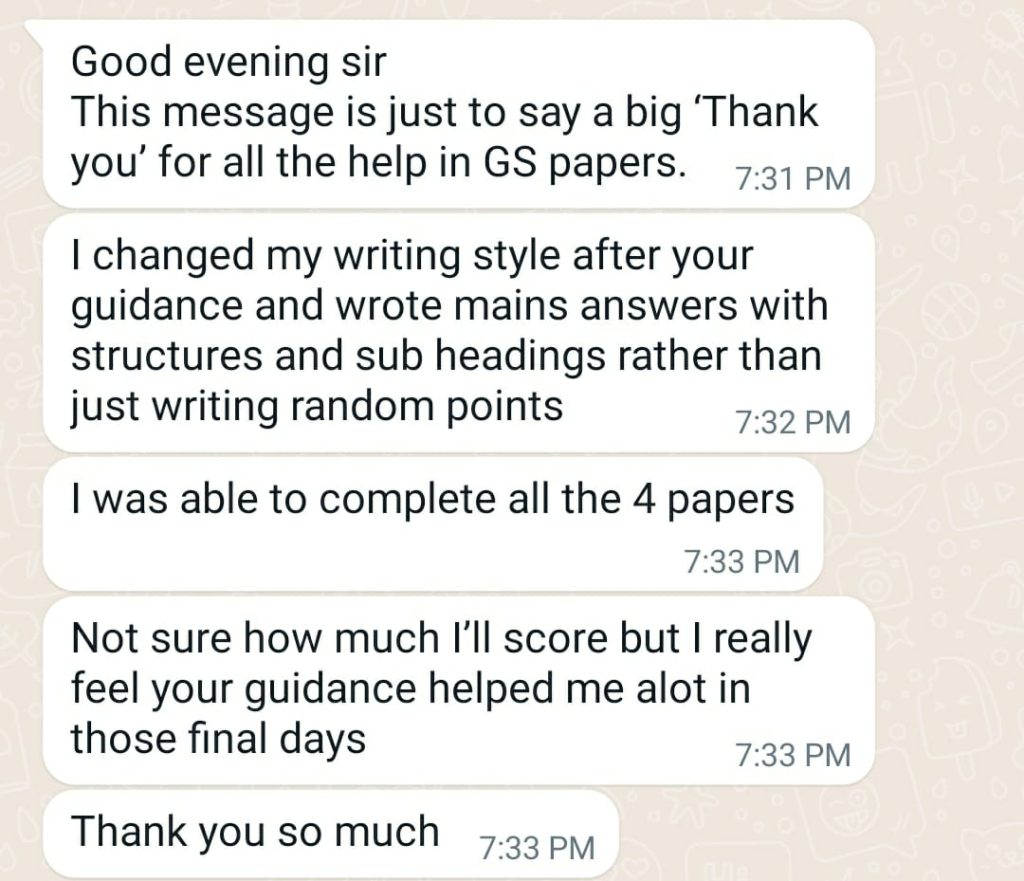
    As UPSC Mains results were announced last week, Sajal sir (Co-Founder of Civilsdaily and Mentor of Smash Mains 2021 Program) was flooded with calls by delighted aspirants who thanked him for his mentorship. Sajal Sir himself is the topper of GS 2017 Mains paper and mentor of 400 UPSC Toppers.

    After a quick check, we found out 41 Smash Mains students are qualified to attend the interview this year. As we are waiting for their interview results, we will not be announcing their names right now. However, we are sharing the testimonials of the qualified aspirants. We wish them all the very best!

    How Do You Solve UPSC-CSE Prelims Papers?

    What would you do if UPSC Civil Services Preliminary Exam was conducted right now? What method would you use to solve the question paper? Would you start with Question 1 and work your way  up to the 100th question, or would you take a different approach? Given  the possibility of negative marking, how many questions would you  generally  attempt?

    Any UPSC-CSE topper who has successfully cleared the Prelims exam, use the 3-2-1-0 E method, otherwise also called the 100-50-33-25 per cent method. What’s that?

    Free Live Q&A Webinar with IAS Officer Kunal Chavan

    The 3-2-1-0 E Method is nothing but the 4 stages of answering the UPSC Prelims paper. In the first round, you have to answer those questions you are 100% sure of (i.e you can eliminate all the 3 options), in the second round, answer those questions you are 50% sure of (can eliminate only 2 options) and the third round answer those question you are only 33% sure of (can eliminate only 1 option). Finally, just check those questions where you are unable to eliminate any options. To be on a safer side, leave those questions unanswered.

    However, since UPSC prelims is a competitive exam, what can we do about those questions where you are 50-25% sure of? How do you find the right answers using your exisiting knowledge? This free live webinar, we have invited IAS officer Kunal Chavan to help you out.

    IAS Officer Kunal Chavan belongs to the Orissa cadre. He started his UPSC-CSE preparation in 2015. The first time he was unable to clear prelims. In the next three attempts, he reached the interview stage. Finally he cleared the exam with an All India Rank 211 to become an IAS officer.

    What Will You Learn in This Q&A Webinar with IAS Officer Kunal Chavan

    1. Analysing a test when attempting the paper. How to save time while answering each question?

    2. What was the change in Kunal’s strategy after 2015? He will talk about the mistakes he made while studying for his first attempt.

    3. The online revision sources Kunal used in the last few days to prelims. Why is it important to revise online sources of those topics you couldn’t score well in your test series?

    4. The static part of current affairs and the dynamic part of NCERTs and standard books. What’s that?

    5. How to use elimination techniques for each of the 4 rounds? Kunal Chavan speaks from his experience.

    6. Finding hints in prelims questions. Kunal Chavan IAS will conduct live demonstration of certain UPSC questions.

    7. The important prelims topics for 2022. Kunal Chavan IAS will list out the important topics for every subject.

    Webinar Details

    The free live webinar will be mostly in Q&A format, where IAS officer Kunal Chavan will answer every aspirant’s doubts. Since, it’s only a 1-hour session, the intake is limited. Hence, fill the registration form ASAP to confirm you slot!

    Date: 27 March, 2022

    Time: 8PM

  • Free Live Webinar Today @ 8PM, Registrations Closing in 4Hrs||What is the 3-2-1-0 E Method of Solving UPSC Prelims Paper? || Free Q& A Webinar by IAS Officer Kunal Chavan, Orissa Cadre [2020 Batch]|| Limited Slots Available, Register Now to Get Tikdam: Art of Elimination Handbook for Free|| Also Read: 41 out of 50 Smash Mains 2021  Aspirants Qualify for Interview This Year, They Share Their Joy with Us

    Free Live Webinar Today @ 8PM, Registrations Closing in 4Hrs||What is the 3-2-1-0 E Method of Solving UPSC Prelims Paper? || Free Q& A Webinar by IAS Officer Kunal Chavan, Orissa Cadre [2020 Batch]|| Limited Slots Available, Register Now to Get Tikdam: Art of Elimination Handbook for Free|| Also Read: 41 out of 50 Smash Mains 2021 Aspirants Qualify for Interview This Year, They Share Their Joy with Us

    Quick Note Before Webinar Annoucement:

    As UPSC Mains results were announced last week, Sajal sir (Co-Founder of Civilsdaily and Mentor of Smash Mains 2021 Program) was flooded with calls by delighted aspirants who thanked him for his mentorship. Sajal Sir himself is the topper of GS 2017 Mains paper and mentor of 400 UPSC Toppers.

    After a quick check, we found out 41 Smash Mains students are qualified to attend the interview this year. As we are waiting for their interview results, we will not be announcing their names right now. However, we are sharing the testimonials of the qualified aspirants. We wish them all the very best!

    How Do You Solve UPSC-CSE Prelims Papers?

    What would you do if UPSC Civil Services Preliminary Exam was conducted right now? What method would you use to solve the question paper? Would you start with Question 1 and work your way  up to the 100th question, or would you take a different approach? Given  the possibility of negative marking, how many questions would you  generally  attempt?

    Any UPSC-CSE topper who has successfully cleared the Prelims exam, use the 3-2-1-0 E method, otherwise also called the 100-50-33-25 per cent method. What’s that?

    Free Live Q&A Webinar with IAS Officer Kunal Chavan

    The 3-2-1-0 E Method is nothing but the 4 stages of answering the UPSC Prelims paper. In the first round, you have to answer those questions you are 100% sure of (i.e you can eliminate all the 3 options), in the second round, answer those questions you are 50% sure of (can eliminate only 2 options) and the third round answer those question you are only 33% sure of (can eliminate only 1 option). Finally, just check those questions where you are unable to eliminate any options. To be on a safer side, leave those questions unanswered.

    However, since UPSC prelims is a competitive exam, what can we do about those questions where you are 50-25% sure of? How do you find the right answers using your exisiting knowledge? This free live webinar, we have invited IAS officer Kunal Chavan to help you out.

    IAS Officer Kunal Chavan belongs to the Orissa cadre. He started his UPSC-CSE preparation in 2015. The first time he was unable to clear prelims. In the next three attempts, he reached the interview stage. Finally he cleared the exam with an All India Rank 211 to become an IAS officer.

    What Will You Learn in This Q&A Webinar with IAS Officer Kunal Chavan

    1. Analysing a test when attempting the paper. How to save time while answering each question?

    2. What was the change in Kunal’s strategy after 2015? He will talk about the mistakes he made while studying for his first attempt.

    3. The online revision sources Kunal used in the last few days to prelims. Why is it important to revise online sources of those topics you couldn’t score well in your test series?

    4. The static part of current affairs and the dynamic part of NCERTs and standard books. What’s that?

    5. How to use elimination techniques for each of the 4 rounds? Kunal Chavan speaks from his experience.

    6. Finding hints in prelims questions. Kunal Chavan IAS will conduct live demonstration of certain UPSC questions.

    7. The important prelims topics for 2022. Kunal Chavan IAS will list out the important topics for every subject.

    Webinar Details

    The free live webinar will be mostly in Q&A format, where IAS officer Kunal Chavan will answer every aspirant’s doubts. Since, it’s only a 1-hour session, the intake is limited. Hence, fill the registration form ASAP to confirm you slot!

    Date: 27 March, 2022

    Time: 8PM

  • Free Live Webinar Today @ 8PM, Registrations Closing Soon||What is the 3-2-1-0 E Method of Solving UPSC Prelims Paper? || Free Q& A Webinar by IAS Officer Kunal Chavan, Orissa Cadre [2020 Batch]|| Limited Slots Available, Register Now to Get Tikdam: Art of Elimination Handbook for Free|| Also Read: 41 out of 50 Smash Mains 2021  Aspirants Qualify for Interview This Year, They Share Their Joy with Us

    Free Live Webinar Today @ 8PM, Registrations Closing Soon||What is the 3-2-1-0 E Method of Solving UPSC Prelims Paper? || Free Q& A Webinar by IAS Officer Kunal Chavan, Orissa Cadre [2020 Batch]|| Limited Slots Available, Register Now to Get Tikdam: Art of Elimination Handbook for Free|| Also Read: 41 out of 50 Smash Mains 2021 Aspirants Qualify for Interview This Year, They Share Their Joy with Us

    Quick Note Before Webinar Annoucement:

    As UPSC Mains results were announced last week, Sajal sir (Co-Founder of Civilsdaily and Mentor of Smash Mains 2021 Program) was flooded with calls by delighted aspirants who thanked him for his mentorship. Sajal Sir himself is the topper of GS 2017 Mains paper and mentor of 400 UPSC Toppers.

    After a quick check, we found out 41 Smash Mains students are qualified to attend the interview this year. As we are waiting for their interview results, we will not be announcing their names right now. However, we are sharing the testimonials of the qualified aspirants. We wish them all the very best!

    How Do You Solve UPSC-CSE Prelims Papers?

    What would you do if UPSC Civil Services Preliminary Exam was conducted right now? What method would you use to solve the question paper? Would you start with Question 1 and work your way  up to the 100th question, or would you take a different approach? Given  the possibility of negative marking, how many questions would you  generally  attempt?

    Any UPSC-CSE topper who has successfully cleared the Prelims exam, use the 3-2-1-0 E method, otherwise also called the 100-50-33-25 per cent method. What’s that?

    Free Live Q&A Webinar with IAS Officer Kunal Chavan

    The 3-2-1-0 E Method is nothing but the 4 stages of answering the UPSC Prelims paper. In the first round, you have to answer those questions you are 100% sure of (i.e you can eliminate all the 3 options), in the second round, answer those questions you are 50% sure of (can eliminate only 2 options) and the third round answer those question you are only 33% sure of (can eliminate only 1 option). Finally, just check those questions where you are unable to eliminate any options. To be on a safer side, leave those questions unanswered.

    However, since UPSC prelims is a competitive exam, what can we do about those questions where you are 50-25% sure of? How do you find the right answers using your exisiting knowledge? This free live webinar, we have invited IAS officer Kunal Chavan to help you out.

    IAS Officer Kunal Chavan belongs to the Orissa cadre. He started his UPSC-CSE preparation in 2015. The first time he was unable to clear prelims. In the next three attempts, he reached the interview stage. Finally he cleared the exam with an All India Rank 211 to become an IAS officer.

    What Will You Learn in This Q&A Webinar with IAS Officer Kunal Chavan

    1. Analysing a test when attempting the paper. How to save time while answering each question?

    2. What was the change in Kunal’s strategy after 2015? He will talk about the mistakes he made while studying for his first attempt.

    3. The online revision sources Kunal used in the last few days to prelims. Why is it important to revise online sources of those topics you couldn’t score well in your test series?

    4. The static part of current affairs and the dynamic part of NCERTs and standard books. What’s that?

    5. How to use elimination techniques for each of the 4 rounds? Kunal Chavan speaks from his experience.

    6. Finding hints in prelims questions. Kunal Chavan IAS will conduct live demonstration of certain UPSC questions.

    7. The important prelims topics for 2022. Kunal Chavan IAS will list out the important topics for every subject.

    Webinar Details

    The free live webinar will be mostly in Q&A format, where IAS officer Kunal Chavan will answer every aspirant’s doubts. Since, it’s only a 1-hour session, the intake is limited. Hence, fill the registration form ASAP to confirm you slot!

    Date: 27 March, 2022

    Time: 8PM

  • What is the 3-2-1-0 E Method of Solving UPSC Prelims Paper? || Free Q& A Webinar by IAS Officer Kunal Chavan, Orissa Cadre [2020 Batch]|| Limited Slots Available, Register Now to Get Tikdam: Art of Elimination Handbook for Free|| Also Read: 41 out of 50 Smash Mains 2021  Aspirants Qualify for Interview This Year, They Share Their Joy with Us

    What is the 3-2-1-0 E Method of Solving UPSC Prelims Paper? || Free Q& A Webinar by IAS Officer Kunal Chavan, Orissa Cadre [2020 Batch]|| Limited Slots Available, Register Now to Get Tikdam: Art of Elimination Handbook for Free|| Also Read: 41 out of 50 Smash Mains 2021 Aspirants Qualify for Interview This Year, They Share Their Joy with Us

    Quick Note Before Webinar Annoucement:

    As UPSC Mains results were announced last week, Sajal sir (Co-Founder of Civilsdaily and Mentor of Smash Mains 2021 Program) was flooded with calls by delighted aspirants who thanked him for his mentorship. Sajal Sir himself is the topper of GS 2017 Mains paper and mentor of 400 UPSC Toppers.

    After a quick check, we found out 41 Smash Mains students are qualified to attend the interview this year. As we are waiting for their interview results, we will not be announcing their names right now. However, we are sharing the testimonials of the qualified aspirants. We wish them all the very best!

    How Do You Solve UPSC-CSE Prelims Papers?

    What would you do if UPSC Civil Services Preliminary Exam was conducted right now? What method would you use to solve the question paper? Would you start with Question 1 and work your way  up to the 100th question, or would you take a different approach? Given  the possibility of negative marking, how many questions would you  generally  attempt?

    Any UPSC-CSE topper who has successfully cleared the Prelims exam, use the 3-2-1-0 E method, otherwise also called the 100-50-33-25 per cent method. What’s that?

    Free Live Q&A Webinar with IAS Officer Kunal Chavan

    The 3-2-1-0 E Method is nothing but the 4 stages of answering the UPSC Prelims paper. In the first round, you have to answer those questions you are 100% sure of (i.e you can eliminate all the 3 options), in the second round, answer those questions you are 50% sure of (can eliminate only 2 options) and the third round answer those question you are only 33% sure of (can eliminate only 1 option). Finally, just check those questions where you are unable to eliminate any options. To be on a safer side, leave those questions unanswered.

    However, since UPSC prelims is a competitive exam, what can we do about those questions where you are 50-25% sure of? How do you find the right answers using your exisiting knowledge? This free live webinar, we have invited IAS officer Kunal Chavan to help you out.

    IAS Officer Kunal Chavan belongs to the Orissa cadre. He started his UPSC-CSE preparation in 2015. The first time he was unable to clear prelims. In the next three attempts, he reached the interview stage. Finally he cleared the exam with an All India Rank 211 to become an IAS officer.

    What Will You Learn in This Q&A Webinar with IAS Officer Kunal Chavan

    1. Analysing a test when attempting the paper. How to save time while answering each question?

    2. What was the change in Kunal’s strategy after 2015? He will talk about the mistakes he made while studying for his first attempt.

    3. The online revision sources Kunal used in the last few days to prelims. Why is it important to revise online sources of those topics you couldn’t score well in your test series?

    4. The static part of current affairs and the dynamic part of NCERTs and standard books. What’s that?

    5. How to use elimination techniques for each of the 4 rounds? Kunal Chavan speaks from his experience.

    6. Finding hints in prelims questions. Kunal Chavan IAS will conduct live demonstration of certain UPSC questions.

    7. The important prelims topics for 2022. Kunal Chavan IAS will list out the important topics for every subject.

    Webinar Details

    The free live webinar will be mostly in Q&A format, where IAS officer Kunal Chavan will answer every aspirant’s doubts. Since, it’s only a 1-hour session, the intake is limited. Hence, fill the registration form ASAP to confirm you slot!

    Date: 27 March, 2022

    Time: 8PM

  • What is the 3-2-1-0 E Method of Solving UPSC Prelims Paper? || Free Q& A Webinar by IAS Officer Kunal Chavan, Orissa Cadre [2020 Batch]|| Limited Slots Available, Register Now to Get Tikdam: Art of Elimination Handbook for Free|| Also Read: 41 out of 50 Smash Mains 2021  Aspirants Qualify for Interview This Year, They Share Their Joy with Us

    What is the 3-2-1-0 E Method of Solving UPSC Prelims Paper? || Free Q& A Webinar by IAS Officer Kunal Chavan, Orissa Cadre [2020 Batch]|| Limited Slots Available, Register Now to Get Tikdam: Art of Elimination Handbook for Free|| Also Read: 41 out of 50 Smash Mains 2021 Aspirants Qualify for Interview This Year, They Share Their Joy with Us

    Quick Note Before Webinar Annoucement:

    As UPSC Mains results were announced last week, Sajal sir (Co-Founder of Civilsdaily and Mentor of Smash Mains 2021 Program) was flooded with calls by delighted aspirants who thanked him for his mentorship. Sajal Sir himself is the topper of GS 2017 Mains paper and mentor of 400 UPSC Toppers.

    After a quick check, we found out 41 Smash Mains students are qualified to attend the interview this year. As we are waiting for their interview results, we will not be announcing their names right now. However, we are sharing the testimonials of the qualified aspirants. We wish them all the very best!

    How Do You Solve UPSC-CSE Prelims Papers?

    What would you do if UPSC Civil Services Preliminary Exam was conducted right now? What method would you use to solve the question paper? Would you start with Question 1 and work your way  up to the 100th question, or would you take a different approach? Given  the possibility of negative marking, how many questions would you  generally  attempt?

    Any UPSC-CSE topper who has successfully cleared the Prelims exam, use the 3-2-1-0 E method, otherwise also called the 100-50-33-25 per cent method. What’s that?

    Free Live Q&A Webinar with IAS Officer Kunal Chavan

    The 3-2-1-0 E Method is nothing but the 4 stages of answering the UPSC Prelims paper. In the first round, you have to answer those questions you are 100% sure of (i.e you can eliminate all the 3 options), in the second round, answer those questions you are 50% sure of (can eliminate only 2 options) and the third round answer those question you are only 33% sure of (can eliminate only 1 option). Finally, just check those questions where you are unable to eliminate any options. To be on a safer side, leave those questions unanswered.

    However, since UPSC prelims is a competitive exam, what can we do about those questions where you are 50-25% sure of? How do you find the right answers using your exisiting knowledge? This free live webinar, we have invited IAS officer Kunal Chavan to help you out.

    IAS Officer Kunal Chavan belongs to the Orissa cadre. He started his UPSC-CSE preparation in 2015. The first time he was unable to clear prelims. In the next three attempts, he reached the interview stage. Finally he cleared the exam with an All India Rank 211 to become an IAS officer.

    What Will You Learn in This Q&A Webinar with IAS Officer Kunal Chavan

    1. Analysing a test when attempting the paper. How to save time while answering each question?

    2. What was the change in Kunal’s strategy after 2015? He will talk about the mistakes he made while studying for his first attempt.

    3. The online revision sources Kunal used in the last few days to prelims. Why is it important to revise online sources of those topics you couldn’t score well in your test series?

    4. The static part of current affairs and the dynamic part of NCERTs and standard books. What’s that?

    5. How to use elimination techniques for each of the 4 rounds? Kunal Chavan speaks from his experience.

    6. Finding hints in prelims questions. Kunal Chavan IAS will conduct live demonstration of certain UPSC questions.

    7. The important prelims topics for 2022. Kunal Chavan IAS will list out the important topics for every subject.

    Webinar Details

    The free live webinar will be mostly in Q&A format, where IAS officer Kunal Chavan will answer every aspirant’s doubts. Since, it’s only a 1-hour session, the intake is limited. Hence, fill the registration form ASAP to confirm you slot!

    Date: 27 March, 2022

    Time: 8PM

  • Forging a social contract for data

    Context

    The Draft India Data Accessibility and Use Policy 2022 released in February for public consultation, is silent on the norms, rules, and mechanisms to bring to fruition its vision.

    Aims of the policy

    • The Draft Policy aims for harnessing public sector data for informed decision-making, citizen-centric delivery of public services, and economy-wide digital innovation.
    • It seeks to maximise access to and use of quality non-personal data (NPD) available with the public sector, overcoming a number of historical bottlenecks.
    • This GovTech 3.0 approach — to unlock the valuable resource of public sector data — does upgrade the OGD vision of the National Data Sharing and Accessibility Policy (NDSAP), 2012.
    • It seeks to harness data-based intelligence for governance and economic development.

    What is lacking in the draft policy?

    • Lacking in norms and rules: The Draft Policy is silent on the norms, rules, and mechanisms to bring to fruition its vision of data-supported social transformation.
    • Ignores the canons of RTI: Any attempt to promote meaningful citizen engagement with data cannot afford to ignore the canons of the Right to Information (RTI), and hence, the need for certain citizen data sets with personal identifiers to be in the public domain, towards making proactive disclosure meaningful.
    •  The unfinished task of the NDSAP in bringing coherence between restrictions on the availability of sensitive personal information in the public domain and India’s RTI, therefore, has been lost sight of.
    • Risks to group privacy: With respect to government-to-government data sharing for citizen-centric service delivery, the Draft Policy highlights that approved data inventories will be federated into a government-wide, searchable database.
    •  But even in the case of anonymised citizen data sets (that is no longer personal data), downstream processing can pose serious risks to group privacy.
    • Lack of data trusteeship framework: The Draft Policy adheres to the NDSAP paradigm of treating government agencies as ‘owners’ of the data sets they have collected and compiled instead of shifting to the trusteeship paradigm recommended by the 2020 Report of the MEITY Committee of Experts on non-personal data governance.
    • The lack of a data trusteeship framework gives government agencies unilateral privileges to determine the terms of data licensing.

    Suggestions

    • Taking on board a trusteeship-based approach, the proposed Draft Policy must pay attention to data quality, and ensure that licensing frameworks and any associated costs do not pose an impediment to data accessibility for non-commercial purposes.
    • Create common and interoperable data spaces: In the current context, where the most valuable data resources are held by the private sector, it is increasingly evident to policymakers that socioeconomic innovation depends on the state’s ability to catalyse wide-ranging data-sharing from both public and private sector actors across various sectors.
    • The European Union, for instance, has focused on the creation of common, interoperable data spaces to encourage voluntary data-sharing in specific domains such as health, energy and agriculture.
    • Mandatory data sharing arrangement: Creating the right conditions for voluntary data-sharing is a necessary, but not sufficient, condition for democratising data innovation.
    • In this regard, the data stewardship model for high-value data sets proposed by the MEITY’s Committee of Experts in their Report on Non-Personal Data Governance (2020) is instructive.
    • In this model, a government/not-for-profit organisation may request the Non-Personal Data Authority or NPDA for the creation of a high-value data set (only non-personal data) in a particular sector, demonstrating the specific public interest purpose.
    • Once such a request is approved by the NPDA, the data trustee has the right to request data-sharing from all major custodians of data sets corresponding to the high-value data set category in question – both public and private.

    Conclusion

    • What we need is a new social contract for data whereby:
    • a) the social commons of data are governed as an inappropriable commons that belong to all citizens;
    • b) the government is the custodian or trustee with fiduciary responsibility to promote data use for public good; and
    • c) democratisation of data value is ensured through accountable institutional mechanisms for data governance.

    UPSC 2022 countdown has begun! Get your personal guidance plan now! (Click here)

More posts