💥UPSC 2026, 2027, 2028 UAP Mentorship (March Batch) + Access XFactor Notes & Microthemes PDF

Search results for: “”

  • What are the 5 Methods to Maintain Daily Consistency in Current Affairs, Optional & GS Preparation?|| What are the 4 Factors you Need to Work on if you can’t Study Regularly?|| Register for  Free 1-on-1 Mentorship if You are Yet to Restart Your UPSC Preparation

    What are the 5 Methods to Maintain Daily Consistency in Current Affairs, Optional & GS Preparation?|| What are the 4 Factors you Need to Work on if you can’t Study Regularly?|| Register for Free 1-on-1 Mentorship if You are Yet to Restart Your UPSC Preparation

    Since its inception, UPSC-CSE has had toppers from various academic and socio-economic backgrounds who have cracked the exam with flying colours. It’s clear that one doesn’t have to go to Delhi or a coaching centre to crack UPSC-CSE.

    If education, geographical and economic background doesn’t matter, then what does? Attitude, or precisely consistency. If you are persistent and adamant to clear UPSC- CSE and have given more than two attempts till now, then you must replace that with consistency. Because, being persistent might lead you to the door, but it’s consistency that unlocks it.

    In last month’s Samanvaya 1-on-1 counselling sessions, our expert Civilsdaily mentors reached out to aspirants to address their concerns regarding UPSC-CSE preparation. These are the responses they often heard from them —

    How do I start preparing after a gap of 3-4 months?

    It’s easy for me to maintain consistency in GS Preparation but not Revision

    I study daily, but can only remain focused for 2-3 hours. How do I improve?

    My long working hours don’t allow me to study daily.

    Why am I losing interest in completing a subject? It’ s easier to read a new subject everyday.

    This week, we have decided to answer all these questions and take additional questions in our personalised & motivational counselling session

    Key-Takeaways from This Week’s Samanvaya, Free 1-on-1 Counselling Session?

    If you want to experience the same mentorship as Rishab Sharma, then here’s the good news – your first UPSC mentorship is on us and is absolutely free! All you have to do is confirm your slot now.

    This prompted us to reach out to one of our students who is currently an IPS officer, Rishabh Sharma. He cleared the exam in 2020 with AIR 454. After his first attempt, Rishabh had enrolled in Smash Mains program under Sajal sir and also attended our free interview program. Cracking the mighty UPSC-CSE the second time, Rishabh explains what consistency means to him —

    UPSC doesn’t just test your intellect. It tests your patience, mental strength, your emotions, the very character of yours . As far as the journey of CSE is concerned you might know when to start, but you never know when the journey will come to an end. So be consistent and enjoy the journey.

    Every topper follows a plan, a method or strategy that makes it easier for them to study on a daily basis and complete the traget modules of the day. In this free live counselling session, we will explain the many ways you can do to avoid faltering on your preparation.

    1. The difference between a consistent study pattern v/s an inconsistent one. How UPSC-CSE becomes easier over time with consistency?

    2. Social media distraction. How to avoid spending long hours on social media?

    3. Number of ideal breaks everyday. Why is it necessary to reward yourself with a short break from time to time?

    4. Best way to plan your timetable in advance? Why daily timetable should not be rigid but yearly timetable should be well defined?

    5. How to remain consistent when you are not opting for coaching?

    6. What are the practical methods to maintain regularity in studies. Tips to sustain the fire and passion for studies.

    7. Why using Public Libraries is a way to remain consistent in UPSC-CSE preparation?

    8. What are the 4 factors that determine if you can remain consistent for a year? If not, then why should you work on them first before starting UPSC-CSE preparation?

    Get Motivated to Maintain Overall Consistency for UPSC

    It’s understandable we are humans and not programmable robots who can maintain the same level of interest everyday. However, maintaining an overall consistency throughout our preparation is neccessary to clear this competitive and vast exam.

    Our philosophy behind MENTORSHIP is to get you out of this Snooze cycle. This ensures that you are the BEST VERSION of yourself in this journey. If you are under the impression that mentorship is weekly calls you attend, then you are mistaken, my friend. Trust us, your mentor will be your ‘FRIEND, PHILOSOPHER AND GUIDE’.

    TO EACH THEIR OWN – Every aspirant is different. Their strengths and weaknesses are different. Their time availability is also different. Identifying this is important so you don’t end up making unrealistic targets and lose momentum. Your mentor will make sure you start slow but remain consistent to build your confidence. Making your schedule structured based on our experience of working with 2500+ students is our first priority. 

    This image has an empty alt attribute; its file name is WhatsApp-Image-2021-05-05-at-10.14.09-AM.jpeg

    TRACK YOUR PROGRESS – When you see yourself grow, it becomes easier to motivate yourself to push boundaries. Tracking your progress can happen in many ways like mentorship calls or chat sessions or by regular tests. The idea is to ensure that you don’t go off track in your preparation, and even if you do, we have your back.

    This image has an empty alt attribute; its file name is WhatsApp-Image-2021-05-05-at-10.14.09-AM-4-576x1024.jpeg

    EVOLUTION – A constant guidance is important to bring consistency to your UPSC preparation. Guidance is not about clearing your doubts or asking you to study when you don’t. It is also about the evolution of your preparation. This is where you and your mentor work as a team. A constant effort to PLAN AND BUILD UP YOUR ABILITY to learn in a faster and more efficient way.

    This image has an empty alt attribute; its file name is WhatsApp-Image-2021-05-05-at-10.14.09-AM-6.jpeg

    TALK IT OUT – The biggest hurdle in achieving your highest level of consistency is the emotional part. Every now and then, you. surround yourself with negative thoughts, you feel scared and depressed. Instead of resolving these emotional issues, you avoid them as it seems like a waste of your precious time. You have to understand that ignoring emotional troubles does not solve them. What your doing is building an emotional time bomb that may burst a week before your mains or prelims! This is where your MENTOR AS A FRIEND comes in. All our mentors have been through this journey. We understand your fears and anxieties. So, TALK IT OUT.

    This image has an empty alt attribute; its file name is WhatsApp-Image-2021-05-05-at-10.14.09-AM-3.jpeg

    Don’t let inconsistency keep you away from your dreams.

    Fill up the SAMANVAYA form given below. Let us know your problems and we will find a solution to it, just like our students say ” TOGETHER WE CAN AND WE WILL”. BOOK YOUR SLOT FOR YOUR FREE 1-0N-1 COUNSELLING SESSION IN THE NEXT 24 HOURS

    How has Civilsdaily Mentorship, helped Aspirants become Toppers?

    The most difficult challenge faced by EVERY candidate is inconsistency. Be it inconsistency in studies, answer-writing practice, covering the syllabus, or revision, every candidate finds it difficult to cope with. But how do successful candidates manage to FIGHT Inconsistency so consistently?

    This image has an empty alt attribute; its file name is hall-of-fame.jpg

    In UPSC 2020, Civilsdaily helped 80+ students secure ranks in their exams. In the top 100, every 3rd ranker was a Civilsdaily student.

     A very recent success story would be Vishwa Shah, student of Civilsdaily Mentor, Sukanya Ma’am. Vishwa has cleared the GPSC exam to become the Deputy Superintendent of Police in Gujarat. He has penned a thank-you note yesterday. Heartiest Congratulations to Vishwa!

    This image has an empty alt attribute; its file name is WhatsApp-Image-2021-12-27-at-18.49.53-727x1024.jpeg

    One of our other Civilsdaily Student, Shubham Nagargoje cleared the exams in 2020 to become an IPS Officer. Shubham was gracious enough to let us know how he felt about Civilsdaily Samanvaya Guidance under Parth sir.

    This image has an empty alt attribute; its file name is image-1.png
    This image has an empty alt attribute; its file name is WhatsApp-Image-2022-01-11-at-19.37.54-461x1024.jpeg

    To know how all of them cleared the exam with our mentorship, visit the Unherd Podcast.

    Now that results are announced for UPSC 2021 Prelims, out of 15 out of 25 students of Santhosh Gupta sir have been recommended to Mains. One such student, Rahul expresses his gratitude and extends his appreciation.

    Most of our Mentors like Sudhanshu sir, Sajal sir, Santhosh sir, Pravin sir, Parth Verma sir and Sukanya Ma’am were UPSC aspirants themselves and have attended UPSC Mains more than five times and UPSC Interview more than twice. Hence their mentorship is always a blend of the best test series, comprehensive notes and current affairs knowledge.

    This image has an empty alt attribute; its file name is 29d33a91-62aa-45e9-a906-327fbaad5180-1024x814.jpg
    This image has an empty alt attribute; its file name is 50f70a4d-c239-44a5-b49b-9b93617a378f-461x1024.jpg

    All of them dedicate their time weekly to give 1-on-1 mentorship to every student where they discuss last week’s performance and next week’s approach.

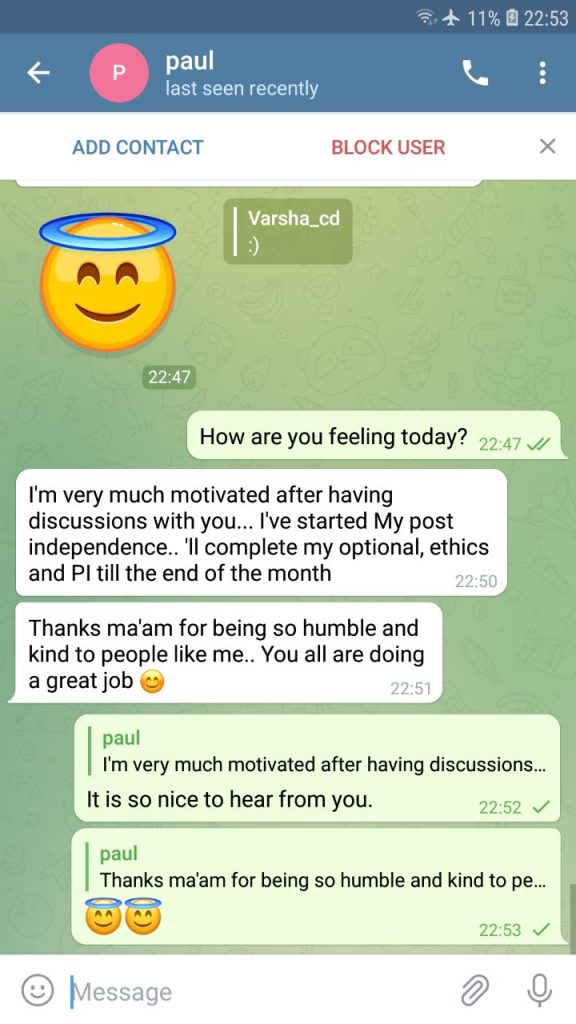
    Be it Telegram, Whatsapp or Habitiat channels, they are always available and clear student’s doubts in a turnaround time of 24 Hours.

    This image has an empty alt attribute; its file name is image-9-6.jpg
    This image has an empty alt attribute; its file name is WhatsApp-Image-2021-12-18-at-13.22.45-576x1024.jpeg
    This image has an empty alt attribute; its file name is WhatsApp-Image-2021-12-18-at-13.22.45-1-576x1024.jpeg
    This image has an empty alt attribute; its file name is WhatsApp-Image-2021-12-18-at-13.22.46-576x1024.jpeg
    This image has an empty alt attribute; its file name is WhatsApp-Image-2021-12-18-at-13.22.46-1-576x1024.jpeg
    This image has an empty alt attribute; its file name is WhatsApp-Image-2021-12-18-at-13.22.46-2-576x1024.jpeg
    This image has an empty alt attribute; its file name is WhatsApp-Image-2021-12-18-at-13.22.47-576x1024.jpeg
    This image has an empty alt attribute; its file name is image-9-5.jpg
    This image has an empty alt attribute; its file name is image-8.png

    Why Civilsdaily Mentors are the GPS for Your UPSC-CSE Preparation

    Remember there is always light at the end of the tunnel and if you want to get out of the tunnel you have to follow the direction of the light! Our mentors’ give you direction which is divided into daily modules. All you have to do is study and complete them on time.

    This image has an empty alt attribute; its file name is WhatsApp-Image-2021-11-29-at-21.47.49-1024x527.jpeg
    This image has an empty alt attribute; its file name is IMG-20211030-WA0003-461x1024.jpg
    This image has an empty alt attribute; its file name is IMG-20211029-WA0002-1-461x1024.jpg
    This image has an empty alt attribute; its file name is IMG-20211029-WA0001-1-461x1024.jpg
    This image has an empty alt attribute; its file name is IMG-20211029-WA0019-461x1024.jpg
    This image has an empty alt attribute; its file name is IMG-20211029-WA0018-461x1024.jpg
    This image has an empty alt attribute; its file name is WhatsApp-Image-2021-05-19-at-6.12.52-PM-576x1024.jpeg
    This image has an empty alt attribute; its file name is WhatsApp-Image-2021-05-05-at-10.14.09-AM-3.jpeg
    See the source image
    This image has an empty alt attribute; its file name is WhatsApp-Image-2021-05-19-at-6.12.52-PM-1.jpeg

    As every year passes by, we don’t get confident by the previous years’ performance and become laidback. Instead, we become more hungry to convert all our students into toppers.REGISTER HERE TO SCHEDULE YOUR FIRST FREE SAMANVAYA COUNSELLING SESSION IN NEXT 24 HOURS

    How are Current Civilsdaily Students Gearing up for UPSC-CSE 2022?

    This image has an empty alt attribute; its file name is 5_6161088602806683010.jpg

    Initially, our Civilsdaily student Smriti wasn’t confident about Prelims when she began her preparation. Though she had joined Civilsdaily in 2020, she started studying for UPSC-CSE back in 2019. At that time, Smriti had enrolled in multiple institutes. Though, most of these institutes had promised a personal mentor, she was unable to get in touch with them on a daily basis. Also those mentors never scheduled test-series on a weekly basis. Hence, despite preparing for a year, Smriti had scored only 35 marks out of 200 in her first test series by Civilsdaily.

    She then started writing 20-25 test series over the course of UAP 2021 and in her last test, her scores have drastically improved. She now scores in the range of 130-135 marks in prelims’ and 110+ in mains’ papers.

    In Smriti’s own words she describes her Samanvaya Mentorship Experience to be —

    Our parents provide us financial and emotional support, friends provide us moral support and the right mentor gives you logistic and logical support for UPSC. There are days when I felt I won’t be able to compete against lakhs of aspirants. That’s when my mentor, Ravi sir reminded me of my improvement and encouraged me that I can crack it with the same consistency. We need someone, who tells us we are performing well especially when we cannot see that ourselves. The mentorship at Civilsdaily helped me become mentally stronger as a person. In other institutes, mentors are allotted only for doubt resolution. But at Civilsdaily, I am getting end-to-end mentorship via value added notes, classes, test series and detailed evaluation.”

    Similarly our another Civilsdaily student, Ashish sums up his Samanvaya experience with Civilsdaily mentor, Pravin Sir, “Because of Pravin sir’s support, I am able to understand a topic in lesser time.”

    This image has an empty alt attribute; its file name is ashish-anand-testimonial-1-461x1024.jpg
    This image has an empty alt attribute; its file name is 69f7a70f-c53d-44b4-8e59-f297401650b5-1-461x1024.jpg
    This image has an empty alt attribute; its file name is ashish.jpg

    This is how Pravin sir evaluates Ashish’s Mains Test Series every week. After every test series evaluation, Pravin sir schedules a 1 hour call to discuss how Ashish can improve his marks and the sources he can refer for key topics.

    This image has an empty alt attribute; its file name is test-461x1024.jpg

    It’s Your Turn Get the Free 40 Min Counselling Session By a CD Mentor

    Civilsdaily mentors are so dedicated, consistent and focused for your UPSC goal, that you will eventually become focused into turning your dreams to reality.

    This image has an empty alt attribute; its file name is a2d57403-4c49-462b-8459-b15e690ea928-1-461x1024.jpg

    At the core of Civilsdaily UPSC mentorship, lies the fact that each one of you will have a unique journey while preparing for the exam. Some will get through on the first attempt without much effort while others will take both more time and more effort.

    We want to understand you better to help you optimize your journey so you can focus on the right things and not waste time on the wrong ones. We are asking you to tap into the valuable experiences of mentors who underwent the same grind and realize the pitfalls and understand the shortcuts to make it.

    In the first counselling session, we will understand your weaknesses. We then help you to stick to one plan or strategy throughout your preparation. We will then follow up with you on a daily basis to check if you are right on track. TALK TO OUR MENTORS & CLARIFY YOUR DOUBTS NOW

    This image has an empty alt attribute; its file name is photo1627364370-1024x1024.jpeg
    This image has an empty alt attribute; its file name is AAJ-.jpeg
  • What are the 5 Methods to Maintain Daily Consistency in Current Affairs, Optional & GS Preparation?|| What are the 4 Factors you Need to Work on if you can’t Study Regularly?|| Register for  Free 1-on-1 Mentorship if You are Yet to Restart Your UPSC Preparation

    What are the 5 Methods to Maintain Daily Consistency in Current Affairs, Optional & GS Preparation?|| What are the 4 Factors you Need to Work on if you can’t Study Regularly?|| Register for Free 1-on-1 Mentorship if You are Yet to Restart Your UPSC Preparation

    Since its inception, UPSC-CSE has had toppers from various academic and socio-economic backgrounds who have cracked the exam with flying colours. It’s clear that one doesn’t have to go to Delhi or a coaching centre to crack UPSC-CSE.

    If education, geographical and economic background doesn’t matter, then what does? Attitude, or precisely consistency. If you are persistent and adamant to clear UPSC- CSE and have given more than two attempts till now, then you must replace that with consistency. Because, being persistent might lead you to the door, but it’s consistency that unlocks it.

    In last month’s Samanvaya 1-on-1 counselling sessions, our expert Civilsdaily mentors reached out to aspirants to address their concerns regarding UPSC-CSE preparation. These are the responses they often heard from them —

    How do I start preparing after a gap of 3-4 months?

    It’s easy for me to maintain consistency in GS Preparation but not Revision

    I study daily, but can only remain focused for 2-3 hours. How do I improve?

    My long working hours don’t allow me to study daily.

    Why am I losing interest in completing a subject? It’ s easier to read a new subject everyday.

    This week, we have decided to answer all these questions and take additional questions in our personalised & motivational counselling session

    Key-Takeaways from This Week’s Samanvaya, Free 1-on-1 Counselling Session?

    If you want to experience the same mentorship as Rishab Sharma, then here’s the good news – your first UPSC mentorship is on us and is absolutely free! All you have to do is confirm your slot now.

    This prompted us to reach out to one of our students who is currently an IPS officer, Rishabh Sharma. He cleared the exam in 2020 with AIR 454. After his first attempt, Rishabh had enrolled in Smash Mains program under Sajal sir and also attended our free interview program. Cracking the mighty UPSC-CSE the second time, Rishabh explains what consistency means to him —

    UPSC doesn’t just test your intellect. It tests your patience, mental strength, your emotions, the very character of yours . As far as the journey of CSE is concerned you might know when to start, but you never know when the journey will come to an end. So be consistent and enjoy the journey.

    Every topper follows a plan, a method or strategy that makes it easier for them to study on a daily basis and complete the traget modules of the day. In this free live counselling session, we will explain the many ways you can do to avoid faltering on your preparation.

    1. The difference between a consistent study pattern v/s an inconsistent one. How UPSC-CSE becomes easier over time with consistency?

    2. Social media distraction. How to avoid spending long hours on social media?

    3. Number of ideal breaks everyday. Why is it necessary to reward yourself with a short break from time to time?

    4. Best way to plan your timetable in advance? Why daily timetable should not be rigid but yearly timetable should be well defined?

    5. How to remain consistent when you are not opting for coaching?

    6. What are the practical methods to maintain regularity in studies. Tips to sustain the fire and passion for studies.

    7. Why using Public Libraries is a way to remain consistent in UPSC-CSE preparation?

    8. What are the 4 factors that determine if you can remain consistent for a year? If not, then why should you work on them first before starting UPSC-CSE preparation?

    Get Motivated to Maintain Overall Consistency for UPSC

    It’s understandable we are humans and not programmable robots who can maintain the same level of interest everyday. However, maintaining an overall consistency throughout our preparation is neccessary to clear this competitive and vast exam.

    Our philosophy behind MENTORSHIP is to get you out of this Snooze cycle. This ensures that you are the BEST VERSION of yourself in this journey. If you are under the impression that mentorship is weekly calls you attend, then you are mistaken, my friend. Trust us, your mentor will be your ‘FRIEND, PHILOSOPHER AND GUIDE’.

    TO EACH THEIR OWN – Every aspirant is different. Their strengths and weaknesses are different. Their time availability is also different. Identifying this is important so you don’t end up making unrealistic targets and lose momentum. Your mentor will make sure you start slow but remain consistent to build your confidence. Making your schedule structured based on our experience of working with 2500+ students is our first priority. 

    This image has an empty alt attribute; its file name is WhatsApp-Image-2021-05-05-at-10.14.09-AM.jpeg

    TRACK YOUR PROGRESS – When you see yourself grow, it becomes easier to motivate yourself to push boundaries. Tracking your progress can happen in many ways like mentorship calls or chat sessions or by regular tests. The idea is to ensure that you don’t go off track in your preparation, and even if you do, we have your back.

    This image has an empty alt attribute; its file name is WhatsApp-Image-2021-05-05-at-10.14.09-AM-4-576x1024.jpeg

    EVOLUTION – A constant guidance is important to bring consistency to your UPSC preparation. Guidance is not about clearing your doubts or asking you to study when you don’t. It is also about the evolution of your preparation. This is where you and your mentor work as a team. A constant effort to PLAN AND BUILD UP YOUR ABILITY to learn in a faster and more efficient way.

    This image has an empty alt attribute; its file name is WhatsApp-Image-2021-05-05-at-10.14.09-AM-6.jpeg

    TALK IT OUT – The biggest hurdle in achieving your highest level of consistency is the emotional part. Every now and then, you. surround yourself with negative thoughts, you feel scared and depressed. Instead of resolving these emotional issues, you avoid them as it seems like a waste of your precious time. You have to understand that ignoring emotional troubles does not solve them. What your doing is building an emotional time bomb that may burst a week before your mains or prelims! This is where your MENTOR AS A FRIEND comes in. All our mentors have been through this journey. We understand your fears and anxieties. So, TALK IT OUT.

    This image has an empty alt attribute; its file name is WhatsApp-Image-2021-05-05-at-10.14.09-AM-3.jpeg

    Don’t let inconsistency keep you away from your dreams.

    Fill up the SAMANVAYA form given below. Let us know your problems and we will find a solution to it, just like our students say ” TOGETHER WE CAN AND WE WILL”. BOOK YOUR SLOT FOR YOUR FREE 1-0N-1 COUNSELLING SESSION IN THE NEXT 24 HOURS

    How has Civilsdaily Mentorship, helped Aspirants become Toppers?

    The most difficult challenge faced by EVERY candidate is inconsistency. Be it inconsistency in studies, answer-writing practice, covering the syllabus, or revision, every candidate finds it difficult to cope with. But how do successful candidates manage to FIGHT Inconsistency so consistently?

    This image has an empty alt attribute; its file name is hall-of-fame.jpg

    In UPSC 2020, Civilsdaily helped 80+ students secure ranks in their exams. In the top 100, every 3rd ranker was a Civilsdaily student.

     A very recent success story would be Vishwa Shah, student of Civilsdaily Mentor, Sukanya Ma’am. Vishwa has cleared the GPSC exam to become the Deputy Superintendent of Police in Gujarat. He has penned a thank-you note yesterday. Heartiest Congratulations to Vishwa!

    This image has an empty alt attribute; its file name is WhatsApp-Image-2021-12-27-at-18.49.53-727x1024.jpeg

    One of our other Civilsdaily Student, Shubham Nagargoje cleared the exams in 2020 to become an IPS Officer. Shubham was gracious enough to let us know how he felt about Civilsdaily Samanvaya Guidance under Parth sir.

    This image has an empty alt attribute; its file name is image-1.png
    This image has an empty alt attribute; its file name is WhatsApp-Image-2022-01-11-at-19.37.54-461x1024.jpeg

    To know how all of them cleared the exam with our mentorship, visit the Unherd Podcast.

    Now that results are announced for UPSC 2021 Prelims, out of 15 out of 25 students of Santhosh Gupta sir have been recommended to Mains. One such student, Rahul expresses his gratitude and extends his appreciation.

    Most of our Mentors like Sudhanshu sir, Sajal sir, Santhosh sir, Pravin sir, Parth Verma sir and Sukanya Ma’am were UPSC aspirants themselves and have attended UPSC Mains more than five times and UPSC Interview more than twice. Hence their mentorship is always a blend of the best test series, comprehensive notes and current affairs knowledge.

    This image has an empty alt attribute; its file name is 29d33a91-62aa-45e9-a906-327fbaad5180-1024x814.jpg
    This image has an empty alt attribute; its file name is 50f70a4d-c239-44a5-b49b-9b93617a378f-461x1024.jpg

    All of them dedicate their time weekly to give 1-on-1 mentorship to every student where they discuss last week’s performance and next week’s approach.

    Be it Telegram, Whatsapp or Habitiat channels, they are always available and clear student’s doubts in a turnaround time of 24 Hours.

    This image has an empty alt attribute; its file name is image-9-6.jpg
    This image has an empty alt attribute; its file name is WhatsApp-Image-2021-12-18-at-13.22.45-576x1024.jpeg
    This image has an empty alt attribute; its file name is WhatsApp-Image-2021-12-18-at-13.22.45-1-576x1024.jpeg
    This image has an empty alt attribute; its file name is WhatsApp-Image-2021-12-18-at-13.22.46-576x1024.jpeg
    This image has an empty alt attribute; its file name is WhatsApp-Image-2021-12-18-at-13.22.46-1-576x1024.jpeg
    This image has an empty alt attribute; its file name is WhatsApp-Image-2021-12-18-at-13.22.46-2-576x1024.jpeg
    This image has an empty alt attribute; its file name is WhatsApp-Image-2021-12-18-at-13.22.47-576x1024.jpeg
    This image has an empty alt attribute; its file name is image-9-5.jpg
    This image has an empty alt attribute; its file name is image-8.png

    Why Civilsdaily Mentors are the GPS for Your UPSC-CSE Preparation

    Remember there is always light at the end of the tunnel and if you want to get out of the tunnel you have to follow the direction of the light! Our mentors’ give you direction which is divided into daily modules. All you have to do is study and complete them on time.

    This image has an empty alt attribute; its file name is WhatsApp-Image-2021-11-29-at-21.47.49-1024x527.jpeg
    This image has an empty alt attribute; its file name is IMG-20211030-WA0003-461x1024.jpg
    This image has an empty alt attribute; its file name is IMG-20211029-WA0002-1-461x1024.jpg
    This image has an empty alt attribute; its file name is IMG-20211029-WA0001-1-461x1024.jpg
    This image has an empty alt attribute; its file name is IMG-20211029-WA0019-461x1024.jpg
    This image has an empty alt attribute; its file name is IMG-20211029-WA0018-461x1024.jpg
    This image has an empty alt attribute; its file name is WhatsApp-Image-2021-05-19-at-6.12.52-PM-576x1024.jpeg
    This image has an empty alt attribute; its file name is WhatsApp-Image-2021-05-05-at-10.14.09-AM-3.jpeg
    See the source image
    This image has an empty alt attribute; its file name is WhatsApp-Image-2021-05-19-at-6.12.52-PM-1.jpeg

    As every year passes by, we don’t get confident by the previous years’ performance and become laidback. Instead, we become more hungry to convert all our students into toppers.REGISTER HERE TO SCHEDULE YOUR FIRST FREE SAMANVAYA COUNSELLING SESSION IN NEXT 24 HOURS

    How are Current Civilsdaily Students Gearing up for UPSC-CSE 2022?

    This image has an empty alt attribute; its file name is 5_6161088602806683010.jpg

    Initially, our Civilsdaily student Smriti wasn’t confident about Prelims when she began her preparation. Though she had joined Civilsdaily in 2020, she started studying for UPSC-CSE back in 2019. At that time, Smriti had enrolled in multiple institutes. Though, most of these institutes had promised a personal mentor, she was unable to get in touch with them on a daily basis. Also those mentors never scheduled test-series on a weekly basis. Hence, despite preparing for a year, Smriti had scored only 35 marks out of 200 in her first test series by Civilsdaily.

    She then started writing 20-25 test series over the course of UAP 2021 and in her last test, her scores have drastically improved. She now scores in the range of 130-135 marks in prelims’ and 110+ in mains’ papers.

    In Smriti’s own words she describes her Samanvaya Mentorship Experience to be —

    Our parents provide us financial and emotional support, friends provide us moral support and the right mentor gives you logistic and logical support for UPSC. There are days when I felt I won’t be able to compete against lakhs of aspirants. That’s when my mentor, Ravi sir reminded me of my improvement and encouraged me that I can crack it with the same consistency. We need someone, who tells us we are performing well especially when we cannot see that ourselves. The mentorship at Civilsdaily helped me become mentally stronger as a person. In other institutes, mentors are allotted only for doubt resolution. But at Civilsdaily, I am getting end-to-end mentorship via value added notes, classes, test series and detailed evaluation.”

    Similarly our another Civilsdaily student, Ashish sums up his Samanvaya experience with Civilsdaily mentor, Pravin Sir, “Because of Pravin sir’s support, I am able to understand a topic in lesser time.”

    This image has an empty alt attribute; its file name is ashish-anand-testimonial-1-461x1024.jpg
    This image has an empty alt attribute; its file name is 69f7a70f-c53d-44b4-8e59-f297401650b5-1-461x1024.jpg
    This image has an empty alt attribute; its file name is ashish.jpg

    This is how Pravin sir evaluates Ashish’s Mains Test Series every week. After every test series evaluation, Pravin sir schedules a 1 hour call to discuss how Ashish can improve his marks and the sources he can refer for key topics.

    This image has an empty alt attribute; its file name is test-461x1024.jpg

    It’s Your Turn Get the Free 40 Min Counselling Session By a CD Mentor

    Civilsdaily mentors are so dedicated, consistent and focused for your UPSC goal, that you will eventually become focused into turning your dreams to reality.

    This image has an empty alt attribute; its file name is a2d57403-4c49-462b-8459-b15e690ea928-1-461x1024.jpg

    At the core of Civilsdaily UPSC mentorship, lies the fact that each one of you will have a unique journey while preparing for the exam. Some will get through on the first attempt without much effort while others will take both more time and more effort.

    We want to understand you better to help you optimize your journey so you can focus on the right things and not waste time on the wrong ones. We are asking you to tap into the valuable experiences of mentors who underwent the same grind and realize the pitfalls and understand the shortcuts to make it.

    In the first counselling session, we will understand your weaknesses. We then help you to stick to one plan or strategy throughout your preparation. We will then follow up with you on a daily basis to check if you are right on track. TALK TO OUR MENTORS & CLARIFY YOUR DOUBTS NOW

    This image has an empty alt attribute; its file name is photo1627364370-1024x1024.jpeg
    This image has an empty alt attribute; its file name is AAJ-.jpeg
  • [Prelims Spotlight] Mission Nikaalo Prelims Phase-II


    Dear Aspirants,

    From today onwards, Phase-II of Mission Nikaalo Prelims-2022 starts.

    You can check the broad timetable here

    Session Details

    Morning 12 PM  – Prelims Spotlight Session

    Evening 06 PM  – TIKDAM/MCQs Session

    Evening 08 PM  – Tests on Alternate Days

    Join our Official telegram channel for Study material and Daily Sessions Here

    Polity Titbits: Fundamentals of Polity and Constitution

    Form of Government:

    1. Autocracy/ Absolute Monarchy – Concentration of power in one unelected hand
    2. Democracy – government on the basis of elections
    3. Constitutional Monarchy – head of state is king/ queen but acts on the aid and advice of elected council of ministers
    4. Republican Govt.- head of state is elected not a monarch

    Democracy

    Direct -people vote on every issue, they make laws for themselves

    Indirect/ Representative – people choose their representatives who make laws on their behalf

    Referendum -people voting on certain important issues in representative democracies

    Plebiscite – vote where people choose whether or not they want to remain in a state

    In representative democracy

    Written constitution – Laws can not be in violation of constitution. Constitution is supreme. Two types of laws – ordinary laws and constitutional laws

    Unwritten constitution – Laws framed by parliament is supreme i.e parliament is supreme. Ordinary law and constitution law one and the same

    So constitution basically limits the power of state. It has to abide by the constitution

    Who will interpret the constitution – Judiciary. It can review laws and policies of govt – not violative of constitution i.e Judicial review

    Legislature will frame the laws.

    Who will implement – Executive

    Two systems here

    1. Parliamentary form – Executives/ ministers come from Parliament/ must get themselves elected within 6 months.
    2. Presidential form – Executive is not part of legislature
    System of Govt Presidential Parliamentary/ Cabinet form
    Executive Not part of legislature Part of legislature
    Separation of Power Complete Incomplete
    Responsibility to legislature Not responsible Responsible to Lok Sabha
    Term Fixed term of both legislative and executive Lok Sabha and cabinet can be dissolved any time
    Govt and state Both head of govt and state Head of state, head of govt is PM, real power vests in PM

    Titbits

    1. In parliamentary form, head of government is prime minister while head of state is president (republic) or monarchy (constitutional monarchy) whereas president is both head of government as well as head of state in presidential form
    2. Incomplete separation of power in parliamentary form; complete separation of power in presidential form

    Form of Govt

    1. Unitary – Only 1 tier of govt for the whole country. Units do not get any power directly from the constitution. There may be local bodies and provinces but parliament delegates power to them
    2. Federal – more than 1, generally 2 tier. Units i.e states/ provinces derive power directly from the constitution

    Shades of Federalism:

    Federal features Unitary features
    Written constitution Area, names, boundaries of states can be changed
    Dual govt, Separate lists – union, state and concurrent Governor
    Judicial review Integrated and unified Judiciary – Supreme court at top
    Rigid constitution – when amending articles having interest of state Emergency provisions
    Bicameral legislature – RS is council of state CAG, EC, All India services, Single citizenship, single constitution

    Note:

    1. Federal government is possible only in countries with written constitution
    2. 3rd tier of governance i.e. Panchayati Raj and Municipalities is not federalism but more decentralisation and local self governance.

    Various constitutional doctrines

    1. Separation of Powers – among legislative, executive and judiciary so that no one becomes all powerful
    2. Checks and Balances-  among the three: for instance, judicial review is judicial check on executive and legislature
    3. Doctrine of repugnancy – state law on concurrent list liable to be struck down if inconsistent with central law
    4. Doctrine of harmonious reconstruction – Constitutional provisions interpreted not in isolation but to be construed as to harmonize with those other parts
    5. Doctrine of pith and substance – finding out the true nature of a statute, an act or a provision created by the State is valid if the true nature of the act or the provision is about a subject that falls in the State list
    6. Doctrine of colorable legislation- Whatever legislature can’t do directly, it can’t do indirectly It is most commonly applied wrt article 246 (3 lists)when a Legislature does not possess the power to make law upon a particular subject but nonetheless indirectly makes one
    7. Basic Structure – Constitution has some basic structure which can not be amended even if all members of both the house vote to amend that provision (Keshvananda Bharati Case)
    8. Judicial review – Constitutional courts to examine whether laws or policies violate the constitution

    Historical background

    Timeline

    1. Regulating Act, 1773 – Governor of Bengal became Governor General of Bengal (not India) i.e. Bombay and Madras presidency subordinate, Supreme court in Calcutta
    2. Pitts Act 1784 – Board of Control for political affairs, 1st time called British Possession in India
    3. Charter Act of 1833 – Centralization complete, Governor General of Bengal became that of India, law member introduced in the council
    4. Charter Act 1853 – Open competition for civil services
    5. Government of India Act 1858 – Act for good govt, abolished EIC, under direct rule of British govt/ crown now, Secretary of state post created
    6. Act of 1861 – Recognition to portfolio system, some Indians nominated to council
    7. Act of 1892 – same story
    8. Act of 1909/ Morley – Minto – element of election introduced, 1st Indian in executive council of viceroy, Separate Electorate
    9. Act of 1919/ Montagu – Chelmsford – Dyarchy or dual govt in provinces – transferred and reserved subject, Bicameral legislature
    10. GOI Act 1935 – Federation, Autonomy to provinces, 3 lists, residuary powers in viceroy

    Titbits:

    1. From 1858 under direct control of British govt. Therefore, GOI acts, before that charter act (EIC charter) and regulating act
    2. Concurrent list was borrowed from GOI act 1935 as well as Australian constitution. Residuary power vests with centre now while it vested in viceroy in GOI act 1935
    3. 1st name is secretary of state and 2nd name is viceroy i.e. Montagu and Morley are secretaries
    1st Governor General (GG) of Bengal (1773) Warren Hastings
    1st GG of India (1833) William Bentinck
    Last GG and 1st Viceroy (1858) Lord Canning
    1st law member (1833) Macaulay
    1st Indian to Viceroy’s executive council Satyendra Sinha

    Features from other constitution (Only Imp things)

    USA Federalism, Bill of rights, Judicial review, due process of law
    Britain Parliamentary system, Rule of law, Bicameralism
    Russia Fundamental duties, Justice
    France Republic, liberty, equality, fraternity
    Ireland DPSP, Nomination to RS
    Australia Concurrent list, Joint sitting
    Canada Federation with strong centre, residuary powers with centre, office of governor.

  • Why do Indians go abroad for medical studies?

    • According to estimates from Ukraine, reported in the media, around 18,000 Indian students are in Ukraine (before Operation Ganga).
    • Most of them are pursuing medicine.
    • This war has turned the spotlight on something that has been the trend for about three decades now.

    Preferred countries for medical degree

    • For about three decades now, Indian students have been heading out to Russia, China, Ukraine, Kyrgyzstan, Kazakhstan, and Philippines to pursue a medical degree.

    Hype of becoming a Doctor

    • Prestige: The desire to study medicine still holds a lot of value in the Indian community (the other is becoming an IAS officer).
    • Shortages of Doctor: In many rural areas, people still look at doctors as god’s incarnate.
    • Rarity of opportunity: The lack of equal opportunities exacerbated by the caste factor in the Indian context, has a great deal of impact on the prestige still associated with being a doctor.
    • Social upliftment ladder: For years, certain communities were denied the opportunities, and finally they do have a chance at achieving significant educational status.

    Why go abroad?

    • No language barrier: The medium of education for these students is English, a language they are comfortable with.
    • Affordability: The amount spent on living and the medical degree are far more affordable than paying for an MBBS seat in private medical colleges in India.
    • Aesthetics and foreign culture: People are willing to leave their home to study far away in much colder places and with completely alien cultures and food habits.
    • Practice and OPD exposure: It broadens students’ mind and thinking, expose them to a whole range of experiences, and their approach to issues and crises is likely to be far better.

    Doesn’t India have enough colleges?

    (a) More aspirants than seats

    • There are certainly far more MBBS aspirants than there are MBBS seats in India.
    • In NEET 2021, as per a National Testing Agency press release, 16.1 lakh students registered for the exam, 15.4 lakh students appeared for the test, and 8.7 lakh students qualified.
    • As per data from the National Medical Commission (NMC), in 2021-22, there were 596 medical colleges in the country with a total of 88,120 MBBS seats.
    • While the skew is in favour of Government colleges, it is not greatly so, with the number of private medical institutions nearly neck-to-neck with the state-run ones.

    (b) Fees structure

    • That means over 50% of the total seats are available at affordable fees in Government colleges.
    • Add the 50% seats in the private sector that the NMC has mandated must charge only the government college fees.
    • In fully private colleges, the full course fees range from several lakhs to crores.

    (c) Uneven distribution of colleges

    • These colleges are also not distributed evenly across the country, with States such as Maharashtra, Karnataka, Tamil Nadu and Kerala having many more colleges.

    What about costs?

    • The cost factor on both sides of an MBBS degree is significant.
    • The costs of an MBBS degree in a Government college tot up to a few lakhs of rupees for the full course, but in a private medical college, it can go up to ₹1 crore for the five-year course.
    • In case it is a management seat, capitation fees can inflate the cost by several lakhs again.
    • Whereas, an MBBS course at any foreign medical university in the east and Eastern Europe costs far less (upto ₹30lakh-₹40 lakh).

    Way forward

    • While PM Modi emphasised that more private medical colleges must be set up in the country to aid more people to take up MBBS, medical education experts have called for pause on the aspect.
    • If the aim is to make medicine more accessible to students of the country, the path ahead is not in the private sector, but in the public sector, with the Central and State governments’ involvement.
    • Starting private medical colleges by reducing the strict standards set for establishing institutes may not actually be the solution to this problem, if we think this is a concern.

    Conclusion

    • Creating more medical colleges will be beneficial for the country, if access and availability can be ensured.
    • This will not be possible by resorting to private enterprise only.
    • The State and Central governments can start more medical colleges, as recommended by NITI Aayog, by utilising district headquarters hospitals, and expanding the infrastructure.
    • This way, students from the lower and middle socio-economic rung, who are otherwise not able to access medical seats, will also benefit.


    UPSC 2022 countdown has begun! Get your personal guidance plan now! (Click here)

  • Highlights of the Democracy Report 2022

    A Sweden-based institute has said that India is no longer an ‘electoral democracy’, classifying the country as an ‘electoral autocracy’ instead.

    About the report

    • The study, titled ‘Democracy Report 2022: Autocratisation Changing Nature?’ states that more than twice as many countries are undergoing Autocratisation as are witnessing democratization.
    • The conceptual scheme takes into account not only the electoral dimension (free and fair elections) but also the liberal principle that democracy must protect “individual and minority rights”.
    • The V-Dem report classifies countries into four regime types based on their score in the Liberal Democratic Index (LDI):
    1. Liberal Democracy
    2. Electoral Democracy
    3. Electoral Autocracy and
    4. Closed Autocracy

    What is the report’s methodology?

    • Since key features of democracy, such as, judicial independence, are not directly measurable, and to rule out distortions due to subjective judgments, V-Dem uses aggregate expert judgments.
    • It gathers data from a pool of over 3,700 experts worldwide who provide judgments on different concepts and cases.
    • Leveraging the diverse opinions, the V-Dem’s measurement model algorithmically.

    The Liberal Democratic Index (LDI)

    • The LDI captures both liberal and electoral aspects of a democracy based on 71 indicators that make up the:
    1. Liberal Component Index (LCI): It measures aspects such as protection of individual liberties and legislative constraints on the executive.
    2. Electoral Democracy Index (EDI): It considers indicators that guarantee free and fair elections such as freedom of expression and freedom of association.
    • In addition, the LDI also uses:
    1. Egalitarian Component Index (to what extent different social groups are equal)
    2. Participatory Component Index (health of citizen groups, civil society organisations) and
    3. Deliberative Component Index (whether political decisions are taken through public reasoning focused on common good or through emotional appeals, solidarity attachments, coercion)

    Highlights of the report

    • The democratic gains of the post-Cold War period are eroding rapidly in the last few years.
    • Autocratisation is spreading rapidly, with a record of 33 countries autocratising.
    • The level of democracy enjoyed by the average global citizen in 2021 is down to 1989 levels.
    • While Sweden topped the LDI index, other Scandinavian countries such as Denmark and Norway, along with Costa Rica and New Zealand make up the top five in liberal democracy rankings.

    What does the report say about India?

    • India is one of the top ten ‘autocratisers’ in the world says the report.
    • The report classifies India as an autocracy (‘electoral autocracy’) rather than a democracy, ranking it 93rd on the liberal democracy index, out of 179 countries.
    • The report notes that India is part of a broader global trend of an anti-plural political party driving a country’s Autocratisation.
    • Ranked 93rd in the LDI, India figures in the “bottom 50%” of countries.
    • It has slipped further down in the Electoral Democracy Index, to 100, and even lower in the Deliberative Component Index, at 102.
    • In South Asia, India is ranked below Sri Lanka (88), Nepal (71), and Bhutan (65) and above Pakistan (117) in the LDI.

    Concerns raised by the report

    • (Communal) Polarisation: The report also points out that “toxic levels of polarisation contribute to electoral victories of anti-pluralist leaders and the empowerment of their autocratic agendas”.
    • Rise of political hate speeches: The report states that measures of polarisation of society, political polarisation, and political parties’ use of hate speech tend to systematically rise together to extreme levels.
    • Misinformation as a policy tool: The report identified “misinformation” as a key tool deployed by autocratising governments to sharpen polarisation and shape domestic and international opinion.
    • Repression of civil society and censorship of media: These were other favored tools of autocratising regimes.
    • Declining autonomy of Election bodies: The report also found that decisive autonomy for the electoral management body (EMB) deteriorated in 25 countries.

    Note: The west uses every nook and corner to bully India in all walks of life. This report is an evidence. It ranks India as more autocratic than Pakistan (where democracy is a namesake joke). Credibility of such reports are definitely questionable. But we as an aspirant have to take cognisance of such reports (but not very seriously).

    UPSC 2022 countdown has begun! Get your personal guidance plan now! (Click here)

  • FATF retains Pakistan on its terror funding ‘Grey List’

    The global money laundering and terrorist financing watchdog Financial Action Task Force (FATF) has retained Pakistan on its terrorism financing “grey list”.

    What is the FATF?

    • FATF is an intergovernmental organization founded in 1989 on the initiative of the G7 to develop policies to combat money laundering.
    • The FATF Secretariat is housed at the OECD headquarters in Paris.
    • It holds three Plenary meetings in the course of each of its 12-month rotating presidencies.
    • As of 2019, FATF consisted of 37 member jurisdictions.

    India and FATF

    • India became an Observer at FATF in 2006. Since then, it had been working towards full-fledged membership.
    • On June 25, 2010, India was taken in as the 34th country member of FATF.
    • The EAG (Eurasian Group) is a regional body comprising nine countries: India, Russia, China, Kazakhstan, Kyrgyzstan, Tajikistan, Turkmenistan, Uzbekistan and Belarus.

    What is the role of FATF?

    • Watchdog on terror financing: The rise of the global economy and international trade has given rise to financial crimes such as money laundering.
    • Recommendation against financial crimes: The FATF makes recommendations for combating financial crime, reviews members’ policies and procedures, and seeks to increase acceptance of anti-money laundering regulations across the globe.

    What is the Black List and the Grey List?

    • Black List: The blacklist, now called the “Call for action” was the common shorthand description for the FATF list of “Non-Cooperative Countries or Territories” (NCCTs).
    • Grey List: Countries that are considered safe haven for supporting terror funding and money laundering are put in the FATF grey list. This inclusion serves as a warning to the country that it may enter the blacklist.

    Consequences of being in the FATF black list:

    • Economic sanctions from IMF, World Bank, ADB
    • Problem in getting loans from IMF, World Bank, ADB and other countries
    • Trade sanctions: Reduction in international trade
    • International boycott

    Pakistan and FATF

    • Pakistan, which continues to remain on the “grey list” of FATF, had earlier been given the deadline till June to ensure compliance with the 27-point action plan against terror funding networks.
    • It has been under the FATF’s scanner since June 2018, when it was put on the Grey List for terror financing and money laundering risks.
    • FATF and its partners such as the Asia Pacific Group (APG) are reviewing Pakistan’s processes, systems, and weaknesses on the basis of a standard matrix for anti-money laundering (AML) and combating the financing of terrorism (CFT) regime.


    UPSC 2022 countdown has begun! Get your personal guidance plan now! (Click here)

  • Tiger Density in India

    Preliminary findings of a study by the Wildlife Institute of India (WII) suggest that the density of tigers in the Sunderbans may have reached the carrying capacity of the mangrove forests, leading to frequent dispersals and a surge in human-wildlife conflict.

    Tiger Density of India

    • In the Terai and Shivalik hills habitat — think Corbett tiger reserve, for example — 10-16 tigers can survive in 100 sq km.
    • This slides to 7-11 tigers per 100 sq km in the reserves of north-central Western Ghats such as Bandipur, and to 6-10 tigers per 100 sq km in the dry deciduous forests, such as Kanha, of central India.
    • The correlation between prey availability and tiger density is fairly established.
    • There is even a simple linear regression explaining the relationship in the 2018 All-India Tiger report that put the carrying capacity in the Sunderbans “at around 4 tigers” per 100 sq km.
    • A joint Indo-Bangla study in 2015 pegged the tiger density at 2.85 per 100 sq km after surveying eight blocks spanning 2,913 sq km across the international borders in the Sunderbans.

    Conflict: cause or effect

    • The consequence, as classical theories go, is frequent dispersal of tigers leading to higher levels of human-wildlife conflict in the reserve peripheries.
    • Physical (space) and biological (forest productivity) factors have an obvious influence on a reserve’s carrying capacity of tigers.
    • What also plays a crucial role is how the dispersal of wildlife is tolerated by people — from the locals who live around them to policymakers who decide management strategies.
    • More so when different land uses overlap and a good number of people depend on forest resources for livelihood.

    Why tiger corridors are not a solution?

    • But though vital for genes to travel and avoid a population bottleneck, wildlife corridors may not be the one-stop solution for conflict.
    • First, not all dispersing tigers will chance upon corridors simply because many will find territories of other tigers between them and such openings.
    • Even the lucky few that may take those routes are likely to wander to the forest edges along the way.
    • Worse, the corridors may not lead to viable forests in reserves such as Sunderbans, bounded by the sea and villages.

    Way ahead

    • Artificially boosting the prey base in a reserve is often an intuitive solution but it can be counter-productive.
    • To harness the umbrella effect of tigers for biodiversity conservation, it is more beneficial to increase areas occupied by tigers.
    • For many, the prescription is to create safe connectivity among forests and allow tigers to disperse safely to new areas.

    Try this PYQ from CSP 2020:

    Q.Among the following Tiger Reserves, which one has the largest area under “Critical Tiger Habitat” ?

    (a) Corbett

    (b) Ranthambore

    (c) Nagarjunasagar- Srisailam

    (d) Sunderbans


    Post your answers here.


    UPSC 2022 countdown has begun! Get your personal guidance plan now! (Click here)

  • Ex Vayu Shakti 2022

    The Indian Air Force (IAF) has decided to postpone its firepower demonstration, Ex Vayu Shakti, scheduled in the Pokhran ranges in Rajasthan.

    Exercise Vayu Shakti

    • It is conducted once in three years which is participated by fighters, helicopters, force enablers and support systems.
    • The aim of the exercise is to detect and identify targets and neutralise them in day, dusk and night capability demonstrations.
    • The Indian Air Force showcases repower capability of indigenously developed aircrafts and its missile arsenal in this exercise.
    • Fighter aircraft including Jaguar, Rafale, Sukhoi-30, MIG-29, light combat aircraft Tejas, MIG-21 Bison, Hawk 32, M200 participates in the exercise.

    Also read

    Various Defence Exercises in News


    UPSC 2022 countdown has begun! Get your personal guidance plan now! (Click here)

  • [Sansad TV] Perspective: Cost of Free Power

    UPSC 2022 countdown has begun! Get your personal guidance plan now! (Click here)

    Context

    • Ongoing assembly elections in five states have seen a flurry of promises from political parties.
    • The prominent one amongst these is the promise of free or subsidised power for farmers and domestic consumers.

    Also read:

    The Lure of Free Electricity

    • Free or subsidized power to farmers (sometimes accompanied to the farm loan waiver) is present in election manifestos of each political parties during elections.
    • According to a report:
      1. Free power to farmers accounts for 70% of total subsidies.
      2. Free power to the Scheduled Caste, backward caste and BPL families contribute 14%.
      3. Subsidized power to industrial consumers constitutes 16% of total subsidies. 

    Why free electricity is an issue?

    • Cost bared by the States: The entire cost of electricity that includes the cost of production, the purchase price of power, the cost of distribution and collection is bound by the state government.
    • Burden on exchequer: Due to free power in Delhi, the total state subsidy amounts to 11% of the total expenses.
    • States incapacity to pay back: The State governments have to reimburse the Discoms, but given the financial state of the governments, they either defer the payments or delay the payments.
    • DISCOM failure due to poor finances: As the Discoms suffer from financial shortage their ability to provide service is affected, especially in rural and far-flung areas.
    • Shortage and outages: This is a key reason for the limited electrification of the industrial and commercial sectors.

    Necessity check

    • Unaffordability: Providing subsidised low tariffs for small consumers is necessary, considering the rising costs of the electricity supply.
    • Relief in distress: Free or low-tariff power is at best a short-term relief, which should be provided to those who desperately need it.

    Long term impact

    Free power distorts demand, discourages efficient use and resource management.

    • Impact on power generation: This makes Discoms unable to pay the generators who are dependent on these finances for the procurement of coal.
    • Financial burden on end-customers: It leads to industrial and commercial consumers paying cross-subsidy in terms of higher power tariffs to compensate for the under-recoveries of Discoms.
    • Burden on Banks: Banks are also affected as power generators can’t pay the interest due to which the costs of borrowing also increases.
    • Tariff Issues: The high tariff also makes the states and the country uncompetitive against the other countries in the global market.
    • Ignorance to critical issues: The financial implications are immense, undermining a state’s ability to provide critical services such as health, education and basic infrastructure.

    Consequences of free power

    The free/subsidized power supply is provided for improving the financial condition of farmers. However, this has led to certain dysfunctions:

    • Overuse of Power and Wastage
    • Wastage of water through overt irrigation
    • Land degradation due to Water Logging
    • Such cultivation often leads to Crop Failure

    Giving free power imposes intergenerational costs in terms of exacerbating water scarcity and deterioration of air quality.

    Policy alternatives: PM-KUSUM

    • Pradhan Mantri Kisan Urja Suraksha evam Utthan Mahabhiyan (PM-KUSUM) is an Indian central government-sponsored scheme led by MNRE.
    • The PM-KUSUM scheme helps Indian farmers in installing solar pumps as well as solar power plants in India.
    • Under KUSUM yojana, you will have to bear only 10% of the total cost. The remaining 30% will be provided by the central government and 30% by the state government as solar pump subsidies.
    • In that way, you’ll receive a total 60% subsidy on your solar water pump. The remaining 30% will be financed.

    Way forward

    • DBT: Eschewing free power is not anti-poor. Electricity-poor households can be supported through direct benefit transfers or prepaid meters.
    • Cap on usage:  The subsidies should be given for a limited number of units and be given in increasing slabs to avoid overconsumption and wastage.
    • Subsidization: Currently, the subsidies are also extended to the large cultivators who grow cash crops, vineyards, sugarcane and make huge profits.
    • Concessional tariffs: Fixing concessional tariffs (not below 50% of the discom’s average cost of supply) for consumers with monthly consumption below 50 kWh and connected load up to 1 kW.   
    • Extensive eligibility: Rather than giving the subsidy to the discoms, the expert group proposed the subsidy be paid as a direct benefit transfer to eligible consumers.
    • Feeder separation: Separation of agricultural meters from non-agricultural meters should be implemented throughout the country.

    Conclusion

    • India needs greater electrification of its economy. It must create the conditions that encourage this.
    • The reckless and indiscriminate promise of free power prevents that transition.

    UPSC 2022 countdown has begun! Get your personal guidance plan now! (Click here)

More posts